Published
- 07:00 am

A new independent survey by research firm Ovum on behalf of global analytic software firm FICO has found that most banks plan to integrate their fraud and financial crime compliance systems and activities, in response to new criminal threats and punishing fines. Responses show that UK banks are more advanced in their progress and ambitions than most countries surveyed.
More information: https://www.fico.com/en/latest-thinking/ebook/united-kingdom-banking-survey-2019
The survey found that two thirds of banks across the regions surveyed have strategic plans for further integration, either to fully integrate functions or share resources where synergies exist. A further 20% are actively seeking to obtain synergies even if they are only taking a tactical approach.
Since the financial crisis, regulatory fines for the global banking industry for compliance breaches related to AML or sanctions failures now total more than $28 billion. Some single fines have been as high as $8.9 billion. However, this regulatory ‘stick’ is only one driver for banks to tackle financial crime — banks also wish to protect their customers and themselves.
“Banks are asking a fundamental question: Is the current approach to tackling financial crime sustainable or should they seek a more integrated approach between fraud and anti-money laundering (AML) compliance?” said Matt Cox, who oversees fraud, compliance and cybersecurity solutions for FICO.
However, FICO’s survey found major differences between approaches in the UK and the nine other countries studied.
Top pain points in meeting financial crime compliance objectives
Priorities | UK | Rest of World |
1 | Managing high workload volumes due to defensive approach (e.g. SAR filings) – 47% | Ensuring detection rates are high – 41% |
2 | High levels of false positives – 47% | Speed in responding to new financial crime threats – 36% |
3 | Ensuring detection rates are high – 35% | High levels of false positives – 35% |
“Ensuring high detection creates major operational challenges in the subsequent operational workloads,” Cox remarked. “Particularly in Europe (as well as South Africa), institutions struggle to manage high levels of false positives (suspected fraud or money laundering that is not). In the UK, the overall volumes of suspicious activity reports or SARs that require investigation poses the biggest challenge.”
Main technology-related challenges for anti-financial crime
Priorities | UK | Rest of World |
1 | Performance of technology platforms – 53% | Performance of technology platforms – 46% |
2 | Use of multiple systems across operational processes – 35% | Use of multiple systems across operational processes – 43% |
3 | Speed to change technology systems – 35% | Cost of technology systems – 39% |
“Performance is the key driver in the UK and other countries,” said Cox. “Similarly, banks in all regions are frustrated by the number of systems they need to use.”
Current level of integration between fraud and financial crime compliance functions
Top Areas | UK | Rest of World |
1 | Investigation systems – 53% very integrated | Data – 30% very integrated |
2 | Detection systems – 35% very integrated | Controls – 25% very integrated |
3 | Controls – 25% very integrated | Investigation systems – 24% very integrated |
“UK banks reported higher levels of integration in six out of seven areas,” said Cox. “That said, even in the area with the highest level of integration — investigation systems — only just over half of UK banks said their fraud and financial crime compliance systems were very integrated. We are still at the start of the process of bringing these functions closer together.”
Ambitions for integration between fraud and AML compliance functions
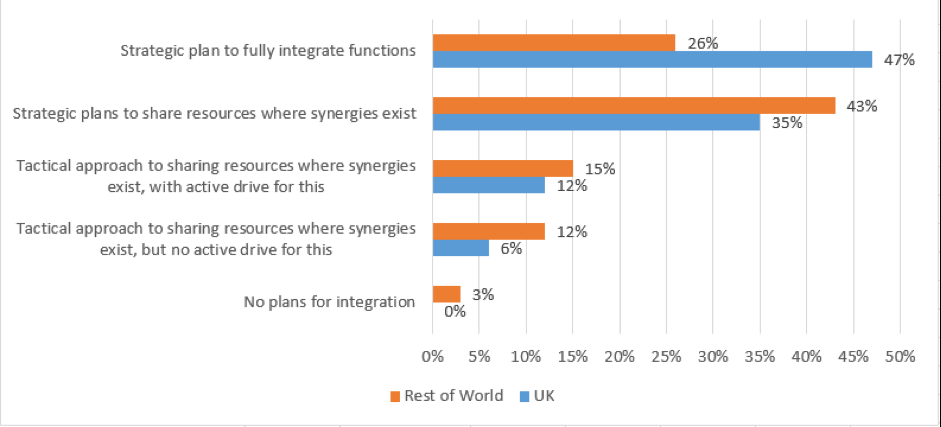
While the majority of banks across all regions have strategic plans for convergence, nearly half of UK banks reported a strategic plan to fully integrate functions, compared to 26 percent of all other banks.
“Convergence is a hot trend in the fraud and financial crime compliance space,” Cox said. “Overall, our survey shows that banks are moving in this direction, though the UK is further along than most countries surveyed.”
Ovum surveyed over 100 retail banks on their priorities, challenges, and plans for financial crime, looking to assess the maturity of the sector in tackling financial crime, and ambitions towards integration. Respondents came from the UK, the US, Canada, South Africa, the Nordics, Germany and Austria.
- 01:00 am

Temenos (SIX: TEMN), the banking software company, today announced that it has published the European results for its retail banking survey, conducted by the Economist Intelligence Unit (EIU), “A Whole New World: How technology is driving the evolution of intelligent banking in Europe”. The largest share of European bankers sees embracing openness as the future of the industry: 35% of respondents view acting as a true digital ecosystem — offering both banking and non-banking services that originate either internally or from third-parties to customers and other financial services providers — as the primary direction in which their organization’s business model will evolve.
Unsurprisingly, given the mandate of Payment Services Directive (PSD2), launching an open banking strategy is a top priority for the coming year for 29% of European respondents. Open banking will still be a priority in 2025 for 26% of respondents, although more expect to be prioritizing responding to regulation (35%), migrating clients to digital channels (29%) and mastering digital marketing (29%) by then.
Technology-driven change is following a specific agenda, geared toward complying and fully utilizing PSD2. For consumers, PSD2 will deliver seamless, open, accessible and intelligent banking services. For banks, there are both opportunities to better serve their customers, and challenges in managing compliance and competition.
In the years leading up to 2025, non–banks see technology and e-commerce disruptors such as Google, Facebook and Alibaba (31%), and payment players such as PayPal and Apple Pay (23%), as their biggest non-traditional source of competition. And yet as banks struggle to figure out where they fit in the picture, they are also looking at how to evolve their business models. The bigger question for banks is how they will continue to create value for customers in a highly digital, highly disaggregated banking system. The report points out that European banks are increasingly open to the idea of becoming the architects of an ecosystem of services, many of which are provided by third-parties.
Steen Jensen, Managing Director – Europe, Temenos, said: “The big question for banks is how to create value in a banking ecosystem that is highly digital, open, and disaggregated. In order to remain competitive, they must offer customer journeys, digital experiences and innovative products and services that their customers can’t get elsewhere, by digitally transforming their operations, using advanced analytics and tapping into new technologies like artificial intelligence and machine learning.
“Temenos empowers banks with an end-to-end digital banking platform that is API-first, cloud-native, and cloud agnostic, which gives banks the freedom to innovate and achieve tangible business benefits. By partnering with Temenos, banks can also easily integrate with an ecosystem of over 150 fintechs, and provide their customers with an unrivalled digital experience.”
- 08:00 am

Volante Technologies Inc., a global provider of technology and software as a service to accelerate digital transformation and payments modernization, today announced the launch of free RTP / instant payments processing on the cloud as a service.
The capability to offer RTP is rapidly becoming the norm for large banks and an emerging necessity for smaller and mid-sized banks. Traditional implementation models, with their high costs and long project times, are also not suited to real-time payments.
Volante offers a cloud native microservices architecture which allows for quicker implementation cycles. Volante’s broad experience of delivering complex payments projects in record time allows us to deliver the same payments technology used by other larger Volante customers to a wider audience, as a free RTP / instant payment processing service.
The free offering is for US TCH RTP and European SEPA RT1 or TIPS instant payments. Free implementation and onboarding are provided alongside, and there are no service or per transaction fees. Certain limits will apply.
Vijay Oddiraju, CEO, Volante Technologies, said, “We have always been passionate about bringing simplification and automation of payments processing to financial institutions. This allows us to bring the power of our payment solutions to all banks.”
Deepak Gupta, Global Head of SaaS, Volante Technologies, added, “Banks are following two clear routes as they consider their RTP strategies: take a reactive approach and watch the industry and their competitors get RTP-enabled or, look to adopt a more proactive approach using RTP as a means to future revenue-generating services and remain competitive.”
Gupta concluded, “Volante’s cloud-native payment capabilities, inherent in the VolPay ecosystem, not only helps to remove obstacles to adoption but also provides firms with an extensible platform to include additional payment schemes quickly and ensure compliance with emerging standards. Speed to market and revenue without having to worry about the cost is our goal.”
- 07:00 am

ECOMMPAY, a leading international online payment service provider and direct card acquirer, has partnered with online payments company Trustly to expand its online payment offering and strengthen its position in the European market.
Online banking payments are a popular way to pay in Europe, especially in the Baltics and the Nordics. The new partnership will allow consumers who shop with ECOMMPAY’s merchants to make safe online transactions directly from their bank account.
By integrating Trustly’s online banking payments, ECOMMPAY helps its merchants receive payments from consumers by means of a fast, simple and secure bank transfer, and get a real-time confirmation after the payment has been finalized. On top of that, its merchants can benefit from Trustly’s unique refund process, which removes the administrative complexity for merchants while issuing fast refunds to consumers.
Arthur Gots, Head of Operations at ECOMMPAY, said: “Especially in key markets like the Baltics and the Nordics, online banking payments should be a vital part of any merchant’s payment mix. Through our partnership with Trustly, we’re excited to be able to offer our merchants new markets and broader reach, helping them to scale their businesses in an efficient way.”
Adam Bowman, Director of Partnerships at Trustly, said: “ECOMMPAY is a key partner for us as we expand our presence in the financial services and e-commerce verticals. Through our partnership, Trustly’s fast, simple and secure online banking payments will be available to ECOMMPAY’s thousands of merchants, helping them increase conversion at their checkout.”

Ian Pollard
VP EMEA at Signavio
The Competition and Market Authority (CMA) has recently instructed two British high-street banks to appoint an independent body to audit their Payment Protection Insurance (PPI), after sending out see more
- 06:00 am

Scalable automated solution Sumsub provides trading market giant Exness with a unified gate to general AML/KYC due diligence, and regulatory compliance, slashing costs in half.
Companies in the financial sector confront many challenges to develop a relevant identity verification strategy that will be compliant with growing AML requirements such as the new AML5 directive, as well as the FATF guidelines, recommendations and others. Since Exness is a global brand with offices in Cyprus, UK and the Seychelles, their international coverage required an automated KYC solution suitable for multiple-country use. To achieve the necessary level of compliance and fight off increasing identity fraud, Exness has joined forces with Sumsub — a single solution for all things compliance and user onboarding.
Sumsub solution automates identity verification and anti-fraud, providing compliance to relevant regulations and KYC/AML screening. The Sumsub dashboard allows Exness to choose its workflow out of fully automated, semi-automated and agent-assisted verifications. It’s also possible to manage and control bulks of applicants: their status, history, reasons for being approved or declined. The solution documents each decision’s history and produces reports following global market practices used in AML/CFT frameworks worldwide.
“We researched the market for KYC platforms and considered subscribing to many different databases. The project took on an immense scale with separate technical flows for each jurisdiction, which made AML/KYC very challenging,” said Maria Fedorova COO at Exness. “Sumsub’s specific expertise in this area complimented our existing compliance routines very well. They have been able to customize AML/KYC document screening to fit our specific flows and needs.”
Sumsub provides a risk-based approach to verification, compliant with respective rules and regulations, with corresponding support for each region. Monitoring across jurisdictions and multiple databases including PEP, sanction lists and adverse media, will enable Exness to better single out non-acceptable users.
“With FATF announcing their updated guidance with reinforced AML demands, followed by FCA, CySEC and similar policies introduced worldwide, trading industry players have to step up their compliance and anti-fraud measures. We are happy to see how our product is already helping industry leader Exness optimize compliance costs and meet due diligence obligations under tightening regulatory rules: from personal data security to CDD and crypto AML, Sumsub provides not only much-needed technologies, but helps shape the business processes as well,” said Jacob Sever, Co-Founder of Sumsub.

Lina Andolf-Orup
Senior Director and Global Marketing at Fingerprints
When it comes to new payments technologies, it’s often difficult to know what consumers are thinking, and banks have a lot on their plates. see more
- 03:00 am

QuantHouse, the global provider of end-to-end systematic trading solutions including innovative market data services, algo trading platform and infrastructure products and part of Iress (IRE.ASX), today announced that Goldman Sachs’ SIGMA X MTF market data will be readily accessible from within the QuantHouse API Ecosystem store.
SIGMA X MTF is a multilateral trading facility operated by Goldman Sachs (GS), offering deep and diverse liquidity on the basis of non-discretionary crossing with flow from external participants and the Goldman Sachs franchise. A recent analysis performed by GS of SIGMA X MTF auction activity identified that there is often a surplus of unexecuted liquidity in most periodic auctions. SIGMA X MTF’s own Periodic Auction Book, the second largest periodic auction book in Europe by volume traded, publishes indicative auction quotes. This market data is now available via the Quanthouse API and can be used to identify auctions, unveiling potential untapped, addressable liquidity.
Available as part of QuantFEED which normalises and disseminates market data for more than 150 feeds globally, SIGMA X MTF market data increases the scope of venues and data available to QuantHouse’s community. The qh API Ecosystem store connects over 300+ buy-side firms and investment banks to solutions provided by other buy and sell-side firms, execution venues and technology partners. Connection to the Ecosystem is managed by QuantHouse via a single API, making access to these services quick, efficient and cost-effective.
“QuantHouse is constantly monitoring the market for new API-based providers to improve and enrich the scope of the offering within our qh API Ecosystem store,” says Stephane Leroy, Chief Revenue Officer and business co-Founder, QuantHouse, “Our store acts more and more as a “Netflix kind of” portal for the API user community to source advance solutions. We are happy to now offer Goldman Sachs’ SIGMA X MTF market data to our client base across the globe.”
Paul Brennan, Chief Operating Officer SIGMA X MTF at Goldman Sachs, comments, “SIGMA X MTF continues to meet the needs of our clients as transparency develops in the equities landscape post-MiFID II. We are pleased to work with QuantHouse to offer broad-based distribution of our market data via the qh API Ecosystem store. We think the QuantHouse community will benefit from accessing SIGMA X MTF market data, offering the opportunity to identify high quality liquidity to help improve trading and execution outcomes.”
- 01:00 am
Stripe officially launches its services in Estonia, Greece, Latvia, Lithuania, Poland, Portugal, Slovakia, and Slovenia today, helping internet businesses in these countries to start, grow, and scale their business globally and accept money from anywhere in the world.
“Central and Eastern Europe has a lot of entrepreneurial and technological talent, and we believe even more of its companies could be expanding globally,” says Felix Huber, Head of Central and Eastern Europe, Middle East, and Africa, at Stripe. “Stripe aims to empower more companies from this region to export their creativity and ambition to the rest of the world.”
In just a few clicks, businesses can export to the world using Stripe infrastructure
Starting today, businesses in these countries can start accepting payments in over 130 currencies in as little as 10 minutes. For the first time, Stripe is giving them access to Stripe’s global payments and treasury network. In addition to accepting payments, companies can use Stripe to handle accounting, billing, paying out to third parties and optimizing for mobile payments—all from one centralized dashboard. Stripe users also get access to mobile wallets such as Apple Pay and Google Pay.
Stripe helps companies minimize online fraud
In addition to the challenges of handling multiple currencies, fraud is often one of the greatest blockers for businesses looking to sell to consumers around the world. Stripe uses sophisticated machine learning to provide unrivalled fraud protection and security safeguards that protect businesses and their customers against fraudulent transactions.
Stripe accelerates new internet business models and helps traditional businesses innovate faster
As more activities move online, a new wave of internet companies is growing, including marketplaces, crowdfunding and subscription businesses. Stripe can equip software developers and entrepreneurs in Central and Eastern Europe with the tools they need to be part of the next batch of internet giants.
- 06:00 am
Stanbic Bank Uganda (SBU) and Traydstream Ltd have signed an agreement to implement the Traydstream platform at SBU. This platform is intended to digitize the current manual process of vetting Letters of Credit for Discrepencies. The trade document processing conducted over the past few months proved the dramatic improvement the Traydstream platform brings to SBU’s processing, turnaround and end-to-end trade capabilities.
SBU is Uganda’s largest commercial bank by assets and branch network, with majority ownership by Standard Bank Group Limited. With world trade volume outperforming the growth rate of the global economy, SBU is actively expanding their footprint in cross border trade through better ways of working and leading the way with technological solutions.
Kevin Holmes, Head of Trade & Product Management for Standard Bank Group noted, “Traydstream’s one stop shop for processing enables SBU to speed up processing time, mitigate risk with thorough trade checks as well as improve the transparency of transactions through an aggregated compliance module. We are proud to be investing in next gen technology solutions that minimize repetitive tasks for greater human contribution to achieve real scale. The platform opens up exciting and innovative new options for us to grow and service our customers.”
“SBU has been a wonderful partner with a hunger to change the industry and actively lead a shift away from manual, error-prone processes to automated and value-added work. They have a fantastic team, experienced and leading with a deep client focus. We are delighted to be working with SBU and look forward to expanding pan Africa for the group” said Uzair Bawany, Chief Revenue Officer, Traydstream.