
Published
- 04:00 am

Brits are suffering from the scourge of ‘Lazy Money’, according to new research by Wise, the international money account.
A Censuswide poll of 2,000 UK adults nationwide found that only 39% of us are happy with the return our money is making. This is unsurprising, given so much money is being allowed to rest: 30% of us hold the majority of our savings in current accounts that pay little-to-no return.
There is a fundamental problem, we work hard for our money - but allow the money itself to lazily earn low returns. This is particularly important during a time of high inflation and a cost of living crisis, with 37% finding it harder to save and 26% noticing the impact of inflation on their money.
So, why is so much money being given such an easy life? Understandably, many of us find finance’s world of jargon, caveats, and terms and conditions confusing and hard to navigate.
Almost one-third (31%) of us think the language in financial documents and disclosures could be made simpler. Half (51%) feel nervous about investing, with 43% saying it could be made simpler and easier to understand. While 29% think banks could do more to shine light on their savings rates, only 16% trust their bank to offer a fair rate.
But there’s another problem. Between work, family dramas and walking the dog, we’re too tired to make sense of the confusing world of finance. Just 36% of us make money decisions when we’re not tired. Young people are especially afflicted, with only 21% of 16-24-year-old not tired when making money decisions.
To end Lazy Money once and for all, Wise has partnered with Kia Commodore, a personal finance expert. Kia has not only launched a guide to make money management simple - but also a limited edition range of Wise sleepwear, so Brits can relax while their savings grow and their money works.
The sleepwear has been designed by celebrated sustainable designer Leticia Credidio and features nightgowns, kimonos and pyjamas. Eagle-eyed followers can win a set via Wise’s social channels, and a limited number are available to buy.
Kia said:
“It’s wrong that we work so hard yet our money is allowed to be so lazy. Think about how you want to save, and perhaps invest, your money. Saving is easiest when it becomes a habit. Put money away consistently but at a frequency that works for you.
“You can even find an ‘accountability partner’, someone who saves with you and helps keep you on track and accountable. However you save, it’s also vital to think about how your money is being held.
“Let’s put our money to work - and allow ourselves to relax.”
Wise allows investors to easily put their money to work, offering two investment options:
Wise Stocks, which invests in an index tracking fund that tracks stock markets
And Wise Interest, which invests in a fund holding government-guaranteed assets and closely tracks the Central Bank interest rate - and currently pays a variable rate of 4.95%* on GBP balances
Wise’s investment features are particularly useful for people who manage multiple currencies. Wise allows instant access and for invested money to be withdrawn and converted into 40 currencies, with no hidden fees.
Shafie Ali, Product Lead, Wise, said:
“At Wise, we believe that your money is yours, not ours. That’s why we aim to make investing and saving simple. For those looking to invest, Wise Assets is a great option. We charge only a small, transparent fee for investing with us, and we make doing so as simple and convenient as possible. Interest is great for those who want a consistent, solid return while Central Bank rates are high, while Stocks more closely match international markets’ performance.
“What’s clear is that you should be relaxing, not your money. It’s time to end Lazy Money.”
- 06:00 am
Bybit, the world's third-largest crypto exchange by volume, is celebrating its fifth anniversary with a unique personality-based trading competition. This initiative invites crypto enthusiasts to discover their trading personalities, gain NFTs, and join their fellows in a team competition that rewards trading prowess.
Bybit's fifth anniversary is an opportunity for traders of all personality types, whether they're the pioneering ISTP "Trailblazer" with a penchant for disruptive technologies or the ESTP "Entrepreneur" who thrives on the adrenaline of day trading. This event celebrates the diverse tactics and strategies within the crypto community, offering a stage for every participant to shine.
Bybit's First NFT Collections
Starting from 10 AM UTC on Nov. 27 until 10 AM UTC on Dec. 25, 2023, participants can take the Archetype personality test to receive a trading personality analysis. Everyone who takes the quiz will receive a distinctive NFT avatar and the first 10,000 entrants will earn a 10 USDT voucher. In the spirit of inclusivity, those who decline the test can directly enter the trading competition by selecting a personality archetype of their choice.
With 16 unique designs and a supply of 10,000 for each, these NFTs are distributed on a first-come, first-served basis. These digital assets are not just for show; traders can exchange Archetype NFTs on the Bybit Marketplace and even merge Origin Archetype NFTs (colorful) to create Hero Archetype NFTs (shiny silver) and Legend Archetype NFTs (shiny gold).
Bybit will take a snapshot of all holders of Legend Archetype NFTs on Dec. 25, 2023, at 10 AM UTC, and anyone holding one will be eligible for a share of a 10,000 USDT prize pool. The distribution will be proportional to the number of Legend Archetype NFTs held, rewarding users who've elevated their trading game.
1 million USDT Archetypes Team Trading Competition
The trading competition runs from Dec. 4 to Dec. 25th, 2023. In an innovative twist, users will be sorted into 16 distinct teams based on their trading personality archetype, with a colossal prize pool of up to 800,000 USDT on the line.
The competition will rank teams according to the aggregate trading volume of their top 1,000 participants, transforming individual trades into a collective effort for victory. The top 10 teams will reap the rewards of a shared bonus pool, proportionate to the total trading volume they generate throughout the event.
"In celebrating Bybit's fifth anniversary, we're proud to introduce the Archetype Quiz and Trading Competition, reflecting our dedication to empowering traders worldwide," said Ben Zhou, co-founder and CEO of Bybit. "This event recognizes that each participant brings a unique psychological footprint to the market. Our NFT collection is a nod to the personal journeys that intersect as people join Bybit's Crypto Ark.
- 01:00 am

Mollie, one of the fastest-growing financial service providers in Europe, has revealed that merchants saw a 7.3% increase in sales during Black Friday week 2023 with larger basket values (+8.7%) when compared to last year. Increased spend was driven by the average number of items per order increasing +14% YoY. Black Friday itself was the busiest day of the week with a 2% increase in share of the total week’s sales versus last year. Sales peaked between 10am - 11am on Black Friday as consumers waited until the end of the week for the best deals.
Digital, vehicle and furniture sales jump, fashion falls
This year saw increased spending on digital products (+24%), vehicles (+13%) and furniture (+9%). However, all sectors - with the exception of digital products - saw smaller increases in spend when compared to Black Friday week last year. The most notable decline was in fashion, which saw a 10% drop in payments volume vs. 2022, as the sector continued its fall in purchase volumes throughout 2023.
iDEAL and BNPL battle it out
Each European market saw consumers prefer different payment methods during Black Friday week. Highlights:
- iDEAL dominates - iDEAL remains overwhelmingly popular in the Netherlands, constituting 72% of all purchases. However, PayPal's popularity is decreasing, dropping from an overall share of 5.1% in 2021 to 3.3% in 2023.
- BNPL shifts - BNPL volumes were stable for Belgium and the Netherlands, but German consumers shifted away from BNPL with a 10% decrease, as they opted more for credit cards (+6.1% share) and PayPal.
- Credit is king: The top 10 favoured payment methods for UK shoppers showed a heavy reliance on credit card and BNPL (such as Klarna) payments to make purchases over the week.
Record month for merchant lending
To meet peak season demand, merchants secured more funding in November - a dramatic 20% increase - when compared to yearly average (based on Mollie Capital data). Capital was used by merchants to pay for advertising, acquire inventory and invest in new tools ahead of Black Friday week.
“This Black Friday week is a reflection of our economic climate with shoppers across Europe continuing to search for the best prices for a wide variety of needs, not just Christmas shopping,” said Ken Serdons, CCO, Mollie. “Consumers demonstrated clear preferences for different payment methods market by market, a clear signal for ecommerce businesses to prioritise payment diversity and optimise the checkout experience to secure sales.”
- 03:00 am
Finastra’s annual global survey reveals that, despite economic constraints, financial institutions globally continue to invest in artificial intelligence (AI), Banking as a Service (BaaS) and embedded finance.
The ‘Financial Services: State of the Nation Survey 2023’ finds that decision-makers in financial institutions worldwide are excited about the opportunities presented by fast technological and cultural change within the industry today. Nearly nine in ten respondents (87%) are personally excited about the pace of change, while 83% are excited for the opportunities it will bring for their financial institution and 81% for the wider financial services industry.
The survey found that financial institutions are rapidly exploring the benefits of AI, with deployment of AI and improvements in AI capabilities increasing notably year-on-year. Globally, 37% of respondents stated that their financial institution had improved or deployed AI technology in the last 12 months, rising from 30% in 2022. The growing importance of generative AI also stands out. More than four fifths (83%) of decision-makers say their institution is interested in the technology, with 26% having already incorporated generative AI in some form. Only 6% of respondents globally say that their financial institution is not interested in adopting the technology.
Respondents perceive generative AI as a key means to meet increased customer expectations for tailored, personalized services, with 32% of those interested in the technology saying they will use it in this way. When asked about specific business areas, the most common use case for generative AI is collecting, processing, and analyzing data for ESG criteria classifications and decision-making. Other widely cited use cases include: automating manual or repetitive tasks; collecting, processing, and analyzing data for KYC or AML purposes; and improving risk management and decision-making processes.
The research, conducted from August to September 2023, canvassed the opinions of 956 professionals at financial institutions and banks across France, Germany, Hong Kong, Singapore, Saudi Arabia, the UAE, UK, US and Vietnam.
Other insights include:
· Increased uptake of Banking as a Service: 48% of financial institutions surveyed have either deployed BaaS or improved their capabilities in this area in the last year. This is a sizeable increase from the 35% recorded in 2022. Key use cases globally include buy now pay later schemes, embedded lending and embedded cross-border payments.
· Optimism about outlook for tech investment despite current constraints: While 78% of financial institutions surveyed say the current economic climate has constrained their investment in technology, 69% expect their investments to resume in full before the end of H1, 2024.
· Agreement that Open Finance is making financial services more collaborative: The vast majority of financial institutions (85%) believe Open Finance is having a positive impact on the industry. In addition, 85% say that at least a quarter of their customers are using Open Banking-enabled services. 46% say that over half of their customers are using them.
· Financial institutions are not turning inwards during challenging economic conditions: Instead, decision-makers still believe it is as important as ever to maintain a strong commitment to their communities. 86% of decision-makers believe financial services and the banking sector are about more than just finance and that they have a duty to support the communities they serve.
“Despite the challenging economic climate, it’s clear from our research that investment in AI, BaaS, and embedded finance remain key priorities for financial services organizations over the next 12 months, particularly as they seek to further enhance and personalize the customer experience,” said Simon Paris, Chief Executive Officer at Finastra. “We share the industry’s ongoing commitment to ESG initiatives, to collaboration around Open Finance, and excitement in using advanced technologies like AI to help deliver on the opportunities ahead.”
- 04:00 am
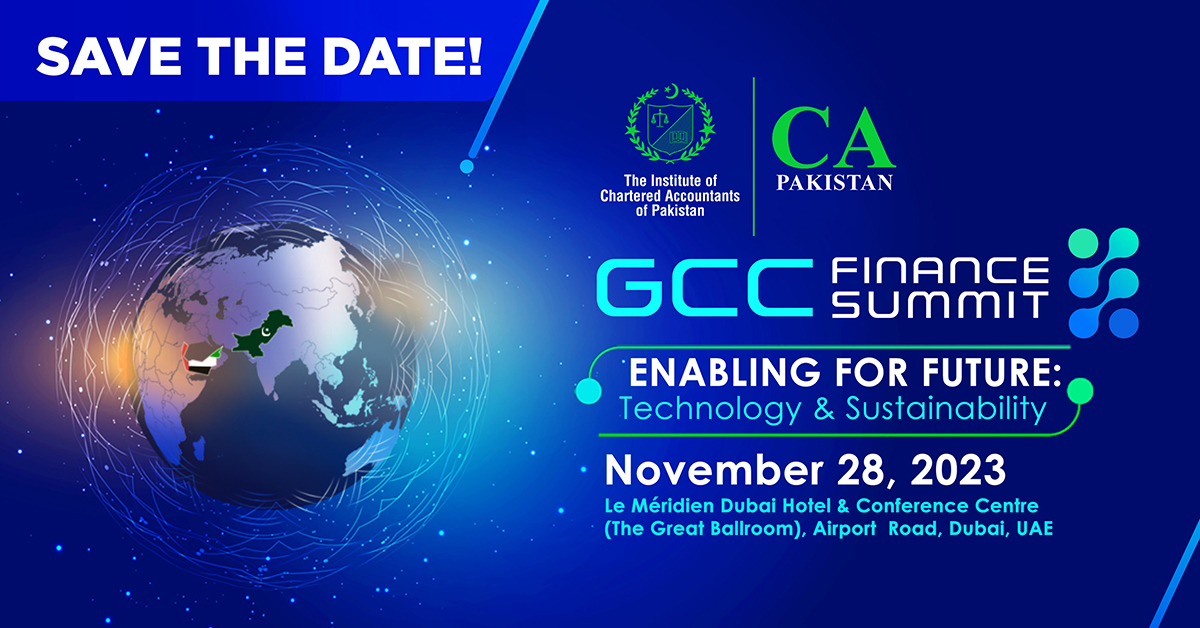
The first GCC Finance Summit opens tomorrow, Monday 28 November, at Le Méridien Dubai Hotel & Conference Centre, Dubai. Under the theme 'Enabling for Future: Technology & Sustainability'. This landmark event convenes finance professionals, investors, board members, and regulators to explore the dynamic intersection of technology and sustainability shaping the financial landscape.
Organised by The Institute of Chartered Accountants of Pakistan (ICAP), the summit marks a significant platform for the exchange of insights in response to the evolving economic, social, and technological factors impacting the finance profession.
The primary goal of this summit is to foster knowledge exchange among seasoned professionals within the GCC region. It aims to delve into the emerging avenues of technology and sustainability, which hold paramount relevance to our profession. This theme of the Summit underscores the critical importance of technology and sustainability in the ever-evolving landscape of finance.
With an emphasis on real-time oversight, disclosures, and a heightened focus on Environmental, Social, and Governance (ESG) factors, the summit promises a deep dive into the challenges and solutions facing finance professionals in today's fast-paced environment.
Senior financial professionals in attendance will have the opportunity to hear from thought-leading speakers from PWC, PepsiCo, HSBC Group, KPMG, Shelf Drilling, Albaddad Capital Group, Emaratech, RMB Holdings, Udrive and more across a full day of keynote speeches, panel discussions, case-studies and fireside chats.
Mr. Zafar Masud, President & CEO, The Bank of Punjab, the Platinum Sponsors of the summit, commented: "We are thrilled to be part of the GCC Finance Summit 2023, an exceptional platform that brings together industry leaders and visionaries. This summit aligns perfectly with our commitment to fostering innovation and advancing the future of finance. We look forward to engaging with fellow professionals, sharing insights, and contributing to the vibrant discussions that will shape the financial landscape for years to come."
The GCC Finance Summit 2023 will welcome a distinguished lineup of notable dignitaries from both the financial and diplomatic realms. Among the esteemed guests are H.E. Sheikh Nahayan Mabarak Al Nahayan, UAE Minister of Tolerance and Coexistence; Dr. Shamshad Akhtar, Minister for Finance, Revenue, Economic Affairs, and Privatization; H.E. Mr. Faisal Niaz Tirmizi, Ambassador of Pakistan to UAE; Ms. Asmâa Resmouki, President, IFAC; Mr. Zafar Masud, President & CEO, BOP; Mr. Ali Latif, President, ICAP; and Mr. Ashfaq Yousuf Tola, Former Minister of State Pakistan & Former President, ICAP.
For more information, please visit: https://gccfinancesummit.com/
Event Details:
Date: November 28, 2023
Venue: Le Méridien Dubai Hotel & Conference Centre, Dubai, UAE
Theme: Enabling For Future: Technology & Sustainability
Website: https://gccfinancesummit.com/
- 07:00 am

Collctiv will leverage Ryft's expertise to facilitate the creation of their money pots for users, simplifying the money collection process for organisers of group gifts and activities. The new arrangement provides a multitude of additional benefits for Collctiv, such as reduced fees and increased payment flexibility. Additionally, the company expects the introduction of customisable payment links to significantly enhance user engagement by making the payment process more personalised.
Moreover, the collaboration looks set to greatly streamline Collctiv’s merchant onboarding processes, bringing about greater transparency and efficiency in operations.
The new alliance further signals Manchester’s growing influence in the fintech sector. In recent years, the city has become the largest fintech hub outside of London. In working together, Collctiv and Ryft have underlined their strong commitment to global growth and expansion. This exciting partnership will help to extend the reach of both companies within Europe and beyond, enabling them to enter new markets.
Speaking on the groundbreaking collaboration, Pete Casson, CTO & Co-Founder of Collctiv, commented: “We are thrilled to collaborate with Ryft as their technology enhances our ability to offer improved payment options through the Collctiv app. This partnership not only streamlines the money collection process, but also lays the foundation for potential future expansions. Our shared commitment to exceptional customer support aligns seamlessly, making collaboration with a fellow northern British company like Ryft a testament to the robustness of the North and its pivotal role in shaping the future of British commerce.”
Speaking on the partnership, Sadra Hosseini, CEO of Ryft commented: “This is an exciting moment for Manchester’s fintech scene with two of its most innovative companies joining forces for a highly relevant strategic partnership. We’ve been big fans of what Collctiv have done over the years and believe the integration of our complementary services can help the company take its offering to a new level.”
The new partnership officially went live on the 1st November 2023. Since launch, the joint venture has already demonstrated a 7% increase in Apple Pay transactions, a testament to the enhanced freedom and flexibility that users have during the payment process. Moving forward, Collctiv and Ryft plan to continue collaborating with one another as they both seek to accelerate their growth ambitions, both domestically and internationally.
- 03:00 am
UK Finance and global management consultancy Oliver Wyman today released their report on the use of AI in financial services (FS), and the future opportunities and risks for the sector. It includes a snapshot survey of 23 companies ranging from international to mid-size banks and non-banking FS firms.
- Nearly three-quarters (70 percent) of FS firms surveyed said they are at the pilot stage for generative (content production-focused) AI using ‘co-pilot’ type employee efficiency tools, but it is expected that return on investment will take between three and five years for more advanced use cases.
- Three-quarters (75 percent) of FS firms believe they will benefit from generative AI – with the biggest opportunities expected from productivity improvement and operational effectiveness rather than customer-facing, revenue-related, use cases.
- When Marsh McLennan tested a generative AI assistant with staff, 94 percent of users said it improved their productivity.
- 95 per cent of firms surveyed are already accounting for AI risks in their control frameworks, and three out of five (60 percent) have already taken action to prepare for the risks of generative AI.
- Four out of five FS firms (80 percent) say collaboration with regulators is beneficial to highlight best practices in AI and create an internationally aligned regulatory system.
Jana Mackintosh, Managing Director of Payments, Innovation and Resilience at UK Finance, said: “Generative AI is a new horizon for financial services, with clear opportunities for firms, from boosting productivity and growth to improving the experience for customers. And as this report shows, a majority are already piloting the technology to find the best way to safely explore these exciting opportunities.
“At the same time, however, FS firms are clear-eyed about the risks. The sector has been using predictive AI for years, and firms have enhanced their risk management processes to make sure the technology only ever adds to their accuracy, security, and offering for customers. And the majority are already upgrading these processes to lock down the risks from generative AI.
“What firms want now is to collaborate with policymakers and regulators on a long-term, flexible approach to regulation that can keep pace with technological change, ensuring our FS sector can guard against any risks from this technology, while safely seizing its great competitive advantages.”
Sian Townson, Partner, Oliver Wyman said: “With the financial services sector in the throes of technological change, AI has the power to turbocharge opportunities, if used correctly. Adoption should be balanced with nascent regulation, both within the UK and internationally.
“Our survey shows that while adoption is widespread in the industry, firms are clear about the risks to ensure best practice to meet both customer needs and also wider competitive advantages that AI can bring.”
Nearly three-quarters (70 percent) of financial services firms are in the pilot stage of testing the use of generative (content production-focused) AI, while nine out of ten (91 percent) already use predictive AI for functions including fraud detection and risk analysis.
Three-quarters of firms believe generative AI will benefit them to at least the same level as predictive AI, with the main expected benefits in process automation, sales, and customer service functions. Survey respondents said the top three expected benefits in these areas are better productivity (74 percent), operational effectiveness (70 percent), and better customer experience (61 percent).
This is borne out by the case study of Marsh McLennan, which deployed its own generative AI assistant called LenAI. It was used by 15,000 staff within 30 days of launch, of whom 94 percent said it improved their productivity and efficiency. The main uses were writing and improving communication (70 percent), searching for answers to specific questions (68 percent), and summarising documents (56 percent).
Firms are also clear, however, about the risks posed by this new technology, and three out of five say they are already adapting their existing risk management frameworks to include generative AI.
To safely seize the opportunities from generative AI, four out of five firms (80 percent) want to collaborate with regulators to define best practices. Firms also want to ensure international alignment of regulations, with 65 percent saying conflicting rules between jurisdictions is one of their top-three concerns about AI policy. The report also includes a range of possible statutory and non-statutory options to tackle the policy challenges currently facing the sector.
- 07:00 am

iDenfy, a Lithuania-based RegTech company offering identity verification and fraud prevention tools, announced a new partnership with ByNoGame, a Turkey-based online marketplace business, providing its customers with a fast and secure way to sell and buy gaming products. iDenfy’s ID verification solution will ensure that all platform users have access to a safe marketplace by eliminating fraud in real-time through a quick onboarding process.
ATO fraud and identity theft pose significant dangers for online marketplaces, jeopardizing user privacy and causing financial losses. This year, ATO attacks saw a 354% year-over-year increase, as reported in Sift's Q3 2023 Digital Trust & Safety Index, revealing that 22% of US adults, which is equivalent to 24 million households, have fallen victim to ATO fraud. According to iDenfy, unauthorized access to a user's account can lead to serious consequences, such as privacy breaches and financial losses for the victim. However, iDenfy highlights that in cases of fraud, the consequences are worse for the online platform itself since ATO can compromise the trust and safety of the entire marketplace.
According to iDenfy, the primary defense against such attacks is identity verification, with robust Know Your Customer (KYC) practices providing insights into users, including risk factors like their location and presence on global sanctions lists. However, iDenfy emphasizes the importance of selecting an ID verification provider with integrated liveness detection technology and biometric authentication, as fraudsters increasingly use deepfakes or synthetic IDs, combining false information with real documents to evade KYC checks more effectively. In addition, iDenfy explains that ID verification helps prevent multiple accounts and bots from being used for fraudulent schemes on platforms like ByNoGame. Consequently, Turkey's largest gamer-friendly marketplace opted to adopt a new identity verification solution by partnering with iDenfy.
With the goal to scale faster, maintain compliance with evolving regulations, and upgrade its fraud prevention system, ByNoGame found iDenfy to be the best fit for its marketplace. The company will use iDenfy's full-stack identity verification solution, which rapidly extracts and verifies user data, ensuring document authenticity and protection against forgery or alteration. Notably, iDenfy stood out in the market due to its all-encompassing KYC software, featuring real-time manual verification by in-house specialists, various document analysis tools, including liveness detection for anti-spoofing measures, and a user-friendly dashboard for efficient process management and monitoring.
ByNoGame didn’t see a highly manual process in identifying and eliminating fraud as an option for its platform. With that in mind, the company wanted to improve its design considerations for trust and safety investigations. Currently, ByNoGame will be able to onboard users from diverse countries worldwide in a seamless, user-friendly manner. iDenfy’s extensive global coverage of +190 countries and territories will ensure that the nationality of ByNoGame users is not a hindrance to the verification process, assuring the authenticity of all marketplace users.
Due to this partnership, ByNoGame users will experience a swift and efficient ID verification process, which will take less than two minutes on average to complete. According to iDenfy, the switch to a fully automated KYC workflow will contribute to the marketplace’s consistent conversion rates. Moreover, iDenfy claims that this partnership will enhance ByNoGame’s fraud detection strategy by helping detect potential risks early in the user cycle. As a result, his proactive approach will not only minimize fraud but also reinforce the whole user experience on the ByNoGame marketplace.
"We aim to support ByNoGame's secure and efficient audience growth, enabling real-time fraud detection and onboarding of legitimate users. Our identity verification software will enhance trust and safety while facilitating ByNoGame's global user expansion.” — commented Domantas Ciulde, the CEO of iDenfy.
- 05:00 am
DXC Technology, a leading Fortune 500 global technology services provider, will support Polish Payment Standard (PSP) in the expansion of its mobile payment system, BLIK, into Romania and Slovakia.
DXC will modernize and adapt the BLIK central system to meet payment standards in Romania and Slovakia. DXC will ensure BLIK is able to handle transactions in Romanian Leu and Euros, and can connect to the SWIFT (Society for Worldwide Interbank Financial Telecommunications) system.
Continuing a nine-year relationship, DXC will use software engineering to help develop PSP’s essential activities, adapting the existing system to serve the fastest-growing e-commerce segments in Romania and Slovakia, and providing daily technical support.
One of the largest payment systems in Poland, BLIK is at the forefront of driving a new era of digital payments in the region. Between July and September 2023, BLIK facilitated 455 million transactions worth 63 billion PLN ($15.7 billion USD).
“BLIK is highly regarded in Poland and we have confidence that our solution will easily meet the requirements to integrate with other large European banks. This will help us grow the number of users engaging in e-commerce payments,” said Dariusz Mazurkiewicz, President at Polish Payment Standard. “We are pleased to have the support of an experienced partner in DXC that can help us implement our plans.”
PSP is a joint venture between six leading Polish banks (Alior Bank, Bank Millennium, Santander Bank Polska, ING Bank Śląski, mBank and PKO Bank Polski) and Mastercard. BLIK, introduced in 2015, is a key part of Poland’s shift towards a common payment system. It allows customers to use their mobile phones to withdraw cash from more than 20,000 ATMs and facilitates hundreds of thousands of digital payment transactions.
“This is a major project for Polish and European banking. As a trusted partner, we will help PSP innovate the BLIK solution on a global scale to achieve international success,” said Michał Burda, Country General Manager at DXC Technology Poland.
- 07:00 am
Volante Technologies, the global leader in cloud payments modernization, today announced the general availability of the latest version of the Volante Experience™.
Following the initial launch of the Volante Experience, which focused on the onboarding experience, this latest release enhances Volante’s Payments as a Service (PaaS) to support financial institutions on their digital transformation journey and speed up innovation. The suite has already been integrated into the operations of a major U.S. insurance and banking institution. Following this successful deployment, it is now available to all U.S. PaaS customers.
“In a world where the financial services industry is evolving at an unprecedented pace, Volante Technologies continues to deliver innovative solutions that aim to address the needs of its customers. The enhanced Volante Experience offers a comprehensive suite of cloud-native, Software as a Service (SaaS) capabilities that cater to financial institutions’ unique digital transformation requirements through the use of modularized functionality, and providing a pathway to ongoing modernization,” said Gilles Ubaghs, Strategic Advisor, Datos Insights.
The enhanced suite comprises key modular capabilities, including out-of-the-box reporting, operational productivity improvements, business insights, and cloud service management. Banks that deploy Volante Experience will gain a 360-degree view of their customers and support the growing demands of payments modernization and digital transformation initiatives.
The suite features a centralized portal, the Command Center, that provides mission-critical insights, payment processing metrics, and real-time notifications for the institution. The suite sources data from across the bank’s payments ecosystem, from Volante PaaS, to select third-party solutions, providing users greater visibility across their payments business.
Out-of-the-box reports can be generated ad hoc or prescheduled. Onboarding is streamlined using self-service capabilities, templates, and automation. With the business insights module, users can harness the power of data synthesis to test use cases for payment processing and operations management and tune performance improvement parameters.
“This latest release of the Volante Experience represents a pivotal moment for the financial services industry,” said Deepak Gupta, EVP of Product, Engineering and Service, Volante Technologies. “We are empowering banks to embark on their digital transformation journeys with unmatched efficiency and effectiveness, ensuring they remain competitive in an ever-changing landscape.”
Gupta added, “The Volante Experience is resilient, highly scalable, and architected to be resource efficient. The suite provides key platform frameworks that drive innovation in analytics, reporting, and policy-based configuration for greater visibility.”
Delve deeper here to find out how Volante Experience is supporting the digital transformation needs of financial institutions and helping them innovate at the speed of business.








