
Published
- 06:00 am
Lloyds Bank customers are the first in the UK to be able to support their bank account application using the chip in their passport, in the latest innovation for their app.
The new high-tech feature speeds up the process of applying, by pre-populating key data fields including name, title, date of birth, gender and country of birth. As well as a slicker experience for customers, it also reduces the risk of errors which can cause delas.
The app utilises Near Field Communication (NFC) technology to scan a chip embedded within the passport, similar to how contactless payments are made (e.g., Apple Pay). While the use of NFC technology has become common, especially since the launch of contactless payments, Lloyds Banking Group is amongst the first to leverage this technology for ID verification within UK banking.
Surina Somal, Head of Product, Packaged Bank Accounts & Transformation at Lloyds Bank said: “Unlocking technology is key in making it easier to bank with us. Using existing technology within passports, customers can open and complete their bank account application on their phone. It's the first of many updates we are making to our banking apps over the next few months, to give our customers the best possible experience.”
- 03:00 am

myTU, the fintech pioneering the use of cloud-only infrastructure and AI to transform banking, has attained Principal Member status with Visa Europe. The achievement reinforces myTU’s high standards of security, resilience, and compliance in its payment operations, and opens new ways for the fintech startup to differentiate its brand via enhanced control and flexibility of payment services.
myTU is growing rapidly and currently serves more than 26,000 customers representing over 100 nationalities. myTU offers customers a debit card for all their daily transactions, whether they're at home or travelling abroad. As a Visa Principal Member, myTU can now issue Visa cards directly to its clients without relying on third parties. As a result, it gains the ability to design and implement its own card programs, and customise features that will accelerate myTU’s business strategy. In addition, myTU boosts its ability to remain competitive with access to Visa's latest technologies and innovations via the Visa API. With greater flexibility to develop new and innovative financial products, myTU expects to maintain leadership in its market segments through advances in payment security and mobile payments.
Raman Korneu, CEO and co-founder of myTU, commented: “We’re very proud of this achievement, which involved passing a rigorous audit by Visa to ensure myTU is compliant with operational and regulatory requirements. We now have direct access to Visa's widely accepted and secure card scheme. It also gives us early access to important payment innovations, such as the Visa Token Service, that will ensure myTU remains at the front of innovation.”
The Visa Token Service is a new security technology from Visa which replaces sensitive account information, such as the 16-digit account number, with a unique “token” or digital identifier that allows payments without exposing account details.
In separate developments, myTU says it expects to integrate with Google Pay and Apple Pay within Visa Token Service in the first quarter of 2024. It also announced that it has got its Visa issuance licence passported across the entire European Economic Area (EEA).
- 06:00 am
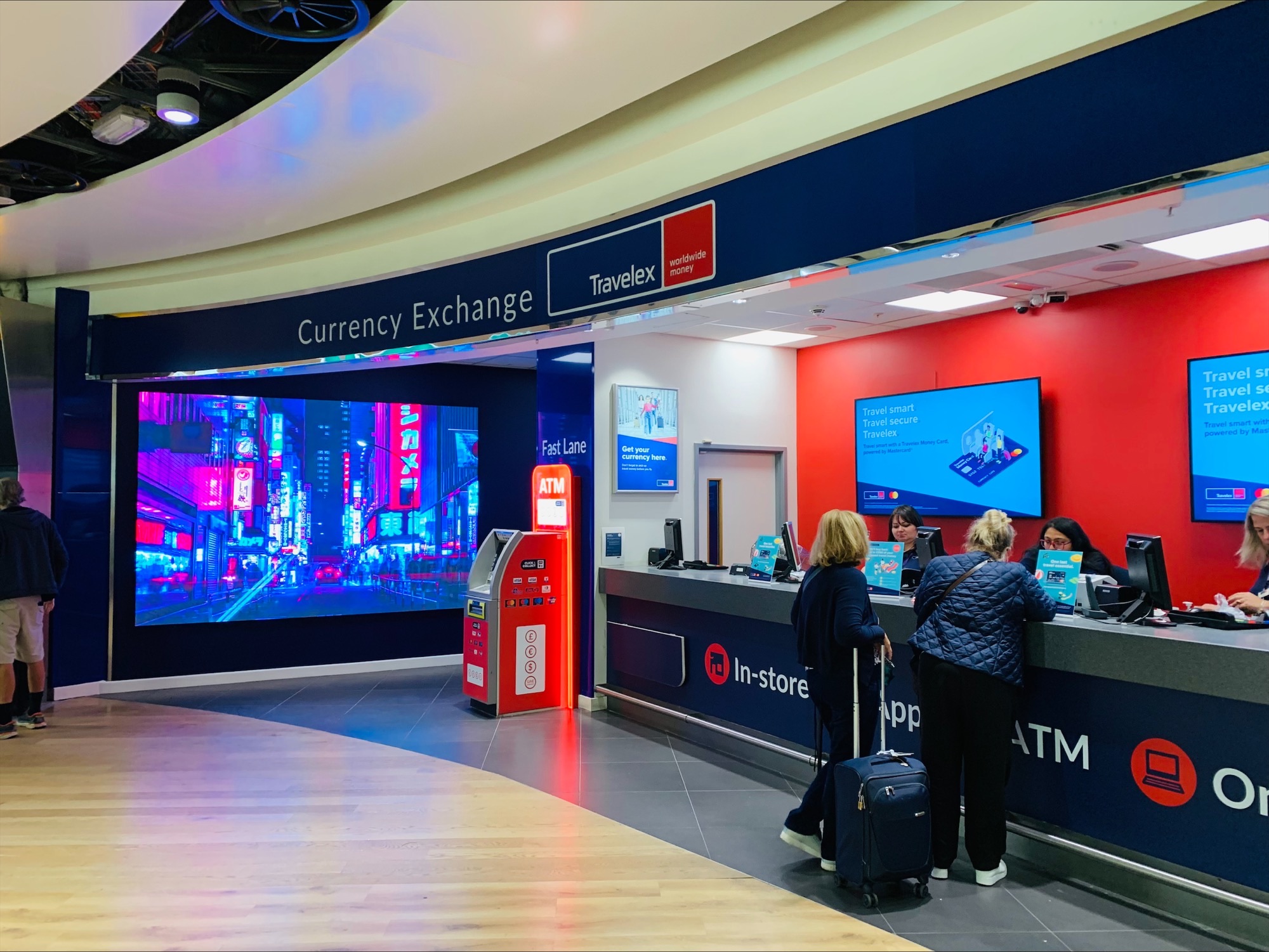
Travelex, the market leading foreign exchange brand, is investing in more than 75 new bureaux, kiosks and ATMs internationally as global travel continues to rebound.
In Europe, Travelex has significantly expanded its ATM network with new ATMs across Berlin, Frankfurt and Zurich airports, as well as over a dozen ATMs across the Netherlands’ national railway network. Travelex has also celebrated its 30th anniversary in Germany this year (its first German store opened in Frankfurt in 1993); and announced contract extensions for both its bureaux at Hamburg Airport and its tax refund business in the Netherlands.
In the UK, Travelex has launched two firsts: its first ever bureau at a UK rail station with a new branch at London Paddington, and a first-of-its-kind automated, self-service, FX kiosk at London Heathrow that requires no human interaction. Furthermore, a new store has been opened at Edinburgh Airport, an extensive bureaux refresh has been undertaken across part of Travelex’s UK estate, and new three metre LED walls have also been developed for Heathrow terminals 3 and 5.
In recent months Travelex has also undertaken extensive investment across the Middle East. In the UAE, Travelex has launched a series of new bureaux and On-The-Move kiosks across airports in Dubai, Abu Dhabi and Sharjah as well as the Mina Rashid sea port, in addition to investing in the refurbishment and expansion of existing stores at Sharjah airport. Furthermore, Travelex is in the process of launching a dozen new ATMs across the Dubai Harbour Cruise Terminal, Dubai International and the new Abu Dhabi Airport Terminal A.
In terms of a retail footprint expansion in the Middle East, Oman saw a launch of a new Travelex pre-immigration store at Muscat International Airport in October 2023. The new store comes as Travelex celebrated its 20th anniversary in Oman this year. In the UAE, a new flagship Landside Arrivals store has opened in Dubai International’s Terminal 3, and at Abu Dhabi seven new stores and eight ATMs have opened to coincide with the inauguration of the new Abu Dhabi International Airport – Terminal A which will serve as the capital city’s main airport.
In Asia, two new stores have been launched at Kuala Lumpur International Airport 2 (KLIA2), taking the total number of retail stores in Malaysia to ten, while two further stores are also set to be launched at Shanghai Pudong Airport Terminal 1 in the coming months. In Japan, Travelex has introduced its prepaid foreign currency card, the Travelex Travel Money Card, to the local market, and also celebrated its 20th anniversary in the country.
Travelex has opened six new stores in Australia and three in New Zealand. Travelex has also partnered with both Bank of New Zealand (BNZ) to offer its 1.2m customers access to discounted travel money.
In Brazil, Travelex has continued to invest in and expand its operations with seven new stores launched nationwide, including in Rio de Janeiro and São Paulo. Travelex now operates over 125 stores across the country, with further openings planned for the coming months.
The new bureaux openings follow Travelex’s recent announcement of a £90m refinancing package. With international travel now at 93.1% of pre-Covid levels, and demand for travel – particularly among emerging markets – continuing to accelerate, Travelex is now working to further expand its retail offering, develop new wholesale relationships and increase investment into both its digital transformation and further product innovation.
Richard Wazacz, Travelex CEO, said:
“Customer convenience is at the heart of everything Travelex stands for, and so we’re thrilled to be investing in the growth of our retail store operations. This investment, along with the recent news of our £90m refinancing, is a clear statement that both travel, and Travelex, are on the rise once again.”
- 07:00 am

Square today launched Tap to Pay on iPhone across the UK, making it the third market globally where Square will offer the technology to its sellers. Available within the Square Point of Sale, Square for Retail, and Square Appointments iOS apps, Tap to Pay on iPhone lets sellers of all sizes accept contactless payments directly from their iPhone, with no additional hardware required and at no additional cost.
Through Tap to Pay on iPhone, Square is making it easier for both new sellers and established businesses to conduct in-person commerce. Any Square merchant with a compatible iPhone can accept contactless payments by simply opening the Square POS, Square for Retail, or Square Appointments app, making a sale, and presenting their iPhone to the buyer. The buyer completes the payment by tapping a contactless payment method such as a contactless credit or debit card, Apple Pay, or other digital wallet, directly onto the seller’s iPhone. Tap to Pay on iPhone also supports PIN entry, which includes accessibility options.
Tap to Pay on iPhone uses the built-in features of iPhone to keep the business’ and customers’ data private and secure. When a payment is processed, Apple doesn’t store card numbers on the device or on Apple servers.
“I’m excited to be using the new Tap to Pay on iPhone as it means I can take payments and manage orders from the one thing I’ve always got with me”, said Sam Corbin, Owner of 400 Degrees Pizzeria, one of the first businesses in the UK to try the new product. “With no extra hardware needed, using the individual team member login feature with profiles means that staff can now use their own devices to safely take orders and payments with the technology they’re most familiar with. We’ve been serving faster, keeping customers happy!”
Powered by Square’s elegant, intuitive software, Tap to Pay on iPhone gives sellers a flexible, mobile solution that can adapt to any environment while meeting evolving consumer preferences for contactless payments. Together with Apple’s contactless payment technology, Square’s software creates a smooth, straightforward checkout experience that provides shoppers with all the information needed to help them complete their purchase with confidence.
Tap to Pay on iPhone is already proving to be a valuable part of Square’s ecosystem, after becoming available to its millions of sellers in the US late last year. Since launching, sellers of all types and size have found new value in the ability to seamlessly and securely conduct business with no additional hardware:
Mobile professionals like tradespeople and caterers gained the ability to securely accept contactless payments onsite at their project location;
Retailers found new efficiency through line busting and the convenience of helping shoppers complete their purchase wherever they are in store;
Hairstylists and beauty professionals benefited from the speed and ease of enabling customers to pay for their services right from their chair.
“With Tap to Pay on iPhone, we are further leveling the playing field for businesses of all sizes to be able to start, run and grow”, said Samina Hussain-Letch, Executive Director of Square in the UK. “The British business landscape is competitive and tech savvy, always on the lookout for solutions that can make operating their business more efficient. Tap To Pay on iPhone helps reduce some of the barriers to entry for new businesses, and enables existing sellers to create new ways to sell with nothing more than their iPhone and Square’s software. They can get set up in minutes and begin making sales in seconds.”
Square sellers and new merchants can begin using Tap to Pay on iPhone today, on an iPhone XS or later running iOS 16.4 or higher, by downloading the Square POS, Square for Retail, or Square Appointments app on compatible devices. For more information, please visit squareup.com/gb/en/payments/tap-to-pay.
- 03:00 am

Finder.com analysed figures by the BVA to find that just over 600,000 small and medium enterprises (SMEs) are using business credit cards, out of a total of 5.5 million. This means that 9 in 10 SMEs (89%) could be missing out on the benefits offered by business credit cards.
While 18% of SMEs were using business credit cards in 2019, more than 1 million SMEs, this had lowered to just 11% in 2022.
Credit card applications also made up just 5% of external financing applications by SMEs between July 2021 and December 2022, a far less popular option than bank loans, which made up 50% of applications.
Why aren’t many businesses using credit cards?
Figures show that 95% of SMEs have between 0 and 9 employees. These micro businesses may prefer to use personal funds to free up cash flow, rather than risking taking on too much debt.
SMEs might also be put off using a business credit card due to the steep interest charges that can quickly add up if you don’t make repayments promptly. Those businesses who are wary of getting into debt may not consider a business credit card to be the right option for them, as is common for 9 in 10 SMEs.
However, having a business credit card can be advantageous for small businesses, especially those who wish to build their business credit score.
Commenting on the statistics, Emily Herring, credit expert at finder.com, explains why small businesses could be missing out:
“Some small businesses are wary about signing up for a business credit card, but if you’re responsible with how you use these cards, they can offer important benefits for SMEs. Here's a list of the key ones:
Boost your business credit score. If you have a limited credit history or a poor business credit score, a business credit card could help you build this. You’ll need to make repayments on time and keep a low credit utilisation ratio, which is the percentage of credit you're using of all the credit available to you.
Earn rewards and other perks. Many business credit cards and charge cards offer attractive rewards and cashback, allowing you to earn benefits so you can treat your team or your clients. Some rewards cards also allow you to earn air miles, to help make business trips more affordable. And some offer a welcome or sign-up bonus for new customers.
Keep personal and business finances separate. If you keep all business-related expenses on your business credit card, it could be much easier to track them and fill out any necessary tax returns or financial forms.
Control spending and improve cash flow. You can typically get a certain number of additional credit cards at no extra cost for your employees to use, which allows you to monitor spending and even set spending limits.
"These benefits might make business credit cards more appealing to SMEs - just keep in mind that you need to be responsible with managing your finances and paying back balances in full each month, or you can quickly rack up debt that cancels out any benefits."
- 06:00 am
In a significant move to further enhance the financial technology landscape, Payment Components, a leading global provider of payments software solutions, is proud to announce its strategic partnership with Fimple, a renowned entity in the core banking sector.
The collaboration between these two companies aims to combine Payment Components' expertise in open banking & payment solutions with Fimple's robust core banking services, ultimately delivering a seamless, integrated experience for banks and financial institutions worldwide.
With this partnership, Payment Components and Fimple are set to cover the needs of banks and financial institutions in open banking. As open banking is paving the way for new and better banking services, Payment Components's vast experience in PSD2 implementations are set to further enhance Fimple's offering in this area.
This partnership will redefine the standards of financial integrations by providing a comprehensive suite of services that will bridge the gap between traditional banking and modern financial technology.
Fimple strategic alliance with PaymentComponents will also enable current and existing customers with a wider range of tools for payments also like the FINaplo.AI component for smart financial messaging handling, aplonHUB Payments Hub to modernize banks' payment systems, ISO20022 compliance (MEPS+, SEPA, FedNow, BAHTNET and more).
- 03:00 am

Infor®, the industry cloud company, today announced that Dormac Marine & Engineering, a division of Southey Holdings, has embarked on an upgrade journey, moving its existing Infor LN enterprise resource planning (ERP) solution to the cloud. Having implemented Infor LN in 2014, Dormac recognised the value in a SaaS approach needed today.
Dormac Marine & Engineering provides a full spectrum of ship repair and specialised engineering services to owners and operators of cargo vessels, passenger liners, navy vessels and offshore construction vessels. With ship repair yards in Cape Town, Durban, Richards Bay, and Saldanha in South Africa, and Walvis Bay in Namibia, Dormac offers a variety of services, including; ship repairs, oil and gas projects, and industrial engineering projects.
According to Siva Pillay, IT manager at Dormac, while the previous implementation of Infor LN showed immediate benefits — and has continued to drive value over the past nine years — it was beginning to become outdated. “As a business, we realised that the latest service pack and new feature releases were no longer going to support the version of LN that Dormac was on. Now the question became whether to change our entire ERP system or upgrade to the Infor Cloud.”
Having conducted in-depth evaluations of a variety of ERP solutions, Pillay and his team carefully considered which direction would make the most sense for the business, both financially and operationally. Dormac soon realised that getting another system to a similar functionality as the current LN would require time consuming and expensive customisation — and still would not be totally compatible with the older LN version. “As a business operating in a projects environment, a single day’s delay could cost us millions. We knew that the solution we chose had to be agile, automated, and offer unmatched reporting capabilities,” Pillay says.
With a strategic approach, the team at Infor partner iOCO guided Dormac in charting the best course to ensure its ERP system was geared for the future, while also enjoying continued support and easy upgrades, immediately deployed. As a result, Infor CloudSuite Industrial Enterprise was selected. As the upgrade begins in earnest, iOCO is working closely with Dormac to identify which processes and reports will be moved to the cloud today, and where enhancement opportunities can be capitalised on. The teams will be taking all historical data to the cloud rather than only opening balances, ensuring easy and complete reference into past projects and eliminating the need to run two systems.
Offering a data lake, reporting, and dashboarding benefits, the move is set to greatly enhance and simplify Dormac’s project module design, driving intelligent information that empowers teams to work effectively anywhere in the world.
“This upgrade will help strengthen and continue the development of the way Dormac does business,” concludes Belinda Best, solution executive at iOCO. “From the Infor OS cloud platform, dashboards, and workflows to true automation driving efficiencies — and the value of utilising an existing licensing model with no additional costs — this cloud approach is set to drive massive business value.”
“We are excited, as the Dormac team, to embark on this upgrade journey with Infor, our trusted and long-term ERP partner,” said Devon Simpkins, Dormac’s financial director. “This upgrade to the Infor Cloud, with the release of related new features, perfectly aligns to our strategic vision of incorporating cutting-edge technologies into our shipyards. We aim to enhance operational efficiencies and, ultimately, pass these benefits onto our valued clients through our ever-improving service offerings.”
- 07:00 am

B2B LendTech platform Trade Ledger and 10x Banking, the transformational cloud-native SaaS core banking platform, have partnered to offer banks and alternative lenders a modern, composable banking proposition that helps banks provide working capital to small to mid-sized enterprises.
This new partnership expands 10x’s commercial banking offering and supports Trade Ledger’s strategy to connect to all major modern and legacy core banking systems. It also supports both firms’ ambitions to support the transformation of the global banking industry.
"We are excited to partner with Trade Ledger to transform the lending and account creation process”, commented Frederico Venturieri, VP and Global Head of GTM and Partnerships at 10x. “Automating integration between credit applications and account creation allows banks to deliver a superior customer experience, while also driving operational efficiency. This collaboration reflects our shared vision of leveraging technology to revolutionise the business banking landscape."
Alan Walsh, VP of Channels for Trade Ledger added: "Partnering with 10x is an important milestone for Trade Ledger. Combining our lending automation capabilities with 10x’s core banking expertise, we can redefine how financial institutions onboard customers and manage the lending process. We are proud to contribute to the digital transformation of the banking industry and deliver enhanced customer experiences and look forward to developing our strategic partnership and joint solutions further in future."
The joint solution enables banks and alternative lenders to bring complex working capital products such as invoice, receivables and supply chain finance to market with unprecedented speed. Through a real-time API connection between Trade Ledger's data platform and the 10x SuperCore platform, approved credit applications can be automatically linked to the creation of a 10x customer account. Trade Ledger manages the loan application, risk assessment and risk and collateral management processes, and 10x manages account opening and the credit account life cycle.
10x’s SuperCore is delivered as a managed-SaaS platform, providing financial institutions with a resilient, regulation-agnostic, and highly-available core banking platform. By leveraging 10x’s API-first design and partner ecosystem, banks can bring solutions to market in hours, instead of months. For its part, Trade Ledger has been able to accelerate the application to delivery time for working capital loans from 90 days to 48 hours.
Trade Ledger will play a crucial role in managing the onboarding and origination processes. Leveraging its expertise in lending automation and portfolio management, Trade Ledger's platform will seamlessly capture and process customer data, enabling a faster and more accurate assessment of credit applications. By automating these processes, Trade Ledger enables financial institutions to accelerate loan origination and enhance risk assessment, improving overall operational efficiency.
Such efficiency is critical to closing the global working capital credit gap, estimated to be $30 trillion. SMEs, the engines of economic growth worldwide, have been the hardest hit. According to the World Bank, SMEs account for about 90% of businesses and more than 50% of employment worldwide and 40% of GDP growth in emerging economies. However, access to finance is a major obstacle to their growth.
High acquisition costs have historically made this market less attractive to lenders, while difficulty navigating complex and lengthy application processes has discouraged would-be applicants. According to recent research more than 50% of applications fail*. Decreasing hurdles to account opening and increasing access to capital are critical for advancing financial inclusion. This partnership increases operational efficiency and reduces technology cost of ownership, allowing banks to capture the working capital lending market opportunity.
- 06:00 am

The ClearScore Group, a leading global financial services marketplace group, announces today a new partnership with alternative lender Plend. Unlike traditional loans providers, Plend looks beyond credit scores to assess risk and affordability, and Plend loans will now be available on the ClearScore UK consumer marketplace. As well as the marketplace, Plend will also be using the ClearScore Group’s open banking services arm ‘D•One’ for comprehensive and specialised open banking connectivity and transaction categorisation intelligence. This allows Plend to consume applicant transaction data via open banking to perform a real-world assessment of affordability. Not only does this support responsible lending, but also provides consumers who have impaired or limited credit histories with access to credit options they might otherwise have missed out on.
Now in its ninth year and with 14m users in the UK, The ClearScore Group includes both the ClearScore data-driven, online marketplace retailing financial services products, and D•One – its fast-growing open banking services provider. The combination of both an open banking technology provider and a distribution channel in the form of a consumer-facing financial services marketplace allows lenders such as Plend to include transaction data in their lending decisions, thus reaching a large audience of consumers switched on to financial services products.
Justin Basini, ClearScore Group CEO and Co-founder, said: “We welcome Plend on board as a forward-thinking and data-driven alternative lender that is the perfect fit for our users. We are seeing more consumers unlocking the power of open banking and lenders increasingly recognise the need to make a truer and fairer assessment of how much credit a consumer can realistically afford to repay. Our highly scalable digital platform and proprietary datasets help translate open banking into smarter decisions, and thereby open new lines of credit that people would not otherwise have had access to.”
James Pursaill, CTO & Co-Founder at Plend, said: “We’re on a mission to give more people the affordable loan they deserve, and credit assessments powered by open banking are the way to make that a reality. We’re pleased to partner with the ClearScore marketplace for extensive reach, and with D•One for its comprehensive transaction categorisation intelligence which helps us accurately and fairly assess potential borrowers.”
D•One’s Open Banking services consists of two products that clients can use independently or in combination: the first, ‘ConnectionOne’, provides the most comprehensive set of open banking connections in the market to over 50 financial institutions. ConnectionOne powers a client’s open banking sign-up and authorisation process and can be white-labelled or fully managed by D•One.
The second product is ‘CategoryOne’, an advanced transaction categorisation engine which allows clients to classify and analyse bank account transactions. CategoryOne has been developed over the past decade and has benefited from well over 5 billion transactions being categorised allowing a powerful deterministic approach to be developed. This approach to transaction categorisation allows lenders much greater confidence in making decisions leading to better outcomes for lenders and borrowers.
- 06:00 am
JCB International Co., Ltd., the international operations subsidiary of JCB Co., Ltd. (JCB), announced its partnership with FrenchSys, a subsidiary of CB-Investissements (CBI), to facilitate a greater JCB certification process for payment terminals across France. This alliance helps banks, terminal manufacturers, and merchant partners to accept JCB Cards through an integrated certification process, hosted by FrenchSys.
This partnership means that French acquirers do not need to perform an additional Level 3 certification for terminals to accept contact and contactless payments from JCB cardmembers. This agreement applies to all payment terminals that comply with FrenchSys-defined FRv6 and nexo standards, which integrate the latest payment innovations, such as online PIN, and can work with all national and international card schemes present in France.
This new terminal certification process has started, and the partnership will benefit acquirers, merchant partners and cardmembers alike. The collaboration streamlines payment terminal setup, giving merchant partners a competitive edge by welcoming JCB’s over 154 million cardmembers to use cards in their stores.
The partnership between FrenchSys and JCB is a long-anticipated development. With the return of post-COVID tourism and major cultural and sporting events on the horizon, the acceptance of JCB payments will be a welcome opportunity to drive up incremental revenue for French merchant partners and their payment service providers.
Ray Shinzawa, Managing Director, JCB International (Europe) Ltd., said: “The growth of our partner network is great news, and we are thrilled to announce our partnership with FrenchSys. This development will allow our valuable cardmembers to use their JCB Cards more widely throughout France, which is fantastic news for them and the merchant partners who serve them. We look forward to seeing the positive impact this partnership will have in the French payments industry”.
Cédric Sarazin, Managing Director, FrenchSys, added: “FrenchSys was established in 2019 to facilitate the acceptance of multi-scheme payments in France, serving acquirers, card schemes, manufacturers, and digital payment processors. The partnership between FrenchSys and JCB has been eagerly awaited by the financial services industry, as it will enable the seamless processing of JCB payments, without additional processes or costs being passed on to the merchant. This in turn means that JCB-accepting merchants can now tap into a lucrative market of global consumers, especially from Asia, making their time in France more convenient and enjoyable.”
For the certification and approval of payment terminals in France for JCB Cards, manufacturers of payment terminals or developers of integrated payment solutions can contact FrenchSys or its sister company Elitt, which is responsible for terminal testing, for more information.








