
Published
- 06:00 am

NatWest Group is making its new Customer Attribute Sharing service available to businesses as an embedded digital ID solution after signing a deal with identity service provider OneID.
The bank is rolling out the service, in collaboration with OneID, across a wide range of use cases, including e-document signing and digital onboarding.
Powered by NatWest Group’s Bank of APIs, Customer Attribute Sharing makes it easy, safe and secure for customers to consent to businesses accessing bank-held data that will help speed up their online experiences – for example, when signing up to new services or buying goods online.
The new service also lets customers digitally verify their details when buying age-restricted services like hiring a car.
Customers can also grant permission for businesses to be instantly notified when they update their details, such as their address, to help ensure their delivery details are kept up to date.
This can reduce the need for customers to fill in lengthy online forms or scan and upload documents, helping them save time and reducing the risk of manual error.
For businesses, Customer Attribute Sharing can speed up and streamline the online experiences they offer their customers. And it can help reduce the risk of fraud by making it easier to verify that customers are who they claim to be.
One e-signature provider using the service has already reduced its document signing process from 5 minutes to 45 seconds, thanks to the speedier customer journey that Customer Attribute Sharing enables.
In the months ahead, NatWest Group will be signing deals with more providers to bring its Customer Attribute Sharing service to an even wider range of use cases - for example, by embedding the service in e-commerce journeys to improve the online payments experience.
Claire Melling, Head of Bank of APIs at NatWest Group, commented:
“We recognise that our customers are spending more time on digital platforms and so we’re focusing on embedding our services in our customers’ daily lives. Moreover, as a trusted institution, we have a key role to play in the emerging concept of digital identity. Our new Customer Attribute Sharing service will provide our customers with a safe, secure and convenient way to verify their identity online, while enabling businesses to speed up and streamline customers’ online experiences. We’re excited that, through our collaboration with OneID, businesses and consumers are now experiencing the benefits of this service.”
Martin Wilson, CEO of OneID, commented:
“We are delighted to be working with NatWest Group on their Customer Attribute Sharing. As an organisation committed to making the world a safer place, OneID can digitally verify details for over 40m UK citizens, protecting them from fraud and identity theft when online. Our partnership with NatWest will help businesses streamline their customer service and reduce costs, for example when registering new customers or setting up direct debit payments.”
- 08:00 am
New research from open banking platform Yapily reveals businesses are potentially losing up to £656 million in missed revenue at the last mile.
The research, which polled 2,000 adults in the UK, found that 52% of those surveyed have ditched at least one online purchase in the last 12 months due to a poor experience at the online checkout. This figure soared among younger generations to 70% of those aged 16 to 24 and 64% of 25 to 34-year-olds.
The need to manually input card details (25%), merchants not accepting their preferred payment method (19%), and payments being blocked due to suspected fraud (15%) were among the most popular reasons for consumers abandoning their online purchases.
Abandoned sales were mostly priced between £21 and £60 (69%) and £61 and £100 (25%), with the average value of a discarded shopping basket sitting at £30.
The findings come at a time when getting consumers to spend is already tough and profit margins for businesses are tight. Reports recently published by the Confederation of British Industry and Office for National Statistics warn organisations to expect a slump in retail sales in March following a month-on-month drop in online sales since January this year.
The research also revealed that payment headaches don’t stop at online checkout. Overall, 77% of Brits are frustrated when it comes to making and receiving digital payments. Over a third (36%) said refunds taking a long time to appear in their accounts frustrated them the most, whilst 20% said their main grievance was not knowing what dates payments will leave their account.
Instead, 41% of Brits want to see businesses offer more convenient and easier payment methods at checkout, with over one-third (34%) stating they would use a Pay by Bank app, product or service. Powered by open banking, Pay by Bank enables consumers to instantly send and receive money directly from their bank account when making an online purchase. Businesses also benefit from using open banking payments, cutting out costly interchange fees, reducing fraud risk, and boosting conversion rates.
Founder and CEO of Yapily, Stefano Vaccino, said: “In times like these, payments are becoming a more critical and strategic focus for every business. New payment innovations like open banking are enabling businesses to realise this, transforming payments from a cost-reduction exercise into a way to increase performance and grow revenue. To stop poor payer experiences eating into their profits, businesses and payment service providers should listen to what consumers and merchants are asking for – a faster, cheaper, and more secure way to pay.”
These findings are part of Yapily’s new report ‘State of Payments 2023: The £650 Million Problem Open Banking Can Fix’ which can be downloaded here.
- 07:00 am

Aiviq, a leading cloud-based SaaS business for the global asset management industry, today announced a multi-year deal with AllianceBernstein (AB), a global investment management firm, to provide client assets under management (AUM) and flow data management products and services for AB’s international business.
Aiviq has licensed its industry-leading client AUM & flow data management platform to AB and will provide a number of enterprise AUM & flow data sets via its managed service offering. This will standardise a diverse range of AUM and flow data sources across AB’s European funds business to support AB’s reporting and analytics requirements across sales, marketing, client service and business management.
Honor Solomon, Head of EMEA Retail, AllianceBernstein said:
“Aiviq and AllianceBernstein share a culture of collaboration, partnership and co-innovation, which has enabled us to develop this highly successful capability together. The Aiviq platform is a key pillar of AB’s global strategy to develop a data-driven sales capability. We look forward to our continued collaboration with Aiviq.”
Mark Leedham, Head of Technology and Operations – Client Group, AllianceBernstein commented:
“The Aiviq platform’s extensive data model, and expansive library of data quality rules, allow us to accurately map the role of key participants in the investor ecosystem to a given transaction or holding. This capability enables us to reconcile client AUM and ‘flow to fund’ accounting data and use sophisticated data matching techniques.”
Greg Glass, Executive Director, at Aiviq commented:
“AB’s investment in the Aiviq platform is evidence of the accelerating trend in the asset management industry to gain competitive advantage by exploiting data more creatively. AUM & flow data describing a client’s economic footprint is one of the most valuable and under-exploited data sets in the industry. AB has created a definitive Customer Book of Record (CBOR) that can be used to support use cases across the enterprise in sales, marketing, finance, strategy and beyond. We are delighted with the partnership with AB and we look forward to collaborating closely in the years to come.”
- 09:00 am
The introduction of digital banking has revolutionized the way customers manage their finances, providing a more convenient, secure, and accessible banking experience compared to traditional banking methods. With digital banking, people can access and manage their bank accounts using smartphones or computers, eliminating the need for physical branch visits and long queues. This has led to continuous innovations in banking industry.
To stay ahead of the competition, banks continuously innovate and offer new solutions that meet the evolving demands of customers. Banks aim at providing personalized experiences that differentiate them from their competitors as digital channels are increasingly adopted. This article will delve into five digital banking innovation ideas 2023 that are impacting the future of the banking industry.
We will discuss mobile banking, artificial intelligence, blockchain technology, open banking, and big data analytics. We will examine the latest breakthroughs in each of these areas, how they are transforming the banking industry, and assist in financial software development.
Bank on the Go: How Mobile Banking is Transforming Financial Management

https://unsplash.com/photos/QwAL909kTiY
Mobile banking has emerged as a fundamental aspect of digital banking in recent years. Because smartphones are widely used, there has been a significant increase in the number of customers who use mobile banking. This shift towards mobile banking has led to an increase in online banking innovations in this area, with banks constantly looking for new ways to improve the customer experience, for example:
Check deposits. Mobile check deposits are one of the most recent advancements in mobile banking that permit clients to deposit checks through their smartphones by taking a picture of them. This feature eliminates the need for customers to visit their bank branches or ATMs to deposit checks, saving them time and effort.
Biometric authentication. Biometric authentication is another digital banking innovation that involves verifying customers' identities using their biological characteristics. This functionality provides clients with a more convenient and secure approach to accessing their accounts.
eWallets. Mobile wallet integration is another exciting innovation in mobile banking. It allows customers to store their payment cards digitally and use them to make purchases directly from their smartphones. This feature provides a quick, hassle-free, and secure payment method for customers to purchase products and services.
With mobile banking, customers can perform a wide range of transactions from anywhere, anytime, making banking more accessible and convenient. Mobile banking also offers a more personalized experience, with features such as customized alerts and notifications. All these innovations have significantly improved the customer experience, making mobile banking a key aspect of the digital banking of the future.
Intelligent Banking: How AI is Revolutionizing Digital Banking for Smarter Financial Management
Artificial intelligence (AI) is rapidly transforming the banking industry, with banks leveraging AI technologies to improve customer experience and streamline operations. The latest AI innovations in digital banking include
Chatbots and voice assistants. Chatbots and voice assistants are becoming increasingly popular in the banking industry, allowing customers to get quick and personalized responses to their queries without having to speak to a human agent. They are capable of performing various tasks such as responding to customer inquiries, furnishing details about products and services, and executing transactions. Banks can benefit from a 30% cost reduction, improved efficiency, and increased customer satisfaction through this measure.
Fraud detection algorithms. These algorithms are another area where AI is being widely used in digital banking. They use machine learning techniques to detect patterns of fraudulent behavior, allowing banks to prevent fraud before it happens. This not only helps banks to save money by reducing losses due to fraud but also helps to improve customer trust by ensuring that their accounts are secure.
AI in digital banking can result in significant cost savings, making it one of the major advantages of this technology. AI implementation in digital banking can automate numerous tasks. This automation process aids in decreasing labor costs and increasing efficiency. AI also improves accuracy, minimizing errors and reducing the risk of fraud.
Another benefit of AI in digital banking is personalized customer service. AI-powered chatbots and voice assistants can provide customers with personalized recommendations, making banking more relevant and convenient for customers.
Revolutionizing the Banking Industry with Blockchain Technology: Enhancing Security and Transparency

https://unsplash.com/photos/JlijbOtSWuw
Blockchain technology is a distributed ledger system that enables various parties to access and verify transaction data simultaneously and in real-time. It employs advanced cryptographic algorithms that ensure transaction security, making it a suitable option for financial transactions.
Blockchain's most exciting application in digital banking is cryptocurrency. A digital currency that utilizes blockchain technology to ensure secure and transparent transactions, and is not governed by a central authority like conventional currencies, making it more secure and resistant to fraudulent activities.
Another area where blockchain is being widely used in digital banking is decentralized finance (DeFi). DeFi is a financial system that enables transactions to occur without the involvement of intermediaries like banks. With the aid of blockchain technology, DeFi provides a more streamlined and transparent method for carrying out financial transactions, as well as lowering the expenses associated with conventional financial services.
Blockchain technology offers the following benefits to the digital banking industry:
Improved security via creating an unalterable and open record of all transactions, which makes it challenging for criminals to tamper with the system
Enhanced efficiency via decreasing the reliance on intermediaries and automating numerous financial processes
Blockchain technology can eventually drastically change digital banking. With the ongoing evolution of this technology, we can anticipate further groundbreaking advancements in the future.
Unlocking New Opportunities: How Open Banking is Changing the Game in Digital Banking
Open banking is transforming the traditional banking industry by allowing third-party providers to access and use customer data through APIs (application programming interfaces). This innovation enables consumers to securely share their banking data with third-party providers, such as fintechs and other financial institutions. As a result, open banking is creating a more competitive and customer-centric banking ecosystem.
One of the latest open banking innovations is banking as a service (BaaS), which allows fintech companies and other non-banking entities to offer banking services to their customers. BaaS providers partner with traditional banks to access their banking infrastructure, allowing them to offer services such as deposits, loans, and payments.
Open banking presents numerous advantages to customers, such as:
Increased competition
Enhanced customer satisfaction
Improved financial inclusion
By enabling third-party providers to access banking data, open banking creates a more competitive market, leading to lower costs and better products for customers. Moreover, open banking allows for personalized services, such as personalized financial advice, which can help customers to better manage their finances.
Open banking can be beneficial for financial inclusion by expanding access to financial services for underserved populations, such as those without a credit history or limited access to traditional banking. This can be achieved through the creation of new products and services like micro-loans and peer-to-peer lending.
Revealing the Power of Data: How Big Data Analytics is Revolutionizing Digital Banking
Big data analytics has become a key tool in digital banking, enabling financial institutions to:
Obtain a deeper understanding of customer behavior
Improve decision-making
Advance customer experience
Financial institutions can use big data analytics to make data-driven decisions by analyzing the vast amount of data generated by digital transactions and identifying patterns and trends.
Predictive analytics is a recent big data innovation in digital banking that utilizes machine learning algorithms to analyze data and make predictions about customer behavior. Financial institutions can use predictive analytics to examine past data and gain insights into potential risks and opportunities.
Customer segmentation is another big data innovation in digital banking. By dividing customers into segments based on their behavior, preferences, and needs, financial institutions can develop targeted marketing campaigns and personalized offers that meet the unique needs of each customer segment.
The benefits of big data analytics in digital banking are numerous:
Personalized offers and targeted marketing can help financial institutions to increase customer engagement and loyalty
Risk management strategies based on big data analytics can help to minimize losses due to fraud and other risks.
Big data analytics can help financial institutions to identify new opportunities and to optimize operations, leading to increased efficiency and profitability
To summarize, the future of digital banking is being shaped by advanced digital banking technologies that have the potential to revolutionize the industry. Technologies such as mobile banking, big data analytics, artificial intelligence, blockchain, and open banking offer unique benefits that can improve customer experience, streamline operations, and help financial institutions stay competitive.
With the increasing demand for digital banking solutions, financial institutions need to continue innovating and adopting new technologies to meet customer needs. Failure to do so can result in falling behind in the highly competitive industry. Therefore, embracing the latest innovations in digital banking is crucial for financial institutions to deliver the best possible services and stay ahead of the game.
- 07:00 am
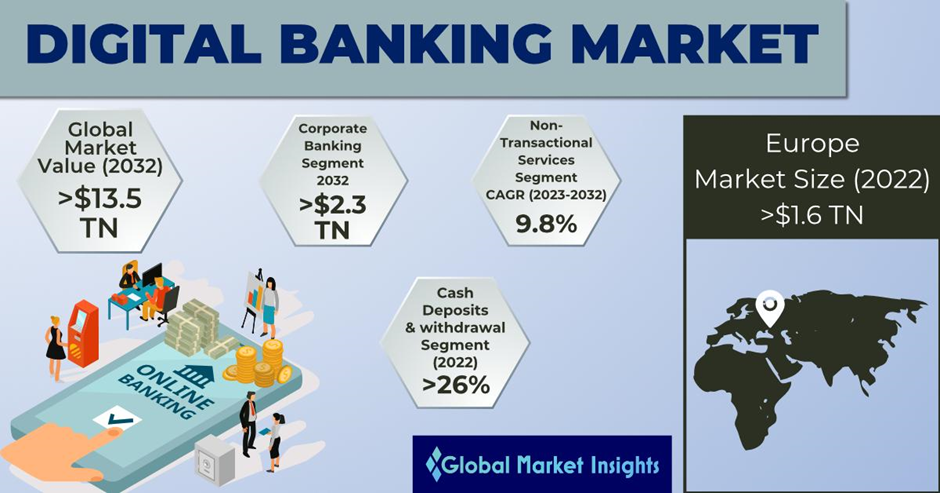
As per a recent industry report put forward by Global Market Insights, Inc. Digital Banking Market is forecast to register its name in the billion-dollar fraternity down the line of seven years, by exceeding a revenue of USD 13.5 trillion by 2032 with a projected CAGR of 3.6% over 2023-2032.
The market growth is owing to the rising penetration of fintech players in the industry. Besides, the fintech industry is witnessing an upsurge in investments across asset management, lending, insurance, payments, and money transfers, which is slated to have a positive impact on the market landscape through the upcoming years.
In addition, various central governments are incorporating approaches and initiatives to fast-track the fintech industry growth. Most governments are supporting fintech to achieve business goals, including increasing financial inclusion and access, improving efficiency, ensuring stability, and stimulating competition, all of which are expected to accelerate the digital banking market growth.
Overall, the digital banking market is categorized into type, service, transactional services, non-transactional services, and region.
Considering the type, the investment banking segment is slated to grow exponentially through 2032. The growth can be credited to the rising adoption of technology and data analysis to understand clients better and find new ways to cross-sell and enhance relationships.
Based on services, the non-transactional services segment is expected to register considerable growth by 2032 end, owing to the rising consumer inclination towards digital and mobile channels. In addition, the burgeoning adoption of numerous non-transactional services, such as account services, customer service, asset management, consultancy, stock advisory, financial planning, and SMS services, are further expected to support the segmental expansion in the future.
The digital banking market from fund transfers segment held over USD 3 trillion market share in 2022 and is expected to demonstrate massive growth through 2032. Online fund transfers are the most widely used transactional services, owing to which digital fund transfers are slated to showcase a massive revolution. In addition, the rising penetration of smartphones and increasing use of mobile payment apps is expected to drive segmental growth.
In terms of non-transactional services, the financial planning segment is expected to exhibit over 11.5% CAGR during 2023-2032, owing to the rising digitalization and deployment of modern technologies, including AI and big data analytics.
In the regional context, the Latin America digital banking market will register revenues of over USD 690 billion by 2032 as the banks in the region are observing massive digital transformation. In addition, financial institutions are turning to digital banking technologies in place of the traditional core to minimize the effort. Moreover, well-known banks are developing new digital banks and intend to gradually transition consumers away from the current platform, which is expected to positively impact regional growth through 2032.
Source: https://www.gminsights.com/industry-analysis/digital-banking-market
- 02:00 am

PXP Financial, an expert in acquiring and payment processing services, has today announced a new collaboration with global technology company Mastercard and payments infrastructure provider Payall, to deliver safe, compliant and efficient cross-border payments and international money transfers.
This collaboration offers inclusive payment capabilities that enable PXP Financial's customers to send funds to their partners, employees and suppliers safely, efficiently and more conveniently than ever. This includes inclusive payout options to recipients regardless of whether they are banked or unbanked. The next step for PXP Financial is to work with Payall to open new destinations and new payment channels, including sending to mobile wallets, cash pickup locations and paying direct to card.
PXP Financial began working with Payall in mid-2022, having chosen Payall for its focus on payments compliance and safety, as well as its cutting edge, fintech-level experience for end users. Payall offers financial institutions worldwide a new paradigm for providing cross-border payments with first-ever capabilities that transform international money movement.
Mastercard gives people and businesses a secure and convenient way to send money to bank accounts, mobile wallets, cards and cash payout locations around the world. Mastercard Cross-Border Services reaches more than 100 markets and 90% of the world’s population.
Commenting on the announcement, Kamran Hedjri, CEO of PXP Financial, said: “We’re delighted to be working with Payall and Mastercard to facilitate cross-border payments, which have traditionally been slow, cumbersome and risky for both payers and financial institutions. By leveraging Payall's proprietary compliance tech and Mastercard's innovation moving funds globally, we are now able to offer our customers speedy, safe and simple access to international payments.”
Gary Palmer, CEO of Payall, added: “With a focus on international funds transfer compliance, process automation and payment orchestration, we deliver turnkey technology and power new paradigms that eliminate the inefficiencies and address the complexities of cross-border payments. We’re thrilled to support PXP Financial to deliver better-than-fintech service to its customers making international payments.”
Rasika Raina, SVP, Mastercard Cross-Border Services, said: “Whether sending money home to families or working with global suppliers, the need for fast, reliable and transparent payments has never been more crucial. Through programs like this, we’re making cross-border payments safe, fast and easy for everyone.”

Todd Latham
CEO at Divido
Last year saw increased interest rates and the onset of the cost-of-living crisis. see more
- 03:00 am

Fundpath, the data and technology business bridging the information disconnect between asset managers and wealth managers, today confirmed the completion of a £4m late seed funding round with growth capital partner Fuel Ventures.
Launched in 2021, intelligent data-driven SaaS platform Fundpath, is transforming the traditional sales process, enabling fund buyers and allocators to share their business responsibilities, parameters, interests and intentions quickly and securely with asset management firms. This helps asset management fund distribution teams to deliver a superior client experience by communicating relevant, timely and actionable investment information, thereby improving the quality and relevance of engagement between fund buyers and sellers.
The £4m investment round will enable Fundpath to extend the breadth and depth of its systems and data, and to invest in new technologies.
Fundpath Co-Founder & CEO, Jamie Hinchliffe explains:“Our mission is to bridge the information disconnect between the buyers and sellers of funds. Over the last 18 months, we’ve been working even closer with the wealth and asset management industry to do just that. Now, with Fuel’s investment and hands-on support we can continue to innovate, launch supporting tech platforms, and invest in the very best people.
“The Fundpath team is extremely excited about this next phase of growth, providing the industry with ever smarter solutions, to further improve professional lives.”
Fuel Ventures evaluates more than 6,000 investment opportunities each and every year, but invests in just 12-15 firms.
Mark Pearson, Managing Director at Fuel Ventures said: “With Fundpath, we see a huge opportunity to positively impact an important industry, by solving a genuine problem through technology and data.
“The outstanding feedback we have received from wealth managers and asset managers about what Fundpath is creating, and the scale of the progress that has been made in such a short period, was enough to convince us that we should be part of their journey. The team can be sure of our total support as they work to bridge the information disconnect in the fund buying sales process.”
- 07:00 am

PhonePe, one of India’s largest fintech platforms, today announced it has raised additional $200 million in primary capital from Walmart, at a pre-money valuation of $12 billion.
This new funding comes as a part of PhonePe’s ongoing fundraise of up to $1 billion in capital, following its domicile shift to India last year. With this tranche, the company has raised $650Mn from several global investors. The company expects further investments, which will be announced in due course.
PhonePe plans to deploy these funds to build and scale new businesses like Insurance, Wealth Management, Lending, Stockbroking, ONDC-based Shopping and Account Aggregators. The fundraise will also help PhonePe turbo-charge the next wave of growth for UPI payments in India, including UPI lite and Credit on UPI.
Speaking on the fundraise, Sameer Nigam, CEO and Founder of PhonePe said, ‘’We would like to thank Walmart, our majority investor, for their continued support of our long-term aspirations. We are excited about the next phase of our growth as we build new offerings for Indian consumers and merchants, along with enabling financial inclusion across the nation.’’
President and CEO for Walmart International Judith McKenna said: “We are excited about PhonePe’s future and have confidence in how it continues to expand its offerings and provide access to financial services for Indians at scale. India is one of the world’s most digital, dynamic and fastest-growing economies, and we are pleased to have the opportunity to continue to support PhonePe.”
- 08:00 am

New data published by the World Federation of Exchanges (WFE), the global industry group for exchanges and central clearing counterparties, indicates that $25 trillion was wiped off global stock markets in 2022.
WFE’s FY 2022 Market Highlights report reveals that stock markets declined by 20% in market capitalisation and 10% in value traded in 2022, interrupting the positive trend observed in the two previous years.
Factors that caused last year’s slump include the aftermath of the Covid-19 pandemic which caused inflationary trends fuelled by strong consumer demand and supply bottlenecks exacerbated by the war in Ukraine and the sanctions against Russia, which increased energy prices, especially for European countries.
China’s renewed Covid lockdown, with stringent measures enforced for most of the year, strained the global supply chain, increasing prices of imported goods. Investment cooled down in the equity market as a result of the high inflation environment, alongside the tightening of monetary policies which included raising interest rates across most economies.
Nandini Sukumar, Chief Executive Officer at the WFE, said: “We witnessed a perfect storm in 2022 of so many negative pressures culminating to bring immense pressure on global stock markets, as our report highlights.”
There was some good news, however, as volumes of exchange-traded derivatives continued a positive trend, with the exception of commodity derivatives. There was a pronounced increase in the case of options – possibly due to a greater need to hedge against market uncertainty.
Some highlights from the report:
Cash equity
- Global equity market capitalisation declined annually by approximately 20% in 2022, with all regions declining significantly. In absolute terms, this represents more than $25 trillion wiped off stock markets worldwide.
- While trading value fell about 10% globally in 2022, with trading value declining in every region, global volumes increased about 5%, with every region contributing to this result. 2022 recorded the highest global volumes in the last six years (48.32 billion trades) and the highest regional volumes during the same period: the Americas (13.44 billion trades), APAC (31.13 billion trades) and the EMEA region (3.74 billion trades).
- The number of IPOs and the capital raised through IPOs declined sharply compared to 2021 (-50% and -65%, respectively).
Exchange-traded derivatives
- The number of exchange-traded derivatives contracts, including both options and futures, reached their highest level in the last six years, amounting to 56.17 billion for options and 29.59 billion for futures (84.76 billion derivatives contracts traded). This represents a 34.4% increase compared to 2021.
- Commodity derivatives were the only product line whose overall volumes (that is, considering both futures and options) declined in 2022 (-14.5%), while equity, currency, and ETF derivatives volumes witnessed double digit increases (48.4%, 48.2%, and 36.9%, respectively).
- Interest rate derivatives volumes increased 8.5% year-on-year.
Other products
- While the number of listed exchange-traded funds (ETFs) increased only 5% when compared to 2021, the ETF value traded increased considerably (32.2%), due to increases in every region.
- The number of listed securitised derivatives (SD) went slightly up year-on-year (2.6%), but the value traded declined year-on-year (-21.6%), due to declines in every region.
- The number of listed investment funds (IF) fell year-on-year (-6.1%) while the value traded increased 12.5%. EMEA region recorded declines in both the number of listed investment funds and in value traded, while in the Americas both changes were positive. The APAC region recorded the largest drop in the number of listed funds and the largest increase in value traded.
You can download a copy of the report here.








