
Published
- 09:00 am

TrueFX, a purpose-built OTC market designed for the buy-side, has today announced it executed the first set of disclosed trades between counterparties on its network. The first trades were executed by FXCM, AxiCorp, Velocity Trade and leading electronic market makers.
TrueFX has been designed to provide all market participants with direct access to FX liquidity through a single point of credit intermediation and technology integration. Delivered in a cloud environment, its ultra-low latency network can be easily connected to and offers uninterrupted access to market participants around the world. TrueFX operates both disclosed and non-disclosed trading and supports a wide range of execution methods, including full amount and VWAP.
Daniel Beale, Head of Institutional Sales and Trading at AxiCorp said, “AxiCorp is extremely pleased to have participated in the first live trades on TrueFX. The transparent and highly efficient model employed by the platform is an exciting development for the markets and we look forward to continuing our participation over the coming months.”
Richard Holman, Head of Prime Brokerage at Velocity Trade said, “Velocity Trade is proud to demonstrate its commitment to TrueFX by executing the first trades on the platform. TrueFX represents an exciting opportunity for many FX market participants through the increased accessibility and transparency it brings.”
Brendan Callan, CEO of Forex Capital Markets (FXCM) said, "TrueFX is an exciting and innovative proposition that allows more market participants to connect and trade with the widest range of counterparties. By eliminating credit as a barrier to market, many can access core FX liquidity far more efficiently than ever before.”
“TrueFX is open to the entire FX community and customers have access to any form of liquidity of their choosing.” said Harpal Sandhu, CEO of Integral and technology provider for TrueFX. “Clients can take full advantage of a centralized credit and technology offering, which delivers high cost savings and opens up the market to the widest possible user base. We are thrilled by the extremely positive reaction we have received from the market and are now responding to the significant demand from customers looking to TrueFX for efficient and convenient trading.”
- 05:00 am

Funding Options, the marketplace for business finance, is now using Open Banking to make it quicker and easier for businesses to access finance. Businesses applying for finance will see their application time reduced from days and hours, to just minutes as they will no longer need to source original bank statements. Around 20 lenders have agreed to consume the Open Banking data as part of their analysis for credit decisions. These include Just Cash Flow, YouLend, Liberis, iwoca, Newable, and White Oak UK.
To date, around 200 UK finance providers are enrolled in the UK’s Open Banking scheme, meaning the potential for expansion is huge. There is an opportunity for the industry to come together and unlock data, which can streamline access to finance and extend the choice of providers for SMEs, allowing for fast and secure access to funding. In the current health crisis, this will be of the utmost importance.
Last week, the Chancellor overhauled the Government’s Coronavirus Business Interruption Loan Scheme (CBILS) after claims that many businesses were being denied the government backed loans, and that it was taking too long to deliver the funds. Open banking can help deliver funds more quickly to businesses whose cash flow and revenue have been disrupted.
By partnering with AccountScore for Open Banking and driving a strategy of API connectivity with our lender partners, Funding Options can minimise the amount of work applicants and lenders need to do to approve a credit application. For applicants, they will no longer need to send documentation to lenders. Instead, thanks to open banking APIs, Funding Options can immediately make their transaction history available to lenders, in a safe and secure manner. As all the data is standardised, it’s easy to share with multiple lenders.
For lenders, they will be able to make decisions based on the standardised data much quicker than through the traditional methods. It will also move the financial services industry towards being able to pre-approve businesses for loans based on real time data.
Simon Cureton, CEO at Funding Options, says: “Open banking has the potential to transform the business lending landscape, improving the experience for the customer while also improving security and response times for lenders. We’ve already seen a number of customers using the platform and successfully receiving loans which highlight the value and benefit from shared data. In the face of the current health crisis, when access to finance is vital for the survival of many businesses, reducing the time it takes to go from application to draw down is of paramount importance.
Cureton continues: “In time, open banking will be adopted across the board, and we will see the true potential of how data can be used to improve all aspects of business finance. This will require some behavioural changes, and as an industry, it’s up to us to lead this revolution and improve the experience for all our customers.”
Caryl Regnault, Senior Product Manager at Funding Options, adds: “Open Banking has been around for a couple of years now and yet we’re still to experience mass adoption. Although there are several resources out there published from credible sources and industry bodies such as Which, Money Saving Experts, FCA and Open Banking Org, it can be overwhelming for individuals to understand the value of Open Banking. This opens up uncertainty which is coupled with concerns around data security. It’s important to recognise that streamlining processes using the data is not compromising the security of customer data.
Regnault continues: “At Funding Options, we have made a conscious decision to ensure our business finance specialist teams are in contact with our customers over the phone to avoid relying solely on email, which could be mistaken as a phishing attempt. Our teams will talk customers through the data usage, security measures in place and consent of data access so they can understand the value.”
John Davies Exec Chair and Founder of Fintech Lender Just CashFlow Plc adds “I couldn’t agree more with the comments made by Simon and Caryl but the time saving isn’t just about uploading hard copies (which are easy to forge) but also the analysis that can be done on those statements using Accountscores dashboard which cuts hours from manually checking them and is clearly more accurate. We applaud Simon and his team for innovating and making it easier for Borrower and Lender alike and we look forward to further partnering with Funding Options with the projects they have in the pipeline.

Shaun Collings
Director of Public Sector UK at Pure Storage
Across the public sector there are various forms of digital transformation taking place, at different stages of progress. Part of the driver for this is that citizens now expect a level of service see more
- 02:00 am

As a global fintech that operates in the UK, US, Australia and Poland, we're witnessing first-hand the effects that the global shutdown is having on personal lending around the world.
The COVID-19 crisis is having a severe impact on the consumer credit market in almost all of the territories in which we operate. In the UK and the US particularly, we're seeing two key themes play out since the outbreak of the virus; a significant reduction in the demand for personal loans combined with a contraction in the supply of credit across nearly all lenders.
We’ve seen a significant contraction in the market with a reduction of 30 to 40% in the demand for personal loans. It's our view that the fall in demand is being driven by faltering consumer confidence due to job insecurity and economic uncertainty amongst other factors.
Additionally, under the current restrictions, one thing remains clear. The ability to actually purchase some products or services that personal loans are used for, has virtually disappeared overnight, further driving down demand.
"It's almost impossible to purchase a car under the current restrictions," says Monevo CEO and Founder, Greg Cox, "but other loan purposes like holidays are also affected due to travel restrictions, while major home renovation projects are put on hold, and the house-buying process has effectively paused."
A reduction in the demand for personal loans alone would be significant and unprecedented, however we're seeing this trend combined with a marked contraction in the supply of credit across nearly all lenders, creating what Cox describes as "a perfect storm".
With the UK gripped by COVID-19 and life as we know it entering a state of paralysis for an undefined time-frame, it's perhaps unsurprising to also see UK lenders making widespread changes to their credit and risk appetite, and restrict the supply of credit.
This contraction in supply has followed two distinct trends. Lenders have either paused lending completely or have severely restricted who they lend to by significantly tightening their criteria and relying to a far greater extent on manual underwriting.
"We're now starting to hear discussions from lenders on how they view certain 'at risk' employment types within their existing loan books in terms of payment performance" says Monevo Commercial Director, Tim Kirby.
For some lenders, these changes mean excluding or restricting lending to consumers that are self-employed or work in high-risk sectors such as travel. Other lenders are restricting lending to consumers who fall under the occupation of key-workers, a classification of workers that the UK government deems vital to public health and safety during the corona virus lockdown.
Industry regulators have been swift to respond and yesterday [April 2, 2020] the FCA proposed a range of temporary measures designed to help customers with certain credit products who face financial difficulty as a result of the corona virus pandemic.
Their proposals to the sector include temporary payment freezes on loans and credit cards, zero interest overdrafts of up to £500, along with the guidance that consumers using these temporary measures should not have their credit rating affected. Time will tell if these proposals affect lender behaviour further.
With widespread measures now put in place to fight the pandemic, travel restrictions and business closures are having a significant impact on the US economy.
In response, the US government passed the CARES act last week, now the largest economic stimulus bill in modern history and more than double the amount passed in 2009 for the Financial Crisis.
US lenders are focusing on restricting customer acquisition volumes. "Since mid-March, lenders have made significant changes to credit policy to offset risk or have paused new customer acquisition to assess short-term strategies," explains Monevo US Territory Director, David Brooks. "Defaults are the big risk and it is critically important for lenders to support enrolled consumers over the next 3-6 months."
We've noticed a considerable drop in demand for personal loans in the US, again driven by falls in consumer confidence, and the fact that many reasons for taking out a personal loan are now obsolete given the purchasing restrictions that remain in place.
In Australia, we've seen the least impact to date with most lenders still operational and only just beginning to tighten criteria. The current controls and restrictions, although not as currently severe as in the UK, are affecting industries such as tourism, hospitality and entertainment.
Despite this, International Development Director Seb Haack who oversees the Australian territory, explained that weekly credit demand volumes on Monevo continue to be strong while the platform continues to match customers to the right lender across an array of credit risk criteria.
"We particularly expect lenders’ responsible lending criteria to focus on income stability over the coming weeks and months," says Haack. "Overall, and despite the global turmoil, the Australian lending market, at the moment, appears to be holding."
Given the economic and social impact of the restriction measures implemented to mitigate the spread of the virus, we expect that credit risk appetite will continue to narrow as lenders evaluate the current impact to new customers and their existing portfolios.
The spread of the COVID-19 virus in Poland remains lower than in other European countries due to the Government’s quick response to close schools and borders early in March. Nonetheless increasing restrictions on the movement of people this week took the country closer to a total lockdown similar to that in the UK.
New legislation was passed into law this week which limits fees that lenders can charge on new loans. This has caused a temporary shutdown of most lenders while they update their systems, products and marketing to reflect the new restrictions.
This change is likely to leave some lenders without viable operating models, which in turn may increase pressure on the supply of personal lending in Poland, while lenders quickly adapt their loan offers to maintain profitability and assess risk.
According to International Development Director, Seb Haack who oversees the Polish territory, Monevo has begun to see some lenders pause lending or tighten criteria.
"Our initial estimation is that these lenders will come back online within the first two weeks of April," commented Haack. "We expect that overall lending risk criteria is tightening the Polish industry as the economic outfall of the COVID-19 virus begins to take effect in Poland."
Globally we're currently in uncharted territory. While we've already seen a significant impact to personal lending, we expect further disruption and changes to continue in the coming weeks.
The impact of the pandemic on consumer lending is rapidly changing on a daily basis, and in our next roundup, Monevo will continue to deliver more insights from the lending sector.
- 09:00 am

Red Hat, Inc., the world's leading provider of open source solutions, today announced that it has named Paul Cormier as president and chief executive officer of Red Hat, effective today. Cormier, who previously served as Red Hat’s president of Products and Technologies, succeeds Jim Whitehurst, who is now president of IBM.
Since joining Red Hat in 2001, Cormier's leadership and vision have driven major strategy shifts and expansion of the company’s portfolio of products and services. Cormier is credited with pioneering the subscription model that transformed Red Hat from an open source disruptor to an enterprise technology mainstay, moving Red Hat Linux from a freely downloadable operating system to Red Hat Enterprise Linux, the industry’s leading enterprise Linux platform that today powers more than 90% of Fortune 500 organizations.
Cormier has driven more than 25 acquisitions at Red Hat, moving the company well beyond its Linux roots and helped create a full, modern IT stack based on open source innovation that disrupted the IT industry. The availability of true enterprise-grade open source products across the technology stack and changing business models have made open source a de facto source of innovation in the software industry, resulting in faster progress than proprietary vendors could provide alone.
For more than a decade, Cormier has championed a vision for open hybrid cloud, giving customers the flexibility to deliver any app, anywhere on any infrastructure from the edge and bare metal to multiple public clouds in a common, consistent manner. That vision helped establish Red Hat OpenShift, the industry’s most comprehensive enterprise Kubernetes platform, as a backbone of hybrid cloud deployments across industries. Cormier has also forged industry-changing partnerships, including a landmark partnership with Microsoft to bring broader choice to hybrid cloud deployments. He has been instrumental in Red Hat’s structural combination with IBM, focused on scaling and accelerating Red Hat while maintaining its independence and neutrality.
During his tenure at Red Hat, Whitehurst oversaw Red Hat’s expansion and increasing influence across the technology industry including growing revenue from more than $500 million to almost $3 billion for the company's 2018 fiscal year, as well as the landmark acquisition of Red Hat by IBM for $34 billion in 2019. Under his leadership, Red Hat was named to Forbes’ list of “The World’s Most Innovative Companies” six times and named to Fortune’s list of the Most Admired Companies in 2019 and 2020. In addition to his new role as president of IBM, Whitehurst becomes chairman of Red Hat, succeeding Arvind Krishna, who is now CEO of IBM.
Supporting Quotes
Paul Cormier, president and CEO, Red Hat
“When I joined Red Hat, it would have been impossible to predict how Linux and open source would change our world, but they are truly everywhere. The transformations I see happening in our industry are exciting, as they present new challenges and opportunities. The opportunity for Red Hat has never been bigger than it is today and I am honored to lead the company to help our customers solve their challenges and to keep Red Hat at the forefront of innovation.”
Arvind Krishna, CEO, IBM
“Red Hat is synonymous with open source and hybrid cloud - two of the biggest driving forces in our industry. Paul’s deep engineering skills, product expertise and industry vision make him the right leader to capitalize on this opportunity and fuel Red Hat’s continued technology innovation and accelerated growth.”
Jim Whitehurst, president, IBM
“After working with him closely for more than a decade, I can confidently say that Paul was the natural choice to lead Red Hat. Having been the driving force behind Red Hat’s product strategy for nearly two decades, he’s been intimately involved in setting the company’s direction and uniquely understands how to help customers and partners make the most out of their cloud strategy. He is a proven leader and his commitment to open source principles and ways of working will enable Red Hat not only to keep pace with the demands of enterprise IT, but also lead the way as emerging technologies break into the mainstream. It was my honor and privilege to lead a company filled with many of our industry’s best and brightest and I am excited to see what Red Hatters accomplish under Paul’s leadership.”
- 02:00 am

Curve, the banking platform that consolidates multiple cards and accounts into one smart card and app, has become one of the first companies in Europe to provision numberless cards.
Investors from Curve’s record breaking crowdfunding round will be amongst the first in Europe to benefit from the innovative technology when they receive their card in the coming weeks.
Many bank card users will be familiar with the long card number, known as the ‘primary account number’ or PAN, which is often printed on the front or back of their payment cards. However, printed PAN numbers are simply a legacy from the past and as cards and finances have digitised, the real technology of payment cards now resides in the chip.
Curve has decluttered the new cards, producing a fresh looking and sleek design unique to the investor cards. Because all the numbers from the physical card will be removed, users will instead access the details in the Curve app, making online transactions much easier and more secure.
The new investor cards still work with chip and pin machines or contactless technology in shops throughout the world as all the data is stored in the chip in the card. Those that have received the card will be able to simply copy and paste the number directly from the Curve app. This provides an extra layer of security as the information is stored behind a pin number or biometric technology in the Curve app, rather than on the card itself.
“PAN-less technology is the future for all payment cards, and we are truly very proud that Curve’s crowdfunding investors will be among the first in Europe to benefit from the technology,” said Nathalie Oestmann, Curve’s Chief Operating Officer.
“Not only are these new investor cards more secure and easier to use, but the clean, de-cluttered and minimalist design is something we feel our investors are going to be very happy with. We are delighted that Curve is one of the first companies in the world to bring this unique technology to market,” she added.
Curve’s crowdfunding round broke records in September last year, becoming the fastest UK startup in history to raise £4M in crowdfunding on Crowdcube. After initially smashing its £1M target in under five minutes it closed out the record breaking round at just under £6M from over 9000 investors
- 08:00 am
Temenos (SIX: TEMN), the banking software company, today announced it has been recognized by Google Cloud as its Technology Partner of the Year in Financial Services. This prestigious award recognizes Temenos’ commitment to innovation in helping financial services organizations run mission-critical banking software and applications on Google Cloud, create profitable business models, and differentiate customer experiences.
Temenos and Google Cloud have a joint go-to-market strategy, offering leading-edge banking software in the cloud to drive scalability, operational efficiency, time-to-market, and innovation. The two companies started their collaboration in 2019 and integrated Temenos’ cloud-native, cloud-agnostic software into Google Cloud. The partnership has already demonstrated success with joint banking customers in Europe and Asia. Temenos end-to-end software portfolio is available on Google Cloud, including solutions for branch, digital, and core banking.
Temenos was the first global banking software provider to run on Google Cloud Anthos, illustrating its leadership in delivering software across hybrid and multi-cloud environments. Anthos is Google Cloud’s hybrid and multi-cloud application platform that enables organizations to migrate and modernize their existing applications, build new ones and run them anywhere, whether it’s in the cloud, on-premises or on multiple clouds. Built on open-source technology pioneered by Google Cloud, it helps banks enhance employee and customer experiences, reduce bottom-line costs and increase top-line revenue.
Alexa Guenoun, President, Americas and Global Head of Partners, Temenos, said: “We are delighted to be named a Google Cloud 2019 Technology Partner of the Year award winner, recognized for our leadership in the cloud, and revolutionary cloud-native technology on Google Cloud. As a strategic global banking software partner of Google Cloud, we bring together innovative solutions that combine our API-first, cloud-native, microservices-based banking software with Google Cloud’s scale and leading cloud capabilities. Together, we help banks reduce their time to market and operational complexity, allowing them to elastically scale and deliver outstanding digital customer experiences. With Google Cloud’s Anthos, we give banks the freedom to innovate and reap the true benefits of hybrid and multi-cloud.”
“We are thrilled to recognize Temenos as our Technology Partner of the Year for Financial Services,” said Kevin Ichhpurani, Corporate Vice President, Global Ecosystem at Google Cloud. “Through our strategic partnership, Temenos’ full suite of banking software and applications are available on Google Cloud, and with Anthos, financial services organizations can deliver mission-critical workloads across on-premises and cloud environments, or even across multiple clouds. We’re proud to partner with Temenos and look forward to working together to help banks digitally transform their businesses.”
Over 3,000 financial services institutions around the world leverage Temenos’ modern, cloud-native and API-first technology. With this award, Google Cloud recognized Temenos as a strategic partner helping banks run its banking software applications in Google Cloud, taking advantage of its scalability, resilience, and global infrastructure.
Temenos has been at the forefront of software innovation, relentlessly investing 20% of its revenues in R&D and is pioneering in cloud banking for over 10 years. Temenos was the first banking software vendor to offer cloud-to-cloud, active-active resilience. The company enables banks to significantly reduce their total cost of ownership through elastic cloud scalability, distributed database technology and multi-cloud resilience, all underpinned by the benefits of vendor and platform independence.
- 01:00 am

Data gathered by InsideBitcoins.com indicates that about 38% of organizations are planning to integrate blockchain solutions into their operations in 2020. From the data, 15% of the enterprises will adopt blockchain solutions on a large scale while 23% will have moderate operations.
Blockchain technology gaining popularity
In the course of this year, entities also plan to adopt the Public cloud at 79% with 72% of organizations going for Artificial intelligence (AI) and machine learning. Organizations also plan to integrate Private cloud (70%), Multi-cloud (63%), Containers (63%), Robotic process automation (58%), Edge computing (46%), Serverless (51%) and ChatOps (40%).
Most of the entities are moving towards adopting new technologies due to factors ranging from improving efficiency and enhancing customer service.
However, over recent years, blockchain technology has been gaining a lot of popularity. The financial sector is the biggest beneficiary of blockchain solutions. The technology’s pillars of decentralization, transparency, and immutability are attractive to many organizations. According to the report:
"During the time of crisis like the current Coronavirus pandemic, blockchain technology might prove important since it cannot be taken offline contrary to centralized tracking services."
The report further places customer experience as the main motivation behind entities adopting new technologies with 69% of entities considering it important while 24% find it somewhat important. Improving product quality and services is second with 57% considering it very important, while 39% find it somewhat important.
Additionally, enterprises also consider new products as the reason behind digitization with 53% finding it important while 41% find it somewhat important. For a growing market drive, 53% consider it important while 33% find it somewhat important in driving digitization.
Elsewhere, technology is also a priority with 52% finding it important while 43% consider it somewhat important. Saving costs account for 52% importance while 42% of entities find it somewhat important.
Only 40% of business entities consider workforce re-skilling as important while 48% is somewhat important. Partners also play a role with 31% of enterprises considering it important while 52% find it somewhat important.
- 01:00 am
Saga Monetary Technologies (Saga) today announced that its SGA token - the first global, stabilised, digital currency controlled by its holders - has been listed on Celsius Network, a cryptocurrency interest income platform.
The partnership is aimed at market players seeking both a stable store of value and an attractive yield for their funds amid current market turbulence. As of today, SGA holders can earn interest of up to 9.9% APR on their assets. In addition, SGA holders will also be able to borrow cash or stablecoins against their SGA at rates as low as 3.45% and use their assets as collateral. SGA - not a stablecoin, but rather a stabilised coin - mimics the SDR instrument issued by the IMF: a composition of the world’s five most prominent national currencies.
Founded in 2017, Celsius Network manages more than $730 million in customer deposits across over 75,000 active wallets. Celsius is able to offer competitive rates because it consistently earns higher returns on its deposits, and is therefore able to distribute 80% of this income back to its community.
Ido Sadeh Man, Founder of Saga Monetary Technologies said: “Tumultuous times send people looking for solutions that guarantee a degree of safety without losing the prospect of growth altogether. Through the SGA token, users gain access to the same stabilising tools that central banks have been using for decades, and combined with the Celsius network, users can also earn interest on their stabilised assets. We look forward to working closely with the team and building a strong partnership”.
“People have been crying out for a stable currency and dependable source of interest income for years, and in these times of fiat inflation due to unprecedented fiscal stimulus and easy monetary policy, those cries are getting louder,” said Alex Mashinsky, CEO of Celsius Network. “Celsius partnered with Saga the industry leader to join these two domains, and by joining forces, we are providing our communities with something that never existed before and an even better way to protect and grow their wealth.”
- Case Studies
- 06.04.2020 01:23 pm
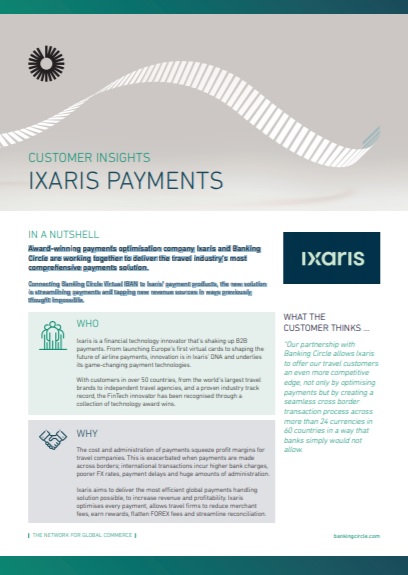
- Banking Circle / Ixaris Case Study
Award-winning payments optimisation company Ixaris and Banking Circle are working together to deliver the travel industry's most comprehensive payments solution.
Connecting Banking circle Virtual iBan to ixaris’ payment products, the new solution is streamlining payments and tapping new revenue sources in ways previously thought impossible.








