
Published
- 06:00 am

Award-winning cybersecurity company, BullGuard, today announced the availability of a free, three-month minimum BullGuard Small Office Security[1] license for small businesses that need assistance managing their cybersecurity in the wake of the disruption caused by the coronavirus pandemic and the subsequent sudden mass migration of millions of employees who are now working from home.
The free, three-month minimum license of BullGuard Small Office Security comes with no financial obligations whatsoever and small businesses don't need to submit any form of credit card payment information to obtain their three-month cybersecurity software license. The BullGuard Small Office Security platform supports up to 50 Windows, Mac and Android devices and provides robust endpoint cybersecurity protection for desktops, laptops, tablets and smartphones, making it perfect for remote workforces to work safely on their devices from home.
“Small businesses are in a very challenging position right now, making the sudden transition to working from home without the cybersecurity training, technologies or procedures that are commonplace within enterprise companies,” said Paul Lipman, CEO of BullGuard. “As a result, many small companies are vulnerable to being compromised by cybercriminals who are exploiting the coronavirus pandemic with predatory instinct.”
The free, three-month BullGuard Small Office Security product provides small businesses with the endpoint protection they need to ensure their remote employees and businesses are protected against cybercriminals. It provides powerful protection against the very latest threats, including the avalanche of coronavirus themed attacks that cybercriminals have unleashed, such as phishing emails and malware. These particular threats are unlikely to abate until the coronavirus runs its course.
BullGuard Small Office Security is a cloud-managed endpoint security service dedicated specifically to the needs of small businesses. Central to the platform is remote management from a cloud-based dashboard that makes it easy to manage all devices at the same time, which is particularly key with the surge in telework due to the current pandemic. For example, all teleworker devices (PCs, laptops, tablets and smartphones) are easily managed from the dashboard, enabling security updates to be applied simultaneously on all devices, and if a mobile device is lost or stolen it can be remotely locked down to protect sensitive data. An alert system also provides immediate notification about security events to allow instant remedial action, such as isolating a device infected with malware.
“Cybersecurity is the last thing many small businesses are thinking about as they grapple with all sorts of issues just to keep operating. They have more than enough to deal with and certainly don’t need to contend with cybercriminals and malware infections,” added Lipman. “We understand their cybersecurity needs in these unprecedented times and want to help them so they can concentrate on the essentials of day-to-day business.”
Businesses interested in obtaining a free, three-month license to BullGuard Small Office Security can find further information at www.bullguard.com/staysafe.
- 07:00 am

PXP Financial, the global expert in acquiring and payment processing services, has launched research into the payment habits of different generations of players in the online gaming and betting space.
This research looks at topical payment issues to provide the sector with a deeper understanding of its target market, revealing various key perceptions from customers of the online gaming and betting industry. When securing the sentiments of each generation on their payment habits, PXP Financial found that Millennials (1981 – 1995) are the biggest spenders and prefer to use debit payments. In contrast, Generation X (1965 – 1980) prefers to play with credit instead.
January’s announcement of a credit card ban across the industry produced interesting results. Unsurprisingly, Generation X had an incredibly negative response. However, perhaps more surprisingly, each of the generations had a majority negative view on the regulation, leading to over 50% of the respondents citing it to be harmful to the sector.
“At PXP Financial we work hard to ensure we understand trends within various markets and how they will affect our clients,” commented Koen Vanpraet, CEO of PXP Financial. “It is our hope that the insights provided within this sentiment research will provide the industry with a greater understanding of its target groups and help our clients with their market strategies.”
This sentiment survey was developed following PXP Financial’s 2019 Are Payments the Key to Maximising Gen Z Appeal for the High Street research, which looked at the retail spending habits of Generation Z (1996 – 2012). Interestingly, the survey found that the majority of respondents preferred shopping instore to online and preferred to spend using digital currencies instead of cash. It aimed to provide another look into this generation and the spending habits of other generations in the retail sector.
With regards to Generation Z, they have yet to have a significant impact on the online payments industry, primarily due to their age and financial capability. However, this is set to change as the group matures.
And as for the perception of retail, Millennial’s were found to lean more positively towards physical shopping, although it was nearly an even split. Generation X, on the other hand, vastly preferred the convenience of shopping online.
The research for this survey was conducted at ICE London 2020, Europe’s biggest Online Gaming expo. For more information, or to download PXP Financial’s whitepaper, A Conversation About Payments: Differences in Generational Betting, visit: https://info.pxpfinancial.com/differences-in-generational-betting

Danny Scott
CEO at CoinCorner
“By now, a lot of people have heard of Bitcoin. It’s been running consistently for just over 11 years and has enjoyed it’s fair share of positive and negative media attention. see more
- 07:00 am

Wirecard, the global innovation leader for digital financial technology, today announced a new strategic partnership with renowned Hungarian e-commerce agency UNAS to offer Wirecard’s payment solutions to its almost 5000 merchants. Through the agreement, Wirecard will be integrated as payment service provider (PSP) for UNAS. As a result, merchants can leverage on Wirecard’s payment solutions for their online shop.
Based in Sopron, Hungary, UNAS empowers all kinds of merchants, ranging from cars to furniture, in the region to move their businesses online through its powerful e-commerce site development tools. Through a unique subscription model, businesses get a multitude of professional, built-in features and integrations without the capital expenditure. These include all the necessary functions for the operation of a successful e-commerce site in 2020: persuasive marketing options, shopping incentives, social media tie-ins and a wealth of different payment options.
Today, an e-commerce site’s success depends on ensuring that customers can use their preferred means of payment and that their checkout experience is seamless. When a merchant chooses Wirecard as their PSP, they benefit from: acceptance of all major payment methods, an easy integration, integrated fraud protection, and additional banking services.
“We open up a whole new world to legacy businesses struggling to survive through traditional retail methods alone. With our solutions, merchants of any size and industry can launch their online shop and become operational in minutes,” explained Gáll T. Barna, Business Development Manager at UNAS. “Key to these merchants being able to compete on a global footing, is the ability to ensure a smooth and frictionless payment experience for all. Wirecard provides the most comprehensive payment technology on the market so was an obvious choice as a PSP integration partner.”
UNAS is a true visionary. It was the first to introduce the concept of an e-commerce site as a service to the Hungarian market and now hosts one-in-five of all Hungarian online stores. Since inception, 27 million customers have bought from the e-commerce sites it hosts.
“Having Wirecard as a payment service provider adds real intrinsic value for the merchants UNAS work with. Through this agreement, they can implement the payment options demanded by their customers. Whether they are big global enterprises, or traditional family-run micro-businesses, they get the most advanced payment system at their fingertips,” added Roland Toch, Managing Director Central Eastern Europe at Wirecard.
- 07:00 am

As the world adapts to the COVID-19 pandemic, organisations of all sizes are struggling to manage increased demand while working to keep employees safe. To help navigate these challenges, Genesys® (www.Genesys.com), the global leader in cloud customer experience and contact centre solutions, has launched a new Rapid Response offer to give any organisation free access to Genesys Cloud so they can provide mission-critical support and enable remote teams fast, with deployment in just 48 hours.
In response to COVID-19, more than 700 organisations from all over the world, including Arise-Europe, City of Helsinki, eFinancial, FMI Call Centre, Gleaners Food Bank, Home Credit, JPIMedia, Ly.com, Lenovo, Ping-An Insurance and Tokyo Individualised Educational Institute, Inc., have requested assistance from Genesys to support remote capabilities, shift their geographic operations or manage unexpected surges in customer inquiries. In fact, the Genesys Rapid Response offer has already allowed more than 500,000 contact centre employees to continue serving consumers from the safety of their homes since February. Examples include:
A major financial services company transitioned nearly 10,000 in-office contact centre agents to remote work within days. The company plans to enable another 5,000 to work from home. In addition, the company doubled its record for customer transactions, jumping to 3 million during this period.
A Fortune 50 software company shut down its contact centres in a COVID-19 outbreak area and shifted all calls to other countries. The company updated its IVR and rebalanced its routing to accommodate this change while transitioning thousands of agents around the world to virtual work within days.
A large state government entity was able to convert 3,000 agents to remote work in a single day. It also onboarded 400 new agents in just three days.
Genesys Rapid Response
The company's Rapid Response offer allows organisations to launch a secure cloud contact centre with the fundamental capabilities needed to engage effectively with customers and colleagues from anywhere. This includes support for automation and self-service, voice and email routing, interaction recording and employee collaboration tools. To make the transition easier for employees and supervisors, on-demand training and education is also included. In addition, Genesys is assisting organisations in controlling costs by waiving overage premiums resulting from unexpected spikes in customer inquiries.
"At Genesys, we have a responsibility to help however we can during this difficult time," said Tony Bates, chief executive officer of Genesys. "No matter what challenges organisations face, Genesys is committed to partnering with them to protect their employees, serve consumers and help contain the COVID-19 outbreak. Every action we take to stop the spread matters, but we can't do it alone. Across every function and with support from our partners, the Genesys community is coming together to help organisations through this unprecedented situation."
Broader support for COVID-19 response
The Genesys ecosystem is instrumental in this effort with many providing services and guidance to facilitate business continuity during the COVID-19 crisis. The company is also exploring solutions with Google Cloud and others, as well as implementation partners, including Avtex, ConvergeOne and NTT, Ltd., which are critical in helping expedite deployments of Genesys Cloud. In addition, several Genesys AppFoundry® partners are also extending their free trial period to align with Genesys Rapid Response.
"Genesys is doing more than giving away technology," said Ken Landoline, principal analyst, Customer Engagement, Omdia. "The company is delivering a holistic solution and providing access to a community that delivers services, support, training, guidance and best practices so organisations are truly equipped to help employees and customers through this difficult time. I believe this is right on target and is the best course of action given the complexity of what businesses are up against."
Customer comments on Genesys Rapid Response:
The City of Helsinki partnered with the local Evangelical Lutheran parishes, and many charities, to contact proactively more than 80,000 elderly residents to ensure their well-being amid the COVID-19 crisis. Genesys Cloud serves as the technology foundation for this service and enables 500 volunteers to support these citizens. "The cooperation with Genesys to launch the Helsinki Helpline has already been amazing. In just a couple of days, we launched a fully functioning contact centre and trained our team, including citizen volunteers with many different backgrounds," commented Tiina Hörkkö, director of the Helsinki Helpline, City of Helsinki.
eFinancial, the second largest direct-to-consumer life insurance brokerage in the nation, deployed Genesys Cloud for use by its eSales department three weeks earlier than planned due to COVID-19. "Employees from all three of our call centres are working remotely now and we are maintaining production levels," said Paul Bourdeux, vice president of Information Technology for eFinancial. "Without Genesys Cloud this could have been disastrous. The added investment for the solution has already paid off."
Since mid-March, Gleaners Food Bank has tripled the number of households it is feeding per day. Part of the spike was from individuals requesting food delivery services, which the organisation did not provide previously. Gleaners Food Bank President and Chief Executive Officer John Elliott commented, "Within seven days, we went from not being able to handle the surge of calls to being able to manage them effectively via Genesys Cloud. We now have an automated qualification process so we can identify eligible households and deliver food to those in need."
JPIMedia is one of the largest national, regional and local multimedia organisations in the UK. "We successfully transitioned 450 users to a temporary remote working model within 5 days following government advice. This allows our commercial teams to stay connected with our customers," said Rebekah Avill, head of Commercial Systems at JPIMedia.
Ly.com, China's leading high-tech travel provider of transportation and hotel reservations serving more than 300 million people, has leveraged support from Genesys to ensure its customer service operations during the COVID-19 outbreak holiday period. Yuchi Xiao, CEO of Customers Service Centre of Ly.com, said, "With the help of Genesys, thousands of remote agent services were successfully deployed in only two days. As always, the Genesys China team was standing together with us to overcome challenges and deliver excellent customer experience."
Learn more about Genesys Rapid Response, which is available for any organisation, including existing Genesys customers as well as other businesses, government agencies and non-profits. Local restrictions may apply, and organisations must sign up by April 30, 2020.
- 01:00 am

Billhop (billhop.com/ie) has launched a collaboration with Visa in Ireland to enable businesses to pay their suppliers using card, regardless of whether the supplier accepts card payments. As part of the collaboration, Visa cardholders have a preferential rate of 1,99%* with Billhop, considerably lower than the headline rate of 2,95%.
Billhop, which has already launched in Sweden and the UK, is a payment service enabling businesses to pay invoices with cards regardless if the end beneficiary accepts card payments or not. No onboarding of the end beneficiary is required allowing Billhop to enable 100% of supplier payments on card instantaneously. In practical terms, this means that Irish businesses from now on are able to pay virtually all invoices using their existing credit card.
On the back of card payments made by small and large businesses, Billhop has experienced a significant pace of growth in Europe generally. In the United Kingdom particularly, Billhop has been well received by companies of all sizes and sectors. Small companies benefit from the grace period on their existing credit cards. Similarly, larger corporations use bespoke credit cards as a working capital financing solution when paying larger ticket suppliers through Billhop.
Sebastian Andreescu, CEO of Billhop, said: “Our ambition has always been to find the best possible solution for businesses to address their need for supply chain financing. Together with Visa we have been able to compose a very attractive offering which will benefit all Irish businesses whether they are an SME or a multinational Large Cap.”
Philip Konopik, Country Manager, Ireland, Visa, said: “More and more small businesses are turning to card as their payment method of choice for convenience and simplicity but also for easier tracking. This collaboration provides small businesses with all of these benefits, as well as a practical cashflow management tool.“
- 01:00 am

The Emerging Payments Association (EPA), which encourages collaboration and innovation within new and existing finance companies, today announces the outcomes of its first COVID-19 consultation.
The detailed assessment, ‘Weathering the Storm: The impact of COVID-19 and what the payments industry, government and regulators should do about it’, emphasises the seismic change that COVID-19 will have on how we use payments to live, work and shop and the effect this will have on the shape and size of the payments industry.
The EPA, which represents 130 member companies that are responsible for transacting more than £6 trillion annually across the payments value chain, completed the report along with some of the most prominent leaders in the sector. It was developed in consultation with the EPA’s Advisory and Ambassador Boards, underlining a five-point plan which is designed to aid recovery, foster resilience and promote leadership during these challenging times. These include:
- Protecting the vulnerable
- Planning for an interruption in growth
- Taking a customer-first approach
- Regulators playing a loose-tight role
- Leading from the front
Protecting the vulnerable - Some groups in society are finding it challenging to pay and get paid. Currently, there are 13 million people in the UK who are financially excluded and in vulnerable groups, especially the elderly who are further impacted by the pandemic. Those people who are self-isolating and relying on others to shop or the millions of who are digitally excluded must be catered for in new and creative ways and payments companies must adapt their policies and services to mitigate this.
Planning for an interruption in growth - It is also important to plan for an interruption in growth. The stability of the payments industry is not challenged but growth and profitability will be, especially over the next two years. Analysts are forecasting activity could drop by as much as 8% to 10% of total revenues. This means the industry needs to plan to keep thriving and to not pull up the drawbridge to investment, visibility and innovation initiatives to mitigate a slower recovery after the pandemic.
Taking a customer-first approach - Additionally, a customer-first approach must be at the forefront. The payments industry is already adapting to changes in how it manages its customers, finances and operations, but it will take a long time to recover and will require creativity and understanding.
Regulators playing a loose-tight role - The report also sheds light on the role that the regulators must play. The regulators could adopt a loose-tight strategy by showing flexibility in some areas and increased vigilance in others. For example, industry consultations should be postponed, but conforming to capital adequacy ratios or deadlines for SCA compliance should be adhered to vigilantly.
Leading from the front - Finally, it stresses the importance of leading from the front. It has uncovered inspiring illustrations of the industry stepping up to the challenge and leading by example in support of COVID-19 in creative and inspiring ways. Never at any other time in our history has leading by example for business, society and the economy been so important as now.
Commenting on the launch of the report, Neira Jones CEO, Phoenix Edge Ltd & EPA Ambassador, said: “It was a great privilege to have the opportunity to work on this project and the Emerging Payments Association is to be commended for doing it so fast: not just an insightful paper for those who want to understand the impact of the crisis on our industry, but real help, actions and commitments, where it matters!”
Tony Craddock, Director General of the Emerging Payments Association, added: “It’s not going to be plain sailing. We have to weather this storm as an industry. This paper identifies how we can do so, and then what needs to happen to ensure people can continue to pay and get paid, as we move into the recovery phase.”
Andrea Dunlop, Chair of the EPA Advisory Board, said: “In these unprecedented times, it does humble me to see the payments community come together in this way. Payments is an essential service and it's important that we as a community ensure resilience during this challenging period. I hope that this paper helps to highlight the impacts that the crisis has on the industry and some areas where we as an industry can do more to make a difference.”
She added: “It's important during this time that we embrace community and do our very best to help the most vulnerable in our society. Good leadership and social responsibility will go a long way with employees and customers. I believe that companies that go out of their way to help employees and their customers will come out stronger after this. Social Capital is the most needed currency now.”
For more information about and to download the new report, please visit: www.emergingpayments.org/article/weathering-the-storm-with-the-epa-and-what-to-do-now/or you can speak directly to the EPA at: info@emergingpayments.org
- 07:00 am
Wolters Kluwer’s Finance, Risk & Reporting (FRR) business and Vizor Software, today announced a partnership for the Singapore market that will increase the quality of regulatory reporting while reducing the time and effort required in regulatory compliance. Using the Vizor Reporting API, Wolters Kluwer’s OneSumX for Regulatory Reporting will now automatically consume published machine-readable regulatory rules and data models directly from Singapore’s regulatory system.
OneSumX for Regulatory Reporting will automatically integrate these specifications into its Financial Institution (FI) template solutions. This seamless alignment between the regulator and financial institution systems will facilitate an on-time and high-quality submission of regulatory reports, while also reducing the cost and effort associated with new or changing reporting requirements.
OneSumX for Regulatory Reporting combines bank data into a single source of data to ensure consistency, ease of reconciliation and accuracy. It includes access to Wolters Kluwer’s unique Regulatory Update Service which is maintained by Wolters Kluwer experts who actively monitor regulation in 30 countries. In July 2019 Wolters Kluwer announced the launch of its software-as-a-service (SaaS) Regulatory Reporting solution, marking the first time that the company’s OneSumX regulatory software has been made available on the cloud.
“While much has been written about the need to reduce the burden of regulatory reporting, the global standardization required for full, cross-border automation does not yet exist. We recognize that regulators require a wide variety and increasingly granular level of jurisdiction-specific data to deal with emerging risks. Regulators using our platform are able to dynamically define data requests and rules in an open, standardized format,” said Conor Crowley, CEO of Vizor Software. “However, this increased volume of data requests from the regulator poses problems when FI systems also require changes to respond. APIs provide machine-to-machine communication so that both FIs and the regulator can layer automation onto their existing processes and technology investments.”
This level of integration allows global and domestic FIs in Singapore to accommodate local requests in a timely and cost-efficient manner. By leveraging the same software as the Singapore regulator through the Vizor Software platform, the preparation and validation of regulatory data becomes more of a machine-to-machine task and both financial institutions and regulators can instead focus on data analysis and risk management.
“This partnership will redefine the regulatory compliance landscape in Singapore. Wolters Kluwer is the global market leader in producing regulatory reports for financial institutions, while Vizor is the global market leader in collecting and processing these regulatory reports on behalf of regulators. Together, the two companies are able to provide an integrated solution out-of-the-box which brings end-to-end regulatory compliance within the financial industry to the next level,” commented Claudio Salinardi, Executive Vice President and General Manager of Wolters Kluwer FRR. “Beyond the immediate benefits for financial institutions such as superior time-to-market, this also opens the door to many new value-added services down the road, all directly integrated with regulators. Notably, this partnership will provide a solution in time to help our clients meet the revised MAS610 requirements recently introduced by the Monetary Authority of Singapore.”
Vizor Software helps regulators to make clear data models and rules publicly available in both machine and human-readable format to all reporting FIs and vendors. The partnership with Wolters Kluwer and the full integration in the OneSumX platform allows customers to collect, validate and refine data in synchronization with the financial services community.
Wolters Kluwer FRR, which is part of the company’s Governance, Risk & Compliance division, is a global market leader in the provision of integrated regulatory compliance and reporting solutions. Wolters Kluwer FRR receives frequent independent recognition of its excellence and innovation, celebrating a record year for award wins in 2019. Risk magazine has awarded the company its coveted Regulatory Reporting System of The Year Award for the second year running. It is also the #1 provider in both Regulatory Reporting and Liquidity Risk according to the RiskTech100, as compiled by Chartis Research.

Bernard Foot
Strategy Analyst at MYHSM
Recently, I looked at the question of whether using cash presented more of a COVID-19 health risk than using contactless. see more
- 02:00 am
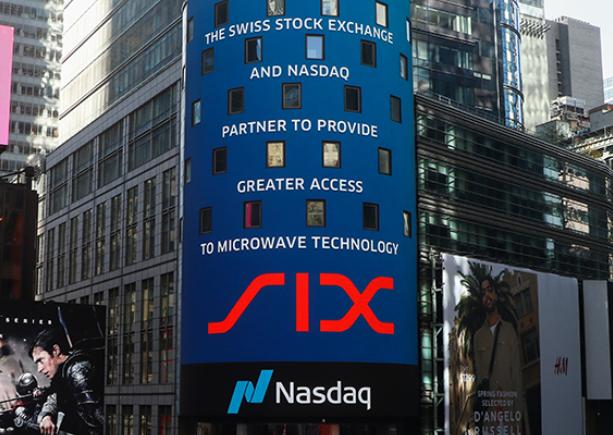
The Swiss Stock Exchange and the operator of Nasdaq´s Nordic exchanges have signed a partnership in the first quarter of 2020 to expand the current European microwave network, fostering equal access to the most modern market data transmission technology for the benefit of all market participants.
The Swiss Stock Exchange has announced that it is to establish a jointly owned company with Nasdaq. The new company RF Nordic Express AB will build and operate microwave routes for the transmission of market data from Stockholm to London. Having taken a majority stake in 12H AG – the operator of its microwave network – earlier this year, SIX now owns and operates the largest microwave network in Europe. This network allows all Swiss Stock Exchange trading participants to benefit from low-latency market data transmission from Zurich to London, Frankfurt and Milan as well as from Milan to Frankfurt and London. The parties have agreed not to disclose the amount of the investments.
Thomas Zeeb, Head Securities & Exchanges and Member of the Executive Board, SIX, comments: “The new joint-venture marks the extension of this long-standing and successful partnership and is a testament to the innovative nature of the Swiss Stock Exchange. It leverages the benefits of microwave technology across Europe to ensure fair and more efficient trading and highlights how the Swiss Stock Exchange deploys breakthrough technology for all market participants.”
Henrik Husman, Vice President European Equities at Nasdaq, comments: “Technology and innovation are driving forces behind making markets more efficient and we are happy to partner with SIX in bringing faster and more secure transactions to our customers.”
Reinier Fliehe Boeschoten, Member of the Board of 12H AG, comments: “With this new investment by SIX in 12H AG we will be able to continue upgrading our current services and keep providing innovative new products to our customers. 12H AG is proud to be a part of SIX and is looking forward to working together with Nasdaq in creating a service between London and Stockholm.”
Microwave technology enables the fastest transmission of market data between trading centers. Signals are travelling at the speed of light and relayed through the air in the most direct way possible. This enables Swiss Stock Exchange trading participants to identify price movements and implement investment decisions as quickly as possible. As a result, risks can be managed more efficiently which benefits participants and end investors alike. It also improves liquidity and tightens spreads, which results in better execution for everybody trading Swiss securities on the Swiss Stock Exchange.
Equal access to the microwave network is ensured for all trading participants at both regulatory and technical levels, in line with Switzerland's legal framework. The Swiss Stock Exchange not only ensures the stability and availability of its trading infrastructure, but makes the most modern technology accessible to all its participants by partnering with leading technology providers.
Nasdaq and the Swiss Stock Exchange have been technology partners since 2005 and leverage Nasdaq’s trading technology for all markets, including equities, ETFs, structured products, funds and fixed income, as well as Nasdaq Market Surveillance and Nasdaq Pre-Trade Risk Management.
The Swiss Stock Exchange continues to leverage the most advanced technology within its unique market structure to create the best possible trading conditions in Swiss securities and to strengthen its position as the reference market. As a key pillar of the Swiss financial sector's infrastructure, it has a long tradition of moving the industry forward and has repeatedly taken a pioneering role in the development of electronic trading. In December 1995, it became the world’s first stock exchange to switch from floor trading to electronic trading with fully integrated transaction processing and settlement. This created the unique end-to-end Swiss Value Chain which SIX currently aims to replicate in the digital space by building the SIX Digital Exchange (“SDX”) ecosystem.
Nasdaq (Nasdaq: NDAQ) is a global technology company serving the capital markets and other industries. Its diverse offering of data, analytics, software and services enables clients to optimize and execute their business vision with confidence. www.nasdaq.com
12H AG is the largest low latency microwave provider in Europe and majority owned by SIX. 12H AG owns low latency routes between London, Frankfurt, Zurich and Milan. 12H AG is committed to provide low latency services to all customers of SIX on an equal treatment basis.








