Published
- 02:00 am

Quantexa – the contextual decision intelligence software company that empowers organisations to make better decisions – has today announced that it has closed a Series C round, raising a further $64.7 million (£51.2m) in funding.
The round was led by Evolution Equity Partners, with major participation from pre-existing backers Dawn Capital, AlbionVC and HSBC. New investors British Patient Capital and ABN AMRO Ventures also joined previous investor Accenture Ventures in this round. Richard Seewald, Founding and Managing Partner at Evolution Equity Partners will join Quantexa’s board of directors as part of the deal.
Already with thousands of users in more than 70 countries, the funding will help drive Quantexa’s category-leading Contextual Decision Intelligence (CDI) technology market expansion into new industries such as public sector, while developing more platform applications across financial services and broader cross-sector capabilities. The funding will also accelerate Quantexa’s continued growth across North America, Europe, and Asia-Pacific regions, and continue to rapidly grow its global partner ecosystem.
This new round of funding follows a $22.7 million Series B round secured in August 2018, bringing total funds raised to date to $90 million. Since its inception in 2016, Quantexa has built a globally renowned client and partner base, supporting thousands of users within tier one organisations worldwide, including HSBC, Standard Chartered Bank and Accenture.
CDI is an industry-leading, innovative approach to data that gives organisations the ability to join multiple internal and external data sets, providing a single view of data enriched with intelligence about the relationships between people, places and organisations. Through its pioneering platform, Quantexa helps organisations to maximise the value of data and transform decision making across the customer lifecycle, improving efficiency and maximising infrastructure investments.
Vishal Marria, CEO at Quantexa, commented: “We are thrilled that Evolution Equity Partners and British Patient Capital will be joining our team, alongside the strategic investment from ABN AMRO Ventures. Together with the continued trust and commitment from our existing investors, we will drive the next phase of Quantexa’s growth. We are seeing a huge demand for our platform to support multiple applications across our core markets in financial services and within new industry sectors. This investment will accelerate our product innovation roadmap and enable us to invest further into Europe, North America and Asia Pacific regions, as well as expand into new locations.”
Richard Seewald added: “Quantexa’s proprietary platform heralds a new generation of decision intelligence technology that uses a single contextual view of customers to profoundly improve operational decision making and overcome big data challenges. Its impressive rapid growth, renowned client base and potential to build further value across so many sectors make Quantexa a fantastic partner whose team I look forward to working with.”
- 09:00 am
As consumers increasingly leverage digital channels for their banking needs, Finzly, a modern fintech provider of banking applications for foreign exchange, trade finance, payments and digital banking, announced the availability of its contactless consumer digital account opening solutions that empower community financial institutions to deliver convenient, modern banking experiences to account holders while eliminating manual processing and driving operational savings.
With consumers increasingly opting for contactless environments and desiring the ability to conduct the financial lifecycle entirely through digital channels, Finzly is fully automating the account opening process so financial institutions can offer a more seamless experience to customers. Not only does this help reduce abandonment rates among new account applications, but it also it provides financial institutions with greater flexibility and faster integration using core agnostic open APIs to ensure they always have the best, most up-to-date offerings in place to combat the latest fraud threats.
Key benefits of Finzly’s consumer digital account opening solutions include:
Automation flexibility: FIs can customize the level of back-office automation involved, choosing when to automate and when to engage directly with new customers;
Quick and easy implementation: Leveraging the value of existing core technology investments to supports faster integrations;
AI-powered KYC: Reduce fraud using AI-enabled customer ID verification and “selfie” validation, easily paired with out-of-wallet questions, when warranted;
Real-time verified deposits: Immediate funding of new accounts using real-time verification of bank account;
Regulatory compliance: Ensure regulatory compliance with built-in support for KYC, CIP, BSA and OFAC requirements;
Better back-office controls: FIs can easily monitor and manage the status of new applications with improved visibility and audit trail capabilities; and
Ongoing service: Automated next steps ensure the new account is actively used (e.g., card activation, online banking enrollment, direct deposit initiation).
Research shows that 69% of consumers desire the ability to conduct the financial lifecycle, including account opening, entirely through digital channels, yet many financial institutions still require branch visits to facilitate account opening. Finzly’s digital account opening solutions overcome this disconnect by simplifying the process to offer more flexibility, easy implementation and full automation capabilities, without compromising security or compliance.
“While digital transformation may have been more of an aspirational goal before, it is now an imperative for community financial institutions as they work to cultivate and grow new consumer relationships in the current economy,” said Terry Howell, CTO, Finzly. “To be competitive in a more dynamic marketplace, banks and credit unions must strategically address this need by implementing flexible, automated tools to deliver a more modern banking experience via the digital channels that many consumers prefer.”

Graham Brooks
Strategic Account Director at Cradlepoint
This year, the financial sector’s plans have been thrown off course by a global pandemic that sent a wave of disruption rippling through the business world. see more
- 09:00 am

Bottomline’s virtual media roundtable, hosted by the company’s Ed Adshead-Grant last month, gave three financial experts the chance to discuss the findings of the Bottomline Business Payments Barometer 2020 and their implications across the UK payments landscape.
**********************************************
Box panel
Gavin Maclean, Head of Cash Management and Payment Product, Lloyds Banking Group:
“Making payments fast, transparent, seamless and as free from error as they can be is what we are trying to do. Frankly, consumers wouldn’t accept anything else.”
Dan Bellis, Senior Policy Adviser, the Federation of Small Businesses (FSB):
“There is a plethora of reasons why late payments occur and it is something that we have to get out of to help businesses survive. If we are able to do this it will mean there are more small businesses out there, more jobs for the UK Plc.”
Naresh Aggarwal, Associate Director, the Association of Corporate Treasurers (ACT):
“Payments really are moving away from being a utility function - there is a richness to that interaction with customers, whether it’s B2B or B2C, which can provide a real advantage.”
**********************************************
It was hard to avoid the single subject that has dominated every media channel since early in 2020. COVID-19 was always lurking in the background, providing a context that emphasised the critical importance of what was under discussion: radical changes to the trading environment of just about every UK business; the ongoing challenges involved in combating fraud; and the very real threat posed to countless smaller businesses by the continuing scourge of late payment.
Gavin Maclean from Lloyd’s Bank summed it up: “We now all face unavoidable changes on a scale that I certainly have not seen in my career and I guess many of us have not seen in our lifetime.”
But perhaps these changes were already on their way before the pandemic, driven by regulation, technology and more empowered consumers? When it came to addressing radical change in the trading environment, Maclean for one suspected that COVID-19 is merely speeding up a process that was already both inevitable and necessary. “Businesses right now urgently need to review their processes and the methods used for accepting and making payments,” he said. “I think we are starting to see, through some of the data, that COVID is causing an acceleration of some of the trends that we’ve been used to over the last few years.”
He expects a lasting legacy from this period as businesses urgently address how they are going to run processes and keep cash flowing in a socially distanced world.
As he said, “There is cause for optimism here in the UK. I think we have a great track record of cross-industry collaboration to deliver things that can make a positive difference for businesses. And I think that as we come out of the crisis, we’re all going to be grateful for some of the great payment systems we’ve got and some of the innovations we’ve seen over the last few years.”
Facing up to fraud
The FSB’s Dan Bellis believed that the changes Maclean referred to had a role to play in combatting the fraud statistics highlighted in the Payment Barometer, which showed that 88% of small businesses currently recover less than 50% of the amount they lose to fraud each year. “If we begin to get payment structures correct and in place, and get small businesses actually using them, then we can begin to mitigate the amount that is lost to fraud each year,” he said. It all comes down, he believes, to relationships with the right partners, including banks, payroll providers and other specialists. “That is incredibly helpful for small businesses who are looking to recover that loss.”
But when the conversation turned to the contentious issue of late payment, Bellis was far less positive, saying it can be “devastating” for small businesses. “I was speaking to a small business who sent their invoice in early January. It is now [in March] overdue, and when they chased it they were told they will not be getting paid until the pandemic has subsided.” They were even called “delusional” for expecting to be paid.
A call for transparency
Bellis believes that part of the problem is that the current culture is overly based on self-certification. “We would like to see these payment statistics put in annual reports, so that they go through independent auditors to show what a company’s payment performance is really like. We are looking to big businesses to lead the way on this.”
The ACT’s Naresh Aggarwal, however, thinks that in many larger organisations, late payment can be due to poor operating processes, when “somebody somewhere in the process sits on an invoice for 30 days, 40 days before they actually realise it needs paying.
“A lot of it, I think, comes down to transparency – and I think there is a lot more we can do. We need to shine a light around processes internally, and also to create more transparent relationships with the supply chain. Hopefully COVID-19 can be an accelerator for this.”
Aggarwal also believes we are on the verge of a new era, where people can start to make the shift towards faster payments: “I think there are some really exciting areas where payments are delivering an opportunity for change. It allows things like the gig economy to be supported more effectively, getting cash moving into smaller businesses much more quickly. I think businesses need to understand a lot more about what works for them.”
The final word belongs to Lloyds’ Maclean, who believes no one should lose sight of the positive role regulation can play in driving innovation. “Regulatory-driven collaboration has given us some frankly brilliant systems. Faster payments is great for us as consumers and businesses. Open banking, confirmation of payee – these are real innovations from the UK payments market.
“I think we have got to look at regulations as an opportunity to innovate and improve what we have. We have got to help businesses pick out the advantageous parts and the commercial edge they can obtain by adopting these new services.”
- 05:00 am

Maitland, the leading global advisory and fund administrator, has announced it is enhancing its AML regulatory compliance capabilities to meet rising demand among Luxembourg fund managers.
Driving the need for outsourced compliance services in Luxembourg is the latest anti-money laundering (AML) guidance from the Commission de Surveillance du Secteur Financier (CSSF).
The legislation, issued in November 2019, requires all regulated funds in the jurisdiction to appoint two persons responsible: one for compliance at board or management level (the “RR”) and one for control at the corresponding level (the “RC”).
Catalysed by COVID-19, the recent trend towards remote working business environments has placed a renewed focus on security and AML risk assessment process, leading many Luxembourg regulated funds to outsource the RC role to third parties.
Maitland’s comprehensive service will provide regulated Investment Funds in Luxembourg with the ability to be fully compliant with the RC role requirement and support the boards with sound governance.
Founded in Luxembourg over 40 years ago, Maitland’s experience within the funds industry combined with its in-depth AML expertise and knowledge of the Luxembourg regulatory landscape continues to attract new clients to its comprehensive solutions.
Kavitha Ramachandran, Head of Business Development & Client Management – Continental Europe, comments: ‘There’s no doubt that the latest CSSF AML guidance will help to reinforce Luxembourg’s prominent position as a leading hub for funds and alternative investments in Europe. We expect to see new players enter the market as structures around the new regulation take shape and we are fully prepared to help them navigate this environment.’
Dave Kubilus, Managing Director – ManCo Services, adds: ‘From enhanced risk assessment technology to new legislation from governing bodies, the regulatory landscape in Luxembourg is constantly changing. It’s vital that we evolve with it and adapt our services to meet the needs of our existing and future clients.’
- 07:00 am

Eventus Systems, Inc., a multi-award winning global trade surveillance and risk management software platform provider, today announced the appointment of Joseph Schifano as Global Head of Regulatory Affairs, Mikhail Gasiorowski as Sales Director, North America, and Diane Imas as Director of Marketing. Schifano is an attorney with more than 20 years of experience in market surveillance matters, most recently as Deputy General Counsel and Global Chief Compliance Officer (CCO) of Tower Research Capital in New York, along with senior regulatory roles at two global banks and the New York Stock Exchange (NYSE).
Schifano, Gasiorowski and Imas are all based in New York and report respectively to Eventus President Jeff Bell, Global Head of Sales Scott Schroeder and Chief Strategy Officer Eric Einfalt. The three new roles are the latest in a series of strategic hires this year as part of the firm’s aggressive growth strategy facilitated by a successful investment round that closed in February.
Eventus CEO Travis Schwab said: “Joe brings outstanding experience to this important new regulatory affairs role, with expertise across the legal, compliance, supervisory, risk management and technology landscapes. Mikhail already has a strong track record running North American Sales in the trade surveillance space, and Diane is another great addition to the firm with her hands-on integrated marketing experience in the fintech and financial services sector. We’ve been very fortunate at a time when many companies are contracting to add significant depth to our talented team.”
Schifano said: “I met Travis and Jeff when Eventus was just starting out and have been impressed with the Validus platform from those early days. I look forward to partnering with our key client stakeholders – as a former CCO who understands their perspective – to continually assess and improve their experience, generate ideas for new functionality and products based on marketplace intelligence, and ensure we stay ahead of global regulatory developments that impact clients’ businesses.”
At Tower, Schifano led the global compliance team covering proprietary trading activity in electronic markets worldwide. Prior to his appointment as Global CCO, Schifano served as Head of Americas Compliance. He joined Tower as Counsel in 2014. Previously, he was Vice President, U.S. Markets in the Legal Department at the NYSE, responsible for advising the exchange’s affiliates on rule interpretations, regulatory exams and regulatory reporting. Prior to joining NYSE in 2013, Schifano served as Director, Equities Supervision – Americas at Barclays Capital Inc. in New York. He spent more than 10 years at UBS Securities LLC in a number of roles including Regulatory Attorney, Head of Customer Service and Regulatory Affairs Officer. Schifano received a Bachelor of Science degree in Applied Social Sciences and Business from Binghamton University in Vestal, New York, and a Juris Doctor from New York Law School.
For more than two years beginning in early 2018, Gasiorowski was Director of Sales, North America for b-next Americas, Inc., a provider of software solutions for capital markets trading surveillance and compliance. For six years prior, he served in the same role at Business Connect China, Inc., an independent research provider focused on China and the emerging markets. From 2008 to 2011, Gasiorowski was in sales at UBS Investment Bank, in roles related to exchange-traded derivatives and prime services clearing. Gasiorowski received a Bachelor of Arts Degree in economics from the University of Pennsylvania.
Imas has a decade of communications experience in New York in roles spanning marketing, public relations (PR) and investor relations (IR). Prior to joining Eventus she was Associate Director of Brand, Advertising and Content for Prometheum, Inc., a blockchain securities platform. She previously served as Senior Director of Communication, Business Development for a global initial coin offering (ICO) company, as blockchain technology first entered the financial marketplace. From 2011 to 2018, she worked at several PR, marketing and IR firms including Cognito Media, Peppercomm and KCSA Strategic Communications. Imas began her career at The Week Magazine. She is the New York City community partner for the FinTech Connector, a professional membership network connecting fintech start-ups and entrepreneurs with global professionals, organizations and investors. Imas earned a Bachelor of Science degree in public relations from Boston University’s College of Communications and has a certificate in digital marketing from Columbia Business School.
- 01:00 am

Lloyds Banking Group (Lloyds) has today announced a strategic partnership with Form3, a cloud-native payments technology fintech, to accelerate its digital transformation and enhance the digital experience for customers.
Founded in 2016, Form3 is a leading payment technology fintech that focuses on simplifying payments architecture capabilities in a faster and more efficient manner, while providing support for the industry New Payments Architecture (NPA) initiative through its cloud-native Payments-as-a-Service for UK and European banks and fintechs.
The strategic partnership will enable Lloyds to investigate and develop a cloud-native Payments-as-a-Service platform which has the potential to significantly improve the Group’s payment processes, making them more efficient. The partnership with Form3 will aim to simplify Lloyds’ payments capabilities, aiming to create the basis for Lloyds’ response to the industry NPA initiative and provide support for enhanced data and new overlay services.
Supporting this partnership, Lloyds is also acquiring a minority equity stake in Form3 as part of its strategic investment round which is expected to complete in full next month.
Otto Benz, Director, Payments Technical Services at Lloyds Banking Group said, “Simplifying payments architecture while enhancing security and performance are critical to our digitisation of the Group. The potential of the cloud in payments is enormous and is firmly at the forefront of our strategy. We are committed to working with the most innovative technology providers, including Form3, to deliver a range of solutions that push the boundaries of what’s possible while reducing risk and providing customers with an improved digital experience.”
Michael Mueller, CEO at Form3 commented, “We believe this is an opportunity to support Lloyds’ transformation using our rapidly evolving technology. The partnership is breaking new ground in collaboration by enabling Lloyds to utilise best in class software built to harness the unique properties of the cloud.”
- 06:00 am

Mode, the new breed digital banking app, has extended its partnership with payments provider Modulr to launch its first feature powered by ‘Open Banking’, as part of a long term commitment to deliver a truly digital banking app. The feature allows users to connect their external bank accounts to the Mode app, enabling them to make quick and easy top ups within the app.
At its core, ‘Open Banking’ is a secure technology that enables financial institutions to communicate efficiently and openly, whilst allowing customers to grant access to the account information or payment initiation. The initiative is designed to bring more competition and innovation to the financial services landscape.
Mode’s new functionality leverages the power of ‘Open Banking’ to offer its UK customers a new solution allowing them to make seamless top-ups into their Mode Sterling account. Users can now securely connect their external bank accounts to the Mode app, allowing them to add Sterling in just a few taps.
Mode users will no longer need to remember their account details, or worry about mistyping them. All a user needs to do is:
● Select an external bank;
● Type in the top up amount;
● Safely approve the transaction!
Mode’s brand new ‘Open Banking’ top-up feature allows users to connect to most of the UK’s major banks including Santander, Barclays, Lloyds, NatWest, and RBS, with further additions expected in the coming weeks. The new feature represents the first move to demonstrate Mode’s commitment to ‘Open Banking’ and is the beginning of many other features to come.
Janis Legler, Chief Product Officer at Mode, said : “We see huge potential in ‘Open Banking’, and we’re delighted to showcase our early promise to what we believe to be the next generation of banking. We’re putting this feature at the very core of our customer journey, and it marks the first step of our mission to leverage the potential of ‘Open Banking’ technology and progressive regulation to provide further novel and innovative features. Thanks to our partnership with Modulr, this move will allow us to take another step forward in our journey to become the UK’s first truly digital banking App.”
Mode’s underlying payments infrastructure is powered by Modulr - a leading alternative to wholesale and commercial transaction banking. The new top-up functionality leverages the Faster Payments network - the same reliable, secure payments technology that powers bank transfers in the UK. This means that Mode users will typically receive their funds straight away, owing to the fast and seamless user experience that Mode aims to provide.
Myles Stephenson, CEO of Modulr said: “We are proud to have Mode as one of the first clients leveraging Payment Initiation to deliver a seamless and secure customer experience, which also benefits from faster settlement behind the scenes. Modulr is pleased to power the future of payments technology, enabling Mode to bring innovation to market.”
Do you want to discover our new banking features? Download Mode now: https://apps.apple.com/gb/app/mode-the-bitcoin-banking-app/id1483284435.
- 04:00 am

Symphony, the leading provider of secure collaboration for global markets, today announced the appointment of financial industry pioneer Brad Levy, as President and Chief Commercial Officer.
Levy’s appointment comes at a pivotal point in the Company’s momentum as customer demand for secure and compliant collaboration integrated with automated workflows continues to grow. Levy will lead Symphony's efforts within the global financial services space, focusing on expanding the company’s commercial offering on capital market workflows and solutions.
“Brad’s unmatched experience within financial services, coupled with his inclusive leadership style and network make for a perfect combination as we enter our next phase of growth at Symphony,” said David Gurlé, Symphony’s founder and CEO. “Brad’s expertise in capital markets will further solidify Symphony’s role as the complete solution provider and partner to our clients. I am thrilled to welcome Brad to the Symphony leadership team.”
Prior to Symphony, Levy was a partner at global analytics and information provider, IHS Markit, having also served as CEO of MarkitSERV and global head of its loan settlement and software services division. He was recently awarded the prestigious Markets Media Markets Choice Neil DeSena Market Advocate Award for his dedication to driving change as a global leader in financial services. In 2018, he was fourth on Institutional Investor’s Trading Technology 40.
Earlier in his career, he spent 18 years at Goldman Sachs, culminating in his role as managing director and global head of Goldman’s Principal Strategic Investments Group. Levy currently serves as Chairman Emeritus of FINOS, the Fintech Open Source Foundation, as well as a member of the Technology Advisory Committee of the CFTC, the U.S. Commodities and Futures Trading Commission, and chairman of its Distributed Ledger Subcommittee. He has served on numerous other boards within the financial sector and is an oft-requested advisor and speaker.
“The financial services industry has arrived at an inflection point, as technological developments and demand for expanded digital offerings call for true, industry-wide transformation,” said Levy. “From day one, I’ve admired how Symphony has evolved to meet the specific needs of its clients, and I look forward to working with David and the Symphony team to grow our community.”
At its 7th Innovate conference in April, Symphony shared record growth numbers in Q1 2020, with more than half a million licensed users, a 42% increase in daily active users and a 280% increase in messages sent. Symphony announced its commitment to delivering truly secure meetings to its users later this summer. The company also recently revealed Deutsche Bank has become one of the first companies to enable the Symphony Connect Solution for secure chat and collaboration with its clients via WhatsApp.
- 09:00 am

According to a survey conducted by the P2P lending platform Robo.cash, more than a third of P2P investors expect the industry to recover by the end of this year. Investors see regular payments and a decrease in the number of loan defaults as two main signs of the market's recovery.
37.7% of investors believe that the P2P lending market will regain its pre-crisis volumes by the end of 2020. 36% are of the opinion that this will happen only in the first half of next year, and just 10.9% of respondents think that the market will recover only by the end of 2021.
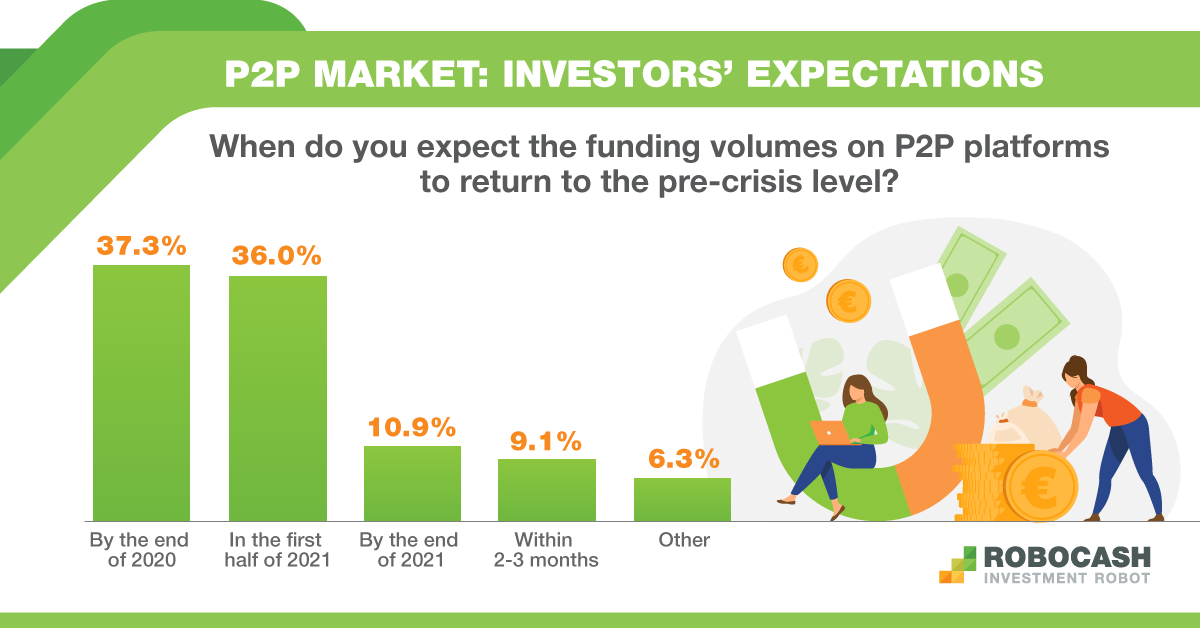
Curiously, 44.6% of German-speaking respondents tend to think that the market will recover only in the first half of 2021. Meanwhile, the majority of English-speaking participants (36.1%) expect that it will happen by the end of 2020.
According to 30.3% of investors, the main sign of the market recovery will be the restoration of regular payments to investors by the loan originators and P2P platforms, which have suffered liquidity issues. The outflow of investments from P2P platforms due to the massive withdrawal of funds by investors hesitating to reinvest was one of the factors. Still, the introduction of repayment holidays in some countries and the crisis which has left numerous borrowers unemployed and therefore, insolvent have become the most crucial for the lenders. Thus, 26.3% of the surveyed believe that a noticeable decrease in the number of default loans will be a sure sign of recovery.
Sergey Sedov, CEO of Robocash Group, comments on the data:
“Despite the crisis of the first months of the year, in summer, the market is resuming its growth just as we expected. In May, the market began to grow, and in June, the growth rate increased by another 19%. We can predict that the platform will come back to its pre-crisis level of funding within 2-3 months, and the recovery of the whole market may well happen by the end of 2020. This generally complies with our investors' expectations."