Published
- 08:00 am

Financial institutions would be well advised to adopt a flexible approach to their hedge accounting portfolio, especially in light of the COVID-19 pandemic. That’s according to a new white paper from Wolters Kluwer’s Finance, Risk & Regulatory Reporting (FRR) business.
Hedge accounting is a way to align risk exposure with true economic and financial exposure. Hedge accounting ensures that an income statement reflects steps taken to mitigate risk in a loan portfolio. It achieves this by adjusting accounting figures to neutralize the portion of the realized or potential profit or loss that a bank has protected with a hedge.
According to the white paper, the pandemic will certainly have a significant impact on hedge accounting. Companies frequently turn to cash-flow hedges to offset transactions that have highly predictable outcomes. The use of hedge accounting can also be affected when the contractual terms of an underlying financial instrument are changed. A bank might apply fair-value hedge accounting to term deposits with conditions that include significant penalties for early withdrawals, for instance. If the bank no longer applies these penalties during the pandemic, then the hedging relationship practically dissolves as the term deposit turns into a demand deposit and there is no longer a fair-value exposure to hedge.
Another effect of COVID-19 might occur if an increase in a borrower’s credit risk reduces the effectiveness of a hedge. If a hedged asset becomes impaired, then the hedging relationship will end if the hedge can no longer be deemed effective.
Hedge accounting requirements and best practices evolve in line with market trends and are often complemented by amendments to accounting standards. There is, for example, the way in which money market rates and spreads behave and the impact of the overall interbank offered rates (IBOR) reform for financial institutions to consider. Equally important are the economic consequences of the COVID-19 pandemic, currently being addressed by government relief measures, which can impact the behavior of financial institutions and their counterparties. This, in turn, alters the measurement of instruments and projection of cash flows, affecting hedging and hedge accounting. A great deal of flexibility is therefore required to align hedging and hedge accounting with the new economic realities, the white paper notes.
“Hedge accounting rules try to tackle the thorny dilemma of how to represent real-time economic realities in accounting terms,” comments Frederik Roeland, Director of Product Management for Finance Solutions at Wolters Kluwer FRR and author of the white paper. “Market conditions are constantly changing and require a great deal of flexibility to resolve the discrepancies between the real world and the way it is depicted in a firm’s accounts. Businesses will need to continually monitor and be prepared to amend their hedge accounting processes to handle the frequent changes they are likely to face and be able to automate these processes wherever practicable, such as with recurrent hedge effectiveness testing.”
To help with this, Wolters Kluwer FRR’s clients are using its OneSumX for Finance solution. Through the use of the solution financial institutions are empowered to streamline and automate the finance chain and better manage complex business processes, including hedge accounting. This is achieved through the implementation of transparent policies coupled with an accounting engine capable of supporting multi-GAAP accounting schemes, generating rich content at the most granular level.
“A flexible data solution will have a modular design that can be reconfigured with new business and risk management strategies, and that can accommodate regulatory updates,” Roeland adds. “It will feature fully automated processes to ensure operational efficiency, and a detailed, reliable audit trail to keep track of hedge accounting procedures. Spreadsheets are not enough.”
Wolters Kluwer FRR is a part of Wolters Kluwer’s Governance, Risk & Compliance division which offers a range of expert solutions to help the financial services industry respond to the COVID-19 pandemic. Wolters Kluwer Compliance Solutions, for example, offers Paycheck Protection Program Supported by TSoftPlus™ to support stimulus loan applications and loan forgiveness processes under the Coronavirus Aid, Relief, and Economic Security Act or U.S. CARES Act. Wolters Kluwer Lien Solutions, meanwhile, last week launched iLien for Main Street, a technology solution specifically designed to help U.S. lenders optimize their due diligence and lien management efforts when securing loans for small and medium-sized businesses under the “Main Street” lending program.
- 08:00 am
Global analytics and technology provider FICO has just won Financial Crime Product of the Year at this year’s Risk Technology Awards, held by Risk.net.
FICO has a strong heritage of delivering advanced financial crime and fraud analytic solutions that drive smarter decisions and impactful strategies for its customers. As a market-leading provider for more than 20 years, FICO has significant experience dealing with regulatory compliance and developed its solutions to cope with the evolving legislation globally. Its solutions help customers ensure full compliance with international regulations, lower operational costs, ensure highest security and availability and realise end-to-end anti-financial crime processes.
“As a one-stop supplier for anti-financial crime, we cover all compliance-related requirements in a truly integrated solution that breaks down financial crime risk management silos and provides the risk-based approach according to Financial Action Task Force out-of-the-box,” shared FICO’s chief marketing officer, Nikhil Behl. “Having the most widely used and recognized industry market leading AML, KYC and Sanctions Screening software in the world, we are committed to staying at the forefront of technological advances to create sustainable customer success and bringing to market the next generation of financial crime detection.”
“In the past year, we have enhanced our solutions with AI and Robotic Process Automation capabilities and recently launched a unified environment for the detection and investigation of both fraud and money laundering,” said Dr. Sebastian Hetzler, vice president of product management for financial crime compliance. “FICO Falcon X is a next-generation financial crime platform, built for the cloud that provides a single source for centralized fraud and financial crime strategies and a coordinated perspective of risk. I am pleased that these enhancements have been recognised in this award win – congratulations to the entire team.”
The Risk Technology Awards were determined by a panel of 12 industry experts and Risk.net editorial staff. 20 awards were granted this year.
For more information visit: https://www.fico.com/en/solutions/compliance.
- 05:00 am

Consumer interest and investment in digital currencies are growing, with research showing that up to 20 percent of the population of some countries are holding cryptocurrencies1, and an increasing number of merchants, digital players and financial institutions are exploring crypto payments.
Aiding adoption and creating innovative experiences in the crypto space, Mastercard today announced the expansion of its cryptocurrency program, making it simpler and faster for partners to bring secure, compliant payment cards to market. Supercharging the partnership experience, cryptocurrency and crypto card partners are invited to join Mastercard’s Accelerate program2 for emerging brands and fintechs, giving them access to everything they need to grow quickly.
The move comes as Wirex becomes the first native cryptocurrency platform to be granted a Mastercard principal membership, allowing it to directly issue payment cards.
“The cryptocurrency market continues to mature, and Mastercard is driving it forward, creating safe and secure experiences for consumers and businesses in today’s digital economy,” said Raj Dhamodharan, Executive Vice President, Digital Asset and Blockchain Products and Partnerships, Mastercard. “Our work with Wirex and the wider crypto ecosystem is accelerating innovation and empowering consumers with more choice in the way they pay.”
Accepted at Millions of Merchants Worldwide
Mastercard principal membership enables Wirex to issue payment cards directly to consumers, making it easier for people to buy, hold and exchange multiple traditional and cryptocurrencies. Consumers can instantly convert their cryptocurrencies into traditional fiat currency, which can be spent everywhere Mastercard is accepted around the world. Currency will always enter Mastercard’s network as traditional fiat currency. Users will also benefit from Wirex’s Cryptoback™ rewards program, which automatically gives customers up to 1.5% back in Bitcoin for every purchase made in-store.
“We are very excited for Wirex to be the first crypto-native company granted principal membership from Mastercard,” said Pavel Matveev, CEO and co-founder of Wirex. “It represents a growing interest and recognition in the acceptance of cryptocurrency by leading bodies and regulators and will help us to realize our vision of empowering everyone to experience a world where all currencies, traditional and crypto, are equal.”
Regulated by the UK’s Financial Conduct Authority with a license to issue cards in Europe, Wirex has been growing rapidly over the past 18 months, with a successful expansion into the Asia Pacific region and the release of its native Wirex Token (WXT). Later this year, the company plans to launch a next generation of Wirex card for customers in Europe, with features including additional currencies and free international ATM withdrawals. Wirex also plans to start issuing corporate cards for Wirex Business clients.
Simple, Fast, Compliant, Progressive
Mastercard’s Accelerate program provides a simple, single entry point to the company’s wide range of specialized programs and gives crypto partners and other fintechs support and assistance for every stage of their growth and transformation, from market entry to global expansion. Crypto partners can be onboarded to Mastercard in a matter of weeks and are provided a guided experience through everything the company can offer.
Program participants are connected to relevant parts of the business to integrate Mastercard’s proprietary technology, leverage its insights and cybersecurity services, engage new customers, and reach new markets and segments. In addition, Mastercard’s commitment to financial inclusion drives focused product development, helping co-create solutions that enable a more inclusive economy.
Enhancing with the program for crypto card partners, Mastercard has streamlined its approval processes to reduce the time to market for partner products while maintaining its commitment to its principles for partnerships. Mastercard will only work with crypto partners that follow our core principles. Cryptocurrency partnerships must:
Provide strong consumer protection, including privacy and security of the consumers’ information and transactions;
Deliver a level playing field for all stakeholders, including but not limited to financial institutions, merchants and mobile network operators;
Operate in full compliance with all applicable laws and regulations, including those applicable to anti-money laundering, and consistent with the economic systems of the countries the network operates in.
Mastercard is committed to applying its innovation, experience and scale to emerging cryptocurrency and digital currency partners, building global ecosystems to modernize payments and transform the way people and businesses transact.
___________________________
1 Source: Statista Global Consumer Survey, 2019
2 Accelerate is comprised of a range of award-winning programs that have helped participants all over the world access and benefit from Mastercard’s ecosystem, customers and innovations:
· Mastercard Fintech Express – Provides easy access to a customized set of rules, relevant resources and digital-first services designed to address the unique needs of fintechs and enable program launch and global expansion with speed.
· Mastercard Engage – Connects fintechs to thousands of Mastercard technology partners, making it quicker and easier to work together.
· Mastercard Start Path– Invites later-stage startups to participate in a six-month program, providing opportunities to scale and secure strategic investments. More than 200 companies have participated in the Start Path’s program since its founding in 2014, and those companies have collectively gone on to raise $1.5 billion in capital.
· Mastercard Developers – Provides APIs for everything, empowering engineers with the ability to access Mastercard payment, security and analytics services via simple, user-friendly documentation, SDKs and sample code for the top programming languages.
- 03:00 am
FinecoBank today announces the expansion of its investment products with a suite of funds from Algebris.
With the new funds from London-based Algebris, Fineco clients in the UK now have access to a wide variety of investment strategies and asset classes. The funds include:
Algebris Global Credit Opps
Algebris Financial Credit
Algebris IG Financial Credit
Algebris Financial Income
Algebris Financial Equity
The Algebris announcement follows partnerships with Aberdeen Standard Investments, M&G Investments and Columbia Threadneedle Investments in the last year as the company builds out its investment offering.
Paolo Di Grazia, deputy general manager, Fineco: “We are delighted to be able to offer our UK customers more investing options. Algebris has a strong global presence, built on a strong foundation of intellectual and financial capital. This partnership is an important step in our mission to provide Fineco customers to access the best investments at competitive prices.”
Fineco launched in the UK just over two years ago with an integrated offering providing trading, banking and investing services through a single account in up to 13 standard currencies.
Davide Serra, Founder and CEO at Algebris adds: “We are extremely delighted to partner with Fineco, the best European platform for investing. This partnership is strategically meaningful for us in terms of scale, fit and growth potential in the UK, and will allow us to enlarge our UK distribution efforts on the market through the extensive client base Fineco has been able to build in the region over the years. The combination of our investment expertise with Fineco’s innovative solutions makes this partnership very efficient in delivering a compelling proposition for clients.
- 06:00 am

SEON, the fraud fighters, has today announced the launch of the latest version of its self-service Intelligence Tool. The solution is an industry first and allows merchants to integrate the tool on their own within minutes, simply by downloading a chrome extension or API. This allows SEON customers to receive help and intelligence immediately before even speaking to a SEON advisor.
The unique and innovative tool gives businesses instant access to rich data taken from the email, phone number or IP addresses they gather from customers, while allowing them to collect all accessible data points about a customer's digital footprint from social media profiles, available via open sources in the public domain. This is all done in actual real time removing the need for outdated databases.
The collection and use of this information when fighting fraud optimises the payment experience by maximising payment acceptance and minimising declines based on the most up-to-date information. This relieves friction which is time consuming and costly for businesses and can provide a poor experience for customers, all without compromising on security. This is something legacy fraud systems have been trying to tackle unsuccessfully for years.
What’s more, its rapid integration time means that it provides day-one value for fraud managers, who have access to real-time decisions and scoring in minutes. They can use the tool 24 hours a day, seven days a week.
The new tool can be integrated to work alongside a business’s existing fraud tools as well as working seamlessly with SEONs award winning fraud prevention platform and has a 7-day free trial, giving fraud managers a level of commercial flexibility previously unseen in the industry.
The new product launch also comes as SEON opens its new commercial HQ in London’s Soho, the business’ second European hub.
SEON’s CEO and Founder, Tamas Kadar, explained from his London HQ: “We launched SEON because the existing fraud prevention tools are not fit for purpose for the levels of intelligent fraud that we are all facing. In addition, when we created the Intelligence Tool, we wanted to produce a great solution that is loved by its users. It makes life much easier for fraud managers or anyone looking to safeguard transactions, giving them round-the-clock access to a platform which contains all the information needed to fight fraud.”
Set up by digital natives straight out of one of Europe’s leading universities – Corvinus University in Budapest – the company has already experienced rapid growth in the first two-and-a-half years of its life and its platform is being used by over 5,000 merchants. Already, its Intelligence Tool is being used 50 percent of these businesses, including notable merchants such as, KLM, Air France and AVIS.
Bence Jendruszak, COO and Co-Founder at SEON continued: “When we entered the fraud prevention industry, we knew we had to do things differently. We didn’t want to create a solution that took months to integrate, which included lengthy contracts and different solutions for different sized businesses. Instead, our solution is appropriate for any merchant. It can be downloaded and integrated almost immediately, has a monthly rolling contract that can be picked up and put down when needed, and also has a trial-period allowing fraud professionals to judge the product for themselves. It’s like Netflix but for protecting businesses.”
Moving forward, SEON will continue to add more and more social networks to its Intelligence Tool, giving businesses even more access to data that helps establish customers’ digital footprints. In addition, it aims to grant even easier access to SEON’s services with its new product-led strategy.
To learn more about SEON’s services, visit: https://seon.io/
- 07:00 am

Tide, the UK’s leading business banking platform, has announced the start of a new multi-year strategic partnership with Mastercard to further enhance its innovative SME banking services, with Tide becoming a principle Mastercard issuer.
This partnership cements Tide’s position as a leader in digital business banking, and means Tide will now settle funds directly with Mastercard.
Tide and Mastercard will also work together to deliver industry leading card functionality and innovative payments features onto the Tide platform to meet the rapidly developing needs of UK small businesses.
Oliver Prill, Tide CEO said: “Entering a strategic partnership with Mastercard and becoming a principal card issuer is an extremely exciting step for Tide. We are looking forward to working closely with Mastercard to further develop the innovative service we offer to our members, and to push further forward in our mission to save small business owners time (and money) on their banking and admin. This partnership is testament to the extreme growth Tide has experienced in the past few years. With over 200,000 SME members now using the platform, Tide is rapidly increasing its market share and quickly catching up to the traditional players. I look forward to seeing what we can achieve in partnership with Mastercard.”
Scott Abrahams, Senior Vice President, Business Development and Fintech at Mastercard, comments:“Tide are revolutionising business banking for SMEs and we are proud to have worked with them over the past five years since their inception. We are delighted to be expanding our relationship with Tide to continue to develop and offer their ground-breaking services to small business owners.”
- 01:00 am

The COVID-19 pandemic has significantly changed the psychology of average borrowers. One of the near-time effects will be the growth of non-bank lending. According to a customer survey of Robocash Group in Asia, 50% of respondents say about a higher need for financing. Moreover, the decrease in incomes during quarantine have prepared 45% for active borrowing when restrictions are lifted. At the same time, the other 9% will be motivated by the desire to satisfy their hunger for consumption.
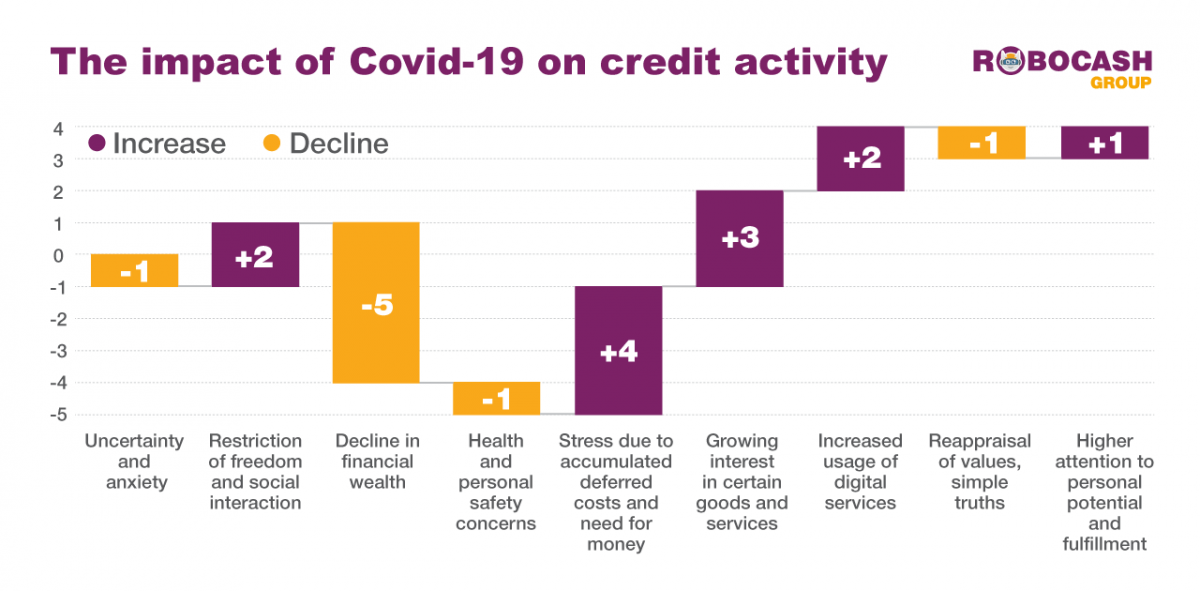
To assess the psychological impact of the pandemic on the future credit activity of borrowers, company analysts identified nine main factors evaluating their positive and negative influence on a 5-point scale. Besides, the results of online customer surveys in the Philippines, Indonesia, Vietnam and India were taken into account.
On the background of the increased need for financing amid the pandemic due to various reasons among half of the respondents, one in four (28%) faced a real drop in income. The decline in financial wealth of the population became the main factor, which reduced the demand for all types of loans during the active phase of the quarantine. Other factors such as overall insecurity and anxiety, established habits to keep social distance and cut down on expenses have strengthened it. The effect will be long-term. Combined with tightened scoring requirements, it will also prevent a sharp surge in lending after the removal of restrictions.
However, the broader usage of digital services with the growing deferred consumption will still gradually prevail over the habits to social isolation and lower spending. The survey results confirm it. An increase in the volume of deferred expenses and the need for money has become stressful for many people. Thus, it will encourage 45% of respondents to borrow more in the post-COVID-19 period. Then, 9% of the surveyed are more likely to resume borrowing because they miss the usual spending.
Analysts of the company added: “Coronavirus has only expedited the expansion of digital and Internet services, boosting the demand for apps providing remote communications, video streaming, online shopping, etc. It has produced a solid base for the further penetration of non-cash payments and fintech.”
Although a far more complex set of factors will affect the outcome such as government policies, the state of alternative lending, the adaptation of traditional banks to the changes etc, psychological and related points allow predicting an increase in volumes for non-bank lending after the complete removal of restrictions. As the findings show, it won't be sharp but steady.

Conor O’Driscoll
VP of OTC Platform at Devexperts
The market volatility that has resulted from the COVID19 pandemic has prompted more people to take upretail trading. see more
- 02:00 am
BAE Systems Applied Intelligence and Acuminor recently announced a new technology trial to help banks identify transactional behaviour linked to human trafficking. The two organisations have collaborated to provide an unnamed major Nordic bank with a proof of concept that can simulate suspicious activity and test the efficiency of the banks’ financial crime detection systems.
According to recent data, the projected total cost to financial institutions to detect financial crime is $180.9 billion. Alongside this, the global effects of money laundering - caused by human trafficking, terrorist financing and sanction violations – continue to be devastating. The criminal proceeds are counted in trillions of euros and millions of lives are destroyed each year as a result. Understanding how the criminals misuse financial institutions is critical to detection, and current methods of tracking suspicious behaviour still prove challenging. Financial institutions struggle with having a clear and up-to-date view of the criminal landscape making it challenging to know or understand how accurate they are at detecting criminal and victim behaviours.
New FinCrime Testing Service simulates criminal activity
Against this backdrop, a major Nordic Financial Institution is trialling a revolutionary new solution to test the effectiveness of its financial crime detection systems and quantify how effective they are at spotting crimes associated with money laundering.
Acuminor, a Swedish risk management start-up, gathers up-to-date, jurisdiction specific financial crime threat intelligence, collecting information on criminal methods from hundreds of sources around the world. Its advanced technology analyses this information for trends to deliver a digital view of key financial crime risks. With these data insights BAE Systems Applied Intelligence has enhanced its new FinCrime Testing Service – a technology that simulates criminal and victim’s behaviour to provide an independent test of a financial institution’s detection systems. Due to this collaboration, banks for the first time will have the ability to test and quantify the effectiveness of their current detection systems against known bad behaviours.
Harriet Shaw, Venture Lead at BAE Systems Applied Intelligence commented: “It’s a privilege to be working with Acuminor to enhance the development of the FinCrime Testing Service. Nuanced detection of criminal and victim behaviours is long overdue, banks are fed up of not being able to quantify the effectiveness of their detection systems and justify the implementation of better, more targeted detection techniques. This collaboration and proof of concept takes us an enormous step forward.”
Martin Nordh, CEO of Acuminor, added: “We started Acuminor to help society and the industry fight financial crime with a new and innovative solution - to make a real difference while reducing costs and increasing quality and effectiveness for our clients. We are excited to collaborate with BAE Systems Applied Intelligence and expect to see very interesting results from the FinCrime Testing Service trial.”
Currently, the trial is focused on the crime of human trafficking but the FinCrime Testing Service will soon be rolled out across the other 22 money laundering offenses such as counter terror financing and tax evasion, for example.
The trial will culminate in a report that will highlight any areas of vulnerability and will allow the financial institution to close these vulnerabilities and improve their detection of financial crime.
The global impact of money laundering*
· $180.9 billion is expected to be spent by financial institutions on compliance
· 23 billion Euros fines for non-compliance with anti-financial crime regulations in 2018
· 80,000 dead in terrorist attacks in the last 5 years
· 2.4 million human trafficking victims today
· 79% of the human trafficking victims are being exploited sexually
· 450,000 kilograms of heroin is being smuggled each year
· 20,000 African elephants killed by poachers for ivory each year
- 03:00 am

MV Index Solutions GmbH (MVIS®) in partnership with CryptoCompare, the global leader in digital asset data, announced the licensing of the MVIS CryptoCompare Bitcoin Index (MVBTC) to Arrano Capital, the blockchain arm of Venture Smart Asia Limited, for its recently launched Bitcoin fund. The fund, which tracks the price of Bitcoin, uniquely features daily subscription and redemptions, offering investors greater ease of access, security and liquidity. Available only to institutional and professional investors, the fund aims to bridge the gap between regulated finance and the digital asset industry.
With the inherent complexity and risk of blockchain investment operations, complicating factors such as safe custodianship, accurate net asset value reporting, trade execution and settlement across a multitude of cryptocurrency exchanges, often make it prohibitive for institutions to invest in the asset class themselves.
“We are pleased that our Digital Asset Indices continue to be popular and that we are now also the underlying index or Hong Kong’s first regulated cryptocurrency fund.” said Thomas Kettner, Managing Director at MV Index Solutions. “This will help to strengthen the status of digital assets as an asset class and fulfils the needs of institutional investors.”
This licensing is part of a broader push to bring institutional grade fund products to investors looking to gain exposure to bitcoin and the cryptocurrency asset class. Family offices, endowments, pensions, hedge funds, and other asset managers are interested in this new asset class as an inflation hedge or simply as an early stage asset class with long term growth potential. The asset class has the additional benefit of being uncorrelated with traditional financial assets, which enhances risk-adjusted returns.
“Our Bitcoin fund targets institutional investors and therefore it is important to partner with a recognised index pricing provider. Not only is MVIS extremely well regarded, the company has an innovative approach which suits digital assets, combined with the track record to develop indices that are licensed to underlie many exchange traded funds (ETFs).” explains Avaneesh Acquilla, Chief Investment Officer at Arrano Capital.
Charles Hayter, CEO and Co-Founder of CryptoCompare, commented: “We are delighted to work with our partners to help bring this institutional-grade product to investors looking to gain exposure to Bitcoin. With the launch of their fully regulated Bitcoin fund, VSFG and Arrano Capital will help further the adoption of digital assets that fulfil the needs of institutional investors.”
MVIS CryptoCompare Bitcoin Index (MVBTC) launched on 23 October 2017 is a rules based index, intended to give investors a means of tracking the performance of a Bitcoin digital asset. Detailed information about the MVIS CryptoCompare Bitcoin Index (MVBTC) including methodology details and index data are available on the MV Index Solutions website.
Key Index Features
Full Market Capitalisation (bn USD): 169.89
Number of Components: 1
Base Date/Base Value: 31.01.2012/10
(Data as of 15 July 2020)