Published
- 06:00 am

Royal Bank of Canada (RBC) and its AI research institute Borealis AI have partnered with Red Hat and NVIDIA to develop a new AI computing platform designed to transform the customer banking experience and help keep pace with rapid technology changes and evolving customer expectations.
As AI models become more efficient and accurate, so do the computational complexities associated with them. RBC and Borealis AI set out to build an in-house AI infrastructure that would allow transformative intelligent applications to be brought to market faster and deliver an enhanced experience for clients. Red Hat OpenShift and NVIDIA’s DGX AI computing systems power this private cloud system that delivers intelligent software applications and boosts operational efficiency for RBC and its customers.
RBC’s AI private cloud has the ability to run thousands of simulations and analyze millions of data points in a fraction of the time than it could before. The flexible and highly reliable self-service infrastructure will allow RBC to build, deploy and maintain next-generation AI-powered banking applications.
The platform has already improved trading execution and insights, helped reduce client calls and has resulted in faster delivery of new applications for RBC clients, and has the potential to benefit the AI industry in Canada, beyond RBC and financial services.
RBC is proud to have collaborated with Red Hat and NVIDIA to develop a platform that supports RBC customers while providing the flexibility for AI-powered client interactions.
Mike Tardif, Senior Vice President, Tech Infrastructure, Royal Bank of Canada said: “In today’s ever changing marketplace, we must always be at the forefront of innovation for our clients. We are proud to have delivered a unique AI Private Cloud capability in-house, leveraging our strong collaboration with Red Hat and NVIDIA. This cloud offers GPU acceleration and containerized platform benefits, and we are well positioned to provide the best experience possible for our customers going forward.”
Chris Wright, Senior Vice President and Chief Technology Officer, Red Hat adds: “It is always humbling to see Red Hat technologies in action, and we are honored to see how it contributed to the leading AI computing platform that RBC now has. Together with NVIDIA, OpenShift is helping to power the future of not just positive customer experience and overall operational excellence, but is enabling the bank to embark on research projects that have the potential to make a lasting impact on the world.”
Charlie Boyle, Vice President and General Manager, DGX Systems, NVIDIA said: “Before AI can enable transformative business opportunities, it must first be integrated as a strategic IT platform. RBC is leading the way in accelerating AI development through high-performance infrastructure from NVIDIA and Red Hat. By combining innovative technology with their expert knowledge in financial services, the RBC team has created one of the most sophisticated and dynamic AI development infrastructures in Canada.”
Foteini Agrafioti, Chief Science Officer, RBC and head of Borealis AI comments: “Modern AI cannot exist without access to high performance computing. This collaboration means that we can conduct research at scale, and deploy machine learning applications in production with improved efficiency and speed to market.”
- 01:00 am

Global analytics software provider FICO today released its May 2020 analysis of UK card trends, which shows the impact of COVID-19 on the credit market.
FICO monitors the UK credit market using data reported by the UK’s leading credit card issuers, through its FICO® Benchmark Reporting Service. FICO’s analysis of May 2020 activity provides a clear picture of the impact of COVID-19.
“We have been tracking the impact of COVID-19 and lockdown since March,” explains Stacey West, principal consultant for FICO® Advisors. “We expect further significant impact into 2021, especially on delinquency rates, as payment holidays expire (over 960,000 cardholders), furlough contributions are reduced and then withdrawn (over nine million) and the expected increase in staff redundancies takes place, increasing the financial stress on UK adults”.
Spend on UK cards drops by over a quarter year-on-year
Average spending on UK credit cards dropped by 26.5 percent for the period January to May 2020 compared to the same period in 2019. And, whilst typically spend in May is lower than April when Easter and school holidays normally occur, the spend in May 2020 dropped more sharply – by 7.4 percent – illustrating the persistent financial pressure experienced by UK consumers as lockdown remained in place and millions stayed furloughed.

Card usage also drops year-on-year
Indications of financial caution were also seen through card usage, as the percentage of active accounts decreased at a faster rate than normal. Utilisation on active accounts also fell and was at over a two-year low.

However, during May there was no sign of card limit decreases and average limits continued to slowly grow, reaching their highest levels since 2002, and noticeably higher than in April 2008 during the last financial crisis. There is concern that some consumers will turn to the unused credit on their cards to help finance themselves over the coming months, with over £90 billion available, there is scope for large balance builds.
West adds: “As spending options increase with the re-opening of many non-essential shops, and the hospitality and travel sectors, we expect many consumers to start using their card more as their confidence grows. This is combined with the consumers whose credit card is — or becomes — the only available source of spend”.
Accounts in credit
The percentage of accounts in credit (have excess funds) and the average amount in credit continued to increase. Normally the percentage of accounts in credit would decrease in May and the average amount would marginally increase. However, 6.6 percent of accounts stayed in credit and the average amount rose by 18.3 percent in May 2020. The main driver of this is the refunds to cards for items such as holiday expenses, which have been cancelled due to COVID-19.
West adds: “We expect this trend to continue over the next couple of months as the refunds from cancelled summer holidays are slowly processed. Later in the year we expect to see normal levels resume”.
Accounts over their limit drop
The percentage of overlimit accounts was 36.5 percent lower than a year ago. Although there may be consumers going overlimit with interest as they defer payments or accounts that would previously have qualified for a card limit increase, this is being outweighed by a combination of issuers restricting the spend above limit, consumer caution and the average spend decreasing.
However, the average amount overlimit continues to grow and has increased by 19.5 percent since January.
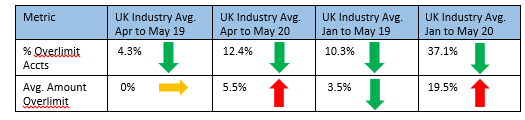
West adds: “Over the coming months, if the number of consumers deferring their payments remains stable or increases, more will exceed their limit. This also means a higher proportion of accounts will qualify for persistent debt treatment”.
Monthly payments experience sharp fall
The percentage of payments to balance experienced its sharpest fall yet, reaching over a two-year low in May. An increase in payment deferrals, lower payments (perhaps due to lower balances) and missed payments may all have contributed to a 16.6 percent drop compared to May 2019.
The percentage of consumers paying less than the amount due has also risen. From January to May 2020, the percentage increased 25.1 percent, compared to a marginal decrease of 0.2 percent for the same period in 2019. And the percentage of consumers paying the amount due was 7.7 percent lower than a year ago, despite increasing 18.5 percent in May compared to April.
“In Q4, we should start to see the true picture of the financial impact on consumers’ ability to continue or resume their payments, with many potentially paying a lower monthly amount”, predicts Stacey West.
New account openings fall
Perhaps the starkest illustration of the impact of COVID-19, as well as a demonstration of lenders tightening policy rules, was the percentage of new accounts (compared to total accounts) opened in May. This was 53.3 percent lower than a year ago; new account openings January vs. May was also 45.1 percent lower compared to a 27% increase in the same period in 2019.
West concludes: “We anticipate it will take several months to revert to the previous levels of new credit card bookings, as there will still be caution in the market in offering credit to new customers, intensified by the uncertainly around predicting customers’ ability to sustain their debt levels”.
These card performance figures are part of the data shared with subscribers of the FICO® Benchmark Reporting Service. The data sample comes from client reports generated by the FICO® TRIAD® Customer Manager solution in use by some 80 percent of UK card issuers. Issuers wishing to subscribe to this service can contact staceywest@fico.com.
For more information visit https://fico.com/en/products/fico-triad-customer-manager.
- 03:00 am

Overbit, a leading Bitcoin derivatives trading platform, has announced a new series of comedy sketches - aimed at highlighting the ease and accessibility of digital currency trading to the masses bringing comedy during the COVID-19 pandemic.
Since March 2020, Overbit saw a 30% to 40% increase in trading activities. Trader dwell time on the exchange also increased with an average of 50% and above, compared to pre-pandemic. The main reason for this is people are trading from home and are spending longer flexible hours to themselves without having to sleep early to go to work.
With this series, Overbit looks to expand the reach of digital assets by transcending language and technical barriers through visual storytelling and the universal language of humour. These sketches also showcase the platform’s stellar track record in the cryptocurrency trading space, highlighting competitive benefits such as 24x7 customer support and military grade security. By creating a casual and entertaining experience for all audiences, Overbit aims to reach more demographics and geographical markets than ever before and ultimately boost cryptocurrency adoption.

Unlike any other traditional financial instrument, Bitcoin and Ethereum hold immense promise and potential in their respective domains. At the same time, these new paradigms can make trading and investing in them really daunting for newcomers.
“Our latest sketches series aims to disprove the notion that cryptocurrency trading is complicated and out of every individual’s reach,” explains Overbit CEO Chieh Liu. “Just like the Overbit trading platform, these sketches have been meticulously designed with all audiences in mind. To that end, they feature friendly visuals instead of extended bits of technical dialog.”
Overbit Sketches was in the peak of its production when COVID-19 hit the shores in mid-march. However, the team at Overbit soldiered on with the series of sketches to ensure that cheers will be brought to the traders and community.
Liu concluded, “With many among us still grappling with pandemic-induced lockdowns, we’ve put out all the stops in our sketches production budget in hopes of bringing back some positivity into the lives of this vibrant community. There indeed is light at the end of the tunnel.”
The first sketch in this new series - available here - will highlight Overbit’s industry-leading digital asset security practices. It will also be accompanied by a behind the scenes highlight reel, which will offer an exclusive sneak peek into the team’s creative processes. Subsequent sketches will be released monthly across Overbit’s communication channels.
Overbit hopes that these series of sketches will go a long way towards generating hype in this space, while also establishing the brand as a safe and trusted entity in the minds of the public.
- 05:00 am

Hudson Fintech, the London-based Capital Markets technology firm, today announced two senior appointments to support its growth strategy.
Ashley Daffin joins as Director of Strategic Development, responsible for global development strategy. Ashley has worked in Capital Markets FinTech for 30 years, which includes institutional sales roles at HSBC, NYSE and Refinitiv, as well as working with a variety of FinTech start-ups on business development. He is also Chair of the Education Committee at ACI UK (the Financial Markets Association), working with the FX industry to increase Global Code of Conduct compliance.
Martin Best joins as Head of Business Development, responsible for managing client relationships. A fixed income specialist, Martin has worked in senior sales and relationship management roles for over 30 years, including fixed income sales at Alpha Bank, Danske Bank, Commonwealth Bank of Australia, LBBW and most recently Rabobank.
Providing financial institutions with a flexible, modular and future-proof design which promises cost savings of over 50%, Hudson can be used to support multiple asset types and business lines, such as Repo trade capture, Securities Lending, data management for regulatory reporting and clearing complex structures like IRS, and reducing the risk of ‘shadow computing’.
Hudson’s software captures and displays trade and market data, and supports end-to-end workflow processes. It improves efficiency and risk management, whilst reducing costs for the processing and reporting of trading businesses. Financial Institutions are given more ownership and control of trading operations, whilst the software provides the tools and capabilities to allow customers to quickly adapt to changes in the regulatory landscape, such as SFTR.
Hudson is the first FinTech to use Entity-Component-System (ECS) in Capital Markets. ECS is an advanced system architecture, which resolves the inherent issues associated with traditional ‘hierarchical’ systems using interdependent components. Instead, ECS works with a data model where all objects become individual entities to which arbitrary data can be added or removed at runtime. Business logic is implemented in the form of unique behaviours that operate on combinations of attached data components.
“We are very happy to welcome Ashley and Martin to our growing team. Between them they bring over 60 years of experience in capital markets technology sales and provide unrivalled domain knowledge, business development expertise and a wealth of senior industry relationships,” said Michael Walliss, CEO of Hudson Fintech. “As Capital Markets continue to evolve Hudson Fintech is seeing an increasing demand for our technology solutions, and Ashley and Martin will each play a significant role as we continue to work with a growing list of financial institutions.”
“The decision to join Hudson was made easier by the fact that they are offering something unique in Capital Markets,” said Ashley Daffin. “The technology is different from that offered by every other vendor, which results in the most flexible technology solution – something all financial institutions want.”
“I am delighted to join Hudson Fintech, where I am able to provide a genuine solution to the significant issues faced by large institutions when managing changing technology requirements,” said Martin Best. “Having faced these issues first-hand in Fixed Income, which is a core market for us, I look forward to leveraging this experience and offering answers to the challenges faced by many of my industry contacts.”
- 07:00 am

RAMSUN Network, India’s e-marketplace for Supply Chain Finance and other Supply Chain related solutions, has joined fintech MonetaGo’s Secure Financing Network.
The RAMSUN Network facilitates easier and faster financing for small businesses, through its artificial intelligence-enabled technology solution. This allows multiple financiers to be part of Supply chain/Channel Finance ecosystem. India’s small business community faces ongoing challenges to securing funding, which have been exacerbated by the coronavirus.
By choosing MonetaGo’s Secure Financing solution, RAMSUN Network will be able to reach even more small businesses in India – and beyond – that need critical cash flow, fast. MonetaGo empowers companies to spot, and stop invoice fraud in real-time. It uses blockchain-technology to create certainty during the invoice financing process, mitigating risks such as double invoice financing.
MonetaGo’s Secure Financing solution has been used by all Trade Receivable e-Discounting System (TReDS) exchanges in India since March 2018. TReDS was formulated by India’s Central Bank as an online mechanism for facilitating the financing of trade receivables of small to medium sized businesses by multiple financiers.
Ramesh Bisht, Co-Founder at RAMSUN Enterprise Payments Network, said: “At RAMSUN Network, we are committed to creating an intelligent & secured ecosystem for all participants including Financial Institutions. For this, while we have in-built system features, we are also tying up with many Fintech’s who can create value-add to the ecosystem with their experience and unique solutions. We are familiar with MonetaGo’s Secure Financing solution and its growth in developing the blockchain ecosystem in India. MonetaGo’s solution is very unique and will help RAMSUN’s e-marketplace to validate if the invoices have been financed by some other financier on a real-time basis before financing or disbursal by lenders on its platform and thus providing them the necessary comfort level by mitigating duplicate financing risk.”
Sunil Kumar, Co-Founder at RAMSUN Network, said: “MonetaGo’s well architected design and its technology roadmap of improving the platform further to cater to the growing volumes efficiently gives us the confidence we have chosen the right partner. We are confident that MonetaGo’s blockchain-based unique solution & their expertise in this space will help us to offer clean assets to the lenders on the platform and also provide additional comfort to the financiers transacting on RAMSUN Network”
Jesse Chenard, CEO MonetaGo, said: “India’s SME community has been hit particularly hard by the cash flow challenges the coronavirus has brought. It is during times such as these that the need for solutions such as the RAMSUN Network becomes stronger than ever. RAMSUN Network has leveraged the lockdown period to build and scale up its marketplace to help deliver vital cash flow to small businesses.“
- 08:00 am

Avaloq, the global wealthtech leader, has further expanded its senior UK team with the appointment of Peter Lamberti to the role of Strategic Sales Director. He is based in London and will focus on developing strategic relationships, expanding Avaloq’s presence in the UK and also globally.
Peter Lamberti will be promoting the company’s market-leading Software as a Service (SaaS), Business Process as a Service (BPaaS) and on-premises solutions for wealth managers and private banks. He reports to Barry Frame, Avaloq’s UK Sales Director and to Bruno Kellenberger, Head of Global Accounts at Avaloq Group.
Peter joins from Exela Technologies, where he had worked for the past three years, most recently as Sales Director. His responsibilities included oversight of strategic relationships, business development within the financial services sector, and end-to-end management of large-scale ITO and BPO transformation programmes. Prior to Exela, he held senior positions at CGI, ATOS Consulting, Capgemini and SAP.
At Avaloq, Peter will be responsible for not just building and maintaining relationships with prospects, but also helping to further shape the strategic sales function, including working closely with clients that are expanding their relationships with Avaloq from on-premise to SaaS and BPaaS models.
Peter’s appointment means Avaloq now has more than 175 members of staff in the UK, including around 65 in the London office, with over 2,300 globally. The expansion in London complements Avaloq’s ongoing growth within the UK implementation team, as well as the Research & Development facility in Edinburgh, one of the company’s three R&D centres globally.
Peter Lamberti, Strategic Sales Director at Avaloq, said: “Avaloq has become the leading provider of BPaaS and SaaS solutions for the UK wealth management sector, with strong momentum to build further on its established client base of tier 1 firms. Avaloq is firmly at the centre of a rapidly growing digital wealth management sector as financial institutions look to remain competitive, agile, focused on costs and benefit from powerful data analytics at scale.”
Jonathan Davis, UK Managing Director at Avaloq, said: “We are delighted to welcome someone of Peter’s calibre and experience to our growing London team. He has a deep understanding of the wealth management sector and exceptional client experience. Peter will play a fundamental role in Avaloq’s ongoing growth.”
- 09:00 am

Exberry, the exchange technology pioneer, has been appointed by London Derivatives Exchange (LDX) to provide matching engine technology. The new technology partnership will enable LDX to launch global markets and cover a wide spectrum of asset classes.
Digital assets have emerged as an attractive new investment class, especially since the pandemic, and demand for alternative secondary market trading opportunities is increasing. Exberry’s infrastructure overcomes the limitations of current exchange technology - it delivers a platform designed to help any asset class launch markets, pivot, and scale.
LDX, the global exchange group, will leverage Exberry’s platform to provide technology for a wide variety of asset classes - from new security tokens, to traditional assets such as commodities or derivatives. Exberry’s exchange infrastructure will help LDX to deliver initiatives designed to improve the end-to-end investment model and implement processes that will drive down costs and increase operational efficiencies, to the benefit of the end investor. Exberry was chosen for its modern, scalable, easily-deployed system and its client focused engagement model.
Exberry delivers an exchange matching engine that is easy to integrate, delivered as a “Matching Engine-as-a-Service” concept, allowing LDX and their clients to reap the full benefits of an exchange-grade solution that can be cloud-based or on-premise. The flexible modular structure means Exberry’s clients will technically be able to start rolling-out a new exchange location within a number of weeks, rather than months or years, and enables global operations to be run from a single location.
James Davies, Director of LDX, said: “Exberry has emerged as the exchange platform provider and its exchange matching engine is an important addition to our technology suite to drive our strategy to transform the investment model. We were immediately impressed by Exberry’s modern architecture, the ability to add new asset classes in a timely and cost efficient way, and their client engagement model. It means that we can utilise our trading engine to support new initiatives globally, rather than being constrained by our technology and limited in what we desire to achieve.”
Vj Angelo, Chairman LDX Group, said: “I am very excited about this partnership. Exberry will provide one of the key tools for LDX to execute its business plan over the coming months and years. The LDX ecosystem will provide new opportunities to financial markets players, and Exberry will become a cornerstone of that system.”
Commenting on the announcement, Magnus Almqvist, Head of Exchange Development, said: “Collaboration and innovation are fundamental to Exberry and we are very excited to work with a visionary firm like LDX to deliver our exchange matching engine. We set up Exberry to help exchanges like LDX take advantage of new possibilities and seize the potential of new asset classes including security tokens and digital assets. This collaboration will make it quicker and easier for LDX to launch new markets anywhere in the world and ultimately scale its business and support its clients’ growth.”
Erez Zada, CEO of Exberry commented further. “We are very excited to have established this partnership with LDX and to bring our innovative solution and technology to the market. We are convinced we are going to help our clients take full advantage of advances in the exchange world.”
- 06:00 am

Infor, a global leader in business cloud software specialized by industry, today announced that it is partnering with DBS Bank, Southeast Asia's largest bank, to integrate digital trade financing capabilities into the Infor Nexus global network of more than 68,000 businesses. The two companies' first joint program recently went live with one of the world's largest global apparel companies, providing faster and more cost-efficient digital trade financing to suppliers in the apparel company's supply chain ecosystem, which comprises mostly small-to-medium-sized enterprises (SMEs).
"This is an important relationship for Infor, where a common vision of data-driven financing bonds us and presses us forward," said Gary Schneider, Vice President of Sales for Infor Financial Supply Chain Management. "DBS is a digital bank, based in Asia, focused on supplier funding and liquidity. Its pursuit of digital innovation and delivering greater value to supply chains, combined with our cloud-based platform and local support team around the globe, makes for a powerful partnership at a time when liquidity is a top priority for everyone."
Sriram Muthukrishnan, Group Head of Trade Product Management, DBS Bank, said: "We continue to accelerate the deployment of our market-leading supply chain financing and digital capabilities to ensure steady financing to SME suppliers during these times of stress. Data forms the backbone of a successful digital strategy and its impact across multiple industries globally has been growing exponentially.
"Our collaboration with Infor enables greater transparency into complex supply chains and provides insights into the transaction patterns between an anchor and its ecosystem of suppliers," he noted. "We leverage these insights to provide quicker and more cost-efficient financing to suppliers much earlier in the cycle, as compared to conventional post-shipment supplier financing programs. This is especially relevant today, as we continue to operate in an environment characterized by prolonged trade disruptions and tighter credit lines, where optimal working capital management is key to survival."
The two companies' next joint program for pre-shipment finance, expected to launch in late 2020, will utilize supply chain data as the primary conduit to assess risk and credit worthiness, as opposed to traditional models that result in the majority of suppliers being under-funded or facing challenges to access necessary capital. Infor provides extensive supply chain data, including historic and real-time milestone information on the physical movement of goods, to enable a data-driven representation of a supplier's performance and credit risk.
According to a research report from Aite Group analyst Enrico Camerinelli (The Supply Chain Bank, 2018), "In the next three years, the competitive frontier in corporate lending and supply chain finance will be the creation of innovative credit risk models that banks will use to leverage corporate supply chain process data. Banks will capture and analyze events in the physical supply chain (source-to-pay, order-to-cash) in order to generate a more comprehensive and realistic representation of a company's risk profile."
- 05:00 am

QuantaVerse, which uses AI and machine learning to automate financial crime investigation processes, engaged an independent model validation firm to ensure the regulatory rigor of its AI and machine learning platform. Leveraging its proprietary modeling framework to thoroughly analyze QuantaVerse’s AI solutions, the firm delivered a comprehensive model validation.
Each solution, including the QuantaVerse Alert Investigator and QuantaVerse False Negative Identification and Investigator, were given the highest possible marks, proving that its AI models are effective and work as intended. QuantaVerse, having been in production in client environments for several years, can now lay claim to being the industry’s only independently validated comprehensive technology platform to deliver AI for AML.
“Models are used throughout the banking and financial services space, particularly for determining risk. As such, bank regulators issue guidance advising periodic model validation,” explained David McLaughlin, CEO and Founder of QuantaVerse. “We encourage banks and financial services companies to review our validation results as part of their regulatory and due diligence requirements. Our validation results are proof positive that the QuantaVerse platform delivers on the promise of AI and machine learning for AML/BSA compliance efforts.”
When presented with input data such as negative/adverse media or transaction data, QuantaVerse’s models produce a value, or observable, which is used to determine the presence or prevalence of financial crime. The models vary widely depending on the nature of the observable they are trying to infer, from natural language processing techniques to neural networks to specialized graphing techniques.
Critical to characterizing the risk associated with an entity or transacting party, the validation focused on model-driven observables relating to profile, monitoring, reputation, and intent. The model validation firm developed generic data sets to exhibit specific characteristics and behaviors that were then ingested and processed through the QuantaVerse platform and, specifically, its AML and screening solutions. The output from the AI solutions was then sampled and reconciled with the input data. All QuantaVerse governance and processes were examined with the highest possible marks.
The validation firm utilized the following methodology to complete its analysis:
Developed detailed transaction and entity test data as input to exercise the model
Processed multiple iterations of simulated transaction and entity data
Analyzed outputs of the system to validate the results against expected values
Logged findings and observations on each observable
A copy of the QuantaVerse model validation report summary can be requested by visiting: www.QuantaVerse.net/contact.
- 03:00 am

Quantexa – the contextual decision intelligence software company that empowers organisations to make better decisions – has today announced that it has closed a Series C round, raising a further $64.7 million (£51.2m) in funding.
The round was led by Evolution Equity Partners, with major participation from pre-existing backers Dawn Capital, AlbionVC and HSBC. New investors British Patient Capital and ABN AMRO Ventures also joined previous investor Accenture Ventures in this round. Richard Seewald, Founding and Managing Partner at Evolution Equity Partners will join Quantexa’s board of directors as part of the deal.
Already with thousands of users in more than 70 countries, the funding will help drive Quantexa’s category-leading Contextual Decision Intelligence (CDI) technology market expansion into new industries such as public sector, while developing more platform applications across financial services and broader cross-sector capabilities. The funding will also accelerate Quantexa’s continued growth across North America, Europe, and Asia-Pacific regions, and continue to rapidly grow its global partner ecosystem.
This new round of funding follows a $22.7 million Series B round secured in August 2018, bringing total funds raised to date to $90 million. Since its inception in 2016, Quantexa has built a globally renowned client and partner base, supporting thousands of users within tier one organisations worldwide, including HSBC, Standard Chartered Bank and Accenture.
CDI is an industry-leading, innovative approach to data that gives organisations the ability to join multiple internal and external data sets, providing a single view of data enriched with intelligence about the relationships between people, places and organisations. Through its pioneering platform, Quantexa helps organisations to maximise the value of data and transform decision making across the customer lifecycle, improving efficiency and maximising infrastructure investments.
Vishal Marria, CEO at Quantexa, commented: “We are thrilled that Evolution Equity Partners and British Patient Capital will be joining our team, alongside the strategic investment from ABN AMRO Ventures. Together with the continued trust and commitment from our existing investors, we will drive the next phase of Quantexa’s growth. We are seeing a huge demand for our platform to support multiple applications across our core markets in financial services and within new industry sectors. This investment will accelerate our product innovation roadmap and enable us to invest further into Europe, North America and Asia Pacific regions, as well as expand into new locations.”
Richard Seewald added: “Quantexa’s proprietary platform heralds a new generation of decision intelligence technology that uses a single contextual view of customers to profoundly improve operational decision making and overcome big data challenges. Its impressive rapid growth, renowned client base and potential to build further value across so many sectors make Quantexa a fantastic partner whose team I look forward to working with.”