
Published
- 04.10.2023 -- 01:24 pm
Financial IT catches up with Shanker Ramamurthy, Global Managing Partner Banking & Financial Markets, IBM Consulting and Hans Tesselaar, Executive Director, Banking Industry Architecture Network (BIAN) to discuss IBM’s recent study, Embedded Finance: Creating the Everywhere, Everyday Bank.
Other Videos
- 08:00 am

Fiserv, Inc., a leading global provider of payments and financial services technology solutions, has expanded its longstanding relationship with Swift by joining the Swift Partner Programme as a Platform Partner. As a Partner, Fiserv will enable connectivity to Swift APIs and enhance support for Swift GPI (Global Payments Initiative) for Fiserv client financial institutions.
Swift API connectivity enhances end-to-end transparency for cross-border payments in real time and facilitates full visibility on the status of those payments for Fiserv client banks. The combination of the unparalleled reach and security of Swift with the unmatched footprint of Fiserv as the largest global provider of technology to financial institutions offers an opportunity for more financial institutions to readily access modern cross-border payments capabilities.
The Swift Partner Programme membership has generated significant interest among Fiserv clients, with multiple financial institutions already committed to take advantage of the enhanced speed and transparency of cross-border payments that Swift API connectivity will provide.
“Our membership in the Swift Partner Program underscores our commitment to the strategic vision of leveraging APIs to facilitate access to Swift services,” said Rossana Thomas, Vice President and Head of Enterprise Payments Platform at Fiserv in EMEA. “This is another way we can facilitate payment modernization on behalf of our clients and the wider Swift community in Europe and across the globe.”
In a world moving faster than ever before, Fiserv helps clients deliver solutions in step with the way people live and work today – financial services at the speed of life.
- 07:00 am

wefox, one of the world’s leading insurtech, has been appointed as affinity insurance partner by WINDTRE, Italy’s leading telecommunications business. The company has launched its own insurance agency, WINDTRE Assicurazioni, to provide insurance directly to its customers.
wefox will provide a range of services and consultancy, starting from its innovative and modular technology platform, through which clients will be able to activate insurance products in-store easily, quickly and digitally. These include insurance products and service solutions. The launch includes two products, home and travel insurance, with additional products to follow. The first insurance carriers involved in this innovative multi-product and multi-insurer proposition are Net Insurance and AXA Partners Italia.
The deal is a 10-year commitment. WINDTRE customers will benefit from innovative insurance products that are fit for purpose, transparent, and easy to understand.
Julian Teicke, CEO at wefox said: “Our partnership with WINDTRE is an endorsement of our distribution strategy and technology platform. Together we will be developing and delivering bespoke insurance products specifically for WINDTRE customers.”
“This is a perfect partnership between wefox and WINDTRE since we share the same values and approach to business. We collaborate and always place our customers at the heart of every decision we take together.”
Maurizio Sedita, Chief Commercial Officer at WINDTRE said: “This strategic partnership with wefox is a game changer for the insurance industry. Best in class, opportunity to distribute innovative insurance products through their technology platform are a key part of our proposition, which is centred around convenience and value for our clients. With wefox we also benefit from excellent customer experience, real differentiation and of course great value for money. These are our customers’ expectations and together with wefox, we will continue to more than meet them with our insurance products.”
- 07:00 am

Aryza, a leading provider of end-to-end financial software solutions, has announced the launch of a new range of products to support embedded finance. With the introduction of Aryza Originate and Aryza Lend, the cloud-hosted secure platforms support the entire lending lifecycle. The company aims to provide businesses with a simple, fully digital, and entirely automated journey that can be customised to fit their needs.
Aryza Originate is an end-to-end loan management software solution designed to enable the implementation of embedded finance for retail and online customers, improving their back-end processes, optimising efficiency, and delivering a smoother user experience. The platform enables businesses to originate and manage financial products quickly, automatically, and cost-effectively. It will revolutionise the application process for customers, streamlining it from start to finish.
Aryza Lend, a secure lending and leasing platform automates the entire lending cycle, saving time and money, enabling loan servicing to be managed with ease. The servicing software delivers seamless integration with existing systems and a unique modular design that can be deployed at the relevant point of a customer’s journey, allowing businesses to streamline lending processes and focus on growing their portfolio.
With extensive experience and market knowledge in embedded finance, Aryza's new products enable customers to implement embedded finance seamlessly. The implementation of Aryza Originate and Aryza Lend will provide businesses with the tools they need to transform their operations and enhance their financial offerings.
These products follow on from the announcement last year of the Aryza Embedded Lending platform, which had been developed in close partnership with Dreams – one of the UK's biggest bed retailers. The platform simplified the in-store and online finance application process and improved sales conversion rates. The success of the Embedded Lending platform has paved the way for Aryza to develop and launch its new range of embedded finance products.
"Our commitment to providing innovative and secure financial software solutions remains at the forefront of our efforts, and we believe that our new products will help our customers transform their businesses, enhance their financial offerings and provide a better customer experience. We understand that businesses need secure and efficient tools to implement embedded finance, and our new range of products is designed to deliver precisely that," said Colin Brown, Chief Executive Officer of the Aryza Group.
- 06:00 am
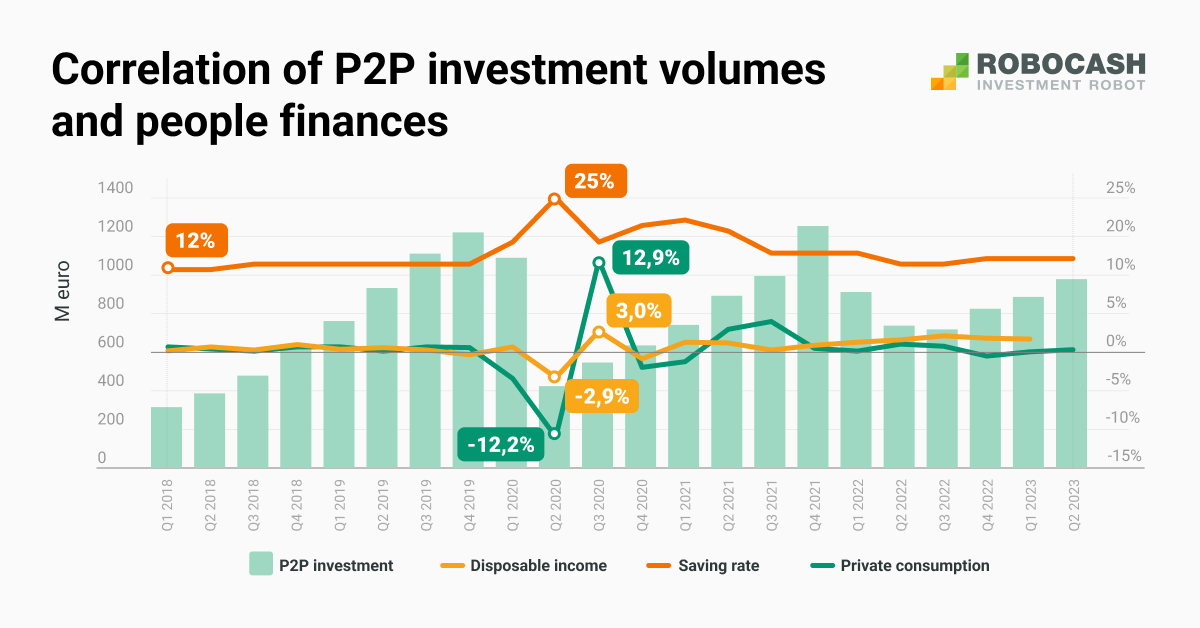
Quarterly investment volumes in major P2P platforms have seen significant variation since 2018. Aside from the obvious global crises, Robo.cash platform analysts have identified correlations with macroeconomic factors.
There is a certain impact on P2P investments from changes in the gross disposable income of European households. In 2019, European incomes were mostly stagnant with a moderate rate of 1% growth per quarter, but P2P investments grew much faster. "Prior to the pandemic, investors in Europe saw P2P platforms as a source of additional earnings to offset near-regressive incomes." - the analysts comment.
With the start of the COVID-19 pandemic, the savings rate has shown significant increase, reaching 25% of disposable income. “People started saving more, which caused a decline in the P2P sector”. - the specialists add. From the second quarter of 2021, the savings rate started to decrease and P2P investments regained momentum.
The analysts also found a correlation between P2P volumes and the level of consumption. “In 2018-2019, personal consumption has grown, as well as P2P investments. With the onset of the pandemic crisis, people reduced their expenditures, which most likely affected the decrease in P2P investments as well”.
- 06:00 am

UK consumers are the least likely in Europe to worry about how the cost of living has impacted their credit rating, despite being among the most impacted by it.
The research from CRIF, Europe’s leading provider of digital transformation solutions for the financial services industry, finds that only one in five (20%) Brits are worried about the impact that the current rise in the cost living is having on their credit score and ability to borrow.
By contrast, and excluding the UK, on average 37% of people in Europe said they worried about the impact on their credit score. This rose to around half of all people in France (49%), followed by Spain (45%) and Italy (44%).
The research comes as the Bank of England announced interest rates would remain unchanged at 5.25% after 14 consecutive rises, and the Governor Andrew Bailey said that rates were reaching their peak. Despite many people in Europe now looking to shore up their finances for the future, people in Britain seem less concerned.
While nearly two-thirds (63%) of Europeans say the cost of living crisis has made them more mindful about getting into debt in the future, less than half of Brits (49%) said they felt this way.
The findings highlight significant cultural differences in the UK when it comes to lending and credit compared to the rest of Europe. When asked in more detail about the impact on their credit scores, 27% of Europeans worry that they may no longer qualify for products and services that they previously would have. By contrast, only 19% of people in the UK say they are worried about this.
This comes even though Brits were the most likely in Europe to have previously been turned down for credit.
Sara Costantini, Regional Director for UK & Ireland at CRIF, said: “Our extensive research across Europe shows that Brits have a different relationship to credit and lending to that of their European neighbours.
“Whereas many on the continent are looking ahead to how they can bolster their finances to better withstand future economic shocks, many in Britain show less concern about their credit score or avoiding debt in the future.
“There is a clear role here for banks and lenders to ensure Brits are using credit responsibly and can afford to repay. Utilising the latest digital banking innovations will help lenders better understand their customers’ needs and provide them with insights and services that can help them improve their financial health.”
The findings come as part of CRIF’s cross-European research, which surveyed thousands of adults in the UK, France, Italy, Germany, Austria and Spain. The results form part of CRIF’s Banking on Banks report, looking at Europeans’ relationship with their finances and their financial providers during these challenging economic times.
CRIF’s UK Director, Sara Costantini, will give a keynote speech at this year’s Open Banking Expo on the findings of the report and what banks and lenders across Europe must do to meet their customers’ needs.
- 03:00 am

The global open banking provider Noda has joined forces with Tickets Travel Network, a frontrunner in the European online travel market, to facilitate instantaneous open banking payments within the travel industry.
Tickets Travel Network, known for its extensive service across various European locations, including Latvia, Lithuania, Estonia, Netherlands, Spain, Italy, Austria, Germany, France, and Poland, has now integrated Noda's robust Open Banking platform. This integration facilitates secure and direct account-to-account (A2A) payments, providing a seamless payment experience for travellers.
With an acceptance rate of around 90% in most of the serviced regions, this collaboration ensures a high throughput of payments, making transactions smoother for millions of travellers.
Customisation has been at the heart of this partnership, with payment flows tailored to meet the specific needs of the merchant, ensuring an efficient and reliable payment ecosystem. Noda's Open Banking platform enhances the reconciliation process for Tickets Travel Network by providing daily settlements for the previous day's transactions. This T+1 payout initiative significantly accelerates the payment process, allowing Tickets Travel Network to settle with suppliers expeditiously on a daily basis.
This synergy also introduces the option for user refunds or payouts, ensuring satisfaction and trust among travellers should service discrepancies occur.
The capability to accept funds in different accounts across multiple currencies further enhances the operational efficiency of Tickets Travel Network.
Michael Bystrov, Chief Revenue Officer at Noda, expressed his enthusiasm about the collaboration, stating: "This partnership with Tickets Travel Network not only marks our foray into the travel sector but also sets a precedent in delivering cutting-edge payment solutions. We are thrilled about the positive impacts and the new benchmarks we are setting in the travel industry together."
Sergiy Tikhiy, Head of Payment Systems at TTN Travel Holding, added: "We are beyond excited to kick off our partnership with Noda, a trailblaser in open banking solutions. Noda's superior technology will empower us to offer instant, secure, and hassle-free transactions, marking a significant step towards achieving a frictionless payment ecosystem. As the leading travel entity, we believe this synergy with Noda will not only enhance our operational efficiency but also significantly uplift the satisfaction and trust of our customers."
Tickets Travel Network and Noda are committed to continuous innovation to deliver superior payment solutions, ensuring a seamless and enjoyable travel experience for millions worldwide.
- 06:00 am

Today, Nuapay, EML Payments’ Open Banking and account-to-account (A2A) payments business, announces further results of research into over 250 UK payment professionals’ views on the potential for Open Banking. Of the Payment Service Provider’s (PSPs) and Independent Software Vendor’s (ISVs) that were surveyed, more than 75% of PSPs and 80% of ISVs already enable their customers to accept Open Banking payments. Furthermore, every single PSP and ISV surveyed that had not yet implemented Open Banking payments planned to do so by 2025.
On average, of the PSPs whose merchants have gone live with Open Banking, 28% of payment flows have already converted to Open Banking-based payments, compared to 20% of ISVs. 1 in 5 PSPs have already seen more than 41% of payment flows convert to Open Banking.
Brian Hanrahan, CEO, Nuapay, comments: “There’s never been a better time for PSPs and ISVs to offer account-to-account (A2A) payments and facilitate even more widespread adoption of Open Banking. It’s clear that there is appetite for Open Banking payments and it will likely surpass traditional payment methods. However, what is hindering the implementation of new payment technologies is the lack of customer understanding, time and cost requirements and lack of skills.”
Over the next five years, both PSPs and ISVs expect Open Banking to become one of the most popular ways for consumers to pay. One in four (24%) ISVs expect Open Banking to be more popular than credit and debit cards, Buy-Now-Pay-Later (BNPL), and digital wallets, as do 22% of PSPs.
As such, PSPs and ISVs expect the volume of payments that convert from traditional methods such as debit and credit cards to Open Banking to grow over the next five years. On average, ISVs expect 57% of their payment flows to have converted to Open Banking payments by 2027, representing growth of almost 185%. Similarly, PSPs expect 51% of their payment flows to have converted to Open Banking-based payments in the same time frame, equating to 82% growth.
Four in ten (40%) PSPs and ISVs expect to see greater demand for new payments technologies as merchants try to differentiate themselves from competitors and offer an enhanced checkout experience.
Ruwani Hewa, Product and Propositions Director, Nuapay, comments: “Amid ongoing economic uncertainty and the cost-of-living crisis, the majority of PSPs, ISVs and merchants recognise that enhanced payments technology can not only provide a competitive advantage but help to build loyalty and protect their bottom line. It’s important that we support them to take advantage of technology available to adhere to demands for Open Banking-based payments from consumers, merchants and PSPs/ISVs.
Chapter Three of Nuapay’s PSP and ISV Open Banking Perceptions series, ‘Just how much potential does Open Banking hold?’ is available for download on Nuapay’s website.
- 04:00 am

While financial forecasters continue to signal near-term economic downturns across the globe, FIS®, a global leader in financial services technology, has conducted new research to understand how corporate executives across industries are innovating amid uncertainty.
FIS’ Global Innovation Report asked c-suite and senior executives in financial services (banks, insurers, capital markets firms, and fintechs) and non-financial businesses (technology, retail, energy and utilities, healthcare, and others) globally about their key areas of innovation over the next 12 months.
According to the study, business leaders in the UK say they face more risk now than in the past, with financial risk as the top concern for 62% of respondents, followed by strategic risk for 50%. Retail and fintech leaders are particularly concerned compared to other industries, with 80% of UK retailers and 70% of UK fintech executives noting rising risks to their business. However, many organisations are embracing artificial intelligence (AI) to mitigate risk and unlock growth. UK business leaders are already realising the potential of generative AI, with 60% of those who have adopted the technology saying they will increase spend on it in the next year, primarily to help them become more competitive.
“UK business leaders are understandably unsettled by the risks posed by the current challenging economic climate, as supply chain disruptions, high-interest rates, and skills shortages have piled pressure on to their performance,” said Silvia Mensdorff-Pouilly, SVP Banking and Payments, Europe, at FIS. “But there are signs of optimism as executives eye emerging technologies, such as artificial intelligence, to boost productivity. While there has been much hype around generative AI in particular, the Global Innovation Report indicates it has real practical benefits, with strong consensus among executives that it will increase their competitiveness. If the technology is harnessed appropriately, it could be a gamechanger for the UK economy, which has been grappling with low growth.”
Key Findings and Insights
UK business leaders believe risk is rising, which may pose a threat to productivity:
- 47% of executives in the UK say they face more risk now than in the past, with 62% citing financial risk the top concern and strategic risk a concern for 50%.
- 52% of leaders in the UK are addressing risk by assigning existing staff to the problem, however, 50% say they are adopting new technology and 42% are restructuring their business model in the face of risk.
- Leaders in retail and fintech are the most worried about risk when compared to their counterparts across industries, with 80% of UK retailers and 70% of UK fintech executives expressing concern.
UK executives are embracing AI to mitigate risk and unlock growth:
- 38% of UK executives believe innovation plays a very significant role in managing risk, according to the research.
- 74% of UK leaders say they see AI as a means to mitigate risk and 69% feel the same about generative AI.
- 60% of those already using generative AI say they are increasing spend in this area over the next 12 months, with 48% of respondents identifying increasing competitiveness as the top reason for increasing generative AI spend.
- 04:00 am

FICO® Platform has received the Banking Innovation of the Year Platinum Award in the Future Digital Awards for Fintech & Payments 2023. Presented by Juniper Research, the awards recognize tech companies that deliver imaginative, innovative products or services that have the potential to disrupt their ecosystems and provide significant benefits to their target audience.
“This award recognizes the innovations that FICO has poured into FICO Platform,” said Stephanie Covert, executive vice president for software at FICO. “We saw the need for the financial services industry to break away from siloed applications and embrace a modern, services-oriented, composable architecture that can truly deliver applied intelligence throughout the enterprise. FICO Platform is built on our tremendous wealth of IP in analytics and decision management, and our customers are seeing transformative results.”
FICO Platform enables firms to ingest data, develop deep new insights with AI and ML, make hyper-personalized decisions at scale, and achieve world-class business outcomes. It is uniquely suited to maximize customer satisfaction, loyalty, and long-term retention, while improving profitability across the entire customer lifecycle.
In May, FICO unveiled 19 major enhancements to FICO® Platform. FICO Platform received placement as a leader among top providers in “The Forrester Wave™: AI Decisioning Platforms, Q2 2023” report.








