
Published
- 02:00 am

Mettle, the digital business banking account from NatWest, today brings its customers Apple Pay, a safer, more secure and private way to pay that helps customers avoid handing their payment card to someone else, touching physical buttons or exchanging cash — and uses the power of iPhone to protect every transaction.
Mettle’s customers simply hold their iPhone or Apple Watch near a payment terminal to make a contactless payment. Every Apple Pay purchase is secure because it is authenticated with Face ID, Touch ID, or device passcode, as well as a one-time unique dynamic security code. Apple Pay is accepted in grocery stores, pharmacies, taxis, restaurants, retail stores, and many more places.
Mettle customers can also use Apple Pay on iPhone, iPad, and Mac to make faster and more convenient purchases in apps or on the web in Safari without having to create accounts or repeatedly type in shipping and billing information. Apple Pay makes it easier to pay for deliveries, online shopping, transportation, and parking, among other things. Apple Pay can also be used to make payments in apps on Apple Watch.
Marieke Flament, CEO, Mettle, said: “We are delighted to be launching Apple Pay to Mettle customers from today, bringing them a safe, secure and simple way to make business purchases using their Mettle account. Apple Pay is another important innovation that will give our customers the freedom to run their business, providing the ease and simplicity that they expect when it comes to payments.”
Security and privacy are at the core of Apple Pay. When customers use a credit or debit card with Apple Pay, the actual card numbers are not stored on the device, nor on Apple servers. Instead, a unique Device Account Number is assigned, encrypted, and securely stored in the Secure Element, an industry-standard, certified chip designed to store the payment information safely on the device.
Apple Pay is easy to set up. On iPhone, simply open the Wallet app, tap +, and follow the steps to add a Mettle debit card. Once a customer adds a card to iPhone, Apple Watch, iPad, and Mac, they can start using Apple Pay on that device right away. Customers will continue to receive all of the rewards and benefits offered by their Mettle card.
For more information on Apple Pay, visit: https://www.apple.com/uk/apple-pay/.
For more information on Mettle, please visit mettle.co.uk.
- 04:00 am

As part of its continued growth trajectory, Crown Agents Bank Ltd. has announced it is expanding its partnership with Paga to increase its payments reach in Nigeria, Africa’s largest economy.
The broadened partnership will see the UK regulated provider of wholesale FX and cross-border payment services, Crown Agents Bank, facilitate international money transfers directly into Paga mobile money wallets and Nigerian bank accounts on behalf of its international customers.
Crown Agents Bank will now be able to offer all of its customers, international and domestic, instant, low-cost transfers to Paga, Nigeria’s widest reaching mobile money network, which has more than sixteen million users. Recipients of remittances will be able to cash out their funds at any of Paga’s 26,068 agents in the country, or use their Paga wallets for paying bills, transferring to others or to top-up their mobile airtime. In addition, Crown Agents Bank’s international development, remittance and other enterprise customers will be able to use Crown Agents Bank’s integration with Paga to reach any account holder at any Nigerian bank, with the same maximum speed and minimum cost.
The move follows on from Crown Agents Bank’s existing work with Paga in Nigeria, which enables domestic transfers for organisations with a local Nigerian presence.
Steven Marshall, Chief Commercial Officer, at Crown Agents Bank, comments: “We have been making great strides in the mobile money space since acquiring Segovia and its proprietary payment gateway. Having a significant presence in this space in Nigeria is a milestone event for our growth. By working with Paga, we are able to quickly expand our offering in this pivotal market with the support of proven technology and increase our ability to move money where it’s needed most.”
Jay Alabraba, Director of Business Development at Paga, continues: “We are excited to finally launch this collaboration with Crown Agents Bank and bring safe, reliable cross-border transfers for both senders and recipients. Our organisations share the goal of improving remittances and the payments experience for banked and unbanked customers in Nigeria – and hopefully, in the future, we will roll this out in other markets.”
Since launching in 2009, Paga has received widespread recognition for its role in driving financial inclusion in Nigeria. The company operates the widest reaching mobile money platform in the country, with a nationwide agent network of over 26,000 agents and 16 million users to date. Paga is committed to making it easy for people to pay digitally and access critically needed financial services. Last year, Paga announced plans to expand into other countries including Mexico and Ethiopia.
- 03:00 am

Payvision as part of ING may be the latest Wirecard case. The company supported fraud and large-scale money laundering. Payvision is a payment service provider founded by Rudolf Booker and partners in 2002. The company was established to provide payment services for online shops. In 2018, ING took shares in Payvision. Risk & Compliance Platform Europe has the exclusive story.
PSD license granted
Payvision has been granted a license as a payment institution under the Payment Services Directive (PSD) for the Dutch Central Bank. The PSD is a European regulation to support the industry in facilitating transactions across Europe more efficiently and with more transparency. The PSD license is only awarded to organizations that comply with a wide set of rules and obligations. This is done so to ensure quality and stability of the international payment sector.
Payvision enables online shops to accept credit card payments and acts as an acquiring partner for the operating companies – merchants – of the websites. The financial flows go through specific vehicles, such as Stichting Trusted Third Party Payvision and Stichting Trusted Third Party or Acapture*.
ING Bank as sole beneficial owner of Payvision
Rudolf Booker was the CEO of the company until April 2020. Now, the sole beneficial owner of Payvision is ING Bank. As part of the implementation of its fintech-strategy, ING acquired 75% of the shares in Payvision in the spring of 2018 at a valuation of 360 million euro. This was primarily based on the highly positive business development of the company.
Dead in the cell
In January 2019, the Austrian and German law enforcement agencies arrested Uwe Lenhoff and charged him with fraud for being the beneficial owner of the boiler room scams Option888, ZoomTraderGlobal, Tradovest and Lottopalace, which ripped off thousands of unsuspecting European consumers. The criminal proceedings against him were opened in Vienna, Austria and afterwards handed over to Saarbrücken, Germany. On 5th July 2020, Uwe Lenhoff was found dead in his cell in Saarbrücken.
Stolen money processed by Payvision
Gal Barak was arrested in Sofia, Bulgaria – where he operated boiler rooms and the investment scams XtraderFx and OptionStarsGlobal. He was found guilty on 1th September 2020 for fraud and money laundering and sentenced to four years in jail in Vienna, Austria. Based on the statements of the accused – Uwe Lenhoff and Gal Barak in the criminal case in Vienna, as well as based on the statements of Rudolph Booker, who can also be found in the criminal file – it has been proven that the stolen money from the following boiler room scams were processed via Payvision from 2015 onwards:
- Option888, ZoomTraderGlobal, Tradovest, Lottopalace (2015 – 2018)
- XTraderFX, OptionStarsGlobal, Safemarkets, Goldenmarkets (2016 – 2019)
- EasyTrade, Binary Options (beneficial owners are not yet known and the extent of the payments are unknown)
- AlgoTechs/BEALGO (beneficial owners are not yet known and the extent of the payments are unknown)
- GetFinancial (extent of payments are unknown)
In September 2018, ING Bank settled with the Public Prosecution Service in the investigation of money laundering practices for 775 million euro. In December 2018, Payvision terminated the contracts due to negative public reporting on the fraud systems on the Fintelegram website. The accusations against Payvision were ‘support fraud and massive money laundering’.
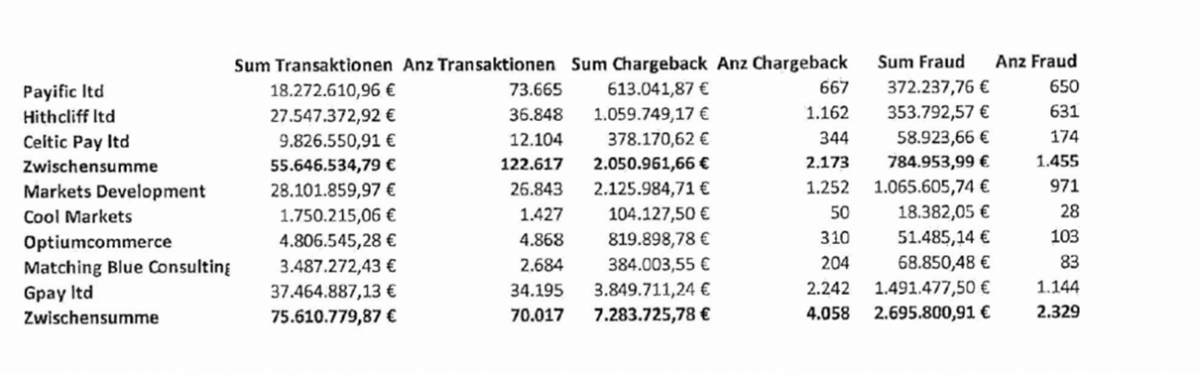
Communication and agreements directly with the Ultimate Beneficial Owners
The operating companies (merchants) of those online fraud trading scams have been shell companies, mostly British, with nominee directors and nominee shareholders. Although the majority of contracts between Payvision and the companies operating the scams were signed by these straw men, according to the statements made in interrogations of these people, there were neither any communications nor meetings between them and Payvision. The communication was done by and the agreements were made directly with the Ultimate Beneficial Owners (UBO) behind the scams. Uwe Lenhoff and Gal Barak discussed all the scam details amongst themselves. On the side of Payvision, communication at the board level was either done by Rudolf Booker or by Gijs op de Weegh.
Personal relationships
Rudolf Booker and Uwe Lenhoff had a private and close relationship. For example, they went on joint skiing holidays, which can also be concluded from the tapped telephone logs between Rudolf Booker and Uwe Lenhoff. Although the acquiring contracts between Payvision and the fraudulent brands were terminated in December 2018, business phone calls between Rudolf Booker and Uwe Lenhoff took place until the end of January 2019. The last call took place two days before Uwe Lenhoff was arrested.
Total amount of money stolen
The companies attributed to Uwe Lenhoff and platforms generated a total turnover of €55,646,534.79 – stolen – with Payvision. The companies and platforms attributed to Gal Barak show a total turnover of €75,610,779.87 with Payvison. Chargebacks are a repayment process which is initiated by the credit card holder.
Rudolf Booker stated that although the chargeback rate was high, Gal Barak achieved around 65% and Uwe Lenhoff around 40% of repayments. Payvision’s own fees were charged for these chargebacks. Later a ‘single rate’ was introduced, which included the commission and chargeback fees. In short, Rudolf Booker was aware of all the chargebacks by the distressed victims. He just didn’t seem to care.
The amounts stated only cover the schemes from Uwe Lenhoff and Gal Barak, not all the other scams which have been and probably are still processed by Payvision. Plus, which are being processed as a subsidiary of ING.
Warnings from European supervisory authorities
There had already been warnings published by various financial market supervisory authorities against the fraud schemes from Uwe Lenhoff and Gal Barak, from 2016 onwards. However, Payvision ignored all of them.
Reward for the founders and board of Payvision
In September 2019, ING bought the remaining 25% share in Payvision, even though ING must have known about the kind of business Payvision was involved in. ING ‘rewarded’ Rudolf Booker and his partners with even more money. At the same time, hundreds and thousands of unsuspecting European consumers have suffered from having been ripped off and having lost their lifetime savings to scammers with the support of Payvision.
“The European Funds Recovery Initiative (EFRI) is based in Vienna. EFRI is an investors protection initiative to fight for the right of victims of investments scams. Payvision is Netherland´s Wirecard, thus a company helping scammers in big style fraud. We filed a money laundering complaint against Payvision already in the summer of 2019. With the additional information that we have now, as well as the detailed information on the total volume, we are about to send an updated version to the Dutch Central Bank in charge for Payvision. We are requesting the restitution of the payments to the victims from Gal Barak and Uwe Lenhoff as enclosed from Payvision. So far, there is no response from them. We are taking legal steps against Payvision,” says Elfriede Sixt, auditor, tax advisor and founder of EFRI.
- 05:00 am

Synechron, Inc., a leading Digital Transformation Consulting firm for the financial services industry, announces the launch of its InvestTech Accelerator program built for the investment management and asset management sector of the financial services industry. This is the eighth Accelerator program that Synechron has launched in the last five years and offers five real-world solutions that meet the growing demands and address the pain points of the institutional investment management industry. Current challenges include shrinking margins, the need to create operational efficiencies, addressing risk management issues and meeting the growing demand for personalized investment services. These new Accelerator solutions respond to the need for evolving technologies and digitized ways of working with and for clients, as well as automating processes for buy-side firms that include tracking regulatory compliance requirements.
Synechron’s fresh new InvestTech Accelerator program’s solutions are built to solve some of the current challenges and add value through time and cost savings. These future-forward solutions are built through Synechron’s own internal R&D efforts in close collaboration with key investment industry firms’ leaders.
The new suite of InvestTech Accelerator solutions includes the following:
ESG Booster: Provides a fresh way to “score” Environmental, Social & Governance (ESG) portfolios and individual companies based upon multiple external data and inputs and can recommend alternative component companies for enhanced ESG scores and performance.
WillPower solution: Safeguards the digital assets, documents/records/videos necessary for an easier estate planning process by providing a blockchain-led centralized digital safe deposit box and to facilitate inheritance of digital assets.
VisualRE tool: Provides a comprehensive predictive analysis model of real estate funds, commercial real estate properties and Real Estate Investment Trust (REIT) securities, for possible external stresses and tenant/property owner defaults based upon the ingestion of data across varied sources.
360+: Provides a dashboard-presented holistic 360 degree picture of each customer and their portfolio based upon individual preferences and behavioral patterns, and allows better targeting of investment products/services.
Digital Compliance: Enables the automatic intake of all new and changing detailed regulatory promulgations and mandates applicable to the investment/asset management industry and enables customization for compliance professionals to work smarter and faster.
Synechron’s new InvestTech Accelerator program brings together the firm’s Digital, Business Consulting and Technology experts. Our newest digital tools and data science-led solutions seek to enhance the initiatives of the asset management firms’ leaders toward doing a better job of analyzing investments—particularly ESG and Real Estate investment securities—as well as assessing performance risks/rewards. One new tool also enables gaining a deeper, more holistic view of each customer and their receptivity to new products and services. In addition, these solutions facilitate the development of an industry-leading blockchain-based centralized digital repository for clients’ assets and key documents, and automate the now-cumbersome manual systems for regulatory/compliance awareness and responsivity. In developing these InvestTech Accelerator solutions, Synechron has partnered with some of the largest, most innovative and forward-thinking data and technology firms who will help power our Accelerator solutions.
“Leveraging our award-winning global Financial Innovation Labs (‘FinLabs’), we collaborated with leaders across the investment management industry, as well as numerous external innovation partners, to innovate artificial intelligence and predictive analytics-driven solutions for these firms real-world struggles,” said Sandeep Kumar, Managing Director, Head of Synechron’s InvestTech Accelerator Program. “These will address multiple use cases and can be fully-customized to the particular needs and nuances of each firm, utilizing the underlying technology components as building blocks,” he added.
“Since 2016 when we launched our very first and industry-pioneering Blockchain Accelerator program for the benefit of the financial industry, Synechron continues to invest heavily in R&D and develop ways to apply new, cutting-edge and digitally-forward accelerated technology solutions to solve many of the global financial services industry’s most difficult business and operational challenges,” said Faisal Husain, Synechron Co-founder and CEO. “We don’t invent solutions then chase problems to back them into. Instead, we actively work with the financial services industry’s participants to identify pain points and business blockers, then leverage our digital and technological expertise and our technology innovation partner firms to ideate, build and deploy smart and targeted solutions.” he added. “Our Accelerator program solutions not only seek to mitigate problems but can identify and help companies adapt and pursue new opportunities that can set them apart.”
- 03:00 am

Tribe Payments, an issuer/acquirer processor and payment technology provider, has been selected by payments prepaid specialist Lerex Technology to provide issuer processing services.
Lerex Technology makes setting up a prepaid payment card product simple, even for businesses that are completely new to providing payment services to their customers. Lerex offers a fast route to market, guiding and supporting their customers through complex processes, and offering the latest technologies including those from partner processors.
Lerex has selected Tribe to process card payments for Lerex’s customer’s end users across Europe. Tribe will be working alongside Lerex’s issuing partner Transact Payments Limited (TPL). Tribe’s modular approach to technology allows Lerex, Transact Payments, and service providers looking to launch payment card products to add and remove functionality as demands dictate.
With a modern cloud-based and API-driven platform, Lerex rapidly deploys the latest technologies from agency banking, acquiring, and foreign exchange. Combined with Tribe’s modular and ‘disposable’ approach to service provision, businesses looking to offer prepaid services can easily evolve and enhance payment products for their end users without sacrificing speed, scale, and security.
“Like Tribe, Lerex brings a fresh approach to the market, with the best use of new technology underpinning our programme management, coupled with guidance based on a wealth of industry experience,” said Richard Ney, CEO, Lerex Technology. “Working with Tribe means both we and our customers have the flexibility and choice needed to put together innovative products—all built on reliable, resilient technology.”
“Lerex and Tribe have many shared values, the key one being our commitment to making it simple for businesses in any vertical to offer innovative payment and banking services,” said Alex Kelly, VP of Customer Success at Tribe Payments. “By taking the technical headache away from Lerex’s customers, together we can help great businesses with innovative ideas get their products and services to market quickly without sacrificing quality.”
- 09:00 am

Avaloq has won the Best Transaction Processing Solution award at the WealthBriefing European Awards 2020. The awards programme, now in its eighth year, recognizes companies, teams and individuals at the forefront of the wealth management sector.
The award is the eighth accolade or industry citation that Avaloq has garnered in 2020, having recently been named Outstanding Wealth Management Technology Implementation – Back Office partner at the Global Private Banking Innovation Awards 2020.
Winners at the WealthBriefing European Awards 2020 were selected by three panels of experts comprised of bankers, trusted advisers and technology experts as the firms demonstrating innovation and excellence during 2019.
The judges commended Avaloq for the industrial strength of its transaction processing solutions and its excellent straight-through processing rates.
Avaloq Group CEO Juerg Hunziker said: “We are honoured to receive this prestigious accolade from WealthBriefing, a leading authority in wealth management. This award is a testament to our commitment to pursuing excellence and driving more innovation in the development of industry-leading digital platforms for all our clients.”
Avaloq’s market-leading core banking and digital SaaS and BPaaS solutions were also recognized by WealthBriefing earlier this year at the Asia awards edition.
- 04:00 am

Signicat, the Trusted Digital Identity™ company, today revealed new research that shows 63% of consumers in Europe have abandoned financial applications in the past year. The survey results—conducted in May and June 2020 during Europe-wide COVID-19 restrictions—are the worst since the report debuted in 2016 and show a sharp increase of 23 points from the 40% abandonment rate in 2019.
The fourth edition of Signicat’s annual study The Battle to Onboard 2020: The impact of COVID-19 and beyond is based on a survey of 4,000 adults across Belgium, Finland, Germany, the Netherlands, Norway, Sweden and the United Kingdom regarding their onboarding experience as well as their attitude towards financial service providers.
Why are abandonment rates so high?
For any business, knowing your customer (KYC) is challenging. Financial institutions must comply with KYC and Anti Money Laundering (AML) rules which requires the consumer shares personal information. All too often identity checking processes are not designed for the digital world:
- Over a quarter (26%) of consumers argue that the onboarding process is “difficult”.
- Over a quarter feel the onboarding process is longer than they expected (28%).
- Consumers have been spoiled by the ease of mobile-first financial service providers. Over two thirds (69%) consider mobile-first providers to be better than more traditional providers.
- Consumers are finally refusing to put up with substandard options—something Signicat believes is the end of “learned helplessness”.
Providers can no longer rely on learned helplessness
Learned helplessness is a phenomenon where if people find themselves in a negative situation for any length of time, they believe that they cannot change this situation—even if better options become available. The increased use of digital brands—effectively better options—is changing this attitude in consumers.
- Far more consumers are now using a mobile-first financial service, up from 30% in 2019 to 47% in 2020.
- Only 4% are unhappy with their new mobile-first provider. 69% are happier than before.
- 70% of those with a digital-first account say that convenience means they are more likely to use it every day.
As a result, we are seeing the “the end of learned helplessness”. Consumers have simply had enough of poor onboarding experiences and have begun voting with their feet. Banks have not responded sufficiently to this change.
It’s Gen Z, not millennials, that institutions need to worry about
The panic around meeting the expectations of millennials—the first digital natives—has been misplaced. Lots of ink has been spilled on their expectations and how this should shape how businesses work. It’s actually the generation after, known as Gen Z (18-24-year-olds), that are the real worry for institutions. This group will represent 30% of the world’s population and will make up a third of all global consumers by the end of the next decade.
This year’s survey findings indicate a growing expectation gap between demographics. Older groups—including millennials—are burdened with “learned helplessness” and are more inclined to put up with inadequate onboarding experiences. Whereas Gen Z show little tolerance for anything other than fast digital onboarding:
o Over a third of these younger consumers feel the onboarding process is longer than they expected (36%).
o Just under a quarter of Gen Z customers are abandoning applications due to lengthy processes (24%).
o They are also more likely to be deterred by too much detail (22%), and most likely to simply change their minds (24%).
The effects of COVID-19
Branch usage was already declining steadily before this year, with customers increasingly using digital channels to manage their finances. The pandemic has only accelerated this process and forced consumers to think about how they engage with financial services.
- Lockdown restrictions has meant 41% of consumers were unable to access financial services.
- Two thirds (68%) see pandemic-driven change as inevitable and expect 100% digital onboarding to be introduced.
“This year we have all been forced to start doing everyday tasks differently. For many that has meant managing the entirety of their financial lives using remote channels for the first time. And this is where some financial service providers' offerings have been found lacking,” said Sarah Kocianski, Head of Research, 11:FS. “Onboarding, in particular, is crucial. If customers can't or won't open new accounts, these organisations will struggle to cope with further economic turmoil. And it's not just the pandemic that providers have to get their heads around, other, pre-pandemic factors which have not been addressed are exacerbating potential customers' failure to complete onboarding.”
“In short, providers should prioritise ensuring customers can apply, open, and start using accounts quickly and digitally if they want to compete in today's environment,” concludes Kocianski.
“In the time since Signicat started the Battle to Onboard series of reports, we’ve seen some indications of improvement, with traditional financial institutions running as fast as they can to keep up with growing consumer expectations,” said Asger Hattel, CEO, Signicat. “Institutions have clearly improved their on-boarding processes. But customer expectations continue to outpace reality—largely due to the digital-first onboarding experience offered by challenger banks and fintechs. Financial services providers simply need to run much faster to avoid losing out on new customers.”
The report The Battle to On-Board 2020: The impact of Covid-19 and beyond is available for download here: http://signic.at/btobpr.
- 03:00 am

SEON, the fraud fighters, today announces it has partnered with Unikrn, the global leaders in esports betting, to help in identifying potential bonus abusers as well as users who attempt to open multiple accounts.
Esports as an industry has great growth potential. However, when any market rapidly accelerates, fraudsters are usually on hand looking to exploit any weaknesses in a brand's system. Therefore, Unikrn stepped up its fraud prevention operations by seeking the expertise of SEON to ensure that only genuine users access its platform and help the company comply with the IOM Gambling Supervision Commission’s regulations.
Unikrn, by integrating SEON’s tool via Chrome extension and utilising SEON’s Sense platform, will have near-immediate access to SEON’s services. Additionally, it will also have access to rich data taken from the email, phone number or IP addresses it gathers from customers, while also collecting all accessible data points about customers’ digital footprints from social media profiles, available via open sources in the public domain. This allows Unikrn to help prevent fraudsters committing bonus abuse fraud — where fraudsters create multiple accounts to claim promotions run by businesses.
Having launched in 2014 as a collaboration between Rahul Sood and Karl Flores, Unikrn has become one of the world’s leading esports companies by building extensive crossroads between betting, gaming and emerging technologies. Its team has been driving innovation in bookmaking for esports and video games for years and has patent-pending technologies underpinning the world-renowned platform.
Kirsty Knight, Head of Compliance at Unikrn, said: “Our mission is to always ensure our customers have a safe place in which to enjoy and bet on esports. This partnership with SEON and its innovative fraud prevention offering helps us to keep fraudsters out and provide additional security and protection.”
Tamas Kadar, CEO and Founder at SEON, commented: “Esports is a key sector for us and where we feel we can provide real value in fighting fraud. We’re proud to be partnering with Unikrn and working closely with them to ensure they use our platform to its full potential. We look forward to growing our relationship even more and help each other to improve our offerings.”
To learn more about SEON’s services, visit: https://seon.io/.
- 02:00 am

Ziglu, the challenger and fully FCA authorised Electronic Money Institution, has announced the appointment of James Sullivan as its Chief Legal Officer.
James joins Ziglu from Monzo where he was Head of Legal and Acting Company Secretary. At Ziglu, his key responsibilities will include growing the team, supporting and protecting the business as it continues on its trajectory of product growth and international expansion.
Commenting on his appointment, James Sullivan said: "It was always going to take an exceptionally exciting opportunity to move on from Monzo. In the last few months Ziglu has launched its exchange and payments app, been licensed by the FCA and is knocking it out of the park with its first crowdfunding on Seedrs. It’s been an impressive journey in just a few months. I’m incredibly excited to be joining the Ziglu team as the business enters its high growth phase and starts to target international expansion."
Mark Hipperson, Chief Executive Officer at Ziglu, said: “I am delighted to welcome James Sullivan to the Ziglu leadership team. He brings a wealth of experience in transformational fintech and will be integral to our international growth. James will be a great addition at Ziglu and we welcome him to the incredibly talented team.”
James joins the company in the midst of a crowdfunding round, which is 300% funded, at just over £3 million from over 1,100 investors. This follows the £5.25 million it raised in seed funding in June 2020. These funds will enable Ziglu to expand both its technology and product teams and become a global challenger.
Ziglu is authorised by the Financial Conduct Authority (FCA) as an Electronic Money Institution (EMI) and is one of the first digital currency companies to be registered under the UK’s 5th Money Laundering Directive.
- 02:00 am
A new study from Juniper Research has found that the value of unsecured loans issued via AI underwriting platforms will reach $315 billion in 2025, up from just $24 billion in 2020. This extraordinary growth of over 1200% over the 5 years will be driven by lenders seeking to leverage AI to rebuild and streamline their lending operations following the dramatic impact of the pandemic.
The report identified that lenders, who have been reeling from the effects of bad debt write-offs and repayment holidays, will seek to leverage AI models in order to more accurately assess and mitigate the risks that consumer and business customers represent. This will enable lenders to build more sustainable lending models in the wake of the unprecedented economic turbulence.
For more insights, download the free whitepaper: Banking Efficiency with AI ~ 3 Key Use Cases.
Consumer Lending to Account for the Majority of AI Underwritten Value
The new research, AI & Automation in Banking: Adoption, Vendor Positioning & Market Forecasts 2020-2025, found that consumer lending is driving overall AI lending and will account for 66% of loans by value underwritten by AI in 2025. AI, when combined with services such as Open Banking, can build a comprehensive picture of financial status and anticipate future risks. Juniper Research recommends that lenders leverage these AI capabilities to expand their portfolios post-pandemic to those without detailed credit files.
Research co-author George Crabtree explains: ‘Expanding lending operations into untapped areas of the market is a critical way in which banks can not only increase their own revenues but also compete more effectively with rival fintech services’
Roboadvisor Assets Under Management Set to Soar
The research also found that roboadvisors, where AI actors manage investments for users, will account for over $3 trillion in assets under management in 2025, from $500 billion in 2020. Rather than selling services directly to users, roboadvisors should partner with large banks. This enables roboadvisors to access large groups of potential users who are underserved by current wealth management propositions, growing revenues while keeping customer acquisitions costs low.
Whitepaper download: https://www.juniperresearch.com/document-library/white-papers/banking-efficiency-with-ai-3-key-use-case.
AI & Automation in Banking market research: https://www.juniperresearch.com/researchstore/fintech-payments/ai-automation-banking-trends-report.








