
Published
- 07:00 am
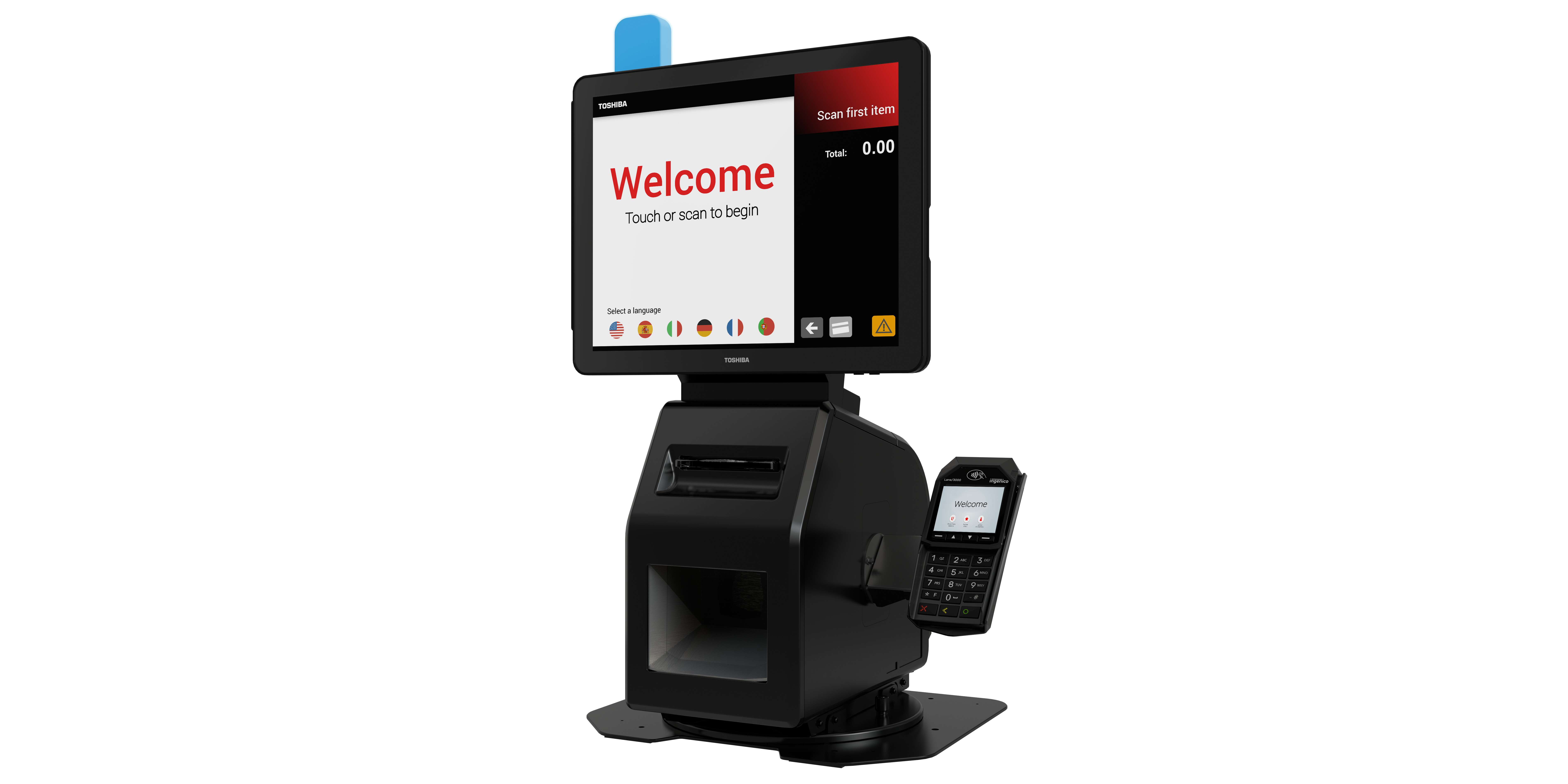
Worldline [Euronext: WLN], the European leader in the payments and transactional services industry, today announces it has strengthened its relationship with long-term partner Toshiba Global Commerce Solutions, a global market leader in retail store technology. The next stage of the retail powerhouses’ partnership will see them bring to market the Pro-X Hybrid Kiosk with payments processed via the Worldline LANE/3000 Terminal, allowing retailers to reimagine their store design and increase throughput capacity.
In line with the needs of both retailers and shoppers for a low-contact checkout, particularly in the convenience, speciality, small format grocery and hospitality sectors, the Pro-X Hybrid Kiosk presents a versatile small footprint kiosk. This option of using convertible POS technology gives the retailer the flexibility to immediately react on customer flow, while always providing an easy to use, secure and seamless shopping experience for customers.
Toshiba’s solution enables retailers to enhance the in-store customer experience by proactively managing queues, meeting shopper’s expectations of a fast and frictionless checkout, and providing more self-service touchpoints where needed. It also helps preserve precious counter space for retailers with its small footprint that can perform self-checkout or traditional register functionality to meet the shoppers’ and retailers’ needs.
The integrated LANE/3000 terminal offers retailers fast and secure transactions, meeting the latest safety requirements for Payment Card Industry PIN Transaction Security (PCI-PTS) 6.x and Point-to-Point Encryption (P2PE). Together, this powerful combination means that Toshiba and Worldline are helping retailers to optimise the layout of their stores through a more flexible approach to the point of payment and providing a more sophisticated checkout experience.
Rob Macintyre, European Business Development Executive of Toshiba, said: “The self-service industry continues to evolve as retailers across all retail segments invest in digital capabilities to support shoppers' expectations of low-contact checkout. We are delighted to work with Worldline to bring checkout innovation to retailers across the European marketplace. Now, they bring their payment expertise and Tetra Lane 3000 augmenting the Pro-X Hybrid Kiosk to provide a next-level checkout experience to customers.”
Lee Jones, Managing Director Northern Europe, GSV at Worldline, commented: “As the way consumers want to pay is evolving, Worldline is committed to staying ahead of the game in order to keep our retailers relevant in this ever-changing market. That’s why we are proud to continue our close cooperation as a trusted global payments leader with Toshiba. This partnership strengthens our joint ability to deliver innovative end-to-end solutions, and together we are creating an even stronger offering.”
The Pro-X Hybrid Kiosk is currently in pilot phase with a number of retailers across Europe, including a high-profile sports and fashion retailer, having been launched in March 2021.
The Lane 3000 is already the PIN pad of choice for many European retailers.
Following the launch, both Toshiba and Worldline will continue to work together to develop integrated products that enhance mutual business opportunities and cover more vertical markets.
- 08:00 am

The global shift towards a cashless society created a huge space for mobile wallets as a safer and more convenient way of managing money. However, the entire sector boomed amid the pandemic as people started questioning the safety of using banknotes for fear of transmitting the virus.
According to data presented by TradingPlatforms.com, digital or mobile wallet payment was the most used point of sale payment method globally, with a 21.5% market share in 2020. By 2024, mobile wallets are set to become even more popular, making one-third of all POS transactions worldwide.
Digital Transactions Rise, Cash Payments Continue to Drop
Over the last few years, mobile payment services provided hundreds of millions of people access to electronic transactions, especially in underbanked markets in Africa, Asia and Latin America. However, they also become very popular among tech-savvy consumers in developed countries.
The digital transformation of the global payments industry, fuelled by the COVID-19, led to the impressive growth of the entire mobile wallets market. Over the last two years, the transaction value of the entire sector doubled and is expected to hit nearly $2.5trn in 2021. The number of people using mobile wallets to make payments surged from around 900 million to 1.48 billion in this period.
In 2020, 25.7% percent of all POS payments were made using mobile wallets, revealed the Global Payments Report 2021. By 2024, this figure is expected to jump to 33.4%.
The survey also revealed that mobile payments made 44.5% of all eCommerce transactions last year, two times more than credit cards and three times more than debit card payments.
Credit cards and debit cards are expected to hold the same market share in the next two years, making around 22% of POS payments each. However, cash transactions are set to witness a significant drop, falling from 20.5% in 2020 to 12.7% in 2024.
Mobile Wallets to Become $4T Worth Industry by 2024
The Statista data showed the mobile payments segment is forecast to continue booming in the following years, both in terms of users and transaction value. In 2021, 1.48 billion people worldwide are expected to use mobile payments services, producing a $2.48trn transaction value. In the next three years, mobile wallets are set to become a $4trn worth industry with nearly 1.8 billion users worldwide.
Generally, the mobile wallets market is dominated by Asian countries, spearheaded by China as the global leader. According to the Statista survey, the transaction value of the Chinese mobile payments market is forecast to reach $1.3trn in 2021. By 2024, this figure is set to jump to over $1.8trn, or 45% of all mobile wallet payments globally.
Western countries are far behind in terms of usage, with many people still preferring cash, credit, and debit cards. The US ranks as the world's second-largest mobile payments market, with $468bn worth of transactions or nearly three times less than China. However, statistics show the US market is set to witness impressive growth in the following years, with transaction value growing by 80% to $840.7bn in 2024.
The United Kingdom is the third-largest mobile wallets market globally, expected to reach $97.6bn transaction value in 2021, a 43% increase in a year. By 2024, mobile POS payments in the country are expected to grow by another 92% and hit a $187.7bn value.
The full story can be read here: https://tradingplatforms.com/blog/2021/06/07/mobile-wallet-payments-to-make-one-third-of-all-pos-transactions-by-2024/
- 09:00 am

The ai Corporation (ai), an FCA approved expert in payments, fraud and risk management, today added a Dark Web Managed Service to its suite of enterprise fraud solutions. Powered by Dark Web experts Skurio's cloud-based technology, the new managed service will enhance ai's fraud capabilities even further. Enabling ai's users in the payments and financial industries to protect themselves against cybersecurity threats emanating from the Dark Web.
The latest addition to the aiFraud Managed Service will provide users with best-in-class cyber intelligence. Automatically scanning websites, marketplaces, and forums to detect incidences of leaked sensitive data. Alerts are generated when any information matching specific search terms appears on the Dark Web, creating an early warning service to both businesses and consumers.
Dr Mark Goldspink, CEO of ai, says: "The battleground in the fight against fraud must now include the Dark Web. With the increase in fraudulent activity, it is vital that ai continues to find ways to mitigate and protect our customers even further. Our partnership with Skurio coupled with our automated aiAutoPilot MLTM technology will ensure that our existing users receive a best-in-class fraud prevention solution, which helps them stay ahead of the fraudster."
According to ai's data:
- Dark web traffic has increased by 300% over the last year, as more criminals look to commit fraud remotely due to COVID restrictions
- Despite increased levels of security, the price of stolen card details on the Dark Web has increased due to increased demand
- Last year (2020), stolen card testing fraud increased by up to 225% – these cards were almost certainly purchased on the Dark Web
Jeremy Hendy, CEO of Skurio, says: “We’re delighted to partner with ai to bring our Dark Web monitoring technology to their world-leading fraud detection and prevention platform. Cybercrime is now a trillion-dollar industry, where criminal gangs buy, sell, resell and trade compromised card information across an increasing number of shady forums and marketplaces. Skurio’s automated monitoring technology provides early warning when cardholder data is leaked, marketed or sold on the Dark Web, hacker forums, and dump sites, allowing ai customers to take immediate action to block compromised cards and cut losses from fraud.”
ai's cloud-based, automated machine learning fraud detection and prevention tools help all types of issuers and acquirers, to monitor account and merchant activity using pre-authorisation and post-authorisation transaction data. Its unique self-service, fraud detection solutions are considered by many industry 'thought leaders' to be the best in the world.
Alongside stopping fraud, ai’s new flexible, aiAutoPilot MLTM orchestration technologies can be applied to many business processes, which require detailed consumer insight, including credit management, marketing (attrition) or pricing. ai’s solutions, including its' state of the art' machine learning/A.I, protect and enrich payments experiences for over three million multi-channel merchants, 100 banks and over 300 million consumer cardholders. ai also monitors over 25 billion transactions and authorisations each year.
- 03:00 am

Online mortgage broker Mojo Mortgages has announced the appointment of Cassie Stephenson as its new director of mortgages as the business looks to scale its team to 50 mortgage advisers across the UK over the next 12 months.
The business, which has expanded its team over the course of the pandemic, has experienced unprecedented demand over the past few months - driven by the need for a digital-focused service as well as a booming property market, with the ongoing Stamp Duty holiday playing a part.
Mojo, which now counts the likes of Uswitch, Zoopla and Snoop as digital partners, has seen year-on-year partner mortgage submissions rise by 165% compared to pre-pandemic levels, with traffic and enquiries to its site also up by 200% compared to the start of 2020.
Stephenson joins Mojo following her time at fellow online broker Habito as VP Operations, as well as previous spells at Atom Bank, Tesco Bank and Lloyds, and will play an instrumental role in helping to scale the award-winning broker over the coming months as society returns to some normality.
Commenting on her appointment, Cassie Stephenson, director of mortgages at Mojo Mortgages, said:
“I am delighted to be joining the team at Mojo as the business enters its next stage of growth. It’s no secret that the past year has been challenging but the market appears to be gaining some real momentum with new government-backed schemes, competitive rates amongst lenders and a bustling property market, so it’s an exciting time to join the team.
“Mojo already has such strong foundations, systems and amazing people - it’s now time to take what we have and accelerate it to make us the number one brokerage in the UK.
“No-one has really perfected the end-to-end process for customers yet and there is still some important work to do in this area. I also feel open banking hasn’t been utilised as much as it could be, with practices such as paper document requests still in place which feel so outdated. There is more work to do with lenders to allow automated submissions and execution-only experiences and this is one area I’ll be working on closely in the coming months. It’s certainly an exciting space to be in at the moment!”
Richard Hayes, CEO and co-founder of Mojo Mortgages, added:
“Cassie’s appointment will play a pivotal role in the future of Mojo as we continue to revolutionise the way consumers access mortgages, advice and information to an industry that still continues to baffle many people.
“We want to help customers to fully understand the process and become more financially confident by empowering them to learn more about mortgages and, of course, find the best deal for them. Not only for those that come to us, but across the wider industry.
“However, we do need more talented individuals to join us. We’re going through a hyper growth phase, so that means we need even more driven, proven mortgage experts to get on board. We have a number of fully remote roles available with further details on our website.”
For more information about Mojo Mortgages and its current vacancies, please visit: https://mojomortgages.com/
- 02:00 am

Zumo announces its key Signatory status of the Crypto Climate Accord (CCA), a global initiative which has been established with the sole aim of harnessing the collective efforts of the crypto community to support the industry’s transition to 100% renewable energy and achievement of net-zero emissions by 2040.
As a CCA Signatory, Zumo commits to work alongside other CCA Supporters on key projects which prioritise climate stewardship across the industry that seek to decarbonise the wider crypto sector. Zumo assents its time and expertise to facilitate and accelerate the development of the operating standards, tools, and tech necessary to achieve the objectives of the Accord.
Via voluntary open-source working groups and a ‘big tent’ approach, Zumo and fellow CCA Supporters will determine key areas in which their expertise can help to drive action, engage with stakeholders, and generate ideas and targets that all contribute towards realising the Accord’s shared vision of industry-wide decarbonisation.
Nick Jones, CEO of Zumo says of this announcement:
“Zumo has been climate neutral since our inception in 2018. The industry, of course is not. However, ours in an industry evolved purely from pioneering tech innovation, and through initiatives such as the Crypto Climate Accord, we are mobilising quickly through collective responsibility towards a clean-tech future.
As an early Accord Signatory, Zumo is committing proactive direct action to engage in knowledge-sharing initiatives and collaborative project development with our key partners to drive down the carbon footprint of our industry.
While today’s announcement is mostly about sharing the news of our Signatory status and trying to spread awareness of the Crypto Climate Accord, we have ambitious plans around how and where Zumo can specifically apply knowledge and expertise and in the open-source ethos of the Accord, we will be very open about sharing our learnings and our journey both within the framework of the Accord and beyond. Watch this space. We will have much to share over the coming months and years.”
- 07:00 am

Goji, a UK-based technology investment platform that provides individual investors with access to private asset investments, has achieved a 50% increase in assets serviced to £1.19 billion amid growing demand for its products from global asset managers in the year ended March 31, 2021.
Despite the challenging backdrop of the Covid-19 pandemic, Goji reported a 27% increase in its user base to 20,000+ individual investors and 690 corporates across over 65 jurisdictions, as global managers increasingly seek to distribute their funds to new pools of capital regardless of asset class or fund domicile. To further capitalise on this growth, Goji has announced the appointment of Premal Vadgama and Matt Chapman to spearhead business development, fulfil this surge in demand and help scale its growth. Vadgama previously worked in business development at Apex Fund Services, while Chapman joins from JPMorgan Chase & Co. where he worked in technology sales.
Goji’s technology automates the client due diligence, onboarding, payments, custody and reporting processes to enable private investment managers – such as private equity, private real estate and private debt fund managers – to seamlessly take on new investors including high net worth individuals, wealth managers and institutional LPs. Asset managers, fund managers and fund administrators can leverage the platform to manage investors securely and at scale, while allowing them to efficiently track their investment throughout its lifetime.
“We are thrilled to help a growing range of investors keep apace of developments and opportunities in the alternative investments sector as more managers seek to raise capital from new investor groups,” said David Genn, CEO of Goji. “We look forward to using our technology to help them improve the investor experience while driving operational efficiency as we continue our mission to make it as easy for investors to access alternative investments as their mainstream counterparts.”
“We are excited to welcome Premal and Matt to Goji,” continued Genn. “They bring a huge amount of relevant experience in the technology and asset management fields as we further build out our capabilities and gain traction with investors and managers. We’re looking forward to their contributions as we continue rolling out new products that enable individual and institutional investors to access private market investments.”
- 07:00 am

Highlights:
- 23 percent of UK respondents would go to a competitor if asked to visit a branch or post documents as part of applying for a financial account
- Younger age groups are less tolerant of disruption in opening accounts
- 79 percent are open to some use of their biometric data for security
- Biometric familiarity increasing but banks must explain how it is used
New data from FICO, the global analytics software provider, reveals the levels of consumer tolerance to new account opening security checks. With 23 percent of UK respondents admitting to going to a competitor if asked to visit a branch or post documents as part of the digital application process, it’s clear that financial services providers need to get the balance right on security checks and a smooth customer journey.
More information: https://www.fico.com/en/latest-thinking/ebook/united-kingdom-consumer-survey-2021-identity-proofing-and-digital-banking
According to the FICO data, if asked to visit branches or post documents, only just over half of customers (52 percent) will complete the process as soon as possible, while nearly one in three (31 percent) will give up completely or go to a competitor.
The risks of abandonment continue when customers are asked to scan documents and email them or use an identity portal. When asked to do so, 17 percent have gone to a competitor, and 8 percent have quit the process.
Generation Y Want to Stay Digital
Consumers between the ages of 25-34 – millennials – are the least tolerant to disruption caused by the ID checking process. 42 percent would abandon the process if it required them to mail documents or visit a branch. If required to scan and email documents or use a separate identity portal, 35 percent would leave the application.
“Our data shows intuitive but flexible customer journeys are required,” said Matt Cox, vice president for fraud in EMEA at FICO. “Some people are happy to provide selfies, others want to scan documents. What individuals can do – or can be encouraged to do – is personal. This makes intuitive apps and education crucial if financial services providers are to be successful at new customer acquisition.”
The role of the various digital channels available to consumers is also important for businesses to understand. Age seemed to play a strong factor in choice, as the older people were the more likely they were to prefer websites over apps for opening an account.
Preferences for Opening an Account Digitally
Age | Prefer App | Prefer Website |
Under 25 | 35% | 13% |
25-34 | 33% | 32% |
35-44 | 22% | 45% |
45-54 | 17% | 50% |
55-64 | 11% | 53% |
65+ | 5% | 53% |
Source: FICO Survey 2021
Biometric Data
Awareness of biometrics is quickly spreading and today most people are open to providing their bank with a facial scan, fingerprint or voiceprint to secure their accounts. A small percentage think banks should never hold biometric data and it is important for many to understand why financial organisations are doing so.
Respondents were asked to select the description that best fits their comfort with biometrics and attitudes towards banks capturing this data. The survey found 38 percent are happy for banks to do so if they explain why, 28 percent are comfortable with banks saving biometrics, and 13 percent said they would provide the data but were not happy about it. Another 13 percent would never provide biometrics to banks or other financial organisations and 9 percent remain unsure.
While older age groups were slightly more likely to say banks should never capture biometrics to protect accounts —17 percent of over 65s compared to 5 percent of 18-24-year-olds — there was generally little variation across age groups in the acceptance and use of biometric security checks.
Few Know the UK Government Holds Biometric Data
Consumer understanding of biometrics is, however, the potential weak link in wider online finance adoption.
Respondents to the FICO research were asked to select organizations they believed already had their biometric data. In the UK, while all current passports are biometric and approximately 76 percent of citizens hold a passport, only 27 percent of respondents thought the government held their biometric data. Social media platforms use biometrics to ‘tag’ people in photographs but only 10 percent identified this as an example in the FICO study. And only 17 percent thought they had given biometric information to their phone providers. If the data never leaves their phone the other 83 percent are correct, but if it is transferred and stored then they are wrong.
“Consumers are familiar and comfortable with using their fingerprints to unlock their phones, for example, but do not consider this to be providing biometric data,” concluded Cox. “Using biometrics from a mobile to unlock financial accounts can mean analysis of the biometric takes place at the bank, but customers already familiar with the process might not perceive it as such. Confusion surrounding biometrics is understandable but must be addressed by financial service providers that wish to use this type of data.”
FICO has released two podcasts for the UK featuring FICO’s fraud experts and Iona Bain, founder of the pioneering Young Money Blog, the UK's foremost blog dedicated to young people's finances: Identity Theft, COVID-19 and Digital Acceleration and Digital Natives, Disruption and Application Abandonment.
- 05:00 am

Chirag Shah, CEO, Nucleus Commercial Finance comments on today’s BDO Optimism Index:
“After a year filled with uncertainty, it’s extremely encouraging to see business optimism continuing to rise, despite continued cause for concern around new Coronavirus variants. The optimism and passion of SME leaders is what will help to drive UK SMEs forward and enable them to look beyond the pandemic.
“Our own research found that nearly a third (31%) of SME leaders are optimistic about all restrictions lifting on June 21st, but 26% believe that the removal of all restrictions by this date will be delayed.* Regardless of how and when all restrictions end, business owners should rest assured that there is help at hand, in the form of government support and SME finance. This finance can be matched to what they need and delivered quickly to help them thrive now and for years to come.”
- 03:00 am

TraditionDATA, the data and information services division of Compagnie Financière Tradition (Tradition), has added more depth to its alternative data set following Tradition’s execution of its first TONAR-SOFR cross-currency basis swap.
Tradition’s London Yen desk executed a Japanese Yen/Tokyo Overnight Average Rate (TONAR) vs US Dollar/Secured Overnight Fixing Rate (SOFR) cross-currency basis swap trade, which will be processed via LCH’s SwapAgent, a service for the non-cleared derivatives market.
This SwapAgent valued trade is the first interdealer broker managed cross-currency alternative reference rate (ARR) transaction which will serve as the future format for JPY-USD cross-currency swap transactions post-LIBOR.
The trade was transacted between two of the largest global banks and further highlights the ongoing desire from customers to have access to new products that will flow directly into the rapidly expanding TraditionData business.
As liquidity continues to build, TraditionDATA’s position as an independent global data provider means it can further improve the quality and depth of its data and analytics.
Jeffrey Maron, Global Head of Product at TraditionDATA, said: “The collection of data sourced from our independent global brokerage desks is vital to meeting our customers’ data requirements and supporting them through the LIBOR transition. We are committed to collecting additional datasets and building new products as part of our drive to support our diverse global customer base.”
Nathan Ondyak, Global Head of LCH SwapAgent, said: “This trade is an important step for the cross-currency swap market, as the industry continues to push forward with the transition to alternative reference rates. We are delighted to support Tradition as part of LCH SwapAgent continuing to provide new areas of the market with standardization and efficiency to support trading activity in the bilateral derivatives market.”
- 09:00 am

Highlights:
- A top priority in the digital agenda
- Hyper-personalisation of investment proposals is the most relevant goal
- Far from a data-driven culture
- Hyper personalisation is mostly useful to elevate customer experience
Objectway, a leader in the Digital Wealth & Asset Management software, publishes today the survey report “Are you developing a hyper-personalised strategy?” describing the results of the online survey filled out by domestic and overseas Wealth & Investment Managers.
The paper illustrates interesting findings on the applications of hyper-personalised services in Wealth Management, and how firms are leveraging them to increase the customer base and ensure their future growth.
A top priority in the digital agenda
More than half of the surveyed wealth managers have developed or are working on a hyper-personalisation strategy, showing that it’s going to become a top priority of their digital agenda, particularly now, as it could represent the future of customer engagement post-Covid.
Hyper-personalisation of investment proposals is the most relevant goal
4 out of 10 respondents are implementing hyper-personalised portfolio construction and product recommentations, where artificial intelligence, data analytics and machine learning are applied to create personalised proposals, which is the most important achievement, according to one third of the surveyed panel.
Bespoke financial planning (18%) and risk profiling (18%), and reporting (16%) are equally placed, underlining that leveraging advanced technology to analyse client behaviour enables to provide a well-rounded tailored advice on investment decisions.
Far from a data-driven culture
Only 25% of interviewees can effectively rely on behavioural sciences and sentiment analysis to personalise client experience, while most of the respondents (67%) would like to leverage them.
Financial advice and reporting are usually data-driven, but the information used to this purpose is generally very limited. So, there is a long way to go before AI-driven technology will be at the centre of hyper-personalisation in Wealth Management.
Alberto Cuccu, Objectway CEO International, commented “To hyper-personalise the client experience, investor’s information and preferences should be captured at all touch points of the client journey. Almost half of respondents argues that the use of hyper-personalisation is essentially aimed at elevating customer experience and consequently to gain a competitive advantage. So far, the Wealth Management industry has still to work on it. This confirms that it will be a major topic for the years to come.”
The full survey report from Objectway can be downloaded here: https://www.objectway.com/insights.
On June 15th Objectway and EveryoneINVESTED will host a webinar, reserved to financial institutions, where they will reveal how to leverage investor risk profiling, gamification and behavioral technology to
boost conversion of digital onboarding processes and enable superior advice for a long-term relationship: to register CLICK HERE.








