
Published
- 04:00 am

Cloud technology is driving change and accelerating digital transformation across multiple industries simultaneously. Not only is cloud technology itself evolving at pace, but the way organisations buy and manage software is having to adapt as well.
Marilyn Moodley, Country Leader for South Africa and WECA (West, East, Central Africa) at SoftwareONE, says navigating multiple systems, processes, and software licence agreements presents a significant challenge. “Software is one of the largest expenses for many organisations. But the buying, optimising and management of that software requires the right balance between tools and digitisation, processes and expertise that work together to reduce costs and the administrative burden on IT and procurement teams.”
She says the bourgeoning number of enterprise applications means IT procurement and asset managers are under increasing pressure to deliver efficiencies and cost savings while improving user experience through faster response times and automation strategies. “Taking into account the resources required to manage licenses and user requests, ensure compliance, and manage spend, organisations are constantly looking for ways to eliminate unnecessary IT costs and optimise contracts across their software and cloud portfolios.”
Moodley explains that IT Procurement functions need to evolve into connected, efficient and digitised operations to address business demands more rapidly and effectively. A software Digital Supply Chain (DSC) is created through a seamless, integrated set of systems and activities across the software lifecycle to support these goals through automating and expediting the purchase of approved products in a portfolio while streamlining the process of requesting and acquiring new software products and services, via the right channels.
“Ineffective software procurement processes pose compliance challenges as businesses don’t have on-demand access to the right information regarding their license entitlements and contract use rights, such as any applicable geographic restrictions or their renewal options that would let them make the right buying decisions,” says Moodley.
“Establishing a system of records, that holds trustworthy software entitlements and contracts data, combined with insights & analytics is one of the largest challenges facing organisations today, and a lack of an effective digital supply chain makes that even harder to accomplish. Missing renewal deadlines due to lack of visibility and monitoring is not only detrimental to productivity, it leaves little time to prepare for contract negotiations,” says Moodley.
She adds that because cloud and software are often some of the largest investments a company makes, it makes sense to take digital supply chain management seriously as a means of improving an organisation’s bottom line.
In addition to improved efficiencies, cost savings, and overall end-user experience, an effective digital supply chain embeds automation by eliminating time-consuming manual tasks and ensuring the right software is in the hands of the right user at the right time.
“Despite this, very few businesses have the tools to ensure that this spend is continuously cost-optimised and aligned with business objectives,” says Moodley.
SoftwareONE’s Digital Supply Chain (DSC) service, powered by the PyraCloud platform, solves a multitude of challenges by providing organisations with the right mix of tools, automated workflows and experts to more closely align software purchases to business requirements. The service allows customers to easily and effectively transact software licenses and cloud subscriptions; view the entire on-premises and cloud software estate; manage contracts; track, control and predict cloud spend across multiple providers; and identify cost saving opportunities across the entire software estate.
Moodley says there is a growing interest in this area. “As South African organisations mature their cloud strategies, business leaders are seeing the inherent value and importance of streamlining their supply chains. International examples are very instructive, as Omnico, a leading global guest engagement technology company headquartered in the UK, halved its cloud spend costs using SoftwareONE’s PyraCloud and managed cloud services. South African organisations who want to remain competitive should be putting a digital supply chain in place if they haven’t already.”
- 04:00 am

Axion Global Digits (" Company") is pleased to announce that its subsidiary, Axion Global Innovation Centre ("AGIC"), is joining the vibrant and growing fintech community with the establishment of an office at the FINTECH CENTRE @INNOCENTRE of Hong Kong Science and Technology Parks Corporation ("HKSTP") in Kowloon Tong
Launched in January 2021, HKSTP FinTech Centre is an ideal platform for the fintech community to accelerate open innovation and foster cross-industry co-creation and commercialization. The Company believes our presence at the HKSTP FinTech Centre will provide AGIC with a focal point for partnering, business matching, research & development and nurturing of talent for fintech innovations.
Hong Kong's fintech market has developed rapidly in recent years. By becoming part of HKSTP's ever-growing fintech community, it will provide AGIC with a strong support network to accelerate R&D efforts in bringing the next generation of financial technology solutions to the market. The Company has initiated many product development projects to date, including DocuRoom, a next-generation secured virtual document portal designed for the virtual asset market, due to be launched in the second half of 2021. Another focused area of research and development is Identity as a Service ("IDaaS") to enable seamless and secure credential authentication. Its cloud-based and artificial intelligence technology can be applied to many scenarios and improve the efficiency and security of identity management.
Mr. Gavin Ho, Director, Strategy & Innovation of Axion Global Digits commented, "We are excited to become part of the HKSTP FinTech Centre community. This move marks an important milestone in fintech innovation for the Company this year. It also demonstrates our commitment to executing our fintech business strategy. We look forward to collaborating with HKSTP and their network companies to foster the development of fintech ecosystem in Hong Kong."
- 05:00 am

HSBC has launched an Application Programming Interface (API) Developer Portal, providing customers with direct access to a suite of tools with which they can integrate the bank’s API solutions into their own products, as well as make use of a secure testing environment.
The portal enables customers and developers to easily find the right APIs for their business needs, access the technical documentation, and try out APIs in the test environment, enabling rapid integration into their own products.
Initially, the portal will provide access to treasury payment and account information APIs, and a number of APIs for trade processing, custody holdings, bank guarantee status and global disbursements. The portal also allows third party providers in the 15 markets where Open Banking Regulation has been implemented to access payment and account information APIs for retail, business and corporate banking.
HSBC will be regularly enhancing the portal with more API solutions over the coming months, and will continue to make enhancements to the customer and developer experience. Eventually, the portal will house all of the bank’s regulatory and non-regulatory APIs.
Nadya Hijazi, Head of Digital, Global Liquidity and Cash Management at HSBC, said: “APIs are the future of corporate-to-bank connectivity, and the launch of our Developer Portal is the natural next step.
“By opening up our API suite to customers and developers, we’re enabling them to rapidly integrate our solutions into their own products. Embedding our insights into customers’ own businesses will make them more resilient, and less dependent on the limitations of their own technology.”
Malcolm Leach, CTO at Flagstone Investment Management Limited, a leading UK cash deposit platform and the first HSBC customer registered to the new portal, said: “Pushing the boundaries of technology helps us deliver greater value to our clients, and HSBC’s API Developer Portal gives us access to the right APIs to streamline our integration with the bank. As a result we spend less time working on the technical detail, and we are free to focus on our enhanced proposition.”
- 04:00 am

AYLIEN, a leading provider of AI-powered risk monitoring and management solutions, has been announced as the Most Disruptive Fintech and Overall Winner in the Deloitte Financial Services Innovation Awards 2021 for their AI-powered Risk Identification and Monitoring Solution, RADAR.
The awards, run by Deloitte in partnership with Financial Services Ireland (FSI) and the Banking and Payments Federation Ireland (BPFI), recognise innovation by financial services-focused companies who solve long standing problems for the industry, address niche segments in a new way, or improve internal operations for financial services providers. The winners were announced on Thursday, 3rd of June, and AYLIEN were chosen from over 100 submissions for their innovation in the risk monitoring and management space, which is set to revolutionize the way financial services organizations manage their risk.
David Dalton, Head of Financial Services, Deloitte Ireland, said: "The judges were very impressed by the impact AYLIEN's product RADAR had on their customers, particularly in operational effectiveness. They identified an ineffective, manual process and developed a truly innovative product. Their innovation has allowed their customers to transform and operate more effectively, meaning highly skilled employees can focus on areas where they can contribute significantly higher value."
AYLIEN's risk identification and monitoring platform, RADAR, transforms how analysts in financial services identify and monitor potential known and unknown risk events on a global scale with beta users of RADAR identifying 10x more potential risk events coupled with an efficiency gain of over 70% in their current investigation processes.
Using proprietary Natural Language Processing (NLP) technology, RADAR aggregates and understands vast quantities of unstructured data such as news, regulatory updates, company filings, and internal data sources providing early signals of critical risk events related to a company's customers, supply chains, competition, and investment strategies.
RADAR applies advanced, specialized, yet configurable human-in-the-loop AI to large volumes of unstructured data to help analysts expand their monitoring reach and transform ineffective manual identification and investigation workflows that are attributable to more than $36bn in fines and losses for financial services companies since 2008.
Commenting on the award, Parsa Ghaffari, Founder & CEO, AYLIEN, said: "RADAR is a transformative tool for risk professionals for uncovering new risks faster and more accurately than any of the existing solutions, and we're delighted that its potential has been recognised by the prestigious Deloitte Financial Services Innovation Awards and the high-profile judges. RADAR is currently being piloted by some of the biggest names in the financial services industry, and our pilot customers are already seeing significant improvements in the effectiveness of their risk monitoring processes, while saving hundreds of hours of analyst time."
AYLIEN currently works with the world's leading financial services companies such as Revolut, IHS Markit, and Wells Fargo, helping them uncover risk and opportunity signals from vast amounts of unstructured data sources and plan on launching their innovative risk identification and monitoring platform in Q3 2021.
- 07:00 am

Yesterday, news broke that Nayib Bukele, President of El Salvador, announced that he was soon introducing legislation which would make the country the first sovereign state in the world to adopt Bitcoin as legal tender. He made the announcement via video to the Bitcoin 2021 conference held in Miami, noting that implementation would be in partnership with a digital wallet company tasked with upgrading the country’s financial infrastructure to make the transition possible.
“While other countries are jockeying for position, trying to ensure that they are ready to launch a CBDC, El Salvador is moving the other direction, eager to adopt cryptocurrency in a different fashion,” said Richard Gardner, CEO of Modulus, a US-based developer of ultra-high-performance trading and surveillance technology that powers global equities, derivatives, and digital asset exchanges.
“What’s interesting about this move is that it could foreshadow a new approach taken by smaller countries with fewer resources to spend on infrastructure upgrades. The global powers are all certain to compete to make sure their own digital currency is king. CBDCs will help unbanked populations and will, very likely, also make banking far less expensive. Major powers will want to harness and consolidate the power of digital currencies for themselves. But, smaller countries like El Salvador may have just opened the door to a digital financial revolution utilizing technology which already exists,” noted Gardner.
Thus far, CBDCs have found willing audiences across the globe. The Bahamas launched its own digital currency, while China is rolling out beta testing of its e-yuan to trial segments of the population in key cities. The EU, Britain, and the United States have all started to evaluate how virtual currencies would enhance their own financial systems.
“CBDCs are the new frontier in digital assets. But El Salvador is moving with vigor to be the first nation to embrace Bitcoin in this fashion, putting it on par with the US Dollar. While the country has a relatively small economy, it is a symbolic step which indicates its president is interested in a blockchain future. The technology behind Bitcoin and CBDCs is truly revolutionary. There will be many ways to harness its power, and the industry should watch how the Central American nation rolls out its financial infrastructure to allow for adoption, assuming that the legislation passes into law,” said Gardner.
Modulus is known throughout the financial technology segment as a leader in the development of ultra-high frequency trading systems and blockchain technologies. Over the past twenty years, the company has built technology for the world’s most notable exchanges, with a client list which includes NASA, NASDAQ, Goldman Sachs, Merrill Lynch, JP Morgan Chase, Bank of America, Barclays, Siemens, Shell, Yahoo!, Microsoft, Cornell University, and the University of Chicago.
“One of the most important things to note is that, regardless of what form it takes, digital currencies are the future. So, governments, exchanges, and multinational corporations are going to want to begin to plan for it now. If you don’t want to get blindsided, the smart move is to begin to make sure that your technological infrastructure is ready to adapt to the change, particularly as more and more financial systems begin to trend towards a digital future,” Gardner said.
- 02:00 am

Bahrain-based Islamic FinTech provider, IFIN, has launched the first of its kind, real economy, automated Islamic financing platform. The secure, innovative technology connects retailers and Islamic finance providers, enabling them to offer consumers instant access to Islamic financing for purchases, at the point of sale.
IFIN’s cloud-based platform reduces the traditional Islamic financing process from several days to just a few minutes and is set to revolutionise the in-store shopping experience. IFIN’s platform eliminates the need for customers to visit their bank branch in order to secure a finance, allowing them to do so as soon as they have made their purchasing decision in the store.
IFIN platform provides retailers with the opportunity to boost their sales and increase customer loyalty by enhancing the payment options for their customers. The platform serves a wide range of goods and service providers, including car dealerships, furniture showrooms, electronics stores, travel agents, healthcare providers, private schools and academic institutions.
Similarly, IFIN’s cutting-edge, secure and fully automated platform enables Islamic financial institutions to substantially expand their distribution network to hundreds or even thousands of retailers and extend their operations beyond the traditional branch model and usual banking working hours and days, thus allowing them to continue booking new financing even on weekends and banking holidays, with utmost simplicity and without any major investment.
Research undertaken in the Sultanate of Oman and the Kingdom of Saudi Arabia, by independent research company, Nielsen on behalf of IFIN, reveals a substantial market opportunity for both financial institutions and retailers. According to the research findings, almost 90% of consumers in both countries are either ‘interested’ or ‘very interested’ in the IFIN offering.
IFIN is a joint venture between two Islamic finance pioneers - Path Solutions (www.path-solutions.com), the world’s leading provider of Islamic finance technology, and IFAAS (Islamic Finance Advisory & Assurance Services), a leading international advisory firm dedicated to Islamic finance.
The founder and CEO of IFIN, Dr. Shaher Abbas said “We are very proud to bring the first of its kind FinTech solution to the Islamic financial services industry. The end-to-end digitalisation of the financing process allows Islamic financial institutions to significantly reduce their costs, enhance their profitability and expand their outreach to be where their customers are, without laying another brick. On the other hand, with the whole financing process taking only 10 minutes to be completed, retailers can boost their sales, expand their product offering and provide their customers with the unique shopping and financing experience that IFIN brings. IFIN plans to expand in 20 countries over the next 5 years to capture a market potentially worth over $600 billion”.
Mohammed Kateeb, Chairman and CEO of Path Solutions added, “We are delighted that, by using our cumulative knowledge in Islamic finance technology and through our collaboration with IFAAS, we have developed an industry-leading solution that will deliver real impact to Islamic financial institutions, retailers and customers. We have known and understood the industry challenges very thoroughly and developed a practical solution not only to meet those challenges but also to help take the industry to the next level”.
Farrukh Raza, IFAAS Group CEO, also commented on the launch saying, “Our experience and insight of the industry has enabled us to develop a much-needed FinTech with Path Solutions to lay down the foundation of a digital Islamic finance industry that serves the real economy and supports the development of communities”.
- 07:00 am
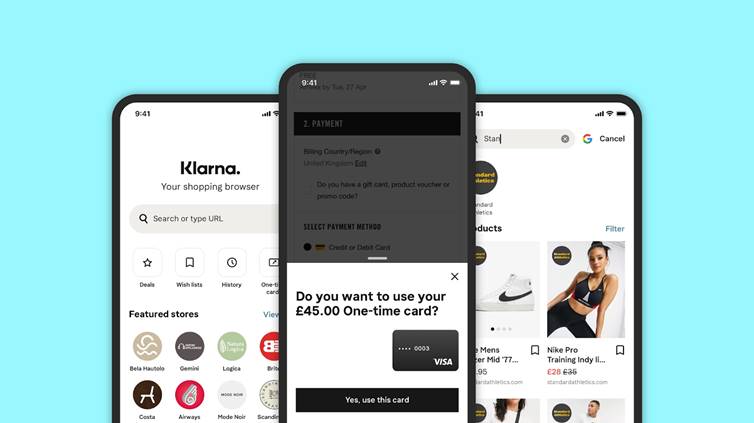
- Klarna users can now shop using pay in 3 at any online retailer, regardless of whether they’re partnered with Klarna or not, directly from the app
- The new feature eliminates the need to use credit cards when shopping online, making high-interest APRs a thing of the past
- Additional features include personalised wish lists, price drop notifications, thousands of deals updated daily, monthly budgets and personal spending limits
Klarna, the leading global banking, payments and shopping service, has today launched its Shopping app, empowering users to Pay in 3 in any online shop directly through the Klarna app, without ever paying more than the price of the product. Klarna’s in-app shopping experience now covers the whole retail journey, from inspiration and discovery right through to purchase and return management.
This new Shopping feature allows UK Klarna users to shop at any online retailer, regardless of whether they’re partnered with Klarna or not, and split the payment into three interest-free instalments - eliminating the need to use a credit card. It will also integrate monthly budgets and personal spending limit functionalities for users to set and remain in control of their spending.
Additional features include personalised wish lists and curated content based on consumers’ interests and their favourite stores, price drop notifications, thousands of deals updated daily, and lists of retailers for users to decide where to buy their favourite product, at the best price.
With an estimated 72% of e-commerce to take place on a mobile device by the end of the year, the Klarna app will give shoppers everything they need right at their fingertips and never have to juggle multiple apps ever again.
The launch of Klarna’s new shopping feature comes during Klarna’s prominent #WhyPayInterest advertising campaign. The campaign highlights the difference between buy now pay later products and credit cards, challenging the outdated credit model that saw Brits pay £5.7 billion in credit card interest and fees in 2020 alone.
Sebastian Siemiatkowski, CEO of Klarna said: “At Klarna, we believe that no-one should ever have to pay credit card fees or high interest rates and now, thanks to our new in-app shopping feature, they don’t have to. Shoppers now can interact with their favourite retailers without having to leave the Klarna app, to create a smooth, safe and frictionless shopping experience. Our one stop shop app is the future of shopping, it creates a truly personalised and bespoke service for every user and liberates consumers from ever paying more than the price of the product.”
The feature is already live in other markets including the US, Australia and Sweden where the app is used by 6.5 million people on average each month and the pay later interest free feature has been used over 12.8 million times to make a purchase through the app. The app is available to download for iOS and Android mobile devices today.
- 07:00 am
Temenos, the banking software company, has been listed as the only ‘Global Power Seller’ in Forrester’s prestigious Global Banking Platform Deals Survey 2021, with a 20% increase in new named deals compared to previous year. Temenos was the only top 5 vendor to grow its number of deals in 2020. Temenos landed more new global banking deals than any other surveyed provider in 2020, as stated in the Forrester report. Temenos was also named a ‘Top Global Player’ in the survey, based on combined deals, which represent a vendor’s ability to enhance its market position and keep creating value for its existing customers. Temenos also became the first vendor to be recognized by Forrester as a ‘Top Global Cross-Seller’ in Forrester’s newest category focused on extended business. According to Forrester, “extended business deals represent a vendor’s ability to keep creating value for its existing customers.”
Forrester reconfirmed Temenos’ status as a ‘Top Global Player’ for the 9th consecutive year. This ranking recognizes platforms with over 150 combined deals (new names and extended deals with existing customers) in more than five regions. With 209 deals signed with new and existing customers, Temenos maintained its position. Temenos also retains its position as a ‘Global Power Seller’, the highest status in the vendor pyramid for new deals, with 93 new business deals in 2020, 3X more deals than the next surveyed vendor. This marks the 15th consecutive year that Temenos has received this recognition.
Max Chuard, Chief Executive Officer, Temenos, said: “We are delighted to be recognized in Forrester’s Global Banking Platform Deals Survey across all seven surveyed regions and categories, and to be the only technology company to be in the top segment of all three tables. We operate in a huge USD 63 billion addressable market, which is largely underpenetrated, with only 27% today spent with third-parties, which creates big opportunities. As the deal figures show, Temenos is one of the only technology providers continuing to grow. We have over 3,000 customers, including over 70 challengers, and we are servicing them by constantly investing in innovation and in our technology roadmap across products and geographies to help them transform their IT landscapes. And by bringing to market The Temenos Banking Cloud, we now empower banks to digitally transform and massively scale faster than ever. We are putting banks in control of their business models and innovation cycles, giving them the agility and speed to deliver real value to their customers and build profitable businesses.”
The report, Use The Pandemic's Market Impact To Improve The ROI Of Digital Transformation:
Results From Forrester's Global Banking Platform Deals Survey 2021, authored by Jost Hoppermann, Vice President and Principal Analyst, Forrester, states: “Banks have long recognized that their application landscapes can’t deliver the seamless and convenient experiences their customers require, leading to many institutions accepting the transformation imperative[...]. The pandemic has improved the banking industry’s application landscapes and digital readiness. However, it is still far from perfect: Despite the increased transformation pace, plenty of functional areas still need digital transformation. Well-suited off-the-shelf banking software is an effective option to drive this transformation.”
Temenos was most recently recognized as a leader in ‘The Forrester Wave : Digital Banking Processing Platforms, Q3 2020’ (Retail Banking and Corporate Banking) and previously in ‘The Forrester Wave™: Digital Banking Engagement Platforms, Q3 2019’.
The Global Banking Platform Deals Survey 2021 is an independent survey conducted annually by Forrester. It assesses both the volume and geographical spread of banking platform sales to new and existing customers for 2020 deals. The research is used by decision-makers at financial institutions around the world looking to effectively evaluate the plethora of banking software solutions available.
- 09:00 am
Innovative payments ecosystem provider set to cut cost and timescale of cross border payments and FX
www.bankingcircle.com PayAlly, the fully integrated payments ecosystem for SMEs is using Banking Circle solutions to improve its multi-currency B2B cross border payments services. In particular, the new partnership gives PayAlly access to a wider choice of payment rails through the Banking Circle super-correspondent banking network, thereby improving the speed and cost of international payments for its e-commerce customers.
With the aim of halving the cost of acquiring and payments for e-commerce SMEs, PayAlly delivers accounts, payments, prepaid cards, Foreign Exchange (FX) and factoring, alongside value-added solutions including supply chain Customer Management System, accounting and E-invoicing. Crucially with its focus on delivering a personal service for every customer, PayAlly aims to empower its customers through its services as Rafal Andzejevsky, PayAlly Co-Founder & CEO explained:
“At PayAlly we strive to help smaller businesses and individuals by providing them with quicker and more reliable payments. Working with Banking Circle, which offers us additional routes for international payments, we are able to improve our ability to execute B2B cross border payments in various currencies more quickly, efficiently and smoothly than we were previously able to do. As a result our clients can send and receive funds much faster and with less hassle and that is good news for their cashflow and profitability.”
London-based PayAlly serves over 1,000 corporate clients around the world and is now using Banking Circle to manage the cross border payments and FX requirements of these clients. Banking Circle enables local B2B payments and collections across borders and eliminates the need for a physical presence or a relationship with a correspondent bank in that region.
PayAlly can issue accounts to business customers, in multiple jurisdictions, giving them access to a reliable and fully flexible cross border payment system previously only accessible through larger banking institutions.
“With its mission to provide customer-centric solutions that break down barriers to international payments and increase SME financial inclusion, PayAlly’s ethos is very closely aligned to ours”, added Anders la Cour, co-founder and Chief Executive Officer at Banking Circle. “Working together, we can help PayAlly’s e-commerce clients expand internationally without the high cost and slow transfer fees that could otherwise hold them back.”
- 05:00 am

A new report from Juniper Research has found sales of iPhones will bring in over $200 billion in 2022; nearly 40% of the total smartphone hardware market, despite representing less than 20% of devices sold that year.
The new research, Smartphone Market: Device Innovation, Regional Analysis & Market Share Forecasts 2021-2026 Market Research, notes that although smartphone purchase cycles are lengthening, Apple has managed to consistently convince users to purchase higher-priced models through curation of a strong hardware and software ecosystem, which other vendors have only limited opportunities to do in the current market. As a result, Apple’s average selling price will rise in the coming years, while Android devices will decline, unless they can leverage new technologies like 5G or bring new design features, such as foldable phones, into the market.
For more insights, download the free whitepaper, Smartphone Market Innovation: A Two-horse Race? Whitepaper
Differentiation Needs More than Features, as Newer Vendors Gain Ground
Juniper Research believes Android vendors will struggle to compete on a features basis in future. The research shows how vendors that focus on a particular segment and investing in premium features, such as high-end audio and advances in camera technology, will not appeal widely enough to compete at scale in the smartphone market.
‘Feature diversification alone is not enough for lasting success in the crowded smartphone market,’ remarked research co-author Nick Hunt. ‘Apple and Samsung have succeeded in fostering brand loyalty, which smaller vendors have struggled with, despite many introducing new capabilities. These players need to pair strong features with strong branding to have sustained success.’
The research also notes that the decline in Huawei’s fortunes, thanks to the US trade ban, will not restore older brands to prominence, but allow other Chinese brands to expand. We expect BBK, the manufacturer of Oppo, Vivo, Realme, iQOO and OnePlus smartphones, will have over 200 million smartphones shipped in 2022; making it the third largest player that year. In the meantime, Huawei’s market share will decline to just over 9% in 2022, from 11% in 2019.
Whitepaper Download: https://www.juniperresearch.com/whitepapers/smartphone-market-innovation-two-horse-race
Smartphone Market market research: https://www.juniperresearch.com/researchstore/devices-technology/smartphone-market-research-report








