Published

Michael Moran
Senior Currency Strategist at ACY
Summary: The Euro rebounded 0.47% against the Dollar to 1.1370 (1.1320) as overcrowded speculative shorts moved to cover their bets. see more
- 03:00 am
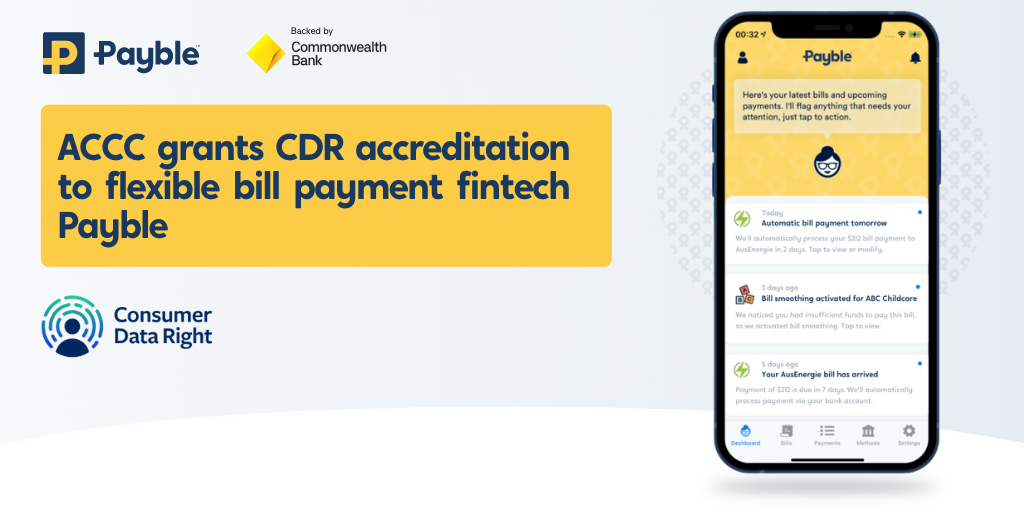
The Australian Competition & Consumer Commission (ACCC) has announced that Payble, the Open Banking platform which prevents late payments before they happen, was granted formal Consumer Data Right (CDR) accreditation. Payble is the first consumer payments app to receive CDR accreditation.
Payble benefits billers and consumers alike, by identifying customers who may benefit further payment flexibility options, including but not limited to paying by instalments, activating a payment extension or accessing COVID relief. The solution then engages eligible consumers directly to facilitate such an arrangement digitally.
Following Payble’s accreditation, consumers who currently bank with more than 91 Australian banks and financial institutions will be able to link their account data to Payble and access the company’s flexible solution for bill payments. Payble is completely free for consumers, with billers charged a monthly software fee.
Commenting on the accreditation, Elliott Donazzan, Managing Director and Co-Founder of Payble said:
“In the retail space, the likes of Afterpay, Klarna and Zip have proved that consumers want and need more flexibility. Payble is different because we’re not BNPL – instead we facilitate a payment arrangement directly between the consumer and biller via the Payble app. There’s no credit, no fees, no interest – we’re on the consumer’s side, helping them stay on top of their bills and payments.”
“It’s fantastic validation to be the first consumer payments app to receive CDR accreditation. For consumers who opt-in to share CDR data, like their transactions or account balance, we’ll be able to more accurately predict when they’d benefit from payment flexibility, and proactively engage them with the most relevant solution.”
“Imagine you have a $2500 council rates payment due tomorrow, but only $1500 in your account. Before that anxiety-inducing moment where the payment fails and you incur a dishonour, late fee, or interest, Payble would proactively prompt you to activate a partial payment pre-approved by your council, and to pay the rest over time to an agreed schedule.”
“We’re seeing more and more billers understand the bottom-line benefits of proactively offering flexible payments. They see a rise in revenue, and a reduction in collection costs and admin time, all while increasing customer satisfaction. Payble really is a ‘win-win’ for consumers and billers alike”.
The CDR puts Australian consumers in control of their personal information, helping them to unlock the true value of their data. According to the ACCC, 94% of Australian banking customers can now safely and securely share their banking data with accredited data recipients.
To achieve accreditation by the ACCC, organisations must complete a rigorous application and pass an independent security audit.
“This accreditation demonstrates Payble’s incredibly high standards of operation, information security, conformance testing and governance. Only a handful of organisations have met the ACCC’s standards and I’m proud of my team, particularly CTO James Andrew-Smith, for their meticulous work”, Elliott said.
Payble’s CDR journey was recently featured by Amazon AWS in their Open Banking webinar series, along with partners Adatree, DNX Solutions, AssuranceLab and Astero.
- 05:00 am

He says:
“Amazon’s decision to no longer accept Visa credit cards in the UK is further evidence - if any was needed - that existing payments are broken and stacked against the merchants that rely on them.
“What makes this news particularly striking is that this is one of the biggest brands in the world recognising that merchants on its platform truly are at the mercy of payment giants. These businesses already fork out thousands of pounds per annum only to be greeted with mid-contract price hikes, which are more often than not imparted on the consumer.
“Fuelled by post-Brexit price hikes this will be the first of many big business clashes with a payments giant. But online retailers should be reminded that there are other options out there and accelerate their efforts to offer new meth
- 02:00 am

Strategic acquisition creates global leader, transforming digital identity and fraud prevention
● Combination supports GBG’s purpose to build trust in a digital world, delivering differentiated solutions for all points of the identity verification and identity fraud customer journey
● Acquisition enables GBG to further expand into the US – the world’s largest and most strategically important market for location, identity and fraud services
● Combination accelerates GBG’s data, product and technology ambitions, delivering world-class technology across the customer lifecycle and bringing together the industry’s most skilled experts in identity verification and fraud prevention
GB Group plc, the experts in digital location, identity and identity fraud software, has today announced that it has reached agreement to acquire Acuant, a leading identity verification and KYC/AML compliance provider, for a cash-free, debt-free enterprise value of $736 million. The acquisition of Acuant brings together two of the leaders in the global digital identity market with a combined revenue of c.£265 million.
A long-time partner, Acuant has a product suite that is a natural complement to GBG’s existing US-based services from IDology. The acquisition creates a leader in the strategically important North American market and accelerates the rollout of GBG’s identity and fraud solutions globally. The combined product portfolio will provide the industry’s best end-to-end capabilities and an enhanced technology platform that will support both companies’ existing network of partners and customers as they manage billions of global transactions across multiple industry sectors.
Acuant has purposefully developed its Trusted Identity Platform with a powerful orchestration layer and easy to configure journey builder, making best-in-class technology accessible to all. This platform enables the seamless combination of data, documents, biometrics and analytics for consumption across the entire customer lifecycle: onboarding, step-up authentication, KYC/AML compliance, fraud and risk analysis, real-time monitoring and identity re-use. These capabilities, available as point solutions or integrated services, are applicable across all consumer or citizen facing markets and can be deployed globally, building upon GBG’s existing presence in APAC and EMEA.
The platform is scalable internationally, allowing GBG and Acuant customers to deploy solutions in multiple geographies and accelerating GBG’s growth in APAC and Europe.
The global identity verification market is projected to reach $15.8 billion by 2025 and the fast-growing identity fraud market is projected to be worth $9.6 billion by 2025[i]. GBG’s acquisition of Acuant strengthens its offering in both markets with a solution for any industry that needs to trust an identity, whether driven by managing compliance, reducing the cost of fraud or improving customer experience at the point of purchase.
GBG and Acuant share a common vision to create a platform that enables trust in the digital economy, and this vision is underpinned by similar cultures and common values, proven over years of collaboration on existing commercial projects. Acuant brings a team of over 200 highly experienced digital IDV professionals and over 1,000 customers, with nearly half of revenues powered by Acuant’s strong channel partner network.
This transaction is expected to complete all necessary legal and regulatory steps by end November 2021.
Chris Clark, Chief Executive Officer at GBG, said: “We are delighted to announce the acquisition of Acuant. It is a business that we have worked with and admired for many years. The combination of our two businesses is a complementary and powerful one. Together we create a global leader in data, document and biometric identity verification services and strengthen our mutual capability to capitalise on the fast-growing identity fraud market.
The US is the largest and most strategic market for location, identity and fraud services. The combination of GBG and Acuant provides a step-change in this market, increasing scale, growing our customer base and introducing us to new and exciting sectors. As importantly, it also strengthens the breadth of our technology portfolio which we can use to support our current customers in new ways in growth geographies such as APAC and Europe where we already have a strong footprint.
The team at Acuant brings new skills and talent to GBG, as well as an aligned culture and shared vision to enable trust in the digital economy. We are excited about the potential of the combined businesses and the acceleration this gives to our strategic goals.
Yossi Zekri, Chief Executive Officer at Acuant, said: “This is an exciting day for Acuant. We are very proud of everything that Acuant has achieved to date – building a world-class technology portfolio and a strong market position across multiple sectors. There is still significant opportunity ahead and joining the GBG family is the best way for us to capitalise on those opportunities. Our customer, technology and geographical mix are complementary and culturally we are aligned in our mission, vision, and how we invest in our people and look after our customers. We are very much looking forward to working together in the years ahead.”
- 04:00 am

WSO2 was named a Visionary in the Magic Quadrant™ for Full Life Cycle Management and earned the second-highest product score in Multi-experience Architecture, Integration Using APIs, and Open Banking Use Cases in the Critical Capabilities for Full Life Cycle API Management
WSO2 today announced that it was recognised by Gartner in both the Magic Quadrant for Full Life Cycle API Management and Critical Capabilities for Full Life Cycle API Management.
· In the Magic Quadrant for Full Life Cycle API Management1 published on September 28, 2021, WSO2 was once again named a Visionary. The evaluation was based on Completeness of Vision and Ability to Execute.
· In the Critical Capabilities for Full Life Cycle API Management2 published on October 5, 2021, WSO2 earned the second-highest product score in three of five use cases. On a scale of 1 to 5, WSO2 was rated 3.60 in Open Banking, 3.50 in Integration Using APIs, and 3.45 in Multi-experience Architecture. Additionally, WSO2 received the fifth-highest score (2.80/5) in the Productising APIs use case as of September 24, 2021.
· A copy of the Critical Capabilities for Full Life Cycle API Management can be accessed here.
“As more enterprises worldwide rely on APIs to deliver great digital experiences, they are increasingly turning to WSO2 API Manager, which now handles more than 18 trillion API calls each year,” said Eric Newcomer, WSO2 CTO. “We are excited to be identified as a Visionary by Gartner in the Magic Quadrant for Full Life Cycle Management as well as receive the second-highest product score for three of five use cases in the Gartner Critical Capabilities for Full Life Cycle Management.”
API Management Moves Further into the Mainstream
Increasingly enterprises are relying on APIs to drive their critical digital initiatives, placing new demands on software teams and the solutions they use to implement for full lifecycle API management.
The Magic Quadrant for Full Life Cycle API Management3 observes, “The number of APIs within organisations is growing rapidly in IT departments and in lines of business. APIs form the connection points between platforms and ecosystems. Every connected mobile app, every website and every application deployed on a cloud service uses APIs. Software engineering leaders must develop a systematic approach to manage and govern the use of APIs across the organisation by using a full life cycle API management offering.”
Meanwhile, the Critical Capabilities for Full Life Cycle API Management4 notes, “API adoption continues to expand as organisations adopt microservices and multi-cloud features, internal API management, along with a need to modernise, capitalise on and monetise legacy assets and data. Concerns around data privacy and security—driven by many high-profile API security breaches over the last 12 months—regulations, and event-driven and resilient architectures also remain strong. In response to these diverse requirements, vendors provide a broad range of functionality in this market.”
WSO2 for Comprehensive API Management
The WSO2 API Manager 4.0 platform provides a comprehensive and cohesive approach to managing the entire API management life cycle—while supporting legacy system integrations and new event-driven architectures—to enable timely, meaningful digital interactions.
WSO2 API Manager delivers a seamless, end-to-end API management experience while addressing all the requirements of API creators, product managers, and consumers. In Version 4.0, WSO2 API Manager also inherits all the capabilities of WSO2 Enterprise Integrator, the open-source hybrid integration platform that provides a graphical drag-and-drop flow designer and a configuration-driven approach to building low-code integration solutions for cloud and container-native projects.
Recognising that different disciplines require different functions and workflows, WSO2 API Manager 4.0 offers three distinct profiles, which can work together seamlessly or as standalone solutions: API Management, Micro Integrator, and Streaming Integrator. WSO2 API Manager is also supported by more than 150 connectors in WSO2’s Connector Store and makes it easy to add integrations to APIs.
WSO2 also offers two industry solutions that build on the capabilities of WSO2 API Manager and WSO2 Identity Server for customer identity and access management (CIAM): WSO2 Open Banking and WSO2 Open Healthcare. Going beyond API accelerators, they provide turnkey platforms that enable organisations to rapidly comply with government mandates while laying the foundation for future, API-driven digital products, and services.
Gartner Disclaimer
Gartner does not endorse any vendor, product or service depicted in its research publications, and does not advise technology users to select only those vendors with the highest ratings or other designation. Gartner research publications consist of the opinions of Gartner’s research organisation and should not be construed as statements of fact. Gartner disclaims all warranties, expressed or implied, with respect to this research, including any warranties of merchantability or fitness for a particular purpose.
1Gartner, “Magic Quadrant for Full Life Cycle API Management,” Shameen Pillai, Kimihiko Iijima, Mark O'Neill, John Santoro, Akash Jain, and Fintan Ryan, September 28, 2021.
2Gartner, “Critical Capabilities for Full Life Cycle API Management,” Fintan Ryan, Kimihiko Iijima, Mark O'Neill, John Santoro, Akash Jain, and Shameen Pillai, October 5, 2021.
3Gartner, “Magic Quadrant for Full Life Cycle API Management,” September 28, 2021.
4Gartner, “Critical Capabilities for Full Life Cycle API Management,” October 5, 2021.
Gartner and Magic Quadrant are registered trademarks of Gartner, Inc. and/or its affiliates in the U.S. and internationally and are used herein with permission. All rights reserved.
- 05:00 am
- The online gaming sector is two thirds (66%) of the way through its 5MLD implementation programme, compared to an average of (60%) across all AML regulated sectors
- Firms need to double their efforts if the impending regulatory clampdown happens as the sector predicts
- Gaming operators expect to foot the biggest implementation bill of all the those surveyed, with firms on average budgeting for a £1 million+ spend
Operators in the gaming and gambling sector are on average 66% of the way through their Fifth Anti-Money Laundering Directive (5MLD) implementation programmes, ahead of all other regulated sectors, according to research conducted by LexisNexis® Risk Solutions.
However, almost half (43%) of firms also predict a regulatory clampdown on 5MLD is coming soon, which suggests meaning businesses need to double their efforts if they’re to avoid the repercussions of non compliance. Firms have already had almost two years to implement controls in line with 5MLD, which came into force in January 2020.
The study shows becoming fully compliant requires significant investment for the gaming industry, with operators expecting to spend on average £1,016,200 – the highest figure for all regulated sectors, including real estate, banks, lenders, wealth management, accounting and gambling.
On the plus side, there appears to be optimism about the effects of 5MLD, with 61% of firms expecting a net positive impact on their businesses’ ability to detect and prevent crime, once implemented. Of those who are more sceptical, a quarter (25%) think regulators would do better to channel efforts into championing the use of networked data sources and AI, to help detect patterns of criminal activity.
Despite the optimism, firms sent a clear message that they need more support from the regulator, with a significant 83% of compliance professionals asking for better guidance on how to make their AML programmes more effective, and ultimately help them ensure compliance with 5MLD.
Looking ahead, over three quarters (78%) of UK firms expect the gambling sector to be targeted with more regulation as a result of the UK leaving the EU.
Nina Kerkez, director of UK&I Consulting for LexisNexis Risk Solutions comments:
“The gambling industry’s collective optimism towards regulation is likely due to an already stringent regulatory regime within the sector, comprised most notably of the Gambling Act, LCCP and GDPR. The fact that optimism is undaunted by the high cost of compliance with 5MLD shows that professionals within the gaming sector realise the potential benefits of stronger AML controls.”
“These results speak clearly of the need for regulators to work more collaboratively with industry on AML controls, as well as the need to perhaps review their position on the use of networked data sources and AI to help detect criminal activity. The gambling industry is already highly technology led, so it’s a natural partner with which to explore the benefits of further technology adoption.”
“If anything is going to help us make significant inroads in the fight against financial crime its better collaboration between the regulator, government and the private sector, and wider adoption of data and technology-driven solutions. The ability to effectively and consistently onboard and monitor customers whilst minimising business risk is increasingly becoming a point of competitive advantage for online businesses and although technology adoption carries a high initial investment in time and money, it can pay dividends in the long run – it’s encouraging that this research appears to show that the benefits of technology are already recognised across the industry.”
- 07:00 am
Today, leading app and data analytics company, App Annie, has published its newest Mobile Finance Report, highlighting the major shifts in the financial landscape, driven by mobile-first innovators.
With Amazon’s recent announcement to block UK Visa credit cards, it will be interesting to see how this effects the end users and if this signals a long-term shift in market power away from established card companies to other payment systems, such as Buy Now, Pay Later – a payment method that has proved immensely popular and only seems to be gaining traction.
The report includes a breakdown of:
- The top finance, neobank and traditional retail banking apps by average MAUs worldwide and on a country-by-country basis
- With crypto gaining more attention than ever, a deep dive into the most popular cryptocurrency apps and what crypto apps are favoured by consumers in 16 key markets
- The rise of Buy Now, Pay Later apps, PayPal’s foray into BNPL and its mission to become a ‘super app’
Rise of Challenger Banks
Neobanks, also known as challenger banks, are financial technology companies that offer specialized software and features that traditional brick-and-mortar banks have not been able to match. These include a range of features such as removing monthly or overdraft fees, incorporating reward programs geared towards freelancers, adding the ability to receive paychecks early, layering in tools to help build credit, and even providing educational components.
From Q4 2020 to Q3 2021, app downloads worldwide exceeded 264 million.
Brazil and LATAM is an especially ripe region for growth in . During that period, Brazil saw the largest share of its overall finance downloads come from at 25%, primarily thanks to Nubank.
- offers a range of features including a no-fee digital account, no-fee credit cards, rewards and loans and has become the #1 most downloaded Neobank in Brazil since Q2 2021 and the 9th most downloaded finance app in the world in Q3 2021.
Reaching a New Generation: Neobanks for Teens
One subcategory of that is quickly gaining traction is geared towards young adults. From Q4 2020 to Q3 2021, 29% of downloads came from those geared towards teens in the United States, with Current - Debit Card for Teens being the most popular.
In the United Kingdom, goHenry is the most popular app for teens.
While traditional banks have continued to fare well over the past year, challenger banks such as Chime, Lili for freelancers, and Greenlight for teens have continued to chip away at the brick-and-mortar bank’s dominance as Gen Z — and the world — increasingly embrace mobile and look towards apps with customized features that fit their needs from the device they always have on them: their smartphones.
You can find more information on the different finance app verticals in App Annie’s latest Mobile Finance Report.

Mikkel Velin
co-CEO at YouLend
Access to finance is a cornerstone of small businesses’ survival – and with 6 million SMEs in the UK supporting the backbone of the economy it is important to address the lack of see more
- 06:00 am

Along with insights from Sensor Tower, report also shows average session lengths have steadily increased, approaching 11 minutes per session globally
Just ahead of what’s widely predicted to be the most mobile holiday shopping season on record, mobile marketing analytics platform Adjust today released E-commerce App Report 2021: Top Trends in Mobile Shopping With Insights From Sensor Tower. The global report finds that in-app revenue has increased significantly in 2021, with May being the biggest month so far. Based on Adjust’s e-commerce app revenue trends from 2020 — when October, November, and December outperformed the previous nine months — this year’s shopping season is likely to reach an all-time high.
Not only are shoppers spending more money in-app, they’re spending more of their time in-app overall per day. Globally, average session lengths are up from 10.07 minutes in 2019, to 10.42 minutes in 2020, to 10.56 minutes in 2021 so far.
“Mobile has emerged as the leader in e-commerce,” said Paul H. Müller, co-founder and CEO of Adjust. “What’s most impressive is that e-commerce apps have managed to retain the users they’ve acquired while continuing to grow and acquire even more new customers. It’s a testament to mobile’s ability to provide convenient and user-optimized experiences. Retaining loyal customers will set brands up for continued growth throughout the holiday season, into the new year.”
iOS 14.5+ and the opt-in
Adjust’s data shows the App Tracking Transparency (ATT) opt-in rate for e-commerce hovering at an average of 17% — far higher than initial industry projections. Adjust predicts that consent rates will continue to rise over time as users become more educated on the value of relevant advertising.
Additional key findings on global and regional growth and engagement in e-commerce apps in 2021 include:
● Global Installs of e-commerce apps have increased 10% in 2021 compared to 2020. Installs also rose regionally in EMEA (15%), LATAM (11%) and APAC (9%). Sensor Tower data shows that Shopee is the world’s top e-commerce app in 2021 so far, with Brazil as its key market.
● Sessions have seen the biggest uptick in LATAM in 2021 so far, jumping 27%, compared to 12% growth globally. Sessions rose 10% in APAC and 13% in EMEA.
● After a slight drop in Q1 2021, compared to 2020, retention rates picked back up in Q2 2021: Day 1 came in at 26% in Q2 of 2021, up from 21% in Q1 and matching Q2 2020. Q2 2021 then maintained higher retention rates than any other quarter — holding at 17% for Day 7, 14% for Day 15, and 11% for Day 30.
"Mobile commerce has finally expanded beyond the core shopping markets to become a global phenomenon, with LATAM and APAC exploding in growth,” said Randy Nelson, Head of Mobile Insights at Sensor Tower. “Meanwhile, trailblazers in the e-commerce space continue to build their user bases in well-established markets like the U.S. and China. Expect retail giants and newcomers alike to thrive on digital channels during the upcoming shopping holidays.”
The full report, including methodology, is available for download here.
- 06:00 am

The Company ranked on the list of the fastest growing North American technology companies after recently being ranked #5 on the Deloitte New Zealand Fast 50 Master of Growth Index
Pushpay the leading payments and engagement solutions provider for the faith-based and non-profit sectors, today announces the Company was ranked 412 on Deloitte’s Technology Fast 500™, which lists the fastest-growing companies in North America. Pushpay grew fiscal year revenue by 278% over the three-year time frame from 2017 - 2020.
“It’s a tremendous honor to be able to partner alongside churches of all sizes across the U.S. to help them reach, connect and engage with their communities in new ways through technology,” said Molly Matthews, CEO of Pushpay. “We’ve seen a societal shift these past two years that has forever changed the approach to engagement. In-person gatherings are no longer the only way to stay connected, and organizations have realized that having a digital strategy is an essential need to remain relevant.”
Celebrating its tenth year in business, Pushpay has been a pioneer in the development of best-in-class technology solutions for online giving and mobile applications. To date, the Company has more than 14,000 customers across the United States and has experienced steady growth year-over-year. Beyond new customer acquisition, recent milestones that have boosted company growth included the 2019 acquisition of Church Community Builder, and more recently the acquisition of Resi Media, an industry leading video streaming platform. Both acquisitions support the Company’s strategy to deliver an all-inclusive suite of end-to-end SaaS engagement solutions for churches that includes a comprehensive Church Management System (ChMS), mobile app, donor management, giving solution and more.
“Each year the Technology Fast 500 shines a light on leading innovators in technology and this year is no exception,” said Paul Silverglate, vice chair, Deloitte LLP and U.S. technology sector leader. “In the face of innumerable challenges resulting from the pandemic, the best and brightest were able to pivot, reinvent and transform and grow. We celebrate the winning organizations and especially the talented employees driving their success.”
This recognition adds to Pushpay’s growing list of accolades this year. The Company was recently ranked #5 on Deloitte’s 2021 Master of Growth Index, an annual ranking of New Zealand businesses with the highest level of sustained growth, due to its 450% growth in operating revenue over the last five years. Pushpay was also recently named a 2021 Best Place to Work by Built In Seattle and Built In Colorado, and newly appointed CEO Molly Matthews won the Gold Award for Business Role Model of the Year in the 2021 Globee CEO World Awards. Lastly, Pushpay was featured on the EY Ten Companies to Watch list by the Technology Investment Network.