
Published
- 05:00 am

Sber has received the SAMS Europe Award for the best software asset management project. The European professional community praised Sber’s “Integrated SAM Solution at Sberbank” project, which took first place. It is the first time a Russian company has won first place in the history of the award.
Sber's solution automates the collection and processing of a huge amount of data received through integrations with primary information sources for software accounting. As a result, Sber receives up-to-date and systematic information about licenses, making it possible to optimize them and improve the quality of planning.
The award ceremony took place at the SAM Strategies Europe Conference in Copenhagen. This year, the jury selected three nominees from the applications received: Sberbank, Atruvia AG, and Toyota Tsusho Systems Europe GmbH. At the conference, the nominees presented their solutions, and the SAMS Europe community voted online to determine the winner of the award for the best SAM project in Europe.
David Rafalovsky, CTO and Global Head of Operation and Technology of SberBank Group, Executive Vice President at SberBank:
“The implementation of a reliable SAM solution will allow Sber to strengthen control over licensing costs and support throughout the entire software life cycle, as well as improve the efficiency of existing software assets. At the root of our solution are the processing of vast amounts of data and a number of complex integrations. We are delighted to be the first in Russia to receive such a prestigious award for a SAM project.”
- 05:00 am
Setting a new industry standard, AllianceBlock DEX’s novel mathematical model synchronizes two automated market makers to reduce impermanent loss
In line with its mission to bridge the gap between decentralized and traditional finance, AllianceBlock has deployed the AllianceBlock DEX Testnet on renowned blockchains Polygon and Energy Web Chain.
Liquidity providers are the lifeblood of decentralized exchanges (DEXs). However, crypto’s volatility puts liquidity providers at high risk of losing some liquidity if price changes occur after staking, resulting in impermanent loss. For many, this risk of loss is a barrier to entry and can result in decreased profits. Designed to reduce impermanent loss, the AllianceBlock DEX is underpinned by a combination of two Automated Market Makers (AMMs).
The DEX is grounded in a new mathematical model designed by an innovation team led by AllianceBlock’s CEO and Co-Founder Rachid Ajaja; Chief Research Officer, Houman Falakshahi, who holds a Ph.D. in Quantum Mechanics from the University of Paris-Saclay; and Head of Quantitative Analytics, Matthieu Mariapragassam, who holds a PhD in Applied Mathematics from the University of Oxford. This novel approach lowers risk for investors and creates a safer environment for high volume liquidity providers, in particular those who may have a low risk tolerance.
Commenting Rachid Ajaja, Co-Founder and CEO of AllianceBlock, said: “The DEX market is becoming increasingly competitive. Right now, there are more than 100 DEX solutions out there. However, most of these solutions are forks of established platforms, meaning they are simply variations of existing offerings. The AllianceBlock DEX aims to go a step further and improve on some of the existing limitations such as impermanent loss. Though there have been incredible developments in the space, especially when it comes to Automated Market Makers, impermanent loss remains a huge challenge. For the DeFi ecosystem to reach its full potential, access to adequate liquidity is key, which is why we have developed AllianceBlock DEX, which relies on a mathematical formula for addressing the key issues faced by Automated Market Makers. Our unique proposition for a DEX also helps institutional investors access opportunities in DeFi, when combined with our upcoming trustless KYC framework.”
AllianceBlock DEX launches with the support of two long-term partners and leaders in blockchain and DeFi. Energy Web, a public enterprise-grade blockchain platform for the energy sector, and Polygon, a protocol for building and connecting Ethereum-compatible blockchain networks. While Polygon is renowned for its near-instantaneous transaction speed, low transaction costs and ever-increasing use by investors and DeFi projects alike, Energy Web Chain is a leading layer 1 blockchain for some of the biggest players in the energy industry, making these two blockchains perfect for the testnet rollout of the AllianceBlock DEX.
Now in Testnet, the DEX will undergo rigorous code auditing and security testing over the coming months before going live on Mainnet next year. Once verified, it’s anticipated that this solution will be integrated and utilized across a host of other AllianceBlock products including its white label liquidity mining and staking solution, LMaaS, to facilitate a wider ecosystem of innovative solutions that will be essential to bridging the gap between traditional and decentralized finance.
AllianceBlock DEX is the culmination of months of intensive research and technological innovation. Houman Falakshahi, Head of Research at AllianceBlock, said: “Over the past number of months, our research and quantitative analytics team have worked on innovative methods to tackle the issue of impermanent loss reduction. Inspired from physics, more precisely from coupled systems where energy is transferred from one system to another, we combined two different Automated Market Makers. This has shown the coupled system of AMMs to be able to absorb the impermanent loss of one another and therefore optimize the impermanent loss profile. We hope this can positively contribute to the research in the field and open new possibilities for future improvements.”
- 03:00 am
The growth of phishing attacks mimicking e-payment pages was spotted in the run-up to the Black Friday period. The total number of financial phishing attacks disguised as e-payment systems more than doubled from September (627,560) to October 2021 (1,935,905), indicating a 208% increase. This and other findings are in Kaspersky’s ‘Black Friday 2021: How to Have a Scam-Free Shopping Day’ report.
The sales season attracts the attention of shoppers and retailers; however, it is also a favorite of cybercriminals who do not hesitate to cash in on online shoppers by creating fake pages mimicking the biggest retail platforms and e-payment systems.
During the first ten months of 2021, Kaspersky products detected more than 40 million phishing attacks targeting e-commerce and e-shopping platforms, as well as banking institutions. While stores rebounded in 2021 after a difficult 18 months and shoppers returned to offline shopping, Kaspersky researchers didn’t observe the typical seasonal trends for phishing related to online shopping such as significant influx of phishing pages with too good to be true sale offers or growth of retail-related scam.
However, there is one notable exception. In 2021, the total number of financial phishing attempts targeting e-payment systems more than doubled from September (627,560) to October (1,935,905) — a 208% increase. Indeed, this year we have seen introduction of new payment systems in various countries due to their unmatched convenience. As consumer adoption has skyrocketed, fraudsters started to actively exploit such systems as a lure to spread malicious activity.
There also has been a rise in the number of spam letters detected by Kaspersky’s products. An active spread of spam emails with 221 745 emails containing the words ‘Black Friday’ was spotted during the month amid the sales season, from October 27 to November 19.
Kaspersky researchers have also analysed which popular platforms were used as bait to spread phishing pages. The results showed that Amazon was consistently the most popular lure used, when looking at the total number of phishing attempts using its name. For the majority of 2021, the second most popular was eBay, followed by Alibaba and Mercado Libre.
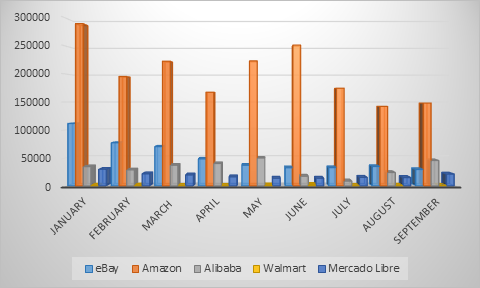
The number of phishing attempts using shopping platforms as a lure in 2021
We always witness intensified scamming activity amid the Black Friday season. Perhaps a bit more unexpected is the attention being paid to e-payment systems. This time, we discovered a huge increase by 208% in a number of attacks mimicking the most popular payment systems. Of course, every new payment application is seen by scammers as a new opportunity to potentially exploit users,” says Tatyana Shcherbakova, a security expert at Kaspersky.
‘So, in order to protect your data and finances it will be a safe practice to make sure the online payment page is secure: you’ll know it is if the web page’s URL begins with HTTPS instead of the usual HTTP and an icon of a lock will also typically appear beside the URL’, adds Tatyana.
To learn more about Black Friday tricks and scams, visit Securelist.com.
To enjoy the best that Black Friday has to offer this year, be sure to follow a few safety recommendations:
- Use a reliable security solution, such as Kaspersky Security Cloud, that identifies malicious attachments and blocks phishing sites – both on your computer and mobile device
- Do not open attachments or click on links in emails from banks, e-payment apps, or shopping portals, particularly if the sender insists on it. It is better to go to the official website directly and log in to your account from there
- Double-check the format of the URL or the spelling of the company name, as well as read reviews and check the domain’s registration data before filling out any information
- Be wary of any deals that seem too good to be true – they usually ar
- 06:00 am
State Street Corporation (NYSE:STT) announced today it has added market leading pre-and post-trade optimization and margin analytics capabilities to its Collateral+ service. In partnership with Cassini Systems, the leading provider of pre- and post-trade margin and collateral analytics for derivatives market participants, Collateral+ now offers an integrated, modular approach to optimization, which addresses collateral efficiency from multiple angles.
First, it integrates collateral and funding impact into the front-office decision strategy ahead of the trades being placed. Through the addition of Cassini’s technology, Collateral+ can optimize margin and carry cost impact, providing the best trade route by identifying all possible ways to execute and clear the trade and highlighting the lowest cost. Collateral+ can also offer margin optimization as a post-trade utility with tools such as novation and compression to lower margin and funding requirements.
Another module provides true collateral inventory optimization based on clients’ collateral funding costs in combination with costs such as clearing fees. This optimization highlights the optimal placement of collateral and the lowest transaction cost routes. Through the bank’s liquidity offerings, including Sponsored Repo and the newly launched Peer-to-Peer Repo, clients can leverage incremental cash and optimized securities revenues in order to effectively execute and grow their investments.
“As an industry, we have a long-held ambition to deliver collateral impacts and trade opportunities to the decision makers in the front office. Our work with Cassini to develop Collateral+ to provide the intelligence and pre-trade knowledge to the desk is enabling State Street to deliver on this,” said Sam Edwards, head of Collateral+ in APAC for State Street. “We are evolving with our clients and developing end-to-end tools and liquidity products in order to allow our partners to focus on their core strengths.”
Today’s announcement builds on the momentum of State Street’s Collateral+ business, as the platform recently became operational with Acadia’s Initial Margin Exposure Manager (IMEM) and DTCC’s Margin Transit Utility (MTU), which simplifies the transfer of collateral among market participants and allows clients to more easily comply with Uncleared Margin Rules (UMR) guidelines.
Cassini Systems CEO Liam Huxley said: “We are excited to partner with State Street on further enhancing the Collateral+ offering with optimization capabilities and analytics that can bring its clients substantial cost savings and a true understanding of front-to-back costs across the entire lifecycle of a trade. The ability to apply these analytics to the Initial Margin requirements of UMR is a powerful way to identify optimal counterparties and manage thresholds strategically with each and every trading decision.”
- 08:00 am

Edison Group, the London-based investment research and advisory company, has today announced it has hired Patrick Yau as Managing Director, Investor Relations. Patrick has joined the London office where he will initially be working closely with the sector teams across the business to further develop Edison’s strategic European Investor Relations advisory service.
Patrick brings almost 20 years of capital markets experience to the Edison team. He began his career working at the London Stock Exchange before becoming an equity research analyst in 1994 when he joined Killik & Co to establish the research team. Following Killik & Co, Patrick moved into institutional broking, where he held positions at Nomura, Credit Suisse, Bridgewell, Canaccord and Peel Hunt.
In 2013 he became Head of IR at Entertainment One until its acquisition in 2019. During his time there, Patrick helped to streamline the company’s equity story, reposition the company in the UK Media sector as a FTSE-250 company and transition the share register away from mainly UK AIM investors to a broad base of supportive international shareholders. He also played an active role in communicating the company’s growth strategy to investors as the business grew from £500mn market cap to an acquisition value of £3.3bn in 2019. Most recently, Patrick was Director of IR at cleantech company, Ceres Power. Patrick also holds a MSc. in Business Finance from UMIST.
Patrick’s focus at Edison is to establish its European Investor Relations advisory service. Edison already has an established and trusted presence in this area having grown this service in North America and is helping NASDAQ listed companies attract funding from a diverse pool of investors. Edison’s balance of experienced analysts and diverse European clients means the group is in a unique position to assist businesses in attracting investors and establishing their investment story within this region.
Patrick Yau, Managing Director of IR, Edison said: “The investment landscape today is more competitive and diverse than it has ever been, so it is critically important for companies to explain their equity stories well and to engage with the right pools of capital through an effective investor relations strategy. By bringing together the in-depth analysis that Edison provides to its clients and the market and a comprehensive strategic IR service, the company is in a truly unique position to create further value for these businesses. I am very excited to join the team and develop this service to complement the work already being done here.”
Rachel Carroll, President, Managing Partner from Edison said: “We are delighted to have someone of Patrick’s calibre join the team as we continue to expand across Europe and North America, supporting growth businesses with a seamless transatlantic investor relations service. His significant experience is an asset to any late stage private or publicly traded company seeking to navigate the evolving investment landscape and build an effective capital markets program across borders. Patrick’s appointment considerably strengthens our European advisory business as we continue to make investments in our analysts, distribution and analytics platform, capital markets engagement teams and digital marketing capability for a fully integrated, global solution.”
- 02:00 am

While 2022’s dominant cyber threats will largely mirror those faced this year, criminals will evolve their modus operandi to boost disruption and monetisation, according to Infosecurity Europe’s community of security leaders. The organisers of Europe’s number one information security event asked its network of CISOs and analysts to comment on the major trends and shifts they foresee shaping the next 12 months.
Ransomware attacks are expected to continue rising in 2022, but are likely to look different, as hackers become aware that the return on investment they can achieve by encrypting data is diminishing. “Criminals are busy exploring alternative means of monetisation,” says Rik Ferguson, Vice President of Security Research, Trend Micro. “The act of encrypting data and denying the owner access to it is actually a minor way of making money. Criminals will focus on their secondary and tertiary means of extorting money – for example threatening to release data for public exposure, contacting people who are a part of the data set and trying to exploit them, or piling denial of service attacks on top of encryption.”
This view is echoed by Barry Coatesworth, Director – Risk, Compliance and Security, Guidehouse. “Ransomware will continue to evolve, and the sophistication of the techniques criminals use will improve,” he states. “They will become more astute in what situations their victims want to avoid, to maximise payment. Attacks affecting the supply chain will probably also increase – including managed service providers (MSPs) that manage parts of infrastructure or software for other organisations, because if adversaries can get to them they can also get to many of their clients.”
Forrester’s cybersecurity and privacy team also points to the supply chain as a key target in 2022, predicting that 60% of security incidents will result from issues with third parties. Paul McKay, Principal Analyst, explains: “With cyberattacks targeting smaller vendors and suppliers, third-party incidents will increase and SolarWinds-style headlines will plague firms that don’t invest in the risk management trifecta: people, process, and technology. Technology needs will grow, requiring tools for risk assessments, supply chain mapping, real time risk intelligence, and business continuity management. We’ll also see organisations transfer third-party risks by embedding policies in contracts stipulating that the partner assumes the risk of an intruder jumping from its environment to the organisation’s.”
The insider threat is also expected to continue making organisations vulnerable with – worryingly – users and employees being brought into play by criminals looking to target critical national infrastructure (CNI).
Barry Coatesworth anticipates an increase in social engineering, which tricks users into making security mistakes or giving away information. “Threat actors have been recruiting insiders with the promise of millions of dollars if they help them gain access to an organisation’s system to install malware,” he says. “This, combined with growing attacks against operational technology (OT) systems and critical infrastructure services, could result in serious disruption, potentially even endangering human life. Improvements in deep fake technology for instance have allowed threat actors to bypass multi-factor authentication (MFA) and also elicit fraud by using faked audio.”
Countering these threats will require organisations to improve their preparedness for incidents, and build their ability to respond effectively, according to the security leaders.
For Munawar Valiji, CISO, Trainline, the recalibration of tooling and capability for the post-pandemic world will be a priority. “Organisations need to validate their use of basic security tooling – such as vulnerability management, and virus and malware protection – to make sure that they haven’t degraded against the performance expected of them. There will be more centralisation of those functions, and increased focus on automation and orchestration..”
Independent researcher David Edwards believes that cybersecurity will attract more senior leadership attention in the coming year. He says: “I think we’ll see an increase in boards taking more interest in cyber risk as spend increases. Meanwhile, vendors will align their product strategy to empower Zero Trust; however we’ll see slow adoption throughout 2022 as a result of businesses starting to compete more aggressively in the digital landscape.”
The need for individual users to recognise they have a role to play in security – and accept that this may mean compromising on speed and convenience – was highlighted by Lisa Plaggemier, Interim Executive Director, National Cyber Security Alliance (NCSA). “We’re realising that sometimes we do have to slow down a bit to be more secure,” she says. “Organisations are recognising that introducing multi factor authentication, for example, doesn't necessarily cost them customers or business, and consumers recognise it’s for their own protection. We'll see companies become less afraid of that friction. As major enterprises make those changes, people will get used to it. They’ll see it as a habit, and might even start asking companies without those controls why their security is so lax!”
Nicole Mills, Exhibition Director at Infosecurity Group, says: “Cyber-criminals are sharpening their skills and techniques, with a focus on using existing attack methods in new ways to hit organisations harder in 2022. Enterprises must be aware of the tactics attackers are likely to use to access their networks, systems and data, and prepare to respond effectively. This will require a concerted effort and commitment throughout the organisation – from the leadership team to suppliers, and right through to the individuals who use its products, services and technologies.”
The conference programme at Infosecurity Europe 2022 will cover the topics raised by the CISOs and analysts who contributed their thoughts, with presentations, talks and workshops exploring the themes across the different theatres. Infosecurity Europe will run from Tuesday 21 to Thursday 23 June 2022 at ExCeL London. Full details about the exhibition and conference programme will be released on the website in the coming months.
- 07:00 am

A recent white paper published by Themis and Encompass Corporation, the leading provider of Know Your Customer (KYC) and Anti-Money Laundering (AML) software, revealed new insight into the ‘cost’ of not adhering to financial crime compliance.
The whitepaper, titled Financial Crime Compliance: The Cost of Getting it Wrong, analysed recent case studies and 2020 polling from Themis, targeted professionals across the financial services sector. One of the headline figures revealed that 30 per cent of finance professionals had estimated the cost – both direct and indirect – of their businesses’ financial crime exposure to be £1 million or more.
In fact, direct financial loss was revealed to be the primary concern of financial crime for 36 per cent of respondents. For comparison, 32 per cent cited reputational damage and the associated customer loss as the biggest cause for concern, and, 15 per cent said that follow up regulatory fines were the biggest issue for them.
However, the white paper suggested that Regulatory fines pose the most obvious, immediate and sometimes the most severe impact to company balance sheets. For example, in 2020, a bank was fined almost £40 million by the UK’s Financial Conduct Authority (FCA) for failing to maintain adequate AML systems and controls over a five-year period. Similarly, in the Netherlands, ABN Amro reached a €480 million settlement, including a €300 million fine, after an investigation found it had overlooked numerous indications of money laundering and related financial crime. The penalty was four times larger than the company’s Q4 2020 net profit of €54 million.
Furthermore, the white paper also drew attention to a 2019 study which revealed that corporate reputation accounts for one third of stock market valuations. Themis therefore conducted an analysis of a sample of the most significant international stories of AML shortcomings since 2019, which indicated that across seven banks, the average share price loss one day after the regulatory probe was announced was 5.15%, falling to 20.71% six months following the announcement.
Dr Henry Balani, Global Head of Industry & Regulatory Affairs for Encompass Corporation comments:
“Clearly, many finance professionals still perceive a ‘criminals’ take’ as the biggest cause for monetary loss year after year. However, this is not necessarily true, and increasing regulatory impositions combined with the increasing importance of corporate reputation, means there are far more hidden costs than to financial non-compliance, than one might initially realise.
“In 2021, there is no excuse to not have the correct regulatory technology in place, to help automate laborious compliance processes, and improve the efficiency and effectiveness of catching financial crime. All too often are finance professionals caught out, not for knowingly endorsing financial crime, but for not knowing it is going on right under their noses. Personal reputations and careers within the financial services sector may suffer as a result.”
- 08:00 am

Claranova reported Q122 revenue of €88m (-2% y-o-y), slightly better than its end-September expectation of a 5% decline. Now that the transition to subscription licensing is complete, Avanquest is seeing revenue growth accelerate. PlanetArt saw organic revenue declines in the last two quarters, but management is confident of a return to growth in Q222. We have revised our forecasts to reflect FY21 results and the Q1 revenue update.
Reflecting the different business models and minority interests for each division, we continue to use a sum-of-the-parts approach to valuation. Using EV/sales multiples that reflect our views on the growth and profitability of each division and are conservative compared to the peer group averages, we calculate a valuation of €10.46 per share (down from €10.55 when we last wrote). In our view, consistent growth in revenues and margins towards the company's FY23 targets will be key to reducing the discount to peers. In the near term, resumption of growth in PlanetArt from Q222 and sustained profitable growth in Avanquest will be the key triggers.
Click here to view the full report or here to sign up to receive research as it is published.
All reports published by Edison are available to download free of charge from its website
About Edison: Edison is a leading research and investor relations consultancy, connecting listed companies to the widest pool of global investors. By focusing on the volume and quality of investors reached - across institutions, family offices, wealth managers and retail investors - Edison can create and gauge intent to purchase, even in the darkest pools of capital, and then make introductions via non-deal roadshows, events or virtual meetings.
Having been the first in-market 17 years ago, Edison now has more than 100 analysts covering every economic sector. Headquartered in London, Edison also has offices in New York, Frankfurt, Amsterdam and Tel Aviv and a presence in Athens, Johannesburg and Sydney.
Edison is authorised and regulated by the Financial Conduct Authority.
Edison is not an adviser or broker-dealer and does not provide investment advice. Edison's reports are not solicitations to buy or sell any securities.
- 02:00 am
Key facts | · 29 percent of UK consumers have started a new banking relationship in the past year. · Young millennials (age 25-29) are most likely to switch to a new bank (46 percent), followed by over a third of senior millennials and Gen Zers (both 39 percent). · Baby Boomers (age 56-75) are the most loyal generation with only 17 percent starting a new account during the pandemic. |
Nearly 1 in 3 British consumes have entered a new banking relationship with a financial institution or non-bank service provider during the COVID-19 pandemic, according to a new report released from financial technology leader FIS® . The FIS PACE Survey examines how UK consumers have altered the way they shop, bank and pay in response to the pandemic.
The report found that younger Generations are more likely to form new banking relationships, with nearly half of young millennials choosing not to return to their pre-pandemic banking habits. The most common reason cited overall for starting a new banking relationship was access to better benefits, while the top reason for almost half (48 percent) of Gen Zers (age 18-24) was due to a pivotal moment in their life such as leaving school, getting their first job or starting university. 38 percent of young millennials switched to gain greater access to products or services they couldn’t get previously, such as credit cards and mortgages, while only 7 percent of those surveyed were driven to set up a new banking relationship as a result of an unpleasant customer experience.
Looking forward, the survey found that access to real-time/faster payments were key for consumers in the next six months. Over a quarter (28 percent) of young millennials want increased spending limits on credit/debit cards, while 22 percent of Gen Z are looking to take out a loan.
“After an uncertain financial year for many, UK consumers are seeking a better experience from their bank, with greater access to products and services tailored to their needs,” said Silvia Mensdorff-Pouilly, Head of Banking Solutions Europe at FIS. “As younger, more tech-savvy consumers enter the financial services market, banks must follow or risk losing engagement with an entire generation. Now more than ever, innovation among banks is critical to ensure a leading position in an increasingly competitive market.”
- 02:00 am

The United States Secretary of the Treasury Janet L. Yellen, multiple award-winning musician and co-founder of CHIC Nile Rodgers, and Director-General of the World Trade Organization Ngozi Okonjo-Iweala were today announced as the latest headline speakers at Reuters NEXT.
They join an impressive and diverse line-up of more than 150 world leaders uniting on December 1-3, which also includes the U.S. Secretary of State Antony Blinken, New Zealand Prime Minister Jacinda Ardern and European Central Bank President Christine Lagarde.
Following the success of the inaugural Reuters NEXT leadership summit in January, the conference will bring together big business and forward-thinking pioneers to address the most critical global issues facing decision-makers in the year ahead across business, society, politics, and the planet.
The line-up also includes:
- Jens Stoltenberg, Secretary General, NATO
- Elvira Nabiullina, Chairwoman, Central Bank of Russia
- Sheikh Ahmed bin Saeed Al Maktoum, Chief Executive Officer, Emirates
- Dr. Soumya Swaminathan, Chief Scientist, World Health Organisation
- Dan Schulman, CEO, PayPal
- Sebastian Siemiatkowski, CEO, Klarna
- Anthony Tan, Co-Founder and CEO, Grab
- Nandan Nilekani, Chairman and Co-founder, Infosys
- Merck Mercuriadis, CEO and founder of Hipgnosis Songs Fund
The complete agenda is now available to view here. Led by Reuters editors, the agenda has been carefully curated to address the most critical global issues of the day – bringing together more than 40,000 professionals from over 150 countries to explore five central pillars:
- Policy for progress – exploring how policy can work towards progress for the whole of society.
- Business of growth – discussing how opportunistic businesses are reshaping the way we live, work, travel and bank.
- A sustainable future – examining the coordinated private and public-sector effort still required to ensure climate change is central to every company and country’s policy making.
- Radical redesign – debating how the pandemic has accelerated new ways of living and working.
- A fairer world – bridging income, racial and gender gaps in jobs, healthcare, education, media, culture, and information access
Josh London, Head of Reuters Professional and Reuters CMO, said: “Combining a diversity of voices with extensive global reach, Reuters NEXT is where new ideas and perspectives can truly flourish. We’re excited to bring world leaders and pioneers together again in a forum where global professionals can gain access to exclusive insights, opportunities and innovative solutions to the challenges we face in the year ahead.”
Reuters NEXT is developed in collaboration with Reuters award-winning newsroom and will be broadcast live, with all sessions recorded and made available on-demand to attendees shortly after broadcast.
For more information on the event, visit: https://bit.ly/3kNL20c








