
Published
- 07:00 am
PHP is a scripting programming language. The code interpretation and its operation is done on the server side. It supports object-oriented application execution techniques. It was created by Danish-Greenlandic programmer Rasmus Lerdorf. It was intended to facilitate the creation of dynamic web pages. Later it became open source software with a BSD-style license. The ability to work with various types of web servers and database engines contributed to the development of this technology and its popularity.
How was the PHP language created?
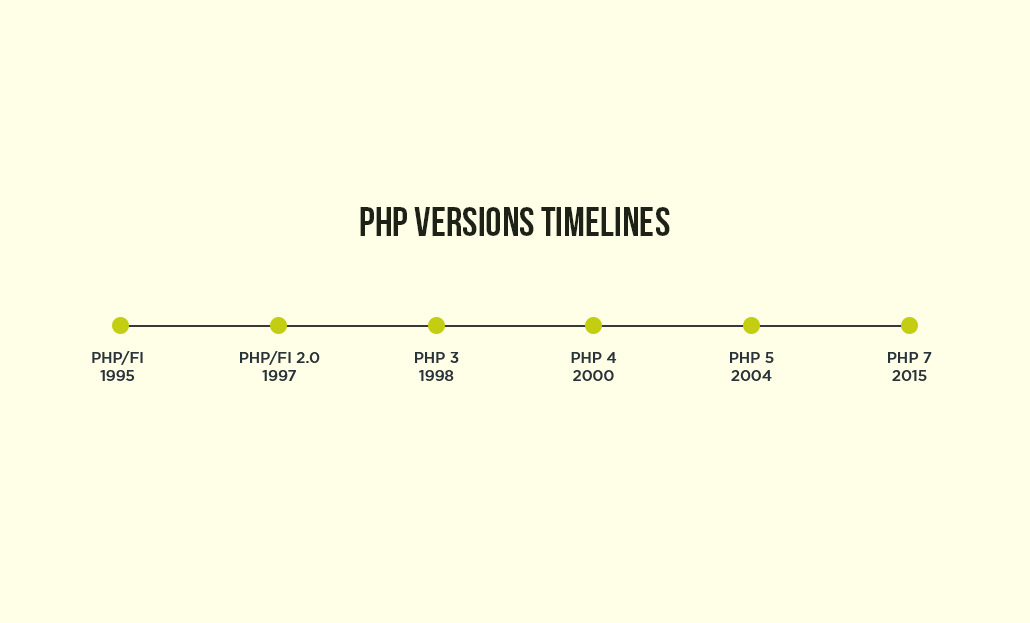
The beginnings of PHP language date back to 1994. At that time, a set of Perl scripts was created, which was supposed to monitor Internet users, who found themselves on his website. As the traffic on the website was increasing all the time, Rasmus Lerdorf rewrote the scripts in C language. After some time, he made the source code he invented available. The next step was to link the project to the "Form Interpreter" tool. This is considered to be the beginning of the PHP language. In the following years, the number of users steadily increased and in 1997 it reached 50 thousand worldwide. Due to further development, a group of programmers was formed, who worked on PHP based on the principles of Open Source software. In the same year, Andi Gutmans and Zeev Suraski also started working on the project.
Two years later they rewrote the existing code from scratch and gave it a new architecture. It was called PHP 3.0 and is now considered one of the foundations of object-oriented programming. Further development led to the creation of PHP 4, the Zend Engine. It had a huge impact on the development of the entire language. Since its creation PHP has been systematically developed and improved. The modules existing before it have been largely rebuilt and improved. Also, new ones were created and developed with the object oriented programming model. Currently, the whole project is supervised by the Zend Technologies company.
What impact did it have on the development of the Internet, websites and web applications?
According to estimates PHP is currently used on about 75 percent of Internet domains. Its code in OpenSource technology allows for easy and free use by people from all over the world. The software can be quickly tested by writing your own script. It also works very well when managing large data sets. The user sees only the result of the operation, so sensitive data is not shared.
Current position of PHP among other web technologies
In the initial years, PHP was used to help create dynamic websites. Nowadays, it can be found in many places, ranging from simple websites, games and also in complex applications of large companies. PHP can also be used to develop web applications for many operating systems and networks. It is used by WordPress, Wikipedia or Facebook.
Does PHP have a future in the era of growing popularity of JavaScript?
Client-side scripts are the most popular additions to HTML today. Support for them is realized by web browsers. It is on them that the functionality of the page depends. Depending on the version there may be differences in interpreting the code. Some users and browsers disable scripts for security reasons. This leads to a situation where the code cannot be executed correctly. One of the biggest advantages, on the other hand, is the speed of JavaScript. The latency of the Internet connection does not affect the performance of the script. PHP scripts on the other hand are executed on the server side. The user receives ready-made data. In the case of a slow Internet connection or a weak server, the delay will be noticeable here. Each run of the script loads the server. With a large number of users this can be very problematic. The advantage of PHP is the fact that the source code is not available to the user. Additionally, no matter what software he has, the functionality will always remain the same. The best solution seems to be combining both scripts in a smart way.
- 07:00 am

IHS Markit (NYSE: INFO), a world leader in critical information, analytics and solutions, today announced a partnership with Financial Recovery Technologies (FRT), a leading provider of securities class action recovery services to the investment community. This partnership will offer best-in-class corporate actions data and processing capabilities to FRT clients while enabling IHS Markit clients to leverage world-class securities class action recovery services.
The partnership will leverage IHS Markit’s unified Corporate Actions solution that brings together the power of award-winning enterprise technology solutions and managed data services that help capital market firms to reduce risk, increase efficiency and enhance service quality by streamlining, optimizing and automating the whole corporate actions workflow for all asset-classes and markets.
Financial Recovery Technologies brings technology-based services to help firms identify eligibility, file claims and collect funds made available in securities class action settlements. Offering the most comprehensive range of claim filing and monitoring services available, FRT provides eligibility analysis, disbursement auditing and client reporting, and delivers the highest level of accuracy, accountability and transparency.
“With the increasing complexity, activity and recovery opportunities in class actions globally, we will be able to offer our clients a state-of-the-art governance and recovery solution through this partnership with FRT, helping our clients achieve a comprehensive coverage and maximizing their recoveries,” said Ankush Zutshi, Vice President, Corporate Actions & Securities Processing, IHS Markit.
“This partnership with IHS Markit seeks to help our clients who want greater transparency and automation into their corporate actions process,” said Rob Rynd, Vice President, Global Head of Partnerships and Alliances. “The trading landscape continues to evolve with increased market complexity, particularly as investing has become more global. We see commonality in our approach to helping our clients with in-depth experts, validated data and greater automation across historically manual processes. It’s this data driven digital first approach that makes a difference and has immediate impact.”
With this strategic partnership, both organizations’ focus on technology-driven solutions, dedicated teams of subject matter experts, and continued product innovation will improve their clients’ asset servicing ecosystems for processing post-trade corporate and class action events.
- 02:00 am

New Corvil Electronic Trading Data Warehouse provides precision visibility into trade execution performance to help maximize alpha
Pico, a leading provider of mission critical technology, software, data and analytic services for the financial markets community, continues to enhance the capabilities of its market-leading Corvil Analytics product suite [1], with the launch of Corvil Electronic Trading Data Warehouse. The new solution for monitoring strategy execution across the trading infrastructure helps business and operations teams make faster, more effective decisions.
In a competitive trading landscape, where stakeholders need to attract and retain clients, capture more flow and maximize fill rates, the ability to obtain and rapidly action insights into execution quality and efficiency is key to gaining a trading performance advantage. Corvil Electronic Trading Data Warehouse complements Pico’s commitment to making AI-driven technology easy for the financial markets community, while advancing levels of trading performance, agility and outcomes.
With data streamed from Corvil’s network instrumentation, Corvil Electronic Trading Data Warehouse provides visibility into transaction execution quality to correlate client trading behavior with execution path and counterparty performance. The platform delivers real-time visibility at a granular level from individual trades to aggregate transaction outcomes, providing clients with a lens into technology stack performance and its impact on trading.
Additional benefits from Corvil Electronic Trading Data Warehouse include:
- Aggregate transaction flow monitoring allowing isolation for specific clients, strategies, order types and counterparties, to reveal how execution path, component latency and market destinations impact trading success.
- Full trade traceability from issuer to market, across every hop, translation and parent/child order relationship to isolate degraded decision and transmission latencies.
- Transaction completeness monitoring and reconciliation across both inter and intra-plant to detect lost messages and discrepancies in real-time.
- Live order state monitoring to track open positions, close open orders and reconcile client/market records after component failure.
- Machine learning and analytic alerts to detect problems in real-time to mitigate business impact.
- Client-quality reporting, to provide brand-aligned execution transparency to clients and internal stakeholders.
“As the de facto standard for real-time performance analytics for capital markets, Corvil Analytics plays a crucial role in providing unique visibility and intelligence to assure the speed, transparency, and compliance of trading infrastructure. As trading systems become more complex and faster, we continue to invest in innovation that meets performance demands and advances our analytics capabilities,” said Roland Hamann, Chief Technology Officer & Head of APAC at Pico. “Corvil’s high throughput, lossless, granularly time-stamped trading data capture provides an incredibly rich data source that can be used for broader analytics and use cases including trade analytics. Corvil Electronic Trading Data Warehouse elevates high-fidelity data to new business stakeholders to deliver precision insights, ultimately helping them realize further value from their Corvil investments.”
Corvil Electronic Trading Data Warehouse is available now as an extendable turn-key solution that utilizes AI-assisted configuration to achieve value in days, not months.
The successful launch of Electronic Trading Data Warehouse follows the release of Corvil’s new flagship 100Gbps capture and analytics appliance in October 2021 which delivers sustained 100Gbps real-time processing to handle the most demanding market data and enterprise network environments. Most recently, Pico was granted a US patent (The invention name is "Method and System for Accelerating Storage of Data in Write-Intensive Computer Applications"), on its turbo capture storage acceleration technology, as used in the Corvil 9000 product.
Pico’s vision is to become a leading provider of technology, software, data and analytics solutions to the financial markets. With the continued electronification of markets, the need for global borderless trading and data access and high levels of operational resilience are among the key trends shaping capital markets today.
Pico/Athena
On August 4, 2021, Pico announced that it had entered into a definitive agreement for a business combination with FTAC Athena Acquisition Corp. (Nasdaq: FTAA), a special purpose acquisition company. Upon closing of the transaction, the combined company will operate as Pico. The transaction reflects a pro forma enterprise value for the combined company of approximately $1.4 billion. The business combination, which has been unanimously approved by the boards of directors of both Pico and FTAC Athena, is targeted to close in early 2022, subject to stockholder approvals and other customary closing conditions.
- 06:00 am

Susannah Streeter, senior investment and markets analyst, Hargreaves Lansdown
‘’The collapse of the blockbuster Arm deal is a bitter blow of disappointment for Soft Bank, which now faces more of an arduous journey to generate funds. If it had sold Arm as rumoured for as much as $80 billion had the cash and stocks deal been delivered at the heady heights of Nvidia’s share climb last year, it would have marked a reversal in the dismal fortunes elsewhere in the portfolio where valuations have been hurt hard. It had the rare hallmarks of a SoftBank investment turning to gold, but instead Arm will head back for listing in financial markets where tech stocks have been seriously tarnished of late, and such a bumper valuation is likely to be far from reach. Given the number of obstacles strewn in the path of SoftBank in its attempts to strike the deal, news that it has called it off comes as little surprise. The highly sensitive nature of the computer chip industry was always going to attract significant scrutiny and concerns competition will be stifled at a time of severe shortages has made regulators more determined to block the deal.
Nvidia saw Arm as an accelerated way to enhance its artificial intelligence prowess but the eye-watering price tag risked being painful if expectations that it would help propel the company right to heart of the AI revolution didn’t work out. So it will have to work harder in this space to stay ahead, but the acquisition of Mellanox and its high performing network technology should help. For now high gross margins have given R&D a hefty budget to work with, which has helped the company throw up fresh innovations particularly in gaming technology, so Nvidia is still in line for metaverse opportunities, without being weighed down by the cost of a blockbuster acquisition.
The British company is set to go public once again, but if, as rumoured Arm reaches for a listing in New York, it may be seen as a vote of no-confidence for London, where newly listed ‘tech’ companies have had a distinctly rocky ride over the past year. Deliveroo’s disastrous IPO did little to inspire optimism, Moonpig has been brought down to earth with a bump and although payments firm WISE got off to a running start with its direct listing, its shares have been on a distinct downwards trajectory since the Autumn. Cyber security Darktrace has also been hit by a fresh jolt of insecurity among investors.
London has been working hard to position itself as a Fintech hub, as the UK continues to grapple with its post-Brexit status, in an era when it has struggled to attract fast growing companies to launch an IPO. The government has begun to make changes to try and make the city more attractive to founder led firms, but it seems these alone aren’t cutting it, with other disappointments popping up, like the decision of GP Bullhound, a venture capital firm to raise money in Amsterdam not London, via a blank cheque company. If the UK’s largest home grown tech firms shuns London for New York it will be a major blow to London’s ambitions and will pile pressure on the government to speed up reforms.’’
- 04:00 am

New, standardized, and decentralized ecosystem based on Trust Over IP Governance Metamodel supports digital identity for all legal entities globally
Basel – The Global Legal Entity Identifier Foundation (GLEIF) today announces the publication of its verifiable LEI (vLEI) Ecosystem Governance Framework.
The vLEI Ecosystem Governance Framework, which has been designed from the ground up to complement GLEIF’s existing LEI governance, defines the vLEI operational model and describes how the new ecosystem’s range of vLEI issuing stakeholders will qualify for and perform their roles in the Global LEI System.
A year in the making, the Framework has been created in full accordance with standards and recommendations of the Trust Over IP Foundation (ToIP), hosted by the Linux Foundation. It is the most comprehensive framework ever developed based on the ToIP Governance Metamodel.
The Framework provides essential detail on the governance structures and processes that will shape the development of the vLEI issuance ecosystem together with the services that GLEIF will provide, including the vLEI Issuer Qualification Program, essential key and credential management services, and a communications platform for information sharing between GLEIF and its network of vLEI issuers.
The current rate of digital transformation, together with the growth in the global digital economy, has created an urgent unmet need for greater security, convenience, and ease-of-use in digital identity for organizations and the persons that represent them in either official or functional roles. Through the vLEI Ecosystem Governance Framework, GLEIF has established itself as the guardian and gatekeeper of a new, standardized, and decentralized system that answers this worldwide need.
By wrapping new and existing LEIs in Verifiable Credentials, the vLEI offers a digitally trustworthy version of the LEI, allowing automated verification of legal entities and their authorized representatives, without the need for human intervention. The vLEI leverages the Global LEI System, which is the only open, standardized, and regulatory-endorsed system for legal entity identification.
Stephan Wolf, CEO, GLEIF, comments: “The LEI has a critical role to play in today’s digital world through its ability to provide organizations with unique, permanent identification globally. This especially is important in the context of identifying legal entities involved in digital transactions, where manual background checks inflate costs and cause huge unnecessary delays.
“GLEIF’s vision is that every legal entity should have one global identity, and this should include a digital identity. Establishing the vLEI Ecosystem Governance Framework is a significant step toward realizing that vision. We’re delighted by the progress made this year and are excited to see the first real-world vLEI applications go live in 2022.”
John Jordan, Executive Director, Trust over IP Foundation comments: “The vLEI is a great, early-stage example of how the potential of the ToIP Stack can be realized to digitally enhance an already established global system. It shows how a secure, interoperable, and massively scalable decentralized trust layer can enable an existing service to get ahead of critical issues relating to authentication and verification that would otherwise threaten its smooth transition to the digital realm and all the benefits that delivers.”
Drummond Reed, Steering Committee Member, Trust over IP Foundation, comments: “To date there has been no standard digital way to verify the identity of a legal organization or a person acting on its behalf. By building on the LEI global standard for legal entity identification and extending it to any designated representative of that entity, the vLEI infrastructure will be the first global, cross-jurisdictional solution to this problem. By choosing to base the vLEI Ecosystem Governance Framework on the ToIP Governance Metamodel, GLEIF is helping ensure the maximum global interoperability of vLEI credentials. The result will be a sea change in digital trust infrastructure that will benefit every country, company, and citizen in the world."
Once established, the vLEI system will be capable of establishing digital trust between all legal entities, everywhere. It will give government organizations, companies, and other legal entities worldwide the capacity to use non-repudiable identification data pertaining to their legal status, ownership structure and authorized representatives in a growing multitude of digital business activities, such as approving business transactions and contracts, onboarding customers, transacting within import/export and supply chain business networks, and submitting regulatory filings and reports.
A wide range of industry specific vLEI use-cases have already been identified by stakeholders participating in GLEIF’s cross-industry vLEI development program, launched in December 2020. Several of these are now entering the proof-of-concept trial phase and GLEIF expects to share further details throughout 2022, as these initiatives mature.
- 06:00 am

The innovative e-money account has become a principal member of Visa, a world leader in digital payments, to streamline money management for the UK’s working professionals.
E-money institution Frost has become a principal member of Visa, a world leader in digital payments, to further its mission of helping working professionals conquer their finances. The company is now ready to issue Visa debit cards and launch its app, bringing a multitude of different financial services together in one digital space.
According to research, 94% of UK working professionals have money worries.[1] It’s in this economic climate, amid a rise in the cost of living, that Frost founded its e-money app.[2] Its aim is to take the stress out of money management through a simple and easy-to-use interface. Customers can use the app to send and receive money, view a breakdown of their spending by category, ‘freeze’ a certain amount of money to keep aside for savings, and switch energy providers.
Today, the average person in the UK spends almost £200 a month on ‘impulse purchases’.[3] Within the Frost app, users can easily keep track of money coming in and out, and set up notifications on suggested ways they can make savings each month. What’s more, younger consumers are increasingly conscious of their impact on the environment, including whether their energy provider is the most sustainable.[4] The Frost app provides a way for people to reduce their carbon footprint, by suggesting alternative utility providers that align more closely with their values.
Now, as a principal member of Visa, Frost is launching its own Visa debit card which is both fully recyclable and made from recycled materials.
“Partnering with Visa is one of the best moves we’ve made as a business,” says Frost Chief Executive Officer Pawel Oltuszyk. “It was clear that Visa immediately ‘got’ what we are trying to achieve with Frost, and they’ve been incredibly supportive in helping us reach principal member status ready for our launch. We’re now better placed than ever to deliver a smarter way for the UK’s working professionals to deal with their finances.”
Jill Docherty, Head of Business Development, UK&I at Visa comments: “Fintech companies play a crucial role in driving innovations that meet specific consumer demand. We’re delighted that Frost has become a principal member of the Visa network, to enable more working professionals to feel confident in managing their money.”
- 07:00 am

- Despite concerns, 56% plan to increase their allocation to the digital asset
- 59% of young investors plan to increase their stock investment allocation despite recent correction
- Tech stocks, WFH, energy and Meme stocks expected to perform best
- Social media remains a key source of information for new investors, with Reddit, Twitter and Facebook the most used
New research1 conducted on behalf of Saxo Markets UK, the licensed subsidiary of Saxo Bank, the leading fintech specialist focused on multi-asset trading and investment, revealed that retail investor participation in financial markets will continue to grow in 2022, but investors are wary of the risks ahead as markets see a correction. The biggest concern for young investors (aged 18-34 years) is a cryptocurrency crash. However, despite these fears, more than half (56%) plan to increase their investment allocation to the digital asset class, challenging the risk on/risk off setting. An even higher percentage (59%) would increase their allocation to cryptocurrencies if the asset class were regulated.
Inflation and a more widespread stock market bubble leading to a correction were second and third respectively in terms of biggest concerns for young investors. Just a little over one in ten (13%) were concerned about the impact of the pandemic risk on their investments.
Despite the recent stock market performance, three in in five (59%) young investors still plan to increase their stock investment allocation this year. Nearly half (46%) believe tech stocks will perform best despite well-known shares such as Netflix losing 33% of its value, Amazon 16%, Microsoft 12% and Alphabet 10%2. WFH stocks, energy stocks and Meme stocks were listed second, third and fourth respectively in terms of investment performance expectations.
Of the young adults surveyed, most of them are drawn to investing to earn extra income followed by securing their long-term financial future. One in seven (14%) cited fun as the reason for investing.
Young investors continue to use social media as their primary source of information, followed by news sites and forums. Just one in ten are influenced by their peer group. When asked more specifically, Reddit, Twitter and Facebook were seen as the most important media platforms for investing in 2022. Just over one in ten (12%) suggested it was Instagram, despite the increasing use of influencers to lure retail traders.
Commenting on the research, Charles White-Thomson, CEO of Saxo Markets UK, said: “One year on from the events which saw the rise of the so-called Reddit army of traders, a quieter but more sustainable cohort of younger investors is emerging which will shape the future of investing for years to come. Many such investors have, however, not witnessed a market crash or a major financial crisis, so it is critical that alongside their increased investment activity, they not only seek credible sources of investment information but also look to diversify their holdings to ensure that any recent gains are protected rather than wiped off.
“Platforms such as ours are investing heavily not only in terms of improving the user experience, but also in encouraging investors to think across different scenarios that will impact their performance. The mantra that markets always go up may no longer be true in 2022 so diversification and risk management will be key.”
- 03:00 am

Cabital, a leading digital assets institution, today announced that one of the fastest growing cryptocurrency exchanges Bybit has integrated with Cabital’s comprehensive fiat on-ramp solution.
Cabital’s flexible, secure, and fast fiat-to-crypto on- and off-ramp solution allows Bybit users to buy crypto at some of the most competitive rates in the industry without leaving Bybit’s platform.
“Cabital believes that it should be easy to buy crypto,” said Raymond Hsu, co-founder and CEO of Cabital. “We are very excited about partnering with Bybit and helping their customers buy crypto in a seamless, safe and low-cost fashion. With Cabital’s fiat on-ramp solution, Bybit users can now buy crypto at some of the most competitive rates in the market. We achieve this through an off-chain settlement mechanism with Bybit, allowing their users to avoid hefty gas fees and long waiting periods. Let’s take the crazy out of crypto and help millions of people achieve financial independence.”
“Cabital’s goals of creating an innovative and reliable crypto experience are aligned with ours to bring forth next level trading to our users and elevate their experience,” said Ben Zhou, co-founder and CEO of Bybit. “We at Bybit are thrilled to embark on this new partnership with Cabital, and look forward to empowering folks from all walks of life in realizing their financial goals through crypto. Let’s revolutionize the industry together.”
Through Cabital’s fiat on-ramp solution, Bybit users can buy crypto using EUR and GBP seamlessly and directly on the Bybit platform via bank transfers, and transfer crypto between their Bybit and Cabital wallets with no transfer fees between Bybit and Cabital wallets. As fiat on-ramp is the first step in a crypto investor’s experience, this offers an easy-to-use entry point to Bybit users looking to expand their portfolios and venture into crypto investing and trading.
Cabital’s fiat on-ramp gateway is integrated with multiple leading cryptocurrency exchanges to provide customers with the most competitive rates in the industry. When Bybit users buy crypto through Cabital’s fiat gateway solution, they will not have to pay hefty gas fees because Cabital transfers the crypto from its platform to their Bybit wallets through an off-chain settlement solution. Cabital’s off-chain settlement mechanism will save Bybit users a lot of money on every transaction and provide them with a seamless user experience.
When Bybit users enter Cabital’s fiat on-ramp gateway, they will go through a simple and painless know-your-customer process to ensure compliance with regulatory demands. After verification, Bybit users can easily link their bank accounts to Cabital’s fiat on-ramp gateway and start buying and selling crypto with their fiat currencies.
Cabital’s fiat on-ramp gateway is also fortified with technologies from the market leader in crypto security and infrastructure, Fireblocks, which safeguards users’ funds with best-in-class, institutional grade protections.
Bybit is Cabital’s first partner to use its fiat on and off-ramp infrastructure for cryptocurrency exchanges. The Lithunian-based cryptocurrency exchange offers a full-stack payment infrastructure that enables cryptocurrency companies to operate fiat-to-crypto on- and off-ramps to accept fiat currencies.
Cabital’s plan is to partner with more cryptocurrency exchanges in demand of a simple and secure fiat on-ramp solution to make crypto affordable and accessible to all people.
- 01:00 am

Identity verification leader to make customizing and deploying its global identity API even easier by adding best-in-class, intuitive workflow builder
Trulioo, the leader in global identity verification, announced today it has acquired HelloFlow, the innovative no-code, drag-and-drop builder of client onboarding, monitoring and digital workflow solutions. As consumers increasingly interact and transact online, the demand for reliable and robust identity verification services and technology continues to surge. The acquisition accelerates the delivery of an enhanced end-to-end identity platform by combining Trulioo GlobalGateway, the world’s largest data and identity services network for both business and individual verification, with a full suite of orchestration, onboarding workflow and risk management capabilities.
With the digital economy rapidly growing, companies are seeking to optimize their onboarding workflows to make the user experience seamless, while continuing to meet Know Your Customer, Anti-Money Laundering and other regulatory and fraud prevention requirements. Together, Trulioo and HelloFlow will ensure customers can do exactly that through a single unified platform, providing an unrivaled offering in the identity verification industry. The combination of Trulioo eIDV, KYB and DocV capabilities and the orchestration solution from HelloFlow will expand how trust is established and extended online.
“Establishing and securing trust online is a foundational step for all digital activity,” says Steve Munford, Trulioo President and CEO. “Our ability to verify both businesses and individuals globally combined with HelloFlow’s advanced orchestration delivers unmatched capabilities and helps us accelerate an end-to-end identity platform that meets the evolving needs of our customers.”
Copenhagen-based HelloFlow disrupted the traditionally complex and lengthy client onboarding process with their no-code platform that allows organizations to easily build and deploy digital onboarding journeys in minutes. The intuitive drag-and-drop interface removes time consuming and expensive development costs while giving businesses of all sizes the ability to manage their global customer lifecycles. Trulioo customers will see increased efficiencies as the automated process will provide a vastly simplified onboarding process.
“We set out to build a platform that businesses could leverage for digital onboarding regardless of company size, resources, market or jurisdiction,” says HelloFlow Founder, Mikkel Skarnager. “We’re thrilled to be joining Trulioo and continue the journey of digital innovation and inclusion.”
The acquisition comes after another year of explosive growth for Trulioo, continued global expansion of their go-to-market presence and the addition of numerous key executives. Trulioo plans to continue strengthening its global presence in 2022 by doubling the size of its team and continuing to expand its footprint around the world. HelloFlow’s current locations and operations will support the company’s European expansion; positioning Trulioo well for further growth and allowing it to continue providing additional excellent service to its robust client roster in the region.
- 02:00 am

In the wake of the pandemic, banks across the globe continue to pursue digital transformation aggressively to position and prepare themselves to thrive in the post-COVID, digital-first world. As a result, the MENA banking sector is also undergoing profound changes, giving regional banks the opportunity to rethink their existing business models and take a giant leap into the future.
Introducing the Future Banks Summit MENA, an exciting and timely two-day event organized by Verve Management set to take place at the Conrad Dubai on the 20th and 21st of February 2022, featuring practical case studies and interactive panels, all intended to assist the region's banking industry in determining the best path forward for overcoming long-standing resistance.
The summit intends to emphasize the future of the banking industry in the MENA region through digital breakthroughs and innovation, along with tech-driven redefined business continuity planning strategies. Changing consumer trends, adoption of next-generation technology, the change from customer service to customer engagement, mobile workforces, and the need to right-size branch networks are all opportunities for regional banks to seize and accelerate the transition to digital banking.
The two-day event will feature number of well-known industry professionals from across the globe who will participate in a number of panel discussions and Q&A sessions covering topics such as Financial inclusion via open banking in the Middle East & Africa, Core banking on the Cloud, Banking as a Service (BAAS), Revolution in Sharia-Compliant digital banking, AI-Bank of the Future, Conversational Banking, Fraud, AML & Financial Crime, Digital Onboarding & Journeys, and more, all of which assess the impact of digital transformation in the financial sector today.
Our roaster of speakers includes experts like Mr. Tareq Al-Sadhan, President and Chief Executive Officer, Riyad Bank – KSA, David Bolocan, Head of Deposits, Payments, Cash Management and Banking as a Service, Lending Club – USA, Ewa Kostorkiewicz, Head of Customer Insights and Performance, First Abu Dhabi Bank (FAB) – UAE, Devid Jegerson, Head of Customer Experience & Platform Development, National Bank of Fujairah PJSC – UAE, Shino Thomas, Chief Technology Officer, National Bank of Oman – Oman, Stefan Kimmel, Chief Operating Officer, Commercial Bank of Dubai – UAE, Fahad Altwaijri, Head of Retail Banking Technology & Enterprise Solutions, SABB – KSA, Amit Malhotra, General Manager – Personal Banking Group, Commercial Bank of Dubai – UAE and many more.
Furthermore, attendees will also have ample opportunity to network with these globally renowned professionals making this a must-attend event if you are eager to innovate and want to join the ranks of the industry’s brightest minds.








