
Published
- 03:00 am

On 26 February 2021, Ron Kalifa published his independent review of UK FinTech, commissioned by the Chancellor of the Exchequer. Innovate Finance and the City of London served as the co-secretariat for this report. The Kalifa Review identified the opportunity for Britain to build on our success as a leading global centre for FinTech, which will in turn:
- foster job creation and high income tech-based employment across the UK, supporting the ‘levelling up’ agenda
- better leverage the FinTech sector as a core asset for Britain’s international competitiveness, by enabling more UK FinTechs to achieve global scale and reach, and lead on regulation and standard-setting
- help citizens and small businesses access more, better and cheaper financial services, creating a more inclusive, democratic and sustainable financial services sector
The Kalifa Review provided a clear strategy and a helpful roadmap set out across five chapters - policy & regulation; skills; investment; international; and national connectivity - to ensure the UK strengthens its support of the FinTech ecosystem and maintains its position as one of the best places in the world to start, build and scale a FinTech.
The Innovate Finance membership community - and in particular the founders and CEOs of FinTechs based across the UK as listed below - have been pleased to see action taken to implement a majority of the Kalifa Review’s recommendations by UK Government, regulators and industry, including:
-Government has committed its support to a new industry-led Centre for Finance, Innovation and Technology (CFIT), which will help catalyse development of much-needed solutions to critical challenges facing the sector such as open banking, digital ID, and finance for small firms through the creation of key coalitions. Work is underway, led by the City of London, to have CFIT up and running this year.
-On policy and regulation, the Bank of England has commenced work on a Central Bank Digital Currency; the FCA has set up a scalebox to support FinTechs as they grow and, with the City of London, have supported the development of Net Zero FinTech solutions through its digital sandbox; and the Department for Digital, Culture, Media and Sport has progressed the introduction of Digital ID, together with industry-led task forces. FinTech has also been recognised in new trade agreements with Australia and Singapore.
-On skills, at IFGS 2021 the Chancellor announced plans to implement a scale up visa, and, after a series of feedback consultations with Innovate Finance members and the broader industry, we eagerly await its introduction in April. The Department of Education also held sessions with industry to better understand how the FinTech sector uses current government skills initiatives, such as apprenticeships, and what more is needed.
-On investment, the Government and regulators have made good progress in overhauling the UK listings regime to make it more attractive to companies from around the world, with the creation of a “golden share” for founders and a reduction in the minimum free float requirement. In the Budget the Chancellor also confirmed that R&D tax credits for innovation will be extended to data and cloud computing (boosting investment in FinTech such as AI, open banking and SaaS) and allocated £160 million for the British Business Bank to co-invest with regional business angels, helping to address the early growth funding gap.
-On international, the Department for International Trade announced a package of export support for the FinTech industry to boost trade, jobs and economic growth, including the FinTech Export Academy and FinTech Champions Scheme. Innovate Finance is also convening industry partners and businesses to work with DIT, to ensure our FinTech export and promotional efforts are greater than the sum of their parts.
-On national connectivity, CFIT will serve to convene and support our FinTech hubs across the UK. The Review also spurred a number of short and long-term FinTech strategies across UK regions.
Continuing to Build Momentum
It is clear that the above marks good progress made by the government, regulators, and industry. But rather than resting on our laurels, it is imperative that we continue to build on this momentum and work together to establish an environment in the UK that is even more supportive of and conducive to innovation in financial services.
The regulatory rule book requires further updating, and regulators must have the capability and culture in place to allow them to fully embrace innovation while protecting the consumer and financial stability. The Future Regulatory Framework has identified international competitiveness as a secondary objective for the FCA and PRA - we believe it is critical that this is adhered to, and along with the scalebox approach, applied to all regulators. In addition, we should seize on the opportunities afforded to us from leaving the EU. Regulators should take this opportunity to build a more proportionate regulatory and capital requirements regime for scaling and challenger banks.
The Kalifa review also recommended the introduction of a full UK crypto regulatory regime to strengthen Britain's global position; to extend open banking to new areas; and to support the scaling of RegTech solutions. Across the multi-varied and fast-developing world of crypto and defi, we need to work together to create a clear UK strategy for growing global opportunities as well as managing risk. We also need a vision for how the UK can be the centre for the next stepchange in data and AI solutions.
Furthermore, we must continue to better address the growth capital gap here in the UK. As part of this, we must work to shift the mindset of institutional investors in the UK to take a longer-term view and focus on growth opportunities here in Britain. We can also all do more to celebrate UK FinTech businesses, promote the benefits of investment and continue to support the world-leading ecosystem we’ve built over the past decade.
In addition, there is an opportunity for regulators and industry to further encourage larger UK institutions to invest more in advanced technology.
There is also an opportunity to further nurture the high growth potential of the top 10 FinTech clusters across the UK, and accelerate the development and growth of FinTech clusters through further investment, such as in R&D.
And critically, we must continue to drive forward the timely delivery of CFIT. It can be a catalyst to address the key challenges facing the sector, and we are keen to see it up and running this year.
Realising the Kalifa Vision
In light of the successes outlined above, it is now more important than ever that we - industry, government, and the regulators - do not pause, but rather build on this current momentum and commit to cement the UK’s position as the best location in the world to start, build and scale a FinTech business.
FinTech is making a positive impact on the UK economy and society. New market entrants are challenging the status quo by providing consumers and small businesses with alternatives to the incumbent financial services providers, encouraging all financial services players to provide a better experience for the consumer. Many FinTech companies are also supporting demographics that have traditionally been underserved by the sector, including providing SMEs finance for growth and unlocking opportunities for consumers to build their wealth through savings, pensions and investments in a much cheaper and more transparent way.
The pandemic has increased the adoption of digital finance and placed a renewed focus on the critical role that technology and innovation must play if we are to make financial services work for all. Now is the time for even bolder action to realise the Kalifa Review vision: to work together to maintain the UK’s coveted position as the leading hub for FinTech, creating solutions that strengthen our economy, foster greater financial inclusion and wellness, tackle climate change and build a more sustainable financial services sector for all.
Sincerely,
- 02:00 am
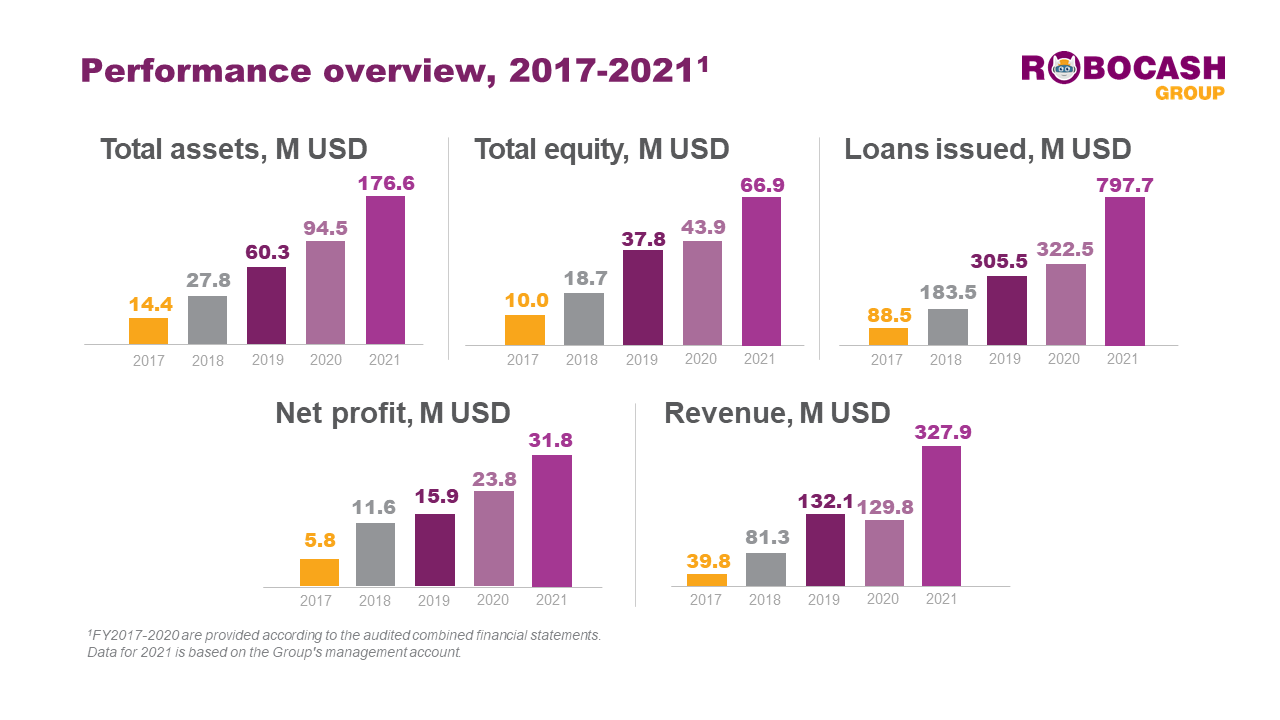
The international fintech holding Robocash Group has shared its financial and operational results for the FY2021. Surpassing the initial plans for the previous year on multiple accounts, including loan disbursements and revenue, the Group plans new product launches and unit economics optimisation in 2022.
In 2021, Robocash Group issued 797.7 M USD worth of loans worldwide, a substantial increase of 147.4% from 2020. Following the trend, the Group’s revenue saw a similarly sharp increase - 327.9 M USD, up 152.6% from the previous year. Thus, Robocash group had greatly surpassed its initial yearly goal of doubling loan disbursements and income, reaching approx. 2.5x increase.
Robocash Group’s net profit for the period amounted to 31.8 M USD. In 2021, the Group put a significant emphasis on swift scaling of the newer products in Asia, as well as optimising services in mature markets in search of better unit economics. While effective, these processes had affected the marginality of the business. Even still, the Group’s net profit saw a 33.6% increase from 2020.
Sergey Sedov, Founder and CEO of Robocash Group, reveals the plans for 2022: “This year, Robocash Group continues to aim for better unit economics across all markets of presence, optimising the net profit. Our continued global expansion will include a new short-term loans product launch in Kenya. Additionally, the Group’s product line-up in the Philippines will be expanded with an introduction of an online marketplace.”
Robocash Group’s finances for 2021 are once again being reviewed by FBK Grant Thornton. The audited financial statement is expected to be published in Q2 2022.
- 07:00 am

Sidetrade announces that it has reached an agreement with an American IT services giant, marking the largest market in its history. The contract represents an order intake of $4.2 million over an initial term of three years.
As of the first quarter of 2022, Sidetrade has signed a global contract for an initial period of three years with an American company specializing in strategic technology consulting and the delivery of critical IT services. Listed on the NYSE and belonging to the "Fortune 500 global technology services", this player is present in 70 countries, has more than 130,000 employees and supports the digital transformation of the largest private companies and public organizations in the world.
With a turnover of more than 17 billion dollars, the control of the Working Capital Requirement, and in particular of customer payment terms, had become a crucial issue for this group which had placed the securing and acceleration of cash flow generation has been at the heart of its financial objectives for several years. Sidetrade will equip all employees in charge of the Order-to-Cash process, and in particular those within their four shared service centers. Sidetrade's Augmented Cash platform with Aimie , the Artificial Intelligence technology, will replace worldwide another American solution currently used by the group.
This new contract, the largest in Sidetrade's history, is fully in line with the Fusion100 growth plan, which notably aims to integrate the Top 3 players on the North American continent. In line with its record order intake in the fourth quarter of 2021 and the 16% growth in its SaaS activities 1 , Sidetrade – with this new contract – smashes its SaaS order intake record for a single customer with a total value of $4.2 million in Annual Recurring Revenue over three years.
Olivier Novasque, President and CEO of Sidetrade, said:
“We are proud to support an American giant in its transformation project to accelerate its cash flow generation. Being selected by a key player in IT consulting is tremendous recognition of the value of Sidetrade, its technology and its teams.
In a competitive context, our technological lead in Artificial Intelligence has been decisive against our two main American challengers. After Expedia, Tech Data and XPO, this emblematic signature propels Sidetrade as a benchmark Order-to-Cash player in the American market and strengthens the execution of our Fusion100 strategic plan, just a few months after the start of our activities. in the USA ".
Sidetrade approaches the 2022 financial year with confidence, a clear vision for its future and the means to match its ambitions.
- 06:00 am

Instant SME lending platform, Kintai has chosen to partner with Nordigen to obtain transaction data for credit risk assessments.
Kintai is dedicated to making entrepreneurs’ goals a reality by helping finance business ideas for freelancers and small to medium-sized enterprises. The service is incredibly convenient, as the process is fully online and credit checks are performed in real-time thanks to open banking technology provided by Nordigen. Due to this, loans can be secured almost instantly. The repayment process is flexible and frictionless, with different terms and payment methods available to clients.
“The idea behind Kintai was to create a solution for risk-free loans to merchants and SME's who are not in the position to access traditional financing for their projects. We prioritise high quality customer service and value each one of our clients and would like to see them succeed. This is what led to us choosing a quicker and more streamlined credit assessment process, which was then brought to life by Nordigen’s open banking solution,” says Ignasi de Llorens, CEO of Kintai.
The Kintai x Nordigen collaboration enables Kintai to use Nordigen’s open banking connections to securely and quickly connect to client bank accounts. Their system is then able to analyse customer transactions and payments to establish creditworthiness.
“Often freelancers and SME owners have amazing ideas that they would like to bring to life, but financial aspects put limits on their growth. Quick and easy financing solutions like Kintai allow entrepreneurs to enter the market more successfully and with more stable financial foundations. We are elated to play our part in helping Kintai’s clients become the next big thing in their respective industries,'' says Rolands Mesters, co-founder and CEO of Nordigen.
- 03:00 am

If you own a car, you need to purchase car insurance. Car insurance is one of the most expensive purchases that users never want to use. Auto insurance is an unavoidable expense, but that doesn’t mean that you need to pay top prices to get the protection you need.
One of the best ways to minimize your car insurance premiums is by being shrewd about the type of vehicle you purchase. There are certain styles and brands of vehicles that are always going to cost you more on your premiums. For example, an expensive sports car or a European luxury model are going to cost you more than an American made sedan.
You should be able to drive whatever car you choose, and still save on your auto insurance. Let’s take a closer look at a few easy ways to lower your auto insurance costs.
Annual Review
Your car insurance may have been a great deal when you first signed up a few years ago. But, over time, your rates may have continued to rise even when you haven’t made a claim. One of the reasons for this is that many insurance companies offer discounted prices to draw in new clients that eventually run out after as little as a year. If you are tired of paying higher premiums each year, it may be time for a change.
When your premium is coming due, it’s a good idea to review your coverage. You may be able to make some changes within your current policy that could save you money. You can also shop around and take a look at what other insurance providers have to offer.
Deductible
One of the easiest ways to reduce your monthly insurance premiums is to increase your deductible amount. Your insurance deductible is the amount that you have to pay out of your pocket before you are paid for your claim. Most people set a $500 deductible. However, if you increase the amount of your deductible, it will lower your monthly premiums by up to 40%. If you choose to raise your deductible, you should put that extra money aside so that you have it available if you need to make a claim.
Bundle
Every insurance company wants your business and is willing to give you discounted premium prices for using them for all of your coverage. If you have a home, an RV, a motorcycle, and a car, you may have several different policies. By using one broker for all of your policies you can take advantage of significant savings on your insurance costs.
Discounts
Most insurance companies don’t advertise the discounts that they make available to their customers. For that reason, it is up to you to ask your broker if you may qualify for any of these savings discounts. Common insurance discounts include:
- Senior discount
- Military and Veteran discount
- Low mileage discount
- Safe driving discount
- Driver training discount
Maintain Good Credit
In most states, your insurance company will check your credit score when you apply for coverage. If you have a good score, you may be able to save on your insurance premiums. For customers that have a poor credit score, the insurance company is taking more of a risk and may charge more for coverage.
If you own a car, you will need to pay for insurance coverage. Follow these tips to help you save on your auto insurance.
- 04:00 am

U GRO to leverage platform’s Early Warning Predictions
Leading global AI-powered credit decision platform provider, Scienaptic AI announced today that U GRO Capital, an Indian listed MSME lending fintech company, is now live on its platform. This collaboration will facilitate better early warning signal mechanism for credit underwriting and enhance loan decisioning for the MSME sector in India.
Incepted in 2018, U GRO Capital is working towards bridging the 600 billion USD SME credit gap, which is growing annually at 7%. U GRO Capital utilizes a sector focused and technology-enabled approach leveraging fintech and fintouch to deliver customized credit solutions to its MSME customers. The company aspires to capture 1% market share of the total MSME lending market by 2025.
Subrata Das, Chief Innovation Officer at UGRO Capital said, “At UGRO Capital, we pride ourselves in being a ‘people’s company’ and providing a ‘You-centric’ credit approach for small and medium businesses who have historically lacked access to formal credit. Our partnership with Scienaptic AI will help us to identify any emerging signals if our customers are facing financial difficulties and help them overcome their hurdles. This will support our mission of building India’s leading Lending as a Service (LaaS) platform to resolve the credit gap in the MSME sector. Our early analysis indicates that the Scienaptic’s platform resonates well with our technology architecture, as we continue to enhance its utility.”
“We are extremely excited to announce that U GRO Capital is now live on our platform. They are now leveraging our early warning predictive modelling for pre-emptive calling and collection strategies on their existing customer base,” said Joydip Gupta, APAC Head of Scienaptic. “Our AI-powered credit underwriting platform will enable U GRO Capital in creating an inclusive financial ecosystem for those businesses lacking proper credit history.”
U GRO Capital has an AUM of INR 2,589 cr. It recently crossed 16,500 customer base mark. As of Jan. 31, 2022, the company had a network of 85 branches across nine states. It plans to achieve over INR 20,000 crore of AUM, serving 250,000 MSME customers and expand to 270 branches by 2025.

Clifford Bennett
Chief Economist | World’s most accurate currency forecaster at ACY
The Ukraine situation is clearly in a downward spiral, and seems more like an 85% probability of invasion at this point. see more

Michael Moran
Senior Currency Strategist at ACY
Stocks Extend Losses; Bonds Up, EMFX Haven Demand Rises see more
- 02:00 am

UK homeowners that took to improving their gardens during the pandemic lockdown periods have invested wisely as they see property values increase greater than building an extension, or fitting a new kitchen, experts reveal.
According to the 2019 Post Office Money Survey, landscaping your garden could potentially increase the value of your property by a whopping 77%. This means garden landscaping provides a greater return on investment than building an extension, adding a swimming pool, or fitting a new kitchen.
The study, which was conducted over five years, was based on the mid-range asking price of a three-bed semi-detached home across the UK. It found that properties with garden landscaping added the most value to a home. Garden landscaping was proven to be the most cost-effective form of home improvement when selling while providing the best Return on Investment (ROI) compared to other types of home improvement projects. A home improvement like a new kitchen was found to add a property value increase of only 25%, with a building extension saw a 37% increase, and a low 7% increase was seen after adding a wet room.
Nexus Pro Systems is a UK leading manufacturer of paving jointing compounds for the landscaping and construction industry. Their head of operations, Tom Hamilton, said: “Our consumer trends data certainly supports that garden landscaping has been a significant growth area with homeowners, especially over the pandemic period. Particularly, during the lockdown period, we saw increased consumer demand for our Pro Joint Fusion ‘all- weather’ paving grouting product, which I can only assume meant that landscapers and DIY enthusiasts were actively rejuvenating their outdoor spaces come rain or shine.
“Indeed, many of our merchants based throughout the UK have reported a significant rise in consumer demand for all manner of landscaping supplies. I believe it is important for homeowners to know that investing into their gardens not only increases the kerb appeal of their property but also its saleable value.”
Foxtons estate agents conducted research revealing that simply having a garden will generally increase a property’s value by 20%. A high percentage of 72% of buyers were prepared to pay more for a property with a garden, according to the Foxtons research.
Data by Rightmove revealed that access to a garden was a priority for over 60% of buyers searching for a new home. On the other hand, the Royal Chartered Institute of Surveyors found that 80% of property professionals consider the demand for a garden will continue to increase.
“Any improvement that raises the value of a property can be significant. If you need to access funds quickly, borrowing against your property, whether with a further advance, refinancing to better terms or a second-charge bridge can be one of the quickest and cheapest methods. At the same time, if you are investing in a property to rent out, and will be borrowing to buy and renovate, don’t overlook the garden, given that improving it will certainly raise the overall Gross Development Value (GDV) and as such improve the amount and potentially the rate at which you will borrow,” said Alastair Hoyne, CEO of ‘Finanze’, an FCA regulated specialist property finance firm.
In their recent study, ‘MyToolshed’ analysed house prices across ten areas of London and found that a well-maintained green space could increase the average Islington North London house price of £848,710 by £141,451. Similarly, homes in Ealing priced at £786,507 could gain an additional £132,806 by rejuvenating their garden spaces. Properties could see profitable gains of £131,084.50 on a house priced at £796,834.00 in Wandsworth.
Sourced from a variety of UK industries, the above research proves that many UK homeowners who invested in landscaping garden improvements during the lockdown periods have benefitted from a quantifiable increase in the saleable value of their property.
Nexus Pro Systems
Nexus Pro Systems Ltd is a national manufacturer specialising in the supply of innovative products to the paving, landscaping, and driveway industries. The manufacturer has a UK stockist network of over 250 builders and stone merchants. It boasts a product portfolio that includes a range of paving ancillary products and a range of sealers and cleaners. There are also unique resin jointing systems for pointing between paving slabs and setts

Duncan Cooper
Senior Market Strategist & Trading Mentor at ACY
Overview: Watch the video for the key trading levels for the week ahead for AUDJPY, AUDUSD, EURJPY, EURUSD, GBPJPY, and GBPUSD. see more








