Published
- 03:00 am

GoldenSource, the leading independent provider of Enterprise Data Management (EDM) and Master Data Management (MDM) solutions, today announced that it has integrated FactSet content into their ‘GoldenSource ESG Impact” product and will be listed on the Open:FactSet Marketplace, the platform for premier data applications and workflow solutions tailored for investment professionals.
Integrating FactSet content, including Truvalue Labs ESG data, not only eases current daily operations for investment managers, it also puts them in the best position to thrive under evolving ESG requirements and regulations such as the EU’s Sustainable Finance Disclosure Regulation (SFDR).
‘GoldenSource ESG Impact’ is uniquely positioned to handle interlinked reference data, as well as fundamental and ESG data, helping to solve the complexities of ESG-related portfolio management and reporting with granular content depth and data governance in a single application. This application can also complement FactSet’s comprehensive symbology offering, which links data sets such as Company Fundamentals and ESG, saving clients time and resources. For example, if a portfolio manager needs to replace an investee in their portfolio because its ESG scores are too low, they can now easily identify another company that has appropriate ESG metrics AND the underlying financial fundamentals that justify an investment. Previously, this match-making process was a significant challenge.
Todd Hartmann, Senior Director, Product Management, at FactSet, said: “We are very pleased to be working with GoldenSource to expand access to our data. GoldenSource’s presence on the Open:FactSet Marketplace also gives investment professionals the opportunity to take advantage of a centralized data tool for a whole portfolio view when undertaking ESG data analytics and reporting.”
Volker Lainer, Head of Connections & Regulatory Affairs at GoldenSource, said: “Integrating FactSet data with the proven investment management and data quality workflows in GoldenSource will further advance the operational and ESG efficiencies that firms are seeking in order to take advantage of market opportunities and rise to the demands for discipline in sustainable investing. We look forward to accelerating our shared clients on their journey towards excellence in data ROI.”
- 02:00 am
Leading payment and financial services platform added to Twitter’s “Tips” feature in Nigeria
New feature increases economic participation, supports Paga’s mission to help small business owners and the creative community access, use money, and enables their financial empowerment
Paga, the African payment company and market leader in Nigeria, is delighted to announce it has been added as a payment provider by Twitter for its Tips feature in Nigeria.
Tips is a feature that lets users send and receive money through Twitter, by allowing them to add links to select third-party payment services to their profile.
From today, Twitter users can choose Paga as their payment provider of choice. It is a new method for people to send, and receive, money in Nigeria, and further simplifies payments for individuals, small businesses, and the creative community in Africa’s most populous nation.
Paga’s inclusion expands the pathways via which people in Africa can be paid. It is an important step in digital currencies via the promotion of financial inclusion and meaningful economic participation. It also supports Paga’s mission of enabling consumers to access, and use money, in the most convenient way.
Launched in May 2021, Twitter initially experimented with Tips by only permitting a limited group of people including creators, journalists, public figures, experts, and community leaders, to see the option. Tips is now available on iOS and Android and can be accessed by anyone over the age of 18.
Tayo Oviosu, Founder and Group CEO of Paga, said:
"Our mission at Paga is to simplify payments for individuals and businesses. Via this partnership with Twitter, and Tips, we create an effective way for creators to get paid into their Paga accounts, directly from Twitter. As an avid Twitter user, I'm thrilled about this partnership. Creators are a key demographic we are building for at Paga, and this partnership allows us to enable them to effectively monetise their work. We are really excited about solving payments in the most innovative ways, especially with companies such as Twitter.”
Turning on Tips adds an icon next to the user’s profile, which will now have a link to Paga, for quick and easy person-to-person tipping. By selecting the Paga service, the user will be redirected to the Paga consumer app to send/transfer funds. Twitter takes no cut.
- 08:00 am

Global credit and risk platform DirectID announces seven new hires to their commercial team as they eye expansion into new markets. The move follows the completion of a $3M bridge funding round led by Hong Kong based venture capital firm QBN Capital.
%20(1).png?width=570&name=Copy%20of%20Instagram%20Post%20-%20DirectID%20(3)%20(1).png)
Nicholas Tuttelberg joins DirectID as Director of Business Development. He specialises in the development of credit risk and customer decision management solutions for organisations operating in the Financial, Retail, and Telecommunications industry. He joins from Experian and brings with him over 20 years’ expertise in risk, software, and analytical data solutions. He has held senior positions previously at TransUnion, Reunert Group, Nedbank, and Standard Bank. Tuttelberg is based in Cape Town, South Africa, and will lead the business growth for Africa. Tuttelberg says with his new role he aims to become the ‘trusted digital’ and ‘insight’ partner to all businesses in Africa.
Damiano Cracolici joins DirectID as Director of Business Development. Damiano brings valuable experience in the deployment and enhancement of data-driven business processes and solutions across the credit and risk lifecycle. Having previously served at TransUnion, FICO, and Experian, Cracolici brings with him 20+ years of experience in credit information and decision support services in the UK, Europe and emerging markets. He has provided consultancy and advice in a wide range of financial services organisations and a number of other vertical markets. Cracolici is based in the UK and will take point on DirectID’s insurance sector clients.
The growing fintech has also added four sales graduates to their commercial outfit, complimenting the significant industry experience of the broader commercial team. The graduates were hired through the IT Technical Sales apprenticeship training programme at Pareto Law, a global market leader in sales recruitment and sales training. Through Pareto, the team of Business Development Executives will continue to build upon their learning and development, while gaining invaluable hands-on experience in their employment at the rapidly growing fintech.
Completing the new tranche of hires, fellow Experian alumnus, Lee Sansom, will lead the new graduate team. He joins DirectID with a decade of experience in business development with B2B SaaS providers. This move further demonstrates DirectID’s commitment to nurturing young talent, having recently participated in the UK Government Kickstart Scheme.
Clare McCaffery, Chief Commercial Officer at DirectID, said:
I am delighted to be joined by such a prestigious group of colleagues. Having worked with both Nick and Damiano previously I know our growing client base will benefit from their vast experience and consultative approach. It is equally an honour to enable the talented BDE team as they start their careers after gaining exceptional academic qualifications. I am sure that under the guidance of Lee’s hands on leadership approach they will help us to expand DirectID across many markets over the next 12 months.
DirectID’s platform, data, and unique insight engines offer decision makers a more comprehensive view of applicants and customers across the credit lifecycle. This enables more informed and appropriate decisions.
Credit decisions are traditionally based on historic transactions, which are obtained from Credit Reference Agencies, or on self-declared information provided by the consumer. These information sources are often out-of-date and can only provide a partial view of the customer’s credit history or current financial health.
Broad adoption of PSD2 and open banking adoption in Europe and the UK has paved the way for the development of innovative services based on bank data.
DirectID has developed a market leading credit & risk platform that powers some of the world’s largest brands. Data obtained, with explicit consent, directly from consumer’s bank account is real-time, verified, incorruptible, and guaranteed to be accurate. Applying advanced modelling techniques, DirectID also provides unique insights into customers' financial status, which enables decision makers to have a more precise view of credit risk and to make faster, more accurate and personalised decisions.
Based in the UK, DirectID’s reach is global and rapidly growing, with over 13,000+ bank connections giving them access to 1.5bn users in over 45 countries. The fintech operates across banking, consumer and SME lending, utilities, gambling and gaming, the gig economy, and many more sectors.

Anders la Cour,
CEO at Banking Circle Group
“A year ago, the Kalifa report revealed that the UK was at risk of losing its trailblazing position in the FinTech wor see more
- 04:00 am

Nivaura, a London based fintech, announced today the launch of the General-purpose Legal Markup Language (GLML) plug-in for Microsoft Word. This follows the launch last summer of a not-for-profit foundation (the GLML Foundation) to promote and develop GLML for use by lawyers and other non-programmers to make legal documentation machine readable and executable in debt capital markets.
Easily installable and accessible, the plug-in is featured as a Microsoft Word add-on appearing under a ‘GLML’ tab of the main Microsoft Word ribbon. The plug-in enables users more easily to annotate legal documents with GLML so that they become machine readable without needing to learn how to “code”. For example, a lawyer can take a static pro-forma template and apply GLML to that document using the plug-in to generate a GLML template. The advantage of this is that all the data points needed for a transaction will then be structured in a digitised format with GLML.
GLML enables straight through processing (STP) of transactions allowing the structured data to be mapped to downstream processes and systems without manual key entry for both traditional and Distributed Ledger Technology (DLT) clearing, for example facilitating the automatic setup of smart contracts.
The plug-in can also generate accompanying JSON files which are becoming popular in tech solutions. The GLML template and JSON can then be uploaded to any technology solution that can utilise structured data from documentation. In the context of debt capital markets, for example this enables dealers to digitise their own custom term sheets and make these available for transactions.
GLML was developed by Nivaura along with input from several leading international law firms including Allen & Overy and Linklaters, starting in 2017, before being moved into the GLML Foundation to promote adoption across the industry. Nivaura’s innovative debt capital markets product, Aurora, automatically generates debt issuance transaction workflows from pro-forma documents that have been annotated with GLML.
Aurora facilitates primary market negotiation and execution, enabling the data to flow automatically from upstream processes (i.e. term sheet negotiation) to enable faster completion of the final terms document compared with the current processes relying on the manual replication of data from emails and word documents. Data entered by lawyers using Aurora to generate the final terms document can be mapped to downstream processes (i.e. operational and compliance) to enable straight through processing of transactions by other market participants.
The goal for GLML is for capital markets participants and tech firms focused on drafting, negotiation and transaction execution to leverage GLML by using the plug-in to create structured data documentation that can then drive technological processes and efficiencies.
GLML is compatible with any underlying taxonomy, and is particularly aligned with industry efforts such as Common Domain Model, and can work with other private data taxonomies that may exist within firms and banks. In this way, GLML is well placed to enable easy digitisation of documentation by capital markets experts who are non-programmers, as well as easy interoperability between different systems and taxonomies.
Quotes:
Scott Eaton, CEO of Nivaura, commented: “Since establishing the GLML Foundation last year our ambition has been to roll-out this product as soon as possible. The launch of the GLML Word plug-in will enable our product engineering teams to hear first-hand exactly what the dedicated user-base requires and what needs to be addressed before its full launch. We welcome the opportunity to continue our long-standing partnership with Allen & Overy and Linklaters and look forward to the next phase of GLML development. While this product has been designed to alleviate strain for DCM work, it has application across the broader legal landscape.”
Daniel Fletcher, Partner at Allen & Overy, commented: "The potential for efficiency gains may be enhanced if the market chooses to adopt a single data standard. That standard will need to be readily deployable by market participants. The GLML plug-in tool is designed to make it easier for lawyers to apply GLML to documents, which can then be used by clients in tech solutions such as Aurora. Importantly, the tool exists within Microsoft Word, and so fits within lawyers’ existing workflow practices. Enabling lawyers to retain oversight over the legal documentation while reducing the digitisation costs can help the legal community to better serve its clients.”
Richard Levy, Partner at Linklaters, commented: “We take a keen interest in opportunities to increase efficiencies in our documentation processes and in new technologies which enable improvements in the execution of capital markets transactions for our clients. We welcome the release of the new GLML plug-in for testing, and we look forward to working with market participants to explore the benefits offered by the new plug-in.”
Phil Smith, Chair of the GLML Foundation commented “The release of the GLML plugin for testing is an important step in the adoption of GLML and the drive toward common data standards in the market. While the industry discusses and converges on a common taxonomy, GLML provides an optimal way for taxonomies to be implemented into documentation and data flows. The GLML Foundation will be hosting a series of training sessions for lawyers and non-programmers to utilise the MS Word plug-in to annotate documentation.”
- 03:00 am
Atom bank has increased the rates on its range of Instant and fixed rate savings products for the second time this year, as it leads the drive to put value back into the UK savings market.
Atom’s Instant Saver now offers 75x times more reward than Lloyds, HSBC and Barclays’ equivalent products*.
Atom is also offering table topping fixed saver rates, making sure savings are working hard as cost pressures pile on to households.
Atom’s top rated app (rated 4.8/5 by Apple users and 4.9/5 by Android users) means that these rates are available in minutes to both existing and new to bank customers.
Mark Mullen, Chief Executive Officer at Atom, said:
“In contrast to most banks, who continue to offer rock bottom rates to savers, we have increased the rates across our savings range for the second time this year. Savers have had it rough for a long time, and traditional high street banks have done very little to support them for many years. The notion that many banks take away the umbrella just as it starts to rain is clearly illustrated by their reluctance to pass on the returns they are making and the recent base rate movements to savers.
“Saving with Atom is easy and quick, and our award-winning savings range is available to everyone through our top rated app. Because of our highly efficient digital business model and our focus on lending to UK homeowners and small businesses, we can give savers better rates whilst also giving great value to our borrowers. It’s about time that other banks did the same, but in the meantime we’re delighted to be on the side of savers as we work to create a new model for banking in the UK.
“Atom is trusted with over £2.5bn of UK savers’ deposits, and our 4.6 Trustpilot rating shows the current high level of customer satisfaction. We’re here to grow and to create competition in a market that has not treated consumers well; this is a moment to make that promise real to UK savers.”
Details of the new rates:
Instant Access Saver: Increase from 0.65% to 0.75%
1 year fixed saver: Increase from 1.35% to 1.45%
2 year fixed saver: Increase from 1.60% to 1.70%
3 year fixed saver: Increase from 1.75% to 1.85%
5 year fixed saver: Increase from 1.80% to 1.85%
*Comparison of Atom Instant Access Saver versus average rate of RBS Instant Saver 0.01%, Lloyds Bank Easy Saver 0.01%, HSBC Flexible Saver Standard 0.01%, Barclays Bank Everyday Saver 0.01%. Rates correct as of 17th February 2022.
- 05:00 am


- 05:00 am

AstroPay, the online payment solution of choice of over five million users in the world, is proud to announce that it has joined the line-up of official sponsors of the most important trade show of the gaming industry in Latin America, SAGSE Latam 2022, set to take place on the 30-31 March 2022, at the Hilton Buenos Aires.
The event, which will bring together the region's key gaming industry players, will showcase the latest innovations in the gaming and entertainment industry, as well as provide an ideal space for industry professionals to network and find the latest developments and trends on technology in gaming.
Mikael Lijtenstein, CEO of AstroPay said: "As sponsor of SAGSE Latam this year, we see this as an excellent opportunity to reconnect and expand our business network in the region, as well as the ideal place to showcase our payment solution that allows users to pay via more than 200 payment methods worldwide."
Alan Burak, Director of Monografie mentioned: "Much has changed in the post-covid world, and with SAGSE we had already anticipated this change by providing an innovative experience for Latin America. But the pandemic accelerated the process of evolution towards online entertainment, so we worked on that aspect without leaving aside the physical game".
AstroPay has a strong presence in the Latin American market since its inception in 2009, which has allowed it to achieve a vast experience in each of the countries that make up the continent and in the knowledge of the needs of their respective populations.
- 02:00 am
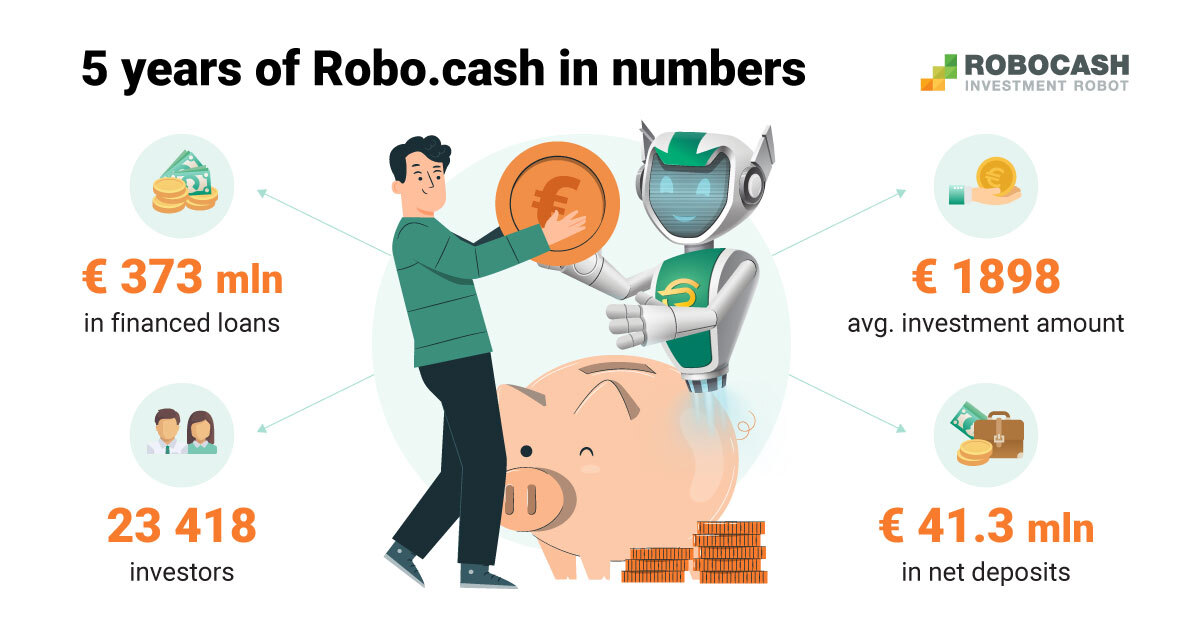
More than 370 M euros have been funded over the 5 years of Robocash operation. In 2021, the growth was 117% YoY and the customer base was replenished with another 10 thousand new investors. In the near future, the platform plans to introduce automatic investment strategies.
Robocash today is a fully automated European investment platform which is on its way to becoming one of the leading players in the P2P market. The platform currently ranks 11th in the P2PMarketData list with a total funding of 373.17 M euros since its launch in February 2017.
More than 23 thousand investors have already joined Robocash. In the last quarter of 2021, they earned over 1 M euro, which is 21% of the total amount for the entire lifetime of the platform. Also, the quarter was marked by a record amount of net deposits, totalling to 11 M euros. At the moment, the average investment amount on Robocash is 1898 euros.
“We are happy to celebrate our 5th anniversary, which was marked by excellent results. Over the last year of operation, we raised 33 M euros, which is 70% of the total amount of attracted funds. Our growth in financed loans averaged 5% per month. We want to reach our 10th anniversary with the same achievements and a large base of satisfied investors”. - CEO of Robocash Group, Sergey Sedov, commented on the anniversary.
In 2022, the platform plans to implement new features such as one-click investment, making the product more convenient to use. Robocash analysts predict that the company could reach 47 M euros of net deposits per year, increasing the monthly figure to 5 M euros.
- 03:00 am

Adam Hancox, director of retail at TransUnion in the UK, comments on the latest retail sales index from the Office for National Statistics:
“It’s really encouraging to see sales bounce back following a challenging Christmas period for retailers, with the latest ONS data showing sales volumes rising by 1.9% in January 2022. It seems as though the swift post-Christmas lifting of social restrictions, that were introduced as a safety measure during the busy holiday period, has coincided with increased footfall across UK shops – with sales volumes now 3.6% higher than pre-pandemic levels recorded in February 2020.
“That said, growth might have been significantly higher if it had not been for the increasingly challenging cost-of-living crisis, already felt keenly by consumers this year. Rising inflation, with steep increases in energy prices and consumer goods, along with national insurance contributions going up in April, suggests that many consumers may consider reeling in spending, as disposable income takes a hit.
“One thing that this data has confirmed though, is just how accustomed people in the UK have become to doing their shopping online. Despite the proportion of retail sales being made online falling to 25.3% in January, they remain notably higher than the pre-pandemic levels seen in February 2020, where just 19.8% of sales were made online. With or without COVID-19 restrictions in place, it’s vital that retailers don’t deprioritise the online experience if they are to continue to give consumers the smooth digital experiences they expect in 2022.”