Financial IT Fall Edition 2026
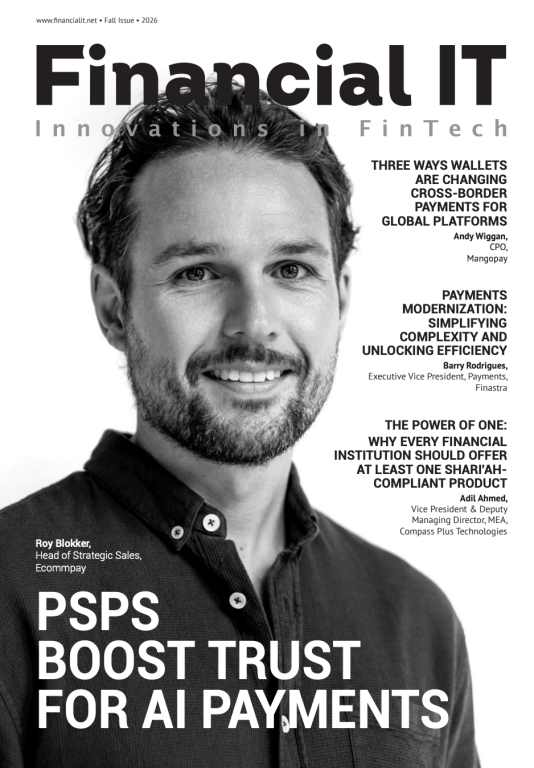
- 23 Sep, 2026 03:00 am
The Big Calls Edition
Welcome to an edition of Financial IT that is rather different to all others that we have published.
In many of the previous editions, it has been possible to link most of the articles to themes that feature prominently at major conferences where we have been a media partner. In some editions, almost all articles have related to a topic that is particularly current. With the help of our contributors, we have been able to share expert opinion in order to look at issues in great depth.
This edition is not linked to a particular conference or to a particular theme. However, a diverse variety of contributed articles lead to four major insights into the intersection of financial services and technology. This is the Big Calls Edition of Financial IT.
People don’t entirely trust AI yet - and that may be a good thing
At the time of writing of this Editor-in-Chief’s letter (mid-September 2026), the mainstream media (in the English-speaking world, at least) is pre-occupied with the possibility that Artificial Intelligence (AI) destroys humanity. Some commentators are calling for the development of AI systems to be slowed.
An important message from our contributors is that, for now, it is people who are in charge of AI - and not the other way. As one of them observes: “AI will become an essential compliance tool— but it will not replace human judgment.” A key issue is trust - or the lack of it. As another contributor notes: “The research revealed that consumers are broadly comfortable using AI for search, discovery and price comparison. However, trust falls sharply at checkout. Agentic commerce will only expand beyond support for searching and price comparison if trust is built into the checkout journey from the start.”
A third contributor emphasises the need for transparency when AI is used to provide solutions: “The customer [does not have] to understand the AI model, but they do need to understand why a pricing, credit, or risk decision was made, and how it affects them, and who remains accountable for the outcome. Guardrails are what make innovation scalable, and AI must be as compliant as it is intelligent.”
Actual implementation of AI in financial services through 2027 may be slower than most people have been expecting.
Stablecoins could and should bring a revolution to cross-border payments
Customer experience in cross-border payments can and should improve further. According to one of our contributors: “businesses feel that gap directly: nearly one-third of cross-border payments still cost more than 3%, and only 40% of B2B transfers settle within a single working day. The network they lean on is thinning, too: the global supply of correspondent banking relationships has fallen 20% since the mid-2000s, and some corridors now have no intermediary at all.
Nevertheless, a solution is to hand - stablecoins. As one of contributors points out: “the demand for stablecoins is greater where they are easier to source than dollars through local exchanges: for example, in India, Nigeria, Brazil, Indonesia, Argentina. [Meanwhile], a large corporation in a developed market has no difficulty opening a dollar or euro account. Holding stablecoins isn’t going to solve a problem that that corporation doesn’t have. What it does need, however, is speed, transparency and lower transfer costs, without having digital assets on its balance sheet.”
This presents new opportunities for intermediaries. “When a payment starts in stablecoins, somebody in the middle has to take the asset, convert it to local currency, screen the counterparty and produce reconcilable records. Similarly, when a business pays local currency to freelancers or suppliers who would rather receive stablecoins, that intermediary provider is needed.”
Such an intermediary, moving stablecoins between wallets, will also need to build the trust of its customers. Expect this to be a developing story through 2027.
Wallets make multi-currency accounts more likely for all
Wallets are, of course, not just for stablecoins. Nor are they necessarily the favoured method of payment across all national markets. Nevertheless, as one of our contributors suggests: “Many global initiatives are pushing cross-border money movement toward a model that is easier to operate, reconcile and scale. The common goal is a more connected environment for domestic instant payment systems, where global businesses can collect, hold, convert and distribute funds with less friction, while still supporting the local experiences users and partners expect. In that context, wallets support platforms in meeting the new requirements of global cross-border finance.”
In many developing countries, people are used to thinking in terms of more than one currency - often the local one and a major one such as the US dollar or euro. It is possible that this happens to a greater extent in developed countries - and especially in the event of a financial crisis. In this eventuality, look for the popularity of multi-currency wallets to grow rapidly.
Digital strategy plays a central role in any emerging market’s prospects
The last word in this Editor’s letter goes to … Uzbekistan. Since 2023, the government has been transforming the economy as envisaged in its “Uzbekistan 2030” strategy. Simultaneously, the government has boosted investment and employment in digital- and fintech- related areas, mainly through the IT Park network which spans the entire country (and not just Tashkent).
In the 1980s and the 1990s, the key question for any emerging market revolved around the assumptions underpinning the development of the particular country being discussed. Were the assumptions still valid? In the mid-2020s, Uzbekistan shows how it is now other things that really matter the most: is the digital strategy really supporting sustainable development? The emerging markets phenomenon is even more exciting than it was 30 years ago.
Once again, we thank our contributors and supporters - and wish all a successful 2026 conference season.
Andrew Hutchings,
Editor-in-Chief, Financial IT