Published
- 02:00 am
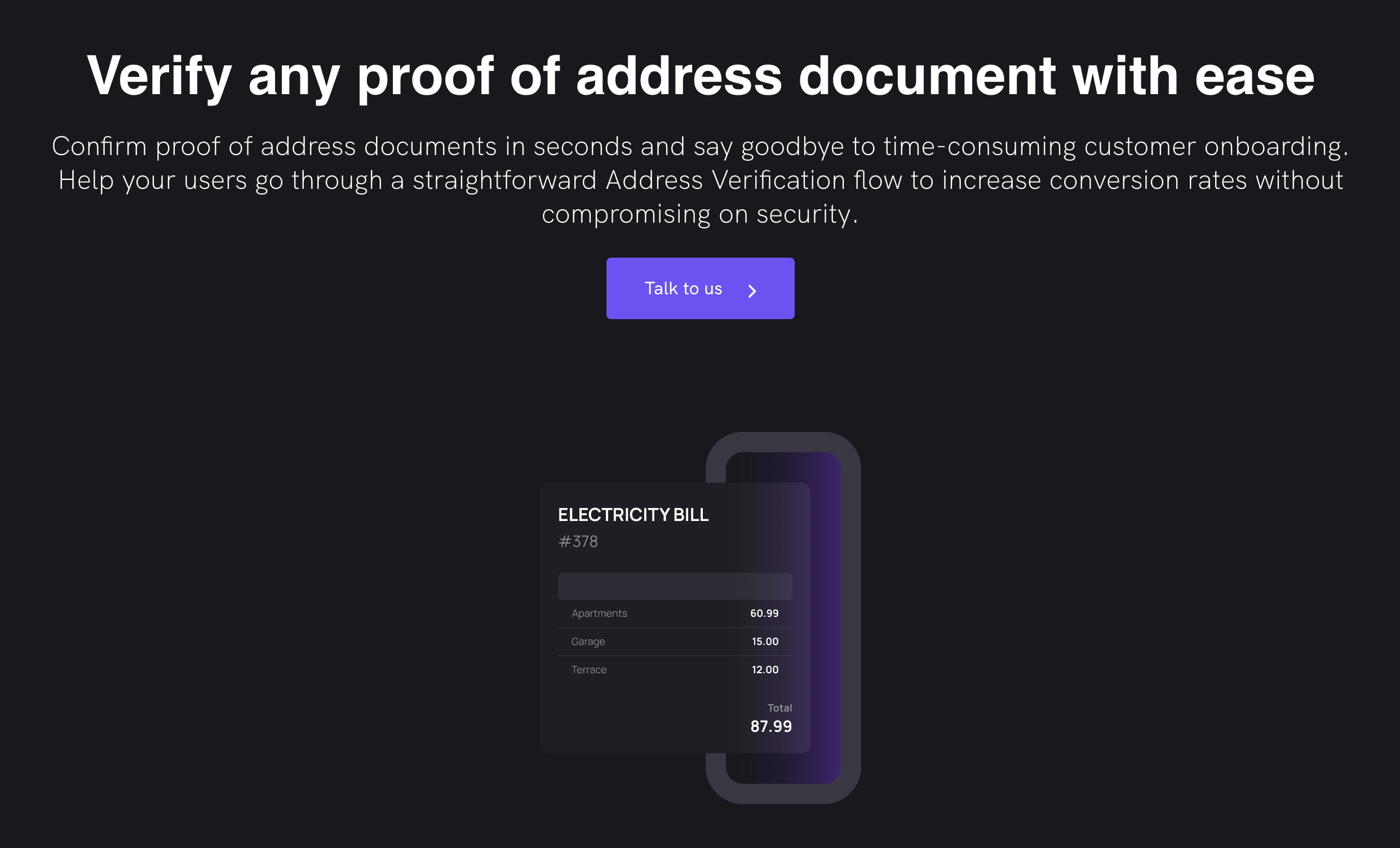
iDenfy, the global compliance and fraud prevention startup, launched a new solution to perform proof of address checks. Currently, the latest semi-automated Address Verification service helps organizations ensure KYC/AML compliance while reducing user friction.
Anti-money laundering (AML) regulations now have built-in laws that help enhance security in Know Your Customer (KYC) and Customer Due Diligence (CDD) processes. That means verifying customer identities isn’t enough, as businesses are now additionally required to verify address information.
Bank statements and utility bills are the number one accepted documents out of all proof of address (PoA) options. However, iDenfy argues that these documents are also easy to alter, especially for advanced cybercriminals who use sophisticated digital tools.
Consequently, spotting altered documents became a challenge in the digital age, slowing down productivity and creating a backlog for many regulated entities that are obliged to accept digital identity and address verification applications.
To tackle this issue and protect client data, iDenfy launched a new addition to its fraud prevention toolkit, proof of address verification. The service focuses on simplifying customer onboarding by removing friction and allowing companies to efficiently restrict individuals from high-risk jurisdictions while ensuring complete compliance with ever-changing regulations.
While the traditional proof of address operations could take hours to complete, iDenfy’s solution is simple and efficient. Users upload photos of their PoA documents, such as utility bills, then the system scans and extracts the physical address data. Additionally, the startup has an in-house reviewers team that compares the information manually to ensure complete accuracy.
As stated by iDenfy’s officials, their Address Verification is beneficial when businesses aim to maximize their security programs. For example, iDenfy’s proof of address verification flow can be customized to ask high-risk users to connect to their utility providers’ dashboards. The software automatically verifies the documents and checks their upload date. Afterward, iDenfy captures the address data, and the experts manually check if the address is legitimate.
Asked about the new product's advantages, iDenfy states that its mentioned direct Address Lookup feature is new on the market. Compared to other built-in PoA features, like geolocation, iDenfy claims that its Address Verification tool is more accurate since sharing the user’s location can provide faulty results, especially if the individual resides in a different location when on vacation.
iDenfy’s goal was to develop a speedy and secure solution. In addition to efficiency, the semi-manual fraud prevention method is reliable due to having two layers of security backed up by AI-powered software and 24/7 human supervision. According to iDenfy’s CEO, Domantas Ciulde, Address Verification gives the business certainty and helps detect new, more sophisticated fraud schemes in the fast-paced digital environment:
“While verification speed is a crucial factor, we focus on providing secure proof of address verification services that allow meeting regulatory requirements while providing a frictionless onboarding experience for the customers. Our goal is to help other businesses save time and resources,” — added Ciulde.
- 07:00 am
Lloyds Bank Business & Commercial Banking has combined its commercial card and invoice finance teams under a new senior appointment.
James Sykes will serve as the Business and Commercial Banking’s Head of Invoice Finance Product, while retaining his current position as Head of Commercial Cards.
The invoice finance product and commercial card teams will be brought together under his leadership, unlocking new opportunities for cross-team collaboration, product innovation and growth.
In his new role, James will be responsible for delivering Lloyds Bank’s full range of commercial card and invoice finance products – ranging from traditional card services to cutting-edge virtual solutions, and single to whole-book factoring and discounting.
James has led Lloyds Bank’s commercial cards team since 2017. Prior to joining Lloyds Bank in 2013, he was head of Barclaycard’s UK-wide large corporate commercial card sales division.
James Sykes, Head of Commercial Cards & Invoice Finance Product, Lloyds Bank Business & Commercial Banking, said: “Combining these two teams will make it easier than ever before to share the expertise and innovation we have within our teams to deliver market-leading, cutting-edge solutions for our clients.
“We have a relentless focus on innovation. As our clients’ needs change, we want to be a step ahead – having solutions ready that make the financing they need faster, simpler and more convenient to access.”
Chris Loring, Managing Director, Lending and Working Capital, Lloyds Bank Business & Commercial Banking, added: "James' appointment demonstrates our intent to grow and strengthen our card and invoice finance propositions to respond to increased needs from our clients in this space.
“James has a strong track record, with a particular focus on delivering exceptional client outcomes. It is an exciting time for our team and I'm looking forward to working with James, as we continue to develop new, market-leading propositions that help clients better manage their working capital and, ultimately, turbocharge their growth."
In March, Lloyds Bank announced a new partnership with fintech Satago to deliver the first end-to-end digital single invoice finance and whole-book invoice factoring solution on a single platform offered by any UK bank. To reflect the strengthening of the partnership, Lloyds Banking Group invested £5m in Satago in exchange for a 20% equity stake.
Meanwhile, in October, it announced a new partnership with Billhop to unlock new, innovative services for commercial banking clients.
This includes a solution that enables businesses to make card payments to any supplier – even those that do not accept them already.
- 02:00 am
actyv.ai, the category creator in the Enterprise SaaS with embedded B2B BNPL and insurance space, today announced its partnership with Mswipe, an omni-channel digital payments platform, providing a host of offline and online payment acceptance solutions to merchants across 800 cities and towns of India.
Through this alliance, Mswipe will leverage actyv.ai’s technology stack, enabling its B2B merchant community to the digitisation of business processes and also score for various business opportunities through the platform’s embedded offerings, which include B2B BNPL and insurance.
“At actyv.ai, it is our endeavour to aid large enterprises and their partners modernize their supply chain ecosystem and enable growth through our embedded offerings,” said Raghu Subramanian, Founder and Global CEO, actyv.ai. “Mswipe, being one of the largest payment solution providers in India has a vast network, both online and offline. We hope to augment our enterprise base and strengthen their small businesses with Mswipe’s payment solutions. Together, we hope to leverage each other’s expertise and unlock new potential,” he added.
As part of the platform, actyv.ai will offer Mcapital a multidimensional score which consists of both financial and non-financial data to enhance their credit underwriting.
Ketan Patel, CEO, Mswipe Technologies said, “We are delighted to partner with actyv.ai, category creators in the embedded offerings space. Merchants are the backbone of our business and by adopting actyv.ai’s platform, they can digitise business processes. Mswipe is happy to enable offerings like merchant BNPL and payment solutions to distributors, dealers and retailers on actyv.ai’s platform. We are confident that this partnership with actyv.ai will empower small businesses and further drive embedded financial offerings to the grassroots of the country.”
- 07:00 am

Debite, the dynamic financing platform built for early-stage companies, has announced they’re launching a new product called Debite Pay.
Debite Pay is an innovative payment solution that allows early-stage companies to send a payment directly from their Debite corporate credit card to a bank account.
Early-stage companies can unlock the ability to use their line of credit to pay suppliers that prefer bank transfers or might not accept card payments. Companies can also split those payments up to 12 months using the “Pay-in instalments” feature, extending their runway and ensuring greater payment flexibility.
Debite Pay solves the long-standing problem founders have faced; making a bank transfer payments when they don’t have enough cash in their bank account. When cash flow is low, large payments to suppliers can prevent or stunt growth and, in many circumstances, may even cause a business to close down. With Debite Pay, this problem is removed.
Debite was born with a mission to help businesses manage their cash flow more effectively and maximise their growth potential. This new feature provides even more flexibility to early-stage companies searching for new ways to smooth out business expenses, whether it is a card payment or bank transfer.
Debite Pay will initially be offered to companies in the UK market. It is an interest-free credit for up to 35 days, with transfer fees starting from only £5. It has a built-in instalment feature that can split payments over 3, 6, 9 or 12 months.
Debite’s CEO Tayga Baltacioglu says about the launch: “I’m thrilled to launch Debite Pay. Having founded and invested in high-growth startups myself, I’ve personally experienced the deep frustration that can come from struggling to pay suppliers who insist on bank transfers and the big impact that can have on fueling growth. I know many founders will be excited to use this new product, and I’m delighted to be part of a team that is helping boost the growth of UK startups.”
Debite’s application process takes less than 5 minutes and is underpinned by its proprietary technology, with no personal guarantees required. A decision is made within 24 hours, with a credit limit available instantly. Customers can then easily use this limit to make card payments or bank transfers with the Debite corporate card or Debite Pay.
Since the official launch in July, demand and usage for Debite have been impressive. Debite has seen hundreds of customers applying to use the corporate credit card.
- 09:00 am

US-headquartered global investment research company, Morningstar has introduced the industry-first Morningstar PitchBook Global Unicorn Indexes, including the Morningstar PitchBook India Unicorn 25 Index, a new series of benchmarks to daily measure Unicorns, or privately held venture capital-backed companies with valuations of $1 billion or more.
Morningstar determined only four countries have a critical mass of unicorns sufficient to create a meaningful single-country unicorn index. The creation of the Morningstar PitchBook India Unicorn 25 Index reflects local market conditions that are fertile ground for companies to remain private while they undergo considerable growth.
Morningstar noted that the pace at which new unicorns are coming up in India is rapid; as many as 10% of all new unicorns across the globe are born in India. The investment, consumption, and regulatory landscape in India is ripe for the growth of unicorns, as well as for upcoming unicorns, or “soonicorns.” Active government support for India’s start-up ecosystem, including its openness to foreign capital being invested, helps Indian startups secure funding while staying private. Behavioural changes towards technology and online consumer products that were brought on by the pandemic have also created a favourable environment for innovative startups. And the size of the consumer market in India allows businesses to produce at scale.
Similar to the Indian stock markets that remained relatively resilient compared to global peers, Indian unicorns have remained resilient as well. Despite the slowdown in 2022, Indian unicorns have seen some large deals for companies. BYJU’s, Swiggy, ShareChat and Meesho were among the many Indian unicorns that have successfully raised funding in 2022.
Another important differentiator among Indian unicorns is that diversification has been consistently increasing among them. In 2019, the top 10 constituents of Morningstar Pitchbook India Unicorn 25 Index comprised nearly 80% of the index which has dropped to almost 60% in 2022. This is indicative of the increasing number of companies having large up-rounds.
Sanjay Arya, Head of Innovation, Morningstar Indexes said, “Considering the pace at which internet and other technology solutions are turning mainstream in India, these segments are poised for further growth. Pandemic-induced lifestyle changes are also expected to bolster growth in these segments. B2B products and services are expected to witness growth as the focus shifts towards self-reliance among Indian businesses.”
B2C product and service providers such as BYJU’s, Swiggy, OYO Rooms, and Ola comprise of 60% weight in the Morningstar Pitchbook India Unicorn 25 Index. This is followed by a 25% weight in the Information Technology sector which include companies like Dream Sports and Razorpay.
“In today’s market, investors are increasingly looking to nontraditional asset classes like private markets for portfolio diversification and investment opportunity,” said Ron Bundy, President, Morningstar Indexes. “Our new global unicorn indexes combine the deep data and insight of PitchBook with the best practices of Morningstar Indexes to deliver a new state-of-the-art series of benchmarks for the late-stage venture capital market.”
According to Morningstar research, private capital markets have grown substantially in the last decade, with more companies staying private longer or pursuing less traditional funding strategies. This trend has fueled a growing number of “unicorns,” or VC-backed companies with more than a billion dollars in valuation.
This new series of market indexes combines the leading VC data, analytics and insights from PitchBook, an independent subsidiary of Morningstar, with the indexing best practices of Morningstar Indexes, one of the fastest-growing global index providers. It employs a proprietary three-factor mark-to-model pricing methodology to provide more frequent valuations for the asset class. The first of its kind, the model employs a range of valuation measures and comparable data from private and public market peers to bring transparency to an asset class that has been hard for investors to track.
- 07:00 am
Spendesk launches its industry-first set of Invoice Automation features, bringing secure, one-click, end-to-end supplier payments to its 7-in-1 spend management solution. The new features relieve small and medium-sized businesses (SMBs) from the burden of invoicing by streamlining the process while providing full visibility and control through an easy-to-use interface.
By automating time-consuming invoicing processes, finance professionals can cut hours of manual work and focus their efforts on revenue growth, while also removing the risk of costly human error; with real-time reporting and controls keeping them in the driving seat. With a single engine, SMBs gain the invoicing efficiencies and capabilities typically only achievable in larger organisations.
The new features were developed through analysis of customer pain points, which revealed the need for innovation in the invoicing process. Research from YouGov and Spendesk found that invoices represent more than half of company spending (in the volume of spend), and that two-thirds of companies still approve and track invoices manually.
James Colgan, Spendesk’s Chief Product Officer, said: “Spendesk's Invoice Automation Engine delivers to finance teams the industry's first single source of truth for the entire end-to-end accounts payable process. Without Spendesk, finance teams waste countless hours managing invoices manually. This is the root cause of costly errors, such as unapproved and duplicate invoices being paid, late fees being accrued and an overall souring of the customer and supplier relationship.”
“Our supplier invoicing solution is a trusted and reliable automation that keeps finance teams on top of company cash flow and enables them to make better decisions faster.”
Spendesk CEO Rodolphe Ardant, added: “In this challenging and unpredictable economic environment, SMBs are looking for ways to increase efficiency, cut costs, and reduce the strain on their finance teams. By handing the most laborious parts of invoice processing over to our advanced engine, SMBs can redirect their resources and finance talent to where they are most urgently needed.”
The Invoice Automation Engine includes:
· Easily pay supplier invoices from Spendesk in one click.
· Pay suppliers by wire transfer directly from the Spendesk wallet.
· Informed payment confirmation stage with strong authentication for secure payment.
· Live payment status overview and real-time budget tracking.
· Payment reconciliations with direct bank journal entries.
· Faster payments in less than 24 hours.
· Capture invoices in seconds by forwarding invoice emails to Spendesk.
· Manage supplier invoices on the go with the Spendesk mobile app.
- 05:00 am
Apptio, the leading provider of technology business management (TBM) applications, today announced several product updates designed to support organizations looking to take tighter control of their costs in the face of challenging economic conditions. New features provide key decision-makers with improved visibility and insights into their technology spending, allowing them to better understand and communicate key business metrics and build operational agility to respond to changing requirements.
Inflation, labour shortages, and the threat of a recession are adding more pressure on businesses to determine their optimal strategies. In periods of market growth, organizations find it easier to invest in multiple growth strategies or continue to support legacy products. However, in periods of pullback, it becomes essential to weigh how much value each of these options brings.
A recent report from Gartner® found that “…78% of CFOs will increase or maintain enterprise digital investments through 2023 even if inflation persists.” [1] Organizations are not reevaluating their commitment to digital transformation; instead, they are being more targeted in their spending to increase efficiency and innovation in the long run.
Deeper insights
In response, Apptio is launching new updates to enable organizations to accelerate this journey while simultaneously delivering the unit-cost reductions the present moment demands. Modern technology projects and investments consist of so many different expenses, such as labour, hardware, and services, that it can be difficult to make sense of their true costs and value through the use of complex data and reports.
Apptio provides true transparency and flexibility in technology spend by giving organizations multiple ways to view, understand, and analyze their data – from looking at high-level insights into projects and products to drilling down to the resource level for in-depth cost analysis. The result is more accurate decision-making and faster troubleshooting.
· Cloudability: Rightsizing Explorer
Cloud rightsizing is the process of matching instance types and sizes to your workload performance and capacity requirements at the lowest possible cost. Apptio’s Rightsizing Explorer adds a powerful interactive launching pad to easily digest rightsizing recommendations. This makes it faster not only to implement more recommendations but also to potentially increase returns from a variety of approaches to rightsizing.
· Cloudability: Container cost amortization
Kubernetes provides businesses with unparalleled flexibility and scale. However, the cost to run Kubernetes is spread out and can be difficult to track. Amortization techniques allow businesses to plan the cost of an asset over a set period. Apptio’s addition of the cost (amortized) metric to Cloudability’s container cost allocation feature will allow users to apply the full cost of consumed reserved instances (RI) and savings plans (SP) to Kubernetes clusters. This solves challenges related to costs appearing excessively reduced (RIs) or inflated (SPs).
· Apptio BI: Storytelling & customizations
Apptio Business Intelligence (BI) has improved user capabilities to organize, personalize, and provide context to reports. Businesses need to be able to tell a story with their reports, whether that is visually, organizationally, or with the right data, to ensure that essential information is communicated across the organization and key stakeholders are aligned.
· Apptio BI: Interactivity enhancements
Further enhancing interactivity and engagement improvements, Apptio BI is adding a variety of features including enhanced drilling capabilities, alternative measure pickers, and global time filtering, expanding the potential for analysis and creating a fully interactive report experience.
· ApptioOne: Integrated Investment Planning
Customers looking to understand their project and investment costs face issues arising from disconnected planning and management systems. Integrated Investment Planning (IIP) enables IT organizations to gain a deeper understanding of project/investment costs and their impact on current and future budgets, such as internal and external labor, infrastructure, vendor, and other expenses.
Surfacing business value
Apptio’s new launch features help to connect project investments to the value being delivered by breaking down data siloes among business, finance, and IT – presenting insights in real terms that improves collaboration and alignment.
· Data integration of ApptioOne and Targetprocess
The integration of ApptioOne and Targetprocess connects CFOs and financial teams to each level of Agile business functions, including portfolio managers, product teams, and Agile development teams. This eliminates financial blind spots commonly created by Agile practices at scale. This integration enables Agile product teams to gain visibility into non-labor costs such as support contracts, capitalized asset investments, or cloud services consumption. At the same time, CFOs and financial teams gain a more accurate view of Agile program costs by capturing and capitalizing actuals for capacity and labor costs.
· Cloudability: ROI tracking for rightsizing recommendations
Cloudability’s Rightsizing ROI feature is now available to all customers with no requirement to integrate with Jira. This means that individual rightsizing recommendations can be tracked automatically entirely within Cloudability. This provides engineers with a clear list of savings actions to prioritize.
· Apptio BI: Content library expansion
An expanded library of pre-created reports will help users to create meaningful reports and save time, providing an easy starting point for report creation. This larger out-of-the-box library caters to a wider variety of specific use cases across various industries and means that users can spend less time creating reports and more time analyzing.
Accelerating business agility
Apptio’s innovations help businesses build operational agility and respond more rapidly to changing market conditions. During economic uncertainty, Apptio is supporting businesses to improve time to value, accelerate the planning process, direct funding to the most important projects, and provide actionable direction for teams regardless of their chosen operating model.
· Targetprocess: Solutions Library improvements
Continued enhancements to the Targetprocess Solutions Library allows customers to rapidly deploy a mix of Agile solutions, meaning that businesses can increase their agility and realize value faster through the accelerated deployment of a mix of industry standards, frameworks, and methodologies.
· Targetprocess: Lean budgeting solution
One set of solutions being added to the library supports portfolio-management capabilities. These solutions include a full set of lean budgeting mechanisms, including participatory budgeting, designation of guardrails, and horizon planning. This addresses businesses’ need to adapt strategies and conduct planning faster and more frequently than ever before while controlling the levels of unoptimized resource and budget allocations that can continue to grow at the portfolio level as Agile practices continue to scale throughout the business.
· Targetprocess: Azure DevOps native integration
Apptio is delivering a native integration solution for Targetprocess and Azure DevOps, one of the most leveraged Agile team tools in the industry. By investing in native integrations, Targetprocess allows teams to keep their preferred methodologies and stay connected to programs, portfolios, and the rapidly evolving priorities of the business.
“Businesses are facing increased pressure on their budgets from the challenges posed by the difficult economic conditions. It is crucial that key decision-makers are equipped with the best tools to ensure their technology investments are driving business value,” said Jeremy Ung, Chief Technology Officer at Apptio. “Traditional financial management tools cannot compete with the demands of today’s rapidly changing technology environment, and as Gartner has highlighted, the winners on the other side of this cycle will have continued to accelerate the right digital initiatives across their organization even as they face mounting pressures on their profits.”
Organizations that build operational agility and visibility will be best placed to meet this challenge. “By driving visibility and accountability across our organization with Apptio, we have been able to increase our agility, reduce costs in areas that do not drive business value, and accurately measure our return on strategic investments,” said Ronan Hughes, Principal Architect for Core Banking and Group Manufacturing at Bank of Ireland. “Having undertaken a large and complex core transformation program in 2020, Bank of Ireland has continued to make significant progress in partnership with Apptio. We recently went from an initial four-week proof of concept to delivering our first full-scale total cost of ownership model for the entire bank in just five months through the power of TBM.”
- 08:00 am
Starling Bank has taken swift action to make life simpler for bereaved individuals, following recommendations made in a key nationwide bereavement report.
The digital bank has unveiled a new strategic partnership with end-of-life admin service Settld, which will streamline account administration for those handling the affairs of a Starling bank customer who has died.
Starling customers’ bereaved next of kin will be able to notify a death to the bank and all other relevant service providers, in one go, using Settld’s award-winning online service.
In addition, Starling is brushing aside the need for bereaved individuals to use prefixes such as Mr, Mrs, Ms etc when notifying the company.
After the death of a loved one, these details can often cause one-half of a grieving couple unnecessary upset- given the change in their relationship status.
Charity Wood, Head of Customer Service at Starling Bank, said: “As a digital bank we pride ourselves on making life easier for our customers, and we are focusing renewed attention on those who are bereaved and vulnerable.
“Through our new partnership with Settld, Starling Bank now offers even better bereavement customer service and sympathy. We want our customers to know that we are here to help and that we care.”
In a comprehensive report, published in October 2022, the UK Commission on Bereavement said treatment of bereaved individuals and families must improve.
The Commission also said organisations across the UK should make end-of-life admin, or “sadmin”, simpler and recommended one-stop shops like Settld.
Using Settld’s service will save customers up to 10 hours spent contacting individual companies following a death, and weeks or months more trying to resolve accounts satisfactorily.
Settld notifies all service providers, from banks and insurers to energy firms, mobile providers, subscription services, social media platforms and others.
In addition to registering the death with service providers, Settld’s free online service helps users close, transfer or amend accounts and obtain date-of-death balances for probate.
Vicky Wilson, co-founder and CEO of Settld, said: “Working across the financial services sector, we see how Starling Bank stands out when it comes to approaching bereavement customer care.
“We’ve been extremely impressed with their attention to detail on this topic, and it’s great to see them taking the lead in responding to the UK Bereavement Commission’s report.
“Using Settld, bereaved families face significantly less effort and stress when it comes to informing Starling Bank and all companies of death - giving bereaved people time to focus on what really matters. We hope other companies follow suit.”
Settld - at www.settld.care - consistently receives 5-star reviews from its customers, who appreciate the benefits of the one-stop-shop, automated service.
Starling Bank is an award-winning, fully-licensed and regulated bank built to give people a fairer, smarter and more human alternative to the banks of the past.
- 08:00 am
Digital financial transactions are rapidly becoming the norm. In the US, some 78 percent of consumers prefer to bank digitally, and financial institutions have to cope with this shift. Not only do they need to offer digital channels, but they must also offer users frictionless experiences.
To deliver on these expectations, app startups and established institutions alike have to embrace fintech infrastructure best practices and find ways to integrate with other services. These integrations are often powered by application programming interfaces (APIs). Through APIs, services can exchange and process data in the background, saving users the trouble of switching between apps or constantly providing information, and allowing fintech platforms to remain the sole touchpoint for transactions.
While this makes things convenient for users, the use of APIs brings security challenges for companies. To authenticate users and machines, APIs require using “secrets,” which include credentials, keys, and certificates. If managed incorrectly, each secret can become a security vulnerability. This should concern fintech ventures, since finance organizations remain among the top cyberattack targets.
Trading and investing platform Stash is one such organization that uses APIs extensively, tapping into services like Mastercard and Stride Bank to enable payments and banking functionalities in its app. To keep these interactions secure, Stash utilizes unified secrets management through its security partner, Akeyless.
Examining how Stash accomplishes this should provide insights to other fintech ventures on how to apply this practice for securing their own integrations.
The Surge of Fintech API Use
In recent years we’ve witnessed a wide scale adoption of APIs. In the pre-API era, connecting disparate systems was tedious and required extensive development work. APIs make it easier for product teams to automate interactions and exchange of data between apps and servers.
Any platform can develop an API to open its services to others. Third-party apps that wish to integrate their services simply need to follow the API's documentation and acquire a secret to gain access to a service’s data and functionalities.
Almost any digital platform that works with financial information and processes transactions uses APIs. For example, ecommerce merchants link their online stores to payment APIs for their checkout mechanisms. Accounting departments use banking APIs to conduct financial transactions and monitor cash flow.
However, the sensitive nature of financial use cases makes security a real focal point in fintech API use. APIs aim to be fully secured, but any system can have weak points, and careless use of secrets can expose vulnerabilities for various reasons.
First is the nature of secrets. They are used to validate access. Should a secret be compromised, malicious actors can gain access to the system it is supposed to safeguard. Second is the sheer number of secrets that are in play. Hundreds of API connections can link various machines, platforms and services in a single organization's infrastructure.
Finally, misconfigurations can happen, which can lead to security flaws. Machines can be given persistent access and elevated privileges inadvertently. Certificates used by servers can be left to expire, effectively killing integrations. Developers who don’t know better might even hard-code secrets into their apps, allowing malicious actors to discover and exploit them.
Secrets, naturally, bear the risk of being compromised, and the danger expands in situations where product teams focus on a high volume of rapid rollouts.
“As you grow your software development team, your engineering teams, more and more secrets are going to come into play,” explains Stash CISO Gavin Grisamore, speaking to the need for secrets management in fintech app development. “It allows us to scale and grow the engineering team more efficiently. We have hundreds of engineers, and we need to produce product quickly.”
How Stash Applies Secrets Management
APIs are at the center of Stash’s operation. Not only does the app have to integrate with other financial services, but it also uses various tools and services for its internal development.
Despite its numerous integrations and rapid development cycles, Stash has been able to keep its platform secure through its partnership with Akeyless. Using the platform, Stash has centralized its use of credentials, keys, and certificates, managing its comprehensive inventory through a unified vault. The secrets are secured by a patented encryption technology called Distributed Fragments Cryptography (DFC) that makes it virtually impossible for anyone aside from Stash to see the data, staying true to Zero Trust cybersecurity standards.
Akeyless's privileged access capabilities make it easy to implement just-in-time security. API access is generated on-demand and with only the privileges needed by a user or machine to perform a specified task. Access is set to expire automatically once the task has been completed. This ensures that no standing access is left active for too long to be compromised. Through these mechanisms, Stash has been able to streamline its operations and prevent issues like misconfigurations.
By adopting a unified secrets management, Stash is able to secure its integrations and allow its users a highly secure experience. Recently, the company launched Stash Core, a new infrastructure platform that allows Stash to expand into other financial services like card services, savings, and lending by integrating with services like Marqeta, Mambu, and Alloy. Such an expansion would have been hard to implement securely without centralizing and automating the issuing of credentials and access management.
Integrations Are the Future
APIs are set to remain a vital aspect of the financial ecosystem in the foreseeable future. By leveraging interoperability, fintech ventures can enrich their products and services.
Exploring partnerships with other service providers can help ventures create more useful use cases that deliver better value to customers. As such, fintech platforms should expect to deal with more integrations moving forward.
But to manage this, fintech platforms would do well adopting the necessary measures to secure how they use APIs. Doing so will enable them to explore more features without worrying about secrets becoming vulnerabilities.

Michel Roig
President of Payments & Access at Fingerprints
Last month marked the one-year anniversary of the contactless payments limit rising in the UK from £45 to £100, making it one of the highest limits in the world. see more