
Published
- 08:00 am

A small number of U.S. banks (11%) are currently well-positioned to adopt growth activities, according to a comprehensive business designation study from The ROIG Group, a specialized consultancy with a relentless focus on executable, customer-centred outcomes. Inversely, the research found that most banks (89%) should be focused on other challenges to drive value.
The ROIG Group examined 397 U.S.-based publicly traded banks using 2021 data, including net interest income and non-interest income, efficiency ratio, equity capital, the cost of equity capital, and market value amongst others. ROIG assessed both the historical and future implied performance of each bank in order to classify each bank into one of four designations based on the results-- Revive, Optimize, Incubate or Grow. Banks that earned a “Grow” designation are in the best position to evaluate acquisitions, explore product or service diversification, or pursue customer, channel, or market innovation choices.
“Most executives are wired to grow, resulting in too many companies being hyper-focused on growth activities, such as product and service expansion, growth through acquisitions, attracting new customers, expanding channels, and diversifying product and service offerings through new capabilities, when they are not ready to successfully execute. The customer or top-line revenue and bottom-line or profitability challenges vary widely based on the company’s designation. Getting the strategic direction right really matters and getting it wrong can be disastrous,” said Rob Willey, Managing Partner at The ROIG Group.
The ROIG Group research uncovered the following about banks and their designations:
- Thirty-three per cent (33%) of banks fell into the Revive designation. These banks do not deliver profits in excess of their cost of equity capital and may even face liquidity challenges. The relationship with their best customers is fractured. Revive banks must prioritize their efforts on fixing what is broken, pruning non-customer-facing expenses and underperforming assets, and improving the earning asset mix. CEOs must be prepared to place large bets to turn the company around.
- Fifty-six per cent (56%) of banks fell into the Optimize designation. This group of banks is profitable today but the market believes they will be worth materially less in the future. Some banks may be haemorrhaging customers while other banks are actually growing. Optimize banks need to invest in improving the customer experience on one side while optimizing expenses and assets on the other. Streamlining is the mantra. It is difficult, but not impossible, to “restart growth” again. Growth efforts outside of existing capabilities should be scrutinized. Acquisitions need to be carefully vetted – there is no room for error.
- Eleven per cent (11%) of banks fell into the Grow designation. Most banks with a Grow designation are not only profitable today but the market believes they will be more profitable in the future. The challenge for these companies is to make sure the 5-year business plan contemplates the right mix of growth. The type of growth innovation available includes product and service expansion, product and service diversification, acquisitions, and exploring new customer markets and channels.
This designation research has emerged just in time to help answer a highly debated question: will banks be able to keep up with fintechs in the payments race? Banks have many inherent strengths to be competitive in the payments race but they must understand their designation and create a strategy that helps them pursue the right path forward. The ROIG Group’s Payments and Financial Services Practice Lead Sheree Thornsberry explains:
“Banks are jumping into payments innovation out of fear of ‘losing the race’ to fintechs, but how banks expand or diversify their presence in payments or make decisions to build, buy or partner are often more complicated than anticipated. They can be taken by surprise when they realize what they are trying to build does not fit with the structure, designation, or capabilities of their organization. What a bank should work on, and more importantly, how they should approach the work is materially different depending on the designation.”
- 02:00 am

Jack Henry™ and Cornerstone Bank announced today that Cornerstone Bank has experienced significant loan growth backed by Jack Henry’s sophisticated digital loan-origination platform.
Cornerstone Bank was formed in 2017, built on the foundation of two local banks that have served Central Massachusetts communities since the 1800s. After the merger, the $1.5-billion asset bank, which focuses primarily on commercial real estate loans, was looking for a modern and efficient loan-origination platform that would automate internal processes, improve the borrower experience, and power growth. In only two years on the Jack Henry platform, the bank increased loan production by 180% and reduced the loan application to approval process from 14 to eight business days, without adding manpower.
Chelsea Prizio, vice-president, Credit Manager at Cornerstone Bank, said, “Jack Henry has streamlined our lending process, helping us meet the digital expectations of our customers and accelerate their access to capital. The team has been great at embracing our feedback and helping us maximize the use of the technology. We have big growth plans for our lending and deposits divisions and are confident that we will reach those goals powered by Jack Henry’s automation and flexibility.”
Touching on the internal efficiencies gained with Jack Henry, Prizio added, “The time we have saved internally is immeasurable, allowing our bankers to spend more time with our customers and truly focus on their needs. We particularly like how the system creates robust task lists for each stage in the lending process and how borrowers can upload documents directly to the portal. We have also noticed a significant drop in errors and a decrease in the need for post-closing follow-ups, indicating happier customers.”
Gary Lewis, managing director of Lending and Deposit Solutions at Jack Henry, said, “By offering a wide range of technology solutions, Jack Henry enables financial institutions like Cornerstone Bank to continue to deliver a high-touch approach while streamlining processes, saving costs, and competing with mega-banks and fintechs. We are delighted to see the success that the bank has had with our technology and are excited to continue to support them on their growth trajectory.”
- 09:00 am

Profile Software, a leading financial solutions provider, has announced today a major upgrade in Axia Suite, the award-winning investment management platform that comprehensively supports the full range of Asset and Fund Management operations on a single platform.
Axia Suite, the integrated cloud-based and omni-channel investment platform has significantly enhanced its combined Asset and Fund Management Solution with front-to-back office functionalities that fully cover the needs of investment firms, managing and administering their own mutual funds (fund portfolio asset management, fund fees and Net Assets Value calculations, unitholders management, fund accounting entries). The aforementioned companies may also act as transfer agents for third-party mutual funds or have their own distribution networks, or collaborate with individual agents, while at the same time offer a variety of asset management services to their private or institutional clients (Discretionary Portfolio Management, Advisory and/or Execution Only Services).
In addition, the Axia Asset and Fund Management Solution supports a wide range of instrument types, and includes an advanced client portal with digital client onboarding capabilities, as well as a distributor agent portal. The functionalities for the internal users cover the needs of relationship managers, advisors, asset managers, traders, fund administrators, compliance managers, back-office users, and client relationship and client support personnel.
The Axia Suite’s flexibility enables organisations to become more resilient and responsive by adapting immediately to changes whilst offering their services in the most streamlined manner. Moreover, the enhanced version of the solution allows for better and improved data management of large volumes, better execution of daily tasks, and automated generation of multiple reports, saving substantial time and resources.
Profile Software has been continuously investing in the enhancement of Axia Suite, as well as in its full product range, to deliver the ideal platform that offers business agility, increased automation of processes, improved User Experience (UX) as well as operational and cost synergies to its existing and future users. At the same time, by anticipating market trends, it incorporates advanced functionalities and features.
Mr. Nikos Zorbas, Products Transformation Director of Profile Software says that “the upgraded Axia Suite contributes significantly towards a more unified IT applications landscape based on a single platform. Through its cutting-edge technology, the omnichannel platform enables Mutual Fund and Asset Managers to rethink and optimise their internal processes by unifying, simplifying and automating them. They can also avoid dealing with many different solutions vendors and not fully integrated systems, take advantage of cost and operational synergies, focus on their core business, and be able to enhance internal users’, clients' and agents’ experience while increasing their engagement”.
- 10.11.2022 -- 05:51 pm
Other Videos
- 01:00 am

Leading African digital payments company DPO has announced the appointment of Judy Waruiru as Managing Director for DPO Africa. In her new role, becoming effective in January 2023, Judy will be responsible for DPO business in more than twenty countries across Africa.
Judy has been with the DPO since 2019 and was appointed as Deputy Managing Director in early 2022. Her previous position was Chief Operating Officer, where she oversaw the operations across 20 countries in Africa and was responsible for strategy implementation, risk management, customer excellence and operational compliance. She has built a centre of excellence, by simplifying complex business processes and embracing technology to create the best-in-class customer experience. Judy was part of the team that led to the acquisition of the DPO by Network International and was responsible for structuring the operations department.
She is a senior executive possessing 20 years of experience in managing and identifying growth opportunities across different markets in Africa and globally. Before working at DPO, Judy built her career in the airline industry, spending 15 years working for Kenya Airways, Qatar Airways, and Jambojet Limited, with a focus on the digital landscape. As MD, Judy will also serve as the Country Corporate Officer for Kenya within the Network International Group.
Commenting on Judy’s appointment, Offer Gat, DPO Chairman, co-founder and interim Regional Managing Director, said: “We are delighted that Judy will lead our business in Africa. Her experience in managing and identifying growth opportunities, new market development and her understanding of the digital payments ecosystem will prove invaluable as we continue to grow and help drive digital commerce in support of the region’s businesses and economies. Her passion, expertise and invaluable understanding of DPO are an excellent fit to further DPO’s vision of driving economic growth across Africa.”
Judy Waruiru, incoming DPO Managing Director for Africa, added: “It is a privilege to be given this opportunity and to further work with a talented team to grow our services in Africa. I look forward to taking on this new challenge and continue delivering innovative digital payment solutions for our clients to serve the communities and economies we operate in better. DPO is at the forefront of changing the payments narrative across the continent, and I am proud to be able to drive this agenda.”
Founded in 2006, DPO has developed integrated payments technology to support businesses of all sizes in over 20 countries and accepts payments securely and swiftly in all currencies and through many payment methods, including virtual cards, mobile money, and e-wallets.
- 02:00 am

Southern Bank of Tennessee and Teslar Software today announced their partnership to strengthen the bank’s lending strategy, boosting automation, efficiencies and transparency across the organization. The community bank plans to leverage Teslar’s technology to support their growth goals, which includes increasing their portfolio by over 10% each year.
“Teslar’s ability to quickly create comprehensive, up-to-date reports will save our lending operations team up to one week per month of manual work,” said Justin Cary, president and chief credit officer of Southern Bank of Tennessee. “We are deeply rooted in building quality, long-lasting relationships and delivering personalized solutions that meet the needs of the communities we serve. With Teslar, our team will spend less time on manual operations and more time streamlining information to the lenders that will allow them to work more efficiently.”
With Teslar, the bank expects to significantly reduce reliance on tedious, manual processes, improving overall productivity and efficiencies. Given Southern Bank of Tennessee’s strong construction lending activity, they plan to use Teslar’s construction management module to streamline operations in this area. The bank will also use Teslar’s secure document upload portal and exceptions module.
“We are excited to partner with Southern Bank of Tennessee as they continue to grow. They are community-focused and have an innovative mindset that recognizes the power of technology," said Joe Ehrhardt, CEO and founder of Teslar Software. “Through our partnership, the bank will be able to better harness data around individual borrower relationships as well as their broader portfolio, leading to more informed strategic decisions and borrower service.”
- 08:00 am

Sumsub, a global tech company offering customizable KYC, KYB, KYT, and AML solutions, today announced the successful completion of the System and Organisation Controls (SOC) 2 Type II audit.
The audit was supervised by BARR Advisory, P.A. and resulted in a SOC 2 Type II report. It states that Sumsub satisfies trust services criteria and operates effectively over an agreed-upon observation period. This attestation demonstrates Sumsub's ongoing commitment to the highest standard of data protection and security. Earlier this year, Sumsub was successfully audited, again by BARR Advisory, resulting in a SOC 2 Type I report.
Obtaining SOC 2 report becomes the industry standard when it comes to security compliance. It’s designed to give clients assurance that the measures a service provider takes to process client information are effective.
“With the SOC 2 Type II attestation, Sumsub’s partners and customers have even more confidence that they’re getting best-in-class security. Sumsub is 100% committed to safeguarding its clients’ data, especially given the critical role of information security in every aspect of our offerings. This achievement challenges us to continue our efforts towards strategic data security initiatives, and we will continue to proactively investigate and pursue new ways to upkeep our high security standards,” comments Andrew Sever, Co-founder and CEO of Sumsub.
To complete this attestation, Sumsub partnered with Vanta, a leading automated security and compliance platform. Vanta helped automate the collection of audit evidence and provided Sumsub with a foundation to ensure compliance with international information security and privacy standards and implementation of controls to protect its customer data.
“Partnering with Vanta on SOC 2 Type II helped us to manage compliance with multiple information security standards for ensuring data security and privacy, which will only become more important as we scale. The Vanta team saved us valuable time and resources, automating the challenging compliance process. Completing a SOC 2 Type II audit and achieving the report, issued by independent auditors, is a critical step toward demonstrating the security of Sumsub’s all-in-one verification platform for customers and investors”, adds Andrew Sever, Co-founder and CEO of Sumsub.
Sumsub is now going to be audited by BARR Advisory, P.A. on a yearly basis to ensure that its security systems and controls remain effective.
- 03:00 am

JP Morgan is teaming up with Mastercard on a service that uses open banking to let customers make payments using their bank account information instead of a card.
The Pay-by-Bank service offers ACH payments that use open banking so that customers can have permission for their financial data to be shared between trusted parties to let them pay bills directly from their bank account.
This means that customers do not need to type in routing and account numbers each time they need to pay a bill.
For billers and merchants, it automates consumer onboarding and reduces the risk and cost of storing bank account information. JP Morgan says the offering will be particularly beneficial for recurring payments.
Pay-by-Bank is currently being piloted with a few billers and merchants before an expansion next year.
In an internal memo seen by Finextra, Max Neukirchen, head, payments and commerce solutions, JP Morgan Payments states: "While Pay-by-Bank is not new to the industry, our collaboration with Mastercard, a long-time trusted partner, will make our approach differentiated.
"Our solution will offer a number of benefits. For our clients, it will minimise the risk of returns from an insufficient balance - through advanced analytics, we are creating a feature that will help clients determine the best time to initiate a payment. Plus, receiving consumer-permissioned bank data will reduce the likelihood of unauthorized transactions. For consumers, this offers another attractive payment option to choose from. "
- 03:00 am
The universe of machine learning (ML) and its applications is expanding at an ever-increasing rate and there is hardly any industry that is not leveraging the power of sophisticated and cutting-edge algorithms to foster business growth. Solutions using Artificial Intelligence (AI) have gained even more significance as the world has moved to digital properties with the onset of the pandemic era.
The finance industry is no exception. Organizations are increasingly using ML algorithms to build credit risk models, detect fraud, respond to customer queries, and much more.
The post will apprise you of the widespread applications, challenges and trends of employing AI and machine learning in the finance industry, featuring insights from these top industry experts who will be speaking at Data Science Salon NYC on December 7, 2022:
- Harry Mendell, Senior Researcher at Federal Reserve Bank of NY
- Erin Stanton, Global Head of Analytics Coverage at Virtu Financial
- Michael Kortering, Chief Credit Officer at Reprise Financial
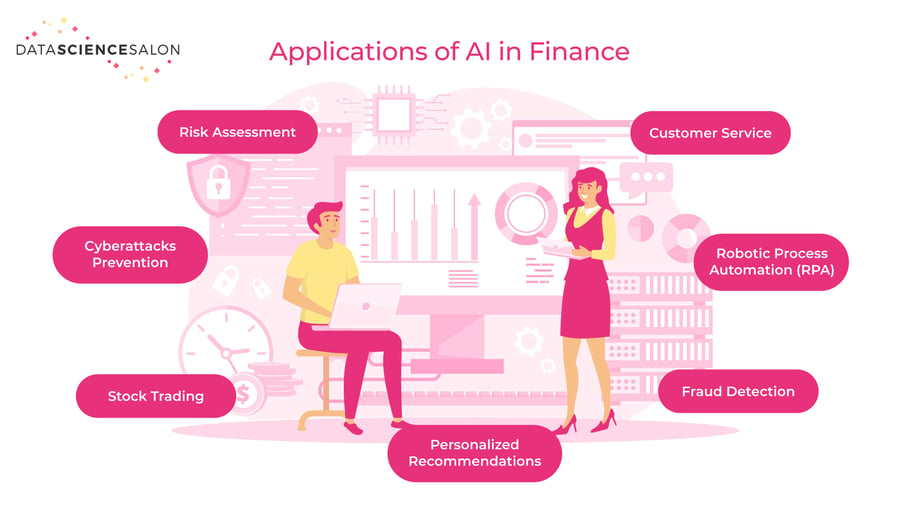
Applications of AI in Finance
Risk Assessment
Banks have been using ML algorithms to assess the creditworthiness of loan applicants. Not only do the algorithms help banks in making the binary decision of whether to issue the loan or not, but they also have the power to suggest the extent of loan issuance amount to qualify the loan as a good risk for the bank. With the ever-increasing need for explainability, the algorithms are now able to ascertain the model outcomes thereby adhering to governance measures.
The algorithms are also capable of highlighting some hidden factors outside the books of a general auditor that enlightens the organizations to think out of the box while collecting and storing data.
Fraud Detection
ML algorithms are working at the forefront of banking solutions preventing users from a multitude of frauds. Such advanced solutions analyze the buying behavior and a host of other attributes to distinguish a regular transaction from fraudulent ones to create alerts. There is a human in the loop i.e., a customer executive who acts on such alerts and verifies the original author of the transaction to approve it.
According to Harry Mendell, Senior Researcher at Federal Reserve Bank of NY, there are some enhanced ML techniques that can be leveraged to detect fraud or measure credit risks:
“Language models have revolutionized the way we analyze documents and look for risk. Graph convolutional networks, transformers and other deep learning techniques are showing great promise for fraud detection, risk and climate change impact analysis.”
Customer Service
A lot of banks have employed chatbots to speed up the turnaround time of queries from customers. Many inquiries such as checking account balances or examining account activity are easily facilitated through the help of such chatbots.
The latest advancements in chatbots have proven to be less dependent on customer executives and are self-sufficient in serving the customers’ needs. The smart virtual assistant is a win-win for both – the business as well as the customers. Such reliance on technology provides an added competitive edge and yields greater productivity returns by sparing the employees from redundant tasks and enabling them to contribute to business value.
Further, it saves customers the pain and time of soliciting responses from bank representatives. Erica is an example of a powerful virtual financial assistant launched by Bank of America (BoA) that alerts users about duplicate charges, merchants posting refunds, reminding bill payments, highlighting increases in spending and recurring charges, etc. Owing to the surge in digital banking activity, BoA reported almost 1 billion Erica interactions in the first four years since its introduction.
Cyberattacks Prevention
Financial institutions, by the very nature of their business, adopt strict guardrails to ensure that their customers’ wealth and personal information are not at risk because of foul play by bad actors. AI models monitor the data patterns and assist organizations in keeping a strict eye on any unusual behavior or activity.
Personalized Recommendations
The predictive power of algorithms does not stop here — it also helps meet the users’ demand for more customized and personalized recommendations that better suit their requirements. AI-powered assistants learn patterns from dynamic user behavior to generate meaningful and actionable insights and recommendations. The key highlight is that such recommendations are tailor-made to suit the specific content, services, or applications relevant to the customers.
As per JPMorgan, “our research platform produces over 10,000 pieces of research a year, but until recently, clients did not always know the reports existed. ML techniques solved the issue, and now each client logs into a customized portal that provides unique and relevant research, personalized to their needs.”
Stock Trading
Stock trading is a field where time is of the essence to take advantage of the stock movement and generate profits. The faster one can analyze the stock price pattern, the timelier decision of whether to buy, sell or hold that stock can be made. That’s precisely the forte of AI algorithms. Its power lies in sifting through humongous amounts of data in no time and presenting trading firms with data-driven insights to call the shots.
Algo trading is a common term used for high-frequency automated trading where specialized algorithms are used for stock identification, candlestick pattern identification as well as stop loss decision.
Robotic Process Automation (RPA)
RPA brings in a lot of operational efficiencies by automating several repeat tasks. As per Gartner, the use of RPA minimizes efforts and improves speed and accuracy. Smart Process Automation (SPA) / Intelligent Process Automation (IPA) are the latest terms used in the automation field using ML and deep learning techniques. Banking and insurance firms have benefitted from natural language processing (NLP) applications like invoice processing, service request generation, credit application processing, contract processing, etc.
Challenges of Using AI in Finance
Insufficient Data
Advanced AI algorithms are largely black-box by nature and must comply with regulations and ethical principles to ensure that the technology is aimed at the benefit of the end user. Insufficient or biased data leads to skewed models, which is a challenge in smaller organizations in particular:
“Having sufficient data is the main challenge. That is less problematic in larger, established organizations, but can be more problematic in small and medium size organizations”, says Michael Kortering, Chief Credit Officer at Reprise Financial.
Data does not only need to be available but also accessible, adds Harry Mendell: “I believe that the main challenge is making our vast troves of data available to data scientists. Data architectures that allow data to be cataloged and be searchable and available with the right governance throughout the organization, such as the Data Mesh, will create a renaissance in both AI and ML in finance.”
Data Bias
The recent news where Goldman Sachs was accused of issuing a disparate credit limit based on gender bias created a lot of stir in the industry. The financial institutions are responsible to explain every model outcome and prediction to instill trust in the ecosystem. This trustworthy and explainable AI will lead to the widespread adoption of such advanced algorithms and improve the quality of services to the users.
According to Erin Stanton, Global Head of Analytics Coverage at Virtu Financial, the results of an ML model heavily depend on the humans training them:
“While Finance has been capturing data for several years, there are still ongoing data quality issues as well as details and granularity that are not always captured. Machine learning, or machine training as I like to think of it, is also still heavily dependent on the human responsible for the model research. The data we include and exclude as well as the model inputs or features we include and exclude have a huge impact on model performance.”
Trends for AI in Finance
When asked about AI trends for the finance industry in the next 3-4 years, Erin Stanton mentions the continuous adoption of ML among organizations:
“I think we'll continue to see firms deploy more and more models, starting first with simple problems and moving to more sophisticated issues over time. Within Virtu Analytics, we had one ML model deployed in production for a few years and this year we've launched 4 new ones. I would expect this growth to continue over the next 3 to 4 years.”
Michael Kortering agrees with Erin and thinks that the analysis of images will be one of the applications with increased popularity:
“Machine learning will grow in usage across all organizations. Companies that are more heavily regulated will continue to adopt it in more areas. New modeling techniques will develop. One area I expect modeling techniques to develop is converting data to pictures and then using models to recognize pictures.”
In conclusion, we can say that the finance industry believes in the future of AI and understands that if used rightly, it is one of the most powerful tools to increase customer engagement, drive innovation and push newer avenues to transform the business.
This article has originally been published here.
- 01:00 am
Data Science Salon, the most diverse data science and machine learning community in the US, is excited to be back in New York City to host Data Science Salon NYC on December 7th, 2022; a one-day conference focused on AI and machine learning applications in finance and technology, held at The Theater Center in Hell’s Kitchen District.
The intimate event will feature speakers from S&P Global, Capital One, Freddie Mac, PayPal, Point72, Morgan Stanley, Sofi, Federal Reserve Bank of NY and many others. These data science sessions will bring industry leaders and specialists face-to-face to educate each other on innovative new solutions in artificial intelligence, machine learning, predictive analytics and acceptance around best practices in finance and technology. Data Science Salon attendees consist of executives, senior data science practitioners, data science managers, analysts, and engineering professionals. The format includes a combination of talks and panels with an optional expo and lots of time for networking in a casual environment with unique entertainment. “Our vision is to build local data science communities that really bring long-term value to our members. Besides the incredible knowledge shared at the events it is a great opportunity for data science managers to amplify their network and create personal connections. Everyone is hiring in the industry and this network is key to finding the right people.” says Esther Rietmann, Director of Content and Programming at Data Science Salon.
Data science approaches in the finance sector are some of the most sophisticated in the practice. Data Science Salon NYC is set to explore and discuss the core impacts of those practices. This conference series is designed to be not only informative, but also entertaining. “Over the years Data Science Salon has grown into an amazing community of likeminded practitioners across multiple domains.” Said Moody Hadi, Head of Credit Analytics New Product Development at S&P Global “We learn from each other different applications and techniques that normally we would not have seen within our own industry. Such a strong community of smart applied data scientists within an open and collaborative setting!” Past attendees have pointed to the tightly curated content and the ease of networking in such a unique and intimate setting.
Data Science Salon NYC provides a common framework for thinking about what machine learning and AI mean to the finance sector and what applied methods are actually successful for those practising in the field. Attendees will see a mix of use cases, technical talks and panels, and they will walk away with actionable insights from those working on the frontlines of machine learning in finance and technology. Every major application of machine learning in finance and technology will be covered; 200+ attendees, 15 speakers; the most cutting-edge research.
For more information on the Data Science Salon NYC visit the event website here.
The female-owned and operated Data Science Salon (DSS) was launched six years ago and is headquartered in the heart of Miami, FL near the Design District. The Data Science Salon community is an in-person and virtual hub for senior data science, machine learning and other technical specialists to educate each other, illuminate best practices and innovate new solutions in a casual atmosphere. Members can also tune into data science webinars, events, and podcasts. Learn more about Data Science Salon on the company website.








