
Published
- 04:00 am

Neo, the cross-border payments and FX fintech has today announced that the firm is now profitable as an increasing number of SMEs explore alternatives to banks for managing their international business needs.
The Barcelona-based fintech which provides a one-stop-shop multi-currency account for corporate treasurers recorded an annual revenue of over €5 million and an annual profit of €1 million. It also saw cleared volume double in just under a year, reaching over €7 billion in 2023 alone, reflecting growing demand from businesses for alternatives to traditional banks.
Research shows that when working with traditional banks, SMEs with international operations suffer from unfair pricing, slow execution, and difficulties in reporting transactions. As a result, 92% of SMEs are having conversations about virtual account solutions such as digital wallets to help solve these problems.
There has also been an increased bank diversification drive since the banking crisis which highlighted the risks of relying on one or two banking partners. This has prompted company treasurers to diversify their banking pools and look to fintech providers as an alternative.
These factors have helped Neo acquire new clients and receive an increasing number of inquiries from corporates that are doing more business abroad and are looking to move away from their traditional banking providers.
Neo has been able to help these businesses through its multi-currency account. It offers International Bank Account Numbers (IBAN) through which businesses can send and receive payments in 25 currencies. Neo’s wallet architecture makes it easy for firms to organize their funds and store multiple currencies, ready for making rapid payments or exchanging currencies, revolutionizing the way they transact. Neo has also put a strong focus on state-of-the-art client support by lining up a team of highly skilled professionals who support clients with their cross-border operations.
Neo has evolved from a platform offering FX trading to becoming a one-stop shop for businesses across the globe, working with more than 300 corporates across 28 countries and more than 8,000 banks are connected to its Bank Identification Code (BIC) on the SWIFT network.
Laurent Descout, co-founder and CEO of Neo, said: “When we founded Neo, we knew that businesses were being underserved by treasury management software and banks which was holding back their international aspirations. So, we built a solution using our own proprietary software which simplifies cross-border payments, FX and treasury, giving them everything they need to expand internationally, all in one place. Our solution comes with a top-class support team that helps clients on a daily basis and offers a level of service that banks have failed to provide for too long.”
“Over the past year, we have experienced exponential growth across our customer base, volumes and revenues which is a testament to the product and team we have built. Turning Neo into a profitable fintech was our main objective for 2023 and achieving this just three years after the launch of our multi-currency accounts positions Neo as a sustainable business. This helps us stand out against some VC-backed fintech players which have struggled with a lack of profitability. This is a very positive message for our shareholders, clients, supervisors and banking partners. Being financially independent will help us continue to grow our success and enhance our offering as we rebuild corporate finance from the ground up.”
- 01:00 am

Industrial Thought Ltd. – a group of companies focused on accelerating the future of wealth management – has announced a £500,000 investment in the collaboration platform Finbridge Global with £150,000 cash, plus £350,000 worth of strategic support.
According to 2023 statistics from Deloitte, there are currently around 30,000 fintech startups worldwide with a global market value of approximately £252 billion. The UK fintech market is valued at £15.9 billion. However, despite the significant opportunities this represents for startups, investors, and financial institutions (FIs), it’s challenging to search and compare fintechs based on their capabilities, limiting the number of potential collaborations.
Finbridge Global has been created to bridge this gap. It is the only global platform with a smart assessment engine that can define a fintech's suitability for FIs, aiding the creation of powerful partnerships. The platform offers a straightforward way of accessing an extensive array of fintech solutions in one space and includes an in-depth evaluation, expediting the Request for Information (RFI) process. It also identifies strengths and weaknesses; where weaknesses emerge, fintechs are provided with a clear path to improvement.
Barbara Gottardi, CEO and Founder of Finbridge Global explained: “FIs recognize that they can reap major benefits from technology innovators in areas such as operational efficiency and better consumer outcomes. Yet, while most of these organizations are keen to engage fintechs, they struggle to get the information they need to establish trust. Our goal is to simplify the process, promote transparency, and ultimately facilitate progress.
“Working with the right partners is key to achieving positive outcomes, which also applies to our own growth as a technology startup. The investment from Industrial Thought allows us to cement our positioning, build strategic partnerships, and encourage adoption in the UK, before expanding the platform’s global footprint in 2024. We’re incredibly pleased to work with the team and leverage their expertise.”
Nuno Godinho, Group CEO of Industrial Thought Ltd., added: “Finbridge Global’s commitment to collaboration reflects our firm belief in the power of partnerships to fast-track the future of financial services. The technology behind the platform stands out for its comprehensive capabilities and streamlined approach, and the standardized assessment criteria is a crucial element to build trust.
“As part of our strategic investment approach, we don’t just look at the financial value we can offer, but also the benefits we can add through the support of our shared services and sales channel. We look forward to helping Barbara and her team maximize the platform’s impact in the UK and beyond.”
Finbridge Global hosts a monthly Innovation Board in collaboration with The Investing and Saving Alliance (TISA) to ensure its platform is fully equipped to meet the sector’s needs. The Innovation Board brings together diverse financial institutions to discuss the changing nature of fintech engagement.
Innovation Board Member John Thompson, from the global investment company ABRDN said: “We are pleased to be collaborating with Finbridge Global in tackling some of the industry’s biggest tech innovation challenges. To succeed in an API-led world, FIs must employ increasingly efficient fail-fast methods for identifying and evaluating the potential and interoperability of new technologies. Having an effective “match-making” platform will speed up these assessments and make a big difference for further innovation.”
- 02:00 am

Marouane Bakhtar, Managing Director at Synpulse UK, commented, "This collaboration marks an exciting milestone for Synpulse as we continue to evolve our digital offerings for financial services firms. By joining forces with Instinct Digital, we aim to provide our clients with an innovative solution that addresses the unique opportunities of the digital era for the wealth sector."
Cassian Scott, CEO of Instinct Digital, added, "We are thrilled to collaborate with Synpulse, a well-respected name in financial services consulting. Together, we look forward to transforming the industry by delivering a product that empowers asset and investment managers to control their client reporting solutions and deliver efficiencies."
- 05:00 am

ZORRZ, a London-based fintech start-up focused on empowering financial inclusivity and security, has announced its partnership with IDnow, a leading European identity verification platform provider, to revolutionize customer onboarding for their innovative credit solution, the BlueAccess Card.
Aiming to democratize access to credit, ZORRZ is set to launch the BlueAccess Card, a hybrid credit card specifically designed for immigrants, individuals with past credit challenges, students, those with learning or physical disabilities, and other groups currently excluded from mainstream credit.
The card features integrated Buy Now, Pay Later (BNPL) functionality, providing consumers greater financial flexibility to split payments for purchases. ZORRZ also offers an AI-powered Application Programming Interface (API) generating a comprehensive Financial Health Score, an alternative to conventional credit scores.
“The mission of ZORRZ is to provide responsible and seamless access to credit, fostering financial inclusivity through secure and innovative solutions,” says Priyesh V. Mistry, Managing Director at ZORRZ. “Our collaboration with IDnow signifies our commitment to combating fraud while ensuring a frictionless experience for our customers. IDnow's cutting-edge AI-driven identity verification aligns perfectly with our ethos of delivering both security and a smooth onboarding journey.”
Real-time responses, robust fraud protection, and seamless customer verification
By harnessing IDnow’s advanced AI-based KYC (Know Your Customer) solution, ZORRZ aims to comply with FCA regulations, ensuring real-time responses, robust fraud protection, and seamless customer verification. IDnow’s automated document verification, including a face biometric comparison with liveness detection, will empower ZORRZ to streamline customer onboarding securely and efficiently.
Doug Pollock, Vice President Customer Success at IDnow, comments: “We are thrilled to collaborate with ZORRZ in redefining customer onboarding experiences in the UK. Our AI-powered, automated identity verification solutions are designed to make KYC and anti-money laundering processes an enabler rather than a barrier for innovative ventures like ZORRZ. This partnership is an excellent foundation for future expansions, leveraging our expertise in multi-jurisdiction compliance and our extensive European presence.”
In a bid to break down the barriers of bias in AI-powered facial verification, IDnow is participating in the MAMMOth project, collaborating with 12 European partners, including academic institutions, associations, and private companies. Funded by the European Research Executive Agency, the three-year project aims to study and mitigate biases in AI algorithms, particularly in areas such as assessment of loan applications, academic evaluation, and face verification applied to identity verification. This initiative underscores IDnow's commitment to ensuring fair and reliable algorithms, promoting inclusivity, and addressing concerns of underrepresented groups affected by biases in identity verification processes.
The partnership between ZORRZ and IDnow signifies a leap forward in revolutionizing credit accessibility, combining ZORRZ’s commitment to inclusive financial products with IDnow’s expertise in secure and seamless identity verification. This collaboration promises to pave the way for a more inclusive, secure, and accessible financial landscape for all consumers.
- 07:00 am
Balance, the digital payment platform, is announcing its new suite of products spanning the B2B transaction lifecycle.
Thanks to benefits brought by AI-powered net terms assessment and financing, payment cost optimization, and AR automation, these products bring immediate opportunities for distributors, platforms, and B2B brands selling online to improve margins and drive growth.
Bar Geron, CEO of Balance, explains, “While working with brands and marketplaces over the past year, it became clear that the inefficiencies and costs of business payments were impacting their profit margins. Tackling this problem required going beyond the point of purchase. This is why our solutions now optimize across the transaction lifecycle, from order placement to payment settlement.”
Balance’s new product offerings, including Digital Trade Credit, AR Management, Marketplace OS, and B2B Payments, are both modular and customizable. This flexibility allows merchants to find tailored solutions that fit their specific requirements.
For example, both online ACH and Wire processing from the B2B payments product reduce merchants’ reliance on costly credit card fees. Features like Balance’s Surcharge empower businesses to optimize their credit card strategy. For merchants with a significant SMB buyer base, the trade credit product incorporates an SMB data algorithm that helps approve buyers that competitors decline.
Michael Eichinger, COO of Bay Fastening Systems, a leading wholesale distributor using Balance to power their digital marketplace, said, “We were able to grow our digital channel in ways we didn’t know were possible. Balance’s true uniqueness is in its product flexibility and ability to work with our existing business processes.”
Over the past year, Balance has onboarded new customers from both the Fortune 1000 and Forbes’ America’s Largest Private Companies lists and also saw its transaction volume surge tenfold year-over-year. In alignment with this growth, Balance’s transaction network has expanded significantly, supporting over 100,000 unique business buyers and over 13,000 vendors.
Highlighting its industry impact, Balance was recently recognized as one of CB Insights’ top 100 FinTech companies globally. Building on this momentum, Balance has made several strategic moves within the market. These include an EU financing partnership with Hokodo, the launch of the Dunning Suite and Buyer Portal, and securing a $350 million credit facility. Before that, Balance established key partnerships and integrations with leading B2B e-commerce platforms, such as BigCommerce, Mirakl, and Shopify.
All have played a role in establishing the most comprehensive platform that supports the growth of B2B businesses.
- 07:00 am

Visa today announced it has completed its acquisition of Pismo – a global cloud-native issuer processing and core banking platform.
With the transaction complete, the combination of Visa and Pismo will provide clients with core banking and card-issuer processing capabilities across all product types via cloud-native APIs. Pismo’s platform will also enable Visa to provide support and connectivity for emerging payment schemes and RTP networks for financial institution clients.
“Core banking and issuer processor capabilities are key offerings for many of our financial institution and fintech partners’ clients,” said Jack Forestell, Chief Product and Strategy Officer at Visa. “With the combination of Visa and Pismo, we can now broaden these offerings and better serve the ecosystem.”
“The combination of Visa and Pismo will enable our clients to launch innovative payments and banking products within a single cloud-native platform regardless of network, geography, or currency. The closing marks a new era for banking and payments,” said Ricardo Josua, Co-Founder and CEO, Pismo.
Pismo will retain its current management team led by Ricardo Josua.
- 09:00 am

Temenos today announced the launch of Temenos LEAP, a new holistic modernization program, which enables Temenos clients to move to the latest Temenos platform, accelerating their journey to the cloud and Software-as-a-Service. Combining Temenos’ banking platform with proven transformation tooling and processes, as well as Temenos’ experienced services teams and a select group of specialized partners, LEAP offers banks a fast, low-risk route to a modern cloud-native architecture to future-proof their business.
Temenos is revolutionizing platform modernization leveraging 30 years of implementation experience and best practices combined with the power of AI to accelerate traditionally manual and complex areas of migration and testing.
LEAP gives Temenos core banking clients using older solutions the opportunity to modernize by moving seamlessly and quickly to a new, advanced, API-driven, cloud-native architecture. Opening the door to using the latest technology platform from Temenos with cutting-edge banking capabilities, LEAP allows clients to launch quickly and iteratively more personalized products to their customers and improve customer engagement. Temenos’ modern platform makes it easier to expand into new sectors and markets, stay ahead of competitors, and ultimately take advantage of the benefits of Temenos Banking Cloud and SaaS. The Temenos Value Benchmark shows that Temenos core banking clients using its modern banking platform benefit from 24% higher growth and innovation share of their IT spend.
The new banking capabilities support the creation of new products, with a focus on product design, launch, servicing, and retirement, in addition to Temenos Payments Hub which allows adding new payment rails and adopting a 24 x 7 x 365 STP approach. Temenos’ cloud-native platform offers enhanced connectivity and extensibility, elastic scalability, inbuilt security at all layers, embedded testing, and Development Security and Operations capabilities. In addition, it gives banks access to the large Temenos Exchange ecosystem of partners and an easier and more customizable user experience.
Compared to traditional upgrade projects, Temenos LEAP enables banks to modernize in just months, using the power of AI, and ready-to-use service packages, supported by extensive training enabled by the Temenos Learning Community (TLC). With LEAP, clients will be able to enjoy the commercial benefits of faster time-to-value, increased product agility, and reduced operational costs by removing old solutions and having a more efficient platform that operates with fewer resources. Banks can easily keep their technology up-to-date in the future, gaining immediate benefit from Temenos’ ongoing investment in the platform. Furthermore, the single Temenos platform allows for faster and lower-cost updating and maintenance, which means a lower total cost of ownership and higher agility.
Once on the new architecture, banks are ready to move to the cloud or Software-as-a-Service deployment models, when required. In this way, banks can benefit from business agility and quicker time to value, whether they choose to run on a public cloud or private cloud or opt for a hybrid approach.
Temenos LEAP offering has already been successfully proven in modernization projects for clients such as Qatar’s Lesha Bank, a long-standing Temenos customer that moved to the latest banking platform to streamline its processes and offer innovative products. Furthermore, a leading tier-one bank recently reconfirmed its commitment to Temenos with an agreement to move to the latest Temenos Banking Platform to modernize its corporate banking business in the private cloud.
Bola Rotibi, Chief Analyst, at CCS Insight, said: “As banks look to keep up with new market trends and increasing competition, many are held back by the need to modernize legacy systems making it difficult and costly to innovate or launch new products quickly. Organizations need the support of solutions and strategies that can ease the transformation process effectively and efficiently. Programs such as Temenos LEAP, with its AI-enabled, standardized approach accelerate the move for Temenos clients to a modern, cloud-native platform and allow them to gain the business agility to operate more efficiently and stay at the forefront of technological changes. By leveraging the elastic scalability of the cloud and the sophisticated, automated support that AI-based operations afford, can they embrace innovation more successfully?”
Andreas Andreades, Chief Executive Officer, Temenos, said: “With LEAP, banks can benefit from a proven, low-risk, quick-time-to-value, AI-based modernization approach to move to the advanced, cloud-native technology of the latest Temenos Banking Platform. Temenos’ platform enables clients to future-proof their business and leverage a modern architecture to be ready to take advantage of cloud or SaaS opportunities. Powered by AI, banks can optimize for operational efficiency all through extreme automation of manual tasks making new software deployment faster and easier, less resource intensive, and driving down costs.
“LEAP dramatically changes the traditional modernization model in keeping with our engineering tradition to find solutions that enable banks to be future-ready in an affordable and risk-managed manner with a short time to value.”
- 07:00 am

The number of Assisted Self-Service Terminals (ASSTs) installed both inside and outside branches worldwide continues to see double-digit growth. These devices are instrumental in migrating transactions away from the teller line and extending access both in terms of service hours and geographic reach
Banks seek to “do more with less” as the number of branches worldwide declines
Global Branch Transformation 2024 is a brand-new study from RBR Data Services, a division of Datos Insights. The research shows that the number of branches globally continues to contract, as institutions think carefully about how to optimize the efficiency of remaining outlets. Banks worldwide report that the teller role is expanding, with staff increasingly expected to prioritize sales and advisory activities over simple transactions.
Banks optimize cash operations as pressures around branch profitability persist
At the teller counter, Teller Assist Units (TAUs) have been vital in automating cash operations, as evidenced by the RBR Data Services study. But banks have also sought to migrate transactions to the self-service channel, often turning to ASSTs as a stepping stone in this shift.
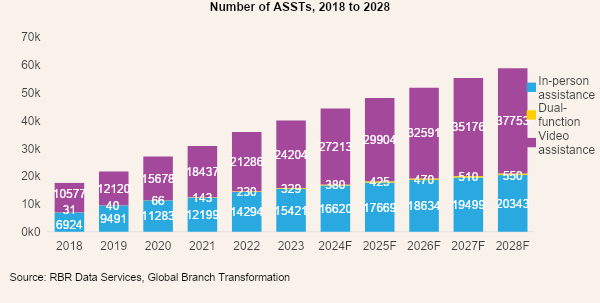
ASSTs grew by 12% in 2023 as more transactions were migrated away from the teller line
ASSTs allow customers to request assistance, from branch staff “in-person” or from remote staff via video link, for more complex transactions, helping them to gain confidence with self-service banking. After years of consistent double-digit growth, there are now nearly 40,000 ASSTs installed in the 20 key markets surveyed. Well over two-thirds are located in the USA, but their reach continues to expand. ASSTs were installed for the first time in Germany in 2021 and were reintroduced in South Africa in 2023.
Many US banks opt for remote devices, while in-person ASSTs are more common elsewhere
Over 60% of ASSTs globally are video devices that are deployed by financial institutions to extend access both in terms of service hours and geography. Although they are present in 14 of the markets surveyed, the USA accounts for the vast majority of video installations. They are the ASST of choice for smaller banks and credit unions, which consider them best suited to their business model.
In-person devices are strongly preferred in Italy and Turkey. They are generally considered more cost-effective since they do not always require specific hardware or a contact center from which assistance is sourced. They are also valued for retaining an element of face-to-face banking, which customers in many markets say they prefer.
ASST penetration is expected to grow, with first-time installations in two more markets by 2028
Between now and 2028, ASST installations in bank branches worldwide are forecast to reach 58,700. As of 2023, ASSTs are yet to be installed in three of the markets studied – France, Mexico, and Poland – where banks report concerns about costs and customer acceptance. Only France, however, is expected to remain without ASSTs by the end of 2028.
Gillian Shaw, who led RBR Data Services’ Global Branch Transformation 2024 research, remarked: “The unique benefits of ASSTs in enabling more modern branch formats is being recognised in an increasing number of countries. While the size of the US market ensures that remote video devices are most common globally, the availability of in-person and even dual-function technology has allowed institutions to acquire devices that suit their specific requirements. With branch optimisation remaining a key priority, the penetration of ASSTs is only expected to grow”.
- 06:00 am

TymeBank, one of the world’s fastest-growing digital banks, is proud to announce that it reached its first month of profitability in December 2023, less than five years since launching in February 2019. This makes it the first digital bank to break even in South Africa and on the continent. This milestone marks a pivotal moment for South Africa’s only black-controlled bank, making it one of the fastest-growing digital banks globally, and the first African digital bank ever, to reach this milestone.
The bank attributes its success to several key factors:
Its unique model of combining digital channels with in-store kiosks at major retailers, consistently acquires ~150,000 customers each month
The long-standing strategic relationships with Pick n Pay and Boxer, The Foschini Group (TFG), and the Zion Christian Church (ZCC)
The rapid ~30% growth of its lending portfolio year-on-year, driven by Merchant Cash Advance, which is now financing more than 50,000 SMEs across the country
The continued confidence of our shareholders in TymeBank, as evidenced by the Tyme Group’s successful capital raise last year, despite a tepid economic landscape
The consistent innovation and launch of a list of firsts, including the most affordable banking offering in South Africa; the ability to open a bank account in under 5 minutes; South Africa’s leading fixed deposit savings rate of 11%; the launch of interest-free Grant Advance for social grant recipients; the launch of healthcare insurance (TymeHealth) in collaboration with the National Healthcare Group – banking first in South Africa; and the launch of the buy-now-pay later product, MoreTyme at a time when the concept was relatively unknown in South Africa
CEO of TymeBank, Coenraad Jonker says, “We are extremely proud of our achievement, particularly when you consider that globally, less than half of the top 100 digital banks are profitable. In fact, a recent study stated that less than 5% of all neobanks worldwide had reached profitability. And of those that are in the black, most have taken a lot longer to become profitable; notable examples being Latin America’s Nubank and London-based Monzo, which took eight and seven years respectively. Having achieved our first month of profitable operations in a significantly shorter timeframe is a South African success story that our 8.5 million customers can share with pride.”
Jonker added: “As the country’s first digital bank, we’ve overcome numerous challenges as we consistently innovated and broke new ground in the market. Through it, our team has remained focused and committed to our mission of providing South Africans with affordable, accessible, and quality banking services. This purpose has clearly resonated with consumers given our rapid growth, high levels of customer satisfaction and the successful introduction of a wide range of products and services.”
TymeBank Chairperson, Thabani Jali says, “Congratulations to the TymeBank team on an extraordinary achievement. On behalf of the board of directors and TymeBank’s leadership team, I must extend my gratitude for our investors’ continued faith in our vision and their commitment to our collective success. Their trust in TymeBank’s team has been instrumental in driving us to this outcome. To appreciate their investment, we are committed to building a sustainable future that delivers a solid return on investment.”
Dr Patrice Motsepe, Founder and Chairman of major shareholder African Rainbow Capital (ARC) says: “TymeBank’s landmark achievement comes after more than four years of dedicated effort, strategic investments, and an unwavering commitment to the business’s core mission to offer quality banking services to all South Africans. Having attracted more than 8.5 million customers, TymeBank’s unique proposition continues to digitally disrupt and transform the banking sector. And as the business evolves, we are seeing it gradually appeal to more affluent consumers who appreciate its unrelenting innovation, customer-centric transparency and accessibility.”
CEO of TymeBank, Coenraad Jonker conclues, “We are excited about what lies ahead as we build on this momentum to continue offering great value to our customers. We believe that we are now perfectly aligned with our goal of becoming one of the top three retail banks in the country. This ambitious target is our next measurable benchmark for success, one that will require strategic focus across all areas of our business. However, we are confident that our proven track record of success positions us well to achieve this audacious aim in the next few years.”
- 05:00 am
TreviPay, the most-trusted B2B payments and invoicing network, today announced the launch of its Universal Acceptance solution to expand supplier access to and faster implementation of TreviPay’s payments and invoicing technology, in partnership with Mastercard. Suppliers who accept Mastercard will be able to extend net terms, trade credit financing, and SKU-level invoicing to business buyers through TreviPay’s Universal Acceptance solution using Mastercard’s commercial card payment capabilities.
Research commissioned by TreviPay unveiled the top three pain points of global business buyers inefficient processes, incorrect invoicing, and slow onboarding. The same research ranked trade credit as a leading payment option preferred by business buyers. With minimal integration required, TreviPay’s Universal Acceptance solution enables suppliers who are already accepting credit cards to quickly and easily offer net-terms financing to their qualified buyers while taking on no credit risk. TreviPay automates the buyer onboarding, financing, and accounts receivable process to drive payment efficiencies and streamline time-consuming back-office operations.
“TreviPay’s technology was developed to eliminate the complexities of B2B purchasing and create a consumer-like purchasing experience while still catering to the needs and requirements of business buyers,” said Brandon Spear, CEO of TreviPay. “Joining forces with Mastercard to launch the Universal Acceptance solution marks an industry milestone in expanding access to TreviPay’s solution, a leading B2B payment method of corporate sellers and their buyers globally. Together we are revolutionizing how businesses can transact by bringing flexible extended payment terms to more buyers.”
With TreviPay leveraging Mastercard’s global acceptance network and commercial card payment capabilities, suppliers can provide approved buyers with a net-terms card for purchasing, offering the checkout convenience of a credit card, as well as the suitability and purchase controls of trade credit. The TreviPay platform then automatically delivers invoices directly to the merchant’s buyer, eliminating the costs associated with chasing outstanding or late payments, assuming all risk associated with collection, and guaranteeing settlement to the merchant upfront.
“Mastercard is committed to building industry partnerships that help suppliers better meet the purchasing needs of their B2B customers and drive loyalty,” said Rebecca Meeker, Senior Vice President of global Partnerships and Segments, Mastercard. “With a shared vision to bring consumer-grade convenience to B2B transactions, we are proud to deepen our collaboration with TreviPay as they facilitate variable financing options, seamless invoice reconciliation, and faster settlement when using cards on our network.”
With the addition of the Universal Acceptance solution, the TreviPay platform can now be implemented for suppliers in two ways: the original API integration of the platform directly into the seller’s point of acceptance, or without API integration, by instead leveraging Mastercard’s global acceptance network.
This announcement comes shortly after TreviPay’s launch of Financial Partner Gateway, a new suite of APIs for financial institutions looking to expand commercial offerings. The Universal Acceptance solution complements this offering as another way TreviPay is expanding its global footprint and optimizing the payment experience for suppliers.








