
Published
- 01:00 am

The British Business Bank’s second annual Nations and Regions Tracker, published today, finds usage of external finance has fallen overall across the UK, as nine out of the twelve regions saw a drop in use of small business finance. In addition, 38% of smaller businesses were using external finance in the second quarter of 2022, down seven percentage points from 45% a year earlier. Core debt products remain the most used and widely available across the UK nations and regions.
Equity finance fuels the UK’s nations and regions
Seed stage equity investment, which is key to building the pipeline of investable opportunities to drive larger quantities of venture and growth capital investment in the future, increased by 88% outside of London in 2021, whereas in London it fell by 22%.
However, London’s dominance of equity finance markets continued in 2021, with 1,286 deals worth £11.9bn taking place, representing 66% of investment and 49% of deals in the UK. This was driven by stronger growth in London compared to the rest of the UK, rather than a decline in the other UK nations and regions. Every nation and regions outside London, except the West Midlands, saw increased small business equity investment in 2021 compared to 2020.
Q2 2022 data suggests that, despite global economic conditions, equity investment in the UK held up in both number of deals and investment value in the first half of the year.
Investment in net zero sectors has grown faster than overall UK equity markets
The Nations and Regions Tracker found that equity investment in net zero sectors has grown at an even faster rate than overall UK equity markets. This growth has occurred across the UK’s nations and regions, with 69% of deals and 67% of investment taking place outside of London between 2011 and H1 2022Since 2011, £6.9bn of equity investment has gone into net zero-aligned UK smaller businesses across 1,307 deals. In the first half of 2022, £2.7bn was invested across 165 deals in smaller businesses in net zero sectors, representing 22% of investment and 12% of deals during the period.
The Nations and Regions Tracker found that equity investment in net zero sectors such as clean tech, electric vehicles, meat substitutes and smart energy, has grown at a faster rate than overall UK equity markets in recent years. The share of deals which are in net zero sectors has grown every year since 2018 rising from 5% in 2018 to 12% in first half of 2022.
These equity finance flows have the potential to form new clusters around net zero innovation in several nations and regions of the UK, including: Warwickshire, Oxfordshire, Cheshire East, Sheffield, Edinburgh, Glasgow, and Bristol.
Businesses in the most deprived areas show greater ambition for growth
The Nations and Regions Tracker found that businesses in the most deprived areas of the UK are more open to using finance and report higher levels of ambition for growth. Nearly half (49%) of businesses in the most deprived areas have a long-term ambition to be a significantly larger business, compared to 40% elsewhere. They are also more willing to use external finance to grow (36%) than businesses in less deprived areas (33%).
The report also showed that businesses from the most deprived areas are less inclined to apply for finance, however, and in addition are more likely to be turned down. A quarter (26%) of businesses in need of finance did not apply compared to 22% elsewhere and in 2019 (pre-Covid), nearly half of businesses (43%) from highly deprived areas that applied for finance were turned down, compared to 25% of those from elsewhere.
Despite rejection rates in 2020 being much lower, driven by the Covid-19 loan guarantee schemes, the gap persisted. In 2020-2021, 16% of businesses from deprived areas were turned down for finance, compared to 11% elsewhere.
Shanika Amarasekara, Chief Impact Officer, British Business Bank said: “We are seeing promising signs of growth in equity finance markets outside of London and data suggests equity investment in the UK held up in the first half of the year. While equity investment slowed in recent months, it is encouraging that net zero-related investments appear to be growing.
For a sustainable and prosperous UK economy to continue to grow, businesses across the UK need to thrive. We want to break down particular barriers to finance so that access to finance is a level playing field for all entrepreneurs – wherever they are, whatever their gender, whatever their ethnicity. While businesses in highly deprived areas are more open to using finance, and report higher ambition levels, more must be done to reduce regional inequalities in access to finance.”
British Business Bank improving access-to-finance conditions for businesses in the UK's most deprived areas
Start Up Loans and the Bank's three regional investment funds have a strong track record in providing finance to deprived areas. A higher proportion of Start Up Loans and regional funds recipients are based in deprived areas of the UK than the wider business population.
The Nations and Regions Tracker finds that the Bank’s regional investment funds continue to be pivotal in helping smaller businesses in harder to reach areas access finance. Since launching, the Bank has invested more than £540m into the Northern Powerhouse Investment Fund, Midlands Engine Investment Fund, Cornwall & Isles of Scilly Investment Fund, and the Northern Ireland Growth Finance Fund. This crowded in more than £825m in additional private sector co-investment and has supported more than 1,650 smaller businesses.
The Bank will launch a series of new Nations and Regions Investment Funds which will deliver a £1.6bn commitment of new funding to drive sustainable economic growth. The new funds will increase the supply and diversity of early-stage finance for UK smaller businesses, providing finance to firms that might otherwise not receive investment. As part of this new programme, the Bank will be establishing investment funds in each of the Devolved Nations and the South West for the first time.
- 06:00 am

A UK wealth manager has grown its assets under management to more than £500 million with the support of investment platform Third Financial, becoming the North West’s largest independent discretionary manager. The firm is one of a series of high-profile client renewals for Third Financial.
Luna Investment Management (Luna) first signed with Third Financial on a short-term basis in April 2020 and has now committed to a further five years of partnership. Luna, founded by experienced wealth managers Alex Brandreth and James Carter, has grown its asset base from zero to more than £500 million since launch.
Mr Carter said Third Financial had played a key supporting role in Luna’s growth. He said: “A high level of personal service, leading technology and the ease of implementation and integration are what attracted us to Third Financial in the first place. We see modern, user-friendly systems as important not just for client acquisition and retention, but also for the well-being of our team.
“During our sustained growth, we have used Third’s technology, custody, and execution services, including for our investments in structured products. The relationship has been nothing but positive and we had no hesitation in renewing our contract.”
Third Financial, trusted by more than 70 wealth managers and IFAs, is on a mission to help advisers simplify and scale their businesses. The firm has also recently signed five-year renewals with AIM-listed wealth manager Kingswood, which manages and advises on more than £9 billion in client assets; Stafford-based high net worth-focused Sorbus Partners; and Fiske, a 1973-founded investment manager that has been working with Third Financial since 2015.
Ian Partington, Third Financial’s group chief executive officer, said: “We appreciate that during an economic downturn, firms and their clients are under pressure. Our aim is to support the firms we work with as efficiently as possible, so they have more time to focus on markets and client service.
“We still speak to a staggering number of firms running a shambles of multiple platforms, which involves dual-keying data and multiple log-ins. Lots has been written about how wealth managers are spending more on technology, but if you choose the right partner the return on this ‘spending’ comes back many times over.”
- 22.11.2022 -- 09:23 pm
What are the opportunities unfolding for capital markets firms as a result of technology innovation? Watch our interview with Horacio Barakat, Head of Digital Innovation for Capital Markets at Broadridge at Sibos 2022
Other Videos
- 05:00 am
Music-investment platform, Sonomo, has announced a new partnership with embedded-finance leader, Weavr. The agreement will make it easier for individuals to invest and generate revenues from the music they love.
Music streaming continues to grow significantly around the world, with global revenues in the sector expected to hit $131bn by 2030 [1]. Now, Amsterdam-based Sonomo is opening this market up to new players. With Weavr’s assistance, the company is helping to democratise a new asset class for investors across Europe and the UK and starting to unlock retail capital for the music industry.
At its core, Sonomo represents a financial exchange for music rights, connecting labels and artists with investors. For as little as €10, users of the music investment platform can invest in songs they believe in. This innovative approach offers customers the potential to make outsized returns on a song should it become popular. As such, the income-generating, non-inflationary asset class represents an attractive alternative opportunity for both experienced, and new capital investors.
To offer its service to customers in the most frictionless, user-friendly manner, Sonomo needed assistance from embedded-finance specialist Weavr. The London-based company powers the embedded digital wallet used in Sonomo’s application through its industry-leading Plug-and-Play Finance solution. As such, Weavr enables Sonomo to facilitate the exchange of funds between traders within its platform and also makes it possible for real-time distributions of artist and investor royalty dividends to happen in a secure manner.
Unlike some modern investment options, such as cryptocurrency and NFTs, Sonomo offers an asset class that is well understood by the general populace. A song's share price on Sonomo typically follows its streaming trend-line. This arrangement greatly benefits artists and songwriters by enabling them to collect cash up front by selling a share of future revenues. What’s more, by selling a portion of their song to investors, artists are essentially creating a bespoke "marketing team" incentivised to promote their music.
Sonomo creates diverse income streams for investors based on future revenues derived from master royalties. With Weavr’s support, these investments can happen in real-time and incur minimal transaction costs. Similarly, Weavr’s powerful solution assists Sonomo’s automated royalty collection, accounting, and distribution engine, which allows players within the music industry to completely streamline financial operations – leading to significant savings amongst smaller players.
Faris Zaher, Founder and CEO of Sonomo said: “Music is widely understood and has outperformed other asset classes over the past decade. Our partnership with Weavr allows us to make music investing a reality for everyone and level the playing field for creators.”
Alex Mifsud, co-founder and CEO at Weavr, commented: "Weavr exists to bring the value multiplier effect of financial services into every digital sector. The entertainment industry is complex and fragmented when it comes to the movement of funds, distribution of royalties and opportunities to invest. It’s also an industry for which digitisation has been bittersweet at best; as musical events moved online, downloads became streams, and ownership for artists became infinitely more difficult.
“We’re pleased to partner with Sonomo to bring much needed value to musicians as they navigate the digitisation of the music industry.”
- 03:00 am
Cryptocurrency wallets remain pivotal for investors to get involved in the digital assets sector. Amid the highs and lows of the crypto markets, the usage of wallets has remained reasonably active.
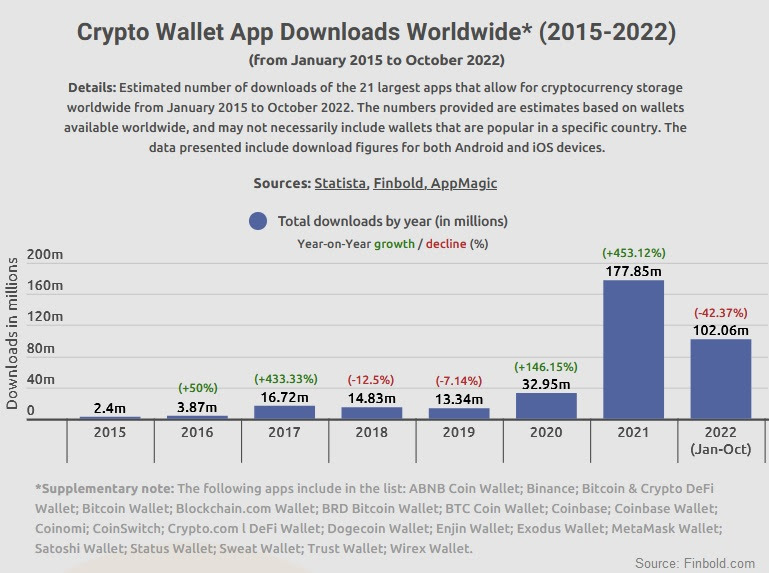
In this line, data acquired by Finbold indicates that between January and October 2022, an estimated 102.06 million crypto wallets were downloaded for Android and iOS devices for 21 selected apps that enable digital currency storage. The value represents a drop of 42.37% from 177.85 million downloads in 2021.
Elsewhere, in 2022, January recorded the highest number of downloads at 16.11 million, while data for the most recent month, October, stood at 8.7 million. July recorded the least number of downloads at 7.29 million.
Notably, last year's figure represents the highest yearly crypto wallet downloads ever, representing a growth of 453.12% from 2020's figure of 32.95 million. At the same time, 2017 registered the second-highest rate of downloads at 433.33%, when the number of downloaded crypto wallets stood at 16.72 million.
A notable download drop was registered in 2018, with 14.83 million downloaded apps or a slump of 12.5%. Additionally, 2019 wallet downloads stood at 13.34 million, a drop of 7.14%.
Impact of crypto market crisis
The report acknowledges that despite the drop in 2022, the number of crypto wallet downloads has remained relatively active. According to the research report:
"The downloads have plunged amid the prevailing bear market as investor interest in digital assets remains low. Indeed, the low interest has been motivated by related activities such as the fear of losing crypto holdings considering high profile incidents like the Terra (LUNA) ecosystem crash and the FTX crypto exchange collapse as confidence in centralized trading platforms took a hit."
Overall, the growth of crypto wallets still faces several challenges, with regulatory uncertainty emerging as a key inhibitor.
Read the full story with statistics here: https://finbold.com/crypto-wallet-downloads-2022/
- 03:00 am
The past year has not been easy — many countries are still recovering after the COVID-19 pandemic while another crisis is on the horizon. The cost of living is increasing rapidly, with inflation rates hitting record numbers. The worst part is that this economic crisis affects every industry.
Currently, tech giants are firing their staff to cut costs amid the recession. Does this mean a grim feature for tech companies? While it may appear so, the situation will become easier next year as this market is remarkably resilient. From a trading app to a passive income app, technology is advancing alongside economic developments, and witnessing it is exciting.
Here are some of the top trends you can look out for in fintech for the upcoming year.
Trend 1: Alternative Financing Opportunities Will Rise
2020 brought many challenges for companies looking to finance their operations through traditional banking institutions. The global trade financing gap is widening even if banks claim not to have reduced financing options for their customers. That’s why many businesses are turning to alternative financing options.
In recent years, alternative financing has become increasingly popular for businesses looking to finance their operations. There are several reasons for this. First, traditional banking institutions have become increasingly reluctant to finance businesses, especially small businesses. This phenomenon has led to a widening of the global trade financing gap. With no choice but to rely on savings or starting capital, small and medium businesses sought alternative financing firms to help them with expenses.
Second, alternative financing options often offer more flexible terms and conditions than traditional bank loans. It can be helpful for businesses that are struggling to obtain financing from conventional sources. Moreover, many companies prefer alternative financing because of its flexibility and fast response to the changing environment.
Finally, alternative financiers are typically more willing to work with businesses with bad credit or no collateral. It makes alternative financing an attractive option for businesses that may not qualify for traditional bank loans. Many fintech companies that offer alternative financing complete requests remotely and quickly. As the demand increases with the economic crisis hurting small businesses, fintech alternative financing opportunities will be more prominent.
Trend 2: “Unicorn” Status Will Decline In Prestige
A unicorn company is a startup with over $1 billion in valuation. Over the past few years, there has been an incredible rise in unicorn companies, particularly in the US. It is due to various factors, such as the proliferation of venture capital and the advent of new technologies, that have made it easier for startups to scale quickly. As a result of this increase in unicorn companies, the status has become less valuable for companies in developed markets.
Notably, investors are more likely to invest in a company headquartered in a developing country or a fintech hub, where there is more potential for growth. However, the status of unicorns should continue to be an essential building block for startups in emerging markets and less mature fintech hubs.
Consequently, these companies often face more significant challenges when raising capital due to high risk and uncertainty about future profitability. That’s why showing that they have achieved unicorn status can help them overcome these hurdles and attract investors.
Trend 3: Abundance Of Options To Build Passive Income Streams
As with any financial crisis, advisors suggest their clients do two things. Firstly, they should diversify their income portfolio. That means relying on several different revenue streams, from full-time jobs, freelancing, investments, and more. Secondly, people should aim to earn as much passive income as possible. It helps to employ your own money to work for you instead of doing any active work yourself.
With technological advancements making our lives easier, we’ve more options to make money in different ways. There are freelancing platforms, survey sites, and passive income apps like Honeygain. The latter is a free Internet-sharing app that lets users rent their bandwidth in exchange for money. You’ll get $3 for 10GB of traffic you share with the Honeygain network.
You can boost your earnings by participating in social media contests, turning on special features, and referring friends. Your referrals will get $5 for free upon signing up, and you’ll get a permanent bonus of 10%, equal to your referral’s daily earnings.
Moreover, Honeygain encrypts your bandwidth and follows a strict security protocol to ensure the safe sharing of your Internet. It’s an excellent way to earn extra cash and cover daily expenses. Additionally, Honeygain is an exciting technology that will likely increase in popularity next year.
Prepare For Next Year
If you’re interested in the upcoming fintech trends, you should pay attention to alternative financing opportunities, unicorn companies, and digital passive income streams, especially applications. With the current situation, these three trends will likely pick up media attention and attract record numbers of users.
- 03:00 am
Leading payment processing fintech VizyPay today announces CEO Austin Mac Nab was named Technology Association of Iowa’s 2022 CEO of the Year at the annual Prometheus Awards. The awards, judged by a panel of distinguished leaders, unite innovators and leaders from technology, business, education and government organizations across Iowa to celebrate the year's most momentous achievements.
Dedicated to disrupting the payments industry from within while providing simple yet powerful solutions to mom-and-pop shops across rural America, Mac Nab works tirelessly to remove common pain points and give entrepreneurs the tools needed to succeed. Inspired by his hardworking mother, Mac Nab committed as much time as possible to help provide for his family. Beginning at a young age, Mac Nab mowed lawns, sold eggrolls, candy and more – teaching him sales skills and work ethic that would ultimately guide him to success. After spending a decade working as a top salesperson for a large credit card processing company, Mac Nab witnessed small business owners being forced to use payments technologies not well-suited to them or their businesses and felt it was time for change. Together with Managing Partner Frank Pagano, Mac Nab and the founding team invested $197,000 of their own money to form VizyPay in 2017. Since then, the company amassed over 12,000 merchants across all 50 states and has grown to 89 employees and more than 600 sales partners – all while remaining entirely owner-funded.
As CEO, Mac Nab ensures every action VizyPay takes falls into its three core values of culture, transparency and being the voice of small business, resulting in numerous award recognitions for company growth, welcoming company culture and powerful, transparent services. The company’s award-winning payments technology empowers entrepreneurs to save money on unnecessary fees and invest back into their business. VizyPay's radical transparency continues to disrupt the industry from the inside by maintaining a workforce 95% from outside the payments space, 50% minorities and 25% women. For his efforts, Mac Nab was also recognized as an EY Entrepreneur of the Year Heartland finalist and included in Electronic Transactions Association’s 2022 40 Under 40 class.
“I’ve been in the payments business for my entire adult life and watched small businesses get left behind by larger companies time and time again. Our technology gives people across rural America the opportunity to play on the same field as businesses located in large metro cities without having to pay for overcomplicated services,” said Mac Nab. “This award proves you don’t need to be in Silicon Valley to succeed in technology. My goal is to keep Iowa’s homegrown talent in the state and attract hardworking individuals to build a tech hub in the Midwest.”
VizyPay’s proprietary payments technology is available for Clover POS systems and PAX SmartTerminals.
- 06:00 am

World-leading biometrics company, Fingerprint Cards AB (Fingerprints™), has announced that its solution will be part of the MENA region’s latest step in its journey toward mass adoption of contactless biometric payment cards as it supports two more commercial launches in Morocco.
This announcement follows previous commercial launches in Morocco with two of the country’s largest banks (BMCI - part of BNP Paribas and Crédit Agricole Du Maroc). All those launches in Morocco are deployed with Thales’ innovative and highly secure biometric payment cards encompassing Fingerprint technology.
As with previous commercial launches, Fingerprints’ proven 1300-series T-Shape module and software platform are driving these latest deployments. Alongside leveraging extensive R&D and experience from eight commercial launches and 24 bank pilots to date, the T-Shape solution is compliant with Mastercard’s new Fingerprint Sensor Evaluation Process. This provides consumers extra security to the ‘tap’ of tap-to-pay, without sacrificing convenience.
Michel Roig, President of Payment and Access at Fingerprints comments: “We are extremely pleased to announce that our solution will fuel two further biometric payment card launches with leading Moroccan banks. Much like the rest of the Middle East, Morocco is a region to watch as it fast becomes an exciting hub for payments innovation, and the continued exciting momentum around biometric payment card deployments reflects this.”
According to the latest data from the Moroccan Monetary Center (CMI), there are 12.1 million contactless cards in circulation. The last 12 months have also seen a significant rise in the technology’s use, with the ratio of card payments being contactless almost doubling from 25% in the first quarter of 2021 to 48.8% in 2022.
“Having quickly embraced contactless card technology after it was first deployed to the region in 2018, Moroccan consumers have come to love the experience, and there is a significant opportunity to offer the next logical step. By integrating Fingerprints’ proven biometric technology, we will further strengthen contactless payment security and convenience for even more consumers in Morocco,” adds Michel.
- 01:00 am

The global payment processing solutions market size is expected to reach USD 192.61 billion by 2030, according to a new study by Polaris Market Research. The report “Payment Processing Solutions Market Share, Size, Trends, Industry Analysis Report, By Component (Solutions, Services); By Payment Method; By Deployment Type; By Industry Vertical; By Region; Segment Forecast, 2022 – 2030” gives a detailed insight into current market dynamics and provides analysis on future market growth.
The growth of the global market is primarily driven by increasing digitization by the adoption of artificial intelligence, cloud computing, and data analytics. Further, there is an upsurge in the sales of e-commerce due to the growing penetration of mobile devices, enabling faster internet connectivity.
Have Questions? Request a sample or make an Inquiry before buying this report by clicking the link below: https://www.polarismarketresearch.com/industry-analysis/payment-processing-solutions-market/request-for-sample
Further, a decrease in physical banking among end users is expected to enhance online payment processing. An increase in cashless transactions, greater inclination toward digital payments, and ease offered by these solutions for processing financial transactions at remote locations with ease and convenience support the industry growth.
Asia Pacific is expected to experience significant growth during the forecast period. The increasing adoption of the system for reduced risks associated with fraud and security drives growth in the region. The rise in penetration of mobile devices and an increase in investment by small and medium-sized businesses have further increased its adoption.
The COVID-19 pandemic has increased the adoption of the system owing to the introduction of lockdown across the world, restrictions on movement, and growth in e-commerce. In addition, its providers have certainly followed demand and requirements on both individual and group levels across several countries globally.
Payment Processing Solutions Market Report Highlights
The solutions segment is expected to dominate the market during forecast period on account of greater convenience and reliability for customers
e-Wallet is expected to be the fastest growing segment, which requires money to be added to a wallet electronically for simpler and easier transactions
The on-premises segment accounted for the largest revenue share on account of greater control over financial transactions
The retail and e-commerce industry accounted for a considerable share in the market owing to rise in e-commerce platforms, ease of use, and higher security
The Asia Pacific region is expected to be the fastest growing segment during the forecast period. Increase in population, greater adoption of digital payments, and decrease in use of usage of cash payments supports the growth in this region
The global market is highly competitive owing to the existence of large industry players with global presence including ACI Worldwide, Authorize.Net, BlueSnap, Fiserv, FIS, and Global Payments among others
Polaris Market Research has segmented the payment processing solutions market report based on component, payment method, deployment type, industry vertical, and region:
Payment Processing Solutions, Component Outlook (Revenue – USD Billion, 2018 – 2030)
Solution
Services
Payment Processing Solutions, Payment Method Outlook (Revenue – USD Billion, 2018 – 2030)
eWallet
Cards
Automated Clearing House (ACH)
Others
Payment Processing Solutions, Deployment Type Outlook (Revenue – USD Billion, 2018 – 2030)
Cloud
On-premises
Payment Processing Solutions, Industry Vertical Outlook (Revenue – USD Billion, 2018 – 2030)
IT & Telecom
BFSI
Healthcare
Government & Utilities
Retail & E-commerce
Travel & Hospitality
Media & Entertainment
Others
- 08:00 am
Rapidly growing payment orchestration provider BR-DGE has today announced a new partnership with leading UK luxury tour operator Kenwood Travel.
The partnership equips Kenwood Travel with the latest payment orchestration technology in order to deliver a first-class, seamless online checkout experience for customers. The luxury tour operator now has access to BR-DGE’s market-leading platform of over 300 payment and technology providers via one single integration point.
Whilst the travel sector recovers, OTAs and airlines have experienced a number of payment challenges that impact margins and company resources. Payment failure and cart abandonment rates remain high as airlines and travel providers grapple with an ever-changing and fragmented payment landscape. BR-DGE research has found that over 13.4% of online transactions in the travel, tourism, and leisure sectors fail. BR-DGE has worked with Kenwood Travel to enhance the payment journey of customers, ensuring that they receive a frictionless end-to-end luxury experience and greater choice through a range of alternative payment methods.
Through dynamic routing and connections to the entire payments ecosystem, BR-DGE’s platform reduces failed payments and supports the evolving payment needs of travel providers and their customers. Kenwood Travel will further benefit from dual acquiring which spreads the payment risk between providers, ensuring great resilience for businesses as the travel market bounces back. In addition, corporate card surcharging with innovative workflows will elevate authorisation and optimise operational costs for the luxury tour operator. For travel providers like Kenwood Travel, onboarding BR-DGE is a simple and quick process, and enables them to innovate at scale.
Commenting on the partnership, Emily Whalley, Senior Travel Specialist at BR-DGE, said: “Kenwood Travel has a proven track record of providing a first-class holiday experience and delivering the very best the sector has to offer in luxury travel. Post-pandemic, holidaymakers and passengers are increasingly looking for greater flexibility, choice and personalisation within the customer journey and at the checkout.
“We are excited to bring our payment orchestration technology to Kenwood Travel so that they can meet this demand and deliver an end-to-end, first-class payment experience that caters to their luxury holiday clients.”
Niranjan Manivasagam, IT and Operations Director at Kenwood Travel, added: “Kenwood Travel is delighted to announce that we are now partnered with BR-DGE a high-end technology, offering our clients a better payment experience.”








