
Published
- 08:00 am
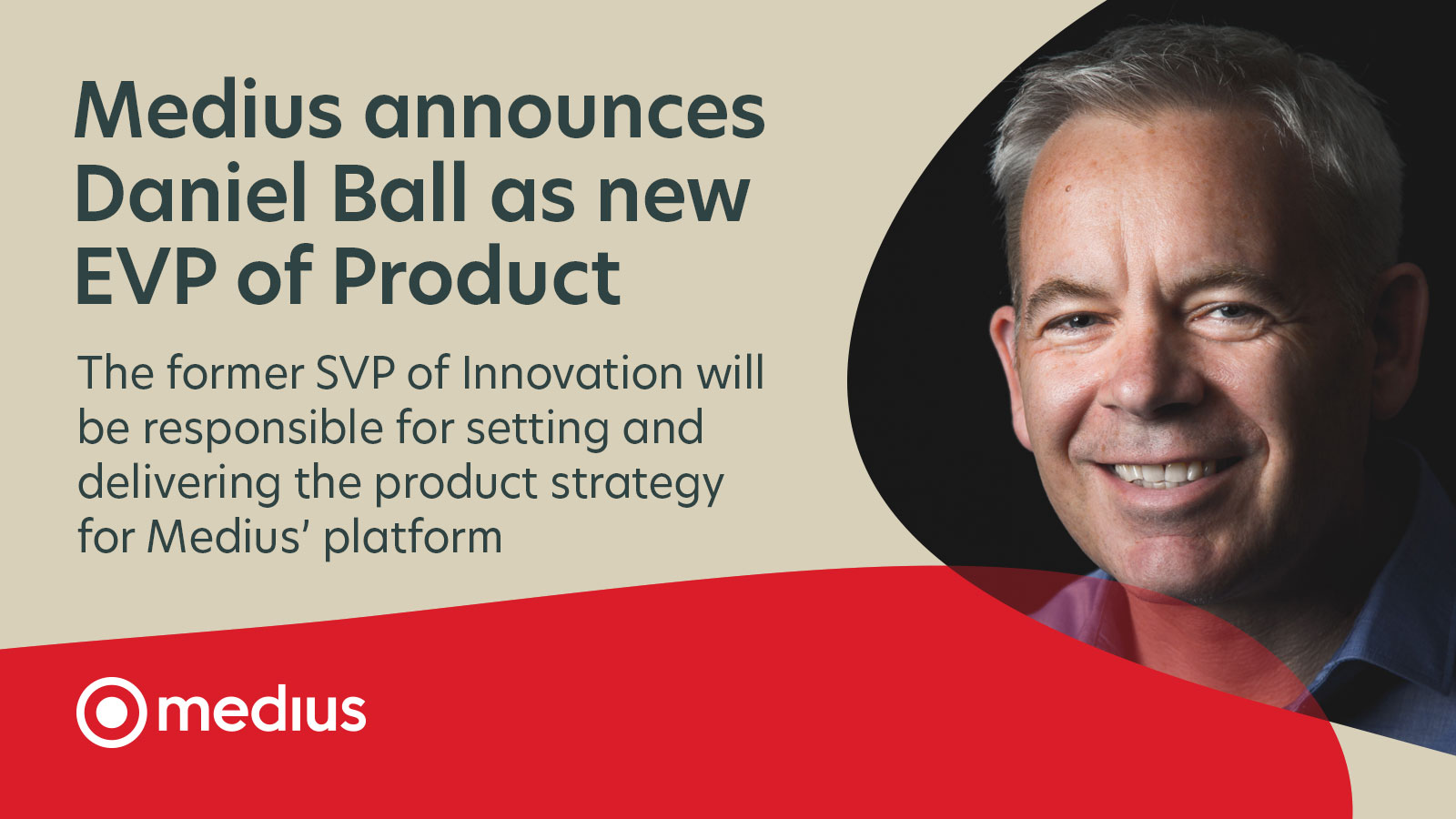
Medius, a leading provider of AP automation, announces the appointment of Daniel Ball as the new EVP of Product, the latest move to further accelerate the company’s growth.
In his new role, Daniel will be responsible for setting and delivering the product strategy for the Medius platform, encompassing multiple product areas and charting the direction for a substantial Research & Development team, globally.
Working as a dynamic product function, Daniel and his team will be working with customers and stakeholders, including market influencers and ERP vendors including Microsoft, Oracle, and SAP, with the goal to innovate ahead of the market, while transforming the procure-to-pay process to become truly touchless and autonomous.
Daniel Ball, EVP of Product, Medius, comments: “In 2023 we’ll see a step change in product development as companies turn to technology to do more with less. Working with our customers and stakeholders, I’m excited to deliver on our product roadmap to bring even more value to customers. Autonomous processing has never been more business-critical, as we help our customers get the most out of their investment in this challenging economic environment.”
Based in Manchester, Daniel was previously SVP of Innovation at Medius. Prior to that, Daniel was Co-Founder & CMO of Wax Digital, a global provider of Source to Pay solutions serving 150 enterprise customers. Founded in 2001 and acquired by Medius in November 2019, at Wax Digital, Daniel was responsible for growing all aspects of the business, ranging from sales, marketing, and product. His experience brings a broad perspective to the product function, grounded in outward-facing strategic principles and practices.
Jim Lucier, CEO, Medius, comments: “As we continue on our growth journey, I am very happy to have Daniel take on the role of EVP of Product, where he will support and most importantly challenge the team to reset the standard for accounts payable. Daniel brings with him his unique experience and perspective from decades in the source-to-pay industry to the product function, which is invaluable as we scale Medius’s global platform for our customers.”
- 07:00 am

Skyscend Inc., a leading SaaS platform provider for supply chain finance, today announced that it has joined Visa’s Fintech Fast Track Program, speeding up the process of integrating with Visa, allowing Skyscend to more easily leverage the reach, capabilities, and security that VisaNet, the company’s global payment network, offers.
Through the Visa Fintech Fast Track Program, Skyscend is now able to expand its offerings and provide faster, more secure and streamlined payments to its customers.
Skyscend will be able to use the Visa Fintech Fast Track Program to automate B2B payments by introducing secure and simple-to-use virtual card payments. This initiative will help reduce the risk and workload involved in transferring funds from Skyscend Capital, Skyscend Inc.'s finance arm, to a customer's bank account. As virtual cards can be tracked and reissued if they expire prior to use, customers recognize it as a more secure and faster method of payment receipt. Skyscend will also be able to simplify international payments with Visa by utilizing Skyscend Cash, a digital wallet for peer-to-peer payments, to meet growing client preferences for personal finance. Businesses and consumers will now have access to cutting-edge payment tools that can help make their lives easier.
Visa’s Fintech Fast Track Program provides fintech start-ups like Skyscend the ability to access Visa’s growing partner network, and experts who can provide guidance in helping them get up and running in the most efficient way possible.
Skyscend CEO David Sulfridge stated, "We are thrilled to join the elite group of start-ups in the Fintech Fast Track Program. Acceptance into the Visa Fintech Fast Track signals Visa's support of Skyscend and thereby serves to strengthen our customers' trust in our solutions. Our participation in the Visa Fintech Fast Program enables us to modify several closed-loop systems limited to specific geographies in the B2B and P2P payment space. With Visa we now have the right partners and resources to provide businesses and consumers with the best digital payment solutions."
“At Visa, we see our work with fintechs like Skyscend as one of our greatest opportunities,” said Vanessa Colella SVP and Global Head of Innovation and Digital Partnerships at Visa. “By joining Visa’s Fast Track Program, Skyscend can gain unprecedented access to Visa experts, technology, and resources to efficiently scale and bring innovative solutions to market.”
- 05:00 am
Viva Wallet and J.P. Morgan announce closing on a 48,5% ownership stake in Viva Wallet Holdings Software Development S.A. (Viva Wallet). Haris Karonis and Makis Antypas, founders of Viva Wallet, secure their majority shareholding after the closing of the Transaction, as they hold 51,5% of shares in Viva Wallet. As part of the Transaction, J.P. Morgan is also converting Viva Wallet's Convertible Loan Note and as a result Viva Wallet Group eliminates its debt. Viva Wallet further increases its capital by a €100m cash injection provided by J.P. Morgan. The agreement between J.P. Morgan and Viva Wallet was announced in January 2022.
Viva Wallet, a leading European cloud-based neobank, has been committed to developing cutting-edge technologies, aiming to shape the future of payments, unifying the fragmented European payments landscape. With local branches in 24 European markets, Viva Wallet is best positioned to serve businesses of all sizes and marketplaces across the continent. Harnessing the power of revolutionary technologies, such as the "tap-on-phone Viva Wallet POS app" and Smart Checkout payment gateway, Viva Wallet delivers an omnichannel solution, that offers seamless, conversion-boosting and secure ways to process transactions both in the physical and digital worlds, streamlining business operations and enhancing the customer experience. Plus, with a focus on future-proofing for the EU Digital Services Act of 2022, Viva Wallet is the perfect choice for any marketplace platform looking to stay ahead of the curve in the rapidly evolving world of payments.
At the same time, Viva Wallet's Share Option Plan remains a key driver for growth. Thirty-five thousand (35.000) shares of $50m will be distributed to 200 Viva Wallet employees -the company's "intrapreneurs"-, reflecting their contribution in the company and their employment tenure; one of the greatest Share Option Plans ever deployed. New and future employees will have the opportunity to become part of a new Share Option Plan, an essential means of attracting new talent from across Europe, who share Viva Wallet's forward-thinking mindset, vision, and values.
- 04:00 am

Researchers at Visa have been investigating how to enable automatic recurring payments for self-custodial crypto wallets.
In a new technical paper, the researchers investigate how to bring the commonplace automatic recurring payment option to the world of crypto and blockchain.
This, the paper says, "is not a trivial task on a blockchain like Ethereum", adding: "For self-custodial wallets where the user has sole control over the wallet and private keys, automated programmable payments that can pull payments automatically from a user’s account at recurring intervals requires engineering work."
Visa's answer is a smart contract application that allows a user to set up a programmable payment instruction that can push funds automatically from one self-custodial wallet account to another at recurring intervals, without requiring the user's active participation each time.
It relies on a concept known as “Account Abstraction” (AA) which makes user accounts on Ethereum function more like smart contracts by allowing a user to have programmable features embedded into their wallets.
In the paper, the Visa team demonstrates a potential application of AA: a new type of account contract that can delegate the ability to initiate a payment by a user account to a pre-approved autopayment smart contract, mimicking the process you use today to set up a recurring card payment.
The paper is the first technical piece to come out a new initiative from the Visa Crypto team as it bids to broaden its core competencies in the Web3 infrastructure layers and blockchain protocols that are driving crypto development.
A team of researchers and engineers across Visa is working to study the foundations of various blockchains — including the security, scalability, interoperability and privacy of different protocols — and propose possible use cases.
Catherine Gu, head, CBDC and Protocols, Visa, says: "To help our clients and partners innovate, we need to immerse ourselves in technologies that can bring real value to the payments ecosystem."
- 07:00 am

Tide, the UK's leading SME-focused business financial platform, today announced the promotion of Kumar Shekhar as Deputy Country Manager, Tide India. The announcement follows Tide’s recent market entry into India, with two business banking solutions – the Tide Business Account and its RuPay-powered Tide Expense Card (issued in partnership with Transcorp - an RBI-regulated PPI issuer). With this, Tide aims to tap into £100 million revenue opportunity in India and create a sizable business in the country in due course.
At Tide, Kumar has played a critical role in building a safe, risk-governed, and seamless business banking platform to help SMEs across India save time (and money). In his new role, Kumar will focus on strengthening Tide’s presence in India, to better meet the needs of Tide members. He will also help position Tide for nationwide growth and realise Tide’s commitment to making it easier for SMEs to do business.
Since starting at Tide in March 2021, Kumar has been instrumental in building Tide’s Know-Your-Customer (KYC) & Underwriting, Transaction Monitoring, Customer Service, and Sales Support teams.
Kumar is a seasoned professional with more than 16 years of experience in Operations, Servicing, Risk & Fraud Management, Collection, Internal Audit, Headcount & Cost Planning, and Team Management. Before joining Tide, Kumar has served as the Vice President-Risk Operations at PayU Payments and held leadership positions at GE Capital and SBI Card.
Tide is synonymous with engaging a highly skilled workforce and employs about 500 people in India. The company set up a Global Development Centre in Hyderabad in 2020 with its business headquarters in Delhi.
- 02:00 am

Fibank (First Investment Bank) has successfully implemented voice menus in some of its ATMs to help blind people withdraw money from them. The service is available on 60 devices of the bank located in key locations in major cities. The innovation is in line with the best global banking practices to facilitate the use of everyday banking by the visually impaired.
ATMs provide audio instructions so that people who cannot read the menus can operate the machine without assistance, by only using the numeric keypad below the screen. Information is provided via a headset (customer-owned) which is plugged into a socket on the front of the device. Each transaction step is explained, allowing the visually impaired to fully utilize the ATMs. Fibank's long-term goal is that every new ATM to have this functionality.
A similar trend is observed in highly developed countries, where ATMs for the blind are being installed by major international banks such as Wells Fargo, Citibank, Bank of America, Royal Bank of Canada and others.
- 03:00 am

When it comes to payments, Latin America is diving deeper into alternatives. Beyond Borders 2022/2023, a recent study by EBANX, a Brazilian fintech that processes payments for global players in rising markets, shows that alternative payment methods (APMs) have taken the region by storm, reaching a 39% share of total digital-commerce volume – a value of nearly USD 400 billion – as of the end of 2022. This rise in APMs follows four years of upward growth since 2018, while credit and debit cards have seen their shares shrink.
The three Latin American countries that use APMs the most for digital commerce are Colombia, El Salvador, and Brazil, where APMs have already reached peaks of 50%, 49%, and 44%, respectively.
The rise of APMs in the region is a result of a sharp increase in digitization and financial inclusion. The share of Latin Americans who have an account has jumped from 39% to 73% between 2011 and 2021, according to the World Bank's Global Findex, while only 28% of people in LatAm have a credit card. It is within this gap between accounts and card ownership that APMs have found a unique growth opportunity.
The fast-growing alternative payments landscape in Latin America is shaped by diversity, with account-based transfers, such as Pix in Brazil and PSE in Colombia; e-wallets, such as Ualá in Argentina; cash-based payments, such as OXXO in Mexico; Buy Now Pay Later (BNPL) solutions, such as Sistecredito in Colombia, and others.

Source: Americas Market Intelligence (AMI), in Beyond Borders 2022-2023
Alternative payments with real-time confirmation are booming
Among the APMs most commonly used in digital commerce across LatAm, account-based transfers have proven to be a real phenomenon. The most recent analysis from Americas Market Intelligence (AMI) shows that these transfers have been roughly doubling in volume for the last five years, growing at a 86% CAGR since 2018. By the end of this year, they should reach USD 68 billion in volume in Latin America, with the most significant shares in Colombia (30% of the country's total volume of digital commerce), followed by Brazil (24%), Guatemala (11%), Chile and Bolívia (10% both). The total payments volume of account-based transfers are forecast to jump to USD 121 billion by 2025.
In Latin America, this growing momentum for account-based transfers is being pushed by two major players: Pix in Brazil and PSE in Colombia. Developed by the Central Bank of Brazil, Pix is expected to represent more than 20% of all online purchases in Brazil this year, and has been used as a global benchmark for other regions seeking fast, safe, trustworthy, and instant transactions. Meanwhile, PSE became the most used payment method in Colombia’s e-commerce sector in 2021, with nearly 35% of all online purchases in the country – ahead of credit cards, which had a 30% share. In 2022, the instant payment created by Colombia’s clearinghouse should reach USD 9.3 billion in total online sales.
Other smaller account-based transfers' solutions are starting to gain traction in LatAm’s e-commerce landscape, such as SPEI in Mexico, Sinpe Móvil in Costa Rica, Simple in Bolivia, and Pagos al Instante in Dominican Republic.
Another APM that relies on real-time confirmation becoming increasingly popular in Latin American digital commerce are e-wallets. They are expected to grow in usage by about 20% per year through 2025 across the region’s digital-commerce landscape, driven most notably by an uptick in Latin Americans’ demand for digital services where they register their largest share. Within that same timeframe, AMI forecasts e-wallets’ payments volume will surpass USD 70 billion, or approximately a 10% share of LatAm’s entire digital-commerce market. Argentina and El Salvador currently lead the way in penetration, having a 23% share of their respective digital-commerce markets being paid with e-wallets, followed by Bolivia (14%), Peru (13%), Uruguay (12%), Brazil (11%), and Mexico (8%).
The fast growth of these alternative payment methods with real-time confirmation is driven by a change in consumers' behavior and expectations regarding payments and online shopping – and therefore shows no signs of slowing down.
“Currently, I cannot think of conceiving of a payment method without the instant mindset. Customers expect their payment options to be aligned with their way of life, which is instantaneous. They want the ability to send or receive money right away – not in a matter of days, but in a matter of minutes or seconds. We are drawn to having our needs solved instantly," said Juliana Etcheverry, Director of Strategic Payments Partnerships at EBANX.
BNPL is finding its way in Latin America
The new Beyond Borders 2022/2023 study shows that another alternative payment that is gaining traction in Latin America is Buy Now Pay Later, following a global trend that forecasts this type of payment may reach USD 400 billion in volume by 2026 worldwide.
Although BNPL still has a low penetration in the overall volume of Latin American digital commerce, in the region's two largest economies, Brazil and Mexico, this credit offering grew by a significant 80% and 82%, respectively, in 2022; while in Colombia, it rose by an impressive 208%. Mexico and Colombia have the largest shares of BNPLin Latin America, with USD 1.2 billion and USD 1.1 billion in online-commerce volume, respectively, per AMI forecasts for 2022, while Brazil reached USD 1.2 billion in sales volume, but it represents a smaller share of the total e-commerce volume in the country.
Experts consulted during the development of EBANX's latest Beyond Borders study said the great opportunity for BNPL in Latin America lies in understanding who its target audience is: consumers who do not have credit cards or enough credit limit but want to pay for their purchases in installments.
For Erika Daguani, VP of Product at EBANX, the key way for BNPL to gain more traction in Latin America is by providing a faster, simpler experience for those who really need this credit. "The key aspect here is accessibility; it is giving credit in an easy way to the right people who are good payers, but have difficulties in proving their scores."
- 02:00 am

Finastra today announced that Mechanics Cooperative Bank, a Massachusetts-based financial institution with more than $645 million in assets, has selected Finastra Payments To Go to introduce new business payments services and enhance the customer experience. The multi-rail payments hub empowers Mechanics Cooperative Bank to leverage the strength of the cloud, providing the tools needed to introduce Real-Time Payments services (RTP) through the Clearing House (TCH) and to quickly join the FedNow rail when it goes live.
“Finastra has been our core technology partner for several years, helping us deliver the financial solutions our customers rely on. When it was time to enhance our payments services, we saw Finastra and Payments To Go as the obvious choice to help us adopt an agile and cloud-based payments hub,” said Joseph T. Baptista Jr., President and CEO of Mechanics Cooperative Bank. “This partnership enables us to not just meet customer demand, but to also exceed expectations. We’re thankful that Finastra’s inclusion in the FedNow pilot program ensures our readiness to adopt the service.”
Payments To Go provides Mechanics Cooperative Bank the agility needed to provide new and innovative payments services, including RTP and FedNow. RTP TCH services, available through Finastra’s Financial Messaging Gateway, offers direct connectivity to the RTP network for easy, frictionless, and more affordable access to the payment rail. Finastra’s participation in the FedNow pilot program, which supports the development, testing and adoption of the service, allows the bank to be among the first financial institutions to go live quickly and efficiently as soon as it launches.
"Our payments solution enables financial institutions such as Mechanics Cooperative Bank to introduce new payments services quickly and efficiently while leveraging the strength of the cloud,” said Barry Rodrigues, EVP of Finastra’s Payments Business Unit. “Through Finastra’s multi-rail payments hub as a service solution, the bank will be able to meet the many new challenges of emerging technologies while differentiating itself amongst its competitors.”
Mechanics Cooperative Bank’s selection of Payments To Go represents a larger shift across the payments industry. As more financial institutions globally continue to embrace cloud-based payments processing solutions, it provides the availability, agility, and scale needed for banks to provide enhanced services and navigate regulatory changes quickly and efficiently. The solution comes pre-configured with rapid, secure, and scalable SaaS-deployment in the cloud on Microsoft Azure.
- 02:00 am
Real-time economic intelligence provider QuantCube Technology today announced that it has secured funding led by Strategic Development Fund (SDF), the investment arm of UAE’s Tawazun Council, together with previous backers Moody’s and Five Capital, and other private investors.
Using AI to analyse billions of alternative data points in real-time, QuantCube is the global leader in macroeconomic intelligence nowcasting and in pinpointing macro regime change. The new funding will help the firm deliver on its vision to become the standard point of reference for real-time macroeconomic, corporate and environmental intelligence.
Headquartered in Paris, QuantCube will build on its existing presence by establishing new offices in Abu Dhabi focused on research and development, as well as offices in Tokyo and New York dedicated to sales and operations.
Ghizlaine Amrani, COO and Co-Founder, QuantCube Technology, said: “Increased focus on geopolitical and macroeconomic issues means the ability to derive insights from real-time data across markets and at scale has never been more essential. With our newly secured funding, we look forward to expanding our offerings into new regions and delivering market-leading economic intelligence to new customers. We would like to thank our existing stakeholders for their continued support as well as our new partners for this truly transformational investment.”
Abdulla Naser Al Jaabari, Managing Director and CEO of SDF said: “SDF looks at investing in companies within specific sectors that have technological solutions that provide an edge to their customers. When it comes to macroeconomic nowcasting, QuantCube Technology’s capabilities are unmatched and users of QuantCube data benefit from highly accurate real-time insights. As one of QuantCube’s latest strategic investors, SDF will be working closely to support the ongoing growth of QuantCube with additional applications building on QuantCube’s capability and platform in new industries and use cases throughout the UAE and globally.”
QuantCube’s Macroeconomic Intelligence Platform delivers macro nowcasting indices on variables including economic growth, inflation, employment and international trade for the G20 and emerging economies—providing critical insight on market turning points across asset classes from equities to fixed income, commodities and foreign exchange.
- 06:00 am
Nominations now over, the excitement is at its all-time high as Forex and financial technology industry players and retail clients alike are about to cast their vote for their favoured brand competing for an UF Award MEA 2023.
Setting the benchmark for excellence in the online trading and fintech sectors, the UF AWARDS MEA confer nominees industry-wide recognition and market validation. Creating a unique identity in such an ultra-competitive market is a great achievement for any market player, and this is precisely what the UF AWARDS MEA recognise.
Which company leads the trend in the MEA region? As the nomination round for the UF AWARDS MEA 2023 has come to an end, the adrenaline rush is at its peak as industry leaders and traders are about to cast their vote for their preferred B2B and B2C brands. Who will be the lucky winners?
Let the voting begin!
With so many top-tier participants in each of the B2B and B2C categories, the competition is tight. Voters are already lining up to support their brand of choice. But how do you vote?
Simple. In order to cast your vote, you need to register an account or use an existing one and take your pick. Scroll through the two main categories (Broker Awards and B2B Awards) to find out who’s in the race in each award category, make your choice, and hit the “Submit” button to confirm your vote. Remember, you can vote in different award categories, but you can only do it once. So, make it count.
Simply the best
There are many accolades to be won in the Broker Award category, leaving room for plenty of wishful thinking amongst participants, as everything is hanging on the voters’ choice. Only time will tell who is the “Best Multi-asset Broker - MEA”, “Most Trusted Broker - MEA”, “Best CFD Broker - MEA”, and the “Best ECN/STP Broker - MEA” from the nominated brokers, or which financial technology provider will prove to be the best in their class.
In the B2B Awards’ group, nominees are hoping to gather enough votes to stand out from the crowd in one or more categories, including the “Best Trading Platform - MEA”, “Best Fintech AI Solution - MEA”, and the “Best Social Trading Solution - MEA”. Make sure to vote before 10th January, when the voting round ends.
What’s next?
Time flies, and we’re rapidly approaching the end of 2022. With the Award Ceremony nearly upon us, be sure to add these dates to your calendar:
10 January 2023: Voting closes
18 January 2023: UF AWARDS MEA 2023 Ceremony
The coming three weeks will be decisive for the finalists. So, it’s time to show your support by giving the best B2B and B2C brand in each category your vote of confidence. Make your voice heard across the industry! Be sure to register or log in to your account and cast your vote. Vote now for your chosen brand.
Lastly, Ultimate Fintech would like to extend their thanks to everyone who participated in the nomination process and congratulate all the finalists who made it through the selection process, battling for an UF Award.








