
Published
- 03:00 am

Currencycloud, the experts in simplifying business in a multi-currency world, has partnered with UK-based venture capital platform Vauban, to enable the platform to be more accessible and permit global investors to launch and run their special purpose vehicles (SPVs) both easily and instantly.
For the platform to reach its true potential, speed was a necessity. By integrating Currencycloud’s APIs into its platform, Vauban is now able to deliver SPVs and funds in hours rather than weeks or months. Now, an SPV will be able to set up bank accounts for each vehicle instantly and run payment processing related to capital calls. As a global company, with global investors and jurisdictions, Vauban benefits from Currencycloud’s competitive FX rates and wallet, which allows the platform to operate in multiple currencies in addition to reducing their FX risks.
Arik Oslerne, COO of Vauban says: “Currencycloud is a robust solution able to handle our banking needs and enable us to be truly global. As we continue to expand into new jurisdictions, enabling more people to get into venture capital and expand equity ownership, Currencycloud is right there with us to deliver on that promise and offer a seamless experience for our customers across the globe.”
Nick Cheetham, Chief Revenue Officer at Currencycloud, commented: “Vauban is on a mission to democratise private investment, a vision that only further amplifies our ethos of ‘backing your bold’. As a result, the partnership between Vauban and Currencycloud has levelled the playing field for investors. Now VCs of any size, anywhere, have the opportunity to invest via Vauban’s platform in startups whenever they want.”
- 06:00 am

OKX, one of the world’s leading cryptocurrency platforms and Web3 technology companies, today launched its Copy Trading tool to its global user base on its Social Trading platform.
Copy Trading allows users to follow high-performing “lead traders,” receive real-time updates on their latest moves, and replicate trading strategies across more than 600 trading pairs.
Since May of 2022, OKX Social Trading has allowed users to view the portfolio breakdowns, transaction histories, PnLs and risk levels of high-performing traders.
Haider Rafique, Global CMO, OKX, said: “In the last year we have added a number of features that make it easy for new traders to follow or learn from other successful traders on the platform. Advancing social trading to include copy trading now adds more utility to the community of traders available to anyone on OKX. This feature is yet another way we believe we can help new traders to trade responsibly and manage risk while giving professional traders on our platform more ways to generate income.”
OKX Copy Trading also provides experienced and professional traders with a convenient way to monetize their trading strategies. When they become lead traders on OKX, high-performing traders receive a percentage of the profits they help their followers realize.
OKX lead traders had the below to say on their experience with OKX Copy Trading:
Kyledoops from Crypto Banter said, "One of the great things about OKX Social Trading is that it provides huge amounts of information on the lead traders and on their metrics and past performance hit rates. That gives the user the opportunity to make a very educated decision on if that trader is someone they want to align with or not."
Grey Jabesi from Crypto University said, “I like the control that OKX gives you in comparison to most other exchanges when it comes to Copy Trading. I like that copy traders can get in and out of a position whenever they want to, without waiting for the lead trader to close their position first. This gives them the flexibility to walk away with their money on their terms.”
- 09:00 am

AU10TIX, the global technology leader in identity verification and identity management automation, today announced the appointment of Dan Yerushalmi as its new CEO. Yerushalmi’s record with global technology enterprises and experience in the security, e-banking and telecommunications industries underlines AU10TIX’s intention to help customers counter increasingly sophisticated fraudsters and comply with regulatory changes. He is replacing former CEO Carey O’Connor Kolaja.
Yerushalmi joins AU10TIX from cybersecurity company Checkpoint Software Technologies, where he served as Chief Client and Revenue Officer. Yerushalmi previously headed the technological division of Leumi Bank as a Group CTO, where he served on the bank’s management team. Prior to that, he was President and Business Manager of EMEA for Amdocs. In 2016, Yerushalmi was named one the 100 most influential CIOs in the world by CIO Magazine.
AU10TIX, chaired by Ron Atzmon, is the long-standing industry leader in automated identity verification and management solutions for the digitally dependent global enterprises of today.
The company began in the 1990s, championing innovations in passenger screening technology for airports and border control all over the world. It was then early to identify the global shift to online and mobile services, drawing its technology superiority from the same security-critical standards it grew on. AU10TIX today offers a full-service identity verification and management automation portfolio, enhanced by forensic-level fraud and risk detection. The company is also celebrating the third year of the operational deployment of the market’s first organized crime attack monitor. AU10TIX powers a list of global household names such as Google, PayPal, Airbnb, LinkedIn, Payoneer, Uber and Santander.
Dan Yerushalmi, CEO: “In a world where ‘automation’ is actually enhanced by human ‘experts’ most of the time, AU10TIX stands out with its level of full-process automation and the richness of its fraud and risk output detection. This wins AU10TIX new clients, creates compelling ROI, and is greatly appreciated by regulators. Being a global player with clients on five continents brings massive opportunity for continued growth and inspires me to take AU10TIX to the next level.”
Ron Atzmon, Chairman: “Dan brings a significant boost to AU10TIX. His experience and extensive knowledge in strategy, operations and sales make him the right person for the company as we expand activity and increase personnel globally. The AU10TIX team and I would like to thank Carey for her contribution to the company and wish her best of luck in her future endeavors.”

James Blake
Field CISO of EMEA at Cohesity
In an ideal scenario, after a ransomware attack that encrypts all production systems, the IT teams react and restore the applications and data from the backup see more
- 04:00 am

As financial markets compliance professionals faced some of their toughest challenges to date, Eventus – a leading global provider of multi-asset class trade surveillance and market risk solutions – today said that the firm continued its significant growth trajectory in 2022 with another record year. The company more than doubled revenues from 2021 as more firms doing business in multiple asset classes across the globe deployed its customizable Validus platform and collaborated with Eventus experts in markets and regulatory affairs.
Eventus continued to grow its global client base to more than 100 companies across the financial spectrum, with nearly 40% of its 2022 revenue coming from outside the U.S. This reflected strong traction in the Asia-Pacific (APAC) region, including a traditional exchange that recently signed with the firm, as well as the Europe, Middle East and Africa (EMEA) region. The company’s reach also extends into Latin America, with a new client in Brazil signing in 2022. Eventus also filled key new management roles and added substantially to its team, now consisting of more than 100 professionals based in 10 countries.
Eventus CEO Travis Schwab said: “We’re incredibly proud to partner with our clients to help ensure they have a robust, reliable trade surveillance operation that brings not only efficiencies but peace of mind. We expect 2023 to be another pivotal year as we introduce some exciting new capabilities that will further broaden our offering and appeal while continually innovating on the platform to meet our clients’ evolving needs. Our experienced team of subject matter experts and true professionals is a significant reason clients turn to us to solve some of their most important compliance challenges.”
In 2023, the Eventus Product and Engineering team will continue to introduce new features and functionality on Validus, including by offering even greater scaling capabilities to support the firm’s largest customers. Other enhancements include an update of the Validus user interfaces to provide streamlined dashboards, improved visualizations, more efficient workflows and greater transparency into the underlying platform to help customers build better compliance programs. In the coming weeks, Eventus will announce a major new product that will extend client capabilities and offer the ability to further streamline outsourcing needs.
Eventus captured another 11 awards and honours in 2022, bringing the total to more than 30 since 2018, with new recognitions globally, as well as for its activities specifically in the U.S., Canada, Europe and APAC. Schwab was also named in 2022 to TabbFORUM’s inaugural 40 Top Innovators in Financial Markets list.

Lionel Grosclaude
CEO at Fime
As the number of devices and connected services rise, our lives are becoming increasingly digitized. see more
- 01:00 am

Biz2Credit, a leading online funding provider to small businesses, today announced the findings of its Small Business Inflation Study that analyzed the revenues and expenditures of more than 140,000 U.S. small businesses from January 2019 to October 2022.
The Biz2Credit Small Business Inflation Study identified three distinct phases:
- The pre-pandemic phase up to Q1 2020
- The initial waves of the COVID pandemic before mass vaccination in the first quarter of 2021, when both small business revenues and expenditures fell sharply
- The period of gradual, partial recovery of small businesses after revenues had bottomed out in Q1 2021 and extending to 2Q 2022. Inflation persisted through the third phase.
Key Findings
- In the pre-vaccination COVID phase, average monthly expenditure by small businesses fell by 21%, from nearly $14,000 in 2020-Q1 to just under $11,000 in 2020-Q3.
- Economic behavior of small businesses in the post-vaccination inflationary phase was very different from the pre-vaccination phase. In the pre-vaccination phase (Q1 through Q3 2020), small businesses conducted severe cost-cutting in the face of falling revenue, with both dollars per expenditure transaction and the number of transactions falling by 14% and 8% respectively.
- In the post-vaccination recovery (Q1 through Q3 2022), a period of high inflation, small business encountered severe cash flow pressures while trying to maintain business activity at higher post-vaccination recovery levels. Thus, dollars per expenditure fell 12%, while the number of transactions rose by 9%, offsetting the fall in the former. This change in behavior reflected the need to control cash outflows by restraining individual cash outflows during a high inflation period.
- During the period of highest inflation, the average monthly expenditure of small businesses fell by 5%, from $11,401 in Q1 2022 to $10,884 in Q3 2022.
- As inflation accelerated, consumers were also increasingly stressed by rising prices. In the post-vaccination recovery, revenue increases outpaced inflation, but by Q2 2022, revenue growth fell below the rate of quarterly inflation.
- This may reflect a reduced capacity for small business to pass on cost increases to their customers (“pricing power”) with important implications for 2023.
The inflationary period is evaluated in the context of the unique circumstances created by the COVID pandemic. Following mass vaccination in Q1 2021, the economy began to recover through a combination of a strong labor market and the spending of accumulated savings by consumers and businesses. However, the economy also faced pandemic-related global supply chain constraints.
“This first-of-its kind analysis is based upon anonymized transactional cash flow data comprising nearly 105 million cash inflow and cash outflow transactions from small businesses on Biz2Credit’s online marketplace,” said Rohit Arora, CEO of Biz2Credit and one of the nation’s leading experts in small business finance. “Unfortunately, the spike in prices came just as the economy was recovering from the initial waves of the pandemic and created a new set of challenges for small businesses. Many of them are still hurting.”
U.S. prices experienced a persistent rise that began in the summer of 2021, and inflation accelerated by the middle of 2022. The Producer Price Index (PPI) which gauges prices paid by businesses, grew at a peak rate of nearly 3% month-over-month by May 2022, and over 20% from the prior year.
“The rise in prices continues to impact us. It is hard to raise our prices. It is mac & cheese; there is only so much you sell a plate for,” said Sarita Ekya, from S'MAC, the first New York City restaurant devoted exclusively to mac & cheese.
Biz2Credit’s Small Business Inflation Study also considered expenditure categories in which inflation was particularly high, such as gasoline and utility prices. These sections consider specific industry sectors (such as Accommodation and Food Services for utility spending) or subsectors (Transportation and Warehousing within B2B for gasoline expenditures) where such spending is high.
Inflation’s impact on individual expenditure items
The study also looked at how inflation impacted small business behavior for individual expenditure items, namely energy prices (gasoline and utility rates). Rapidly increasing gasoline prices in 2022 significantly hurt the Transportation and Warehousing industry, for which fuel is an essential input. Between Q1 2022 and Q2 2022 -- when quarterly average gas prices rose from $3.78 per gallon to $4.60 per gallon -- average expenditure rose from $325 to $345 and then later subsequently fell to $333 in Q3 2022, when average gas prices had subsided slightly to $4.19.
Despite the higher expenditure, gasoline volume fell from 87 gallons to 75 gallons as gas prices rose in 2Q 2022 and later subsequently climbed back to 80 gallons in 3Q 2022 as gas prices retreated. Transportation firms had little choice other than to fulfil customer orders without much leeway to respond to changing gasoline prices.
The Biz2Credit study did a similar analysis for utility spending by measuring against a utility energy price index. As with gasoline prices, the index rose significantly in Q2 2022over the prior quarter. However, unlike gas prices, the index continued to rise in Q3 2022.
Average utility spending was highest for the Accommodation and Food Services industry, where average monthly spending was $353 in Q1 2022 and dropped to $331 in Q2 2022. By the third quarter of 2022, the average cost was back up to $349.
"Inflation is the biggest challenge facing small businesses in 2023, and Biz2credit's research shows the impact it is having on small business. Entrepreneurs are struggling to prioritize costs and manage cash,” said Charles "Tee" Rowe, President and CEO, America's SBDC. “With the current volatile economy, we encourage all small businesses to visit their local Small Business Development Center (SBDC) for guidance on creating a manageable path forward..."
Implications for Small Business in 2023
Inflation during the post-vaccination COVID period led to significant changes in small business activity. In 2023, there is considerable uncertainty remains related to continued inflation, additional spikes in gasoline prices, further increases in interest rates by the Federal Reserve, and weaker economic growth.
“The continuing inflationary environment underscores the need for careful cash flow management. Cash outflows must be well-timed to match cash inflows from customer revenues,” Arora said. “On the revenue side, small businesses must carefully gauge when they have ‘pricing power,’ the capacity to pass on cost increases to the customers without excessively hurting demand.”
“Small businesses need to carefully assess whether their operations require additional financing to manage cash flows better and whether their projected cash flows can support borrowing,” Arora said. “A disciplined historical track record in prudent cash flow management can be very helpful for companies looking to obtain financing from banks and online marketplaces, should they choose to apply for it.”
- 08:00 am

The Payments Association, which celebrates innovation and collaboration across the payments industry, today announces the launch of Project ESG. The Payments Association’s seven Projects drive industry change to shape the future of the payments landscape. Project ESG will aim to encourage companies in the payments industry to adopt progressive strategies for how they impact the environment, our society and their governance in a sustainable way.
Charles Radclyffe, CEO at EthicsGrade and Ambassador for Project ESG, commented: “We are delighted to launch Project ESG, championing progressive strategies for those in the payments industry to operate in a sustainable way. We have a packed schedule that will raise awareness of the issue and support companies as they learn and implement new policies and procedures that can ensure they positively impact our environment, society and governance.”
Tom Brewin, Head of Projects at The Payments Association, said: “The Payments Association seeks to drive industry change and one way we do that is by harnessing the collective expertise of our members in our 6 project working groups. I’m proud to say we can now add a seventh string to our bow by launching Project ESG. The world is becoming increasingly aware of the importance of embedding sustainable and community-driven practices into business. However, the payments industry must continue to recognise ESG as an opportunity for growth and embrace the chance to deliver more for our stakeholders. I have been blown away by the support our members have shown for this initiative and can’t wait to get started.”
- 09:00 am

Schematiq Ltd, the technology company future-proofing and safe-guarding businesses Excel IP, today announces the appointment of Jan-Coos Geesink as Chief Executive Officer.
The appointment comes at a timely moment for Schematiq, as the company pushes to increase growth and market share within the Financial Services and Energy Sectors, following its recent successful fundraise.
“Jan-Coos’ years of management and advisory roles across financial services and fintech will prove invaluable to Schematiq as it takes the next steps growing market share. Jan-Coos’ knowledge and hands on experience will be vital in driving Schematiq’s strategy, vision, and culture through this period of growth” said Dan Look, Non-Executive Chairman, Schematiq.
Prior to joining Schematiq, Jan-Coos most recently worked as an industry advisor for several investment firms, as well as an executive advisor to Dow Jones. Prior to this he held a number of global executive management roles at Refinitiv, Thomson Reuters and Reuters with a particular focus on driving marketing and sales globally across the business.
“Schematiq has reached an important stage in its growth journey. The latest developments of the Schematiq Platform enabling its clients to transform the way they use Excel for mission-critical business processes is unique, and the performance improvements that Schematiq clients are enjoying is astounding. As such, I am excited to be given the opportunity to lead this company as we demonstrate the power of the Schematiq solution to a wider market” said Jan-Coos.
“Giving financial institutions the power to unlock the potential of Excel, and their entwined IP by enabling it to run faster, without data and memory constraints is much needed within the industry. However, Schematiq also enable Excel models and applications to be controlled, governed, tested, run and shared throughout the organisation, via API and accessed via a secure enterprise-grade cloud platform with full audit trail. The Schematiq solution puts them ahead of the market and provides a very compelling solution to financial institutions reliant on vulnerable Excel spreadsheets”.
Jan Coos is a Non Executive Director at social lender Moneyline and a Trustee at the Social Business Trust. He holds a Bachelor of Science and Business Administration from the Questrom School of Business, Boston University.
- 02:00 am
World-leading digital ID verification company OCR Labs Global has today revealed the results of a new research survey, ‘Fighting Identity Fraud in an Economic Downturn’. In partnership with FINTRAIL, a global consultancy helping companies manage their exposure to financial crime, the survey shows that in 2022 FinTech worldwide experienced a rise in third-party fraud, with 60 per cent of respondents citing identity theft, account takeover and social engineering scams as the main types of fraud detected.
The survey received responses from over 50 global members of FINTRAIL’s FinTech FinCrime Exchange, a global network of fintechs, to collaborate on best practices in financial crime risk management. The research looked to understand the impact of fighting identity fraud in the current economy, as well as the challenges and opportunities for fintechs to manage fraud volumes in 2023.
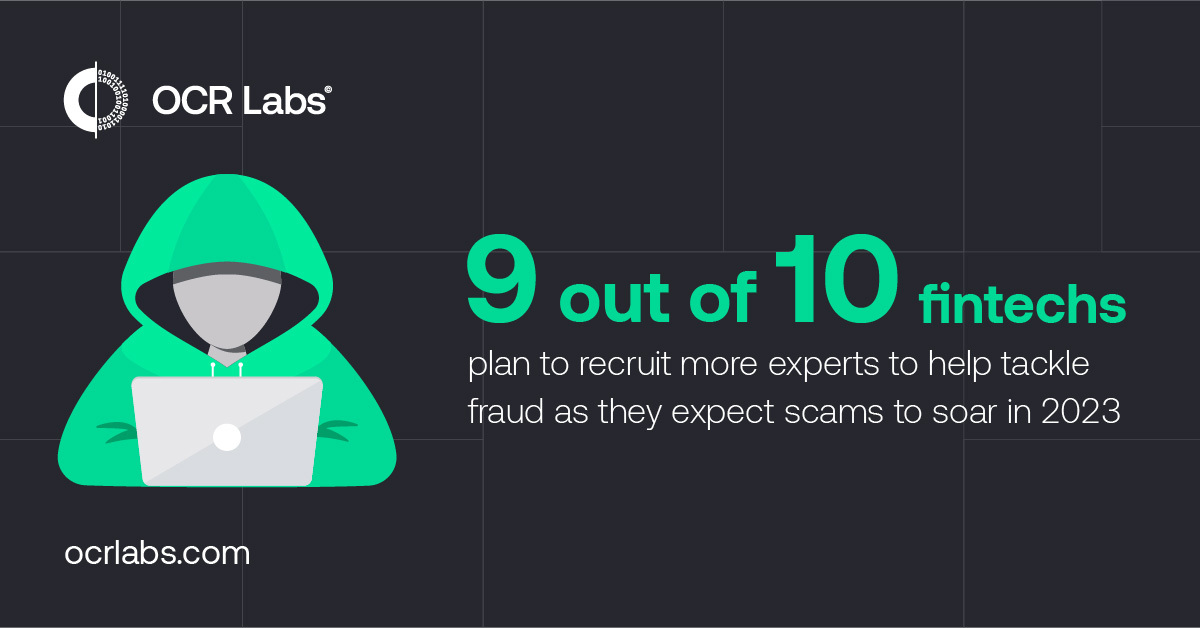
Amongst the survey's findings, 81 per cent of respondents expect to see a rise in all types of fraud in 2023, and, to address this challenge, nearly nine out of 10 (86 per cent) fintechs are gearing up with fraud prevention and management headcount. To complement that, 42 per cent are also looking into fraud prevention software, 40 per cent into AI and Machine Learning solutions and 38 per cent into digital identity verification (IDV) software.
Russ Cohn, General Manager at OCR Labs Global, says, “Our research shows that the main challenge fintechs have with addressing this is the length of time spent reviewing cases.
We are seeing an increase in very convincing AI-generated deepfakes. These synthetic media would fool almost any human, and our research shows that 2 in 3 fintechs planning to add new automated identity verification technology that can detect true human liveness.”
Cohn continues, “Investing in technology that keeps our customers safe is always our top priority. Fintechs that have sound business models and execution will grow, despite hard economic downturns. Unfortunately, growth and success attract fraudsters. That’s why we continue to hire and strengthen our trust and safety capabilities.”
Shay Oshinusi: Financial Crime Operations Unit Lead, Mettle, says, “It’s important to be able to react quickly when fraud comes in. But being able to get the buy-in of all the relevant stakeholders in order to make that happen, and make that happen quickly, can be a challenge.”
Oshinusi continues, “We want to strike a really good balance between people versus tooling. The best solution isn't always to only throw people at a problem – it’s about looking at how we can gain efficiency using fraud prevention software.”
With the Bank of England forecasting that the recession is likely to last until well into 2024, now is a good time for fintechs to think about future-proofing.
The 2008 recession showed fraud rates rising as people found themselves under increasing financial pressure. Fraud prevention measures that worked then won’t be fit for purpose now, as fraud techniques have evolved. Fintech companies need to evaluate their technology stack to ensure they do not fall victim to third-party fraud across the board.
To learn more about the research survey and see full results, visit https://ocrlabs.com/resources/reports/fighting-identity-fraud-in-an-economic-downturn








