Published
- 05:00 am
Zenus Bank, the digital bank that makes U.S. bank accounts available internationally, without the need to be a U.S. citizen or resident, has become the first bank to launch Visa Infinite Debit Card to a global audience.
This world first follows Zenus becoming the first International Financial Entity to become a Principal Member of Visa in 2022.
“Today’s announcement is hugely important for us, as an international bank. Being a business partner, and with Visa’s technology we’ve been able to issue digital and physical credentials in over 46 countries. This gives our clients, access to a Visa Infinite Debit card with which they can make purchases in over 80 million merchant locations in 200 countries with total confidence, security, and unique benefits.”
Mushegh Tovmasyan, Zenus Bank Founder & Chairman
“There is no doubt that the future of money is digital, and that shift is transforming how the world pays. Visa’s past, present and future are about fostering innovation and enabling new partners and capabilities. We are thrilled to be working together with Zenus, on their international expansion. The launch of this new Visa Infinite card will help accelerate digital inclusion in the region and beyond.”
Luis Guerra, Country Manager Visa Puerto Rico
“In the long run, our partnership will allow us to expand our infrastructure for enabling digital payments in the Latin American and Caribbean region, by offering a Banking as a Service platform to distribute payment credentials in an agile, convenient and secure way – via companies whose main business is not banking.”
Jorge Lemus, Group Country Manager Visa Caribbean, and Central America
For people in over 46 countries, this means they can now easily apply remotely for a true U.S. bank account online, be issued with a virtual Visa Infinite debit card and receive a physical card in under 10 days.
The Visa Infinite card is usually available as a credit card, but Zenus offers it as a debit card. This gives Zenus’ clients access to the highest level of benefits and purchase protection offered by Visa.
Travel better: Put the enjoyment back into travel, with the knowledge your family and luggage have the highest levels of protection.
Buy with confidence: Take the worry out of buying online or getting the best price. From price and purchase protection to extended warranties, we’ve got you covered.
Everyday luxury: Let your Zenus card add value to your lifestyle, with our range of exclusive services
The SmartMetal physical card features a metal core with Zenus branding etched into it. Weighing at 13.5 grams, it has a very solid feel and makes a noticeable ‘thud’ when landed on a restaurant table.
- 01:00 am

North American Bancard (NAB), LLC, a U.S.-based leader in electronic payment solutions, is pleased to announce that Director of PCI Compliance Kera Logan, has been selected as part of the Electronic Transaction Association’s (ETA) 2023 Forty Under 40 class. The list of honorees recognizes innovative leaders and influencers in the payments industry.
ETA solicited nominations from across the payments industry, seeking talented payments executives under 40. The final group was selected by previous honorees and the ETA Awards and Recognition committee based on the nominees' impact on the payments industry and their professional character. Logan and the rest of the group will be recognized at TRANSACT’s ETA YPP & Forty Under 40 Reception, in Atlanta.
“It's truly an honour to be recognized among this dynamic group of industry professionals whom I both respect and share a common passion in securing payments,” said Logan. “NAB has proven to be an industry leader and a great environment to enhance my skills over the years. From assisting merchants of all levels to achieve compliance goals, to implementing internal compliance initiatives, these experiences have deepened my risk management expertise to shape me into the strong payments professional that I am today.”
Logan manages NAB’s PCI Compliance program, facilitating merchant adherence to the Payment Card Industry Data Security Standards (PCI DSS) to protect payment data and prevent data breaches. She works with the product and engineering team to continually enhance NAB’s systems, as well as the marketing team to develop and distribute card brand and regulatory compliance updates to merchants and stakeholders.
In addition to Logan, CWA Merchant Services’ Vice President, Erick Weinstein, also received the Forty Under 40 honour. CWA is an entity owned by NAB.
- 04:00 am
Challenges for CPAs with Crypto Data
Blockchain technology and cryptocurrencies (crypto) present a multitude of challenges for CPAs. This article will examine some of those challenges and provide helpful tips.
1. Data is king
The challenge starts with data, and “blockchain” is a fancy word for a database. Just like a business starts with transaction data to compile financial statements, a similar approach is taken to compile the overall economic impact of your crypto transactions. All of the data for on-chain transactions is accessible on a public ledger (aka the blockchain). Understanding and deciphering that data can be difficult if you are not trained in how to read blockchain explorers—unless, of course, you’re assisted with a tool like Ledgible.
2. This is a technology that is evolving quickly
One issue is the constantly evolving and complex nature of these technologies, which makes it difficult for CPAs to keep up with the latest developments and fully comprehend the information they are handling. Because of the pace of change in the industry, it has been said that spending one year devoted to crypto is like 10 years outside of crypto. Not every blockchain works the same, and not every application on the blockchain works the same.
For example, holders of the ATOM token can stake their ATOM and in exchange for securing the COSMOS blockchain, they receive ATOM tokens as a reward. Once ATOM tokens are staked, they are locked up and cannot be traded until unstaked. Contrast that with staking Ethereum (ETH) through Lido; holders of the ETH token can stake their ETH and in exchange for securing the ETH blockchain, they receive ETH tokens as a reward. However, with Lido, ETH stakers can choose to receive stETH, a liquid derivative of ETH. This liquid derivative allows stakers of ETH to effectively trade their ETH while it is locked up. Catch all that? Now imagine the data and the data format needed for CPAs to help their clients report this information. It’s complex, to say the least.
3. There is no standard tax reporting form that assists CPAs, e.g., 1099-B
Another challenge CPAs face is the complexity and nature of how taxpayers can move their crypto. For example, a taxpayer could move their crypto from a centralized exchange to a wallet through different decentralized apps and back into a centralized exchange. Centralized exchanges are not currently required to issue 1099s summarizing the total gain, loss, and income from taxpayers’ activities, but some have taken it upon themselves to at least provide something to alleviate the tax reporting burden of their customers. Complexity with tracking tax basis and proceeds arises when taxpayers transact on-chain because the blockchain, in its simplest form, is open-source code that does not act as a custodian. Therefore, there is currently no way a summarized report like a 1099-B can easily and accurately report a taxpayer’s basis and proceeds.
4. Crypto is volatile
The value of crypto also can be incredibly volatile, fluctuating significantly in short periods of time. Crypto also trades 24 hours a day, 7 days a week, and there is no open or close of market. This creates an inherent difficulty when choosing a method for converting the value of crypto back to fiat or USD. Picking a standard method and remaining consistent with that method is key.
Proper Accounting
Wallet Hygiene
An essential step to check that your crypto is properly accounted for is to keep your wallet “clean.” In the industry, wallet hygiene refers to the practice of keeping your wallet(s) organized and secure. Neglecting your wallet’s organization and security can create accounting headaches for your CPA, so it’s important to stay on top of things. Let’s look at some ways to help you maintain good wallet hygiene.
1. Security
Custodial Wallets & Accounts
The first step to good wallet hygiene is to keep your funds secure. If you plan to use a centralized exchange or other forms of the custodian, choose a password that is long, complex, and unique. Reusing passwords across different custodial accounts increases the chance that your password will be discovered and used to gain unauthorized access to your other custodial accounts. Keep your software up to date to take advantage of the latest security features and bug fixes. Outdated software may have vulnerabilities that attackers could exploit. Consider turning on two-factor authentication. This allows you to easily add another layer of security by requiring verification before withdrawing or sending payments.
Noncustodial Wallets
Noncustodial wallets like hardware (cold) and software (hot) wallets return ownership and custody back to the owner of the private key or seed phrase. Copying the seed phrase and keeping a backup if the original is lost can help prevent losing access to crypto funds. Protecting the seed phrase in a secure location is critical to preventing unwanted access to your wallet. Just like you wouldn’t want a bad actor having access to your online banking username and password, you also wouldn’t want a bad actor having access to your seed phrase.
2. Organization
The next step to maintaining good wallet hygiene is organization. Neglecting the designation and purpose behind each wallet can lead to issues such as mixing personal and business transactions, having too many or too few wallets, and a lack of process for reviewing and approving new wallet usage.
To improve your wallet organization, consider creating separate wallets for each specific business use along with defining a strategy for each use case. For example, you can hold your treasury-type crypto in a noncustodial cold wallet and use an exchange or desktop-based wallet for more frequent operational transactions. Consider another example of using wallet A for receiving payments from customers and wallet B for making vendor payments. Using one wallet for every type of transaction can make accounting more difficult. On the flip side, creating additional wallets just for the sake of creating them can create a lack of organization. Additional questions you should likely ask are who should have access to each wallet, how should transactions that filter through this wallet be coded on your books, and what is the expected flow of funds.
Once you determine what wallets you decide to utilize, document the existence and reason for each wallet. Maintain a document or spreadsheet that you can easily update that clearly defines each wallet and its wallet address. Focusing on wallet documentation early on can save you and your CPA a lot of time in the future. Digging through unorganized crypto data may not be the best use of your CPA’s time.
3. Using QuickBooks
A common and affordable software that a lot of small businesses use is QuickBooks (QB). Unfortunately, QB doesn’t natively support crypto, and the accounting can get very messy over time if you are inconsistent with how you report transactions. Luckily, Ledgible.io can help provide a seamless QB integration. Using the QB API in Ledgible allows users to:
- Map transactions to specific accounts in QB
- Wallet-specific mapping (circling back to wallet hygiene)
- Daily sync crypto transactions to QB
Tax Code Compliance
“Cryptocurrency is here to stay, as far as I’m concerned. It isn’t going anywhere anytime soon and it’s becoming more legitimate as the years roll on,” said IRS Criminal Investigation Unit Executive Special Agent Thomas Fattorusso. The ever-changing and evolving aspects of crypto make it hard for tax laws and regulations to keep up. This quickly evolving innovation has led to a multitude of potential taxable income-generating sources, both for personal and business tax returns.
In general, if a taxpayer sells or exchanges digital assets, a taxable event has occurred, and the character of the transaction will either be capital or ordinary in nature. However, there also are nontaxable events.
There are four common nontaxable events related to digital assets:
- Purchasing and holding digital assets
- Transferring digital assets from one wallet to another (both wallets must be owned by the same party)
- Gifting digital assets is not a taxable event as long as the gift is under the annual exclusion of $16,000 per donee ($17,000 per donee for 2023)
- Donating crypto to a charitable organization (although you may be able to claim this as a charitable contribution deduction on your tax return)
The above events can generally be carried out without reporting income, gain, or loss.
There are five common events that could cause a transaction to be taxable:
- Converting digital assets to fiat currency, e.g., U.S. dollars
- Converting a digital asset to another digital asset
- Purchasing goods or services with digital assets
- Receiving digital assets for compensation, a fork, or airdrop
- Receiving mining, staking, or other DeFi rewards
Once a taxable event has occurred, the taxpayer must determine the character of the transaction. In general, the character will either be capital or ordinary. This will determine the applicable federal tax rates.
2023 Capital Gains Tax Brackets
Source: NerdWallet.com
Converting Digital Assets to Fiat
In most circumstances, this type of transaction will result in a capital gain or loss. This is the most common event related to digital assets and a simple formula should be used to determine a taxpayer’s gain or loss. The formula is as follows:
Proceeds – Cost Basis = Gain/Loss
Proceeds: Fair market value received less any transaction/gas fees
Cost Basis: Purchase price plus any acquisition costs, e.g., transaction fees
The gain or loss will be either short-term or long-term. If the taxpayer has held the digital asset for exactly one year or less, it will be a short-term capital gain or loss. If the digital asset has been held for more than one year, e.g., one year and a day, it will be treated as long term. These gains or losses are then reported on Form 8949 and Schedule D of a taxpayer’s individual tax return.
Determining Cost Basis
IRS’ virtual currency FAQ guide suggests that specific identification and first-in-first-out are the only two methods available for determining cost basis; however, since IRS FAQs are nonauthoritative guidance, you may want to discuss with your CPA whether other cost basis methods could be considered, such as last-in-first-out and highest-in-first-out.
Converting a Digital Asset to Another Digital Asset
These transactions are treated the same as converting a digital asset to fiat as discussed above. The basis in your digital asset is the amount you spent to acquire the digital asset plus transaction, commission, gas fees, and other acquisition costs paid. The proceeds in your gain or loss calculation are equal to the fair market value of the digital asset sold at the time of the transaction.
Receiving Digital Assets for Compensation, a Fork, or AirDrop
When a taxpayer receives digital assets for compensation, the assets are considered ordinary income and will be taxed at the ordinary taxable income rates. Receiving digital assets for a good or service also may constitute ordinary income if the activity rises to the level of a trade or business.
In blockchain terminology, a fork happens when the blockchain diverges due to a change in protocol. Similar to a fork in the road, a chain fork creates two side-by-side blockchains that originated from the same chain. Thus, if you owned the native token to the blockchain before the fork, you will now own the original native token and the new, forked token after the fork. When this occurs, if the recipient of the new token is deemed to have a constructive receipt, they will report the fair market value as ordinary income at the point in time when they have dominion and control.
Airdrops are distributions of crypto coins, typically with the intention of promoting the use of the air-dropped coin. A digital asset received by airdrop will generally be taxed as ordinary income.
Receiving Mining, Staking, or Other DeFi Rewards
Mining, also known as “proof-of-work” mining, is the process of validating crypto transactions that are subsequently added to the blockchain. Staking, also referred to as “proof of stake,” is the process of pledging crypto as collateral and, in return, earning a percentage-rate reward. Mining rewards are taxed as ordinary income at the current year ordinary income rates. Mining cryptocurrency, according to IRS Notice 2014-21, may cause rise to business income and, therefore, trigger self-employment tax. If the activity rises to the level of a trade or business, despite being subject to self-employment tax, the taxpayer may be able to deduct ordinary and necessary business expenses related to mining the crypto.
Because IRS Notice 2014-21 specified mining and did not mention staking crypto, further guidance is needed for clarification on the tax treatment of staking income. However, given that staking is analogous to mining, a conservative approach would be to treat staking rewards as ordinary income.
DeFi, short for decentralized finance, is a popular way to earn additional rewards through activities such as providing liquidity to liquidity pools and play-to-earn (P2E) games. Providing liquidity to liquidity pools allows decentralized exchanges to execute crypto-to-crypto trades without the capital typically provided by a centralized party. In return for providing liquidity, the liquidity provider is rewarded. P2E games are growing in popularity. In P2E, players earn rewards in the form of tokens as they play the games. Although no specific guidance from the IRS exists on DeFi activity, taxpayers are earning income through both liquidity mining and P2E gaming. Due to a lack of guidance from the IRS, a conservative approach would be to treat these rewards as ordinary income.
Crypto Regulation
Since crypto is relatively new, reporting guidelines are still being created and enforced. Originally, there weren’t very many regulations you needed to follow if you were buying, selling, or transacting with crypto, but over time it became increasingly more regulated.
An infrastructure bill passed in November 2021 will change crypto reporting requirements this year. Cryptocurrency and digital asset investors could potentially see higher taxes as the bill ultimately cracks down on IRS reporting requirements. The deal, coming in at roughly $1.2 trillion, mandates yearly tax reporting from digital currency brokers starting in January 2023. However, the effective date of the reporting has been delayed by the IRS until final regulations have been released. This will put a bigger responsibility on tax professionals to understand reporting requirements and have the tools to complete taxes from a crypto perspective.
- 07:00 am
Truzo, the first African-focused FCA-approved digital escrow service, officially launches in the UK this week. An established and fast-growing player in South Africa, Truzo now makes transactions between the UK and South Africa safer and more reliable, providing both buyers and sellers of goods and services greater confidence and security.
Supported by the Department for International Trade's Global Entrepreneur Programme, and having partnered with Currencycloud, Truzo’s easy-to-use web and app-based escrow platform is a one-stop shop for businesses of all sizes to assure the timely delivery of goods or services and on-time payments, the prevention of fraud, scam protection and a significant reduction in administration.
Primarily focusing on digital escrow, Truzo now also offers auxiliary features including multi-currency digital wallets, remittances as well as payments and receipts.
“Businesses are built on trust and relationships. Truzo prioritises trust at the heart of every transaction,” said Terence Naidu, Founder & CEO, Truzo. “Approved by the FCA and supported by the Department for International Trade and Currencycloud, Truzo is one of the safest and most secure ways to buy and sell between businesses whether they be in Africa or the UK.”
Creating better value for both consumers and businesses
South African and UK bilateral trade was worth £10.4bn in 2022, with non-ferrous metals, fresh produce and telecommunications services amongst the most exchanged goods and services.
By digitising and removing the high fees associated with letters of credit and currency conversions, Truzo reduces the cost of trade between the UK and South Africa. In turn, sellers in the UK and SA can more competitively price the goods and services they import by passing these savings on to end-users and consumers, thereby helping reduce inflation.
“With global events driving high levels of inflation and slowing growth, businesses of all sizes are acutely aware that even fractional savings can make a huge impact not only on their profits and competitive advantage but benefit their customers’ pockets too,” added Naidu. “By keeping the cost of cross-border transactions low, Truzo makes it possible to pass on these savings to reduce the rate of inflation on imported products, ensuring businesses stay on the side of consumers and end-users.”
Taking Africa to the world, bringing the world to Africa
From single freelancers and small-scale farmers to multi-national corporations, as a low-fee, easy-to-use platform, Truzo truly democratises international transactions and helps accelerate business growth beyond borders.
With fraud estimated to cost the global economy £3.89 trillion, Truzo makes it possible for individuals, companies and organisations of all shapes and sizes, from any sector, to transact safely and securely.
Truzo provides a safe way to buy and sell between strangers with all registered users fully compliant vetted and verified. Once compliance is verified, users simply set up a Truzo wallet to make and receive payments via the platform easily and conveniently. Alternatively, payments can also be made via credit card, debit card or instant and manual electronic fund transfers.
Currencycloud simplifies cross-border and multicurrency transactions, enabling Truzo and its customers to collect, convert, pay, and manage multiple currencies simultaneously.
“We share a mission with Truzo to make cross-border payments as simple and seamless as possible. Truzo's establishment of the first FCA-approved African-focused escrow platform, combined with its stringent compliance capabilities, is an exciting opportunity for individuals and businesses demanding innovative fintech solutions. We’re ready to see how the platform continues to disrupt the market through the integration of our frictionless payment capabilities,” commented Nick Cheetham, Chief Revenue Officer, Currencycloud.
Forward-thinking, ethical fintech; accelerating growth with an exciting roadmap of continuing innovation
Following a winning entry at the UK Tech Hub Going Global 2019 competition, Truzo accelerated its growth as part of the UK Government’s Global Entrepreneur Programme.
“As one of the leading destinations for FinTech globally, the UK is a hotbed for innovators and pioneers revolutionising the financial services industry by simplifying transactions and reducing costs,” said Derek Goodwin, Head of the Global Entrepreneur Programme, Department for International Trade.
“Truzo is a remarkable success story streamlining the adoption of digital services and driving opportunities for businesses to scale and grow their customer bases across Africa and in the UK. We’re proud to have supported Truzo’s transition to the UK market as we look to advance and scale the fintech community globally.”
A forward-thinking and ethical fintech company, Truzo is a proud supporter of improving digital literacy in the communities where it operates. As a result, 2 per cent of Truzo’s profits are earmarked for its bursary foundation that supports and invests in students from less economically advantaged backgrounds to pursue a university education.
Venture capital funding across the African continent bucks the global trend, with growth spurred on by access to remarkable talent and innovative approaches to tackling the challenges faced by a post-COVID world.
Committed to scaling its operations and services in the UK, 2023 will be a key year in Truzo’s next stage of growth. Early in the second quarter of this year, Truzo will close its next round of funding with the intention of further investing in product development, recruitment, and expansion of its services into new markets.
- 07:00 am
InvestCloud, the global leader in digital transformation for the financial industry with over $6 trillion in assets, today announced partnerships with leading asset managers, AssetCo and Westwood Group to innovate the digital distribution of financial products and strategies. Launching in the US initially, the partnership lays the foundation for both AssetCo and Westwood to tap into new markets through the InvestCloud platform’s global reach.
The partnership will see the investment strategies and financial products of AssetCo and Westwood distributed digitally via the InvestCloud Financial Supermarket (FSM)TM to financial advisors throughout the United States, starting this year. This includes the subsidiaries and associates of AssetCo—namely, River and Mercantile, SVM, Saracen, and Rize ETF.
Campbell Fleming, CEO of AssetCo, said: ”This is a time of dynamic change for AssetCo. Our partnership with InvestCloud plays a pivotal role in our transformational strategy in the US as we engage in a digital partnership to align ourselves with investors preferences of the future. We chose to partner with InvestCloud because of the quality of their digital capabilities and their global distribution. InvestCloud’s Financial Supermarket TM is a hugely innovative approach and very attractive for AssetCo and our operating companies as we support our growth strategy. InvestCloud’s digital approach to distribution will provide us with a highly efficient way for our products to reach a global audience. Through InvestCloud’s brilliant approach to data and their Digital Warehouse TM, AssetCo will also attain key data insights on our strategies and our distribution across our markets, which will provide tremendous insights to serve our clients better.”
Brian Casey, CEO of Westwood Holdings Group, said: “Partnering with InvestCloud will transform the way we distribute financial products, opening up new channels and markets to reach more customers. This will help propel our growth, and in turn enable clients and advisors to more easily discover the products which best match their investment needs. We’re excited to be part of this digital revolution for financial products and portfolio construction.”
InvestCloud’s Financial Supermarket (FSM)TM will enable advisors to search for and select the best products for their clients, using industry-leading digital search capabilities and access to a multitude of virtual products, all in one digital location. The technology will also provide both AssetCo and Westwood with pace-setting data analytic capabilities to understand which products and content are resonating with specific segments.
AssetCo acquired River and Mercantile in June 2022. The partnership offers AssetCo an opportunity to quickly scale this business into the US marketplace.
Alex Hoctor-Duncan, CEO of River and Mercantile, said: “We are well aware of the potential opportunities in the US and believe our tailored strategies will be very successful through our partnership with InvestCloud. It’s an exciting new initiative, reinforcing our belief that as a dynamic boutique we can move with the times and change as the investment landscape changes. InvestCloud offers best-in-class digital distribution, with particularly powerful reach in the US, and we look forward to a very successful partnership.”
John Wise, CEO of InvestCloud, said: “We are excited to be partnering with two industry pioneers in Martin Gilbert and Brian Casey and their teams to transform the way financial products are distributed. InvestCloud has built the industry’s leading digital transformation platform with over $6 trillion in assets, and we continue to invest in innovation of the financial sector with our development of the Financial Supermarket TM. These partnerships will offer tremendous distribution opportunities, with the potential to leverage over 400 wealth management firms with over 20 million investor accounts currently on InvestCloud’s global platform. We are confident that following our success together in the US, we will continue to drive growth by partnering with AssetCo in other key global markets.”
- 03:00 am

For the third year in a row, Sun Finance, a Latvia-based financial technology company, has been ranked as one of the fastest-growing companies in Europe by The Financial Times, the world’s leading business newspaper. This result allows Sun Finance to become the only Latvian company which has earned a spot in the ranking for three consecutive years.
The Financial Times, a London-based business newspaper, has published its annual FT 1000 ranking, compiled in cooperation with Statista, an independent market research firm. The ranking includes 1000 European companies that over the past four years have achieved the highest compound annual growth rate (CAGR) in revenue. This year, Sun Finance has been ranked as the 25th fastest-growing fintech in Europe.
The Latvian fintech debuted the FT 1000 ranking in 2021, when it was rated as the fastest-growing fintech in Europe. At the time, the company attracted worldwide attention as it had achieved unprecedented growth in revenue of 618 times or 61 837,8%, a result unbeaten until today. In the following year, Sun Finance managed to retain a record-high growth rate, coming third in the ranking. By conquering the top for the third time this year, Sun Finance has made it among 125 firms that have landed a spot in the ranking for three consecutive years.
“We are delighted to have made it into the top for three years in a row. The top entrants are assessed by looking at their financial results of the previous years. If in the first year we surprised Europe with our record-high CAGR, then going ahead we not only are expected to retain our financial performance but to beat it. To achieve a good result in the ranking, a consistent growth rate is not enough—a company must expand in geometrical progression,” states Toms Jurjevs, Founder and CEO of Sun Finance.
- 03:00 am
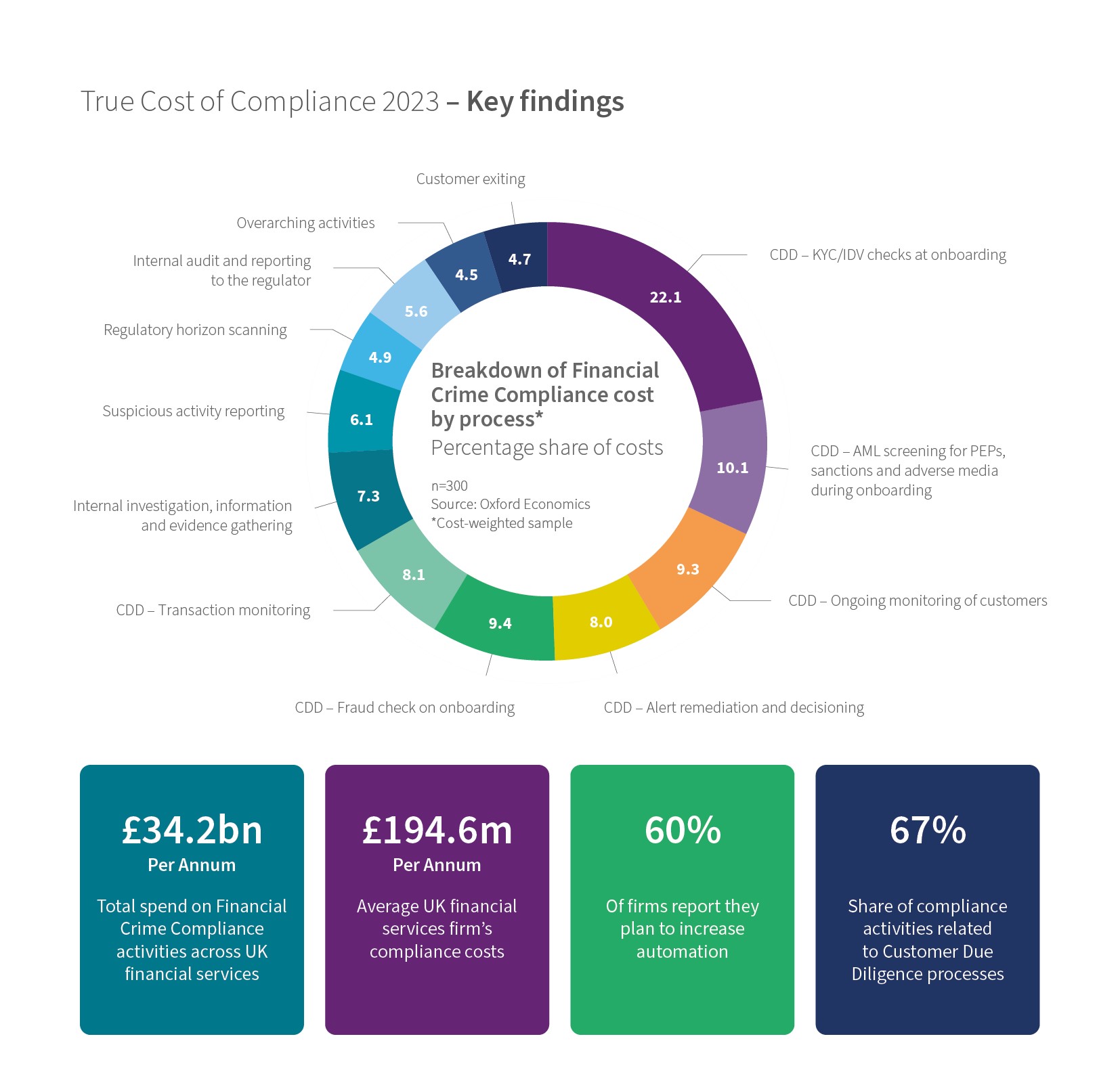
UK financial services organisations are collectively spending £34.2 billion each year on financial crime compliance (FCC), according to the latest True Cost of Compliance report from LexisNexis Risk Solutions. This figure represents an increase of 19% since 2020.
The eye-watering figure of £34.2 billion is the equivalent of almost three-quarters of the UK’s defence spend for 2021/22, meaning financial services organisations are spending nearly as much protecting themselves and their customers against the risks of fraud and financial crime, as the entire UK is against threats to its national security.
And with more than 900 UK firms generating annual revenues of over £5 million, this puts the mean annual cost of compliance for a UK financial services firm at £194.6 million. On average, a typical firm is spending more on financial crime compliance each year than a top Premier League football team spends bankrolling the annual salaries of their multimillionaire players.
On average, financial services firms are spending over half-a-million pounds (£533,150) every day on FCC, equivalent to around £22,200 per hour, or £370 a minute.
Increasing regulatory expectations remain the greatest external driver of compliance costs, though other factors, including an evolving criminal threat and the cost of doing business are also important.
The push for greater automation was highlighted as the biggest internal cost driver. Technology spend as a share of the total amount spent on FCC, increased from 25% in 2020 to 30% in 2022. Combined with technology-related employment and training costs, total technology spend now represents half of all FCC costs (50.9%).
Technology is being most readily utilised throughout Customer Due Diligence (CDD) activities, which continue to consume the largest portion of overall FCC budgets and represent 67% of all spend.
Steve Elliot, Managing Director at LexisNexis Risk Solutions for the UK and Ireland said: “CDD is a priority focus area for compliance because processes can benefit hugely from investment in technology and software. Automated ‘know your customer’ and identity authentication processes not only strengthen fraud and financial crime checks but can also improve overall customer experiences when integrated as part of a seamless onboarding process.”
Most firms expect FCC costs to increase over the next three years by an average of 8%, largely to meet demand for CDD activities including KYC/IDV and fraud checks at onboarding, and transaction monitoring.
Steve continued: “In one sense, the report makes for encouraging reading. It shows firms are investing hundreds of millions of pounds on transformative technology and training. However, this should be streamlining and improving processes to deliver efficiencies and productivity gains. The rising costs suggest financial services firms aren’t yet seeing these investments payoff.
“One reason for this could be that firms’ overall risk management strategies remain extremely fragmented. Day-to-day processes are siloed, feeding inefficiencies, or failing to make the most out of the capabilities offered by the technology, software, and data sources that organisations are investing in.”
LexisNexis Risk Solutions predicts that rising financial crime compliance spend, coupled with the increasing emphasis on combined fraud and AML screening operations, will accelerate a move towards fraud and financial crime risk orchestration.
Whilst risk orchestration is still in the early stages of adoption, more and more firms are realising the benefits of better connecting the systems and data sources used to combat fraudulent and criminal activities.
Steve concludes: “Risk orchestration brings together all the various elements of fighting fraud and financial crime. It’s a more harmonious approach that reduces efficiencies and duplication of processes and effort. Firms are realising it’s a strategy that can save time, expense, and resource, while improving overall performance. As FCC costs continue to rise to exponential levels, risk orchestration is looking increasingly like a next-generation solution.”
To download the full True Cost of Compliance report, visit https://risk.lexisnexis.co.uk/insights-resources/white-paper/true-costs-of-compliance.
- 02:00 am
Mia-FinTech, the technology provider for banks and financial institutions based on the Mia-Platform technology, announced that it has launched Payment Integration Hub (PIH), a new application that brings together all digital payment methods in a single console.
The B2B2C offering will allow all kinds of companies to integrate and handle different payment APIs in a single modular, ready-to-market solution where they can manage the entire digital payments lifecycle.
Businesses will be able to offer their customers the opportunity to choose their preferred payment method at the checkout for a better user experience, while a back office application will ensure that every single transaction is monitored in real time. The Payment Integration Hub complies with all security protocols in digital transactions, ensuring user privacy while maintaining a high level of governance.
Bruno Natoli, CEO of Mia-FinTech, said: "The total transaction value of digital payments in the UK is projected to surpass £360 billion in 2023, out of which e-commerce will account for over £240 billion. With a rapid increase in the use of all digital payment methods, there is a need for an associated ecosystem of services to evolve and keep pace with innovations in this space.
“The pandemic accelerated the appetite for digital payments and now consumer buying patterns and habits will drive new payment innovations, pushing industry players to reconsider and upgrade operating models. The PIH from Mia-FinTech is a composable and flexible solution that will unify all payments and provide true digital payment governance to companies, allowing them to better manage their business and respond quicker to evolving consumer preferences.”
The Payment Integration Hub supports more than 10 payment providers including, but not limited to: PayPal, Google Pay, Apple Pay, Satispay, Stripe and UniCredit. Additionally, it provides APIs to easily connect various physical and digital POS through a simple configuration, making it possible to integrate external ERP systems.
Businesses can engage with multiple payment providers at once and offer different features, such as total and partial reversals, Buy Now Pay Later, pay-outs and refunds, all while producing in-depth analytics and insights.
The PIH provides a customizable white-label, front-end interface so that it will be consistent with a company’s other digital assets. It can be integrated with any website or app and allows clients to apply custom logic for an adaptive checkout experience.
Through its backend management console, users will be able to manage permissions and directly perform special actions on transactions, such as invoice reversals or sending notifications of payments received, which are saved on a log to ensure transparency, compliance, and security.
The launch of PIH comes as Mia-FinTech celebrates its first anniversary since entering the fintech space in 2022. A vertical solution under Mia Platform, an end-to-end platform builder that allows businesses to build modern cloud-native applications, Mia-FinTech is focused on developing capabilities and solutions specifically for the financial market.
In its first year of operating, Mia-FinTech has successfully hired 20+ employees and expanded its business internationally operating from Mia-Platform’s new offices in London and Amsterdam, two of the biggest fintech hubs in Europe. It has also developed a portfolio of technology partners so that the platform marketplace can offer access to specialist tools ranging from encrypted documentation handling to embedded insurance, mobile banking and identity security services.
Bruno Natoli finished: “2022 has been an extremely successful first year! Significant growth in our customer acquisition numbers has laid the foundations for a great future ahead. We have created an impressive catalogue of services together with our partners, which will make digital transformation much more accessible for any financial services organisations looking to introduce cloud-native applications to give them a competitive edge.”
- 06:00 am
The government has announced the launch of a national hub for FinTech, named the Centre for Finance, Innovation and Technology (CFIT), to drive the growth of the sector on a global scale.
CFIT is supported by £5.5 million of Treasury and City of London Corporation funding and will boost growth and innovation, championing businesses and fostering job creation across the sector.
The hub, launched at an event in Leeds yesterday, also aims to promote the benefits of new and innovative technology that will widen consumer choice, cut costs and increase efficiencies.
The CFIT is the first of its kind and will help firms to achieve truly global scale, supporting around 2,500 organisations and tens of thousands of jobs in the UK, which takes second place for FinTech investment behind the US.
Howard Wimpory, KYC Transformation Director at Encompass Corporation, comments:
“It is encouraging to see the government provide this support to the FinTech industry and, widely, digital transformation, which creates opportunities for growth while also assisting economic recovery. The UK technology sector overall has huge potential, with innovation at a high, and support of this kind can help organisations to harness the solutions within it to their advantage.
“Widespread effort to help organisations truly unlock the potential of digital transformation is how strong, long-term value will be created throughout industries, and particularly financial services. These organisations must now recognise the importance of utilising the new and emerging solutions at their disposal, which not only add business value, but also help to protect the nation against the ever-evolving threat of financial crime.
"Realising these goals requires businesses to embark on or accelerate their digital transformation journeys, embracing state-of-the-art cloud-powered technology to overhaul manual processes and instead trust in automation, which brings long-lasting operational benefits to power success."
Charlotte Crosswell OBE, Chair of CFIT, said the launch “represents a significant moment for the UK’s FinTech sector and our economy more widely. This organisation will enable us to come together as a sector to start breaking down barriers that the FinTech sector is facing while creating a clear path for our homegrown FinTech companies to achieve global scale, impact and success.”
- 06:00 am
ImaliPay, a leading global fintech-as-a-service provider, has signed a major deal with 3rd Party e-commerce fulfilment solution Renda.
The partnership will support businesses across Africa by simplifying and streamlining the process of order fulfilment for Enterprise and Medium-sized businesses across Africa, starting with Nigeria. The two companies will provide key services to ambitious businesses, making it easier to reach their target audiences and for consumers to access the products and services they need.
Renda is a technology-driven 3rd Party fulfilment solution provider that enables enterprise and medium-sized e-commerce businesses to grow and scale across Africa. It enables e-commerce businesses to easily search and book a storage space, monitor real-time status of their inventory, push out high volumes of orders to be processed daily, track the delivery of their orders and also ensure real-time collection and reconciliation of cash on delivery. It proudly lists Omnibiz, Marketforce360 and Kyosk among its esteemed clientele.
ImaliPay is a fast-growing “Fintech-as-a-Service" start-up deploying API infrastructure to power embedded financial products and services that promote the operational efficiency of online businesses and drive revenue growth. It offers four main products; automated reconciliation, BNPL engine, payments and ledgers-as-a-service, along with additional value-added services. ImaliPay boasts a diverse clientele, including FleetSimplify, KeraPay, LipaLater, Propel, and many others across Africa.
This partnership aims to bring together the expertise and resources to create seamless and integrated solutions for E-commerce businesses in Africa. By combining ImaliPay’s secure and modular API “Fintech-as-a-Service” platform with Renda’s advanced order fulfilment network, businesses will be able to reach their target audiences and sell their products with ease and confidence.
Ope Onabaye, Founder & CEO at Renda, emphasized that having a supportive and knowledgeable Fintech partner is crucial when looking to expand into new markets, a common challenge many businesses face.
ImaliPay’s service aims to revolutionize payment processes by digitizing transactions and providing a consolidated view of payments through our platform. This will allow for the convenience of decashing, streamlining financial management and making transactions real-time.
Sanmi Akinmusire, Co-founder & COO at ImaliPay says, “Our goal is to drive growth, increase efficiency and bring innovation to the table through modular API technology, making this partnership timely for both startups.
With its focus on automation and customer service, the ImaliPay and Renda partnership is poised to drive the overall growth of e-commerce in Africa underwritten by logistics and distribution excellence powered by best-in-class financial tools that contribute to the development of Africa's economy."