Published

Marina Vassilopoulos
at My Mulah
Cryptocurrency has gained attention in recent years due to its associated risks in trading. see more
- 03:00 am

The UK must be cautious when introducing strict cryptocurrency regulation and consider the effects on the industry as a whole, says Lanistar
The UK cryptocurrency regulation saga continues, with UK Members of Parliament recently likening crypto investment to gambling. Cryptocurrency and digital currencies have been on the political radar for some time now, and regulation is likely on the horizon. In October 2022, the House of Commons approved the Financial Services and Markets Bill recognising cryptocurrencies as regulated financial instruments, but this has yet to pass through the House of Lords.
The FinTech industry has grown significantly in recent years and is estimated to reach $1.5 trillion in annual revenue by 2030, with crypto transactions set to account for a considerable portion of this growth. Cryptocurrencies provide significant value to FinTech’s helping unbanked people access alternative financial services. With traditional money transfers often plagued by inefficiencies and delays, cryptocurrencies move quicker than traditional currencies to reach those who need it, faster.
Given the flexible and autonomous nature of the cryptocurrency landscape, disproportionate regulation may hamper the industry, which has so far thrived through flexible fundraising models. This has enabled organisations to raise funds at faster rates, with retail investors benefiting by having access to a wider range of investment opportunities and inflation protection, meaning digital currency value is not affected by the UK’s recent inflation woes.
Jeremy Baber, CEO of Lanistar, said: “There is undoubtedly a need for regulation with regard to digital currencies, but the UK Government must consider the effects on the crypto industry overall. Overly harsh and unnecessary policy that is a result of a fundamental misunderstanding of crypto and its long-term technological benefits, will hamper innovation and could destroy this innovative and far-reaching system, and in turn could ultimately leave many people out of pocket. Regulations that aren’t thought out or are implemented without expert guidance would hamper the progress of legitimate projects and could be harmful. We support regulation but recommend it is considered with the consultation of experts in the field.”
While rigid rules are likely to harm the industry, Baber believes that regulation is needed and would benefit the UK to help identify any bad players that are manipulating cryptosystems.
Baber continued: “Although there have been claims that crypto is akin to gambling, the same could be said of the traditional stock market investments – consumers can lose all their investment there too. It’s no secret that the industry is sometimes the target of criminals, so targeted regulation that is measured and proportionate would create a safer environment for investors that wish to enter the crypto space. Focusing on pyramid schemes and anti-money laundering activities must be the priority. Now is the time to take a considerate approach to what the future of cryptocurrency looks like, to enable legitimate projects to flourish.”
Baber concluded: “The UK needs to be seen as the financial powerhouse and crypto is here to stay so we need to embrace it while protecting consumers. It is clear that there is a need for regulations across the crypto industry in the UK but likening the industry to gambling is incorrect and unfair. Nevertheless, when introducing planned regulations, the UK Government must consider the potentially damaging effects on the FinTech industry. Appropriate regulations are needed to crack down on any criminal activity in the space, but highly restrictive regulations could greatly affect momentum across FinTech innovation.”
- 01:00 am

New research commissioned by Snowflake, the Data Cloud company, has found that the worlds’ leading financial firms are increasing their urgency to move towards the cloud in order to strengthen cybersecurity (50.5%), fraud detection (38.6%) and claims management (33.8%). Recent high-profile cyber attacks and financial crime, matched by increased media and regulatory scrutiny, have spurred technology teams to make the right cloud investments to better protect data and maintain high levels of security and governance.
The research emphasises the importance for financial organisations to tackle threats and mitigate rising financial crime with increasing digitalisation of banking and payment systems. Dedicated investment in advanced cloud data analytics will result in increased innovation that enable real-time fraud and anomaly detection, improve customer experiences and quicker response times to sophisticated criminals that possess knowledge of banking processes, controls, and vulnerabilities.
“Ultimately, organisations are looking to achieve improved customer and commercial outcomes with speed to market, all with the highest levels of data security and governance”, said Rinesh Patel, Global Head of Financial Services, Snowflake. “With demands for data higher than ever, the opportunity cost is rising for firms that stick with legacy technologies. Firms will need to leverage the value of cloud technology to tackle increasing financial crime, improve the propensity for data insight, and support the data-rich needs of today’s customers. Be it quant researchers seeking to analyse more data to backtest strategies, banks striving to create a new suite of sustainable finance solutions, or underwriters seeking to price risk more accurately — they all need to power their workloads on the cloud with flexibility, scale, and performance to deliver business outcomes.”
Snowflake’s Financial Services Cloud Pulse Survey asked global C-Suite leaders and senior-level technology executives from leading financial firms across banking, asset management, and insurance on their cloud data competency, analysing everything from industry challenges and decision complexity to enterprise strategy and business impact. While almost half of respondents (48.7%) believe they will deliver on their future data cloud strategy in two-to-five years, many financial firms already have business use cases in place or within the next 12 months, suggesting business urgency.
On this cloud journey, the report also found that 37% of financial firms are choosing to adopt a multi-cloud strategy in comparison to hybrid (34%), single (14%), or private cloud (14%). Their decision was based on three key benefits, including: access to the best individual solution providers (67%), flexibility to negotiate on costs (44%), and access to modular flexibility (36%) in a data platform capability. Multi-cloud is seen as part of a broader push towards increasing infrastructure reliability, cost efficiency, interoperability, and ensuring regulatory compliance.
Additional findings from the report, include:
● Many financial firms are adopting modern cloud data platforms to benefit from enhanced data science capabilities (34%), as organisations opt for better data outcomes, automation, and a competitive edge. This is supporting organisations’ drive for new product developments and applications.
● The ability to share or collaborate with users (34%) and use cloud-enabled data marketplaces (12%) were also listed as benefits in enabling organisations to take advantage of a cloud environment that provides users with query-ready data access. Users can enhance internal data with external data to enrich data analysis and insight.
● Organisations are spending up to 40% of their time on data management alone. This is resulting in many financial firms investing efforts away from business innovation and decision making, and increasing costs and time on cloud data management.
● While most organisations (66.9%) mention that their technology teams are primarily responsible for cloud investments, the research indicates that other parties are becoming more influential in the decision-making process, including from the line of business (15.4%), and the centralised data office (16.1%).
Methodology
Snowflake commissioned a survey from December 2022 –-January 2023, conducted by Focal House. A total of 311 participants responded to the survey from the banking, insurance, and asset management industries across EMEA, the U.S., and APAC. More than 35% of the respondents held C-level positions, while the remaining respondents held senior technology, data, and product roles. The survey was conducted using an online questionnaire, consisting of multiple-choice questions. The data collected from the survey was analysed by data and marketing analysts at Snowflake and presented in this report.
Access the full report here.
- 07:00 am

- Pass audits (UNECE WP.29)
- Protect against counterfeit parts and liability claims from clients. The supply chain is more secure and transparent
- Secure products against software tampering by eliminating unwanted changes in the vehicle that could e.g. lead to safety incidents
- Integrate a reliable standard solution that can serve multiple use cases
- Ensure efficient data transfer between plants (KOSTAL’s & OEM’s) to meet production line requirement, which in turn have a direct impact on product cost
Priyank Kumar, Senior Director Automotive & Manufacturing at Utimaco, said: “Creating trust is our mission, and we are proud that our cyber security solutions are contributing to security and increase levels of trust in the automotive space. Device attestation, Secure Boot, Software Signing, and Secure In-vehicle communication are must haves to meet the standard in the automotive industry. Security at the highest level is our core field of expertise, and with a partner like KOSTAL we can provide a market leading solution tailored to Car OEMs needs.”
Dominik Preikschat, Cybersecurity Architect at KOSTAL Automobil Elektrik , added: “At KOSTAL, we are committed to providing our customers with the highest level of security for their vehicles. As one of the top 100 automotive suppliers in the world, we understand that cybersecurity is a critical component in protecting cars of today and tomorrow from cyber threats. That's why we take a proactive approach to cybersecurity, using comprehensive security measures and partnering with trusted experts like Utimaco to ensure the necessary protection for our products and customers. By implementing rigorous security protocols, we are able to meet the highest standards of cybersecurity and maintain the trust of our valued customers.”
- 05:00 am

Lumon Pay, the fast-growing overseas payments and currency exchange platform has announced Vic Darvey as its new Chief Executive Officer [subject to regulatory approval].
Vic joins Lumon following a successful career at a number of leading technology-focused, disruptive brands, bringing with him a wealth of industry experience and knowledge.
He most recently held senior roles at Purplebricks and MoneySuperMarket.com, while his early career included positions at CMC Markets and lastminute.com.
Today’s announcement follows the appointment of Nick Haslehurst as Non-Executive Director and Chair of Risk and Compliance Committee in January and Lumon’s new Chairman, Ian McCaig, who took on the role at the end of 2022.
These new appointments come as the company continues to deliver further growth and re-focus its strategic plan.
Commenting on his appointment as CEO, Vic said: "I am hugely excited to be joining the Lumon team. The business has demonstrated real potential to be a valuable, disruptive force in the FX market. I am looking forward to leading the business and ensuring we deliver a positive impact for our customers and a fulfilling experience for all our 'Lumoneers'."
Ian McCaig, Chairman of Lumon, said: “We are delighted to welcome Vic to the Lumon family at an exciting stage of our journey. Vic brings extensive experience in leading some of the UK’s best-known brands and is eminently well-suited to lead Lumon through its next phase of continued growth and the development of our proposition for our customers and partners."
Lumon specialises in overseas payments for both private and business customers. In 2021, they made over 112,500 payments totalling over £3.3 billion. Lumon currently employs over 150 staff with offices in the UK, Ireland, Spain and Portugal.
- 09:00 am
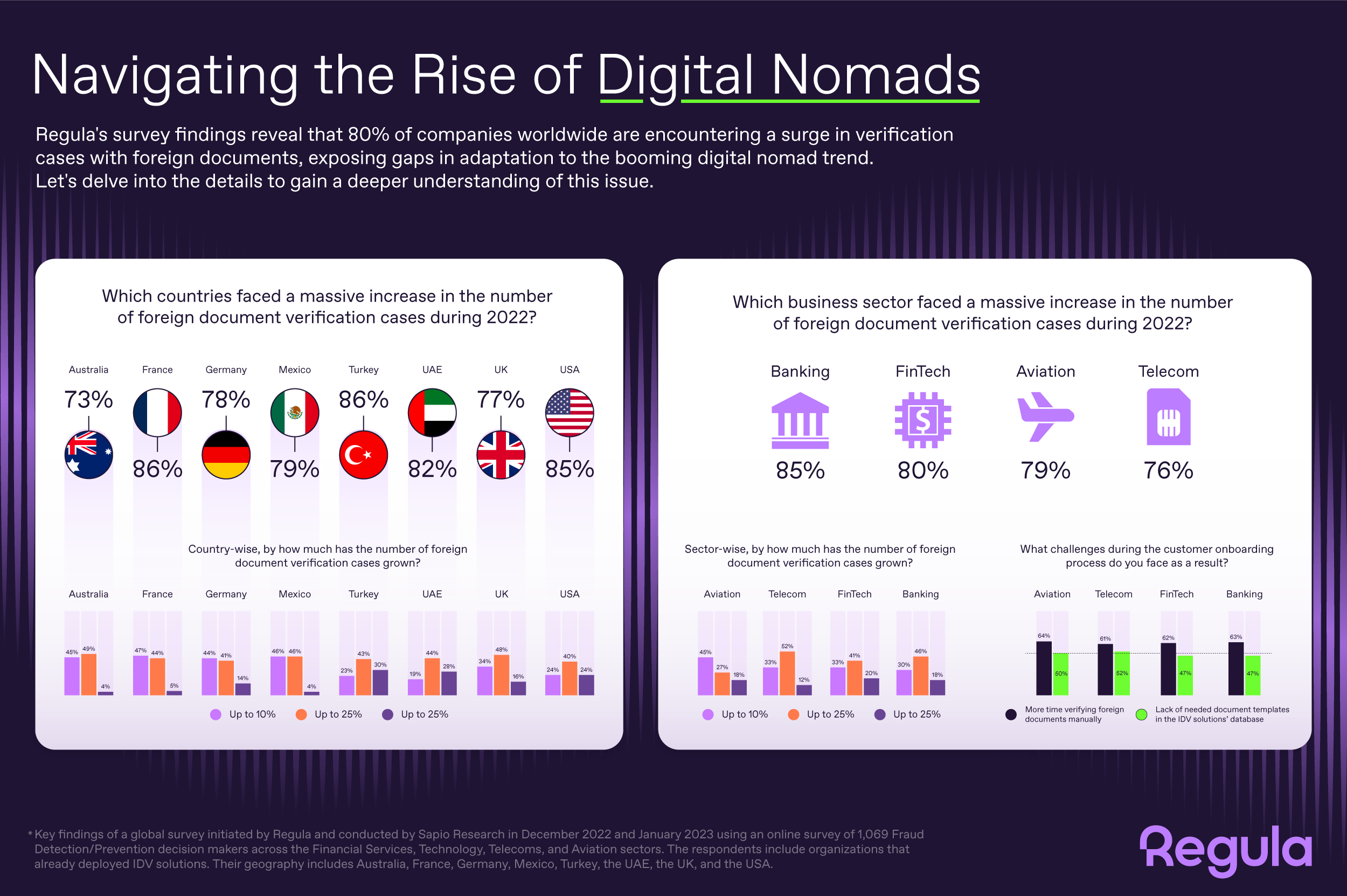
The global COVID-19 pandemic has accelerated the trend of working remotely, which also inspired people worldwide to search for new destinations to work and travel. Being citizens of a wide range of countries, worker travellers become customers of financial institutions at their current locations. This means banks, FinTech businesses, crypto brokers, and insurance companies have to be able to meet the needs of the booming digital nomad community while also maintaining robust fraud prevention measures.
The survey conducted by Regula shed light on the readiness of Banking and FinTech businesses to address new challenges. It appears that Financial Services companies are grappling with a surge in foreign document verification cases, with 80% of them reporting an increase, particularly in countries like France (86%), Turkey (86%), and the USA (85%)—the country most visited by digital nomads as of March 2023. Alarmingly, almost half of these organizations (44%) are facing a staggering 25% rise in volume over the last year. Furthermore, 62% of these businesses have been forced to verify foreign documents manually, which is a time-consuming process.
With 38% and 31% of respondents from FinTech and Banking, respectively, citing accuracy as the most important consideration in choosing identity verification solutions, the increased number of manual checks should be a red flag for the industry.
Business representatives also note the problem of incomplete databases of document templates. As a reference, 48% of companies say they face challenges during the customer onboarding process because they don’t have all the needed document templates at hand.
“The expansion of the global migration and digital nomad community, in particular, has highlighted the need for businesses to work with extended databases with a wide range of document templates, including rare specimens. Failure to do so may increase the risk of fraud since the lack of templates may lead to less accurate and thorough document verification checks. That is why we consistently update our database, which has now reached over 12,000 document templates from 247 countries and territories, to boost the capabilities of Regula Document Reader SDK. Since Regula experts have extensive knowledge of what security elements should look like, based on present documents, all possible IDs can be easily verified, and even the most sophisticated fraud can be promptly detected with our products,” says Henry Patishman, Executive Vice President of Identity Verification Solutions at Regula.
With the current growth of digital nomads, implementing the right identity verification solution can have a significant impact on productivity and efficiency. To respond to new challenges, financial institutions should take into account the following criteria while choosing the most suitable tool(s):
The size and diversity of the document template database provided by the solution: A tool which features a database with detailed information on all present documents issued in different countries, their security parameters, and verification methods, can perform fast and comprehensive ID checks.
The availability of liveness checks in the document verification flow: The solution must encompass both document verification and biometric verification to provide strong protection against fraud, verifying both the document and the liveness of the individual. While document liveness confirms the presence of dynamic security elements (such as holograms) in the submitted document, and ensures that the passport or ID presented remotely is real, biometric liveness detects if a live person is applying, not a spoof or a fake.
Face comparison and matching of a selfie to the photo in an ID document: To mitigate identity fraud online, the solution should compare an image of the user’s identity document and the portrait from the identity document, e.g., from the chip or MRZ.
Read the full report, which analyzes the state of identity verification in 2023, here.
- 08:00 am

Fintech industry leaders warned of the risks posed by AI and ChatGPT last night as well as discussing the role automation and digital skills will play in driving economic growth.
Speaking at the Parliament Street think tank’s Digital Economy summit on Monday night, which was hosted by Dean Russell MP for Watford and chaired by Steven George-Hilley of Centropy PR, a panel of fintech experts debated the ethics of machine-learning and the UK’s skills crisis.
“Small businesses are the economy’s backbone - better support and collaboration is needed between government, academia and organisations alike to meet the growing digital economy’s needs,” said Steven Mooney, Founder and CEO, FundMyPitch.
Khalid Talukder, Co-Founder of fintech firm DKK Partners said, "Blockchain will advance significantly off the back of digital currencies from economies. It's only a matter of time before digital currency becomes more common in the UK."
Meanwhile said Fraser Stewart, co-founder of fintech platform Lyfeguard said, "Half of us in the UK struggle to manage important personal information. Empowering people to gain insights and life management capabilities to streamline their life is a core aspect of the digital economy."
Dean Russell MP for Watford who hosted the debate said, "We live in a world where international collaboration is so important. There's great scope to see how far we can take technology to see how it can work for the global economy."
- 09:00 am
Ozone API and Smart Data Foundry have today announced a partnership and the launch of two new products - the Standards Library and Innovation Atlas - which are designed to support and accelerate financial innovation in Open Banking.
The Standards Library helps financial institutions and innovators understand the global landscape, making it quick and easy to assess the technical standards adopted by a geography or financial system.
With ever-increasing complexity in the global open finance standards landscape, this tool is a must to help banks, fintechs and regulators understand and compare the different standards around the world and accelerate innovation. Globally, there are now more than 20 different open finance standards.
Open finance initiatives are gaining momentum around the world and the Innovation Atlas provides an overview of what is happening where. The levels of financial inclusion, telecommunication challenges and banking and data privacy regulations are all documented and explored in an easy-to-navigate map within the Innovation Atlas.
Ongoing additions and updates will be added to the Standards Library and Innovation Atlas on a quarterly basis, ensuring it is constantly updated to reflect the changing global landscape.
Smart Data Foundry and Ozone API have a shared and aligned purpose to inspire financial innovation. The opportunity has never been greater to embrace Open Banking, Open Finance and ultimately Open Data to safely unlock the power of financial data on a global stage.
The combination of Ozone API’s sandbox with Smart Data Foundry’s aizle synthetic data engine creates the ideal innovation environment for regulators, financial institutions and Fintechs to test new ideas, build prototypes and rapidly bring new products to market. Synthetic data is information that is generated artificially which contains the important and meaningful features of real-world data. Critically, aizle does this without requiring any real-world input data to generate its synthetic data sets, removing privacy and other data risks, making it an ideal building block for innovation.
Commenting on the launch, Bryn Coulthard, Chief Product and Technology Officer at Smart Data Foundry said “We are delighted to partner with Ozone API to bring these two products to market, allowing for the acceleration of innovation in Open Banking, Open Finance and Open Data across the globe. Our strength in synthetic data, coupled with Ozone API’s sandbox creates the ideal environment for innovation.”
Huw Davies, Co-founder & Chief Commercial Officer at Ozone API, added “Today’s launch of the Standards Library and Innovation Atlas could not come at a better time as we see ever-increasing complexity in the global standards landscape. We know, as we’re at the sharp end of helping banks and regulators around the world to deliver standards-based open APIs. We’re delighted to partner with Smart Data Foundry to deliver these valuable tools to the market in order to help accelerate innovation.”
- 01:00 am

Monese, a leading pan-European fintech that offers smart money services to millions of consumers across Europe, announces the launch of XYB, an end-to-end ‘coreless’ banking platform provider, enabling banks and non-banks to break down the barriers to building and providing financial services in record time. XYB is aimed at addressing a market gap in the core banking space of high dependence on costly yet incomplete traditional core banking systems. The global market potential for this space is estimated to be around £700 billion. Available initially in the United Kingdom and Europe XYB is also set to launch its platform in the North American and Asia Pacific markets.
Servicing millions of customers across Europe and UK, and backed by investors like PayPal Ventures, HSBC, Kinnevik, Investec, Augmentum, and others, Monese has utilised its modern retail banking experience and the early success of its modular BaaS technology platform to create XYB which promises to enable the new generation of financial services to all.
XYB’s ‘coreless’ banking platform unlocks endless possibilities for banks and non-banks with highly configurable and scalable microservices architecture, partnering with the best in the industry to offer 172 possible services, and eight foundational engines. This eliminates the dependency on a traditional core banking system.
The ‘coreless’ banking platform fills a gap in the market by enabling banks and non-banks to make new financial services solutions accessible in record time. This is achieved by removing dependencies on legacy technology and processes, leveraging highly configurable and scalable microservices architecture, and providing a turnkey solution with a pre-integrated partner ecosystem.
Investec was the inaugural customer to leverage XYB's cutting-edge coreless banking platform, which in under twelve months facilitated the swift and efficient development of a new current account offering for their business clients. This successful implementation highlights the efficiency and effectiveness of XYB in enabling businesses to bring to market new financial products and services quickly and easily.
Atul Choudrie, previously Managing Director of Monese’s BaaS business, is appointed the CEO of the newly formed XYB to lead the growth of the ‘coreless’ banking platform. Atul is a seasoned fintech executive with a deep knowledge of payments, fintech and digital transformation across banking services.
Commenting on the launch, Norris Koppel, Monese Founder and Group CEO, said: "XYB is testament to our commitment to breaking down the barriers in banking using best-in-class technology. XYB enables banks and non-banks to launch modern money services quickly and cost efficiently, helping millions more people access financial services across the world and empower businesses to grow.
“With his experience spearheading Monese's BaaS platform business, Atul Choudrie's appointment as CEO at XYB is a natural fit for our vision of enabling the new generation of financial services.”
Atul Choudrie, CEO, XYB said: "I am thrilled to introduce XYB's coreless banking ecosystem to the market, a true game-changer in the industry. By building a vibrant ecosystem of partners, XYB empowers financial institutions to unlock new opportunities, deliver tailored financial services that meet diverse customer needs, revolutionising the way financial services are delivered. With comprehensive managed services and a focus on collaboration, XYB promotes innovation, agility, and exceptional customer experiences, shaping the future of banking for all players, traditional and non-traditional alike."
Chris Skinner, an independent commentator on financial markets and fintech, said: “For almost fifteen years we have been talking about the development of Banking-as-a-Service, the Platform Economy and Ecosystems. The concepts are robust in financial services, but the challenge is how to curate this system. With thousands of companies creating financial innovation, how can you leverage and utilise them? What Monese with XYB has achieved is the curation of that system as a pre-emptive offer to turbo-charge banks into this environment. It’s very innovative and admirable, and fits into my views of the curated economy, where firms work together to improve the processes and deliver the best customer experience.”
Lyndon Subroyen, Global Head of Digital & Technology at Investec said: “Our work with the Monese BaaS platform, now part of XYB’s product portfolio, enabled our organisation to complete a current account offering from scratch for business customers within record time, taking less than twelve months from brief to execution. We have ambitious growth plans and look forward to continuing our work with XYB as we continue to respond to the needs of our customers.”
Tim Levene, CEO at Augmentum said: “As a long-standing investor in Monese, we are pleased to support XYB in their mission to transform the banking landscape. With their pioneering technology and extensive experience, XYB is poised to revolutionise the industry and redefine how people engage with financial services. We look forward to seeing the transformative impact we are confident they will have across the banking sector.”
- 08:00 am
Paynetics has agreed to acquire Phyre, one of Europe’s leading digital payments application (app) providers. The acquisition will enable Paynetics’ B2B clients to distribute financial products directly to their end-customer with a branded solution and total app control and ownership.
Phyre was founded in 2015 and has evolved into a leading provider of white-label digital financial apps. The platform enables businesses to launch their own branded payment app in just eight weeks, significantly reducing the time, cost and effort of building and maintaining such projects, allowing both fintechs and established businesses to quickly and economically take products to market.
The app enables businesses to deliver feature-rich mobile apps with a complete set of pre-integrated payment services. The platform boasts 300,000+ users registered across multiple industries, including telecoms, creators industry, human resources and marketing. On top of this, Phyre is a trailblazer in deploying plug-and-play Software Development Kits (SDKs), allowing app developers to include ApplePay™ and GooglePay™ seamlessly into their end-user experience.
The acquisition comes when the world is in a different payment era. Apps are replacing the physical card, and with rising costs, economic uncertainty, and inflation, business owners need a cost-efficient way to expand and grow. Phyre offers the utility, capability, security and sustainability a business requires to take the edge over competitors and meet the payment needs of the modern customer.
Executive Chairman at Paynetics, Ivo Gueorguiev said: “The acquisition of Phyre compliments Paynetics' existing embedded finance proposition by adding a full range of front-end capabilities, including fully functioning white-label apps and discrete components for our partners to create a wide range of banking and payments apps. Paynetics is committed to providing a complete range of embedded finance components and services via multiple channels to create robust, innovative and scalable financial products that can be delivered quickly while meeting all the requirements of the highly regulated financial market.”
CEO at Phyre, Konstantin Djelebov said: “From our inception, we have had a close working relationship with Paynetics and have jointly created some of the leading digital banking and payments products in Europe. Joining the Paynetics team was the next logical step in developing our business. Together, we can provide the full solution to our partners so that they can quickly develop world-class customer propositions in the digital payments arena. I am excited to join the executive management team within Paynetics and look forward to helping develop the leading European embedded finance organisation.”