Published
- 03:00 am

ClearBank, the enabler of real-time clearing and embedded banking for financial institutions, today announced its partnership with Allica Bank, the fintech challenger bank dedicated to supporting established UK small and medium businesses.
Allica Bank was founded to serve established UK SMEs (businesses with 10-250 employees) and provide them with tailored, human support, backed up with the latest banking technology—which established SMEs struggle to get from the big banks. It offers business current accounts and tailored lending products, powered by market-leading lending technology, such as an automated, instant decision-in-principle for business mortgages. It aims to be the go-to bank for established businesses within the next decade, and following significant growth in 2022—including 534% revenue growth, reaching £1.35 billion in lending, and a 76% increase in staff—it is well positioned to meet this ambition.
ClearBank is a key enabler for Allica’s ambitious growth. ClearBank provides Allica Bank with client money accounts and access to UK payment schemes, including Faster Payments (FPS), CHAPS and Bacs, powered by its API-first, cloud-native technology.
Allica launched its business current account to established businesses late last year, offering cashback rewards, no monthly fees and relationship manager support, along with a market-leading 3% AER integrated instant-access Savings Pot. It can also offer quick and secure transactions using FPS, Bacs and CHAPS. Allica believed it crucial to work with a provider that was closely aligned with its values and growth objectives to help it scale at pace.
ClearBank works with 15 of the UK’s newest banks—rather than competing with its own clients, it is a stable and profitable “bank for banks”.
Keith Middlemass, Chief Operating Officer, Allica Bank, said: “By offering a relationship-backed service, powered by modern technology, Allica is building the future of banking for established businesses. It is vital that we work with industry-leading partners that can grow with us as we scale. ClearBank is a leader in its field and is an obvious partner for us—we are on the same path both in growth trajectory, and in our values.”
Charles McManus, Chief Executive Officer, ClearBank, said: “With its focus on SMEs, Allica Bank is supporting the backbone of our economy—and we’re committed to helping them boost business banking in the UK. We're providing the speed, flexibility, and security Allica Bank needs to provide the very best services to UK SMEs.”
The two banks have been working together since July 2021. During that time both have announced that they have achieved profitability—with Allica being one of the fastest UK fintechs to ever achieve profitability—against the backdrop of a wider downturn in the fintech sector.
- 04:00 am

Money20/20, the world’s leading fintech show, regarded as the place where money does business, celebrates five years of RiseUp, a global programme for promoting diversity and empowering women in the financial services and fintech sector at its flagship European show at RAI Amsterdam.
To celebrate the milestone, Money20/20's President Tracey Davies joined the RiseUp alumni on the Fusion Stage at Money20/20 in Amsterdam to discuss the accomplishments, challenges, and lessons learned in establishing a successful and supportive female-focused program, highlighting its impact on the broader business world. The four incredible women sharing the stage from the RiseUp alumni were Annie Guo, Founder of Silkpay, Liliana Carmona, VP Technology Operations at J.P. Morgan, Sharon Chen, Emerging Tech Ecosystem Lead at EY, and Divine Muragijimana, Vice President, Brand and Product Marketing at Cellulant.
Since its launch five years ago, the initiative has successfully facilitated the participation of over close to 300 women from around the world in its global program. Notably, over 60% of participants have been women of colour, highlighting RiseUp's dedication to fostering inclusivity and creating opportunities for underrepresented groups.
Key highlights included:
- More than 70% of participants have received a promotion or moved into a more senior role since RiseUp
- 85% felt more prepared for promotion after RiseUp
- 95% felt the RiseUp network helped progress their career/opened new opportunities
- 99% would recommend the programme to their peers
RiseUp was initiated in 2018 with the aim of supporting the increase of women in senior roles in the financial services and fintech industries globally. It continues to provide women with the network, tools, and techniques necessary to advance in their careers.
In line with the Rise Up programme, Money20/20 has transformed the speaker composition of its stages to reflect the diverse voices that exist in this industry but didn't always get a public platform. In 2017, less than 15% of speakers were women and today each show has a minimum of 45% and 30% people of colour.
“We are thrilled to celebrate the remarkable journey of RiseUp as we celebrate five years of championing women in the financial services and fintech industries. RiseUp goes beyond mere dialogue on gender imbalance, offering tangible solutions and empowering individuals to take real-world action” said Tracey Davies, President of Money20/20. “None of this would be possible without the unwavering support of our incredible network of industry professionals, mentors, and ambassadors who have generously shared their expertise and supported our cause and we are grateful for their commitment to fostering a more inclusive and equitable future.”
The RiseUp initiative has found a home at both the Money20/20 events in Amsterdam and Las Vegas and will also be introduced at Money20/20 Asia in Bangkok in 2024. Through a combination of mentorship programs, professional development initiatives, and networking opportunities, RiseUp has empowered women to break through barriers and excel in their respective fields.
- 06:00 am

American Express today announces a new partnership with Request to Pay-focused fintech startup, Bluechain to help streamline the supplier payment process for small and medium-sized enterprises (SMEs).
Invoice management can be resource intensive for small business owners, especially when using multiple different systems. The partnership solves that problem by allowing small business owners to centrally manage, pay and reconcile supplier invoices, from a single dashboard, whether on desktop or mobile device.
The integration saves SME owners valuable time and resources spent on manual admin with a simple billing and payment process that streamlines operations and automates time-consuming tasks like data entry and bookkeeping. It also enables better visibility and control over cash flow as SMEs can choose to pay how, where and when they want.
Existing American Express business customers can pay an invoice with their Amex Card, regardless of whether the requesting merchant accepts American Express or not. Business owners can also seamlessly connect their accounting system to Bluechain's platform for real-time tracking and reconciliation, streamlining bill management from start to finish.
Carolina Castillo, Vice President, Commercial Partnerships & Innovation, International Card Services at American Express, said: “Our recent research1 reveals over half (56%) of SME leaders feel they would benefit from more time away from the workplace. However, their many responsibilities, from managing invoices to dealing with suppliers, often prevent them from doing so. Our partnership with Bluechain is another example of how we support SMEs and gives them greater choice when it comes to paying and reconciling invoices, giving them back valuable time so they can continue to build business success.”
Tim Annis, CEO at Bluechain, said: “American Express’ commitment to supporting small businesses and its global perspective makes them an ideal partner for Bluechain. With our successful launches in Australia and the UK, this partnership presents a major step for Bluechain to support a global audience. Combining the reach of American Express with the technology of Bluechain is a fantastic opportunity to deliver tangible benefits for SMEs that go beyond payments and into process efficiency. Together we will deliver a billing and payment process that lets UK SMEs focus on growth.”
- 09:00 am

Fresh research looking into the barriers to changing accounting software has revealed that over a quarter of UK finance decision-makers (27%) would be unlikely to change their accounting software provider even if they could achieve ROI in less than 12 months.
The sizable survey, commissioned by award-winning accounting software provider iplicit, sought the opinion of 1,000 UK-based finance decision-makers working in organisations that employ between 50 and 500 employees.
It investigated how finance decision makers plan, manage, and deliver the finance function in their business, specifically looking at the perceived barriers to changing accounting software, their experience of changing accounting systems, current processes and future priorities.
The report has highlighted that legacy accounting software that many businesses are tied into, even when migrated to the cloud, fails to provide the flexibility required by today’s businesses.
Even more galling for mid-sized companies is that many smaller businesses, that can get away with using an entry-level solution, can enjoy the benefits of true cloud software, albeit without the full set of features they need as they grow.
Paul Sparkes, Commercial Director at iplicit says, “Running a modern finance function involves much more than ensuring smooth month-end processes. Finance decision-makers need to carefully weigh up the pros of changing to a true cloud accounting software, vs the cons of sticking with an incumbent – which may lead to a realisation that there is actually nothing to fear about changing providers.”
From the ability to upload expenses to drilling down through reports to gain access to specific information, extending the accounting solution outside finance is a fundamental step to improve insight, control and timely decision-making, all the while reducing the burden on the core finance team.
Encouragingly, however, two-thirds of UK finance decision-makers (66%) would be willing to switch accounting software providers in 2023 if they can achieve a return on investment in under 12 months.
Sparkes continues, “Whilst in part these results offer reassurance that there is an appetite from UK finance decision-makers to take proactive steps and secure the best accounting software, it also highlights a fear about what changing accounting software providers actually involves.
This makes me question just how many organisations have been tied into lengthy contracts that will take years to see any return on investment!"
Earlier results released from the research revealed the top three reasons why UK finance decision-makers are hesitant to change accounting systems are losing historical data (14%), the cost of having to pay for a Right To Use (RTU) licence in order to access historical data (12%) and being too expensive (11%).
“The onus is very much with accounting software providers to illustrate exactly how their technology will improve operations, generate savings and support staff and customers alike – while positively impacting the bottom line,” concludes Sparkes.
You can view the full results of the independent market research in the report titled: ‘A study into how to overcome the barriers of moving to a true cloud accounting system’.
- 03:00 am

Finastra today announced a collaboration with S&P Global Market Intelligence focused on the corporate and syndicated lending market. The companies have agreed to collaborate and integrate their solutions for corporate and syndicated lending, with the aim of delivering significant benefits to common clients.
The collaboration aims to help reduce risk, improve automation, and fast-track transaction processing for clients that use Finastra and S&P Global Market Intelligence’s solutions by removing the manual re-keying element of transactions throughout the lending and trade lifecycles. Users will experience pre-built, seamless integration and the ability to digitally transfer data between the solutions.
“The collaboration between Finastra and S&P Global Market Intelligence brings clear synergies given our complementary solutions, highly overlapping sellside customer base, and extensive reach by S&P Global Market Intelligence into the buyside and their service providers. Together we can bring both sides of the corporate and syndicated lending market together for the mutual benefit of all parties,” said Robert Downs, Global Head of Corporate and Syndicated Lending, Finastra. “We’re addressing a gap in the ecosystem by facilitating end-to-end interoperability and greatly simplifying the loan lifecycle for common clients.”
The parties intend to use their combined capabilities to transform data flows across the board, such as real-time updates for positions, trades, secure wire details, and other areas of the loan lifecycle that can still result in transaction data otherwise being transmitted via fax or email.
“Our work with Finastra and the planned integration of their sellside capabilities with ClearPar and our extensive data, software and workflow applications aims to transform operations for our common clients and bring the loans community forward,” said Patricia Tessier, Head of Loan Platforms, S&P Global Market Intelligence. “When combined with S&P Global Market Intelligence’s extensive KYC, onboarding, tax, and trade closing managed services, this creates a unique set of solutions for the global lending market.”
- 03:00 am

Carbon footprint management fintech, Cogo is proud to be ‘walking the walk’ when it comes to taking climate action by creating a sustainable stand at this year’s Money20/20 banking conference in Amsterdam.
The stand, which takes cues from nature, and is inspired by urban garden architecture, is far from the usual exhibition stand. Its peaceful design aims to offer visitors a moment to pause and reflect on the importance of taking climate action. This is a priority for Cogo, given its work with banks to help customers measure, understand and reduce their carbon footprint.
Visitors to the stand will hear a soundscape of Aotearoa, New Zealand native birds at risk of extinction - an ode to the origins of Cogo, one of the most biodiverse ecosystems left on Earth.
Ian Baksh, Cogo Head of Marketing: “While industry events such as this provide an excellent platform for Cogo to inspire positive change they can also contribute significantly to carbon emissions. Our objective was to minimise our carbon footprint and raise the bar in sustainable stand design.”
When designing for sustainability and circularity, there are functional limitations to consider. While creating aesthetically pleasing designs is easy, creating ones that meet sustainability criteria is more complex.
Kevin Kremer, Cogo Senior Brand Designer, EMEA: “ Throughout the design process, we constantly balanced creativity with environmental impact, often iterating our designs, changing course and starting from scratch.
“We carefully considered the lifecycle of each element and made sure we only used locally sourced, recycled, reclaimed, rented, or reused materials.”
Parts of the stand have previously been exhibited at Milan and Dutch Design Week as part of the No Space for Waste exhibition. After the Money2020 event, all components will be reintegrated into the supply chain, leaving no waste behind.
The key sustainable production elements of the stand include:
Walls which are crafted from waste offcuts from the CNC production of modular wooden holiday cabins. After the event, the panels will become office furniture in a design studio in Amsterdam.
Lamps featuring concrete cylinders collected as construction waste during the renovation of the iconic brutalist Dutch Central Bank, designed and produced by S-44 Amsterdam. The lamps are rented from the designer and will be returned after the event.
Table tops made from 100% recycled plastic from various waste sources like refrigerators, cutlery, and electronics. The pieces will be offered on an Amsterdam-based marketplace for leftover materials after the event.
Recycled felts, produced by i-DID, are made from waste textiles, including old uniforms and consumer clothing, by people who are being coached to re-enter the workforce. The cushions are rented from the Wikkelhouse Store and will be returned for reuse.
Plants and trees, provided by Ten Kate Flowers & Decorations, have been nurtured and brought to the event location by a dedicated florist and event decorator, ensuring their wellbeing and sustainability. The plants are being rented and will be returned after Money20/20.
Cogo collaborated on the project with Space&Matter, an Amsterdam-based design studio specialising in sustainable architecture and circular area development, and their trusted partners at Fiction Factory provided guidance and insights into sustainable design practices and materials.
Baksh adds: “Our project is a testament to the potential of collaboration and shows that sustainable solutions are achievable. We hope our work inspires others to consider more sustainable event marketing options in future.”
Cogo’s stand design can be seen at Money2020 Amsterdam, stand C140. Alternatively, follow Cogo on LinkedIn to see footage of the stand being built.
- 08:00 am
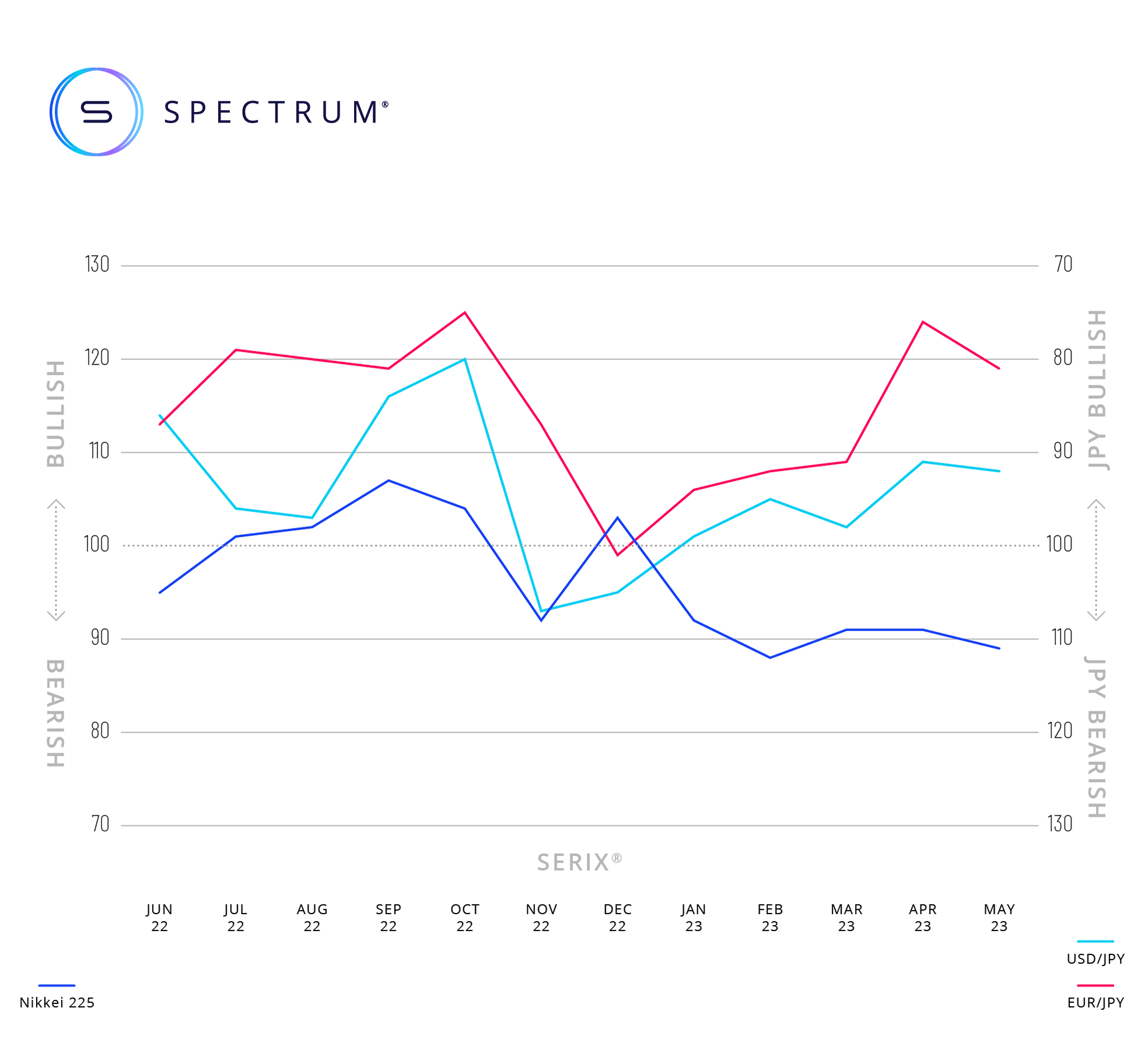
Spectrum Markets (“Spectrum”), the pan-European trading venue for securitised derivatives, has published its SERIX sentiment data for European retail investors for May, revealing strong positive interest towards the Japanese Yen against the Euro and US Dollar. Meanwhile retail investors’ sentiment was bearish towards the Nikkei 225.
The SERIX value indicates retail investor sentiment, with a number above 100 marking bullish sentiment, and a number below 100 indicating bearish sentiment. (See below for more information on the methodology).
For products linked to EUR/JPY the SERIX recorded a bearish level of only 81 points last month, suggesting investors expected the Yen to outperform the Euro. Similarly, USD/JPY SERIX reached a low 92 points, as retail investors digested the positive economic updates coming out of Japan.
Interestingly, the SERIX sentiment index for the Nikkei 225 index reached a bearish 89 points, suggesting that retail investors may not have as much confidence in Japanese equities as they do in its currency.
"One possible reason for this gap could be the announcement made by the Bank of Japan at the end of April stating its intention to maintain ultra-low interest rates to provide support for the export-oriented Japanese economy”, explains Michael Hall, Head of Distribution at Spectrum Markets.
“With stock prices going up due to central bank policies and the Yen remaining artificially down, this could lead to the perception that stocks are overvalued - and the Yen is undervalued, which is reflected in the SERIX sentiment we saw last month”, Hall adds.
In May 2023, 115.2 million securitised derivatives were traded on Spectrum, with 37% of trades taking place outside of traditional hours (i.e., between 17:30 and 9:00 CET).
78% of the traded derivatives were on indices 15.1% on currency pairs, 5% on commodities, 1.6% on equities and 0.3% on cryptocurrencies, with the top three traded underlying markets being DAX 40 (23.8%), S&P 500 (19.1%), and NASDAQ 100 (18.6%).
Looking at the SERIX data for the top three underlying markets, the DAX 40 remained at 98, the S&P 500 increased marginally from 97 to 98, and the NASDAQ 100 shifted from a bullish 101 to a bearish 95.
Calculating SERIX data
The Spectrum European Retail Investor Index (SERIX), uses the exchange’s pan-European trading data to shed light on investor sentiment towards current development in financial markets.
The index is calculated on a monthly basis by analysing retail investor trades placed and subtracting the proportion of bearish trades from the proportion of bullish trades, to give a single figure (rebased at 100) that indicates the strength and direction of sentiment:
SERIX = (% bullish trades - % bearish trades) + 100
Trades where long instruments are bought and trades, where short instruments are sold, are both considered bullish trades, while trades where long instruments are sold and trades where short instruments are bought are considered bearish trades. Trades that are matched by retail clients are disregarded. (For a detailed methodology and examples, please visit this link).
- 03:00 am

Offering a specialist consulting service can hinder short-term growth at consulting firms throughout the UK, but providing specialist expertise remains crucial to their long-term competitive advantage, according to new research published today.
In a report entitled ‘The Consultancy Conundrum: growth and the double-edged sword of specialist talent’, Sonovate, the leading provider of embedded finance and payment solutions for the contingent workforce, explores the opportunities and challenges facing UK consultancies to boost business growth and unlock long term competitive advantage.
The report examines independent research commissioned by Sonovate among a cross-section of UK consultancies of all sizes, locations, disciplines and industries. The research found that 85% of small consultancies surveyed (those with 10 to 49 people) and 55% of medium-sized firms (those with 50 to 249 people) say that being specialised reduces their scope to expand their client base through new business wins, with this issue compounded by the challenges of finding the specialist talent to serve any new clients they were to win.
85% of small consultancies and 82% of medium-sized consultancies say they have enough good talent in their teams to continue serving their clients well, but would need to hire more consultants to expand their businesses. Over half (55%) of medium-sized consultancies say they have lost out on contracts specifically because they do not have the capacity to take on more work.
Finding specialists to join consultancies is, the research confirms, a huge challenge. 57% of all consultancies say that there is a shortage of highly skilled, experienced consultants and they struggle to find and retain enough of them. This rises to 77% among medium-sized consultancies alone.
The research goes on to explore whether the specialist model is appropriate for all firms, and the potential benefit to firms of loosening their focus on a specialism to hire more freely and subsequently win more work and boost turnover. However, the idea of becoming more generalist than specialist is not a prospect for many as it is seen as a challenge to long-term success. 85% of small consultancies and 77% of medium-sized counterparts believe being specialist gives them a competitive advantage over generalist competitors - something which would contribute to the firm’s long-term chances of survival.
Commenting on the research, Damon Chapple, Co-Founder & Co-CEO of Sonovate, says: “Sonovate’s research definitively shows that specialist talent remains crucial to consultancies’ long-term competitive advantage. Yet, it’s intriguing how the data also reveals how focusing on a specialism can also impede business growth in the shorter term, particularly because hiring specialist talent is crucial.
“Sourcing, securing and holding onto specialist talent is a double-edged sword. Without it, a firm will fail to maintain a competitive advantage over the long-term, but acquiring it takes resource, effort and time that smaller-scale consultancies can often ill afford to waste. A specialism, however taxing it makes a business’s growth strategy, is key to commercial success over rivals. Learning to navigate this complexity is paramount.”
- 09:00 am

NatWest Group and the University of Edinburgh have today announced a new partnership based on challenge-led research and innovation that will improve how data is used to benefit bank customers, students, researchers and policymakers.
The Centre for Purpose-Driven Innovation in Banking will combine business insights from NatWest Group (NWG) with the University’s research, data and social science expertise to co-create data-driven, novel solutions for the future of banking.
The Centre builds on previous joint work between the University and the banking group around technological innovation in financial services provision, harnessing data for public good and climate education.
The new strategic partnership, supported by Edinburgh Innovations, the University of Edinburgh’s commercialisation service, is planned for five years, with an initial commitment of £2m from NWG for the first two years of activity.
Dame Alison Rose, CEO of NatWest Group, said: “By combining the University of Edinburgh's world-class research and social science expertise with NatWest's in-depth customer and business understanding, we are creating a partnership which drives innovation and ensures that our customer experience is best in class.
“This, once again, shows that through the power of partnerships, we can support the people, families and business we serve and help them thrive.”
Professor Sir Peter Mathieson, Principal and Vice-Chancellor of the University of Edinburgh, said: “Our world is faced with a variety of significant and complex challenges, from poor health to climate change and the complicated mix of challenge and opportunity associated with the emergence of artificial intelligence.
“The Centre for Purpose-Driven Innovation in Banking will bring together the University’s expertise with NatWest’s in-depth data and business understanding to co-create multidisciplinary research with business applications. The insights generated will help us translate cutting edge research into real-world solutions to benefit society.”
The Centre, led by the Data-Driven Innovations hubs Edinburgh Futures Institute and the Bayes Centre, part of the Edinburgh and South East Scotland City Region Deal, will draw on expertise from more than 100 academics across the whole of the University.
Innovation activity will include skills and talent development for bank staff and university students and challenge-led research and development activities. The Centre will bring the latest academic developments and thinking in data science and AI, climate change, business and the social sciences to tackling issues in the banking sector.
Professor Michael Rovatsos, Chair in Artificial Intelligence at the School of Informatics, will co-direct the Centre with Professor Gbenga Ibikunle, Chair in Finance at the University of Edinburgh Business School. Professor Ibikunle said: “The Centre for Purpose-Driven Innovation in Banking is another enhancement of the excellent student experience we provide at the University of Edinburgh. It will present our students and researchers with industry challenges and interactions to develop our talent for the future, and help our students secure graduate jobs. It will also ensure the impact of our research on the financial services sector and society beyond.”
- 07:00 am
Fenergo, the leading provider of digital know-your-customer (KYC) and client lifecycle management (CLM) solutions, has today launched KYC & Transaction Compliance, a new offering for fintechs that combines its KYC and transaction monitoring solutions and enables continuous monitoring of the customer profile.
Fenergo’s new offering, KYC & Transaction Compliance, provides fintechs a single, integrated software-as-a-service (SaaS) solution that continuously monitors customer profiles and detects a wide array of suspicious transaction activities, including money laundering and terrorist financing, in real-time. In connecting KYC and transaction data, siloes across fintechs’ various monitoring tools are eliminated, providing a holistic, 360-degree view of each customer profile – which receives continuous updates from entity data providers, screening providers, and transaction systems. The insights from the transaction monitoring system can trigger events like Enhanced Due Diligence (EDD) checks, prompt a KYC data refresh, or adjust risk ratings based on the outcome of true positive alerts, ensuring customer profiles stay up to date instantaneously.
Fenergo’s KYC & Transaction Compliance uses a single API to draw data from multiple key sources, like screening and data providers, allowing powerful low-latency AI technology to rapidly analyse complex historical transaction data and flag suspicious activity. It drastically reduces the number of wrongly identified suspicious transactions – known as false positives – saving fintech firms substantial time and money. The solution additionally suggests changes to thresholds and predicts and ranks transactions and alerts based on the likelihood of true and false positives using previous data, all to further reduce false positives. This all ultimately ensures fintechs comply with evolving regional anti-money laundering (AML) regulations, successfully navigate an increasingly complex regulatory landscape, and avoid scrutiny.
“Driven by mounting regulatory pressure and the prevalence of increasingly sophisticated financial crime, we’re hearing a massive demand from our fintech client community for next-gen transaction monitoring solutions that can provide the critical customer insights needed to be compliant at a more regular cadence than bi-yearly or quarterly benchmark reports, which is mainly what the industry has offered to date,” said Christian Roberts, Vice President of Product at Fenergo. “We wanted to take immediate action to meet this need, and of course, the best way to protect against smarter crime is to deploy even smarter tech. To this end, our offering is the most intelligent on the market, allowing fintechs to reap the operational benefits of Fenergo’s industry-leading KYC solution, with AI-driven transaction analysis, enabling smarter, real-time transaction compliance.”
One of the first fintechs to deploy Fenergo’s new solution is Shieldpay, a market leader in solving high-value, complex business-to-business payment transactions within the legal and professional services sectors.
Fenergo launches KYC & Transaction Compliance at Money20/20 Europe, a leading global conference series focused on the future of money, payments, and financial technology. Fenergo is exhibiting the new solution from June 6th to 8th at stand B30. The solution will debut in APAC and for banking institutions later this year.