
Published
- 07:00 am
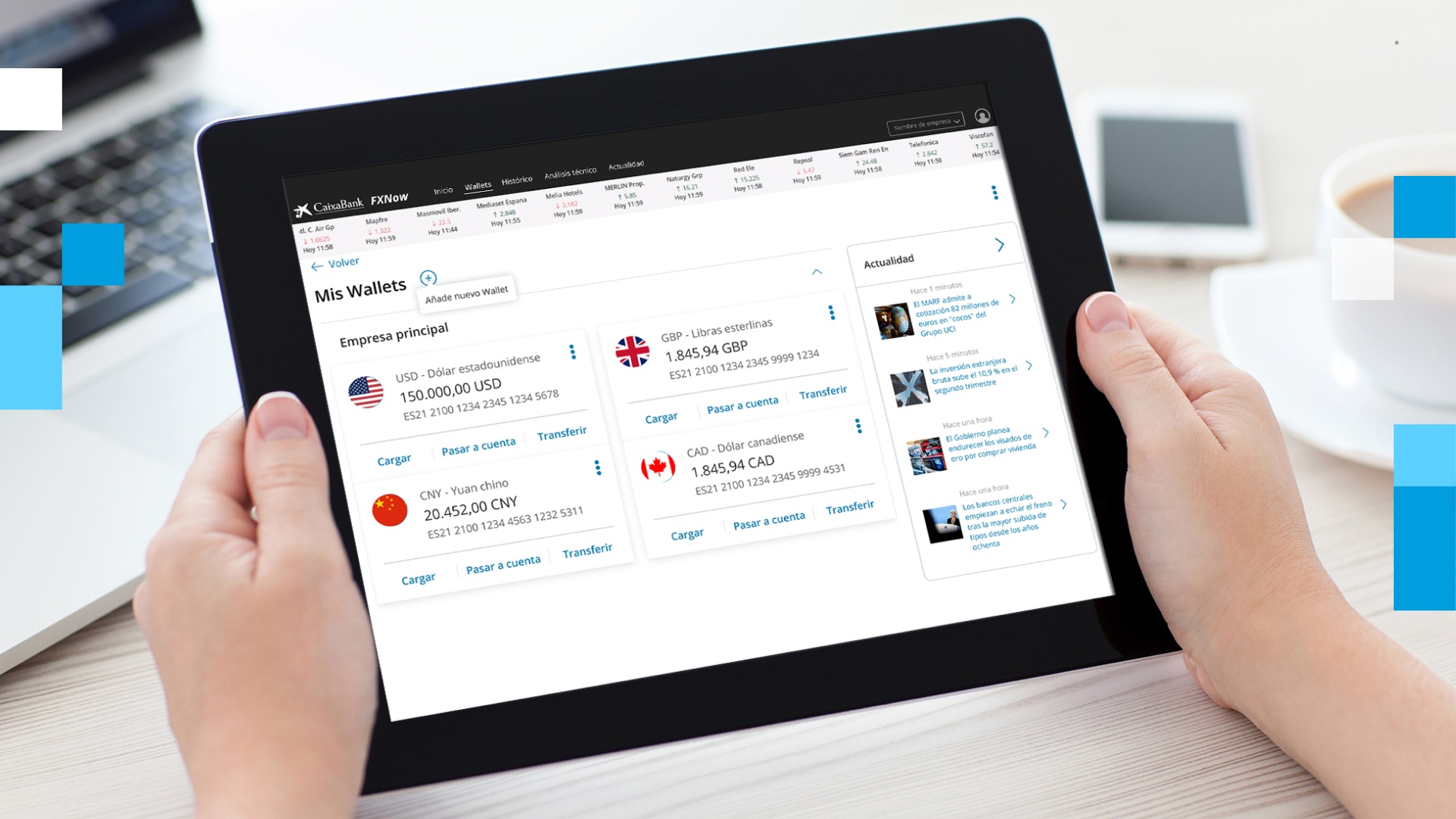
CaixaBank has launched FXWallets, a service that lets you open, immediately, intuitively, and with no opening or maintenance costs, virtual accounts to send and receive international payments in more than 50 currency pairs.
With this step, CaixaBank becomes the first bank in Spain to offer a virtual account service for currencies to all types of companies. The service is available in June in pilot mode for a select group of companies and, starting in September, it will be available to all interested customers. The service is accessed via CaixaBank's website and app, which will feature the FXNow currency market platform.
The new FXWallets service is bringing to international payments all the advantages and security of traditional accounts, with the added benefits of significant advances in user-friendliness and immediacy. In fact, users can open a wallet in the desired currency with just two clicks and use it right away.
Iñaki Badiola, director of CIB and International Banking at CaixaBank said: “the launch of FXWallets is a very significant step in the bank's steadfast commitment to innovation, internationalisation and engagement with our customers and their needs. The development of the project involved a detailed analysis of how we can apply the new advances in usability and customer experience to the universe of currency payments, placing the focus on the customer at all times. As a result, FXWallets is the latest piece to join a constantly evolving digital ecosystem that came into being with the creation of FXNow, which sought to give companies complete control over their currency operations and international payments”.
Commitment to the growth and internationalisation of the service
FXWallets is being added as a new feature to CaixaBank FXNow, the CaixaBank platform for managing the sale and purchase of currencies. CaixaBank FXNow has been servicing CaixaBank's business customers in Spain since its creation in 2020. FXNow was also launched in Morocco in 2022 and, via BPI, in Portugal in 2023.
FXNow bases its model on a balance between user-friendliness and professionalism, which lets it address the needs of all types of companies, from small businesses to large corporations. This has translated into year-over-year growth of over 150% in CaixaBank's currency operations via the digital service channel in Spain.
CaixaBank, leader in innovation
Technology and innovation are crucial for CaixaBank. With more than 11 million users of its digital banking service —the largest customer base in the Spanish financial sector— the bank works daily towards developing new models that are able to meet the requirements and needs of its customers, bringing its products, services and financial culture closer to all citizens.
As part of its digitisation process, the bank, which has its own technology subsidiary, CaixaBank Tech, and multidisciplinary teams that take innovation to every corner of the organisation, drives projects based on new technologies like cloud computing, artificial intelligence, app development, big data, and more. All these technologies provide its advisers with further and better resources to advise their customers and drive the customisation of the commercial offer, with the aim of improving customer linkage, as well as aiding the development of new financial services and streamlining the decision-making process.
This year, the American magazine Global Finance named CaixaBank as the "Most Innovative Financial Institution of Western Europe 2022", and " Best Consumer Digital Bank in Spain 2022". These prizes are in addition to the " Best Consumer Digital Bank for Online Deposits, Card and Investment Product Offerings in the World 2022" and " Best Consumer Digital Bank for Bill Payment & Presentment in the World 2022", and " Best Consumer Digital Bank for Lending in Western Europe 2022also from Global Finance. Furthermore, the bank's online banking service, CaixaBankNow, has been named the Best Consumer Mobile Banking App in the world 2019, and in Western Europe in 2021, 2020, and 2018.
Furthermore, the use of big data and artificial intelligence has earned the bank the accolade of Best Bank in the Analytics and AI category 2022' at the Qorus-Accenture Banking Innovation Awards, and 'Best Private Bank for Big Data Analytics and AI in Europe 2022 and 2021' by the Financial Times Group's PWM magazine.
In the field of private banking, CaixaBank was chosen as the "Most Innovative Private Bank in Western Europe 2022" by Global Finance, whereas the UK magazine PWM (Financial Times Group) named it the "Best Private Bank for Big Data Analytics and AI 2022 in Europe" and " Best Private Bank for Digital Marketing and Communication 2023 and 2022 in Europe".
- 05:00 am

Today, Sendwave, the remittance brand making sending money across borders easy and affordable, announces Sendwave Pay. Sendwave Pay is a banking product available to select Sendwave customers based in the United States.
Sendwave Pay provides existing Sendwave users access to a FDIC-insured bank account* with an accompanying debit card. This makes Sendwave the only major remittance provider with such an offering in the US.
Account holders will have:
a bank account* with no hidden account creation, maintenance or minimum balance fees;
access to up to 0.4% improvement on exchange rates and up to 25% savings on transaction fees on remittances to Kenya, Ghana, Tanzania, Uganda, Nigeria, and Liberia when using the funds in their accounts account funds;
a Sendwave Pay debit card to use on every day transactions;
reimbursements for international transaction fees when using their Sendwave Pay debit card outside of the US;
earn up to 0.51% APY on the money held in their Sendwave Pay account
For migrants, opening a bank account is an important step to establishing themselves and helps to achieve financial autonomy. Sendwave Pay provides an opportunity for our customers to build cross-border wealth and recognizes the demand for a product that better serves customers’ needs than a standard bank account.
“The way that people use and access money has drastically changed over the last decade,” said Eric Huynh, Product Lead, Sendwave Pay, Zepz. “We created Sendwave Pay to better meet the needs of our customers, who are dynamically considering how they manage their money both for themselves and for loved ones abroad.”
Sendwave Pay is the first neobank offering within Zepz, the Group powering global remittance brands Sendwave and WorldRemit. As an organisation dedicated to providing millions of customers around the world with fast, safe and easy-to-use solutions for getting their money home to loved ones,
Sendwave Pay is an important product innovation within the portfolio. This product offering is the first of an exciting future, where Zepz intends to continually invest in migrant-focused financial offerings.
“Investing in meaningful innovations to serve the needs of cross-border communities is part of our purpose and at the heart of everything we do,” said Mark Lenhard, CEO of Zepz. “Sendwave Pay enables US-based migrants to take their money farther, creates financial empowerment through interest schemes and competitive benefits, and firmly establishes Sendwave as a heavy hitter in the fintech space.”
Sendwave Pay is being rolled out to select users via the Sendwave app, available on iOS and Android.
*Sendwave is a financial technology company and is not a bank. Banking services provided by Piermont Bank; Member FDIC. The Sendwave Visa® Debit Card is issued by Piermont Bank pursuant to a licence from Visa U.S.A. Inc. and may be used everywhere Visa debit cards are accepted.

Harry Hanson-Smith
RVP at Dynamic Yield, a Mastercard company
Customer experience is everything – in fact, 61% of people are unlikely to return to a brand that does not provide, at minimum, a satisfactory one. And when see more

Stephen de Blanche
Chief Revenue Officer at TransUnion Africa
South Africa’s most recent unemployment figures paint a gloomy picture. see more

Sara Cerutti
Global Head of Marketing at STICPAY
In just three years’ time over 5.2 billion people, or 60% of the world’s population, will be using digital wallets – a 53% increase from 2022. see more
- 03:00 am

Leading Swiss Fintech Rivero today announced it has onboarded Cornèrcard, a leading issuer of Visa, Mastercard® and Diners Club payment cards in Switzerland, to their card scheme compliance platform.
Under the terms of the agreement, Cornèrcard leverages Rivero’s scheme compliance SaaS solution, Kajo, to digitalise its compliance processing requirements and to make it easier to scale with guaranteed quality control for all its compliance needs.
Since the time it issued Switzerland's first Visa credit card in 1975, Cornèrcard has helped to define the Swiss payment cards environment, building a reputation for quickly adapting to advances in technology, such as the secure e-commerce standard and mobile payments. Adopting Kajo by Rivero shows the card provider’s continued willingness to embrace new solutions that can boost performance and customer satisfaction.
Kajo by Rivero, is the world’s only solution designed for and tailored to the scheme licence compliance management. By fully digitalising and automating the administrative part of the process, Kajo will support Cornèrcard to drastically reduce the time and resources needed to stay compliant with changing rules and requirements of payment networks.
Commenting on the partnership Danilo Redaelli, Head of IT Digital & Card Services at Cornèrcard said: “Rivero is a leader in simplifying card payment operations for the highly regulated payments industry with a proven track record for performance. We are convinced that its SaaS product Kajo will provide us the capability we need to navigate the changing digital payment landscape with ease - giving us more time to focus on core services that put customers first.”
Cornèrcard joins a growing list of companies that rely on Rivero for its compliance needs. Led by a team of highly experienced payments professionals, Rivero has filled a gap in the market for quality fraud recovery, dispute management and card scheme compliance solutions by leveraging the benefits of SaaS, providing solutions for all players in the card payment ecosystem such as issuers, acquirers, BaaS and fintechs.
Thomas Müller, co-founder and CEO from Rivero said: “Rules and regulations around card payments compliance are constantly being updated, and it is important that financial services and payments providers adhere to them. That’s why we created Kajo - to help firms effectively and seamlessly manage their full scheme compliance process. We are excited to be working with Cornèrcard and to deliver a best-in-class tailored solution that can strengthen their service offering and keep them ahead of the competition.”
- 06:00 am
Nutanix, Inc., a leader in hybrid multicloud computing, has announced the public sector findings of its fifth annual Enterprise Cloud Index (ECI) survey, which measures enterprise progress with cloud adoption.
The research reveals that public sector organisations plan to accelerate their hybrid multicloud deployments nearly five-fold over the next three years. Overall, public sector respondents expect to increase their general use of mixed-IT infrastructure to 73%.
Cybersecurity, data security, sovereignty, protection and recovery are top drivers of this group’s IT infrastructure purchasing decisions.
“Public Sector CIOs are universally modernising their IT environments to effectively serve their constituents, missions, and mandates'', says Sammy Zoghlami, SVP EMEA, Nutanix. “The COVID-19 pandemic has underscored the importance of agility to swiftly adapt to changing circumstances in government, education, and healthcare sectors. Recognising this need, public sector IT leaders are embracing diverse IT environments, encompassing data centres, edge computing, colocation, and various public clouds to meet their individual specific requirements. This approach offers the freedom to locate and move workloads and apps where they best meet their strategic priorities; however, it also brings new challenges, including complexity inherent in hybrid multicloud environments.”
Key findings from this year’s report include:
- Public sector organisations expect to grow their hybrid multicloud deployments nearly five-fold. This group also expects to more than double its use of multiple public clouds (“multicloud”). Public sector respondents expect their use of all other IT operating models, such as on-premises infrastructure, to decline during this period.
- Cybersecurity and data sovereignty are the biggest IT infrastructure investment drivers. Among those in the public sector, cybersecurity and data sovereignty—the ability to comply with national rules for data storage and control—tied as the top criterion, at 13% each. Cost was mentioned least often.
- Mixed environments create new challenges for data management, as the value and volume of data in the public sector continues to skyrocket. Top challenges include data analytics and orchestration, data protection and recovery, and data storage costs. The findings also indicate a visibility capabilities gap for all data residing across the extended IT infrastructure. There is room for improvement in the availability of integrated tools for hybrid IT operations, as IT shops can’t manage, secure, synchronise, or analyse what they can’t see.
- The overriding driver of application movement among ECI public sector respondents in the past year was to improve data security. Nearly all respondents in the global public sector (98%) indicated that they had moved applications between IT infrastructures in the past 12 months, and 47% cited a desire to improve their company’s security posture or their ability to meet regulatory requirements as a reason (Figure 6). Improving data security was also the top reason for moving applications among all ECI respondents, cited by a similar percentage (46%). The hope of accelerating data access speeds was a moderately distant second reason for application mobility among public sector respondents (39%), followed by a wish to integrate with cloud-native services, such as AI and machine learning (38%).
- Controlling IT costs. Most respondents rank controlling costs high on their list of challenges. For example, 86% of public sector respondents and 85% of respondents globally described cloud cost control as a challenge with managing their current IT infrastructures, and more than a third of each group—36% of public sector organisations and 34% of global respondents—said it was a "significant" one.
Increased infrastructure diversity, along with a heightened emphasis on data storage, management, security and services, is driving all public sector IT pros to seek hybrid operations that unify private and public infrastructure. Nearly all respondents, including 95% of public sector respondents, expressed a desire to have a single place to see and manage the many aspects of their diverse infrastructures. As these capabilities emerge, respondents will gain access to unified tools that deliver visibility into where all data resides, allow IT teams to holistically manage their applications and data, and let them make adjustments as needed to meet ever-shifting requirements for data security, backup, compliance, performance and cost.
For the fifth consecutive year, Vanson Bourne conducted research on behalf of Nutanix, surveying 1,450 IT decision-makers around the world in December 2022 and January 2023. This report is supplemental to the global 5th Annual Enterprise Cloud Index master report and focuses on cloud deployments in the global public sector, which includes federal/national government organisations, and state & local government organisations, public educational institutions, and public healthcare organisations. It highlights the cloud plans, priorities, challenges, and experiences of IT professionals in the public sector around the world and how they compare to the full, cross-industry global response pool.
- 03:00 am

NatWest, the UK’s biggest bank for business, is offering 24 months of free business banking to UK businesses switching their main business banking account to NatWest.
The new SME switcher offer from NatWest for businesses with up to £2m in turnover comes at a time when customers could benefit from a reduction or break in their banking fees.
The new offer is expected to save business customers on average nearly £2,000 over two years, depending on the size of the business turnover and transaction activity.
New start-ups opening a bank account for the first time will also get 24 months free business banking when they join NatWest, which is a six-month extension on the previous offering.
The offer also extends to businesses who have business banking accounts with multiple providers, who choose to switch all their banking to NatWest.
James Holian, Head of Business Banking at NatWest, said:
“As the UK’s biggest bank for business, we hope that businesses will take us up on the offer of two years of free banking to help reduce costs, and gain access to the innovative toolkit of business support we provide to SMEs in the UK.
“This new offer builds on the recently announced market-leading 3.56% interest rate on our 95 day notice Savings account.
“While a simple switch process will save some money, the true value comes from the breadth of business expertise, insight and support NatWest provides to help SMEs start up, scale up and thrive.”
On top of an average saving of nearly £2,000 over two years, businesses will also be able to benefit from a range of features that come as standard with a Business Current Account, including:
- FreeAgent, award-winning online accounting tool for small businesses
- Business Builder, an online platform packed full of tools and tips to help meet business goals sooner
- MentorDigital, helping them to navigate the world of HR, Health & Safety and Employment Law
- Market-leading savings rates to make their money work harder
Additionally, NatWest’s Local Enterprise Managers and Accelerator Hubs across the UK are specialists in helping businesses thrive no matter what size or sector.
As part of the broader package of support, NatWest also recently announced an increase to the interest rate on one of its business savings accounts from 2.10% to 3.56% AER / 3.50% gross rate – the highest rate of interest offered by any major lender on equivalent accounts at the time, as part of its wider support package to help business customers facing challenges posed by inflation and the cost of doing business. NatWest’s 95 day Liquidity Manager Notice Account is ideal for business customers who want to earn higher returns on their savings, and don’t need immediate access to funds. There is no minimum deposit required to open the account, and there is no maximum balance limit. Interest is calculated on the account’s daily balance and applied on the last business day of each month.
- 04:00 am

LMS, the UK's leading conveyancing services provider, today announces that it has increased the digital capability of its charge registration tool. In the first stage of its dedicated programme of work to improve this process for law firms, they can now update LMS indirectly through their own CMS provider, digitally. This change marks the first step in a redesign of our charge registration processing and oversight.
Following law firm feedback, which suggested that the current process wasn’t aligned with current HMLR timeframes, LMS has invested in a series of integrations with third parties, building a series of connectors that allows firms to update LMS on charge registrations digitally via their own CMS provider, including the ability to upload documents and provide delay reasons. With all the necessary API development done behind the scenes, LMS have designed the process to be simple to adopt, limiting any technical changes firms need to make.
This enhancement ensures continual compliance with lender post-completion requirements and streamlined communication and collaboration between the lender and the firm. In a consistent drive for increased efficiency and digitisation of the conveyancing journey, additional developments this year will seek to utilise the developments being made by HMLR and other stakeholders to further simplify the process and improve how we communicate when it is required.
Ian Robinson, Chief Operating Officer at LMS, said:
“We exist to drive efficiencies and improve the conveyancing journey for all stakeholders, but we can only do that by listening to feedback from law firms and addressing the pain points they are experiencing. Charge Registration is one of those, and by introducing digital update capabilities we hope we have taken a significant step to address this frustration. We appreciate that notifications and requests for updates create additional work particularly when they aren’t necessarily aligned with market conditions.
But, as ever at LMS, we don’t stop here! This is just the first iteration of many – the team is currently looking at automating HMLR services to further assist law firms and, eventually, embedding those services within our e-COT platform. We are defining these regular updates across 2023, and the road ahead is full of exciting new digital services that aim to support lenders, law firms and other key stakeholders. LMS takes pride in ensuring such tools are innovative, collaborative and remain accessible to all.”
- 05:00 am

The European P2P market is not yet highly competitive. However, the situation may change as early as next year.
Analysts of the Robo.cash platform assessed the competitiveness of the European P2P market using the reverse Herfindahl-Hirschman index (HHI)*.
The industry is experiencing a trend of high concentration around key players that occupy more than half of the market. This is confirmed by the fact that its average HHI (reverse) from the beginning of 2017 to May 2023 amounts to 7095 points. “At some point, the activity of the industry leaders led to a decrease in the index and an increase in their monopoly power. But the P2P market, like others, is subject to various external events. With the COVID-19, market volumes declined and the HHI (reverse) rose, thereby opening the doors to future competition.” - the analysts comment.
The experts predict that competition in the market will intensify in 2024. The growth of promising platforms will lead to a decrease in the leader's market share.
*The Herfindahl-Hirschman Index (HHI) is a common measure of market concentration and is used to determine market competitiveness. In the classical understanding of US economists, if the value of HHI (reverse) is greater than 8500, then the market is considered highly competitive, if the HHI is less than 7500, then the market is considered highly concentrated (or monopoly).








