
Published
- 03:00 am

Analysts Explore Digital Leadership and Emerging Technologies for Financial Services at Gartner Symposium/ITxpo, October 29-November 1 on the Gold Coast, Australia
By 2030, 80 percent of heritage financial services firms will go out of business, become commoditized or exist only formally but not competing effectively, according to Gartner, Inc. These firms will struggle for relevance as global digital platforms, fintech companies and other nontraditional players gain greater market share, using technology to change the economics and business models of the industry.
Speaking at Gartner Symposium/ITxpo 2018 on the Gold Coast, Australia today, David Furlonger, vice president and distinguished analyst at Gartner said banks face a growing risk of failure if they continue to maintain 20th century business and operating models.
“Digital transformation is largely a myth as institutional mindsets, processes and structures stand firm,” said Mr. Furlonger. “Established financial services providers will have to move faster on digital business by building digital platforms or finding niche products and services to sell on others’ platforms.”
According to Gartner’s 2018 CEO survey, while financial services CEOs continue to prioritize revenue growth, there has been a clear shift toward emphasizing efficiency and productivity improvements and the importance of management as growth levers. This shift indicates that digital business is predominantly a channel and transaction automation play, focused on business optimization as opposed to a transformation.”
Pete Redshaw, practice vice president at Gartner, said this attitude is dangerous.
“It underestimates the degree of change that digital technology will bring to the industry,” he said. “The future of the financial services industry is increasingly weightless, requiring few physical assets to establish or maintain a presence. That makes the industry especially vulnerable to disruption by digital competitors.”
In addition, emerging technologies (such as blockchain) offer transformational opportunities by creating trust between parties that do not know each other, without intermediary relationships that incumbent financial firms cultivate. Equally, peer-to-peer consensus algorithms can directly match borrowers to those with money, without requiring a bank to mediate.
“The biggest mistake financial services CIOs make is putting too much focus on technology,” said Mr. Redshaw. “They should push their organizations for a more coherent response to digital business — it’s important to set the digital vision and destination first, then think about how to lead an organization there.”
According to Gartner, of the 20 percent of traditional firms that will remain as winners, three types will flourish:
· Power-law firms: Companies that own a digital platform will use its scale, low-cost infrastructure and the customer information it generates to create new services and enter new markets. Very few (5 percent) of these winning heritage institutions have the ability to become power-law firms.
· Fintechs: Individual companies or pure-play/neobank subsidiaries will disaggregate traditional financial services in discrete product areas. They will participate in digital platforms, but will not own them. Less than 15 percent of the winning group of traditional firms can convert themselves into or successfully spin off fintechs.
· Long-tail firms: The dramatically lower costs enabled by digital platforms will allow some traditional providers to act as service brokers. This is likely for large populations of poor and working-class people around the world that were not profitable customers previously. Simultaneously, they can act as concierge providers of bundled offerings to high-net-worth individuals. Around 80 percent of winning traditional financial services providers can become long-tail firms.
The speed of digital transformation in financial services partly depends on regulation, as well as customer demographics and behaviors, which will vary from country to country. In some nations, conservative regulations will inhibit innovation, while other countries, such as Australia, Brazil, China, India and the U.K., will use regulation to speed transformation.
Gartner clients can read more in the report: “Digitalization Will Make Most Heritage Financial Firms Irrelevant.”
- 06:00 am

Equifax, the consumer and business insights expert, announces the latest development in its partnership with consents.online, integrating Equifax Bank Account Verifier into the Open Banking journey.
The new solution means identity information such as the consumer’s name, address and date of birth, can for the first time be matched with transaction data provided through Open Banking in real time. This will help reduce fraud, allowing credit providers using Open Banking to confirm that account information belongs to the person applying for credit, and not a potential fraudster.
Equifax Bank Account Verifier compares the sort code and account number taken from the customer’s online bank account to Equifax’s extensive current account database. The name and address details associated with the bank account are then compared to the details provided by the customer during the credit application. This links the transaction data back to an individual, performs an anti-impersonation check and helps verify the customer’s identity.
HSBC UK, as an early adopter of the Equifax and consents.online Open Banking service, is now testing the new verification process as part of its on-boarding solution to further streamline its digital journey customer application process.
Jake Ranson, Banking & Financial Institutions Expert and CMO at Equifax UK, said: “Since the implementation of Open Banking at the start of the year we’ve seen more and more consumers willing to share their current account data digitally to access new products and services. In our work with clients to develop their Open Banking solutions we uncovered an important gap in the process, as identity information isn’t provided through application programming interfaces (APIs). Equifax Bank Account Verifier (EBAV) closes this gap, helping the industry make the most of the new data sharing in a more secure environment.
“The products and solutions we can deliver through our partnership with consents.online showcase the consumer benefits of Open Banking. Part of the challenge is educating consumers on what Open Banking means in real life, and a streamlined customer identity verification process that helps them get a faster credit decision is a great example.”
Emma Steeley, CEO for consents.online, said: “We have been delighted with the response from companies wishing to innovate using the data available from Open Banking so far. Combining the Open Banking data with Equifax Bank Account Verifier has enabled us to launch the first live ID check in the Open Banking market. It is extremely exciting and showcases our continued evolution in our strategic partnership to deliver the best in class Open Banking solutions.”
- 03:00 am

Société Générale, one of the leading financial services groups in Europe, has deployed Finastra’s Fusion Risk Asset and Liability Management (ALM) and Fund Transfer Pricing (FTP) solutions. The move has enabled the bank to streamline multiple solutions across the group, simplifying its infrastructure so that it can comply more efficiently with regulations including the Interest Rate Risk in the Banking Book, and also reduce costs.
Finastra has a long history of working with Société Générale Group, which already benefits from Finastra’s treasury and capital markets, lending, retail banking and trade finance software. The leadership team at Société Générale sought a solution to facilitate all ALM and FTP activities for the group retail banking entities in France. The solutions are already live at Société Générale Banque De Détail France and Crédit du Nord, and European branches will follow in the coming months. The bank expects to roll out the solution globally in time.
Arnaud Picut, Global Head of Risk Practice at Finastra said, “Fusion Risk is an essential solution for Société Générale to eliminate the complexity around its resources and regulatory compliance. The addition of Fusion Risk to Société Générale’s portfolio is testament to our relationship with the bank and an incredibly significant deal for us which cements our strong relationship with one of the top banks in Europe. We’re looking forward to continuing our close collaboration with Société Générale, helping the bank improve its customer experience by streamlining its solutions, and in turn supporting business growth.”
Built on components that can be shared beyond the risk and compliance function, Fusion Risk offers a strategic path to transformation. Micro-services form the foundation to unite disparate data across the organization while adding performance, scalability, and visibility for timely and better decision-making. Fusion Risk is fully scalable, designed to evolve with changing markets and regulatory demands.
- 04:00 am

OneMarketData, LLC, the creators of OneTick, the leading solution for event stream processing and Tick Data management, today announced that Miami International Holdings, Inc. (MIH) has chosen OneTick, OneMarketData’s proprietary high-performance tick capture and streaming analytics engine, for two additional exchanges: MIAX Emerald, LLC and the MIAX Equities Exchange. With this expansion, OneTick will be a key component of the surveillance and data analytics solution MIH uses for all of its exchanges.
OneTick is a specialized time series ‘tick’ database that provides firms with the ability to analyze and process data with greater sophistication by capturing, compressing, archiving and providing access to global real-time and historical data, up to and including the latest tick. It has no limitations on data volumes, peak rates or length of stored history and collects level one and full order book data across all asset classes, including options.
“OneTick is a trusted solution in the market and following its success on our other platforms there was no question we would turn to OneMarketData again for MIAX Emerald and MIAX Equities,” said Randy Foster, Senior Vice President – Business Systems Development of MIH. “Their track record speaks for itself and with their support the OneTick tick data management system will ensure our exchange continues to provide best-in-class surveillance, compliance and customer support solutions.”
“We are thrilled to expand our relationship with MIAX, having worked with them for two years this is a true testament to our capabilities and trust that MIAX has with OneTick,” said Ross Dubin, Global Head of Sales at OneMarketData. “As OneTick continues to evolves we look forward to developing our relationship with MIAX and exploring further opportunities with the exchange.”
- 06:00 am

Saxo Bank, the multi-asset trading and investment specialist, today announces the appointment of Lars Kufall Beck as Global Chief Financial Officer (CFO), effective no later than 1 May 2019.
He will report directly to Steen Blaafalk, Head of Group Finance & Risk (GFR) and Group CFRO. Kufall Beck will be part of the global management team in GFR and Saxo Group’s Senior Management Team (SMT).
During his 15+ year career, he has held several finance leadership roles and joins Saxo Bank from ISS Group where he spent almost 10 years in various executive positions. Most recently, he served as the Group’s Regional CFO for Continental Europe and prior to this, spent more than 3 years as CFO for ISS Facility Services Sweden, and served as the Group’s Regional CFO for the Nordic region. He has also headed ISS Group’s Risk Management for two years. Before joining ISS, Kufall Beck spent 3 years as Senior Manager for the Actuarial and Insurance solutions at Deloitte Consulting and was Chief Actuary for Danish Re Underwriting Agencies before then.
Lars Kufall Beck holds a Bachelor’s degree in Finance and a Master’s degree in Actuarial Science from Copenhagen Business School. Moreover, he has obtained a certification as Chartered Financial Analyst (CFA).
Commenting on his appointment, Steen Blaafalk, Group CFRO, said:
“Lars has a broad and deep international experience with a good understanding of regulation, risk management, treasury, and financial instruments, which ideally positions him to take the company to the next level. He has served in a broad range of executive roles in risk management, treasury and finance and has a strong background as an actuary. Global CFO is a key role in Saxo Bank and an important sparring partner and advisor to the Executive Team of the Bank. Lars is a very talented top executive with strong leadership skills and practical management experience and we look forward to working with him on developing the CFO function further.”
Lars Kufall Beck comments
“I am delighted and proud to join Saxo Bank and feel strongly about the high level of ambition and the dynamic environment that Saxo Bank is operating in. The prospects for Saxo Bank are highly positive and I very much look forward to contributing to Saxo Bank’s ambitious journey ahead.”
Lars Kufall Beck will succeed Rasmus Lund who will join Copenhagen Airport as CFO.
- 09:00 am

Wednesday marks the 10th anniversary since the publication of Satoshi Nakamoto’s whitepaper on a ‘revolutionary peer-to-peer electronic cash system’. This was the first time the concept of Bitcoin and the underlying blockchain technology was put out into the public domain.
Starting out from a single cryptocurrency on one exchange, the crypto world now has more than 1,500 cryptocurrencies – Bitcoin, Bitcoin Cash, Ethereum, Litecoin to name just a few – being traded on over 190 exchanges around the world.
Ten years on however, this system is being increasingly criticised for its volatility and lack of transparency – calling into question its viability as an alternative monetary system. So far in 2018, Bitcoin has repeatedly shed its value more than half from its year end price of $13,000 in 2017.
However, many still believe in the potential for increasing the transparency and decentralisation offered by distributed ledger technology, on which blockchain is based.
According to Thomas Coughlin, CEO of Kinesis, there’s a risk of missing this potential if stability is not restored to the foundation of these cryptocurrencies. In the last ten years, Thomas has been closely following the journey of the crypto market and campaigning to restore value stability to the currency.
Thomas continues: “The 10th anniversary of Satoshi’s whitepaper is an important milestone reflecting on the progress of Bitcoin and other cryptocurrencies so far, not to mention, the revolutionary blockchain technology that underpins it all. One thing is clear: extreme volatility is perhaps the biggest argument against mainstream adoption of cryptocurrencies in the last decade and the lack of institutional investor trust in the market.
“Looking ahead to the next ten years, the focus must be on restoring stability and trust to cryptocurrencies. This will not only increase its practicality as a store of value and a medium of exchange but also channel mainstream investments into the crypto market.
“Understanding this need, Kinesis has created a secure and easily exchangeable digital currency with direct gold ownership on the blockchain. This system combines new world decentralized technology of blockchain with the oldest, and most sustainable form of money. Digital record of physical, allocated bullion ownership can be exchanged as a stable coin on the blockchain, or in place of fiat currency in everyday transactions.
“Kinesis has raised over $50 million so far – testament to the potential of combining the accountability and efficiency of blockchain technology with the value-stability of age-old assets”

- 09:00 am
Brand new research from RBR reveals that the number of payment cards in circulation worldwide reached 15 billion at the end of 2017, with UnionPay continuing to hold the largest share
Financial inclusion initiatives drive growth in card issuing
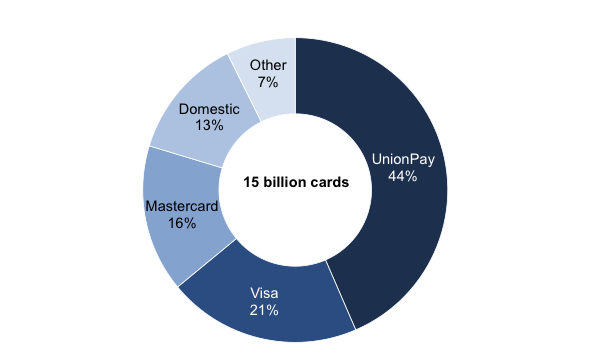
There were 15 billion payment cards in circulation around the world at the end of 2017, up by 6% since the end of 2016, according to RBR’s most recent report, Global Payment Cards Data and Forecasts to 2023. As governments and central banks in developing markets continue to encourage financial inclusion, the number of cards has kept growing, providing further opportunities for card schemes.
Share of Payment Cards Worldwide by Scheme, 2017
Source: Global Payment Cards Data and Forecasts to 2023 (RBR)
UnionPay’s share increases as the Chinese market continues to expand
Growth in the Chinese card market has been strong for several years and the trend continued in 2017 which saw the number of cards in issue rise by 9%. The vast majority of the country’s cards are UnionPay-branded, and in 2017 the scheme accounted for 44% of the world’s payment cards, increasing its share by one percentage point compared to the previous year.
Visa (including Visa Electron, V PAY and Interlink) and Mastercard (including Maestro and Mastercard Electronic) account for 21% and 16% of global cards respectively; if China is excluded, Visa’s share is 36% and Mastercard’s 27%.
The RBR report shows that domestic schemes, usually found in the debit sector, are declining in most markets, as they are either dual-badged with, or replaced by, international schemes. However, they have seen something of a rebirth in a number of large markets in recent years. For example, India’s RuPay’s important role in a financial inclusion campaign has seen its share of the country’s cards rise to 49% since its launch in 2012.
Chinese regulations will only encourage growth in UnionPay cards
For many years, Visa and Mastercard cards in China were dual-badged with UnionPay, but a 2017 regulation prohibiting dual-badging means that this is no longer the case. As all Chinese cards issued for domestic use must be UnionPay-branded, banks are typically issuing UnionPay-only cards to replace existing dual-badged ones, while customers can request an international card for use abroad. RBR’s Daniel Dawson, who headed up the research team, said: “While some Chinese consumers and businesses will request a Visa or Mastercard card, UnionPay will account for the vast majority of Chinese cards for the foreseeable future. UnionPay will also aim to expand internationally, but Visa and Mastercard’s long history in other markets will enable them to withstand pressure from new competitors”.
- 01:00 am
Ingenico Group (Euronext: FR0000125346 - ING), the global leader in seamless payment, today announced that it has signed a partnership agreement with Chinese carrier Xiamen Airlines, to provide the online payments infrastructure for the company. As one of Asia's fastest-growing airlines, Xiamen Airlines' customers come from many different markets, which has led to a complex payments infrastructure. To sustain growth and simplify their payment operations, the company wanted to improve online payments acceptance with complied global Payment Service Providers like Ingenico. This will enable the carrier to increase the number of local payment methods and currencies it accepts, and help optimize the customer experience when purchasing airline tickets online. Ingenico's full-service model with its large portfolio of cards and alternative payment methods, extensive network of local acquirers, and strong regional expertise all contributed to Xiamen Airlines' decision.
Xiamen Airlines was founded in 1984, and today covers a network of around 400 domestic and international destinations, with one of the most modern fleets in the world. The company was recognized as 'The Airline Offering the Best Services' by Chinese passengers for years. As Xiamen Airlines expands operations across Asia and into the far corners of the world, it became increasingly important to offer consumers a localized shopping experience that includes payment options in their preferred currency and with local payment methods. To that end, Ingenico provides Xiamen Airlines with full-service payment processing and value-added services, as well as connections to a series of local acquirers, to drive improved acceptance rates.
"Ingenico has a long track record in the industry, working with many of the world's best airlines. As such, they understand the unique requirements and opportunities that come with operating a growing airline," said Mr. Guo Kaiquan, E-commerce Accounting Manager of Xiamen Airlines. "As consumer expectations change, it is important to us to continue to offer a seamless online purchase experience that reflects our commitment to service and customer satisfaction."
Ingenico works with many of the world's best-known brands from the Travel & Tourism industry. With over 20 years of vertical experience, the company understands the unique payments requirements and has a proven track record of growing revenue and optimizing sales for airlines. Today, Ingenico serves over 100 airlines from all over the world, including a number of the Top 10 best airlines according to the World Airlines Awards 2018.
"Xiamen Airlines continues to pursue innovation and excellence with the aim of building a world-class airline. They understand very well that to continue their growth into new markets, customer experience is key," said Gabriel de Montessus, SVP Global Online (Retail BU) for Ingenico Group. "Ingenico has a long history of processing payments in China and across the world and knows the local customs, preferences and regulations. With our payment solutions and network of local acquirers, Xiamen Airlines is ready to expand operations while providing a familiar and seamless payment experience to travellers anywhere"
- 01:00 am
More than half of UK consumers (54 percent) would be ready to use biometric payment cards if they were available at their bank today, according to new research revealed by digital security leader Gemalto and conducted by GfK*. For 82 percent of them, it would even become their preferred payment card – generating a clear 'top of the wallet' effect. These innovative cards with integrated fingerprint readers let users authorise payments with a simple touch of their finger on the sensor, as an alternative to the PIN code.
If British consumers are to replace their current payment cards, they need them to be more secure than what they currently have (88 percent), to be offered by a trusted bank (79 percent), to be easy to use (69 percent) and to be one that simplifies their life (60 percent).
For a large majority, biometric cards clearly tick all the boxes. Eight out of 10 consumers believe that this new card will be better in terms of convenience and security. Key advantages include: no need to remember different PIN codes, a more secure experience ("no more risk of someone stealing my PIN code when I pay") and more opportunities to pay contactless thanks to higher spending limits. Additionally, the card doesn't rely on a battery and only uses power from the payment terminal to work; this means there is no limit on the number of transactions.
Some consumers also expressed concerns about using biometric technology. 41 percent feel afraid that their fingerprint won't work all the time and more than a third (37%) about it being compromised.
However, these concerns should be alleviated as consumers learn more about the technology. For example, biometric cards will be able to fall back to a PIN code authorisation if for any reason the fingerprint reader malfunctions. The fingerprint data is also securely stored in the card's chip. It never leaves the card. It's not kept on the bank's servers nor sent to a personalization bureau, so to avoid the risk of it being stolen or compromised.
The findings show that Britons are enthusiastic about the potential of biometric cards, but also proves the need to build confidence in order to convince all UK cardholders to take up this new payment method. The majority of them, mainly young active contactless users or multi-banking product owners in the 40-50 age range- are already convinced, but there is also one third of the population that will need more time and proof to feel confident using biometric payments.
Responding to the findings, Howard Berg, SVP Banking and Payment at Gemalto commented, "We are delighted to see that the British public is ready to embrace this new generation of biometric payment cards. Our payment experts have worked hard to design a card that's not only safe and secure but also easy to use and which provides a more convenient payment experience than ever before. Banks are showing great enthusiasm with ongoing trials and we look forward to launching biometric cards in the UK in the near future."








