
Published
- 05:00 am

Five countries stand out in the development of financial technologies in Southeast Asia. In the context of the growing focus on financial inclusion, fintech lending services will provide a determining vector, predicts the international financial holding Robocash Group.
Southeast Asia has the fastest growing Internet penetration in the world estimated at 58% in 2018 (2017 — 53%). Google and Temasek predicted the number of local Internet users to reach 480 mln people in a year and the Internet economy to increase to US$200 billion by 2025 (2017 — $50 bln). In return, it makes the region significantly promising for business in the digital field.
However, the potential is untapped that is proved by the still low financial inclusion (about 38% of adults had no account in SEA in 2017). Robocash Group, which is now providing financial services for the underserved by banks in three countries in SEA, expects that in the context of the Bali Fintech Agenda accepted in October 2018, alternative lending will determine the further progress in fintech across the region. The following countries will stand out on this background: Singapore, Indonesia, the Philippines, Vietnam, and Thailand.
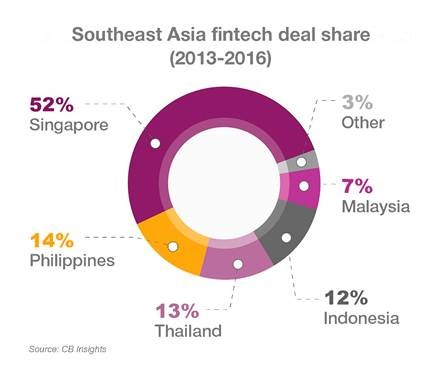
The apparent leader in SEA is Singapore with the highest fintech adoption: 56% of the population was digitally active in 2017. In 2017, Singapore saw US$229.10 million raised in financial technologies after holding 52% of all fintech deals across the region in the period of 2013-2016.
With the support from the government and banks, Indonesia with its largest population in the region is actively catching up. The low rate of financial inclusion (49% of the population had a bank account in 2017) facilitated an increase in alternative lending. According to estimations, 31% of the Indonesian fintechs are p2p platforms. Moreover, the Financial Services Authority of Indonesia (OJK) reported about more than US$1.131 bln loans issued as of October 2018.
Compared to Indonesia, the Philippines has a higher number of people underserved by banks (65.5%). However, the country is adapting quickly and efficiently to the new digital reality. EY stated that local fintech companies raised US$78 million in funding in 2017 that is a 13 times increase year-on-year. About 30% of fintech firms in the Philippines represent alternative finance.
In Vietnam, only 31% of the adult population had bank accounts in 2017. Alternative lending has become widespread on this background: almost 100 platforms have started in the last few years. Yet, the country is actively gaining traction in fintech supported by the fast increasing Internet penetration, mobile connectivity (84% of the Vietnamese had smartphones in 2017) and the government strategy to increase the volume of cashless transactions up to 90% by 2020. Solidance forecasts that the Vietnamese fintech market will grow from $4.4 bln in 2017 to $7.8 bln in 2020.
Thailand, which shows fast progress of the socio-economic development and relatively high financial inclusion (82% of the population had an account in 2017), is nevertheless lagging behind the neighbours. Alternative lending that might be relevant for the population living in rural areas (2016 — 48%) is low spread. Developing according to the economic strategy "Thailand 4.0" (2016), Thailand is focused on high-tech industries and innovations, but expands the lending market carefully. As a result, it affects foreign capital too. In 2017, the country saw US$12M raised that was 40% decrease year-on-year.
Commenting on the potential of the SEA region, Sergey Sedov, Chief Executive Officer of Robocash Group said, “Apparently, there is a scope of several factors facilitating the further growth of fintech lending both for private customers and SMEs. They are the demand for accessible finance, business interest, quickly growing Internet penetration and mobile connectivity, adoption of cashless payments, and the support from the state authorities. We have been present in Southeast Asia since 2017. In a year and a half, many significant improvements have increased the attractiveness of the region from financial and digital view. We expect to see further changes, which will make SEA one of the fintech world leaders in 2-3 years”.
- 08:00 am

TIBCO Software Inc., a global leader in integration, API management, and analytics, today announced the launch of cloud-native TIBCO Cloud™ Mashery®, TIBCO’s API management offering for containerised private cloud and public Platform-as-a-Service (PaaS) environments. The platform delivers key API management capabilities for enterprises adopting cloud-native development and deployment practices, such as DevOps, containerisation, and microservices development. With this news, market-leading features from TIBCO Cloud Mashery will be available globally in a containerised deployment, enabling faster development of digital business capabilities, plus improved platform control and scalability.
Enterprises are increasingly moving their workloads towards a cloud-native architecture in order to develop and deploy faster, in addition to connecting services and systems from both on-premises and multiple clouds via APIs. Cloud-native API management makes both possible in a fully secure and highly scalable way. Cloud-native TIBCO Cloud Mashery is compatible with any PaaS or Infrastructure-as-a-Service (IaaS), including first-class support for Kubernetes.
“Enterprises now require their API platforms to be deployable anywhere, and able to manage APIs from everywhere through a single pane of glass. Many industries, including financial services, healthcare, travel, and more, require enterprise-managed, cloud-native API management,” said Rajeev Kozhikkattuthodi, vice president, product management and strategy, TIBCO. “TIBCO’s approach provides all the benefits of the cloud with additional customer control, plus seamless alignment with cloud-native development tooling and practices. We are proud to continue leading the market in API management through innovation, this time by providing first-of-a-kind capabilities in cloud-native API management.”
“Moving towards a cloud-native architecture is a strategic priority for us,” said Kris Lahiri, co-founder and chief information security officer, Egnyte. Egnyte is a leading provider of software for enterprise file synchronisation, sharing and collaboration. “TIBCO’s innovations will allow us to adopt cloud-native API management, improve our DevOps efficiency, and deliver improved control and security of an on-premises deployment with the scalability and agility of cloud-native infrastructure.”
Visit TIBCO Cloud Mashery to learn about the launch of Cloud-native TIBCO Cloud Mashery and how the solution benefits the cloud-native enterprise.
- 03:00 am

World-leading biometrics company, Fingerprint Cards AB (Fingerprints™) announces its Biometric Software Platform for payments, named FPC-BEP, targeting payment cards, wearables and USB dongles. The platform has been tailored to optimize the performance of its small and power-efficient biometric sensors for payments, which include the FPC1300-series and T-Shape™ module. Fingerprints can now offer card and device makers a complete hardware and software solution to secure biometric authentication and maximize the user experience.
"Biometric performance can only be optimized when you consider the whole package; hardware and software working in harmony," comments Pontus Jägemalm, Chief Technology Officer at Fingerprints. "Our technology is used billions of times every day, and now we have poured our long and unrivaled experience from the mobile world into this software platform to maximize the performance in low-power and low-computing-power payment environments."

Biometric features & benefits
The complete software solution has been designed to maximize the payment transaction speed, user convenience and security. Optimized image capture with high image quality is central to this, which sees Fingerprints' technology actively adapt to various use cases and conditions, both indoors and outdoors.
Other advanced features of the platform include:
- OneTouch® - the sensor is always ready to go, whenever it is needed, letting users make fast transactions as it never needs to boot up
- QuickTouch® - captures and verifies an image of your fingerprint in less than 0.3 second, to quickly confirm a secure biometric payment
- EvoTouch™ - with every touch, the intelligent algorithm learns something new and adapts to the user's changing conditions
- 360Touch® - don't worry about what angle you touch the sensor during enrollment or everyday use, the right fingerprint will be recognized no matter its orientation
- SafeTouch® - a collection of functions designed to maximize the security, making sure the sensor always knows it's you
The software platform can either comprise a 3rd party biometric algorithm or Fingerprints' own newly developed algorithm, enabling vendors to benefit from a holistic, seamless solution from one provider.
The platform is commercially available and will undergo certifications with payment authorities as part of Fingerprints' ongoing collaboration with stakeholders throughout the payments ecosystem.
- 04:00 am

Today Ortec Finance, a market-leading provider of quantitative modeling software for the global wealth management sector, has launched its goal-based financial planning software – OPAL — on Salesforce AppExchange, the world's leading enterprise cloud marketplace. With this solution, Ortec Finance will deliver institutional-grade wealth management capabilities and assisted robo-advice in wealth planning with involvement of a relationship manager. OPAL integrates with Salesforce Sales Cloud and Financial Services Cloud (FSC), providing relationship managers not just a single view of their customers but also the ability to understand their personal life goals.
Natively integrated with the Salesforce Platform and FSC, OPAL is currently available on AppExchange.
OPAL – Goal-based Financial Planning solution
Established in 1981, Ortec Finance has become a specialist in goal-based wealth planning and financial planning solutions that can be tailored for individual markets. The firm's OPAL is a leading software solution for financial institutions globally, providing goal-based financial planning models that enable people to manage the complexity of investment decision making.
Sander Daniels, Regional VP for FS EMEA, commented, "Every client has different goals. One person might be saving for a dream home, another is planning to send their child to university while a third wants to open a small business. Unless an advisor has a pulse on their needs, they won't be successful. The problem is that many advisors lack the ability to track these client goals and provide the proactive and personalized advice needed to grow the relationship."
Globally, OPAL is a leading solution in jurisdictions where regulation such as the Retail Distribution Review and MiFID II has had a significant impact on the wealth management sector. By leveraging the company's institutional investment risk management expertise of using top-notch calculations as the core of the solution, OPAL enables financial institutions to translate personal goals of their clients into an optimal financial plan and monitor these goals over time.
Iwan Schafthuizen, MD Business Development OPAL, said: "With this new solution, financial institutions using Salesforce can easily utilize the integrated economic wealth projections that until now have only been available in the institutional markets. We are also looking forward to further enhancing the OPAL wealth and financial planning capabilities within Salesforce AppExchange."
The OPAL wealth projections give insight into the risk and return of investments, enabling enhanced investment decision-making and transforming the advice process into a client-centric endeavor to achieve personal financial goals with suitable investment strategies. Ortec Finance's portfolio of clients includes ING Bank, Skandia, ABN AMRO Bank, Jyske Bank, Munnypot and Union VisualVest that use OPAL to advise their clients and monitor their financial goals.
Comments on the collaboration news
"Our vision is to unify an ecosystem of leading financial services technology partners." says Rohit Mahna, SVP & GM of Financial Services at Salesforce. "By collaborating with leading FinTech trailblazers like Ortec Finance, we're able to extend the capabilities of our platform and put customers at the center of these new experiences."
"We are delighted to be part of the ecosystem of the world's leading CRM provider" says Ton van Welie, Ortec Finance CEO. "This collaboration not only enables global reach and availability of the OPAL solution, but also gives the future opportunity to enhance OPAL with future developments like financial and retirement planning."
- 07:00 am

A staggering 75 per cent of consumers would not know what to do if they fell victim to cybercrime. According to the Affinion Cybercrime SOS report, despite high levels of concern and awareness, there is widespread confusion about where the lines of responsibility fall and who to turn to.
The study, which explores attitudes to some of the newest crimes of our age, highlights huge gaps in understanding. In the case of experiencing fraudulent transactions, 73 per cent say banks are responsible for resolving issues, 25 per cent would take responsibility themselves and 31 per cent would turn to the police. In contrast, when it comes to identity theft, the majority (40%) expect the police to resolve the issue, followed by bank/credit card providers (36%).
As well as confusion over what to do if targeted, consumers are also in the dark about prevention. More than half (55%) of people surveyed don’t feel confident to prevent cybercrime and most people have not moved beyond basic security measures. Only 16 per cent have access to identity fraud protection; 17 per cent to a credit report subscription and 30 per cent to a password manager. Even the simplest forms of technology security are not universally adopted – a third (31%) of respondents do not employ any software protection and only 58 per cent have access to a firewall, suggesting that many consumers are extremely vulnerable when it comes to resisting cybercrime.
The research suggests that consumers are happy to take day-to-day responsibility for managing their digital lives but if a cybercrime like ID theft occurs, they would prefer to hand the situation over to experts. Only one in three (35%) are interested in learning how to resolve an issue if they fall victim, whereas more would like to learn how to prevent (50%) or detect it (45%). Sixty-five per cent of people do not want to be personally responsible for handling an incident instead preferring to delegate to an organisation that understands the complexities of cybercrime. When incidents have happened, 39 per cent credit their bank with resolving the issue and this has boosted brand perception.
Karen Wheeler, Vice President and Country Manager UK at Affinion, comments: “With the numbers of victims constantly rising, it won’t be long before we all know someone who has been affected by cybercrime. Despite this, our research uncovers a staggering array of confusion - many respondents simply do not know who to turn to if they fall victim. Furthermore, organisations such as the police or legal professionals often do not have the time, skills or inclination to deal with the aftermath of different types of cyber incident. Every day that passes when a consumer doesn’t get help, is an extra day that the criminals can wreak havoc, sharing personal data and information far and wide and compounding the financial impact of the crimes.
“Against this backdrop, there is a clear opportunity for businesses to step in and provide clarity and expertise. Consumers are looking for support, information and additional protection services and they are inclined to trust financial institutions to navigate this emerging field of crime.
Companies that take on this mantle will be rewarded with appreciation, emotional engagement and brand loyalty that elevates their position in customer’s lives.”
- 05:00 am

New research by Maistro, the AI-driven B2B marketplace for services, has revealed that over half of UK companies (57%) think that upgrading their IT systems is a vital factor for improving efficiency and achieving their short term business objectives.
By comparison, only 37% of businesses based in Switzerland and 42% in France agreed when asked the same question, indicating that the UK feels it has further to go than its European counterparts when it comes to upgrading technology.
Despite identifying IT improvements as key to their business goals, 22% of UK businesses also admitted that upgrading IT systems will be the hardest objective to achieve in the short-term. Additionally, nearly one-third of companies across Europe (30%) are acutely aware that new innovations in technology are accelerating faster than their businesses are equipped to handle.
The same research provides additional insights into broader operational activities, including:
- A quarter of respondents in the UK (25%) and nearly three out of 10 in France (29%) are aiming to outsource services to improve efficiency as part of their short-term objectives in the next year
- Nearly one-third of all those surveyed (29%) want to reduce the time between decisions being made and implementing the change required
- Nearly a quarter of respondents (24%) look to procurement to handle business transformation
- 29% of those surveyed are looking to procurement to expand in new markets
Laurence Cook, CEO of Maistro, comments:
“The research shows that businesses undoubtedly see the value in developing and upgrading their IT systems to keep pace with the industry. However, the need to achieve cost saving targets at the same time leaves many businesses dealing with a tough balancing act.
“Traditionally, businesses could have one or the other, but would need to prioritise their goals. This is no longer the case. Investment in technology and cloud-based solutions have the ability to streamline business efficiencies and deliver cost savings. IT upgrades are now far less cumbersome due to cloud-based and AI-driven systems. As a result, companies who may be reluctant or cautious about change can now safely pilot these new ways of working.”
- 03:00 am

World-leading biometrics company, Fingerprint Cards AB (Fingerprints™) announces its Biometric Software Platform for payments, named FPC-BEP, targeting payment cards, wearables and USB dongles. The platform has been tailored to optimize the performance of its small and power-efficient biometric sensors for payments, which include the FPC1300-series and T-Shape™ module. Fingerprints can now offer card and device makers a complete hardware and software solution to secure biometric authentication and maximize the user experience.
"Biometric performance can only be optimized when you consider the whole package; hardware and software working in harmony," comments Pontus Jägemalm, Chief Technology Officer at Fingerprints. "Our technology is used billions of times every day, and now we have poured our long and unrivaled experience from the mobile world into this software platform to maximize the performance in low-power and low-computing-power payment environments."
Biometric features & benefits
The complete software solution has been designed to maximize the payment transaction speed, user convenience and security. Optimized image capture with high image quality is central to this, which sees Fingerprints' technology actively adapt to various use cases and conditions, both indoors and outdoors.
Other advanced features of the platform include:
- OneTouch® - the sensor is always ready to go, whenever it is needed, letting users make fast transactions as it never needs to boot up
- QuickTouch® - captures and verifies an image of your fingerprint in less than 0.3 second, to quickly confirm a secure biometric payment
- EvoTouch™ - with every touch, the intelligent algorithm learns something new and adapts to the user's changing conditions
- 360Touch® - don't worry about what angle you touch the sensor during enrollment or everyday use, the right fingerprint will be recognized no matter its orientation
- SafeTouch® - a collection of functions designed to maximize the security, making sure the sensor always knows it's you
The software platform can either comprise a 3rd party biometric algorithm or Fingerprints' own newly developed algorithm, enabling vendors to benefit from a holistic, seamless solution from one provider.
The platform is commercially available and will undergo certifications with payment authorities as part of Fingerprints' ongoing collaboration with stakeholders throughout the payments ecosystem.
For more information on Fingerprints' vision for the future of biometric payments and its existing solution please visit Fingerprints' website.
Notes
*FRR = false rejection rate measures how often the sensor will wrongfully reject the valid biometric in the matching algorithm
**FAR = false acceptance rate measures how often the sensor will statistically provide a positive match without the right biometric data
- 02:00 am

RPA is becoming a large talking point, as the industry has already started to acknowledge the opportunities it presents. Considering the back office in energy and commodity trading firms largely consists of repetitive and menial manual labour tasks, it is a function that lends itself to the implementation of RPA. This gives rise to operational efficiency, as it cost-effectively completes the manual labour work, in turn freeing up the time of employees to focus on more engaging tasks that rely on human instinct. There are many use cases for RPA in the back office function, but less is seen and understood with DLT, which is also very topical in energy and commodity trading markets. With all this in mind, this marcus evans conference will look at how to increase efficiency of back office operations in the energy and commodity trading using robotic process automation and distributed ledger technology. The ''Optimising the Back Office Function in Energy and Commodity Trading'' conference will be held May 20-22, 2019 in Berlin, Germany.
Speakers from Endesa, Enel Global Trading, Uniper Global Commodities, Repsol Power and Gas and Electroroute to name a few, represent the leading innovators in their respective fields, with a thirst for knowledge and a willingness to share both their success and failures. Attend cutting-edge conference sessions, obtain access to unique expertise and take away new solutions to your day-to-day business challenges. Offering the comprehensive content of a dynamic program and the comfort of a luxurious venue, marcus evans conferences encourage industry thought leaders to learn from each others’ experiences and explore key solutions in the market.
The senior-level nature of our delegates allows us to unlock the value of their collective experience through engaging delivery formats and a mix of both formal and informal networking. Our delegates are top decision makers, heads of Back Office, Back Office Operations, Settlement, Clearing, Regulation/Regulatory Reporting, Business Processes and Back Office IT. The delegates can take advantage of extensive networking opportunities built into the conference agenda, including luncheons and cocktail receptions, all conducted in a professional setting that allows for focused business interactions.
To find out more please visit the event website: http://bit.ly/2Xa8Ii3
For registration fees, please send an email to alexiam@marcusevanscy.com
- 05:00 am

Warsaw, Poland, February 19, 2019. For the second year in a row, IKO, the mobile app of the CEE financial industry giant PKO Bank Polski, took top spot in a global industry ranking of mobile apps of 100 worldwide banks. The ranking was published by the British Retail Banker International magazine. Overall, IKO outperformed the mobile solutions of several renowned banking brands, including JP Morgan Chase, Barclays, and Bank of America. IKO is co-developed by Braintri, a European leader in fintech innovations.
The RBI ranking is based on user ratings from the Apple app store and Google Play. This year, IKO aggregated score reached 4.8 points out of 5.0. User reviews on the two app stores underline IKO’s top-notch UX and UI, which make managing money and conducting transactions seamless and user-friendly. Currently, there are over 3.2 million active IKO apps.
Based on its innovative mobile technology and know-how, the Warsaw-based fintech has been constantly strengthening its market position as a leading provider of mobile banking and payments solutions. Braintri has developed a mobile framework that enables the rapid deployment of fast, functional, and secure banking apps.
”With most apps offering similar features, it comes down to functionality and overall quality to grab consumers’ attention. Banks, payment companies, startups, all of them need mobile apps that can provide their customers with better user experience while maintaining superb security. We are ready to support their digital ambitions with solutions based on our Mobile Banking Framework (MBF). Every mobile application that we currently deliver has MBF at its core,” says Wojciech Zatorski, Braintri’s COO and Co-Founder.
The first version of IKO was the predecessor of BLIK, the Polish national mobile payments scheme, co-created by Braintri as well. Like IKO, BLIK is now enjoying record results.

Jukka Yliuntinen
Co-Chair & Vice President at Mobey Forum, Giesecke+Devrient Mobile Security
The rapid pace of digital transformation has left many industries scrambling to find secure, convenient ways of establishing identity for digital services.The identity ecosystem see more








