
Published

Andre Stoorvogel
Director, Product Marketing at Rambus Payments
We are seeing an unprecedented shift in cons see more
- 09:00 am

Customers give out payment details over the phone even when they aren’t confident or haven’t considered whether the information will be stored safely, new research by Ultracomms has found.
The contact centre specialist surveyed 1,000 consumers on their experience of dealing with brands and presented the results in its comprehensive report It’s still good to talk: Consumer contact centre experiences in the age of the GDPR.
Despite strong public awareness around GDPR regulations, 45% of respondents who gave their payment card details either weren’t confident or didn’t consider whether their card details would be stored safely - 71% of these gave their details to a person over the phone.
Of this group, only 3% were aware that using secure payment technology is the safest method of providing payment details over the phone.
Derwyn Jones, CEO at Ultracomms, said: “This research tells us that there is a need for consumer education around what a secure transaction over the phone looks like and the right to demand secure transactions.”
“In face to face and online environments security has improved considerably by the introduction of Chip & PIN and Verified by Visa. This, whilst great news, has resulted in telephone payments being an open target for fraudsters. Proactivity by businesses to provide Payment Card Industry Data Security Standard services is vital to protecting consumers and ensuring they continue to feel confident.”
The research also highlighted concerns around consent to contact customers with 66% of those who were contacted by a brand stating that they had not given their consent for the contact to take place.
Derwyn continued: “It’s also important that after putting GDPR plans in place these are being executed effectively. With an increase in GDPR data breach reports, contact centres need to be transparent about why they are contacting people to avoid penalties. This needn’t require a complete overhaul of practices or processes, it can be quite simple - with the right guidance, companies can design great relationships with customers and build compliant processes into their existing contact centre workflow.”
The full Ultracomms report – It’s still good to talk”: Consumer contact centre experiences in the age of the GDPR - can be downloaded here.
- 07:00 am

Today, FICO announced the latest version of its industry-leading Decision Management Platform (DMP). FICO DMP is a platform for cloud-based, digital decisioning solutions. DMP enables organisations to create and rapidly deploy digital decisions across departments, functions, and customer lifecycle stages. FICO DMP spans the entire enterprise, helping organisations to make consistent, data and model-driven decisions. As a unifying platform it breaks down functional silos.
Recently named a leader in The Forrester New Wave™: Digital Decisioning Platforms, Q4 2018 report, FICO Decision Management Platform includes:
- High-performance, scalable service execution that supports machine-learning, optimisation and decision execution environments.
- A robust analytic data mart that seamlessly tracks all of the decision assets (data, analytic and decision models, UI) associated with any business decision and provides an audit trail.
- A collaboration hub to connect and enable data, analytics and decision science teams to share best practices, algorithms and other authoring collaboration.
FICO DMP Introduces Open APIs and Kubernetes
With the latest release, FICO DMP now offers improved open application programming interfaces (APIs) that allow other software vendors and customers to extend the platform with complementary capabilities or connect it to other enterprise systems such as CRM or ERP. The latest version fundamentally utilises Kubernetes. Kubernetes is an open-source container orchestration system for automating application deployment, scaling and management. Kubernetes enables FICO Decision Management Suite, the FICO solution for developing analytically powered, decision automation solutions, to support seamless and cost-effective deployment on public and private clouds as well as across hybrid cloud deployments.
“In the latest release of FICO DMP, we’ve focused on scalability, cost management, openness and extensibility,” said Jari Koister, vice president of product management, FICO. “By leveraging Kubernetes and adding open APIs, customers now have a fully extensible platform that can connect to and support the broadest range of cloud services, infrastructure platforms, data ingestion, and other robust customisations.”
As part of the Decision Management Suite, FICO DMP enables digital decisioning by leveraging real-time insights about customers and business operations to automate actions for individual customers, at the right time and via the right channel.
According to the Forrester Wave report, "FICO is best for companies automating consequential business decisions. Because FICO supports both business-rules authoring and advanced analytics modelling, enterprises can use FICO to make sophisticated decisions. FICO also offers business solutions that encapsulate decision expertise for vertical and horizontal applications."
FICO DMP enables deep collaboration and coordination that breaks down organisational silos to connect decisions across the enterprise. FICO DMP provides centralised control, shared knowledge and distributed accountability, which helps facilitate collaboration in complex, distributed and fast-paced organisations.
FICO DMP is available from Amazon Web Services (AWS); FICO is also an APN Advanced Technology Partner and has achieved AWS Financial Services Competency.

Dan Dosen,
General Manager Cloud Services at iManage
The cloud model is gathering pace as the preferred environment for software deployments among financial services enterprises of all stripes, from fund managers and asset managers, to insurance brok see more
- 09:00 am

First and long-time investor Amerborgh sells a part of its stake in Ohpen to NPM Capital, that upon the transaction, will have a 35% stake in Ohpen. Amerborgh wanted to sell this stake to finance ongoing and future projects, like the arts and culture centre "het HEM" in Zaandam.
Ohpen is a fast-growing Fintech company. The Ohpen SaaS, cloud native core banking platform administers retail investment and savings accounts for banks and other financial institutions.
Having the new shareholder on board means a broadening of our options to finance future growth, although Ohpen can still advance with the growth capital that we raised early 2018, says Matthijs Aler, CEO of Ohpen. “With Amerborgh and now also with NPM, we have a well-balanced long-term shareholder structure that enables Ohpen to realize all of its future growth ambitions. I am really looking forward to working with the NPM team.”
Ohpen is the world’s first cloud native core banking provider and became a market leader in the Dutch midsize banking market over the past few years. In the near future, Ohpen will extend its services to large banks and the pension market.
Michel Vrolijk, managing director at Amerborgh Netherlands is happy with the fact that the company decided to invest in Ohpen ten years ago. “Our expectations at the time have always been exceeded. We hope to be a partner of Ohpen’s incredible adventure for a long time to come."
- 07:00 am

FlexTrade Systems (@FlexTrade) today announced an extension of Goldman Sachs’ actionable IOI functionality within the FlexTRADER EMS. The functionality adds IOI profiling and analysis capabilities to the existing FlexIOI product and makes Goldman Sachs actionable liquidity available on the desktop. Customers can action IOI liquidity directly from the trading blotter, which now displays information, including the AFME codes, and the proportion of an order that can be completed using Goldman Sachs’ actionable liquidity.
“True actionable IOI’s are a standard feature in the FlexTRADER EMS, and this latest release allows traders to prioritise which liquidity they prefer to interact with.” said Andy Mahoney, Head of Sales at FlexTrade UK Ltd. “Taking multiple factors into account, including AFME classification, traders can now easily differentiate between risk and principal, and systematically highlight the IOIs that are most relevant at the point of execution.”
“As our franchise growth affords us the opportunity to send increasing amounts of targeted, actionable natural liquidity to clients, solving for the best workflow solutions is a natural next step,” said Danny Mallinson, Head of EMEA Equity Execution Services at Goldman Sachs. “Our clients expect us to deliver unique liquidity via innovative solutions. This partnership with FlexTrade achieves exactly that while adhering to industry-leading best execution standards.”
FlexTrade will be showcasing the Goldman Sachs integration at booth #16 at TradeTech Europe in Paris on April 24th & 25th.
- 07:00 am

FSS (Financial Software and Systems), a global payments technology company, and QRails Inc., a financial services technology company, have entered a partnership to provide next generation strong customer authentication to drive frictionless payments. As part of the agreement, QRails will embed FSS Secure3D, an innovative 3DS 2.0 solution, with its sophisticated integrated payment processing and program management services.
FSS Secure3D, modelled on EMVCo 3D Secure 2.0 guidelines, provides a frictionless approach to authenticate customers and combat fraud in card-not-present scenarios. The solution deploys sophisticated machine learning algorithms to continually learn customer transactional patterns and authenticate customers behind the scenes. Issuers can use a combination of variables including merchant, cardholder details, device, location and transaction related parameters to risk score transactions and determine if it was initiated by the legitimate cardholder. Most customers are authenticated in the background, with zero friction whilst shopping online. This improves customer experience, reduces false positives and minimizes incidence of fraud.
Naseer Nasim, CEO of QRails, commented: “Our industry mandates the highest levels of transaction security, but our clients and cardholders require a frictionless experience. FSS is the ideal partner to enable both and ensure strong security without impacting convenience. We are excited offer this capability to our clients with an innovative partner like FSS.”
“With increased online purchases--especially through mobile devices—consumers expect simplicity and speed. This puts pressures on issuers and merchants to meet consumer demands for simpler e-commerce transactions while mitigating fraud risks. FSS’ Secure3D 3DS 2.0 solution augments the innovative QRails platform to promote secure frictionless payments”, Ram Chari, Global Head - FSS,said.
Commenting on the win, Haresh Hemrajani, Regional General Manager - Europe, FSS said, “We are proud to be a strategic partner for QRails. This win validates FSS’ strong leadership position in the payments industry when it comes to driving strong customer authentication.”
FSS is making significant investments in artificial intelligence and machine learning to drive its next phase of growth, by adding business value to its customers across a wide range of applications including Digital Banking, Payment Analytics, Digital Security, Reconciliation, ATM Monitoring and Data Centre Operations.
- 04:00 am
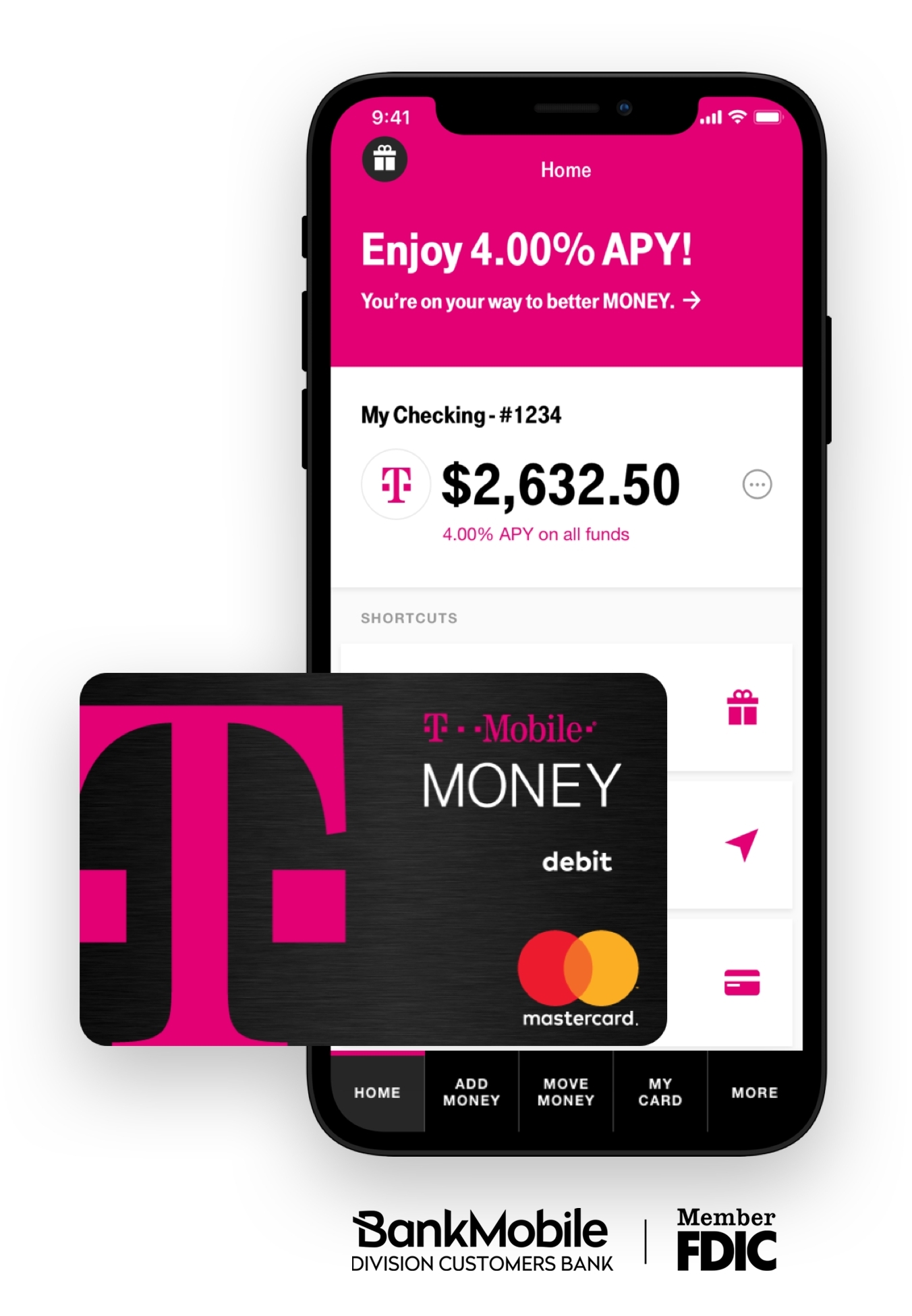
Another mobile pain point: tackled. T-Mobile (NASDAQ: TMUS) launched T-Mobile MONEY nationwide. It’s a no-fee, interest-earning, mobile-first checking account that anyone can open and manage right from their smartphone. With T-Mobile MONEY, eligible Un-carrier customers can earn an industry-leading 4.00% Annual Percentage Yield (APY)* on balances up to $3,000 – 50 times higher than the average U.S. checking account – and 1.00 APY% on every dollar over that! Plus avoid all those big bank fees and overdrafts.
“Traditional banks aren’t mobile-first, and they’re definitely not customer-first. As more and more people use their smartphones to manage money, we saw an opportunity to address another customer pain point,” said John Legere, CEO of T-Mobile. “You work hard for your money … you should keep it … and with T-Mobile MONEY, you can!"
Keep More, Earn More
Big banks are built on fees. In 2017, Americans paid $34 billion … in overdraft fees alone!! And that’s just one kind of fee. Bank of America Advantage Checking has 19 different types of fees, and Wells Fargo Everyday Checking has 14! With T-Mobile MONEY, there are no fees -- no monthly, overdraft or transfer fees, no fees at over 55,000 in-network Allpoint® ATMs worldwide** and no fees from T-Mobile for using out-of-network ATMs. Also, no minimum balance requirement!
And, you’ll earn more interest on your money, too. A lot more. T-Mobile postpaid customers can get 4.00% APY* on balances up to $3,000 and 1.00% APY on every dollar over $3,000 when they sign up with their T-Mobile ID and deposit at least $200 each month. Everyone else scores 1.00% APY on all balances.
Un-carrier postpaid customers can opt-in for Got Your Back overdraft protection when they sign up for T-Mobile MONEY, so when the unplanned happens, they can go in-the-red, up to $50, without penalty -- just bring the account back to a positive balance within 30 days.
Banking Built for Mobile
Consumers are outgrowing traditional banks – 7 out of 10 consumers bank digitally, and smartphones are the fastest growing digital platform.5 Yet less than half of traditional banks say they have a digital strategy6, and only 13% believe their core systems can keep up with digital innovation.
T-Mobile MONEY is built to be mobile-first, and you can do all the things you need to do every day with your checking account right from the app – make mobile check deposits, set up direct deposit, pay bills, send a check, pay with a mobile wallet such as Apple Pay, Google Pay and Samsung Pay, transfer money, even make payments person to person. The app offers biometric security with fingerprint and Face ID login, account alerts and debit card disabling.
Plus, T-Mobile MONEY comes with a Mastercard® debit card you can use at more than 55,000 Allpoint ATMs worldwide – more ATMs than Bank of America, Chase or Wells Fargo. And you can use the T-Mobile MONEY app or web site to locate the ATM nearest you. Plus, your T-Mobile MONEY Mastercard offers Mastercard Zero Liability Protection.
T-Mobile MONEY is created in partnership with BankMobile, a division of Customers Bank (Member FDIC), and has been available in a limited pilot since November 2018. T-Mobile MONEY deposits are FDIC-insured up to $250,000. Customers can get 24/7 bi-lingual customer service and support with T-Mobile MONEY Specialists.
- 05:00 am

Remitly, the largest independent digital remittance company in North America, has launched its award-winning service to France, making international money transfers more fair, transparent, and cost-effective when sending money from France to international destinations.
Remittances are important to the millions who rely on them. For many on the receiving end, remittances are a lifeline providing them with basic necessities. Traditional remittance players have pocketed billions of dollars of hard-working immigrants’ earnings in transfer fees and confusing exchange rates. This is money that could help improve their quality of life and provide them with upward mobility.
Over $21 billion is sent from France to other countries each year. That money is mostly sent by immigrant workers in France sending money to their loved ones in Morocco, Tunisia, and Senegal, among other countries.
“Remitly makes the process of sending money internationally faster, easier, more transparent, and less costly,” said Elena Novokreshchenova, vice president of Europe for Remitly. “We do this by eliminating the forms, codes, agents, extra time and fees typical of the traditional money transfer process. We’re thrilled to be in France where customers are increasingly transitioning away from traditional offline channels to more efficient and affordable digital channels.”
Customers can access the Remitly service through its mobile app or website and benefit from a variety of secure and convenient money sending and receiving options, including:
- An easy way to send money on-the-go from your mobile phone or computer.
- On-time delivery backed by a money back guarantee.
- Great rates and no hidden fees.
- Multiple ways for recipients to receive money including cash pickup, home delivery and mobile wallets with our network of partners such as Attijariwafa Bank, Banque Populaire du Maroc, and BMCE Bank in Morocco, Banque De L’Habitat in Tunisia, and Orabank, Ecobank, and Wafacash in Senegal.
- 24/7 friendly customer support.
Remitly was established in 2011 to disrupt the $625 billion global remittance industry, and today transfers over $6 billion around the world annually through its proprietary global money transfer platform.

Euan Davis
European Lead at Cognizant’s Center for the Future of Work
The European banking industry is under extreme pressure. Although the looming risk posed to financial stability by Brexit is perhaps the most notable risk, 2019 is looking like it will be a challen see more








