
Published

Barley Laing
the UK Managing Director at Melissa
With most banking services now conveniently available online, this accessibility comes with some risk, with customer fraud - whether by an individual or a business - on see more
- 03:00 am

Tools for Brokers (TFB), an international technology provider for retail brokers, prop trading companies, and hedge funds, and Red Acre Group, a premier player in the world of financial market solutions, have announced a partnership that can benefit all stakeholders in the proprietary trading space. This new joint venture offers an all-in-one solution for business owners and entrepreneurs interested in prop trading and is already available worldwide.
Tools for Brokers supplies the infrastructure with Trade Processor at the core of the ecosystem, which includes everything required for prop trading firms: a bridge connection to the LP, an aggregated price feed, an execution engine that simulates real market execution for demo accounts, a risk management system to control drawdowns with a trailing stop out level and much more.
The company's offerings are set to be complemented by Red Acre's cutting-edge technologies. Red Acre Group will integrate into the product its state-of-the-art CRM, Trader's Room, various front-end elements, and, crucially, its renowned 24/7 support for both businesses and traders. In short, prop firm owners will be able to focus exclusively on their network and client acquisition, leaving the handling of all the technology, marketing, and support to TFB and RA Group.
This comprehensive offering caters to a broad spectrum of stakeholders in the financial market. Existing brokers who wish to diversify their product range with proprietary trading can avail themselves of this plug-and-play solution. Likewise, budding entrepreneurs seeking a quick, complete, and reasonably priced entry into the financial market will find an easy and lucrative path forward with their personal prop firm's launch.
Gary Mullen, Chief Commercial Officer of Red Acre Group, spoke enthusiastically about the new partnership: "This is a phenomenal opportunity to enhance B2B financial market accessibility. At Red Acre, we have always prioritized collaborations with industry leaders to create synergies that benefit not only the businesses involved but also all clients who choose to use our platforms. This partnership promises exceptional service and high profitability for all."
Ivan Egorov, the Global Head of Sales at TFB, added: “Over the past year, we’ve seen a huge shift in the Prop Trading world. The industry is on the rise, and many companies come to us asking for technology that would support their intensive growth and ensure excellent performance. Red Acre and TFB have created a turnkey solution for Prop Trading businesses to help them keep the momentum going and guarantee a top experience for all traders.”
- 02:00 am

Nasdaq today published the results of a major global survey across the post-trade ecosystem, including over 300 decision-makers from exchange groups, custodians, brokers, and other service providers. The report was produced in partnership with the ValueExchange.
The landmark study reveals that 78% of Financial Market Infrastructure (FMI) investment budgets are dominated by maintaining and upgrading legacy technology platforms. Simply keeping the lights on is taking up 44% of infrastructures’ investment capacity, whilst a further 34% is allocated to the transition and replacement of these systems. Alongside intense regulatory oversight and mandated change, operating models are being pulled in multiple directions. This is leaving very little scope for spending on growth initiatives and highlights an ever-increasing risk for the industry.
Roland Chai, Executive Vice President and Head of Marketplace Technology at Nasdaq said: “Over decades technology debt has built up amongst infrastructure providers across financial markets. With more than a third of firms planning a major system overhaul over the next five years, alongside responding to an unprecedented wave of regulation, the need for refreshing core technology is a challenge that is core to most industry participants. As the backbone of the industry and global economy, operators must differentiate themselves and remain relevant for the next generation of investors.”
This spending constraint is leading to a substantial difference in investment allocations between FMIs and their participants. For example, for over ten years Robotic Process Automation (RPA) has been proving highly effective in facilitating the quick and tactical automation of core processes and yet today only 4% of FMI spend is on RPA and AI initiatives, compared with over 28% by market participants.
Ageing platforms require major system overhauls
A third of firms surveyed operate with legacy platforms more than ten years old, with 37% of respondents planning a major system overhaul in the next five years. The need to undertake significant projects is particularly prevalent in the post-trade space where 47% of clearing firms expect to trigger an upgrade, while in settlements 44% of firms see a transition as imminent. This comes at the same time as they look to remove time from their processing and increase their settlement efficiency, meaning an inevitable ‘distraction effect’ at a critical time.
Regulatory change is the central concern for FMIs
The study finds the reach of mandatory regulatory change is the central concern for 64% of our respondents. As the global securities industry continues to contend with the impact of the Shareholder Rights Directive II and Central Securities Depositories Regulation, project teams are now faced with the added complexities of the transition to T+1 settlement cycles in North America in May 2024.
In parallel, The UK Securities Financing Transactions Regulation has forced securities finance firms to profoundly rationalize and accelerate their data reporting capabilities – as will the Securities Lending Transparency: Rule 10c-1 in the USA. Considered in the context of multiple local market regulations centred on client asset segregation, client monies and other areas, the regulatory agenda is increasingly requiring significant, enterprise-wide change across the entire trade cycle.
“Across our client base there is an increasing recognition of the need to undertake major change programs, having adopted a patchwork approach for decades” said Magnus Haglind, Senior Vice President and Head of Products, Marketplace Technology at Nasdaq. “The need to respond to regulatory change is also seen as significant factor, which increasingly demands re-engineering entire platforms, rather than tactical initiatives. This underscores the importance of modernization initiatives across infrastructure operators, where growth should form a key part of legacy upgrades.”
- 06:00 am

Finastra, a global provider of financial software applications and marketplaces, today announced the launch of its new payment solution, Finastra Compliance as a Service on Microsoft Azure. The service includes Fincom's real-time AML (Anti-Money Laundering) transaction screening and ThetaRay’s AI-powered transaction monitoring as a pre-integrated packaged solution with Finastra Payments To Go. The end-to-end solution, based on technology proven at many of the world’s leading financial institutions, enables US and European banks to streamline and automate compliance processes to effectively deliver instant payments. The service will soon be integrated with Finastra Global PAYplus.
Finastra Compliance as a Service helps banks take advantage of, and comply with, a range of instant payment infrastructures, including the FedNow service in the US and TIPS in Europe, while mitigating the increased risks of financial crime. With real-time compliance screening by Fincom and real-time AI-powered transaction monitoring from ThetaRay, the service will allow financial institutions to accelerate business growth, increase risk coverage and reduce operational costs.
“The introduction of any new payment rail brings new risks, and especially when that rail operates in real-time,” said Mike Vigue, Chief Product Officer, Payments at Finastra. “We are building on the success of Payments To Go for instant payments by providing accurate and efficient compliance capabilities at a reduced total cost of ownership. By pre-integrating Fincom and ThetaRay with our solutions, our customers will reduce the time and risks of launching instant payment services while benefiting from a new level of security, scalability and flexibility. Finastra is committed to helping banks keep pace with customer, industry and regulatory demands through payments innovation, bringing together our ecosystem of partners to deliver a best-of-breed service.”
“By delivering relevant value-added payment risk solutions as a service, we will help banks to improve speed-to-market and ensure our customers stand to benefit from the ongoing evolution in enabling capabilities like AI and Machine Learning,” added Radha Suvarna, Head of BaaS and Value-Added Payment Solutions at Finastra.
Payments To Go is an end-to-end SaaS payment processing solution that enables banks to deliver instant and flexible digital payments faster and more efficiently. Financial institutions can subscribe to the solution through Microsoft Azure Marketplace for convenient billing through one single invoice. Integrated with Finastra’s Financial Messaging Gateway, Payments To Go provides frictionless, more affordable and direct access to the TIPS and FedNow networks, among others. Combined with specialist compliance services from Fincom and ThetaRay, Finastra Compliance as a Service harnesses the power of AI and ML to provide on-the-spot compliance checks for optimal operational efficiency for instant payments.
- 07:00 am

Temenos has today announced that it has been recognized as a market leader in the latest “Omdia Universe: Cloud-based Core Banking 2023” evaluation from Omdia, a leading technology analyst and consulting firm.
The report, “Omdia Universe: Cloud-based Core Banking 2023”, helps C-level executives and banking heads to shortlist vendors/solutions when replacing legacy core systems. Temenos was recognized as a strong performer across the board, achieving the highest scores in the report for market alignment, innovation, business processes management and solution integration, as well as performing strongly for its broader platform capabilities.
Ouliana Smith, Senior Research Analyst, Omdia, said: “Our research showed that Temenos was a high performer across the board, achieving the highest scores in the report for market alignment and innovation, as well as performing strongly for its broader platform capabilities. During the evaluation, Temenos demonstrated innovation in the areas of open products for the creation of highly configurable financial products or ‘smart products’, AI, and ESG. In conjunction with Temenos’ broader community of global partners, Temenos Exchange fintech partners, developers and its Innovation Hub, Temenos Banking Cloud offers a compelling solution for banks of all sizes and from all geographies who wish to leverage the benefits of cloud, while also being supported through their transformation journeys. Based on our research, Temenos should appear on your shortlist, particularly if you are seeking a platform that enables rapid new product launches and innovation.”
In addition, Temenos was recognized for its extensive expertise, single code base and industry-standard, event-driven architecture. This enables clients to easily and rapidly enhance the platform with additional capabilities as needed via its Extensibility Framework and Temenos Open Products, while allowing them to consume new offerings safely thanks to continuous updates. Omdia also noted the ESG credentials of the platform, with its science-based metrics and Carbon Emissions Calculator, as well as the embedded explainable AI which helps banks to proactively enhance trust with their customers.
Prema Varadhan, President Product and COO, Temenos, said: “Our recognition as a leader in the Cloud-based Core Banking Universe from Omdia is a testament to the work of the team at Temenos in delivering an industry-leading cloud banking platform. We have over 700 clients live on Temenos Banking Cloud, across five continents, covering over 30 regulatory jurisdictions, with a bank going live on our SaaS platform on average every 10 days. Banks of all sizes are increasingly recognizing the benefits of Temenos Banking Cloud, which allows them to elastically scale and accelerate innovation on a continuously updated, trusted, secure service.”
Banks going live with core banking on Temenos Banking Cloud, the company’s SaaS offering, in the past year include Bank of Queensland and Virgin Money in Australia, Alpian, Switzerland’s first digital private bank, and Saudi Export-Import Bank. New signings this year include a top 30 US bank which selected Temenos Banking Cloud to modernize its legacy systems for customers’ records and deposits, and Canadian Tire Bank, part of one of the largest Canadian retail companies, which selected Temenos Banking Cloud to accelerate its core modernization.
Today’s announcement follows Temenos’ recognition by Omdia as a leader in the report ‘Omdia Universe: Digital Banking Platforms, 2023’, where Temenos achieved leadership status as a result of its comprehensive capabilities, solution breadth, strategy and product roadmap across functionalities such as onboarding, digital marketing, analytics, and digital banking. It also comes on the back of Temenos being named a Trusted Cloud Provider by the Cloud Security Alliance, becoming one of only 30 technology providers globally to date to achieve the STAR Level 1, STAR Level 2 attestation and the Trusted Cloud Provider mark.
- 04:00 am

Spectrum Markets (“Spectrum”), the pan-European trading venue for securitised derivatives, announced today one of its members, Societe Generale, is expanding the geographic availability of some of its daily constant leverage products and vanilla warrant products listed on Spectrum to include Italy.
Spectrum's plug-and-play infrastructure, and its novel single European ISIN, enabled the global financial services firm to quickly and easily extend the scope of its geographic coverage within the trading venue, without going through the process of listing new instruments.
The addition of these financial instruments, issued by Societe Generale, expands the range of investment solutions available to Italian retail investors via Spectrum, allowing them to benefit from a deeper pool of European liquidity.
Spectrum will continue to manage a unique, international order book for each individual instrument listed by Societe Generale, that also incorporates trading volumes from Spain, Sweden, Norway and Finland, where some of these products were first made available at the end of last year.
“We’re very pleased to see Societe Generale expanding the scope of its relationship with Spectrum so soon after listing its first products with us. The firm is well known for its pioneering approach within the industry, and we look forward to continuing to work together on delivering our shared goal of providing European retail investors an innovative, accessible, safe and transparent financial market experience,” says Nicky Maan, CEO at Spectrum Markets.
“Our experience with Spectrum Markets has been very good so far, and we’ve been pleased with the way we were able to simply and efficiently add Italy to the scope of our offering on the trading venue. We see significant demand for our range of securitised derivative products from retail investors across Europe and we very much look forward to seeing how this partnership continues to develop in the coming years,” said Didier Imbert, Head of Public Distribution Europe for Societe Generale.
- 04:00 am

UK Finance today releases its latest Payment Markets Report which shows payments trends across 2022 and forecasts to 2032.
Key findings for 2022:
- Total number of payments increased to 45.7 billion, up from 40.4 billion in 2021.
- For the first time, half of all payments (50 per cent) in the UK were made using debit cards.
- The number of cash payments increased to 6.4 billion payments (6 billion in 2021) although the proportion of payments made using cash fell slightly from 15 per cent to 14 per cent.
- The number of contactless payments increased by 30 per cent to 17 billion.
- Nearly a third of adults are registered for at least one mobile payment service, while 86 per cent of adults used a form of remote banking.
- Continued growth in the use of Faster Payments by both consumers and businesses.
The total number of payments (consumer and business) in the UK last year increased to 45.7 billion, up from 40.4 billion in 2021.
Payments made by businesses accounted for 13 per cent of the number of all payments made in the UK during 2022. However, due to the high average value of business payments, these accounted for 82 per cent of the total value of payments made. Consumers made 87 per cent of all payments, accounting for 18 per cent of the total value of payments.
The split of this total across various payment types is shown in the graph below:
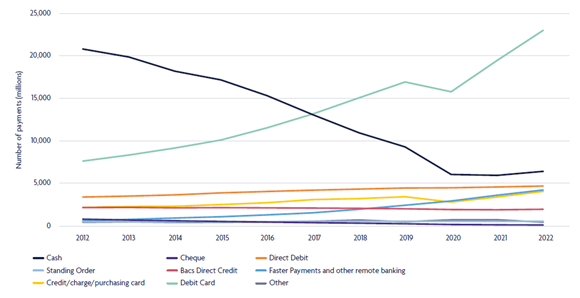
Chart 1.1 – Payment volumes (millions) 2012 to 2022
UK Finance’s data suggests that there has been a shift towards an increasing number of transactions that are each worth a lower amount, without necessarily increasing the overall amount spent.
Anecdotal evidence suggests that people are, for example, making more smaller visits to supermarkets rather than doing one large shop. In addition, as more people work from home, purchases of travel cards have fallen significantly as people instead pay for individual journeys – therefore increasing the number of travel payments.
Credit and debit cards
Debit cards remain the most popular payment method and volumes increased by 18 per cent during the year to just over 23 billion payments (2021: 19.5 billion).
As a result, for the first time, half of all payments in the UK were made using debit cards.
Payments made using credit cards increased by 19 per cent from 3.4 billion in 2021 to 4.1 billion in 2022.
Contactless
Across both debit and credit cards, there were 17 billion contactless payments, a 30 per cent increase on the 13.1 billion made in 2021.
Contactless payments were used extensively throughout the UK in 2022, with 87 per cent of people making contactless payments at least once a month or more frequently.
The average value of contactless payments continued to grow in 2022 at £15.10, up from £12.66 in 2021.
Cash
The long-running trend in cash has been one of continued decline, although it remains the second most frequently used payment method.
The total number of cash payments made in the UK during 2022 increased to 6.4 billion, (2021: 6 billion).
Due to the higher total volume of payments, the share of payments made using cash still fell slightly, from 15 per cent to 14 per cent. A decade ago, 54 per cent of all payments were made with cash.
Growing fears about inflation and the rising cost of living have meant some people are making greater use of cash as a way of managing budgets.
There were 21.6 million people who used cash only once a month or not at all in 2022, down from 23.1 million the year before.
There were 0.9 million consumers who mainly used cash in 2022, down from 1.1 million in 2021 and 2.2 million five years previously in 2017. These consumers use cash when doing their day-to-day shopping, although the majority still use other payment methods to pay their regular bills.
Remote banking
Remote banking (online, mobile, or telephone) remained popular in 2022 with 86 per cent of adults using at least one form last year.
The majority of people across all age groups used remote banking in 2022, ranging from 80 per cent of those aged 65 and over to 95 per cent of people aged 25 to 34.
The number of remote banking payments processed via the Faster Payments Service continued to grow strongly, increasing 17 per cent to 4.3 billion payments. Use of remote banking by businesses contributed to this strong growth.
Mobile Wallets
As well as using contactless cards, other devices such as mobile phones are increasingly being used to make contactless payments.
Thirty per cent of the adult population reported being registered for at least one mobile payment service in 2022, with younger people more likely to be making use of mobile wallets.
Overall, use of these services is still lower than use of contactless cards, but they appear to be growing in popularity and it is likely that mobile payment methods will see strong growth in the future.
Buy Now Pay Later (BNPL)
Around one in eight people in the UK (12 per cent) reported using BNPL services to purchase something during 2022, the same proportion as in 2021.
Those aged 25 to 34 reported using BNPL most, with almost one in five adults in this age group (18 per cent) using it in 2022.
Eight per cent of people aged 65 and over reported using BNPL, which was up from four per cent in 2021.
Forecasts to 2032
Over the next decade, we expect to see a continuation of current trends, with debit cards becoming ever more popular and cash usage falling as shown in the graph below.
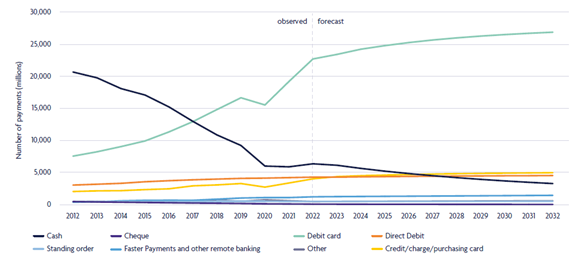
Chart 1.2 – Payment volumes (millions) 2012 to 2032
We forecast debit card payment volumes will increase to over 27 billion, which will likely be driven through contactless payments, online shopping, and the ever-increasing levels of card acceptance among businesses of all sizes.
Meanwhile, we expect the number of cash payments to continue to fall in the long run as the cost of living crisis eases, consumer confidence returns and consumers continue to turn to alternative payment methods. The rate of decline is expected to slow as use is concentrated among those who strongly prefer to use cash. We expect there to be around 3.3 billion cash payments in the UK in 2032, accounting for around eight per cent of all payments.
Adrian Buckle, Head of Research at UK Finance, said:
“During 2022 we saw increased use of contactless, online banking and mobile payments, although cost-of-living challenges meant that some people preferred to use cash to help with their budgeting.
“Changes to shopping and travel habits, particularly related to the rise of hybrid working, led to a big jump in the volume of transactions made. Debit cards remain the most popular way of paying, with them now accounting for half of all payments made in the UK.
“There is a wide variety of payment methods available in the UK and each provides specific benefits to the people using them. Over the next decade we are forecasting further growth in the use of card and mobile payments and market developments such as Open Banking may bring further changes to the payments landscape.”
- 08:00 am

Pay.UK, owner and operator of the Current Account Switch Service, today publishes research revealing that the majority of Gen Z wish they had received more financial education at school.1
As many young people return to school and university, new research from Pay.UK, owner and operator of the Current Account Switch Service, today publishes reveals that three quarters (75%) of 18-24 year olds (“Gen Z”) wish they had received more financial education at school.2
The UK-wide survey of over 2,000 18-24 year olds across different lifestyle groups suggests that many young people want to understand more about their finances. Over half of respondents wished they had learned more about savings, budgeting and building credit when they were at school (63%, 62%, 56% respectively). These topics were closely followed by pensions (43%) and current accounts (42%).
Almost all survey respondents (90%) said they were speaking to someone about their financial situation, with the majority turning to family (59%). Many are also turning to their friends (15%) and their bank or a financial adviser (11%) for advice. Despite this, over half (55%) of 18-24 year olds do not feel confident when it comes to managing their finances.
Reassuringly, 78% of respondents feel supported by their banking provider. However, when asked what their banking provider could do to support them more, 35% felt they would benefit from free financial support and 32% from better budgeting tools.
The research also reveals disparities in financial literacy when it comes to banking, with 31% stating they do not know what a current account is.
Current account switching trends
When asked about switching their current account, only a third (35%) of Gen Zs have ever switched, with financial incentives coming out as the main reason for switching (20%). For others, the main reasons for switching include not feeling that their old provider properly served their needs (18%), poor customer service with their old provider (16%), cashback incentives (15%), frustration with their old supplier (12%), and overdraft facilities with their new provider (10%).
When asked to consider up to three benefits that sound most important when thinking about banking, over half (62%) of respondents felt that online banking was the most important. This was followed by fraud and scam protection (40%), customer service (29%), and being able to have all products with one provider (21%).
Financial stability
As young people grapple with rising inflation and economic uncertainty, the research reveals that 70% of Gen Z are more worried about their financial stability than they were this time last year. Half of respondents (50%) are specifically worried about the cost of living crisis, while a quarter (26%) are worried about the cost of buying a house and 23% about the cost of renting.
Meanwhile, over a quarter (27%) of those surveyed are using their overdraft facility to pay for necessities. This is followed by going out with friends (17%), buying new clothing (15%), and travelling abroad (14%).
Only 27% of Gen Z said they do not have any debt, with student loans (36%), credit card debt (16%) and Buy Now Pay Later (“BNPL”) debt (15%) featuring as the most common types of debt for this generation. Only 14% took loans from their family and 9% from their banks.
As online shopping continues to grow in popularity, the research reveals that BNPL plays a role in spending habits for this age group, with just over a third (34%) using BNPL schemes at least once a month. Buying clothes online (32%), large purchases such as electronics (32%), and birthday or Christmas gifts (20%) came in as the most popular BNPL purchases. However, 1 in 5 (20%) are using BNPL when they are waiting for payday while 12% use BNPL for physical food shops and 10% for takeaways.
John Dentry, Product Owner at Pay.UK, commented: “The number of 18-24 year olds who do not know what a current account is surprisingly high and highlights the need for better financial education for Gen Z, not only for current accounts, but banking habits more generally. For those who do not know what a current account is, it’s really important that banks, institutions, and we as a Service are educating young people, so they can take the first step in finding a bank account that best suits their needs.
“Banks and building societies offer a host of products and services that could better serve the needs of young people across the UK. From cash incentives and higher interest rates for the budget conscious student, to better customer service and streamlined apps, which may offer an enhanced user experience.
“It’s reassuring to see that a large majority of this generation feel supported by their banking provider. As young people continue to navigate an increasingly challenging financial environment, they can rest assured that if they find a bank that better suits their needs, the Current Account Switch Service is on hand to facilitate a quick, easy and guaranteed transition to their new account.”
- 05:00 am

Lingering recessionary fears are causing consumers to still cut spending according to the Q3 2023 Consumer Pulse Report released today by Marqeta, the global modern card issuing platform. The new report surveyed 3,000 consumers in the US and the UK in partnership with Propeller Insights, showing that against this backdrop of economic uncertainty, consumers are reevaluating how new technologies can help them manage their finances and are flocking to embedded finance offerings including Accelerated Wage Access to help them gain access to wages faster. In addition, consumers are showing demand for seamless and delightful shopping experiences along with newfound interest in how Generative AI solutions can help them reduce spending and guide savings.
Marqeta’s Q3 Consumer Pulse report is the second of its kind where the company has surveyed consumers to get a pulse check on how they’re adapting to the changing financial landscape. According to the survey, despite an improved economic outlook, consumers are feeling the crunch as living costs remain high. Eighty-six percent of consumers surveyed reported being concerned about an impending recession and the majority (67%) are changing their financial habits in order to cut spending.
Daily Wage Access Trumps Other Conveniences
According to the report, embedded finance solutions that offer accelerated access to wages are striking a chord with consumers, enabling them to access their wages sooner to help keep up with rising interest rates and inflation. Over two-thirds of consumers surveyed (66%) said that if presented with a choice, they would sacrifice something important to them to get paid daily– the most popular being a year of takeout food (29%), social media access (27%), or haircuts (25%). The appeal for daily access to wages was highest in the US, with 21% of surveyed consumers saying that they would give up an entire week of PTO, compared with 15% in the UK, and 16% saying that they’d give up their retirement savings in order to get daily access to their paychecks, compared with 10% in the UK – underlining the desire for a transformation in how workers get paid in today’s economy.
A Seamless Payments Experience More Important Than Corporate Values
When it comes to brand loyalty, consumers reported the importance of the customer experience. Brand loyalty relies heavily on ensuring a seamless customer journey, from the start of the shopping experience to the checkout and payment process. Almost three-quarters of consumers surveyed (72%) said they are likely to be more loyal to a brand because it offers a better customer experience when they purchase a product or service, including fast checkout, quick shipping, or the ability to pay with a phone or earn rewards. Eighty-five percent of consumers think the checkout or payment experience is more important than a company’s corporate values or social positions when purchasing from a brand – especially critical for brands as discretionary spending increases.
“Today, there is no room for anything less than a stellar customer experience,” said Rachel Huber, Marqeta's Market Intelligence Lead. “Consumers are demanding seamless touch points at every stage of the customer lifecycle. Our report shows the opportunity for companies to think about how they can boost customer loyalty and offer embedded finance solutions that elevate their customer experiences and promote financial empowerment.”
Consumers Are Ready For Generative AI to Generate “Money”
With economic uncertainty taking hold, Marqeta’s report reveals that consumers are increasingly open to leveraging Generative AI tools to help them with their financial planning, including budgeting, investing and how to increase their savings. Over one-third (36%) of consumers surveyed said they’d be interested in using Generative AI to manage their finances, with that number increasing to over 50% for individuals younger than 50 years old. US consumers reported being more open to Generative AI than UK consumers, with 40% agreeing that they’re open to Generative AI tools, compared to 29% in the UK.
“Generative AI has the potential to be a force for good when it comes to financial management,” said Huber. “What our findings show is that after a year of unrelenting rises in living expenses, consumers are open to emerging technologies that could provide support and unlock new ways to improve financial well-being.”
Download the full report here.
- 09:00 am

Fxview, a Forex and CFD industry leader that has made the headlines with its exclusive service offering and commitment to client service, announces its participation in the iFX EXPO International 2023. The broker is also the Elite Sponsor of the prestigious fintech event, securing a central position in front of the industry elite.
The Fxview team has also reserved the prime position at booth 1 at City of Dreams Mediterranean Integrated Resort, the venue of this year’s iFX EXPO International. Looking forward to meeting existing and new partners present at the expo, Fxview professional team will be ready to answer any questions related to its partnership program and exciting offerings. Book a meeting with the team here.
What to expect from Fxview at iFX EXPO International
Between 19 and 21 September, the financial world is set to witness a momentous event as Fxview prepares to take centre stage. With a host of powerful marketing tools, a dedication to personalised service, and a commitment to transparency, Fxview is about to make a significant impact at the biggest and most important global fintech event of the year.
As the Elite Sponsor, Fxview aims to showcase its commitment to excellence and provide valuable insights to industry professionals and traders alike. Its presence demonstrates their dedication to providing top-notch trading solutions and support to their clients.
Eagerly anticipating the event, Fxview’s MD, Janis Anastassiou said: “We are excited to be the Elite Sponsor of iFX EXPO International. This brings us closer to partners globally, enhancing our position worldwide as we aim to engage with more international partners.”
Tailored Partnership Programs
Fxview provides tailored solutions for White Label brokers of all sizes. Some of these include:
White Label solutions: Fxview's White Label Partnership Program provides partners with a fully tailored solution. Partners can take advantage of user-friendly back office systems, direct connectivity to deep liquidity on a variety of asset classes and PSP integrations that work right out of the box.
Liquidity provision: Get access to best-in-class, institutional-grade liquidity directly from an investment bank. As a member of Finvasia Group, Fxview provides its partners with access to the liquidity services offered by Finvasia Capital Ltd., holder of an FSC Mauritius Investment Banking License. Thanks to its ECN connectivity to a vast range of top-tier liquidity sources, Fxview provides seamless access to deep aggregated liquidity. Contact the team to explore this offering.
On top of this, the Fxview White Label Program comes with a variety of options for start-up brokers through the ActTrader platform. It is equipped with advanced tools, a fully customisable interface and a Broker Portal that offers brokers a single view of client accounts, volume, revenue streams and more.
As a distinct advantage, Fxview White Label Brokers can also benefit from a tailored Partnership Program guided by the Fxview marketing team.
In addition, Fxview provides access to a vast range of tools, including marketing materials, tracking links and other deliverables to boost its partners’ efforts. These combined with its advanced infrastructure, seamless access to deep aggregated liquidity and low-cost trading that can create a stable environment for both retail and institutional market players.
On the retail side, Fxview offers more than 500+ trading instruments, including CFDs on forex, stocks, indices and commodities at raw spreads, which traders seek.
Furthermore, Fxview as part of Finvasia Group ensures EU and global regulatory coverage including CySEC, the FSC and FSCA as a guarantee of security, transparency and client fund safety.
Risk warning: CFDs are complex instruments and come with a high risk of losing money rapidly due to leverage. 78.67% of retail client accounts lose money when trading CFDs. You should consider whether you understand how CFDs work and whether you can afford to take the high risk of losing your money.








