
Published
- 09:00 am

Pie People have selected world leading payment processor innovator, Paymentology, to be their card processor. The leading edge Paymentology platform will form the backbone behind the companies new Shari’ah compliant banking payment platform.
Pie People are building a full service Shari’ah compliant banking platform ground up to offer end to end Banking as a Service (BAAS). The Paymentology partnership is one of the first steps in this journey.
Paymentology is an Issuer side payments processor specialising in provision of fast, scalable and dedicated processing for banks and card issuers around the globe. The platform already supports many global banks.
Chief Executive of Paymentology, Shane O’Hara commented, “Adding Pie People to the platform is an important step for us as we enhance our offering to incorporate the world of Islamic banking, and we look forward to cementing our relationship further through provision of highly flexible processing.”
Pie People was created to serve the unbanked, SME’s and Fintechs with a Shari’ah compliant banking platform, helping business to innovate and scale in an ethical, transparent and socially responsible way.
Founder of Pie People Abdul Kadir welcomed the engagement with Paymentology, saying, “We wanted a partner that didn’t just concentrate on profit margins, a partner sensitive to all of our needs as a provider of ethical banking. We needed a partner who could support our business model, was flexible and presented us with a team that could ensure our success. Paymentology’s experience and world class technology stood out from the crowd.”
- 04:00 am

OneSpan™ (NASDAQ: OSPN), the global leader in securing remote banking transactions, today announced that leading Turkish bank, DenizBank, is using OneSpan’s Mobile Security Suite to protect 2.6 million mobile customers across the bank’s mobile banking app MobilDeniz, mobile wallet fastPay and card management application DenizKartım.
Mobile attacks like malware and banking trojans have been increasing at an alarming rate during the pandemic as mobile transactions increase. During this time, DenizBank’s daily mobile banking transactions volume has more than doubled. Using anti-fraud solutions from OneSpan, including Cronto visual transaction signing, DenizBank is able to help fight increases in fraud in a way that is scalable and seamless for its customers.
“Our bank is driven to innovate and deliver an outstanding customer experience at all times in everything we do, which requires the convenience and scalability of technology like OneSpan’s,” said DenizBank Deputy Chief Digital Officer, Gürhan Cam. “OneSpan solutions deliver security and convenience for our customers, which is why we are also exploring how they can deliver digital account opening and risk analytics in the future.”
“Global banks are under significant pressure in responding to pandemic-driven security, customer access, and cost pressures while balancing the immediate need for expanded mobile solutions,” said OneSpan CEO, Scott Clements. “OneSpan’s technologies, like Mobile Security Suite, give banks a quick and easy way to implement security measures without compromising the user experience.”
Additionally, OneSpan’s technology helps DenizBank meet the Turkish Banking Regulation and Supervision Agency (BRSA) regulation for strong customer authentication in mobile banking applications. This competitive win sees DenizBank join Odeabank and several other banks in Turkey already using Mobile Security Suite.
- 01:00 am
Minsait, an Indra company, and Auriga have reached a strategic agreement that will strengthen their position in the digital transformation of bank branches in Spain, Portugal, Brazil, Colombia, Mexico and Peru. The partnership integrates Auriga's omnichannel banking solution, WinWebServer (WWS), into Onesait Banking Branches - Minsait's end-to-end solution that merges physical and digital channels to offer a personalised user experience throughout the service cycle.
Minsait’s market presence and experience, combined with the advanced software technology solution provided by Auriga, will help organisations in the banking and financial market of the countries indicated to offer greater operational efficiency, better cost-effectiveness ratio and improve the customer experience through specific and bespoke customer journeys.
This alliance also coincides with Auriga’s expansion into the Spanish market, a key territory for both companies due to the relevance of its financial industry. Thanks to the combination of the capabilities and technological specialisation of Minsait and Auriga, banking entities operating in Spain will be able to benefit from personalised solutions for the digital transformation of branches, plus leverage new financial services adapted to today's consumers and companies.
"Minsait is the best partnership choice for Auriga’s entry into the Spanish market. It has deep experience and knowledge in the digital transformation of financial institutions and will be key to driving innovation in omnichannel banking," said Vincenzo Fiore, CEO of Auriga.
"The integration of Auriga's WWS platform into the Onesait Banking Branch ecosystem of Minsait will allow access to all the information collected during the service cycle and convert the merely transactional visit into a valuable one; to facilitate the continuous improvement of the customer experience , decision-making and the development of commercial actions, ” affirms Antonio Bolaños, Head of Technology and International Alliances for Financial Services at Minsait.
Auriga's WWS application offers an efficient omnichannel banking experience, with 24/7 access to personalised, contextualised and real-time services. It is a unique cloud-based concept for managing all channels consistently and with minimal effort, regardless of the manufacturer of the ATM or self-service device. More than 70% of ATMs in Italy have the WWS solution installed.
Onesait Banking Branches, from Minsait, represents a comprehensive vision of the merging process of physical and digital channels through the creation of an ecosystem that covers all the phases of service around three main stages of the customer journey: Activa, which includes biometric recognition and identification solutions; Conecta, which facilitates operations with different devices and levels of assistance; and Acelera, which enables the development and implementation of new solutions and emerging technologies.
- 05:00 am

PayCertify, a leading online payment processor for the ecommerce, healthcare and hospitality sectors, today announced its partnership with dispute management specialist, Chargebacks911.
The collaboration has been established to deliver a complete chargeback management and mitigation system for PayCertify. As such, its online merchants will benefit from assistance in preventing, managing and recovering lost revenue due to chargebacks.
Chase Harmer, CEO of PayCertify, commented: “Chargebacks are never a good thing for online merchants. They’re destructive, take valuable resources away from real business growth opportunities, and cost businesses millions every year.
“Managing chargebacks has become even more critical to businesses these days, given the global pandemic situation and the uncertainty that has come with it. That’s why we’ve chosen to partner with the industry leader in chargeback mitigation, Chargebacks911, to support our merchants and protect them from the financial losses resulting from chargebacks and issues with an order.”
PayCertify reached out to Chargebacks911 due to the end-to-end benefits of its merchant services. Even though chargeback services are often seen as a post-transaction process, appropriate management has positive effects on a transaction from the start of the payment process to the settlement. Chargebacks911 does so by using chargeback data to help merchants identify the main source of their chargebacks, enabling them to better understand fraud, errors in their own operations and consumer behaviour.
Monica Eaton-Cardone, COO and Co-Founder of Chargebacks911, explained: “The complexities in the chargeback system often leave merchants throwing their hands in the air in frustration. However, when properly managed, chargebacks can be a great source of important information that can be used when growing a business.
“We’re perfectly placed to help PayCertify to better inform its merchants about chargebacks, to help them reduce losses and increase revenue – and we’re thrilled to be doing so.”
Reports also show that consumers who register a chargeback that goes unchallenged are 50% more likely to file another chargeback within 90 days. So, by helping to identify which disputes to challenge, Chargebacks911 will also help PayCertify’s merchants reduce future claims (and the associated costs).
Available immediately, chargeback management solutions include Visa Merchant Purchase Inquiry (VMPI), alerts and chargeback dispute resolution. For more information, you can learn more here or contact a PayCertify representative at https://paycertify.com.
For more about using chargeback data insights to grow your business with Chargebacks911, go to: Chargebacks911.com
- 09:00 am
Today marks the start of the fourth round of the Fintech Partnership Program Elevator Lab, which was established by Raiffeisen Bank International (RBI) in 2017. While in the past the search for fintechs from all over the world was conducted centrally from Vienna and the subsidiary banks focused on their local fintech ecosystems, this time they play a more active role in the global search. This year they organize their own Elevator Lab programs on specific topics in their countries: they are fully involved in the scouting process and selecting the most promising solutions to be tested locally. For example, the subsidiary banks in Romania and Bulgaria are now starting with the topics of Advanced Analytics as well as customer loyalty programs and are worldwide inviting fintechs with corresponding solutions to apply. Only a little later, the head office in Vienna will be looking for fintechs to help large companies integrate payment systems and use customer data more efficiently. Further subsidiary banks will conduct their Elevator Lab programs in the course of the year.
In addition, RBI's subsidiary banks continue to organize local Elevator Lab Challenges for laterstage fintechs and Elevator Lab Bootcamps especially for early-stage start-ups. Overall, Elevator Lab is thus the largest fintech partnership program in Central and Eastern Europe (CEE). "In the past three years we have evaluated more than 1,000 fintechs from over 55 countries. Together with the selected fintechs, we have developed over 20 proofs of concept and tested them in our markets in CEE. I am very pleased that more than 10 fintech partnerships have already resulted from this," says Christian Wolf, Head of Strategic Partnerships & Ecosystems at RBI.
The aim of the Elevator Lab, recently named one of the Best Financial Innovation Labs 2020 by the renowned magazine Global Finance, is to find fintechs suitable for a cooperation with RBI. In the second quarter of 2021 all the fintech solutions tested will be presented at a Demo Day and evaluated for a potential partnership. "I am looking forward to the ideas that will be presented to us in the coming months. It will also be interesting to see how our new set-up proves itself," states Wolf.
A detailed description of Elevator Lab can be found at www.elevator-lab.com.
- 06:00 am

Finboot, the company behind the enterprise-grade blockchain middleware MARCO, announces it has partnered with the newly launched London Chamber of Arbitration and Mediation (LCAM), an organisation offering arbitration, expedited arbitration and mediation services, delivered by a diverse expert panel of arbitrators and mediators with many years’ experience in dispute resolution. LCAM operates under the auspices of The London Chamber of Commerce and Industry (LCCI).
LCAM is using MARCO’s plug and play BLOCKSTAMP application to administer arbitration and mediation cases. MARCO BLOCKSTAMP uses blockchain technology to optimise case management, ensuring documents are uploaded and stored securely, accurately timestamped and made immutable, thereby embedding confidentiality and trust within the process. In addition to increasing security and efficiency, blockchain can also reduce costs by decreasing the amount of administrative time required, which in turn will result in cost savings for clients.
LCAM is an early adopter of blockchain technology in the dispute resolution field, enabling it to provide rapid and secure case management delivery to help firms in the capital and beyond to settle disputes. The global legaltech industry is worth an estimated $16 billion1 and continues to grow as the legal industry seeks out innovative, cost-effective and efficient legal solutions that are resilient in the “new normal” environment.
Juan Miguel Pérez, CEO and Co-Founder at Finboot, said: “We are delighted to be partnering with LCAM and applying MARCO BLOCKSTAMP to the legal sector. We believe blockchain has the power to transform all legal processes by delivering trust in their management and the way data is handled and stored, while driving efficiency and cost savings in both normal and remote operational environments. Organisations around the world are accelerating their digital transformation programmes as a result of the impact of COVID-19 in order to enhance their operational efficiency, reliability and resiliency for the future. Early movers will have a distinct advantage and speed is of the essence: our conversations with LCAM started in late March and we have already configured and delivered MARCO BLOCKSTAMP for immediate use.”
Farad Asghari, Manager at LCAM, commented: “LCAM has been launched to provide businesses with a path to resolve disputes in an efficient way, so we are delighted that we are able to offer an innovative, digitally enabled service. This is the first time blockchain technology has been used in this capacity, enabling LCAM to provide rapid and secure case management delivery to help firms in London and beyond to settle disputes.”
- 04:00 am
The International Compliance Association (ICA), the leading professional body for the global regulatory and financial crime compliance community, is organising ‘The BIG Compliance Festival’, the BIGGEST online event for regulatory and financial crime compliance professionals in 2020.
With part one starting in June, this immersive virtual experience will take place in three parts: in June- July, September-October and November-December 2020, featuring more than 70 speakers in over 60 sessions, supplemented by live Q&As, podcasts, whitepapers, roundtables, and a range of supplementary resources.
As part of the event, attendees can take part in 20 special interest community forums and benefit from over 50 hours of additional content, all while learning, networking, and collaborating with their peers. Participants will gain unique global perspectives from speakers and fellow professionals from over 50 countries and discover together what compliance and financial crime prevention looks like in a new world.
‘The BIG Compliance Festival’ will attract world-class speakers to address top-of-mind topics ranging from change and culture, communication, operational risk, managing fraud, RegTech, financial crime, leadership, and sustainability, sharing best practice and practical tips about how compliance professionals can prepare to face the challenges of the future.
Speakers at the event include David Blunt, Head of Conduct Specialists, FCA; Paul Asare-Archer, Director of Compliance, O2; Graham Barrow, Director, The Dark Money Files; Wasseem Abdulhaq, Head of Quality Control & Oversight Global Client Due Diligence, Santander Corporate and Investment Banking; Penny Mallory, Performance Coach and Speaker, and many more.
Bill Howarth, ICA President, commented: ‘I’m delighted that we are able to bring our members and the wider compliance community together for this unique virtual event. So much has changed in the last few months and we wanted to provide a platform where compliance and financial crime prevention professionals could connect, collaborate and discover how they can better navigate the rest of the year and beyond in an accessible and affordable way.’
To find out more, visit: https://bigcompfest2020.int-comp.org/
- 06:00 am

Payment cards and other cashless payment methods are reducing demand for cash, but many countries and sectors remain heavily cash dependent
Fall in number of ATMs worldwide skewed by China data
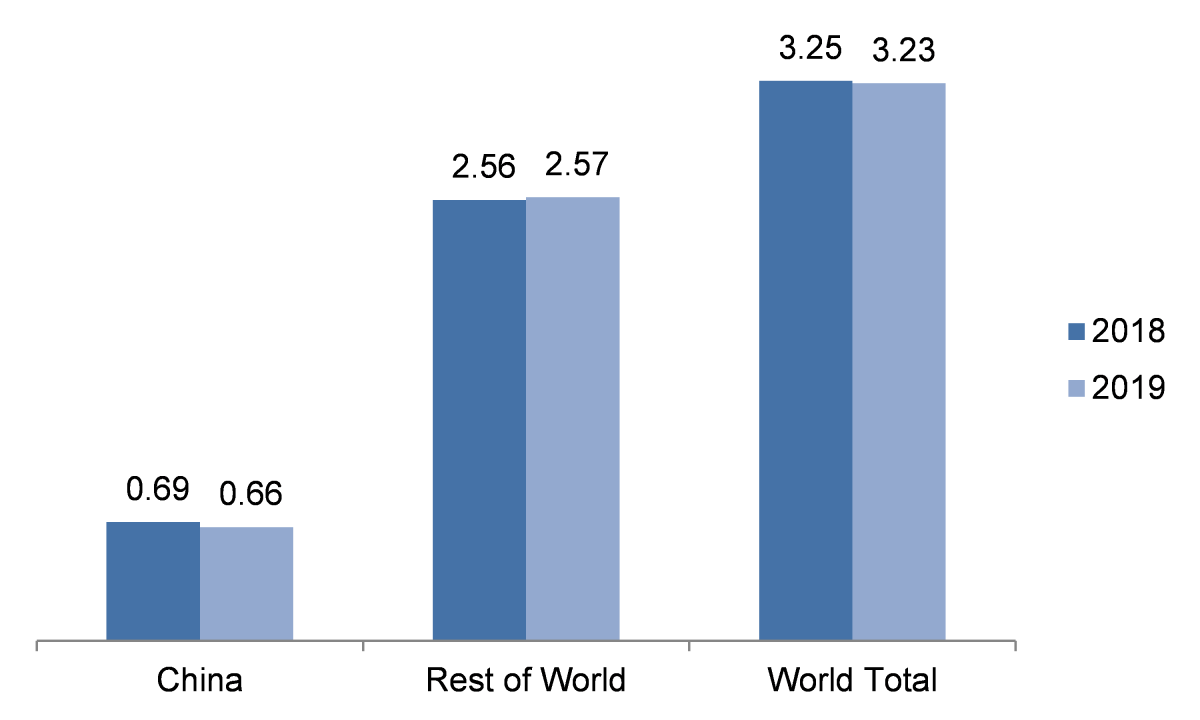
According to RBR’s brand new report Global ATM Market and Forecasts to 2025, the number of ATMs worldwide fell slightly in 2019, contracting by 15,000 units – half a percentage point. China is the main driver of this decline, itself seeing a fall of 30,000 machines, as the country’s migration towards alternative payments erodes demand for cash.
Strip out China, however, and the picture changes, with 15,000 more ATMs in operation at the end of 2019 compared to a year earlier. Almost half of the major markets which the report examined in detail saw an increase in ATM numbers, as did the majority of smaller markets. The biggest rise was experienced by China’s neighbour, India, which actually saw its fastest growth since 2016, adding over 7,000 units.
Financial inclusion remains a key ATM growth driver
Independent ATM deployers (IADs) in India installed three times as many new ATMs as did banks in 2019. India ranks among the lowest countries worldwide in terms of ATM provision, and non-banks play an important role in improving financial inclusion in rural areas. Meanwhile, the study revealed Egypt to be one of the fastest-growing markets; with an increase of 11% in the number of ATMs. Like India, Egypt has a large unbanked population, and financial inclusion measures are a key driver of ATM growth. This pattern of ATMs as a tool to bring financial services to new customers is playing out in markets across Asia-Pacific, the Middle East and Africa and also Latin America, often spurred on and supported by national banking authorities.
Reduced demand for cash in some countries has led banks to pool their ATMs
In western Europe, which saw the world’s very first ATM in the UK in 1967, ATM numbers are being scaled back in many markets. The ongoing march towards digital banking and non-cash payments has led to cash withdrawals either growing more slowly or falling in most countries in the region, and while the role of ATMs has expanded beyond simply delivering cash, many deployers now consider smaller fleets to be more suited to modern banking requirements. Indeed, banks in a number of markets – not only in western Europe – have taken the step of pooling their ATMs or outsourcing them to IADs, as they no longer consider it necessary to manage their own fleets in order to attract and retain customers. The Netherlands, for example, saw one of the steepest declines, as the three largest banks pooled their ATMs and removed those located close to one another.
Number of ATMs, 2018 and 2019 (millions)
Source: Global ATM Market and Forecasts to 2025 (RBR)
Most countries will see renewed growth after COVID-19
Looking ahead to the next few years, the industry is obviously in for a bumpy ride with the impact of COVID-19 on movement, spending and national economies, and some growth markets will see a temporary drop in ATM numbers in 2020. As more countries emerge from lockdown, businesses and consumers will find themselves faced with a new world, and yet many of the longer-term trends will remain broadly similar to the pre-COVID era. The total number of ATMs worldwide is forecast to continue falling because of declines in several larger markets, but the rate of decline will be slow, and most countries should still see ATM numbers going up between now and 2025.
Rowan Berridge, who led RBR’s research, commented: “Cash will remain essential to large segments of the world’s population, either because they lack the ability to pay by other means, or just because they still have a strong personal preference for cash. With banks less willing than before to maintain large branch networks, ATMs will be key to delivering cash to these customers”.
- 06:00 am

Finastra research reveals that 86% of global banks are looking to use open APIs to enable Open Banking capabilities in the next 12 months. In addition, 30% of banks surveyed believe Open Banking is already making a tangible impact in delivering omproved overall customer experience. This is against a backdrop where regulation is perceived to be tighter than a year ago and close to half (48%) of those audited believe that regulators are holding back innovation.
The research, which was conducted prior to the Coronavirus outbreak amongst 774 financial institutions and banks across the US, UK, Singapore, France, Germany, Hong Kong and UAE1, shows a maturity of API adoption and calls for the harmonization of regulations between geographies.
Key findings include:
· Open banking is on the up in 2020 compared to 20192: The percentage of financial institutions looking to leverage open APIs has substantially increased in the US (+23%) and UK (+17%), while Singapore (+1%), France (-1%) and Germany (-4%) are relatively stagnant since our research in 2019.
· Improvements in the overall customer experience accelerate API adoption: the US (45%), Hong Kong (42%) and France (36%) are leading the way in harvesting this benefit of Open APIs (UAE: 32%; Germany: 20%; Singapore: 20%; UK: 19%). Overall, 41% of global banks say that they are ‘still in the early stages of adoption’, so it’s difficult to measure the impact of Open Banking on their business so far.
· Regulation is perceived to be tighter than a year ago and industry or government support is required to foster innovation: Almost half of those audited believe that regulations are holding back innovation. 48% state that ‘regulation is too tight’ - 10% more than 2019 - and the same percentage (48%) believe there is ‘not enough government or industry support to foster innovation’, particularly so in Hong Kong (62%), France (50%) and Singapore (49%), compared to 38% in the UK.
· A call for harmonization: 83% of financial institutions and banks agree that regulations regarding fintech innovation should be harmonized across different geographies.
· Cost of fintech research and development is of concern in some regions: Cost of R&D in the US, UAE and APAC regions is highlighted, more so than in the UK. (USA: 55%; Hong Kong: 55%; Singapore: 51%; UAE: 46%; France: 43%; Germany: 34%; UK: 33%).
Simon Paris, CEO at Finastra said, “It’s encouraging to see Open Banking maturing on a global scale, but it’s still seen by many to be in its teenage years, with scope for creating even greater opportunities. We believe it will be the first step towards Open Finance which will see the next wave of innovation in financial services being created through collaboration on open platforms, like FusionFabric.cloud, using open APIs and open software solutions.
“Currently banks and technology vendors are rightly focused on business continuity and keeping their workforces safe. We’ve also seen many of these firms moving with amazing pace to bring innovative solutions to market, with the help of technology, to support customers in this new environment. As we come through this situation together, we must endeavor to emerge stronger, and it will be interesting to see how Open Banking and collaboration accelerate when this outbreak ends.”
To see the findings summary report, click here
_____________________________________
1. Research was conducted online at the end of January 2020, amongst 774 financial institutions and banks across United States, UK, Singapore, France, Germany, Hong Kong and UAE. These financial institutions represent a gross total of just over USD$4.7 trillion in turnover over the last 12 months, employ over approximately 4.9 million staff and have approximately 110 million client/customer/member relationships.
2. Comparative analysis was made from results from a similar survey run by Finastra in 2019 which was also conducted online in the UK, US, Singapore, France and Germany (March - May 2019).
- 01:00 am
Reducer, the UK’s only cloud-integrated price comparison solution for SMEs, joins the Xero app marketplace. The integration, which became effective in May 2020, enables accountants to manage their clients’ costs in just a few clicks, eliminating the time consuming process of comparing suppliers and searching for affordable deals.
The integration with Xero, the global small business platform, allows Reducer to analyse bill attachments that are uploaded. When customers share financial data from Xero, Reducer identifies areas of overspending, sources bespoke quotes from hundreds of suppliers, and proposes better deals that correspond to a business’ needs. Using research insights, a report is created for each client, and Reducer handles any chosen switches.
Joe Gallard, CEO of Reducer said: “Through integrating Reducer with the Xero platform we are able to further support our customers in streamlining their cost management processes. We understand that replacing time consuming admin with faster and effortless digital solutions is vital for small businesses, who will now have more time to focus on pressing matters.”
Andy Muir Partnerships Manager, Xero UK commented: “We are pleased to welcome Reducer to the Xero app marketplace. It’s great to see how companies like Reducer are enabling small businesses to work more productively.”








