
Published
- 09:00 am

Rimes is delighted to announce the appointment of Vincent Dulhoste as Global Head of Professional Services. Vincent brings more than 25 years of experience working in financial services firms. He most notably spent eighteen years at BISAM, acquired by FactSet, where he managed their professional services team.
Vincent possesses a unique set of skills, having begun his career as a software engineer, transitioning into implementation, pre-sales, and focusing on professional services for the past fifteen years. His deep, hands-on experience across the entire client lifecycle is why he is a strategic hire to support Rimes’ ambitious growth plans.
Vincent comments, “Having worked closely with Rimes during my time at BISAM, I understand the business and more importantly, the customers. Rimes is a client-centric organization that understands data management better than anyone, my mission is to scale that commitment as we add new capabilities and geographic markets. This is the perfect opportunity for me to draw upon my years of experience and make a truly material impact on the business.”
Renaud Larzilliere, Chief Operating Officer, comments, “Vincent’s expertise will play a pivotal role in ensuring our services align seamlessly with the evolving needs of our clients. His strategic insights and proven leadership will undoubtedly contribute to our ongoing success, creating value for our customers as they navigate complex industry challenges and thrive in a volatile economic climate.”
- 03:00 am

In this dynamic financial landscape, businesses can unlock tailored credit solutions by exploring the wide-ranging checkout finance ecosystem.
Checkout finance, the overarching name for payment options offered at the point of purchase, has been offered in one form or another for years, however, in recent times there has been a sharp rise in Buy Now Pay Later (BNPL) offerings. According to strategic checkout finance platform Deko, while BNPL is the most well-known, there is a variety of checkout finance solutions available and by exploring these, merchants can find credit choices that are more flexible and suitable for their business.
As the demand from consumers for flexible payment options continues to rise, checkout finance is now required to suit a large variety of sectors, customer profiles and basket sizes. This has driven the need for a diverse range of credit solutions that each serve a unique section of the market. The development of new products (e.g. digital credit accounts), along with the improvement of existing ones (e.g. instalment finance), means merchants can now offer finance coverage for the full breadth of their product range and to all their customers.
“BNPL is the most familiar form of checkout finance for many consumers with the rise in popularity of the ‘pay in X’ payment offers. These solutions are good for smaller baskets, but the term ‘BNPL’ is often used to refer to all forms of checkout finance. In reality, there are many more options available for merchants and their customers”, said Melanie Vala, CCO at Deko, “For example, monthly instalment-based products, which were actually available before BNPL emerged. And, with the evolution of technology, they now feature frictionless customer journeys along with longer-term repayment options. This solution is, therefore, better suited for higher transaction values which are common in industries such as electricals, furniture and home improvement.”
“As consumer demand and macroeconomic challenges shift, merchants must get ahead so they can support their customers with tailored finance offerings that ultimately lower basket abandonment and boost brand loyalty.”
“Merchants should look beyond BNPL solutions, partnering with a suitable strategic checkout finance partner that offers more comprehensive coverage. Checkout finance products such as digital credit not only reach out to a wider range of consumer basket types but also meet the ongoing demand for flexible payment solutions at the checkout,” Vala concluded.
- 07:00 am
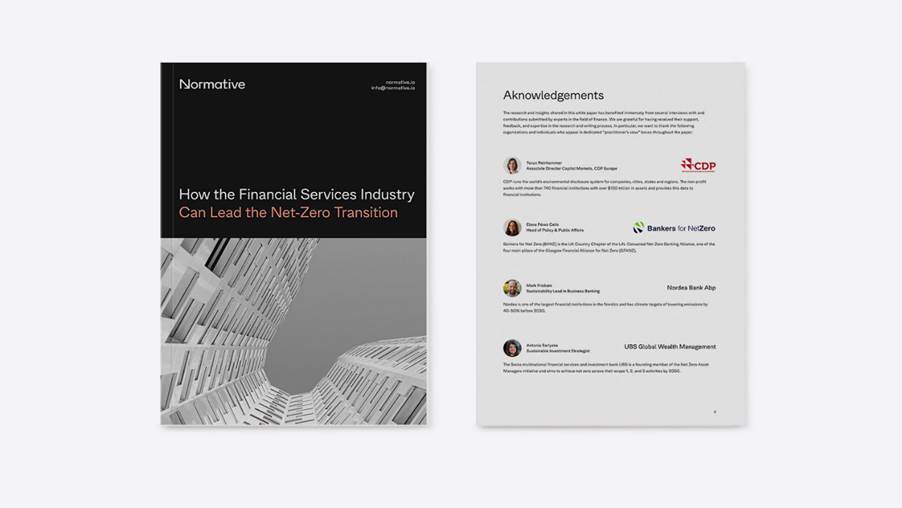
The leading carbon accounting engine Normative has published a white paper entitled “How the Financial Services Industry Can Lead the Net-Zero Transition.” Drawing on insights from industry leaders Bankers for Net Zero, CDP, Nordea, and UBS Global Wealth Management, the paper charts a path through the regulatory landscape, the challenges organizations face, and how to move forward.
“Large companies and banks have so much power to help businesses across the UK transition towards the low carbon economy,” says Elena Pérez Celis, Head of Policy & Public Affairs at Bankers for Net Zero.
But the financial services industry is at a crossroads in the transition to net-zero emissions. Financial actors now have the choice to take a reactive or proactive approach to how they move forward with their sustainability commitments. Their decisions will crucially influence their ability to deliver on commitments – and will play a vital role in determining the success of the global transition to net-zero emissions.
“As allocators and facilitators of capital flows, financial institutions bear a lot of responsibility in ensuring climate financing and investing is effective,” says Antonia Sariyska, Sustainable Investment Strategist at UBS Global Wealth Management.
Normative’s white paper examines the reactive and proactive approaches that financial institutions can take while navigating this landscape, and the challenges associated with both. The analysis of recent developments and future trends shows that the proactive path to net zero creates long-term resilience and growth for financial institutions – and is thus the most viable option to ensure a sustainable transition.
Over the past decade, the relevance given to climate-related considerations in finance has significantly increased. The number of financial institutions setting science-based climate targets quadrupled in 2022, with now more than 40 institutions having submitted their targets.
“Much like financial information, having data on emissions - alongside nature factors - enables institutions to engage actively with their portfolio companies, to effect change and unlock opportunities that lie within the transition,” says Torun Reinhammar, Associate Director, Capital Markets, Europe at CDP.
To propel the global net-zero transition, regulators have developed a range of regulations and frameworks for the financial sector. These are designed not only to drive the sector towards more sustainable practices, but also to inform and protect investors, consumers, and other stakeholders from the risks emerging from a changing climate. This includes physical risks from extreme weather events and transition risks emerging from policy and technology changes, as well as changes in consumer and investor expectations. Accordingly, comprehensive and transparent climate disclosures have become crucial for both navigating the regulatory landscape and for reducing risk.
With the white paper, Normative and the contributing organizations provide a deeper understanding of the current state of the financial industry and regulatory landscape, identify key challenges for the industry, and share how practitioners plan to overcome them.
“According to the World Meteorological Organization, there is a 66% probability of breaching the 1.5 degree celsius threshold for average global temperature increases - crossing this line would risk irreversible changes to the climate,” says Kristian Rönn, CEO and co-founder of Normative. “Financial organizations can make a huge contribution to tackling this challenge by taking steps to hedge against climate-related risks, planning to support increasingly granular regulatory requirements and making investments in new opportunities in the transition to a net-zero economy. There is a huge chance for the sector to play a leading role and capture the business opportunity of selecting the proactive pathway. ”
Find Normative’s white paper here: https://bit.ly/44TTRKl

Robert Sullivan
Public Policy and Strategy Director at Token.io
It’s now been a few months since the European Commission (EC) published its package of proposals for the next generation of payments regulation in the EU. see more
- 02:00 am

Planet, a global software, payment, and technology solutions firm, today announced the findings from its latest guest sentiment poll conducted across 19 countries.
The report provides important data and insights to hoteliers as to what domestic and international guests want from their stay, from booking through to check-out, including their payments preferences.
Even before booking, hotels need to do more to make themselves an attractive option
Browsing on a mobile is second nature for many people and applies for booking hotel accommodation. 59% of consumers globally browse online for hotel reservations; this rises to over two-thirds (66%) in the UK. It’s especially important for internationally focused hotels, with travellers from the UAE (69%), the USA (69%) and China (82%) – all of which are important source markets for the UK – saying they browse on their mobile when booking a hotel. UK hoteliers need to make sure they have a mobile-optimised website to appeal to a broad potential customer base.
While 73% of UK guests always book a hotel online, 61% opt to use online travel agencies (OTAs) to make their bookings. The main reason given by UK guests for choosing not to make their reservations directly on a hotel website is that they don’t want to pay in full up-front (35% in the UK vs 29% globally). Hoteliers looking to grow direct bookings should therefore consider offering preauthorisations or deposits on their websites to help ease the pressure UK guests are facing on their discretionary spending.
Offering a range of payment options is required to appeal to a global audience
The research shows that 73% of Brits prefer to pay with their card at hotels, with digital wallets much lower at 17%. Only 24% of UK guests said it is very important when paying for goods and services in a hotel that payment methods other than credit / debit cards, such as digital wallets, are offered.
But this changes for a global audience, with over a third (35%) wanting to use alternative payment methods – particularly German (60%) and Spanish (49%) guests – while Chinese tourists strongly prefer Alipay or WeChat Pay (84%).
Globally, consumers also have a strong preference to pay using their preferred currency for hotel reservations (48%), at check-in (39%) and for spending during their stay (19%).
Offering a variety of payment options and currencies therefore equips hotels to cater to the differing preferences of international guests.
Hoteliers need to tailor the hotel stay experience to build loyalty
Over half (56%) of UK guests prefer to check-in with hotel staff in-person, so still demand a traditional face-to-face greeting and hotel service. Yet at the same time, they want this to be a quick process; one fifth (18%) say that they always need to complete forms at the front desk when they check-in with hotel staff, which takes away from the initial guest experience. Similarly, at check-out, 52% of Brits say that a quick process with no queues is the most important element for them.
Globally, the research suggests more of an appetite for digital-led experiences. Fewer than half (49%) want to check-in with a person, but a third (32%) prefer to check-in via their smartphone; this is unsurprisingly more so the case for 25-34 year-olds (37%). Investing in the right level of automation for the check-in, and -out, process is crucial in being able to tailor it to different needs and so there is less time spent on paperwork and more time for staff to focus on delighting guests.
Automation and data capture from these processes, including payments data, can also help to boost loyalty by creating tailored experiences. At the moment, almost a fifth (18%) of UK guests say that when they return to the same hotel, staff never recognise them as a returning guest and for a quarter (24%), none of their details were saved on file. However, for the same percentage, having their hotel stay preferences being acknowledged is important in driving future loyalty. This is even more important for visitors from the US (48%), China (42%) and Italy (35%).
Commenting on the findings, Lennert De Jong, President of Hospitality at Planet said:
“With hotel owners starting to look ahead to next year, they’ll be thinking about where they should invest and who to partner with to help them deliver an amazing guest experience that wins hearts and minds of domestic and foreign visitors.
“Fundamentally, hoteliers need to approach this planning from an end-to-end perspective, from booking through to ongoing loyalty – each part of the chain is important and if one drops, it can impact the entire experience.
"As such, integration by connecting payments and software holds the key to creating seamless customer journeys, empowering them to wow their guests.”
- 07:00 am
iDenfy, a global RegTech startup offering AI-based ID verification and fraud prevention solutions, partnered with ECNG Digital, a Lithuania-based fintech company offering virtual currency exchange services and modern payment tools for merchants. iDenfy’s identity verification solution will enable ECNG Digital to reduce drop-off rates and simplify the identity verification process.
While traditional banks often handle identity verification manually, the rise of fintech has spurred the digital transformation of Know Your Customer (KYC) procedures. According to iDenfy, this shift has ushered in benefits like faster onboarding and improved user experiences for customers and fintech service providers. However, fintech companies continue to grapple with the same challenges, which, as iDenfy claims, include inaccurate ID verification results or non-compliance with ever-changing regulatory requirements.
iDenfy officials further explain that this issue comes from the lack of effective measures, especially since risk-based decision-making demands varying levels of detail. For example, thorough risk analysis is crucial for significant international transactions in high-risk money-laundering regions. ECNG Digital agrees with this claim, adding that the company encountered several issues when searching for a new KYC service provider and saw limitations of free or low-cost AI ID verification solutions.
ECNG Digital began solving its challenges by evaluating multiple ID verification solution providers to increase security and ensure a seamless customer onboarding journey. It was important for the fintech company to inquire its potential providers about their data collection methods, the scope of supported documents, and the risk assessment frameworks they employ to help them make compliance-driven decisions. ECNG Digital aimed to adopt a KYC solution that focuses on user experience and accuracy while, at the same time, approving legitimate users without facing various KYC pipeline hurdles.
To optimize user experience, ECNG Digital partnered with iDenfy. From now on, iDenfy’s identity verification software will help the fintech company apply custom-tailored verification processes to its individual users, complemented by various verification methods. They'll use a range of methods like checking government-issued IDs, taking selfies with live detection, and cross-referencing databases. Furthermore, iDenfy's in-house KYC experts will review ID verifications in real-time to improve accuracy alongside the AI software's results.
ECNG Digital is taking steps to boost data security with the help of iDenfy's user-friendly dashboard. This dashboard provides a simple way to access and oversee customer verification data. Users can even manually initiate identification sessions. It’s worth noting that iDenfy's comprehensive KYC solution is ISO/IEC 27001 certified, ensuring the utmost security for ECNG Digital customers' data. This partnership aims to detect suspicious user behavior and prevent unwanted registrations during the customer onboarding process.
Additionally, iDenfy will allow ECNG Digital to analyze all customer data signals and identify suspicious patterns that might go unnoticed by human reviewers. Instead of manually cross-referencing previous applications or closely inspecting ID document photos, iDenfy’s algorithms will automatically detect fraudulent activities, such as deepfakes, stolen documents, or altered images. According to iDenfy, this approach will reduce time and operation burden for the fintech company, automatically allowing ECNG Digital to verify more customers with less hassle.
"In the virtual currency exchange and payment services world, the challenge is to strike the right balance between preventing fraud and swiftly verifying identities. Our goal is to assist ECNG Digital in achieving this by swiftly gaining a deep understanding while ensuring accuracy." — said Domantas Ciulde, the CEO of iDenfy.
- 05:00 am

TangoPay an Authorized Payment Institution based in the UK, and ThetaRay, the leader in next-generation AI-powered secure global payments, today announced they will collaborate to protect TangoPay’s global payments platform from financial crimes as the UK-based business grows.
TangoPay enables expats living in the UK to access fast and affordable financial services to transfer their hard-earned money abroad through its app-based service to 70+ countries. Through the agreement, TangoPay will implement ThetaRay’s cloud-based SONAR solution to monitor and detect financial crime risk including new and sophisticated money-laundering and terrorist financing schemes.
Remittances are an important method of bringing money into low-income countries and unbanked communities, but can also be used as a conduit for financial crime for illicit funds.
As TangoPay scales its business to handle larger volumes of transactions, it needed to adopt a highly automated solution to replace its rules-based monitoring solution that could keep up with evolving compliance demands and enable it to deliver a trusted service.
“TangoPay’s acquisition of ThetaRay’s technology will provide it with unique advanced analytics and machine learning capabilities that help address the complex challenges of the remittance industry,” said Basir Sangerwal, CEO of TangoPay. “With our growing customer base and increasing transaction volumes, we must have a reliable and effective solution to detect potential risks and threats without compromising the quality of service. We are confident that this collaboration will help us to improve our services and provide our customers with a secure and trusted way to send and receive money."
Some 3.96 million non-UK nationals work in the UK with a year-over-year growth rate of 7%, according to UK government figures. More than $10 billion in remittances are estimated to be transferred from the UK every year primarily to key corridors including India, Nigeria, Ghana, Pakistan, China, and the Philippines.
“TangoPay’s mission is to broaden financial inclusion through innovative and accessible digital services that remove barriers for low-income earners and the unbanked,” said Peter Reynolds, CEO of ThetaRay. “To achieve that goal, TangoPay requires world-class financial crime-fighting technology that can ensure easy, efficient and trusted transactions around the world. ThetaRay’s sophisticated artificial intelligence solution will enable TangoPay to grow its revenue, ensure a high level of customer service and win the trust of banks, fintechs and regulators.”
ThetaRay’s cloud-based transaction monitoring and screening system is based on a proprietary form of AI that replaces human bias to swiftly and precisely oversee financial transactions. It enables fintechs and banks to implement a risk-based approach to effectively identify truly suspicious activity and create a full picture of customer identities, including across complex, cross-border transaction paths. SONAR allows the rapid discovery of both known and unknown money laundering threats, and up to 90 per cent reduction in false positives compared to legacy rules-based solutions.
- 06:00 am

Aro, the UK’s go-to embedded finance partner for brands, has today announced it will be adding open-data lender, Plend, to its market-leading lending panel.
Plend will join Aro’s digital lending marketplace, which provides unsecured personal loans, credit cards, secured loans and other financial products. The open-data lender will be directly integrated into the Aro platform, where customers are connected with over 70 of the UK’s leading lenders and service providers to help them achieve their financial objectives.
Unlike traditional credit assessments, which are based on incomplete and biased data sets, Aro’s data-driven matching platform ensures an even greater number of UK consumers are provided with the best credit solutions whilst ensuring they’re only presented with offers that can feasibly work for them and providing lenders with stronger applicants.
This partnership will enable Aro to help more customers to gain access the financial products they need by widening the panel of lenders who offer innovative credit solutions. The partnership reflects Aro and Plend’s joint dedication to creating a financial system that benefits a wider range of people and helps address issues related to financial inequality.
Today’s news comes in the same month as Aro’s company-wide rebrand, as the business continues to reaffirm its mission to driving a more inclusive credit industry through its award-winning embedded finance platform.
Emma Steeley, Chief Executive Officer at Aro said, “We are excited to be announcing our partnership with Plend today. With more consumers than ever looking for credit, we are thrilled to be working with an ethical lender who shares Aro’s values and is also an advocate of the transformative power Open Banking promises with secure access to real-time financial information.”
Robert Pasco, Chief Executive Officer at Plend remarks, “Consumers in the UK are facing an increasingly uphill battle in accessing affordable and longer-term credit solutions. Central to our credit scoring process is a commitment to positive customer outcomes, and our partnership with Aro enables us to offer a lifeline to a broader audience in need of genuinely affordable loans. We are super excited to join forces with Aro, a like-minded partner, whose technology-led approach unlocks greater value for customers across the UK at a time of growing need.”

Peter Smith
Marketing Manager at CCP Digital
In recent years, the digital landscape has witnessed a remarkable evolution, which has brought forth an urgent demand for secure and private communication. see more
- 04:00 am

Infront, the European market leader in financial market data solutions, is combining decades of experience delivering data for financial markets into a modern API by launching its Data Manager API. This key offering gives important players including wealth and asset managers, banks, brokers, and fintechs access to a comprehensive, high-quality universe of financial data. Infront provides firms with streamlined onboarding, access, and alignment, and customizable data solutions. Firms can now move faster with the right data at the right time.
For businesses across the wealth management and brokerage spaces, having direct, reliable access to essential financial data is essential. Ensuring your company has the data you need, at the frequency you want, delivering great value to the business, has been a long-standing challenge.
The Data Manager API solves a number of business-critical points for market players operating in today’s expanding, client-focused financial markets. Infront provides all the market data and content modern firms need, including static data for over 15 million instruments, exchange data from over 100 exchanges, and fund data spanning more than 130,000 instruments. Core market datasets cover reference data, price data, calculated data, regulatory data, ESG data, time series data and news. For firms with specialist data requirements, Infront provides data enrichment services to meet specific business goals like compliance, valuation, and risk.
Additionally, data is delivered when firms need it. Data delivery options include request-response, snapshot, as a stream, or a combination of these options, offering firms needed flexibility in data volume and frequency, from on-demand delivery to always-on streams. Infront has placed a strong emphasis on making integration and customization as straightforward as possible, allowing for cost-effective utilization of the product in a time when rising data needs and costs present a real challenge.
The data available is suitable for a range of use cases, from desktop applications, websites, and data analysis, to front, mid, and back-office functions. Modern cloud technology means the API is easy to set up and has flexible configuration options. All of which make Data Manager API a single point of delivery for reliable, flexible, high-quality data.
Donald Harding, Co-founder of Swedish trading platform Levler: “Levler’s platform caters to both new and experienced traders with a demand for great user experience, low fees, and a mobile-first interaction. Having real-time market data available for our clients is essential to our offering. By choosing Infront we can stream exactly the data we need into our systems, creating a highly responsive solution to our end customers and at the same time power our trading infrastructure with real-time data and full company reference data.”
Zlatko Vucetic, CEO at Infront: “At Infront, we understand that data is more than just a hygiene factor. It drives success in today’s financial markets, which call for flexible, comprehensive, and high-quality data solutions. As a European company, we have a long track record of delivering data and a passion for finding the right solutions for our customers, in close cooperation as their local partner. This has enabled us to create an offering that gives a variety of firms the right data, when and where they need it. A decisive edge firms looking for a market data solution they can leverage today and well into the future.”








