
Published
- 02:00 am

Skilling, a forex and CFD online trading venue, today announced the rollout of new advanced features and an improved user interface across its proprietary trading platform, Skilling Trader, to enhance access and opportunity for its customers of all trading levels and backgrounds.
The new upgrade provides customers with better information flows on Skilling Trader’s trading platform to enable more intuitive decisions. The user interface has been improved so traders can customise their featured lists and also access various instrument collections based on the current market conditions using filters, such as top gainers, fallers, most volatile, or browse the shares by industry.
In order to expand its proprietary platform’s reach into other territories, Skilling has added 12 languages from European and APAC regions to the platform.
Beyond the trader workflow improvements of the platform, Skilling Trader’s new ‘Explore Markets’ feature offers traders access to all the instruments and markets Skilling offers, grouped into easy-to-understand market categories and subcategories. Explore Markets’ quick filter functionality also provides a real-time indication of the market direction applicable to a trader’s interests.
The platform now also offers customers the ability to analyse the performance of their historical trading activity through the latest ‘Portfolio’ feature. Traders using the new platform will be able to drill into the specific factors affecting their closed trades. Customers will now have better oversight of their account’s value progression and metrics to show performance strength across different markets.
André Lavold, CEO and Co-founder of Skilling Group, comments: “We recognise the importance of consistent innovation when improving the trading experience for our customers. Building on the success of various product launches throughout this year, we wanted to bring our customer network a suite of intelligent features to improve market oversight and offer better quality analysis of their trading performance.
These latest additions have been created to serve the needs of our trader community and demonstrate our commitment to facilitating access to multiple pools of liquidity in an efficient and safe trading environment. We’re entering a new period of growth and look forward to stimulating trading activity to an international network of traders.”
- 04:00 am

SEON, the fraud fighters, has announced its partnership with Patreon, the leading membership platform, home to over 200,000 creators and supported by more than 6 million active patrons, which will be utilising SEON’s unique and innovative fraud prevention solution to help fight fraud and abuse in its membership platform.
Launched in 2013, Patreon empowers membership businesses for creators by giving them the tools needed to acquire, manage, and energize their paying patrons and recently achieved unicorn status. The company follows a subscription-style payment model, where fans pay their favourite creators a monthly amount of their choice in exchange for exclusive access, extra content, or a closer look into their creative journey. However, while the internet has opened up new possibilities for creators to expand their audiences and to share their works, it comes with its challenges, such as internet breaches and the selling of data on the dark web.
By integrating the solution via an API or chrome extension, Patreon will have near-immediate access to SEON’s services and will be able to skip the long integration times experienced when it comes to most fraud prevention tools.
The company will have instant access to rich data taken from the email, phone number or IP addresses it gathers from customers, while also collecting all accessible data points about customers’ digital footprints from social media profiles, available via open sources in the public domain. This allows Patreon to identify which users are genuine and which accounts are fraudulent, protecting its customers and creators from online fraud.
Patreon will integrate SEON’s tool alongside its existing fraud solutions, ensuring a fully optimised payment experience by maximising payment acceptance and minimising declines based on having the most up-to-date information. What’s more, SEON’s processes take place in real time and entirely in the back-end so patrons won’t experience any additional friction during the payment process, while security is bolstered.
Jacqueline Hart, Trust & Safety at Patreon, said: “We were impressed with the amount of information SEON could provide on an email address to give us comfort in whom we are doing business with. Being able to give enriched data and save the step of having a human chase down the information on a customer was a step up for us in our fight against fraud and abuse.”
Tamas Kadar, CEO and Founder at SEON, commented: “When we created SEON, we made it our mission to fight fraud differently from existing technologies, in Patreon we found a customer with the same disruptive spirit. Patreon saw the value of how it makes life easier for its fraud team to safeguard transactions and have round-the-clock access to a platform which contains all the information needed to fight fraud.”
To learn more about SEON’s services, visit: https://seon.io/.
- 07:00 am

SIA, a leading European hi-tech company in the payment services and infrastructures sector, controlled by CDP Equity, launches a new platform that allows banks to fully digitize trade finance processes, making it easier and faster for corporates and SMEs operating in markets around the world to manage documentary credit dossiers.
Thanks to the innovative "Digital Trade Finance" solution designed and implemented by SIA, banks can now support the internationalization process of companies and take advantage of new business opportunities with foreign counterparts.
This platform allows banks to simplify to a high degree back-office operations and Global Transaction Banking internal functions through paperless - and therefore totally digital and sustainable - processing of dossiers.
Further benefits relate to the ease of integration with banks’ information systems, the reduction of execution times and greater operating efficiency thanks to digitization of the dossier, which can be processed by the various central and peripheral competence centers - even remotely - in a shared context among all the actors involved.
A possible evolution of the platform will also concern the use of Artificial Intelligence applications, both to support the processing phases of the dossier, such as in the reconciliation of documents or during compliance checks, and for Business Intelligence activities.
Banca Popolare di Sondrio, which has always been at the forefront of innovation in international payments, actively participated in the development of SIA's solution by providing the expertise of its internal structures from the very beginning of the project. Thanks to SIA's new platform, Banca Popolare di Sondrio is the first bank to digitize the entire trade finance process. The project concerned, in particular, the management of letters of credit, from the pre-contractual phase to the settlement phase, making it possible to move to a completely electronic dossier.
The "Digital Trade Finance" solution is an integral part of SIA EasyWay, the digital payments infrastructure that supports financial institutions and other Payment Service Providers in the adoption and management of SEPA payment and collection instruments, instant payments, cross-border payments and, more generally, the new open banking scenario.
"With the launch of the new Digital Trade Finance platform, SIA strengthens its commitment towards banks in supporting the internationalization process of corporates and SMEs. Today more than ever, companies need to simplify processes in order to focus on new business opportunities. Thanks to SIA's technology, they now have a digital tool that facilitates access to foreign markets. The decision by Banca Popolare di Sondrio to choose SIA's experience confirms our position as a reliable and innovative partner in the digital transformation process", commented Daniele Savarè, Innovation & Business Solutions Director of SIA.
"The innovative project for the digitization of documentary credit dossiers involved our International Service division which, in a proactive manner and thanks to the knowhow acquired over years of assisting companies in the Trade Finance sector, was able to support the SIA team in all the stages of study and realization of this new platform", stated Mario Erba, Vice General Manager of Banca Popolare di Sondrio. "Our bank has always worked closely with client companies operating in international markets, supporting them with professional and comprehensive services from the early stages of the internationalization process right up to the signing of contracts with foreign counterparts. And it is precisely documentary credits that allow us to mitigate the commercial risks inherent in foreign trade. The dematerialization of this process will allow our bank to respond even more effectively and rapidly to the needs of exporters and importers," concluded Erba.
Documentary credits are structured payment instruments that are typically used by companies in import-export operations, the processing of which requires the involvement of numerous actors - including various bank departments as well as customs offices, chambers of commerce, couriers, shipping agents and sometimes government ministries - and the exchange of information and documents such as contracts, invoices, bills of lading, etc. takes place in paper format, thus slowing down procedures and increasing the probability of operational errors.
- 04:00 am

INSTANDA, the leading customer and policy management platform for the insurance industry, has today revealed the findings of The Insurance Disconnect, a deep dive into the sentiment of senior insurance leaders in the UK towards the capabilities of their existing IT systems.
The report surveyed 500 UK-based senior Insurance and Reinsurance leaders in IT, Marketing, Strategy, Distribution, and Product Innovation on the ability of their systems to understand how capable are they in meeting their intended purpose, their legacy investment intentions, and how COVID-19 has impacted digital transformation.
Against specified product and business objectives the survey results revealed a muted confidence in the capability of their existing IT systems. Nearly half (45%) of those surveyed reported that their systems were only ‘quite able’ to meet the needs of today’s customers.
The survey results also uncovered a disconnect amongst the views of front-facing respondents in Product and Marketing teams with 51% claiming to feel frustrated by the outdated legacy systems. 52% were of the view that they are missing out on business growth opportunities because of their existing IT systems.
A separate disconnect was unveiled by the report regarding the sentiment across IT teams and Product/Marketing teams, with IT teams strikingly more confident in their current system capability than their front-facing product innovation teams.* Based on those reporting that their current systems are ‘extremely able’ of delivering desired business outcomes, IT teams remained consistently more optimistic than their business-facing counterparts.
When asked about the impact Covid-19 has had on digital transformation initiatives and the shift in sentiment towards existing IT systems, 70% of business-facing respondents agreed that they would be accelerated as a result of the pandemic, with 68% claiming to be now more likely to move part or all their business over to the Cloud because of the pandemic.
CEO and Founder of INSTANDA, Tim Hardcastle, commented: “There’s an encouraging acceptance of the need for digitalisation in insurance post pandemic, but we are still seeing evidence of a strong undercurrent holding innovation back.
“This overriding acceptance of mediocrity is particularly concerning, and a significant mindset shift is needed. Insurers must accelerate their pivot towards digitising their product development, distribution and operational strategies to meet rapidly changing customer needs, otherwise they are at risk of a complete disconnection from their customers and teams. And it is imperative that this acceleration happens at a business-wide level rather than just within IT teams.”
Deloitte’s InsurTech Technology Transformation Partner, Nigel Walsh, added: “There’s an acknowledgment that businesses need to move faster and address speed to market now. To do this, there must be a change in mindset with a capability set to match what is far more open, flexible and agile.”
- 06:00 am
International payment service provider and direct bank card acquirer, ECOMMPAY, has today announced the launch of its new payment system Open Banking by ECOMMPAY, which enables consumers to initiate online payments to merchants.
The London-headquartered company’s new payment system leverages open banking’s requirement for banks to allow third party financial service providers to initiate payments on behalf of customers via APIs. The system plugs into over 48 partner UK banks, with customers of the likes of Barclays, HSBC, Lloyds and Monzo able to utilise the real-time, safe and simple payment solution.
Open banking payments are authenticated directly between banks and consumers so that, unlike direct debits, the risk of chargebacks being generated due to fraud or an inability to capture funds, is eliminated. Because there is no need for a debit or credit card to be used, card fees are cut, and card details do not need to be shared with third parties, speeding up the payment process.
Consumers simply select bank transfer as a payment method during their checkout process, when they are redirected to their bank’s secure environment to complete the transaction. ECOMMPAY handles the payment process between the merchant and the bank, resulting in a one-stop payment solution that allows customers to make payments within a familiar and trusted banking environment.
The system is designed for UK businesses, as well as those expanding into the UK. Upon entering a new market, businesses would previously need to build a local banking relationship to facilitate the collection of direct debit payments and navigate complex legal requirements, licenses, and compliance issues. With Open Banking by ECOMMPAY, businesses can instead use one simple, secure, real-time payment solution with no need for card transactions, ensuring increased conversions and a more cost effective payment solution. The company plans to expand the system across Europe in the coming months.
ECOMMPAY has enjoyed steady growth since its launch in 2012, and has built a global presence with six international offices and operations in key markets including Asia, Europe, Africa, Russia and the UK.
The company is a principal member of Visa and Mastercard, and a member of Visa Direct and MoneySend, as well as being the first payment provider on the PayPal Commerce Platform and the first acquirer to implement a Mastercard Dashboard.
Paul Marcantonio, Executive Director of ECOMMPAY, commented: “Open Banking for the UK by ECOMMPAY will allow us to support both large and medium businesses with an online presence by facilitating the acceptance of payments directly from their customer’s bank accounts.
“Fast, safe and secure payment methods are vital now more than ever as businesses move online to respond to shifting consumer behaviours, and as the pandemic results in a surge in fraud and cyber-crime. This new service joins our growing portfolio of payment products, enabling us to continue to support businesses to scale at the rate they need, and enjoy payment solutions that match their requirements. Our new product for the UK is just the beginning- ECOMMPAY will soon announce a global Open Banking solution.”
- 02:00 am
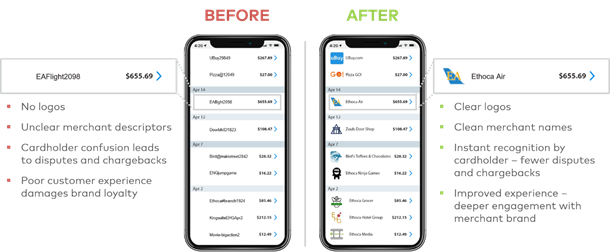
As more businesses turn to digital payments, and the number of connected devices grows, one thing is becoming increasingly clear: consumers are demanding more clarity around what they bought and who they bought it from.
Most everyone has experienced the frustration of trying to decipher confusing and brief purchase descriptions when reviewing online statements. This confusion forces cardholders to contact their banks unnecessarily to dispute unrecognized transactions, adding extra steps for consumers and generating an array of costs for merchants and banks.
A new initiative from Mastercard and managed by Ethoca, the company’s collaborative fraud and dispute resolution technology, aims to eliminate this confusion and improve the customer experience. All merchants are encouraged to visit www.logo.ethoca.com and upload their logos for inclusion in online banking and payment apps. The merchant logos will be linked to corresponding transactions, adding clear visual cues to help cardholders quickly identify legitimate purchases. Participating merchants are provided an opportunity to simultaneously extend their brand presence as well as eliminate expensive and time-consuming chargebacks. This program is also available to all financial institutions.
A recent Ethoca-commissioned Aite Group study of the US market revealed that 96% of consumers want more details that help them easily recognize purchases, and nearly 25% of all transaction disputes could be avoided by delivering these details – including logos. It’s estimated that global chargeback volume will reach 615 million by 2021, fueled in large part by frustrated consumers turning to the dispute process unintentionally.
“With greater digital dependency, having real-time purchase details is critical for consumers, merchants and card issuers alike,” said Johan Gerber, executive vice president, Cyber and Security Products at Mastercard. “We continue to collaborate with industry partners to bring clarity and simplicity before, during, and after transactions. By enriching transaction details, merchants can alleviate friendly fraud, reduce chargebacks and improve the customer experience.”
This endeavour is part of comprehensive efforts to deliver the most efficient, safe, and simple payment experience from the minute a consumer begins browsing to once they’ve made the purchase. This includes Click to Pay, Mastercard’s one-click checkout experience, to the integration of biometrics to secure both digital and physical transactions, and Ethoca’s full suite of consumer digital experience solutions.
- 08:00 am

IriusRisk, the threat modeling platform for Application Security, announced today the closing of its $6.7 million Series A fundraising. Global cyber investor Paladin Capital Group led the round, with participation from 360 Capital Partners and existing investors Swanlaab, JME Ventures and Sonae Investment Management. The funding will enable IriusRisk to continue to innovate through its product roadmap and focus on global growth by expanding its sales and marketing teams in the US, UK and Europe.
The IriusRisk platform helps developers, software architects and security engineers to design secure software from the start of the development process and manage security all the way through to the testing phases. There is an increasing need amongst Application Security teams to ‘shift left’ – move security to the earliest possible point in the software development lifecycle - so that security design flaws and their associated costs are reduced. Given that an estimated 50% of software security vulnerabilities are flaws in the design, addressing the problem at this stage is the most cost-effective way of building security into software.
“We are excited to continue our growth with the backing of leading venture capital firms such as Paladin, 360 Capital and our existing investors,” said Stephen de Vries and Cristina Bentue, Co-Founders of IriusRisk. “Their support allows IriusRisk to expand while providing our clients, such as Redhat and Axway, with solutions that accelerate their adoption of automated threat modeling tools. We have grown our customer base to more than 40 enterprise clients across the US, Europe and the UK, including some of the world’s largest Fortune 500 financial, industrial and consumer groups, and we will continue to expand within these and other verticals as a result of this funding.”
Conor O’Sullivan, Vice President at Paladin, who will join IriusRisk’s Board of Directors, said: “Secure design in Application Security has been a manual, time consuming, inefficient and specialised process for many years. We’re pleased to partner with IriusRisk in its mission to provide automated solutions to the increasing vulnerabilities and threats at the design stage of applications. The IriusRisk team has the domain expertise and product vision that will enable the practice of threat modeling to scale to the thousands of applications that an enterprise maintains every year.”
- 04:00 am

Institutional asset allocators face an increasingly complex investment landscape, but often do not have the tools to efficiently implement and manage those strategies, with many critical functions still relying on spreadsheets and aging technologies that are reaching the end of their useful lifecycle. This is according to new research from global investment fintech firm, Milestone Group. Released today, Milestone Group’s Asset Allocation Technology Survey 2020 takes a deep dive into the current and future technology requirements of institutional asset allocators, both asset owners and investment managers.
The report explores the implications for technology capabilities arising from increasing pressure to deliver better outcomes. That pressure has driven the trend for asset allocators to design and implement more complicated investment strategies. which gives rise to portfolios that are more challenging to monitor, manage and transact. Indeed, 82% of respondents reported that investment strategies are becoming more or much more complex.
While technology is identified as being crucial to achieving investment objectives, fragmented processes remain a challenge with 50% of firms saying they use four or more systems for monitoring portfolio exposures alone. Some firms are using as many as 13 different systems/providers across all investment functions. Half of all respondents indicated that their current technology profile is comprised of multiple legacy systems and spreadsheets, while one-quarter of respondents are still using spreadsheets to manage critical functions such as monitoring portfolio exposures.
The research shows that a clear industry consensus on the best type of technology solution is yet to arrive, but when asked what their preferred technology strategy is, a plurality of respondents (38%) either currently have, or would prefer to have a ‘built for purpose institutional asset allocation investment management platform’.
Randal McGathey, Vice President Asset Allocation Solutions at Milestone Group said, “The impact of asset allocation on outcomes is well recognized and institutional allocators continue to be both propelled and constrained by the complexity of their work. The report finds that current state technology is highly fragmented across the front and middle offices. We know that investment strategies will advance and complexity and demand for scale will increase still further. Reading between the lines, we see evidence of an acceleration in the need for market solutions that strengthen and standardize the underlying platform while supporting product innovation and bespoke investment processes.”
For this report, Milestone Group surveyed 47 institutional asset allocators, with AUMs ranging from less than USD500 million to over USD25 billion. The full report can be downloaded here: https://www.milestonegroup.com/press-releases/milestone-group-report-reveals-institutional-asset-allocators-lack-proper-systems.
- 01:00 am

“Industries worldwide are facing unprecedented and rapid expansion as the number of Internet of Things (IoT) devices is expected to grow to over 75 billion by 2025 and achieve a market worth US $14 trillion worldwide by 2030. Despite this, a staggering 76 percent of IoT projects either stall at the proof-of-concept stage or fail to achieve their objectives,” said Martin Killian, Sr. IoT Solutions Architect at Speedcast.
Speaking on the second day of the CommunicAsia virtual event, Killian emphasized how the current regulatory barriers and costs of connectivity can have a detrimental impact on IoT projects worldwide. This, he said, means that service providers and organizations can often face barriers before they even start, leading them to abandon IoT projects or deem them too unsuccessful to continue.
“If businesses want to avoid common pitfalls to achieve success, complete, managed services of end-to-end delivery for all types of satellite IoT solutions and ubiquitous dual mode-cellular and satellite device coverage are critical,” said Killian. “IoT solutions are, by their nature, complex. Success depends on data capture and data communications on a massive scale and marshalling the right technologies, technology partners and communications providers to meet the necessary requirements.”
Killian continued, that in order to stay ahead of the competition, organizations must consider all aspects of the solution and find vendors that have strong system integration capabilities – allowing for the guaranteed success of their IoT projects; delivering greater efficiency and increased revenues.
“IoT has the capability to be a real game-changer for a range of different industries but can be a challenge due to the local and global regulatory barriers and the costs of moving increasing volumes of data,” added Killian. “Delivering successful IoT projects can be complex but with the right solutions and strong technology partners, the number of IoT project failures can drastically be reduced.”
To help organizations address these challenges, Killian described how Speedcast is committed to innovating and delivering market-leading solutions as technology develops and the industry looks for better ways to incorporate IoT effectively and efficiently into their networks.
He concluded: “To meet the exponential demands of consumers both today and in the future, we have created device and network agnostic IoT solutions to seamlessly manage data from multiple communications vendors. The Speedcast IoT platform has added new capabilities, offering customer-centric devices and applications, Lora gateway and edge functions, to ensure the success of any future IoT projects and offer reliability standards of five nines.”
For more information about Speedcast’s IoT solutions, please visit: www.speedcast.com.
- 06:00 am

Rosecut, the digital financial planning partner and investment manager, today announces free new tools that give people financial insights and guidance previously accessible only by working with expensive professional wealth managers.
Users can get a complete picture of their current financial situation and a projection of their future finances on the Rosecut platform.
The Strategy Board, Personal Balance Sheet and lifetime Cash Flow projection make predictions based on the information users input about their circumstances and future plans.
The tools combine powerful technology with expertise from former private banking advisors to show clients how small changes made to financial decisions today can have a big impact on financial outcomes later in life. Rosecut’s offering to its clients is that you can control your financial future and live the life you want.
Qiaojia Li, Co-founder and CEO of Rosecut, explains: “The right financial planning today can transform how much wealth you have in the future, but most people don’t have access to the information and knowledge they need to make the financial decisions that will help their future selves. Our new cash flow tool uses financial modelling that until now has only been accessible to the uber-rich who have professional wealth managers. We’re breaking open the secretive and opaque private banking industry by giving universal access to that level of financial knowledge.”
Rosecut’s personal wealth balance sheet helps users map out their total income, total spending (both annual and one-off), all investable assets and liabilities. It also guides them to put aside adequate emergency funds needed in cash.
Once the wealth balance sheet has established an investor’s level of liquid wealth and thus their assets available to invest, the cash flow projection provides a visualisation of the current trajectory of their financial position over time, to retirement age and beyond.
The strategy board is where users can get context around the financial decisions they are making - such as their asset mix, level of savings, income level, liquidity ratio and ideal retirement age - and where they can tweak some of those decisions to see how changing the way they live now can affect the life they live in the future. Informed by the wealth management expertise of the Rosecut team, a list is also provided with suggestions of the most meaningful improvements that can be made to a user’s financial situation and wealth.
Qiaojia Li, comments on the importance of clients being able to build up a full financial picture: “Creating wealth is easier than maintaining it. To live the life we want, we often focus on earning a good income, but that’s not enough if you want to also secure the life you want in the future. The recent personal finance tech products - often referred to as Robo-advisors - have given many people a useful introduction to investing, but really only cover the ‘last mile’ of how clients should invest. They don’t give people the advice they need before they can decide how best to invest. That is where tools like the strategy board help us deliver a service normally reserved for millionaires to a much wider market.”
To register and try the free planning tools now, visit https://app.rosecut.com/.








