
Published
- 04:00 am

Fast growth fintech TradeCore has announced FIVE, a New York based development agency, as the newest member of the TradeCore ecosystem. The announcement will further cement the TradeCore platform as the go-to toolbox for businesses looking to launch or build a new fintech product.
FIVE is the first agency to be welcomed into the TradeCore ecosystem, which offers partnerships with leading fintech providers and now app building capabilities to bring a fintechs’ proposition to life. All a new company needs is a business plan and financial backing, with the Tradecore platform able to manage the rest of the process and get its idea to market.
FIVE is a digital product agency that delivers measurable value to its clients, including Rosetta Stone, Penguin Random House, Napster, and Marriott International. FIVE’s services include product strategy and design, software development, growth marketing and user engagement optimisation, whereby FIVE harnesses data to analyse product performance to evaluate, improve, and deliver the best in-house solutions.
The new partnership will enable TradeCore customers to now engage with FIVE, to develop their fintech proposition, and build new products and services using TradeCore’s infrastructure, all from scratch - with TradeCore handling the complex back-end processes - including compliance, regulatory or licensing hurdles, to help reduce overall time-to-market.
TradeCore’s platform, which launched in the UK earlier this year, acts as a one-stop-shop for fintech start-ups looking to accelerate their go to market strategy, so that they can continue to disrupt and revolutionise the financial services.
This is the latest in a long line of partnership announcements, allowing Tradecore customers to access benefits such as payments powered by Modulr, including Bacs, Faster Payments, and SEPA, for Euro payments; utilise category leading open banking infrastructure via Truelayer; and remain compliant through KYC and onboarding with ComplyAdvantage.
Luka Abrus, Business Development Partner at FIVE, said: “The complexity of the sector means many fintech's fail to launch, but through TradeCore's platform, many fintech start-ups are now able to launch - far more quickly. The TradeCore partnership with FIVE will round up their offering, so that all the development needs to launch, can effectively be served through a one-stop-shop.
“For FIVE, partnering with TradeCore means further bolstering our fintech sector domain expertise, so we can continue to deliver maximum value, and drive measurable impact for our clients, through our products and services.”
Stefan Pajkovic, founder and CEO at TradeCore, comments: “By creating a one-stop-shop for emerging fintechs, we are simplifying the complexity of the sector - meaning they can launch far more quickly and much more cost effectively. And through our new ecosystem partnership with FIVE, we can continue to strengthen our position so that all a new fintech needs to launch, is a business plan and financial backing - we can take care of the rest!”
- 04:00 am
Today, the open banking fintech Nordic API Gateway introduces a new platform called Aiia that is set to meet the opportunities of PSD2, for all types of businesses, making innovation possible without cumbersome and expensive tasks of acquiring and maintaining an AISP or PISP license.
With the new platform, Aiia, Nordic API Gateway believes that any industry will be able to benefit from the PSD2-enabled access to account-to-account payments alongside access to financial data. The company also expects that new open banking use cases within retail, accounting system providers, eCommerce and more will emerge with the launch of Aiia.
So far, not many companies have been licensed as third party providers by the local FSAs in the Nordics since the launch in 2018, which shows that financial innovation is being held back, explains Rune Mai, CEO and Founder of Nordic API Gateway:
“Open banking hasn’t been as open as we’ve hoped for; we haven’t seen many TPP registrations going live across the Nordics. With that being said, we see that the interest in using financial data and instant account-to-account payments is increasing across industries and the open banking movement is starting to mature. Our recent survey amongst SMEs and financial institutions shows that more than 91% of the surveyed were aware of PSD2.”
In order to access financial data or initiate open banking payments on behalf of European consumers, all businesses need to do is acquire an AISP or PISP license from the local Financial Supervisory Authorities. But according to Rune Mai, such a license can be costly, time-consuming and difficult to obtain for the many startups and businesses that don’t necessarily fit the profile of an AISP or PISP, based on the various descriptions set forth by the FSAs across Europe. This is where the Aiia platform comes in, allowing businesses to test and get started with the power of a digital bank in their app(s) from day one.
With AIia, Rune Mai and the Nordic API Gateway team want to offer a fast track to open banking and bring PSD2 into its full effect for all by delivering what he calls “open banking with the batteries included.”
“With Aiia, we’re doing an open banking with batteries included model. There’s nothing sadder than spending hours unpacking a product that’s tied to the packaging only to realise that it needs 10 batteries that aren’t included. That’s exactly what open banking is today to many businesses that want to get going with the PSD2-enabled opportunities for their customers straightaway. With Aiia, you get to interact with the product right out of the box and basically skip the hassle of lengthy and ongoing registration processes and expenses,” he explains.
A need for financial data transparency
With an increase in usage of open banking-enabled services by consumers and businesses in Europe, there will be a need for transparency regarding how the data is being used by companies accessing their customers’ financial data.
To secure that, the Aiia platform is also set to empower consumers by providing an overview of which services they’re sharing their financial data with, how it’s being used and the ability to revoke access directly from third parties.
“We see this as an initiative that benefits businesses, consumers and society in general. It truly puts the ‘open’ into ‘open banking’ by creating transparency of financial data use for the end user,” Rune Mai concludes.
The platform is currently being rolled-out across Europe, offering account information and payment initiation services to meet new open banking use cases. Aiia is already being leveraged by various companies across multiple industries in the Nordics, and will be fully rolled out across Europe by 2021.
- 07:00 am
BearingPoint RegTech, a leading international provider of innovative supervisory, regulatory and risk technology solutions (SupTech, RegTech and RiskTech), has launched an outsourcing solution for regulatory reporting that will diminish the cost of compliance for institutions.
The UK banking industry is very complex and diverse, with 58,000 firms impacted by financial regulations, including banks, building societies, lenders, challenger banks and other financial institutions. Aside from the challenger banks (that had no legacy software systems and are therefore inherently ‘digital native’), there is still a heavy reliance on costly, manual processing.
As such, regulatory reporting has become an increasingly complex and consequently expensive part of a UK financial services firm’s operations. For example, the cost of regulatory reporting in the mortgage domain for a large regulated firm was estimated by the FCA at an annual average of £450,000 for ongoing and a further £700,000 on change related costs (in addition to technology costs, which were excluded).
In response, BearingPoint’s ‘RegTech Factory’ utilizes a common platform and provides firms with a standardized granular data model to interface with, something the industry now recognises as being key to driving down costs. The advantage of this approach is not only a shared common infrastructure for market participants, but by moving to a more granular data model, there is a level of shielding from regulatory change and the much sought after data lineage from report to system. By sharing infrastructure services, embracing standardization, and adopting regulatory Reporting-as-a-Service, institutions have the opportunity to reduce the costs and resources associated with the operation of their own reporting system.
“The UK banking industry is competing in processes where no revenue is being generated. We believe that this situation will change,” said Mark Shead, Head of RegTech Solutions UK at BearingPoint RegTech. “There is room for financial institutions in the UK to work together more, collaborating on the conceptualizing of reporting tools, the resultant IT build and the deployment of new reporting systems.”
- 06:00 am

Colt Technology Services has today announced a new three-year strategy and organisational structure, to better align Colt to today’s shifting market dynamics.
The new strategy centres around continuing to develop Colt’s IQ Network through innovation and accelerating growth through the power of its people - taking what’s always been in Colt’s DNA and ensuring the business is agile enough to support enterprises as they move into the future.
The strategy can be broken down further into four areas of focus, which are;
- Increasing Colt’s relevance to the enterprise and capturing the SD WAN market.
- Co-building, co-creating and co-developing with cloud builders.
- Doubling down on the customer experience.
- Optimising foundations for future sustainability.
To ensure Colt is best placed to execute this strategy, a new organisational structure has also been announced. Made up of seven pillars, this structure aims to foster greater collaboration both inside the organisation, as well as with customers and partners.
The new structure is comprised of the below pillars;
- Technology & Security - Streamlining Colt’s systems and processes, as well as enhancing security and harnessing data.
- Operations & Engineering – Driving service improvement with a close alignment to Colt’s engineering capabilities.
- Strategy & Transformation – Managing and driving strategic roadmap and relationships, while aligning our communications to elevate our purpose and vision.
- Sales, Marketing & Customer Relationship Management – The CCO function reimagined, focusing on customers and how we can better cater to their needs.
- Human Resources – Ensuring people remain at the heart of what we do.
- Finance – Continuing to drive a competitive edge for Colt.
- General Counsel – Continuing to keep Colt safe and assist customers navigating the ever changing regulatory environment.
As part of this shift, Ashish Surti, Avijit Singh and Robin Farnan have all been elevated to Colt’s Executive Leadership Team (ELT).
Ashish will hold the newly created role of Executive Vice President – Technology & Security, responsible for Colt’s overall technology and security strategy and execution. Ashish has been with Colt for three years, previously holding the role of Chief Security Officer.
Avijit will now take on the role of Chief of Staff to the CEO, responsible for developing and driving the implementation of strategic initiatives across Colt. He previously held the position of Chief of Staff to the Chief Operating Officer.
Robin will now hold the newly created role of Executive Vice President - Operations & Engineering, responsible for Colt’s overall engineering, delivery and assurance strategy and operations. Robin joined Colt in 2016, as Vice President (VP) Service Assurance and until recently was VP, Service Delivery. These new appointments report into Chief Executive Officer, Keri Gilder.
- 02:00 am

Almost 70 percent of respondents in a new Swedish consumer study would be interested in a biometric payment card without having to touch the point-of-sale terminal. Due to the Covid-19 pandemic, the respondents expressed a strong interest in more hygienic and secure payment methods when shopping in stores. The study was carried out in October 2020 by TietoEVRY together with biometric fintech company Zwipe.
Although smartphones are on the rise as the primary payment method (24%), the study shows that in retail shopping contactless-enabled bank cards are still the predominant form of in-store retail payment in Sweden (72%). When considering the present Covid-19 pandemic, more than 80 percent of respondents are very or somewhat concerned about touching point-of-sale terminals when shopping in-store. 80 percent of the respondents are also worried about the risk of infection when using their payment card and touching the payment terminal to type in the PIN code to complete a transaction.
Almost 70 percent of the respondents expressed interest in a payment card that would increase the safety of payment transactions by eliminating the need to touch the payment terminal and/or enter their PIN codes.
Strong interest in biometric payments cards: 75 percent want their next card to be enabled with biometric capability
New developments are opening the door to new payment methods such as biometric payment cards. According to recent research, awareness among Swedish consumers of biometric cards is on the rise. While 27 percent of the respondents had heard about biometric payment cards before participating in the survey, the majority (73%) was unaware of this innovation.
Biometric payment cards use fingerprint authentication technology enabled by on-card fingerprint sensor and software. This allows for convenient contactless payments, even for large transaction amounts, without the need to enter the PIN. All contactless-enabled payments can be conducted without touching the payment terminal. Consumers simply enroll their fingerprint on their card at home, and the fingerprint template used for on-card authentication is stored only the card, nowhere else.
As awareness of biometric cards grows, so will demand. 75 percent of the respondents would like their next payment card to be biometric enabled. This finding is based on the responses of survey respondents who were shown a short video presenting biometric payment cards.
“Being able to address Covid-19 with a safer and more secure payment method stands out as a clear desire among the consumers. Currently, we see a strong interest in the market, not only for a safer and more secure and convenient payment method, but also for more hygienic options at points of sale. We believe that biometric payment cards address these demands in a unique way,” says Jarmo Rouhiainen, Head of Card Production and Personalization at TietoEVRY.
Consumer willingness to pay extra for biometric payment cards
The survey also shows that:
59 percent of respondents would be willing to pay an extra monthly fee if their current bank offered biometric payment cards. 41 percent would expect a biometric card option to be covered by their existing annual bank fees.
47 percent would be interested in paying a monthly fee of SEK 10–50 for a biometric payment card with no additional benefits.
12 percent would pay a monthly fee between SEK 51–99 for a biometric payment card alongside other card holder benefits.
In addition, nearly half of the respondents (48%) would switch banks if they were offered a biometric payment card by a bank other than their current one, to get access to safer and more secure payments.
“Consumers’ feedback shows that biometric payment cards represent a strong business case for issuers, accelerating customer acquisition, uplifting loyalty and creating new revenue streams. We are excited to see such a strong demand from Swedish consumers, and about addressing their needs together with TietoEVRY,” says André Løvestam, CEO of Zwipe.
About the survey
· The survey was conducted in Sweden in October 2020 by Zwipe and TietoEVRY.
· In total, 202 people aged between 18 and 60+ responded to the survey.
· Respondents were representatively distributed according to age, gender and socio-economic status, and the entire subset of respondents had a household income above SEK 300,000.
· Age distribution:23 percent aged 18–29, 40 percent aged 30–44, 23 percent aged 45–60, and 14 percent aged 60+.
· Gender distribution: 53 percent of respondents were female and 47 percent male.
- 08:00 am

RepRisk, a leading ESG data science firm combining machine learning with human intelligence to identify and assess ESG risks, and Apex Group Ltd. (“Apex”), a global financial services provider, have entered into a strategic partnership to expand access to material ESG risk data for private markets participants.
Apex manages the independent collection of data for investors from their underlying portfolio investments to deliver real time ESG analysis via a secure, intuitive, and flexible online platform. Apex’s unique ESG Rating and Advisory Portal now includes RepRisk Analytics Reports and Cases Data on private companies, allowing unrivalled ESG insights to private companies and their investors.
Apex, in partnership with RepRisk, seeks to close the gap for a previously underserved market of private companies by delivering a high quality, global, independent ESG tool based on data insights. Apex’s ESG offering forms part of its single-source solution model delivering services across the full value chain for its clients.
“Apex is a very exciting partnership for RepRisk, and one we are especially well-suited for,” said Alexandra Mihailescu Cichon, Executive Vice President Sales and Marketing at RepRisk. “RepRisk is the only ESG provider to systematically cover private companies. While our dataset grows every day, it currently includes more than 120,000 private companies worldwide, in every sector and market. RepRisk looks at what the world says about a company, not what a company says about itself – and in combination with Apex’s analysis on company disclosures and reporting, we’re able to provide a uniquely holistic picture of a company’s ESG profile.”
Andy Pitts-Tucker, Managing Director, Apex ESG Ratings and Advisory, adds: “Apex ESG’s new platform was established to satisfy the demand from private markets for greater transparency through a high quality, global, independent, single-source ESG solution. We help investors to collect, verify and evaluate data on their portfolio companies and benchmark the quality and performance of that data to produce quantitative and comparable analysis. With access to RepRisk’s independent ESG data and insights, we are excited to provide a holistic perspective on each company. Ultimately, this partnership can play a role in influencing significant behavioral change, drive capital flows, and support our clients as they look to improve their ESG performance.”
RepRisk offers qualitative research, quantitative risk analytics, and proprietary metrics for more than 150,000 public and private companies, from every sector and market across the globe, serving leading financial institutions and corporates in their ESG integration and risk management processes across their operations, business relationships, and investments.
- 04:00 am

VERMEG, the leading banking and insurance software solutions provider, has today launched Colline.Cloud, a highly cost-efficient end-to-end collateral management service, aimed at smaller buy and sell-side firms.
The launch comes as the global regulations for uncleared derivatives (UMR) moves to phases five and six.
However, due to COVID-19, there is a twelve-month extension to the implementation deadline. Specifically, all entities with an AANA (Average Aggregated Notional Amount) above EUR 8 billion, have until September 2021 to comply. The delay means the likes of smaller asset managers and investment banks will have extra time to prepare and have the opportunity to find a strategic solution that not only meets the regulatory requirements but enables them to review ‘Total Cost of Collateral’ and improve collateral management efficiency.
Colline.Cloud is a modular cloud-based collateral management platform that is highly automated and adaptable, and can be implemented rapidly and seamlessly to meet this need. The agile and scalable software, with flexible sizing and configuration, has been developed from the award winning and market leading service, COLLINE, and has additional capabilities including Standard Initial Margin Model (SIMM) calculations and a new user interface.
VERMEG’s award winning collateral management software is used by over 90 financial institutions, underlying the company’s leading position in the market.
Helen Nicol, Global Product Director, Collateral Solutions, VERMEG, said: “The delay to phase five and six of the UMR provides a vital window for small to medium sized firms to think strategically about how they will meet the regulation. With a more efficient collateral management solution like Colline.Cloud, they will not only tick the regulatory box, but it could also improve business performance by providing a sustainable and flexible cost structure and removing the need for burdensome IT infrastructure.
“Colline.Cloud is developed from our deep collateral management expertise and we’re constantly innovating to provide clients, both big and small, with solutions that are quick to implement, easy to use and are more time and cost-efficient.”
- 09:00 am

The group has published the results for January-September 2020. Despite the challenging time, it has improved its portfolio quality and all the performance indicators, by optimizing the core business processes.
In the first 9 months of 2020, Robocash Group issued loans worth 217.3 mln USD and reached a high share of repeated customers - 72%. During the same period, the group earned 16.2 mln USD, which exceeds the net profit for the entire 2019. Meanwhile, its revenue amounted to 83.5 mln USD and retained earnings grew to 39.3 mln USD.
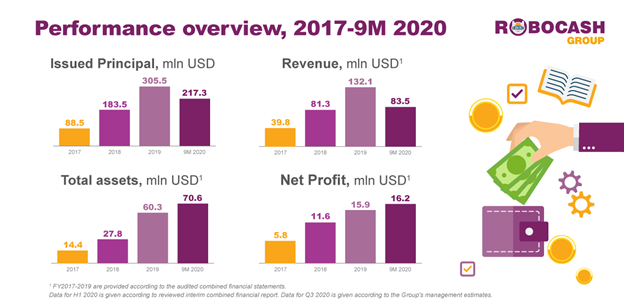
Looking at the group’s performance QoQ, its disbursement volumes grew by 34.4% in Q3, while the net profit and revenue increased by 52.8% and 9.1% respectively.
Seeing the impressive results and active growth this year, the group’s management has decided to make adjustments to the nearest plans. Sergey Sedov, Chief Executive Officer of Robocash Group, commented: “Earlier, we announced the launch of an IPO at the end of 2020 and considered the Australian Securities Exchange as one of the listing options. Yet, our remarkable performance this year has allowed us to develop independently so far. With this in mind, we have decided to focus on getting the best valuation and take extra time to explore more listing venues for this purpose. As a result, we have opted to postpone our IPO until H2 2021. Meanwhile, the pre-IPO fundraising round for the group’s operational business aims is underway, with 8 mln USD raised so far”.
Going forward, Robocash Group has no intention of slowing down. Maintaining its strong position, it is planning to launch a set of new services, as well as enter new markets with a focus on the APAC region.
- 05:00 am

Red Hat, Inc., the world's leading provider of open source solutions, today introduced new capabilities for Red Hat Enterprise Linux and Red Hat OpenShift intended to help enterprises bring edge computing into hybrid cloud deployments. The world’s leading enterprise Linux platform adds features designed to maximize system stability and preserve workload independence in smaller physical footprints, while Red Hat OpenShift, the industry’s leading enterprise Kubernetes platform, now provides remote worker node architecture to help deliver Kubernetes to space-constrained and remote deployments.
According to the Worldwide Edge Spending Guide from IDC, the worldwide edge computing market is estimated to reach $250.6 billion in 2024 with edge-related software predicted to be roughly 21% of this spend. Red Hat strongly believes that edge computing requires open hybrid cloud, built on a foundation of enterprise-grade Linux and production-ready Kubernetes. With today’s updates, both Red Hat Enterprise Linux and Red Hat OpenShift are further equipped to meet this demand.
Enterprise Linux, ready for the edge
The small physical footprints, remote locations and limited connectivity of edge devices pose a challenge for traditional, full-featured operating systems, but not Red Hat Enterprise Linux. With enhancements in Red Hat Enterprise Linux 8.3, the world’s leading enterprise Linux platform can more easily span from core datacenters to space-constrained, remote servers, and is built to provide the levels of supportability, stability and security features required by enterprise edge deployments.
Edge-focused updates to Red Hat Enterprise Linux include:
- Rapid creation of operating system images for the edge through the Image Builder capability. This enables IT organizations to more easily create purpose-built images optimized for the broad architectural challenges inherent to edge computing but customized for the exact needs of a given deployment.
- Remote device update mirroring to stage and apply updates at the next device reboot or power cycle, helping to limit downtime and manual intervention from IT response teams.
- Over-the-air updates that transfer less data while still pushing necessary code, an ideal feature for sites with limited or intermittent connectivity.
- Intelligent rollbacks built on OSTree capabilities, which enable users to provide health checks specific to their workloads to detect conflicts or code issues. When a problem is detected, the image is automatically reverted to the last good update, helping to prevent unnecessary downtime at the edge.
With these capabilities, Red Hat Enterprise Linux is able to provide a single production-grade Linux platform that can span the entirety of an enterprise, from on-premise servers to the public cloud and from core datacenters to the farthest-flung edge devices. This standardization on open innovation provides the backbone for open hybrid cloud, enabling organizations to focus on application and service innovation and not compatibility or integration challenges across an IT estate.
Expanding edge architectures with Red Hat OpenShift and Red Hat Advanced Cluster Management for Kubernetes
In August 2020, Red Hat OpenShift introduced 3-node cluster support, bringing the capabilities of the industry’s leading enterprise Kubernetes platform to bear at the network’s edge in a smaller footprint. Today, OpenShift further expands edge architecture support with remote worker nodes.
Remote worker nodes enable IT organizations to place single worker nodes in remote locations that can then be managed by centralized supervisor nodes at a larger site, such as a core or regional datacenter. This provides an additional topology choice to organizations pursuing Kubernetes innovation at the edge. When combined with Red Hat Advanced Cluster Management for Kubernetes, IT teams are able to deploy more consistent and stable Kubernetes clusters along with the associated resources, wherever connectivity to the internet is reliable across the open hybrid cloud. An example could be telecommunications service providers who need to deploy RAN Distributed Unit (DU) in locations where the smaller footprint is needed, with the controller aggregating multiple DU locations and hosting the supervisor nodes in the central unit.
In addition, a new AI/ML industrial manufacturing blueprint is now available as a complete GitOps repository which everyone can use, study and even contribute to is also now available
A complete edge ecosystem, driven by open hybrid cloud
Beyond the new capabilities within its portfolio of hybrid cloud technologies, Red Hat also maintains an extensive partner ecosystem for complete enterprise-grade edge deployments. Recent announcements with Samsung and NVIDIA showcase how these collaborations help extend Red Hat’s edge leadership across a myriad of enterprise use cases to support critical edge-focused workloads, including AI and 5G.
Stefanie Chiras, vice president and general manager, Red Hat, said: “Red Hat strongly believes that without open hybrid cloud, the concept of edge computing as we know it does not exist. Enterprise-grade Linux and comprehensive Kubernetes platforms form the backbone of the hybrid cloud, making these technologies critical to the continued growth of edge computing. The new capabilities for Red Hat Enterprise Linux and Red Hat OpenShift further drive home this point, making it possible for enterprises to build on open, standards-based innovation across their entire IT estate, from server rooms and virtual environments to public clouds and the most remote locations of their enterprise networks.”
Dave McCarthy, research director, Edge Strategies, IDC, said: “Edge products and services are powering the next wave of digital transformation, globally and across nearly every industry, with edge technology vendors looking at a substantial market opportunity in the next few years. Software providers like Red Hat that can deliver existing datacenter technologies, like Red Hat Enterprise Linux and Red Hat OpenShift, in an edge-centric manner are well positioned to take advantage of this shift.”
- 05:00 am

Proptech Goodlord has partnered with challenger credit reference agency and Open Banking provider, Credit Kudos, to improve the rental process for agents, landlords and tenants by allowing more accurate assessments of a tenant’s financial situation.
The partnership enables Goodlord’s letting agent customers to build a more accurate picture of an individual’s personal finances, such as income and expenditure, to give a clear indication of their overall creditworthiness, using Open Banking.
Unlike a traditional credit check, Credit Kudos’s Open Banking platform takes a more holistic view of an individual’s finances to make a more informed decision about their affordability and creditworthiness, helping more tenants prove their eligibility to rent.
The partnership makes life easier for renters who experience difficulty in building a robust credit file because potential gaps in their address history, moving properties frequently and the absence of a mortgage or other forms of credit make it difficult to build a borrowing history. Tenants with irregular incomes are among those most likely to benefit as these additional insights build a more complete picture of their affordability.
It also helps give landlords peace of mind that tenants can afford to pay the rent given the high levels of income volatility people are experiencing in the current climate. Goodlord’s State of the Industry report recently found that over a quarter (28%) of tenants are worried about the security of their income and one in ten (12%) are worried about their ability to pay rent in the future.
The partnership is a further step towards the complete digitisation of the pre-tenancy process by Goodlord and improving the renting experience for everyone involved.
Tom Mundy, COO of Goodlord, said: “Open Banking makes it easier for more tenants to prove their financial health, regardless of whether they have a thin credit profile or aren't earning a fixed income each month, making renting a home easier for tenants and their letting agents.”
Freddy Kelly, co-founder and CEO at Credit Kudos, commented: “By partnering with Goodlord, we are able to help even more people prove their financial health and, ultimately, find a new home. Individuals who may have struggled under the traditional credit reporting system can now benefit from the additional insights available through Open Banking. In addition, having a more detailed picture of an individual’s finances enables agents and landlords to better understand creditworthiness and assess affordability more quickly and accurately. This does not only help make the renting process more secure and faster, but also fairer.”
Research from Credit Kudos’ most recent Borrowing Index found that almost two in five (39%) of renters have, at one point or another, been turned down for credit. Added to this, one third (34%) of renters have previously struggled to access credit from mainstream lenders such as high street banks - with 24% more likely to turn to credit options they would not have previously considered. Declined credit applications and higher cost borrowing can, in turn, make it more difficult for renters to be accepted as tenants in a new home by estate agents and landlords.








