
Published
- 01:00 am

NICE Actimize, a NICE business (Nasdaq: NICE), today announced the latest version of its Integrated Fraud Management (IFM-X) platform that delivers one of the industry’s most advanced detection capabilities powered by artificial intelligence and machine learning. Providing a real-time response in detection and decisioning across some of the most extensive fraud coverage available on the market, NICE Actimize’s IFM-X introduces new capabilities that support financial services firms’ digital acceleration strategies with fraud management solutions for digital, real-time and open banking channels.
By utilizing NICE Actimize’s advanced IFM-X platform, financial institutions will achieve best-in-class fraud detection, prevention and end-to-end operational improvements. IFM-X offers enhanced, accelerated data acquisition capabilities which enable financial institutions to leverage the vast amount of identity, device and other critical data elements required for advanced enterprise fraud management.
This next-generation fraud management (EFM) platform enables holistic, cross-channel fraud management that is flexible and scalable. IFM-X is driven by advanced “Always on AI” and built upon deep industry expertise to provide clients with the ability to address new and emerging fraud trends with constantly adapting models that stop new fraud threats in their tracks. The advanced capabilities of IFM-X are able to power the entire suite of NICE Actimize Enterprise Fraud solutions, covering multiple payments products and servicing channels to allow organizations to stop fraud while delivering exceptional customer experiences.
“Financial services organizations require advanced data capabilities and automation to support their journey of digitalization to stay competitive and provide optimal customer experiences,” said Craig Costigan, CEO, NICE Actimize. “New market factors are influencing financial institutions’ strategies, including their reliance on specialized fraud solutions which enable scalable fraud coverage across an increasingly complex environment. The AI-driven IFM-X platform is designed to address these evolving needs.”
The updated NICE Actimize IFM-X platform includes the following enhanced features and benefits:
• Open, always-on and agile analytics - powered by the X-Sight AI cloud, IFM-X provides bestin-class data intelligence, analytics and insights on a single cloud-native platform. Adaptable analytics offer more accurate real-time fraud detection, continuous feature engineering using Federated Learning techniques that leverage NICE Actimize’s proprietary payment fraud consortium and integrated modeling tools for self-development and support for Bring Your Own (BYO) Analytics. Quick production deployment of containerized models enables the agility FI’s need to adapt to the changing fraud landscape.
• Easy data integration – Marking its continued investment in advanced data capabilities, IFM-X consumes from scalable, real-time data streams, interdicts and informs downstream systems with fraud intelligence in real-time. • Unprecedented performance and scalability – IFM-X enables organizations to consolidate cross-channel fraud management while maintaining the rapid detection required for real-time environments.
• Entity-driven fraud investigation and resolution – Entity-centric triage and investigations provide a single, comprehensive view of customer intelligence for better, faster decisions which reduces resolution time and cost for fraud operation teams.
Find out more at at www.niceactimize.com.
- 07:00 am

Digital Horizon VC has invested in Round A in the Israeli-American fintech Obligo, which provides deposit-free residential leasing technology in the real estate segment. The service relieves from tenants the need to make security deposits, and has raised $15.5 million up to further develop its deposit-free technology platform and scale the business across the entire US. The round was led by 83North, 10D, Entrée Capital, Viola Credit and other strategic partners.
Obligo finances the security payments that tenants must pay for long-term leases. Most of the companies in this segment operate on the insurance model, in case of damage to other people's property. Obligo's product works differently - as a line of credit, which is more beneficial for users. The service evaluates the tenant's reliability by analyzing his or her bank accounts using open banking technologies, as well as on the basis of data from traditional credit bureaus. If the apartment or home is damaged, Obligo pays the landlord an indemnity and then re-invoices the tenant.
The service is available to tenants by subscription for only $10-15 a month, which is far more convenient and affordable than paying for insurance. In addition to the leasing parties, many landlords use Obligo to make their offer more attractive to tenants.
Obligo works with major homeowners and property management companies that lease nearly 50,000 residential properties across the United States.
“Financing rental deposits is a very attractive niche. According to experts, $46.5 billion is currently blocked on the escrow accounts of American tenants. Obligo has already performed well in New York and is ready to scale to the entire US. This fintech's B2B2C model is much better than that of other companies: the service quickly connects new landlords. Obligo has the potential to become one of the largest players in the market, earning the status of the default solution for all rental property owners and asset managers,” comments Alan Vaksman, managing partner at Digital Horizon.
- 08:00 am

TransferGo, one of the world’s fastest growing money transfer companies, today announces it has received £4m in financing from Silicon Valley Bank UK Branch (SVB), the bank of the world’s most innovative companies. This will enable the business to further develop and expand its real-time payments platform for consumers, SMEs and enterprise clients.
With over 35 years of experience partnering with innovators, SVB’s financial expertise and guidance will enable TransferGo to pursue an accelerated programme of digital payments transformation. With remittances proving a mainstay of financial inclusion, even during the midst of a pandemic, today’s partnership signals a commitment by TransferGo and SVB to service millions of migrants that want to send money home - quickly, securely and affordably.
Despite the market volatility throughout the year, TransferGo continues to defy expectations, seeing cross border payments through its corridors grow by over 117% for the last fiscal year. The funding will be concentrated on its real-time payments service and its local-in, local-out model, that helps 2.5 million customers worldwide send money across borders in seconds.
“We are very excited to deepen our partnership with TransferGo as we look forward to being a part of their growth story as it expands its cycle of innovation to attract more customers to a faster, cheaper and more accessible way to send money around the world,” said Craig Fox, Director at Silicon Valley Bank.
“Today marks the beginning of a prosperous relationship with Silicon Valley Bank,” commented Daumantas Dvilinskas, CEO and Co-Founder of TransferGo. “With its heritage in championing start-ups and providing support and mentoring to innovators, it is the perfect partner to accompany us during the pandemic and as we enter our next stage of business growth.”
Today’s announcement reflects the continued investment TransferGo is making in its award-winning remittances platform. With 2.5 million users and an additional $10 million investment in June, it is committed to expanding its global footprint and launching new services on its cross-border payments platform. TransferGo also recently partnered with VISA enabling global pay-out to cards.
- 05:00 am

Featurespace™, the leading provider of Enterprise Financial Crime prevention software, has been recognized as the fastest growing technology company in the Cambridgeshire and East Region in the 2020 Deloitte Technology Fast 50.
The award marks the fourth time Featurespace has been represented in Deloitte's Technology Fast 50. The annual rankings are based on percentage revenue growth over a four-year period.
Featurespace helps some of the world’s largest financial institutions identify and prevent fraud and financial crime. This year, the company's highlights have included: the release by TSYS of a case study reporting on the adaptive and high performance of our models during lock down; completion of a £30m investment round to help support ongoing global expansion; winning the Global Fast Track Programme at Hong Kong FinTech Week; being selected by Australian-based fintech Hay and Turkey-based Akbank; and partnering with Fiserv on the development and launch of a series of new solutions.
“The Featurespace team has been working tirelessly to protect our customers during these challenging times,” said Martina King, CEO of Featurespace. “We're honored to be recognized by Deloitte for the fourth year and this year as the fastest-growing technology company in Cambridgeshire and the East.”
“Being one of the fastest growing technology companies in the UK is an impressive accomplishment. We commend Featurespace for making a phenomenal 624% growth rate over four years,” said Adam Norman, Technology Partner for the Cambridgeshire and East region.
- 07:00 am

ACI Worldwide (NASDAQ: ACIW), a leading global provider of real-time digital payment and software solutions, today announced that its ACI Fraud Management solution is now available as a fully certified private offering via the Microsoft Azure Marketplace.
With the certification, ACI’s solution can now be deployed quickly and directly from the Azure Marketplace, dramatically accelerating and simplifying the way customers can begin using the offering. The move comes in response to a fast-changing global fraud landscape, increasing pressure on financial institutions to adapt quickly, maximize operational efficiencies and mitigate increased risks.
ACI Fraud Management delivers enterprise fraud management capabilities, including advanced machine learning, predictive analytics and expertly defined rules, to help banks and intermediaries identify and mitigate financial fraud and help reduce the compliance burden in all forms. These include the likes of real-time payments, internet and mobile banking, onboarding threats, merchant acquiring and even internal fraud—within a single comprehensive solution.
The solution’s model generator capabilities enable business users to create and maintain their own predictive machine learning models within minutes. The offering was recently enhanced with network intelligence, empowering the financial community to collaborate, consume fraud intelligence directly from the network and build hybrid machine learning models.
“Today’s rapidly-evolving fraud environment requires organizations to act quickly. Through making ACI Fraud Management available as a fully certified private offering via the Microsoft Azure Marketplace, our customers can streamline deployment and accelerate fraud prevention measures,” said Cleber Martins, global product line manager, Payments Risk Management, ACI Worldwide.
“A highly available deployment of a mission-critical solution, like real-time fraud prevention, requires diverse skills and project orchestration; and delays are usually faced because of small misalignments,” said Ciaran Chu, head of public cloud, ACI Worldwide. “Automating this deployment is also about assuring that best practices will be enforced, and success is predictable.”
Benefits of the fully certified offering via Microsoft Azure include:
Time to Value: With ease of infrastructure and network set-up, software deployment and initial configuration, ACI Fraud Management can be up and running within a few hours instead of days or weeks.
Scalability: As volumes grow, the ability to expand capacity at the touch of a button becomes a reality.
Security: Customers benefit from enhanced security compared to running in an on-premise environment.
Value-added services: Customers benefit from an increased number of value-added services as ACI’s applications and capabilities work in tandem with Microsoft’s capabilities.
Agility: Customers can create new environments whenever they want and can drop them as fast as they create them (e.g., creating User Acceptance Testing).
Compliance: All compliance requirements such as PCS/SLA can be automated.
Data Sovereignty: Cloud deployment allow customers to fulfil data sovereignty requirements.
- 09:00 am

IDnow a leading provider of Identity Verification-as-a-Service solutions, announces Artificial Intelligence (AI) identity verification product AutoIdent Substantial. The product is approved for certification to meet the EU eIDAS regulation following the eID Level of Assurance at Substantial. IDnow will be the first company to have an automated solution that fulfills the EU eIDAS regulation at substantial.
Addressing the rising growth in demand for fully digital solutions on a global scale, identity verification provider IDnow presents AutoIdent Substantial, the first-ever Artificial Intelligence (AI) identity verification product approved for certification to meet the EU’s eIDAS Regulation for identification services following the eID Level of Assurance at Substantial. IDnow believes that reliable security and trust in its products is the bedrock for identity verification in this rapidly growing sphere.
“IDnow is proud to be the only company to possess an approval for certification at this level of assurance for a fully-automated AI product. Understanding the industry and the emerging needs of our clients and prospective users, we knew what to do and harnessed our technological and regulatory leadership,” says Andreas Bodczek, CEO at IDnow. “This is a game-changing development as the benefits of digital identity verification become available to a much wider range of services,” he adds.
AutoIdent Substantial offers digital identity verification with the following features and customizable additions:
• ID document verification
• Authenticity check
• Liveness / Biometric detection
• Optional agent review
• Optional capability for an Advanced Electronic Signature (AES) for contract signing with a Trust Service Provider
The smart solution offers new possibilities to a variety of industries and use cases which require higher levels of vigilance while capitalizing on innovative solutions. Its ease-of-use of a fully-automated and self-guided solution in combination with extraordinary levels of security and extensive regulatory compliance makes AutoIdent Substantial a future-proof product. It will greatly support industries amidst dynamic digitization change processes with ever-changing and increasingly intensified legal and regulatory standards.
In particular, health insurances or health care providers will benefit from this unique offering for sophisticated KYC use cases such as customer portal onboarding, access to electronic health records or issuance of health insurance cards. Furthermore, demanding security requirements of public authorities with a wide range of both regulated and non-regulated KYC use cases for public services will be met without any compromises.
With AutoIdent Substantial being part of the IDnow identity verification platform, customers of any industry will enjoy the unmatched flexibility of this platform with its easy access to a wide range of related products and services, even meeting highest regulatory standards such as eIDAS Level of Assurance ‘High’.
- 08:00 am

Objectway, a leader in the Digital Wealth & Asset Management software, won the XCelent award for Breadth of Functionality and for Client Base in Celent’s October 2020 report, Front-to-Middle Office Platforms: EMEA Wealth Management Edition: 2020 XCelent Awards: Powered by VendorMatch.
This report examined the leading vendors of Front-to-Middle Office platforms in EMEA, delivering a solution that produces an exclusive client experience. Notable differentiators considered by Celent included the provision of actionable recommendations and insights, seamless advisor–client collaboration, and mass customization functionality.
According to the renowned research and consulting firm, Objectway’s “Advisor & Investor Portal and Mobile Apps and Client Lifecycle Management & Onboarding modules are rich with capabilities that ultimately augment advisor–client interaction, drilled-down automated reporting, advisor efficiency, and comprehensive KPIs. Portfolio Management & Advisory has been and continues to be the solution’s sweet spot.”
Celent also noted the Optimiser module, “a new addition to the overall solution which enables wealth managers to achieve mass customization across a large audience of investors while simultaneously aiming to increase their return on margins. The augmented intelligence component and overall scalability of the Optimiser solution is a distinguishing point.”
“We are very proud of this double award recognition from Celent,” comments Luigi Marciano, Objectway Group CEO and Founder. “The outstanding evaluation for breath of functionality of our WealthTech Suite is reflected in the recognition from our client base. Our clients rated Objectway favorably, with particular appreciation of our experience and support, stable product evolution, and the solution’s ease of use, smooth integration, completeness, and flexibility. This testifies the successful implementations of our solutions at our customers.”
Ashley Longabaugh, Senior Wealth Management Analyst at Celent and author of the report, commends the comprehensiveness and robustness of the solution, and states that the Objectway WealthTech Suite is a true advisor-client advocate.
Source: Celent report: Front-to-Middle Office Platforms: EMEA Wealth Management Edition: 2020 XCelent Awards: Powered by VendorMatch
- 02:00 am

Substantive Research, the research discovery and research spend analytics provider for the buy-side, has today launched its Analyst Mapping service, allowing asset managers to gain an aggregated view of banks’ analyst moves, their seniority and sector coverage of relevance to them. Managers can now understand which brokers are investing or disinvesting in experienced analysts covering the sectors and asset classes pertinent to their strategies and allocate their research budgets more efficiently, to ensure the quality of research is maintained.
The changes in the provision and consumption of research following MiFID II unbundling requirements coupled with the move to virtual engagements in response to COVID-19 has presented asset managers with a number of challenges. They have to ensure that their investment professionals receive the quality research they need, at an appropriate valuation. Furthermore, brokers are continuously making changes across their analyst teams as they concentrate on their comparative advantages and areas of greatest leverage.
By launching its Analyst Mapping service, Substantive Research gives buy-side firms access to centralised data to track analyst moves, providing them with crucial context for the evaluation and benchmarking of their payments to research providers. This helps managers optimise their research spend and better manage their broker relationships, whilst recognising where their providers are investing.
What’s more, firms can recognise new areas of quality and coverage inside and outside their existing broker list. This is particularly important post MIFID II, as they are no longer allowed to read research they haven’t paid for.
Mike Carrodus, CEO of Substantive Research, said: “The global research market shows no sign of convergence yet. Europe remains committed to unbundling, with asset managers paying for research from their own P&L, but considering a softening of the rules for research on SMEs and fixed income; at the same time, the US continues to pass research costs to their client base. However, it is clear that both sides are working with capped budgets, meaning they are allocating carefully and transparently.”
He added: “Our Analyst Mapping tool will enable asset managers to have an aggregate view over analyst moves across the market, evaluate where banks invest or disinvest, benchmark sector expertise gains and losses broker by broker, and ultimately decide how to allocate their research spend in relation to the areas and asset classes relevant to them.”
The Analyst Mapping service is delivered as a realtime Dashboard, breaking down relevant data by country, sector and individual brokers; multiple disparate data sources are cleaned, standardised and checked for gaps to ensure accuracy and enable a holistic view.
Key developments in analyst moves since MiFID II came into force include:
- In proportionate terms, since MiFID II came into effect European brokers have shrunk their analyst teams at least three times more than their US counterparts. We have seen a 12% loss of analysts in Europe vs a 4% loss in the US.
- For both Europe and the US the majority of analyst losses took place in 2018 and 2019; increases in 2020 YTD do not outweigh the previous losses.
- Of the analysts lost by US banks from 2018-2020, 61% covered US markets, equating to 172 individuals. Of the analysts gained over the same period of time, 16.3% (equivalent to 46 individuals) are in the UK. In other words, US banks have shrunk their local teams but continued to invest in their international presence, increasing the number of analysts in the UK [who also cover Europe from the UK] and Asia, to cater to customer demand for research coverage outside the US
- Of the analysts lost by European Banks from 2018-2020, 66% covered the US; this equates to 121 individuals. However, European banks increased their UK analyst teams by 8.2% over the same period of time, equivalent to 15 individuals. This means European banks have consolidated back to their core markets, providing pan-European research coverage from the UK and withdrawing from the US.
- From 2018-2020, US brokers in aggregate have grown their analyst teams covering Financials (+6%) and Real Estate (+10%), and shrunk in the other sectors, with Energy (-23%) and Industrials (-21%) being hardest hit.
- In 2020 alone, US banks have increased their analyst teams across 6 sectors, with highest gains across Financials (+18%), IT and Real Estate (with 9% each)
- In Europe, brokers have shrunk their teams across all sectors between 2018 and 2020, with Energy and Healthcare being hardest hit, with an 18% loss of analysts in each area
- In Europe, in 2020 alone, the downward trend continues with Healthcare shrinking 14%, Financials and Energy each losing 7% of their analyst teams and IT being the exception, showing a slight increase of 2%.
The Analyst Mapping dashboard has already been rolled out to 35-40 clients and will be complete to all Substantive Research clients by the end of the year. Additional areas of functionality will be added to the dashboard over time, driven by user requests for more granular insights into the research and analyst sectors.
- 02:00 am

Global analytics software provider FICO today released its analysis of UK card trends for September 2020, which shows the continuing impact of COVID-19 on household finances even while furlough and payment holidays remained in place during the month.
“The big challenge for credit providers right now is understanding the true level of financial difficulty consumers are facing because of the support being provided by furlough and payment holidays,” explained Stacey West, principal consultant for FICO® Advisors. “Our UK card data suggest that many people are becoming more prudent and reducing their card balances, but those who can’t reduce their card use are increasingly struggling.
“The recent announcement concerning the furlough extension and increase in percentage paid, along with the extended payment holidays, will result in increased debt levels being delayed until further into 2021. Christmas spending is likely to add to that longer-term debt burden. Of particular concern is that average balances on accounts missing two or more payments is higher and growing. Cash usage on cards has also increased month on month.”
Spend on UK cards increases marginally
Average spending on UK credit cards increased by only £1 in September to £640. Average spend is now only 2.9 percent lower than a year ago.
“Regional lockdowns and the end of the school holidays appears to have curbed the increase in spend seen over the previous three months,” said Stacey West. “With the introduction of the tier system, with stricter regulations reducing spending opportunities, October could see this stabilisation continue. The early part of November could well reflect extra spending ahead of the month-long national lockdown.”
Monthly payments continue to increase
The percentage of payments to balance increased for the third consecutive month; it is now 2.9 percent above September 2019. This is the first time since April that payments have exceeded those of 2019. The percentage of cardholders paying less than the full balance fell and the proportion paying the full balance increased and is now 8.4 percent higher than a year ago.
“The higher proportion of payments to balance is, of course, good news. Even if it’s a direct consequence of lower balances and the furlough and forbearance arrangements, it is encouraging to see consumers trying to manage their debts responsibly,” adds West.
Two and three month missed payments increase
The one missed payment rates decreased in September after two months of growth. But the average balance on accounts missing two payments is 9 percent higher than a year ago and the three missed payment rates increased for the first time since May, with the average balance 11.3 percent higher year-on-year. There is a segment of customers who could not afford to make their payment in July who continued to miss payments into September. The October data will show if this impacts 4+ missed payment rates.
West added: “Whilst it is positive to see the one missed payment rates falling, the true scale of the debt at risk of being unpaid will continue to be masked for many months due to the announcement of the continued support, extended payment deferrals and the introduction of more forbearance measures by issuers. Enhancing analytics by using better tools and increasing the data available will help issuers effectively identify the customers that need support so that they can communicate appropriately. Open banking transactional data will remain an important source and it is anticipated its use will expand in 2021.”
Unused credit a risk as Christmas approaches
The percentage of the card limit utilised on active accounts reached another over two-year low. September saw a second consecutive decrease in the average card limit to £5,404. While the highest proportion of accounts, 29.3 percent, have a limit in the range of £5,001 to £10,000, the average balance for these accounts is only £1,242. Those with limits of more than £10,000 have an average balance of £2,366.
Exposure on inactive accounts is at 34 percent and 72.3 percent of exposure on active accounts is unused.
“These figures clearly show the level of unused credit in the market. Despite the lockdown Christmas is expected to push spend up and a large proportion of consumers will have existing credit available to use without checks being in place to determine if the extra spend is affordable,” West adds. “Up to 80% furlough payments until at least the end of March, the Job Support Scheme and the extension of mortgage, loan and credit card payment holidays will give some consumers confidence to continue to spend in the short term.
“Higher card debt levels in 2021 is, therefore, a risk and issuers will be taking proactive steps to address this with increased customer interaction to understand the true existing and delayed financial impact. It is likely that digital communication will come more into play as a result. It is potentially easier to ask personal questions and for consumers to respond via digital channels. But this puts the onus on lenders to ensure they have the systems and contact details in place now.” A recent FICO survey showed that nearly one in five Britons say their bank doesn’t have their mobile number.
Accounts over their limit remain stable
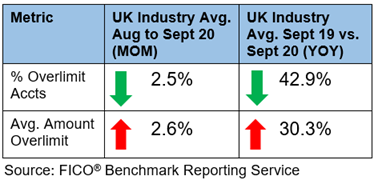
September saw a decrease in the proportion of accounts exceeding their limit and this number is 42.9 percent lower year-on-year. However, the average amount over limit started to increase again and is 30 percent higher than September 2019.
Cash spend on cards continues to increase
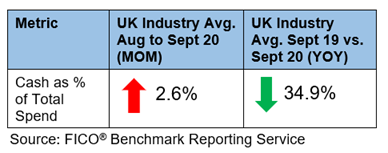
The percentage of consumers using credit cards to get cash increased for the second consecutive month, after a significant fall during the first national lockdown. Although increasing 2.8 percent, levels are still 53.8 percent lower than a year ago.
This has resulted in a 2.6 percent increase in cash as a percentage of total spend. Both monthly increases were higher than those seen in 2019. However, it may be many months until we see the levels of cash usage reach pre-pandemic levels, and they may not rise that high again.
These card performance figures are part of the data shared with subscribers of the FICO® Benchmark Reporting Service. The data sample comes from client reports generated by the FICO® TRIAD® Customer Manager solution in use by some 80 percent of UK card issuers. Issuers wishing to subscribe to this service can contact staceywest@fico.com.
- 09:00 am

The Global Legal Entity Identifier Foundation (GLEIF) announces that J.P. Morgan has become the first Validation Agent in the Global LEI System.
The Validation Agent Framework, announced by GLEIF in September 2020, enables financial institutions to improve their customer experience, accelerate client lifecycle management and reduce costs by using ‘business-as-usual’ know-your-customer (KYC) and anti-money laundering (AML) onboarding procedures to facilitate LEI issuance for their clients.
J.P. Morgan and LEI issuer, Business Entity Data B.V. (BED), a wholly owned subsidiary of The Depository Trust & Clearing Corporation (DTCC), have together issued the first LEI under the new Validation Agent model, via BED’s GMEI Utility service.
J.P. Morgan’s Managing Director, Reference Data Strategy, George Brandman, comments: “Working as a Validation Agent will allow us to improve our client onboarding experience as well as create valuable industry LEI reference data. If a majority of financial institutions implemented this service, it would greatly multiply the number of LEIs in production to the benefit of all.”
“DTCC is pleased to issue the first LEI via the Validation Agent model for J.P. Morgan, leveraging our GMEI Utility,” adds Matt Stauffer, Managing Director and Head of Institutional Trade Processing at DTCC. “Our collaboration with J.P. Morgan demonstrates the additional efficiencies that can be achieved through broader utilization of LEIs and supports our core mission of bringing increased efficiency and resiliency to the industry.”
Stephan Wolf, CEO, GLEIF, comments: “By becoming Validation Agents, financial institutions realize a range of operational and strategic benefits, both now and in the longer-term. Not only can J.P. Morgan streamline its client onboarding and lifecycle management processes, thereby improving its customer experience, it can also use the LEIs in innovative service offerings.”
As well as delivering a faster, more convenient customer experience, Validation Agents can also capitalize on new opportunities to add client value and achieve market differentiation. By expanding LEI issuance beyond clients that require an LEI for financial compliance, a Validation Agent can equip its whole business client base with globally recognized identities that can be leveraged in new services and across borders with any counterparty or supplier around the world.
“Increasing LEI volumes and broadening their usage will solve the issue of trust in financial transactions globally,” adds Wolf. “Validation Agents like J.P. Morgan will play a key part in making this vision a reality. They contribute to growth across the entire financial ecosystem and ultimately will benefit all stakeholders and the broader global economy.”
For more information on the Validation Agent role, please visit the GLEIF website.








