
Published
- 09:00 am

Christmas sits at the end of the calendar as a bright, gleaming target … for fraudsters. Each year, consumers across the country scramble to find the perfect gifts for friends and families. Shopping centres and high streets are flooded with bargain-hunters as the festive spending commences with Black Friday sales. But while this year will differ for a range of reasons, what remains the same is criminals searching for opportunity.
Even if the UK emerges from its second lockdown on 2 December, fraud experts at global analytics software provider FICO still predict significant growth in e-commerce. Previous high levels of festive footfall will become hours of screen time as consumers scroll through page after page for the best deals. And with this ever-increasing amount of time and money spent online, fraudsters have an abundance of opportunity to steal personal data and funds.
UK Finance reports over £27m was lost to fraud at online marketplaces and auction websites in the first half of 2020, averaging at a loss of £720 per case [1]. Its latest intelligence shows a recent rise in purchase scams on Christmas gifts and home improvement products.
To help educate and protect consumers, Matt Cox, managing director, EMEA, Fraud, Cyber and Compliance at FICO has outlined his top five tips and best practices to stay ahead of fraudsters.


Top tips to combat festive fraud
Revisit password habits
It turns out that long passwords are even more important than strong passwords. The length and strength of a password, combined, is the strongest deterrent to a hacker cracking your password with brute-force computing power. It’s also important is to use a unique password for each of your accounts, particularly important ones; not just bank accounts but PayPal, Klarna, Gmail and Amazon.
Take advantage of additional authentication features
Make use of any additional authentication capabilities offered by apps and websites you visit frequently. The easiest type to use is a one-time use passcode, which can be texted, emailed or pushed via an app. You can also use hard token code generators where they still exist.
Use trusted payment methods
Do your research, read the reviews, and check Google carefully to see if the app is a scam. If in doubt, use well established methods like PayPal, Apple Pay, Amazon pay, Ideal and any other local providers.
Be sceptical
It's the season of giving. And during a pandemic fraudsters are bound to capitalise on the opportunities to scam the most giving and caring. Although GoFundMe states [2] that “the overwhelming majority of fundraisers on our platform are safe and legitimate,” scams do happen there [3] and many other places. To protect yourself from charity and disaster relief fraud make sure the donation website is legitimate. It’s very easy for criminals to create lookalike websites that siphon off credit card and personal information, which can then be quickly used to run up fraudulent transactions.
Monitor credit report and bank balance
Everyone needs to monitor their credit reports and their finances. Not just to stay informed about credit history, but also to spot anything suspicious as quickly as possible.
To read more about how to combat festive fraud, click here: www.fico.com/blogs/fightfraud.
[1] https://www.ukfinance.org.uk/press/press-releases/consumers-warned-online-scams-ahead-black-friday
[2] https://support.gofundme.com/hc/en-us/articles/203604694-Reporting-a-Campaign
- 02:00 am

equensWorldline SE, a subsidiary of Worldline [Euronext: WLN], European leader in the payments and transactional services industry, has become one of Europe’s leading Open Banking providers since the formal start of PSD2 a year and a half ago. An increasing number of banks and third party providers are exploring the benefits of equensWorldline’s Access 2 Account TPP Services. These services connect the third party provider to more than 2.800 banks in 16 countries and rapidly increasing.
Via a single API companies are given the possibility to initiate a payment or retrieve account information from any bank in Europe. The demand for access to account is increasing as more and more companies explore the possibilities that PSD2 and Open Banking have to offer, especially on a pan-European scale.
Michael Steinbach, CEO at equensWorldline, said: “As a pan-European player we think ahead and respond to the opportunities offered by European legislation. We have also done that for PSD2. That is why we can now support our clients, when they want to seize the opportunities that Open Banking brings them all across the European banking landscape, so they can be ahead of the competition thanks to the unique reach and industrial scale of our PSD2 offer.”
Broad portfolio
Access to account is just the start of a journey leading to an Open Banking infrastructure. As a pan-European player, equensWorldline offers a broad portfolio of Open Banking services containing Access 2 Account TPP Services, API monetization services and identity services that enable banks and third parties to improve their services and underlying processes for their customers.
In order to understand and quickly grasp the potential of Open Banking, equensWorldline has created more than 10 different use cases that allow clients to quickly and effectively create a value proposition to offer to their customers. They all benefit from it, whether it's the sustainable bank offering carbon footprints to its green-focused customers or the Payment Service Provider wanting to implement an efficient, conversion-increasing account-based payment in-store or online.
- 08:00 am
The Derivatives Service Bureau (DSB), founded by the Association of National Numbering Agencies (ANNA) to facilitate the allocation and maintenance of International Securities Identification Numbers (ISINs), Classification of Financial Instrument codes (CFIs) and Financial Instrument Short Names (FISNs), for OTC derivatives, is today calling for new members for its Product Committee (PC) with an application closing date of 13th January 2021.
DSB PC existing membership includes representatives from the buy-side, sell-side, custodians, data vendors, trading venues and trade associations, and has always chosen members based on asset class and workflow expertise, as well as geographical representation across all user categories. The PC is particularly well represented from the North American and European regions, but seeks to expand its membership from the Middle East and Asia regions to further broaden geographic industry collaboration.
A key role of the PC’s work is to assist the DSB in specific industry developments in the OTC derivatives space. The PC Charter has been revised, expanding in remit to include the DSB’s work as the Unique Product Identifier (UPI) Service Provider. The PC will begin its third term in February 2021, which will run for two years.
Emma Kalliomaki, Managing Director of ANNA and the DSB, said: “We are extremely grateful to our current Product Committee members, who continue to give up their time and work hard to achieve results which benefit the industry as a whole. The PC has ensured OTC ISIN creation has been transparent and efficient for the global OTC derivatives market. Now, with the DSB’s responsibility for UPI assignment, we are calling for new members to reflect that expanding remit and continue with effective industry collaboration for the next two years.”
Joseph Berardo, Co-Chair of the DSB Product Committee and Director of Credit Product Management at Intercontinental Exchange/ NYSE, said: “To deliver on the promise of providing the industry with a global standard OTC derivatives instrument identifier, it requires a diverse group of financial industry experts that come together to identify and resolve the challenges in applying such standards. The DSB Product Committee has successfully met these challenges and will continue to do so as new implementation challenges arise.”
Harry McAllister, Co-chair of the DSB Product Committee, and Information Architect at BNP Paribas, said: “As the industry liaison group to the DSB, the PC is actively engaged with market participants and collaborates extensively with the industry to address data-related challenges such as those posed by changing regulatory requirements. The PC continues to support ISIN assignment for OTC derivative products, refining product template definitions and solving for additional use cases. We are excited to take on a new role in the governance structure of the UPI, and look forward to starting work on implementation.”
To view the Product Committee Charter and download the application form visit the DSB website https://www.anna-dsb.com/product-committee/. Interested OTC derivative users have until 13th January 2021 to put in their applications, with PC membership being announced early February 2021.
- 02:00 am

Riverbed announces expanded product capabilities and strong market momentum of Client Accelerator, with nearly 100% sequential growth, as IT organizations look to accelerate business-critical applications and performance of remote employees as increasingly more employees Work From Anywhere.
Delivered in a software form factor, Client Accelerator extends best-in-class optimization and acceleration technology all the way down to the end user – laptops or desktops – eliminating performance problems caused by network congestion, latency, and increasingly unpredictable last-mile networks, providing accelerated access to on-prem, IaaS, or SaaS-based applications, even in less than ideal user conditions and regardless of location. Client Accelerator reduces network data congestion by up to 99% and offers up to 10x faster and reliable performance for business-critical SaaS apps, on-prem applications and IaaS cloud workloads. As a result, the user experience of business-critical applications significantly improves along with employee productivity.
Client Accelerator feature enhancements include added support for scaling up to 200k clients per customer instance, new reporting APIs and enhanced integration with Riverbed SaaS Accelerator, which eliminates network inhibitors that impact the user experience of key SaaS apps such as Office 365 and Microsoft Teams Live Events and Stream Video, Salesforce, Box, ServiceNow and more. In addition, both SaaS Accelerator and Client Accelerator will be available on the Microsoft Azure Marketplace during November 2020.
“In the continued Work From Anywhere reality, Client Accelerator offers a path to fast, consistent and available enterprise applications wherever employees do their work,” said Dante Malagrino, Chief Development Officer at Riverbed. “While there was an immediate and significant increase to remote working at the start of the pandemic, we expect to see a long-term shift toward employees increasingly working from anywhere, including hybrid work environments, where employees spend half the time in the office and the rest of the time remote at home, client locations, at cafes or while traveling for business. We’ve experienced significant market momentum and customer demand for Client Accelerator, as IT and business leaders are looking to deliver strong user productivity and performance regardless of where an employee resides.”
By eliminating performance problems caused by network latency, congestion and unpredictable competition for last-mile network access, businesses can move from remote workforce triage to achieving improved customer/client/employee satisfaction, faster time to market, increased pipeline/revenue, improved reputation and lower cost/risk to the business. Organizations globally, across all industries have been deploying Client Accelerator to accelerate the performance of their remote and hybrid workforces.
Case Study: ERM – Efficient Collaboration and a Mobilized Workforce
By using Client Accelerator, Environmental Resources Management (ERM), a leading global provider of environmental, health, safety, risk, social consulting, and sustainability related services provides accelerated access to centralized files and applications to 5,500 employees (in 42 countries and territories) who are working remote from home or at a client location. A 15MB Excel file or 30MB PowerPoint file that previously took minutes to open without Riverbed Client Accelerator now opens in a few seconds. Company-wide, the time savings are significant – if half of ERM’s 5,500 employees open three large files a day and save just one minute each time, ERM gains 137 hours of work time daily, the equivalent of an extra 17 employees year-round.
ERM and the Company’s consultants experienced no downtime in the transition to work from home during the pandemic, and no drop in productivity. “I can’t overstate the value of Riverbed for collaboration among people in different locations,” said Ian Trueman, IT Operations Director at ERM. “With Riverbed Client Accelerator, we’re working as efficiently from home as we did in the office. Our clients are impressed.”
For more information, or to sign up for a 60-day trial, please visit Riverbed Client Accelerator.
- 02:00 am

Today, SumUp and Mastercard are announcing their new payment services tailored for Ford commercial vehicles in Germany, France, Italy, Spain and the United Kingdom. With this new solution, small business owners that typically use commercial vehicles – including food trucks, beverage suppliers, mobile florists and other tradespeople – can accept card payments directly from their vehicles.
One of the main advantages of this solution is that it gives entrepreneurs the ability to accept payments from their customers immediately, rather than waiting for an invoice to be paid at a later date. This in turn can help them manage their cash flow more optimally, particularly in cases when they need to receive a deposit to buy the materials to start the job or pay their subcontractors.
Another benefit is that it gives these small businesses more choice by enabling them to accept card payments – including contactless – as opposed to cash only. Similarly, customers can have the option to pay by debit or credit card – either contactless or by chip and pin. Providing more payment choices is particularly important at a time when customers and businesses alike opt for rapid, safe and hygienic solutions such as contactless payments.
"The cooperation with Mastercard and Ford completely fits with our corporate philosophy," said Alexander von Schirmeister, Executive Vice President Europe at SumUp. "Our ambition has always been to support small businesses in their daily work and make it easier for them to get paid doing what they love. The new Marketplace feature within the FordPass Pro app embodies this approach and we are pleased to be a part of it with our payment technology and wide range of services,” he adds.
Jason Lane, Executive Vice President, Market Development Europe, Mastercard, noted: “Now more than ever, small businesses are an indispensable part of our economy, and a crucial part of our recovery moving forward. Providing them more options on how they want to make and receive payments can help them manage their cash flows and ultimately improve their bottom lines. To that end, we are delighted to be the partner of choice of SumUp and Ford in delivering innovative payment solutions that support European small business owners.”
Mark Harvey, Director, Enterprise Connectivity at Ford of Europe, comments: “From couriers putting in the miles to tradespeople putting in the hours, we recognise that for hard-working small businesses small savings can add up to make a big difference,” said Mark Harvey, director, Enterprise Vehicle Connectivity, Ford of Europe. “FordPass Pro, with unique cost- and time-saving offers from the likes of SumUp and Mastercard, is another example of how we are able to use our scale and buying power to help small businesses to thrive.”
- 07:00 am

Two thirds (68%) of business leaders used automation to respond to the impact of the COVID-19 pandemic, according to new research from Deloitte on robotic and intelligent automation.
Deloitte’s survey of 441 executives from 29 countries highlights that the pandemic forced organisations to rethink how work is done. Around three in four (73%) of organisations worldwide are now using automation technologies - such as robotics, machine learning and natural language processing - up from 48% in 2019.
Meanwhile, the number of organisations deploying automation at scale has tripled in the space of two years. Thirteen per cent of leaders say their organisation has implemented over 50 automations, up from eight per cent in 2019 and four per cent in 2018.
Justin Watson, partner and leader of Deloitte’s robotic and cognitive automation practice, said: “Automation has been a lifeline for businesses during the pandemic – allowing for rapid increases in processing capacity, new processes to support the response, increasing productivity and accuracy, whilst also improving the experience of customers and employees. As organisations scrambled to support home working en-masse and provide COVID-secure work sites, automation took the strain to ensure business continuity. For instance, by triaging requests to allow contact centre agents to manage the higher number of calls and emails, or accelerating the validation of loans from financial institutions. In the months ahead, investment in automation technologies will continue to flow with the direct aim of bolstering organisational resilience.”
Business transformation is the leading investment for UK companies
According to Deloitte's latest UK CFO survey, business transformation is the number one area for business investment in the next 12 months. Two thirds (65%) of UK CFOs expect to increase investment in organisation and business process improvements, such as restructuring, streamlining and automation, over the year ahead.
Ian Stewart, chief economist at Deloitte, said: “For years economists have puzzled over the gap between the remarkable power of new technologies and weak productivity growth out in the real economy. Now the pandemic has sparked a surge in technology deployment across the economy. With the right skills to exploit it, this tech surge creates a window for faster economic growth and greater organisational resilience. Very few good things have come from the pandemic – the accelerating adoption of new technologies may prove to be one of the most significant.”
One in 10 workers has already had to retrain as a result of automation
To prepare for the disruption automation will bring to their organisations over the next three years, business leaders expect that they will have to retrain 34% of their workforce because their roles will sufficiently change as a result of the implementation of new automation technologies.
Today, one in four (23%) workers has seen a change to their role and ways of working because of the implementation of these technologies, while one in ten (10%) has already had to retrain because their role has been affected by automation.
Of those leaders working in organisations that are retraining their employees already, 59% are providing learning that focuses on process skills, like active listening and critical thinking. Meanwhile, half (51%) are offering retraining in cognitive abilities, such as creativity and problem solving. This suggests a move away from traditional technology user training, towards encouraging workers to effectively use new technology in a way that augments and adapts their roles.
However, 58% of organisations have not yet calculated how their workforce’s roles and tasks, and the way tasks are performed, will change.
Dupe Witherick, senior manager in Deloitte’s robotic and cognitive automation practice, added: “Leaders must keep in mind that successful automation is not only about new technologies, it's about people. A worrying number of leaders are yet to consider how their workforce will be disrupted as a result of automation. Understanding this will serve two benefits - firstly, to highlight the skills that workers will need to ensure new technologies are rolled-out and managed in an efficient way and secondly, to pave the way to change workers’ perception of automation from a rival to an asset.”
Robotic technologies to be used by 93% of businesses in 2023
Robotic process automation (RPA) is currently the most popular automation technology, with adoption expected to be near-universal in the coming years. 93% of business leaders expect to be using robotics in 2023, with 78% of leaders having already implemented this technology and 16% planning to do so in the next three years. Meanwhile, 89% of organisation using cloud infrastructure for their automations or planning to do so in the next three years.
Usage of RPA has soared since Deloitte first began research in automation adoption in 2015, when just 13% of leaders said they expected to increase automation in the coming months by investing in RPA.
Watson concluded: "While robotic technologies have now been adopted widely, the full potential of automation lies in an ever-increasing range of technologies, tools and techniques. The pace of technology innovation continues to outstrip the pace of automation adoption and, as a result, we still have a long way to go before automation's benefits are fully realised. Upskilling the workforce so every employee can effectively use new technologies to improve their role, while building a culture that prioritises learning and creativity, will ensure that people do not get left behind in the race to scale new technologies.”
- 02:00 am

Ebury, the global transaction platform, has signed a new partnership with TrustBills, a rapidly growing German fintech that helps companies finance their international trade.
The two innovators in international trade have agreed to supplement each other’s portfolios, integrate their payment systems, and support their respective sales activities.
The new partnership will mutually enhance both companies’ product offering and aims to make international trade easier for corporates as well as increasing access to cross border receivables finance to more market participants.
By integrating their payments systems, TrustBills and Ebury will be able to provide a better alternative to the EBICS approval process which can be slow. This will enable clients in Germany, Switzerland and Luxembourg to benefit from both companies best-in-class technology when it comes to payments and working capital.
Juan Lobato, Ebury’s co-founder and CEO, commented: “TrustBills Receivables Exchange provides diversified sources of liquidity and continuous access to working capital at the lowest cost. As we focus on providing solutions for international trade, TrustBills is a very good fit. It provides additional liquidity to our clients and helps to free cash tied up in outstanding invoices.”
Joerg Hoerster, Founder and CEO of TrustBills, commented: “Corporates around the globe can open multi-currency accounts with Ebury in no time. Foreign investors who plan to source trade finance risks through TrustBills Receivables Exchange will now find that processes will become much easier, faster and more efficient.”
- 06:00 am

Wealthify, the multi-award-winning digital investment service, today announces the appointment of Ben Luckett as Chairman. Ben is a former Strategy Director for Aviva’s UK General Insurance business and has served on Wealthify’s board since 2019.
He is currently also Managing Director of Aviva Ventures, the strategic corporate venture fund that invests in innovative, technology growth companies. In 2016, Ben saw Wealthify’s potential to disrupt and transform investing and helped the business secure funding from Aviva in 2017. He is part of the five-strong senior leadership team at Wealthify, working alongside new CEO Andy Russell, who was appointed in June this year to lead the company through a period of ambitious growth.
Ben takes over from Richard Avery-Wright, one of Wealthify’s original co-founders and angel investor, who, as a result of Aviva completing its acquisition of Wealthify in June this year, will now stand down as Chairman.
Ben Luckett, incoming Chairman, said: “I am looking forward to being even more involved and supporting the business to reach its full potential. Wealthify has a very bright future, with a hugely talented and ambitious leadership team. We have many exciting developments ahead of us and I’m thrilled to be taking up my new position at such a crucial time for the business.”
Andrew Russell, CEO of Wealthify, added: “We’re delighted that Ben is moving into the role of Chairman. His experience of building a successful investment vehicle with Aviva Ventures will be hugely beneficial during Wealthify’s next stage of growth. He is keen to protect and nurture our innovative and agile culture and wholeheartedly supports our purpose to inspire anyone to build their future wealth by making investing easy and accessible for everyone.”
- 07:00 am

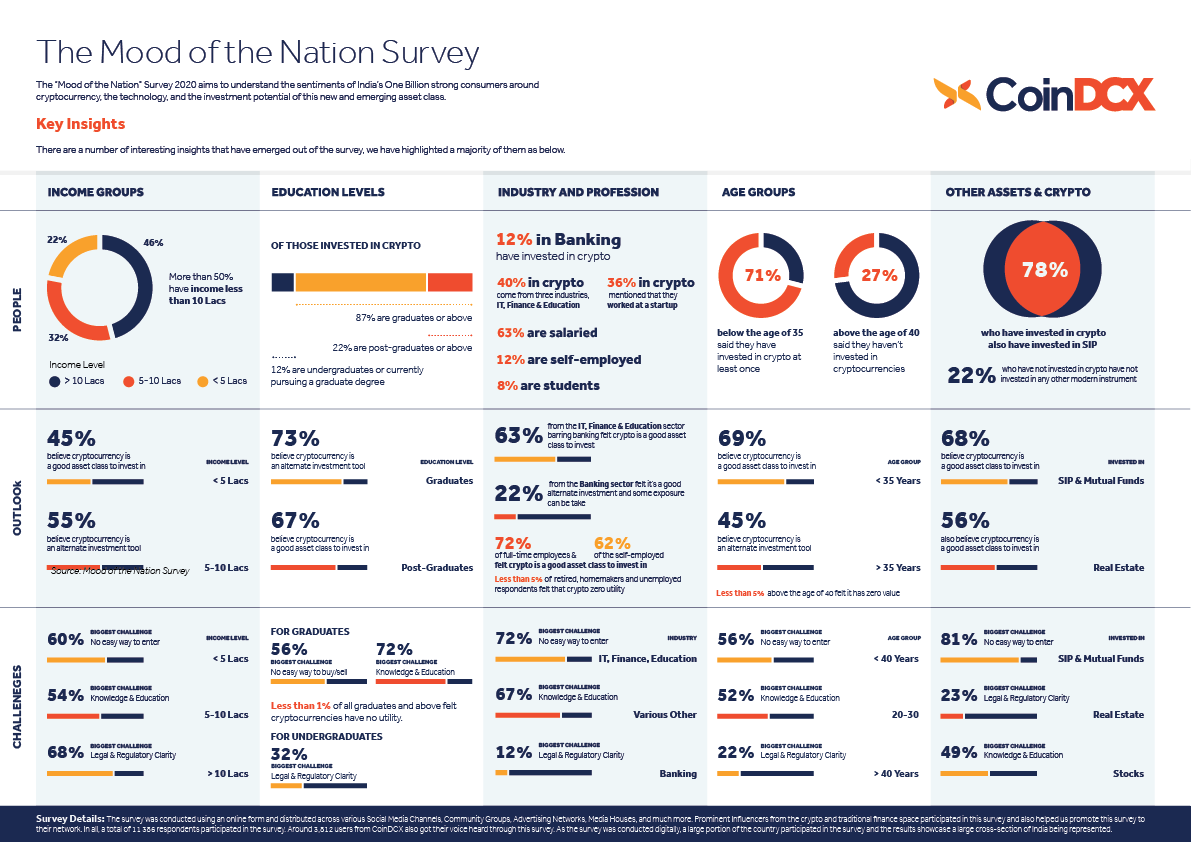
CoinDCX, India’s largest cryptocurrency exchange, today released a report which highlighted that 60% of the respondents earning below Rs. 5 lakh p.a. found it extremely challenging to invest in crypto owing to lack of easy and seamless options available. On the other side 68% of the respondents earning above Rs. 10 lakh p.a. cited legal and regulatory clarity as a major concern for considering investments in crypto.
The survey received an overwhelming response from more than 11k respondents, majorly belonging to the age group of 25-35. Of the total respondents 53% were crypto investors and 47% were non crypto investors. The “Mood of the Nation" Survey 2020” by CoinDCX aimed to understand the sentiments of India’s One Billion strong consumers around cryptocurrency, the technology, and the investment potential of the new and emerging asset class.
The first of its kind national study showcased that 78% of investors in crypto have also invested in mutual funds earlier, 22% of investors in crypto have never invested in any new age investments, whereas 63% of respondents from the IT, Finance & Education sector barring banking felt crypto is a good asset class to invest in. Further only 12% of the respondents from the banking sector felt regulation is the biggest challenge from crypto and stated the reason behind their reluctance to invest in this asset class.
Sumit Gupta, CEO and co-founder of CoinDCX, said: “This survey is an important benchmark in the Indian crypto discourse. It highlights the requirements of options for investing in crypto on one side and also emphasises on the requirement of smart regulation in the country. It is clear from the report that, while outwardly India is set to become the next global player on the international scene, it is extremely important that smart and sensible regulations become a part of the discourse.”
“Knowing how an average Indian perceives cryptocurrency puts CoinDCX as well as the Indian cryptocurrency community in a position of responsibility to ensure that every single Indian can understand and adopt cryptos, and join this ever growing community,” he further added
72% of full-time employees & 62% of self-employed respondents felt crypto is a good asset class to invest in while less than 5% of Indians comprising homemakers and unemployed respondents said crypto has zero utility. The trend showcased the fact that those with disposable income, were marginally higher and more bullish towards crypto, vis-à-vis the others.
Considering the education levels among the respondents, the survey realised around 72% of graduates felt lack of knowledge and awareness was their biggest challenge to enter cryptos. Graduates however took a lead whereby 73% believed that crypto is an alternate investment class, while 67% post graduates cited crypto as a new asset class and a good investment option.
Considering the age group criterion of the respondents, the survey report highlighted 71% of respondents below the age of 35 said they had invested in crypto at least once while 27% of respondents above the age of 40 said they had never invested in cryptos. Besides 69% of the respondents below the age of 35 considered crypto as a good asset to invest in. A significant number of respondents below the age of 40 felt that there is no easy way to enter cryptos while 52% respondents within the age group of 20 to 30 felt lack of knowledge and awareness is a huge challenge.
Kashif Raza, Co-founder of Crypto Kanoon, a platform dedicated to clearing regulatory ambiguities in crypto, said: “This survey will be a gamechanger for all of us in the cryptocurrency community. The results coming from this survey will help us, as a crypto community, how to bridge the gap between the crypto community and people who want to be a part of this community.“
The report interestingly reiterated that being internet savvy and having a better understanding of the digital economy led to increased interest among millennials for crypto as compared to the older generations. Furthermore, considering the majority of millennials are currently working and have a good amount of disposable income added to their inclination towards the asset.
Post Supreme Court’s judgement in March to lift banking bank, Indian crypto industry has witnessed huge influx of crypto demand from investors. The report titled ‘Mood of the Nation - 2020’ aims to understand the sentiments of investors around cryptocurrency and to understand investment potential. As part of its #TryCrypto movement, CoinDCX conducted the survey through digital means encompassing social media platforms, media houses and communities. Leading voices from crypto and non-crypto space too endorsed and promoted the same.
- 05:00 am

Denmark-based Lunar has selected a cloud-based treasury and risk management solution from financial technology leader FIS® (NYSE: FIS) to enable the mobile-only digital bank to optimize liquidity and manage risk as it continues its rapid expansion.
Lunar, which received a banking license in 2019, offers consumers and businesses throughout the Nordics with comprehensive savings, investments and insurance products via a sleek, easy-to-use digital app. The challenger bank, which prides itself on technology innovation, was looking for a leading-edge treasury management solution that provides rich functionality while leveraging open application programming (API) interfaces to ensure simple integration with cloud-based applications.
The Nordic bank chose the FIS private cloud-based Ambit Quantum, a front-to-back treasury and risk management solution, to manage liquidity, hedge accounting and regulatory compliance. Lunar will implement the solution on the FIS private cloud under a managed services contract.
In addition, Lunar will leverage the FIS SWIFT Service Bureau to securely connect its treasury and payment operation to banking partners through SWIFT and other industry exchanges and networks. Seamless integration through API gateways will allow Lunar and its customers to access up-to-date information on the Lunar banking app.
“We’re excited to work with FIS as we look to change banking in the Nordics,” said Anders Hartlev, CFO at Lunar. “Our goal is to change the way people think about and spend their money, and technology is the enabler in that revolution. This innovative solution from FIS will provide us the tools we need to manage risk and maximize our liquidity as we continue to expand our client base and portfolio of offerings.”
“In today’s uncertain business environment, it’s more critical than ever that banks have an accurate, real-time view of their treasury payments, cash flow, and portfolio risk,” said Andrew Bateman, Head of Capital Markets Buy Side at FIS. “We are excited to welcome Lunar as a new FIS customer and are confident that our treasury and risk management solution will provide the platform this digital bank needs to support and power its continued growth.”








