
Published
- 01:00 am

The Insurtech M&A Market Report from international technology mergers and acquisitions advisors, Hampleton Partners, forecasts a record 95 or more M&A deals in 2020, with 48 already banked in the first half of the year. Volume has more than doubled since the year 2013, which saw 46 insurtech transactions.
With global insurance premiums exceeding $4.9 trillion in 2017, investor appetite is growing. The fundraise count in the insurtech space has increased 314 per cent over the past six years, growing from 41 fundraises in the first half of 2014 to 170 fundraises in the first half of 2020. There were a total of 274 insurtech funding rounds disclosed so far this year.
Value raised has also increased over time, growing from $557 million in 1H2014 to $3.5 billion 2H2019. So far in 2H2020, a total of $2.5 billion has been raised.
Six mega-rounds were responsible for 69 per cent of total funding: Bright Health ($500 million), Ki ($500 million), Next Insurance ($250 million), Waterdrop ($230 million), Hippo ($150 million) and PolicyBazaar ($130 million).
Private Equity remains prominent buyer group
Across transactions closed between July 2019 and October 2020, the proportion of private equity acquisitions came in at a very high 39%.
Miro Parizek, founder, Hampleton Partners, said: “Private equity firms are keen to invest in tech companies serving the insurance industry, targeting solutions focused on customer experience through to digital transformation solutions for carriers.”
Partnerships between tech and insurance incumbents
Established insurers are having to maintain relevance and deliver superior customer experience in the face of ‘Big Tech’ entrants to the markets.
Amazon recently announced it will be offering auto insurance and services in combination with Acko General Insurance, with the quote-to-bind process taking less than two minutes and all policy-related communication stored on the Amazon platform.
As a result, funding and M&A activity is shifting towards more customer-centric and direct-to-consumer digital insurance options. Established insurers are improving their partnership and collaboration strategies with new technology providers.
The third quarter of 2020 saw 32 (re)insurer partnerships. These included Hiscox’s partnership with Thimble, on-demand insurance for small businesses and Verily’s partnership with Swiss Re to launch a unit to provide stop-loss insurance which covers unexpected and large employee healthcare costs.
Largest three deals – past 30 months
- Aon Plc and Willis Towers Watson agree merger - $30 billion
- Roper Technologies acquires Vertafore - $5.4 billion
- Prudential Financial acquires Assurance IQ - $2.35 billion
The future of insurtech M&A
Miro Parizek concluded: “Revenue in the insurtech market is expected to reach $10.1 billion by 2025. There is no doubt that the M&A, fundraising and partnership activity unfolding at present will continue to thrive as players compete for a piece of this pie in an increasingly digital world.”
Hampleton’s Insurtech M&A Market Report covers the following sub-sectors: B2B Insurtech, Insurers, Brokers & Intermediaries, Sales & Back Office Tools, Connected Analytics and Fraud Detection & Forensic Analysis.
Download the Hampleton Partners Insurtech M&A Market Report: https://hampletonpartners.com/insurtech-report
- 09:00 am

Meet Fidsy - an AI assistant plugged in to every corner of your company that can analyse data at superhuman speed and share insights with you over a cup of coffee.
The voice-enabled analytics advisor offers plain English answers to what were once complex questions. What do my customers want? Is my business performing well? Am I on track to achieve my goals?
“Our vision is to democratise business intelligence software for companies big and small,” says founder and CEO Yigit Erol. “We do this by providing jargon-free and affordable access to valuable business insights, across all smart devices.”
Launching soon, Fidsy is currently working with beta customers who are helping to test the platform and provide valuable feedback while benefiting from the value Fidsy provides their business.
It brings all of your data together seamlessly from as many sources as you like including, but certainly not limited to, Google Analytics, Xero, Shopify and Facebook, integrating the lot, and offering a holistic view of your business you might never have seen before.
Gone are the days of emailing six different departments to get long-winded charts and reams of Excel-heavy spreadsheets that require painstaking data analysis. Simply ask a question and within moments get a straightforward answer.
Fidsy does it all for you and, of course, doesn’t need sleep so keeps an all-knowing eye on your company’s most important insights, identifies new ones and offers a raft of recommendations and solutions, 24/7.
And if you ask it, it’ll even take actions for you. Want your quarterly results packaged into PDF? Just ask and Fidsy will oblige.
If you want to save time, money and get Enterprise level analysis at unprecedented speeds Fidsy is the cost-saving shortcut to business brilliance.
Register your interest here: https://fidsy.com/#register.

N/A
N/A at N/A
2020 is the year of Bitcoin, as more and more cryptocurrency fans are looking for the best ways to get their hands on th see more
- 07:00 am

Global analytics software provider FICO released its analysis of UK card trends for November 2020, which reflects the mixed financial fortunes of UK consumers as well as highlighting the continuing debt waiting game.
“Our new data shows that despite the introduction of the second national lockdown, credit card spend increased in November, as Christmas shopping got underway, boosted by Black Friday,” explained Stacey West, principal consultant for FICO® Advisors.
“Spending on UK credit cards is now only 2.6 percent lower than a year ago; either consumers are feeling confident enough about their finances to increase their spending levels or they simply need the cheer of Christmas to counteract the continued gloom of COVID-19, whether they can afford it or not. The concern is that a proportion of spend is being funded by the current government financial support for those on furlough. Payment holidays on existing credit agreements are also probably taking the pressure off outgoings and giving some consumers a false sense of financial wellbeing.
“There could be a real issue after Christmas as payment deferrals come to an end in early 2021 and furloughs at the end of April (unless they are once more extended). Christmas debts will be unmanageable for some. The sudden introduction of tier 4 and the anticipation that these measures will be in place for months means extra pressure and hardship on many businesses, especially at one of the most profitable times of year.”
Spend on UK cards increased and percentage of payments to balance dropped
Average spending on UK credit cards increased by £19 to £638 in November and is now only 2.6 percent lower year on year.
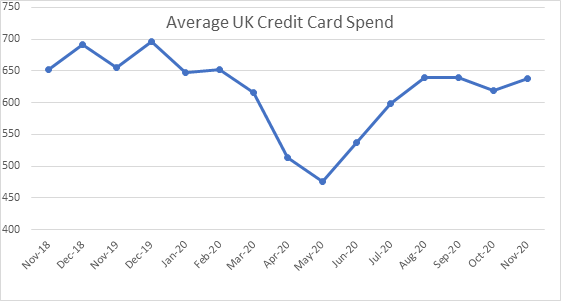
But the percentage of payments to balance fell for the first time since June. The percentage paying the minimum amount on their cards also increased for the first time since June and was especially noticeable for accounts opened less than a year.
Average card balances are, however, at their lowest in the last six years, down 8.9% on November 2019, even though growth in balances is normally seen in this month. This is being influenced by consumers with credit card limits below £5,000 as there has been growth on higher limit cards.
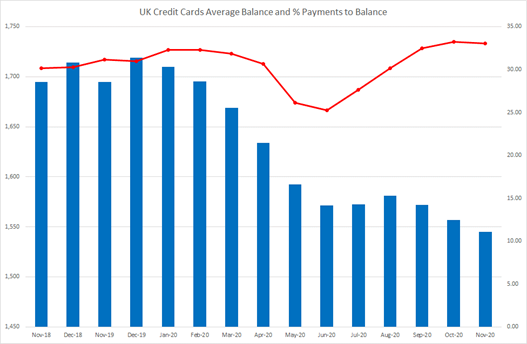
“The lower average balances are a sign of some consumer spending caution and the reduction in in-store spending options,” added West. “Lower average balances and the financial support mean that it is not surprising to see a higher percentage of the balance paid each month. Although the drop is a seasonal trend, this is normally in conjunction with higher balances, this has not happened this year. This fall could be an early sign of financial stress as some consumers struggling to maintain their payments outweigh those paying more due to having a lower balance.”
Lenders take action reducing credit limits
Lender action to stave off a potential debt tsunami early in 2021 is revealed as average credit card limits continued to fall by a further £57 to £5,325. Ramping up limit decreases and/or a reduction in limit increases can be behind this trend. Accounts open more than five years reached their lowest average credit limit in the last two years. The highest proportion of accounts, 28.6 percent, remain in the limit range of £5,001 to £10,000, with an average balance of only £1,251.
“Although there was a continuing decrease in the average card limit, it is falling at a slow rate each month. This means that the concerns expressed in the October review around the potential for unaffordable balance build at this time of year remains,” commented West. “The full picture will not be clear until the end of the payment holidays and furlough payments in 2021, so there is time for both the issuer and consumer to work together to reduce the likelihood of this happening.”
“With the introduction of the harsher tiers in December and new tier 4, resulting in further furloughs and job losses into 2021 combined with rising seasonal spend, there is going to be a proportion of consumers who will be turning more and more to their credit card for their everyday needs, adding to the normal rise we see in debt levels at this time of year. Transactional information could be crucial for issuers to help identify the customers showing a heavier reliance on their credit card than usual. This may, however, prove quite complex as spending patterns will already have changed as consumers increase their online card usage and reduce the volume of cash transactions.”
Increase in missed payments
The one missed payment rates continue to be dynamic, reducing in November; for accounts open less than a year, the percentage of accounts missing one payment reached over a two-year low. However, the average balance on accounts missing one payment is now only £4 lower than a year ago.
Of greater concern is the percentage of accounts and balances with two missed payments, which increased for the fourth consecutive month. The average balance on these accounts grew to over a two-year high in November. Here too, there has been large annual growth in the average balance, which is now £252 higher than November 2019. For three missed payments it is £411 higher.
West added: “We are now starting to see that consumers missing payments have higher average balances. There are also signs that once a payment is missed, this is never recovered. A robust pre-delinquency process is, therefore, more important than ever to prevent the customer going down the collections route. Pre-collections treatment can open the dialogue on the sensitive subject of financial difficulties and help avoid negative actions and increased stress once payments start to be missed.
“Issuers implementing data-driven pre-collections and collection segmentation will ensure that the highest priority accounts are worked first, and that the most suitable treatment is offered to their customers at the right time via the most appropriate channel. This in turn will mean that their customers have a more positive experience.”
Further signs of improvement for accounts exceeding their limit
The proportion of accounts exceeding their limit fell to over a two-year low and is now 45.1 percent lower than November 2019. The average amount over limit fell month on month, albeit by only £2, and is still 27 percent higher a year ago.
“Historically, accounts that have exceeded their limit but have no missed payments are a lower priority in collections,” West added. “However, there will be a subpopulation of these accounts that are at a higher risk of missing numerous payments than some accounts that have missed one payment. This is another area where data-driven strategies have been used to highlight accounts that need faster attention and actions than lower-risk 1 cycle accounts, sometimes called lazy payers.”
Cash usage continues to fall
Despite the increase in average spend, the reduction in hospitality and in-store spending options in November resulted in a further decrease in cash usage on credit cards. The percentage of consumers using credit cards to get cash fell 7.1 percent in November; levels are 55.2 percent lower than November 2019. This has resulted in a 5 percent decrease in cash as a percentage of total spend, 31.3 percent lower than a year ago. With the tiers set to continue into 2021, the introduction of tier 4 and more regions at the harshest level, it is anticipated that there will be a further decline.
These card performance figures are part of the data shared with subscribers of the FICO® Benchmark Reporting Service. The data sample comes from client reports generated by the FICO® TRIAD® Customer Manager solution in use by some 80 percent of UK card issuers. Issuers wishing to subscribe to this service can contact staceywest@fico.com.
- 04:00 am

PayNearby, India’s largest hyperlocal fintech startup, recently announced two strategic leadership hiring in Retail Sales to further strengthen and expand its omnichannel retail network. The company has appointed Rahul Singh as the ‘National Head of Retail Sales’ and Sanjiv Singh, as the Head of ‘Sales Strategy & Planning’. The latest appointments are a part of the company’s ambitious plans to drive growth, through branchless banking, across emerging businesses and for its channel partners.
While digitisation has always been on India’s agenda, PayNearby aims to play a leading transformational role with a strong digital footprint of 12 million consumers, backed by its industry-leading physical network of 10 lakhs+ retail outlets across the country. Deeply rooted in fintech and sales, these highly skilled leaders will fuel PayNearby’s mission and vision to strive to democratise digital payments and access to financial services at the last mile in the country.
Rahul Singh, who previously worked with Atishay Limited, brings with him 29 years of vast experience across several sectors like FMCG, Telecom Sales & Distribution and Fintech with a special focus on payments, mobile wallets, domestic and international remittances and AePS services. Prior to joining PayNearby, Rahul has also worked with Nokia Money, Oxigen Services, ITC Ltd, Colgate Palmolive India Ltd, Idea Cellular and Tata Docomo. As the National Head of Retail Sales at PayNearby, Rahul, apart from acquisition and strategy, will lead and manage future partnerships and alliances to diversify the company’s retail network from 10 lakhs+ to 50 lakhs+ retailers to become the one-stop-shop for branchless banking services in the county. His role will be to make PayNearby the benchmarked financial service provider in India by enabling the best-in-class sales and distribution network.
Sanjiv Singh brings to the table over 25 years of rich experience in helping businesses expand quickly and profitably. His focus has been chiefly in the fields of fintech and telecom while having worked with many renowned companies like Idea Cellular limited, Reliance Communications, Tata Tele Services, among others. During his last stint with Aditya Birla Payments Bank, Sanjiv served as the Head of Sales & Business Development and held a pan-India position for over nine years.
Sanjiv has an affinity for forming go-to-market sales strategies with a unique ability to create and manage large distribution setups. His core strength lies in defining business processes, corporate and large account management, business development and providing market research analytics. At PayNearby, his role will be to strengthen the sales processes, create an effective sales force management system while bringing efficiency in the marketplace through digital and financial enablement. He will help the company expand its portfolio while driving innovation for customer and retailer base and thus help bridge the urban-rural gap and build a digitally inclusive society.
On the appointment, Anand Kumar Bajaj, Founder, MD & CEO, PayNearby, said: “We are delighted to welcome Rahul and Sanjiv into the PayNearby family. Rahul is a veteran and an active player in the fintech industry. He has showcased his leadership prowess in several fintech-related B2B, B2C & B2B2C assignments. His pivotal role in leading three startups to success showcases his extraordinary skills as a fintech visionary. Sanjiv’s unparalleled mastery in sales and adroitness in risk management is imperative to our future expansion goals. We are delighted to collaborate with people who are strongly aligned with our vision for the company and look forward to benefitting from their decades of expertise in the field. As we continue to double down on building the next-generation platform for digital payments, we look forward to utilising their dexterity and leadership in their respective fields to achieve expansive growth and take PayNearby to new heights. This alliance is sure to catalyse the growth of branchless banking and drive financial inclusion further.”
- 03:00 am

Today Mobiquity, a full-service digital transformation enabler, launches the #greatmoments2020 campaign, to celebrate the resilience the general public has shown during the COVID-19 pandemic of 2020.
As part of the campaign, Mobiquity has created a ‘2020 Digital Monument of Great Moments’: A dedicated website to showcase a portfolio of positive experiences in 2020 as a video panel montage submitted from people around the world.
From Africa being declared polio free to the SpaceX Falcon 9 rocket launch, the ‘Digital Monument’ is to remember the positive moments that occurred in the backdrop of a very challenging year.
The world is being encouraged to share the ‘great moments 2020’ video with the hashtag #greatmoments2020 as well as submitting their own great moments to the digital monument via the website.
In addition, people can also share their own personal positive experiences. From a socially distanced wedding, or a virtual birthday, to the birth of a child or accomplishment of a fitness challenge - all great moments, big and small, are being celebrated.
Commenting on the campaign, Lionell Schuring, VP of Creative, Mobiquity, said: “2020 has been a tough year for us all. A year which started with bushfires in Australia was then turned upside down by the COVID-19 pandemic.
“Despite adversity, society has shown a great deal of resilience and it’s important that we look at the good stuff that has also taken place. That’s why we’ve launched the #greatmoments2020 campaign, to share the positive moments that happened in 2020 and encourage others, around the world, to do the same.
“As part of the celebration, we’ve built a ‘2020 Digital Monument of Great Moments’ to give those who are feeling low a lift during these difficult times. Join us and share the video along with your personal #greatmoments2020.”
- 04:00 am

Temenos (SIX: TEMN), the banking software company, today announced that it won three awards at the IBS Intelligence Global FinTech Innovation Awards, 2020. The prestigious awards recognize technology players and banks for their excellence in driving impact through banking technology implementations and innovations using emerging technologies, such as cloud, open APIs, artificial intelligence and machine learning.
IBS Intelligence is a leading global fintech news, research and analyst firm and the innovation awards are a truly global celebration of the best in banking and fintech with 220 submissions across 52 countries with 122 banks participating for the 30 categories this year.
Temenos won in ‘Best Banking Technology Implementation’ categories, recognizing excellence in implementations and in ‘Best FinTech Innovation’ categories, recognizing innovative use of cloud and open API technology, including:
‘Most Impactful Project - Core Banking’ with Varo Bank. Varo is the first consumer fintech granted a national bank charter in the US. With Temenos, Varo estimates the cost to service a customer is going to be 25% of what it will cost a traditional bank.
‘Most Innovative Project - Innovative Cloud Deployment’ with EQ Bank. EQ Bank was the first bank in Canada hosted in the cloud. With Temenos, the bank reached its five-year growth target in half the anticipated time.
‘Best Original & Adoptable Concept - Innovative API / Open Banking’ with Flowe. Italian challenger bank Flowe went live in record time in just 5 months. Temenos’ API-first technology allows Flowe to cut down deployment time and costs as well as easily connect to third parties.
Max Chuard, Chief Executive Officer, Temenos, said: “We are immensely proud to receive these esteemed awards with some of our most visionary clients we call Changemakers. These award-winning projects are great examples of how in partnership with our clients we can reinvent and shape the future of banking. Huge congratulations to Varo Bank, EQ Bank and Flowe for their fantastic achievements and for making banking better, together with Temenos.”
Temenos Changemakers are leaders, disruptors, pioneers and risk-takers who believe in changing the landscape of banking by leveraging the power of technology. They unleash the full power of the Temenos technology platform to imagine, create and deliver outstanding banking experiences to 1.2 billion people all around the world, relying on Temenos today for their banking needs
Robin Amlot, Managing Editor, IBS Intelligence, commented: “We congratulate Temenos and its clients on its standout achievement. This year has brought to the fore the absolute need for digitalization in financial services. The multitude of challenges exacerbated by the global pandemic has forced financial services firms to innovate at a speed never seen before. Winning these awards is recognition that Temenos’ has risen to the occasion and dramatically transformed the industry.”
- 04:00 am

Banks in the U.K. are shifting to digital platforms to gain a competitive advantage against the rising FinTech industry, according to a new report published today by Information Services Group (ISG) (Nasdaq: III), a leading global technology research and advisory firm.
The 2020 ISG Provider Lens™ Banking Industry Ecosystem Report for the U.K. finds banks in the country interested in cloud-based core banking systems, instant payment technologies, automated anti-money laundering services, and API-led applications. The COVID-19 pandemic has accelerated adoption of digital platforms in the U.K., with both banks and merchants pushing for a cashless society.
“The pandemic has fast-tracked the move in the U.K. toward online transactions,” said Bryn Barlow, ISG partner based in the U.K. and co-leader of the firm’s EMEA BFSI industry practice. “Banks are looking for better coordination between their own platforms and their customers’ digital information and records.”
The report also notes the ongoing exit of the U.K. from the European Union will require banks in the country to decouple their networks, including payment and know-your-customers systems, from the EU. For U.K. banks to become a competitive financial hub outside the EU, they will need to invest in cutting-edge technology and business processes, the report recommends.
In addition, the report notes many U.K. banks are closing branches to fund their digital initiatives. Newer and larger banks have begun offering online-only banking services, resulting in several growth opportunities for technology service providers.
Banks in the U.K. are also focused on retaining customers and attracting new ones through new services driven by technology, the report adds. Many banks are offering easy-to-use treasury management, supply chain and credit products in an effort to compete with FinTechs. While banks in the U.K. have been on the forefront of next-generation payment systems, FinTechs and other new challengers are pushing the boundaries of the payment ecosystem further with API-led service portfolios that include virtual payment cards, instant payment options and loyalty-based credit.
As a way to increase agility, many U.K. banks are realizing they need to modernize their legacy core banking systems, the report adds.
In addition, banks in the U.K. are looking to artificial intelligence and other new technology tools to improve their know-your-customer and anti-money laundering systems, the report says. A large number of banks are moving toward automated anti-money laundering checks to improve scaling and speed and to reduce false positives. In some cases, service providers are partnering with smaller FinTech companies to develop integrated solutions.
The 2020 ISG Provider Lens™ Banking Industry Ecosystem Report for the U.K. evaluates the capabilities of 26 providers across four quadrants: Core Banking Platform Implementation Services for Retail, Core Banking Platform Implementation Services for Corporate, Payment Ecosystem Services and Know-Your-Customer/Anti-Money Laundering Services.
The report names Accenture, Infosys and TCS as leaders in all four quadrants and Cognizant as a leader in three. Capgemini is named as a leader in two quadrants, and Atos, FIS, Fiserv and IBM are named as leaders in one.
In addition, Cognizant, LTI, Tech Mahindra and Wipro were named Rising Stars — companies with “promising portfolios” and “high future potential” by ISG’s definition—in one quadrant each.
Customized versions of the report are available from Capgemini and Infosys.
The 2020 ISG Provider Lens™ Banking Industry Ecosystem Report for the U.K. is available to subscribers or for one-time purchase on this webpage.
- 02:00 am

Banks and the Italian Banking Association, in cooperation with ABI Lab, the banking research and innovation centre of the Italian Banking Association (ABI), have started experimentation with the digital euro. The aim of the initiative is to proactively contribute to public debate and support banks operating in Italy as they prepare for the future.
The project focuses on enhancing the role of banks in the European Central Bank’s digital euro environment. Digital euro differs from the existing electronic payments mainly due to its programmability. The project also aims to demonstrate the technical feasibility of a digital euro based on blockchain Distributed Ledger Technology (DLT), a system of distributed ledgers, in addition to exploring new value-added services that will become possible thanks to the currency’s programmability.
The experimentation project is divided into two work areas: one involving the infrastructure and distribution model to analyse technical feasibility, and the second focusing on programmability to experiment with use cases that can differentiate the central bank’s digital euro from the electronic payments already available. The first work area will be carried out in collaboration with SIA, in synergy with the ABI Lab Chain banking infrastructure which already has 100 active nodes distributed throughout Italy, as well as with the banks that operate within it. The second work area will be divided into several working groups that will focus on use cases and will work in collaboration with the banks and NTT Data, PWC and Reply, which have made their resources available to the project. The initiative is open to all interested banks.
The initiative is part of a major focus on the topic. In 2020, many central banks have stepped up their study and consideration of issuing a central bank digital currency, an electronic form of central bank money distributed to citizens. The European Central Bank (ECB) is actively working on this topic, including through the document submitted for consultation on 12 October 2020, following the publication of the “Report on a digital euro”, an in-depth study on the digital euro prepared by the Eurosystem’s High-Level Task Force on Central Bank Digital Currency (HLTF-CBDC) and approved by the Governing Council.
The ECB considers it appropriate to prepare for the possible launch of a digital euro for three strategic reasons: to support the digitisation of the European economy; to respond to the move away from the use of cash as a means of payment; and to respond effectively to a scenario of increased use of digital currencies issued by private entities or by central banks in other countries. Hence the digital euro, a central bank liability offered in digital form, which complements cash and deposits at central banks.
- 06:00 am

Avaloq, a Swiss-based global leader in digital banking solutions and wealth management technology, and Japan-based NEC Corporation today announced the closing of NEC’s acquisition of Avaloq. Each being a market leader in their own field, the combination of their shared vision, technological strengths, and global presence, will accelerate both companies’ long-term growth, global expansion and value creation strategy.
This acquisition was first announced in October 2020, and following receipt of the relevant regulatory approvals, the acquisition was completed on 22 December 2020. NEC now holds 100% of Avaloq’s shares, including the 45% previously held by private equity firm Warburg Pincus, as well as the remaining shares held by Avaloq’s founder Francisco Fernandez and by employees.
Founded in 1985, Avaloq provides powerful cloud solutions for banks and wealth managers around the globe through business process as a service (BPaaS) and software as a service (SaaS) along with on-premise solutions. Avaloq’s vision for the future of wealth management is to maintain the human relationship an investor has with an advisor, to enhance the relationship through technology and to increase engagement and satisfaction. The democratization of wealth management will allow more people to have access to a greater quantity and quality of investment strategies and advice that was once reserved for ultra and high net worth individuals only.
With more than 120 years of expertise, NEC is a leader in the integration of IT and network technologies that benefit businesses and people around the world. Listed on the Tokyo stock exchange, NEC is a truly global organization with office locations in more than 50 countries.
As part of the acquisition, NEC Corporation has installed a new Board of Directors with NEC’s Executive Vice President, Masakazu Yamashina, as the new chairman of Avaloq. Along with a new chairman, there will be four new members to the board, namely Tomoki Kubo, Tomonori Hira, Daichi Iwata and Asako Aoyama. Francisco Fernandez and Peter Schöpfer will remain members of the board of directors of Avaloq Group AG.
Avaloq will continue to operate as its own entity, headquartered in Switzerland, and clients will continue to enjoy the high level of service they have grown used to. This transaction will not lead to a divestment in any of our key regions or offerings, and the management is fully committed to Avaloq’s growth story.
Masakazu Yamashina, Executive Vice President of NEC and new chairman of Avaloq, said: “With its 35-year heritage and focus on innovation in digital banking solutions, core banking software and wealth management technology, Avaloq is uniquely qualified to launch NEC into the Digital Finance field, which together with Digital Government, is one of the pillars for building NEC’s global growth. Our joint value proposition will build on Avaloq’s reliable digital finance products and the trust it has established amongst its clients, coupled with NEC’s cutting-edge technologies, global business network and digital government domain knowledge.”
Avaloq and NEC will be placing great emphasis on building a strong long-term relationship. Through the acquisition of Avaloq, NEC acquires domain knowledge in the digital finance field and enters this segment globally.
Jürg Hunziker, CEO of Avaloq, said: “Avaloq will be entering a new era together with NEC. Since the announcement of the acquisition, I have spoken to many of our clients and partners and am very happy to discover that they are just as pleased with this development as I and my fellow members of the Group Executive Board are. This transaction has generated much interest and we truly believe that NEC is the best partner for our business. Our solutions will only evolve for the better when leveraging NEC’s proven expertise with technologies related to Digital Identity, Artificial Intelligence, Verification, Blockchain, Cybersecurity, and Biometrics. In addition, our innovation capabilities will be elevated with NEC’s strong commitment to Research & Development, evidenced by the resources it has placed towards this, including dedicated facilities in Heidelberg, Germany. I am very much looking forward to starting this new part of our exciting growth journey together with NEC.”








