Published
- 07:00 am

Sophisticated fraud schemes utilizing stolen and synthetic identities are accelerating, requiring more powerful fraud-fighting solutions than traditional identity verification might have previously offered. Addressing these market needs, NICE Actimize, a NICE business (Nasdaq: NICE), today announced the debut of its New Account Fraud onboarding and verification solution. Delivering advanced detection capabilities powered by artificial intelligence, NICE Actimize’s New Account Fraud solution takes a comprehensive and fully connected approach that directly addresses fraud loss manifested by stolen and synthetic identities as well as other fraud schemes associated with the act of opening an account.
With NICE Actimize’s New Account Fraud solution, organizations can take a multi-layered end-to-end fraud management approach. From account origination to both early and ongoing account monitoring, NICE Actimize’s New Account Fraud solution detects and prevents fraud across the customer’s lifecycle.
The solution is designed to work exclusively and seamlessly with IFM-X, NICE Actimize’s industry-leading enterprise fraud platform that delivers advanced detection capabilities powered by artificial intelligence and machine learning. Providing a real-time response in detection and decisioning across some of the most extensive fraud coverage available on the market, NICE Actimize’s IFM-X platform supports fraud management solutions for digital, real-time and open banking channels.
NICE Actimize’s solution orchestrates and connects an organization’s current identity verification data and tools using advanced analytics to bring data and identity risk scores into a purpose-built new account fraud monitoring system. The solution is able to utilize the identity proofing data and risk score to enable optimized account opening decisioning, as well as during post account opening early monitoring for dynamic risk-based account access. By utilizing application data as well as monitoring all payment channels, the account fraud solution’s early monitoring functionality is designed to detect complex fraud emanating from stolen and synthetic ID as well as mule activity with high accuracy.
The NICE Actimize New Account Fraud solution also allows organizations to safely reduce new account application friction as well as false positive application rejections to more fully realize online and mobile customer channel acquisition potential. Identity risk scores and associated data are seamlessly connected into the new account monitoring solution for specialized ongoing monitoring using advanced AI and adaptive analytics for high accuracy new account fraud prevention.
“Investments in new account fraud controls have justifiably occupied top priority among fraud executives looking for a more effective means of balancing risk and client experience. Robust application fraud controls that enable organizations to more effectively monitor and quantify risk throughout the entire lifecycle of the relationship empower the organization to more effectively optimize profitability by minimizing risks without sacrificing acquisition and retention objectives,” said Trace Fooshee, Aite Group, Senior Analyst, Fraud and AML Practice.
“Proliferation of sophisticated fraud schemes that utilize stolen and synthetic ID has intensified the need for financial services organizations to adopt frictionless, digital-only new account opening processes. NICE Actimize’s advanced AI-driven New Account Fraud solution supports FSOs by providing a seamless and cost-effective solution that addresses the challenges reflected in the advancement of new fraud scenarios,” said Craig Costigan, CEO, NICE Actimize.
NICE Actimize’s New Account Fraud solution also offers the following capabilities:
- Identity proofing: Sophisticated identity proofing adds a layer of intelligence across all data streams to provide a single identity risk score for making decisions quickly and efficiently.
- Early account monitoring: Using “zero trust” dynamic risk-based profiling supported by advanced AI not only enables intelligent early account access but also defends and detects against accounts opened for the purpose of perpetrating fraud.
- Ongoing monitoring: Once accounts have matured, they are seamlessly transitioned into ongoing monitoring with all the intelligence acquired during both the application stage and early monitoring period.
For additional information on NICE Actimize’s New Account Fraud solution, please click here.
To access the webinar “New Account Fraud: Verify. Monitor. Trust” conducted with the Aite Group, please click here.
- 01:00 am

The latest research from derivatives exchange ZUBR illustrates how blockchain analytics can give retail traders valuable forecasts of price direction.
Using data from Glassnode, the research shows how traders can use live blockchain analytics to assess market economics of supply and demand. Put simply, Bitcoin balances indicate the supply on exchanges; while monitoring Tether, the most popular stablecoin used to buy Bitcoin, can asses demand. ZUBR has exclusive agreements in place which allow it to offer all traders on its platform access to real-time data as standard.
Key points from the research are:
- Trends can be established from looking at blockchain analytics data, which paints a near live picture of supply and demand. For a majority of extremely volatile days in 2019 to 2021, this blockchain analysis provides early tells.
- Bitcoin and Tether balances are key indicators of supply and demand, and blockchain analytics will give traders an important advantage in forecasting price directions, helping to mitigate the risk of big price swings.
- Important price movements - whether moving high or low for the day - are preceded by a supply jolt on an exchange.
- Even during low periods of reward, miners continued to supply the market, sending more cryptocurrency to exchanges in 2020 than in 2019, indicating a ready and fundamental support of demand.
- Tracking the balance of digital assets, coupled with long block times during heavy periods, leaves a good window of opportunity for traders to properly assess the potential price action to their benefit.
As a case study, the research examined the Bitcoin price rally in January 2021, when prices hit an all-time-high of over $40,000. Analysis of the blockchain shows that the rally was, by and large, a fundamental supply and demand reality, indicating the growing maturity of the crypto market.
Unlike the price rallies seen in 2017, which were driven by a large retail crowd, the recent price hike was the result of dwindling cryptocurrency supply on exchanges. According to ZUBR’s research, cryptocurrency ready for sale had dropped a massive 20% by the end of 2020. At the same time, exchanges held an average 1.3bn USDT, nearly double the amount they held at the start of 2020.
According to ZUBR, this clearly indicated traders were looking to take profits, and were waiting for more opportunities; “The writing seems to have been on the wall as to a strong recovery for anyone who was paying attention”, says the report.
A spokesperson for ZUBR commented: “One of the many great things about digital assets, unlike traditional assets, is that the blockchain can give a very realistic picture of the levels of supply and demand on exchanges. This information is valuable and we are keen for our customers to have access to it and understand it, in order to make the best-informed decisions about their trades.
“Using our research, traders will be able to increase their long-term profits and mitigate against any major price changes coming their way. At ZUBR, we are always looking to support our expert and advanced traders to give them the edge, whether it be with insightful, independent research, or through rigorous checks and balances. This ensures a fair and thoroughly transparent platform for all – democratizing trading.”
You can read the full research report: “Bitcoin-to-Exchange: Supply Trends Setup Early Stage for Price Direction” on ZUBR’s website here: https://blog.zubr.io/bitcoin-to-exchange-supply-trends-setup-early-stage-for-price-direction/.
- 07:00 am

SteelEye, the compliance technology and data analytics firm, has been recognised as the Best Regulatory Reporting Product in the Risk Markets Technology Awards 2021.
The award reflects SteelEye’s data-centric approach to compliance, which ensures automated, optimised, and accurate EMIR and MiFIR reporting.
“Over the past 12 months, we have invested in a wealth of automation across regulatory reporting workflows, meaning that our clients’ transaction reporting processes can be completely seamless from beginning to end,” said Matt Smith, CEO of SteelEye.
He added: “We are delighted that our EMIR and MiFID II reporting module has been recognised by Risk in this hotly contested category.”
SteelEye acquired many new clients for its regulatory reporting service in 2020, including world-class investment manager Schroders.
The firm also made several service enhancements, including the integration into UnaVista’s European Trade Repository to offer a best-in-class reporting service for firms migrating from CME Group’s NEX Abide. Further, in response to Brexit, SteelEye made several adjustments to capture the incoming changes. As a result, SteelEye can assess the instrument and jurisdiction eligibility of each client transaction and submit reports according to the correct destination (to either a UK or EU Approved Reporting Mechanism).
- 03:00 am

The world’s first causal AI platform, created by deep-tech scaleup causaLens, is being leveraged by financial services companies (including Aviva Investors, 2IQ, TIAA, CLS Group and a plethora of prominent hedge funds), to automatically extract valuable causal insights from financial data and boost the profitability of their trading strategies. The technology understands and explains the causal drivers of capital markets, rapidly adjusts to new market conditions, and uniquely is able to deploy counterfactual modelling tools to manage portfolio risk.
The success of the financial services industry relies on understanding the true drivers of dynamic markets, but current AI systems can only identify correlations. These ‘curve-fitting’ machines, which rely solely on historical data to predict the future, fail as the world inevitably changes. They are not scalable, require expensive and hard-to-hire teams of data scientists, offer limited explainability and ultimately do not work well for financial markets.
causaLens’ Causal AI platform, launched in stealth-mode during 2020, addresses these challenges. Causal AI is a completely new kind of machine learning (ML), which brings us one step closer to truly intelligent machines. Causal AI can understand cause and effect, intuitively incorporate human knowledge, design optimal interventions and imagine counterfactual scenarios - all of which help drive strategy and decision making. Furthermore, it displays superior performance on conventional prediction tasks, having been proven to adapt three times quicker to new market conditions than current machine learning technology.
Michael Grady, Head of Investment Strategy and Chief Economist at Aviva Investors explains the asset management company’s work with causaLens: “Causal AI plays an ever more important role in our investment analysis. It empowers our strategists and portfolio managers to generate alpha by identifying new causal relationships in economic, financial and alternative data, with sophisticated, adaptive and explainable models that don’t suffer from overfitting.”
Another example of the value of Causal AI is causaLens’ work with CLS Group, a specialist US financial institution that provides settlement services in the foreign exchange market. Applying causaLens’ technology to its own FX Spot volume data - which consists of over 1 billion trades across 18 currencies - CLS has studied the changing macro patterns in the world’s major currencies through the pandemic and Brexit. These findings can be used by CFOs and treasurers to enhance their hedging strategies.
Masami Johnston, Head of Information Services at CLS Group, explained: “Causal AI enables us to identify significant and unexpected changes in key factors associated with the FX markets, enabling quick reactions to market conditions and enhancing investing strategies.”
Darko Matovski, CEO and Co-Founder of causaLens, commented: “We pioneered automated machine learning (AutoML) for time-series data in 2017 and brought immense value to our clients in terms of performance and cost savings. We are proud to have now brought the next level of intelligence to the market. Causal AI offers superior performance and explainability. Counterfactual and interventional reasoning, unique features of Causal AI, allow our clients to reach a higher level of automation and intelligence than was previously possible, leading to superior ROI. We have also extended our offering beyond time-series data.”
Alongside financial services, causaLens also works with organisations in industries including energy, healthcare, transport and logistics to enable advanced diagnostics, efficient resource allocation, significant cost savings and pricing strategy optimisation.
Further use cases, whitepapers and demonstrations of Causal AI can be found on causaLens’ new website, an invaluable resource for all organisations seeking to unlock the value from AI and their data.
Demonstrations of the product can be requested via causaLens.com.
- 09:00 am
Merger and acquisition activityi, high levels of switching and separated database infrastructures have made customer data management one of the insurance market’s biggest challenges. At the same time, the FCA has issued a final report containing proposed remedies to address the need for insurance firms to provide fair value to their customers and greater pricing transparency to the FCAii. Responding to these challenges, LexisNexis® Risk Solutions, a leading provider of insurance data and analytics, can now help insurance providers create a cohesive single-customer view across underwriting, pricing, renewals and claims. LexID® is the unique identifier built from proprietary linking technology and vast data resources including insurance specific data to match disparate identity information.
A study by the Managing General Agents Association found only 30% of MGAs use their data for cross-sellingiii. LexID for Insurance finds common threads across customer records pulling on a wide range of data sets, comprising circa 2.3bn records including public and insurance policy history data, to help build the picture of the individual to support all parts of the insurance continuum.
Atlanta Group, one of the fastest growing brokers in the UK market, consisting of brands including Swinton, Autonet and Carole Nash is one of the first insurance providers to take advantage of LexID for Insurance in the UK. Atlanta Group said: “LexID for Insurance is enabling us to improve uniformity of our customer data to create a single customer view across all our brands. This also improves data accuracy, helping us to identify new ways to deliver value to our customers.”
Disparate records can be linked into a common LexID identifier using LexisNexis® Scalable Automated Linking Technology, a patented method of linking and clustering data. By pulling together data from multiple touchpoints – quote, renewal, claims and marketing - insurance providers can build a comprehensive and accurate representation of their customer.
James Burton, senior director of product management, LexisNexis Risk Solutions, U.K. & I, said: “Data stored in multiple silos as a result of legacy systems or merger and acquisition activity risks becoming outdated, incorrect and inconsistent. Individuals may appear in multiple disparate customer databases within the same insurance group. This can lead to wasted marketing budgets, customer service inefficiencies, inaccurate pricing and wasted data storage costs.”
“At the same time, the market is under pressure to support customers impacted by the pandemic and needs to prepare for the proposed new pricing regulations. This starts with ensuring you have a complete, single view of your customer’s history across all products and all touchpoints.”
“An insurance provider that knows the details of a customer’s wider insurance requirements, renewal dates and up-to-date contact information is much more likely to be able to carry out effective communication at all stages of the customer journey, and in turn, cross-sell relevant products at the right time. This can be achieved with a consistent methodology for standardisation and matching of customer data across multiple databases.”
A proven ID matching solution, LexID has been the bedrock of LexisNexis Risk Solutions products and services for over a decade. Now, it is available to help bring sense and order to insurance provider-held customer databases.
i https://www2.deloitte.com/us/en/pages/financial-services/articles/insurance-m-and-a-outlook.html
ii https://www.fca.org.uk/publications/market-studies/ms18-1-general-insurance-pricing-practices-market-study
iii https://www.postonline.co.uk/technology/7717331/blog-ecosystems-will-be-the-saviour-of-brokers
- 08:00 am
ConsenSys, the leading Ethereum software company, and Securosys, a leader in cybersecurity, encryption, and digital identity protection, announced the launch of a seamless and secure method for long-term Ethereum 2.0 staking.
The partnership provides the possibility to create Ethereum 2.0 withdrawal keys in Securosys Hardware Security Modules (both on premise and as a cloud service) directly from the ConsenSys Codefi Staking API. The keys are never exposed to Codefi nor Securosys and the stakers retain full control and legal ownership of the keys.
“Together with Securosys we can provide an end-to-end solution for Ethereum 2.0 staking,” says Kuhan Tharmananthar, Product Lead of Codefi Staking. “By combining Codefi with Securosys Hardware Security Modules our customers achieve the highest level of security and convenience when moving from Eth1 to Eth2.”
“Securosys has focused on blockchain applications from the beginning and is committed to extending its lead in providing hardware security for the crypto sector,” says Robert Rogenmoser, CEO of Securosys. “The recognition by the leading developer of the Ethereum platform is not only a great acknowledgement of these efforts, but also a strong motivation to continue providing the best services to our customers."
To validate transactions on Ethereum 2.0, stakers need to stake ETH conveniently and create their Eth2 withdrawal keys with the assurance that they are safe from all types of attacks and failures during the first transition phase from Proof-of-Work to Proof-of-Stake, which could happen this year.
ConsenSys’ Codefi Staking provides a user interface for depositing ETH to the Eth2 Beacon Chain, and removes the challenges of operating independent validator nodes. Codefi Staking will rely on Teku, ConsenSys’ Eth2 client for institutional staking. Integration with the Securosys ecosystem brings the highest level of security to the process, as stakers can seamlessly create keys directly in the Primus Hardware Security Modules (HSMs) and protect them with Securosys’ key control mechanisms. There are multiple levels of authentication and authorization that ensure that the stakers do not relinquish control over the Eth2 withdrawal keys.
While Securosys authentication mechanisms ensure security of the keys against external attacks, their security against various failure factors is also paramount for long-term storage. Securosys Primus HSMs are built on highly reliable, enterprise-grade hardware that is designed for long-term 24/7 operation, can be clustered for high-availability redundant setup, or securely backed up. When on premise operation is not an option Securosys offers its ISO27001 certified CloudsHSM service. It is powered by multiple geo-redundant data centers that meet the highest operational security standards, including an EMP and attack-proof facility deep in the Swiss mountains.
To learn more about ConsenSys and Securosys’ Eth2 staking solution, join us on February 4th at 4pm GMT and hear from Codefi Staking, Securosys, Ledger and Microsoft.
- 06:00 am

A global survey of C-suite executives and Finance and Accounting (F&A) professionals commissioned by accounting automation software leader BlackLine, Inc. (Nasdaq: BL) has revealed that less than a third (29%) of respondents are confident that the financial data they use for financial analysis and forecasting is accurate – even though a third (33%) indicate they are now under more pressure to provide an accurate picture of company performance because of the COVID-19 pandemic.
The survey of 1,300 business leaders and F&A professionals in seven markets (US, Canada, UK, Germany, France, Singapore, Australia) was conducted by independent researcher Censuswide and examined the impact of COVID-19 on a randomly selected sample of large organizations. Findings suggest that while businesses now recognize the critical role financial data has to play in informing business strategy and continuity, poor visibility and a lack of access to real-time data is hindering companies’ ability to respond to volatile market changes.
When asked about the impact the pandemic has had on their organization, four in 10 (42%) respondents globally said their organization has become more focused on financial scenario planning and stress testing because of the ongoing impact of COVID-19. A similar number (40%) said that F&A is increasingly being called upon by their boards of directors to help with scenario planning, highlighting the growing importance of financial insights as companies try to move from crisis mode into recovery.
However, more than a quarter (28%) of respondents are worried that their F&A departments are not able to provide data quickly enough for their company to respond to unpredictable market changes. A mixture of remote and office-based working over the next 12 months could make this even more challenging; more than one in four indicate that hybrid working models will make it more difficult for F&A teams to collaborate (27%) and that this could lead to inaccuracies in financial data (27%).
Additionally, more than a quarter (27%) of C-suite executives admit that they have no visibility into financial scenario planning or stress testing at their organization, suggesting that key business leaders could be making decisions based on an incomplete picture of their organization’s financial health.
This lack of visibility is undermining trust in the data used for key financial processes and planning, particularly among the C-suite. Only around half (56%) of C-level executives said they are completely confident in the accuracy of their company’s financial data, compared with seven in 10 (71%) C-suite respondents surveyed in 2018. When F&A professionals were asked the same question, only 30% agreed they were completely confident in the accuracy of their company’s financial data (compared to 38% of those surveyed in 2018).
When respondents who did not completely trust the accuracy of their organization’s data were asked why, the main reason (cited by close to four in 10 (37%)) was their continued reliance on clunky spreadsheets and outdated processes that leave F&A teams in the dark until month-end. More respondents felt this was a problem in 2020 than in 2018 (28%), suggesting that digital transformation initiatives in F&A still have a long way to go.
“In addition to the significant implications for people’s health and wellbeing, the COVID-19 pandemic continues to have a considerable business impact on organizations across the globe,” said BlackLine CEO Marc Huffman. “As the situation continues to evolve, companies must rethink and reconfigure how they operate to ensure they are planning carefully for different outcomes and using robust and comprehensive data to make rapid, intelligent decisions. Companies that are able to do this will be better positioned to survive and even thrive over the coming months.”
“Many companies are still struggling with visibility and access to real-time financial data, but there is also widespread recognition that this needs to change,” continued Mr. Huffman. “Our research suggests that businesses leaders have recognized the value in having robust financial information and are ready to act.”
Results show that the pandemic has created a renewed urgency around digital transformation and investment in technology. Close to a third (32%) of those surveyed said developments over the last year have made people at their company value real-time access to financial data more and a similar number (31%) said there is now more urgency to redesign core business processes.
Furthermore, when it comes to the best practices that will help companies to remain competitive over the next year, technology that enables better management and visibility over financial data has a pivotal role to play. Just over a third (34%) said that investing in their company’s data analytics capabilities will help their organization retain a competitive edge and the same number are considering implementing or scaling automation solutions to help increase the accuracy and reliability of their organization’s financial data.
More information, including a detailed whitepaper on the research, can be found here.
- 02:00 am
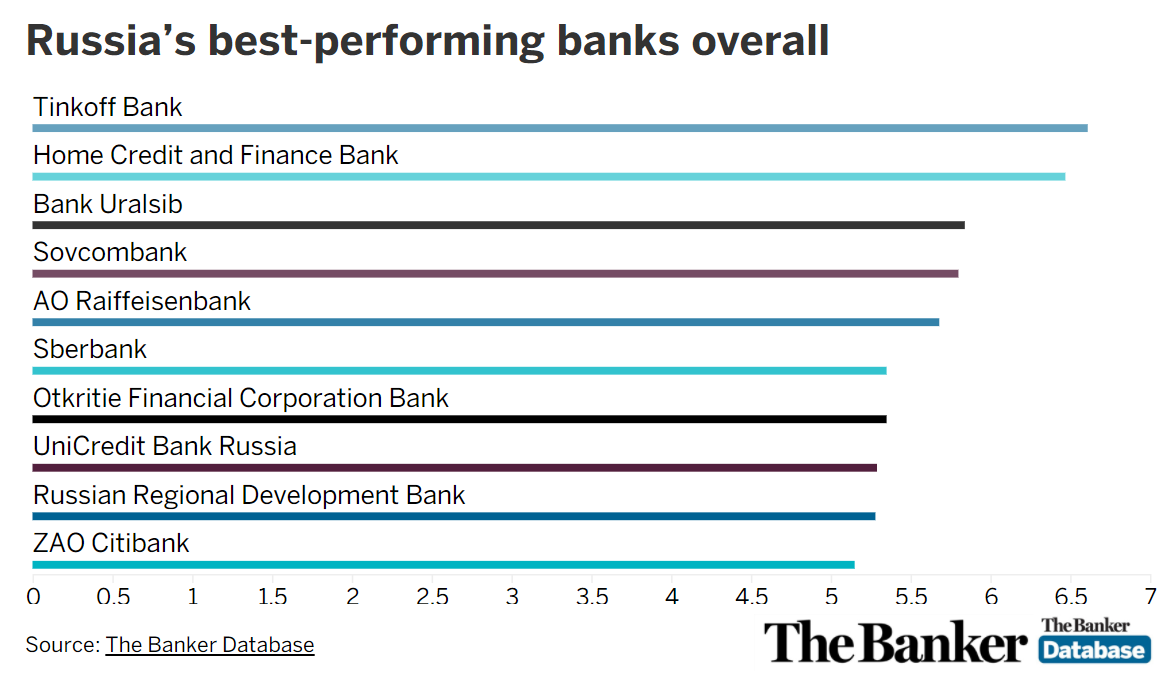
Tinkoff Bank was named Russia’s best-performing bank by The Banker, a leading international financial publication which is part of the Financial Times Group.
Tinkoff topped Russia’s Best-Performing Banks Overall ranking, which uses 17 ratios to score such performance categories as growth, profitability, operational efficiency, asset quality, return on risk, liquidity, soundness and leverage. Each performance category receives equal weighting, according to the methodology.
The Banker also highlighted Tinkoff as Russia’s second-fastest growing bank after Otkritie Financial Corporation, as well as the country’s second-best performer in terms of both return on risk and soundness.
Oliver Hughes, CEO of Tinkoff Group, commented: "We’re pleased that The Banker has recognised Tinkoff’s leadership in Russia’s financial space. Our resilient, highly scalable business model and adaptability to customers’ changing needs is fuelling our growth. We are firmly on track to reach our goal of 20 million customers by 2023, while retaining our focus on profitability."
The Banker has been the trusted source of banking information since 1926. It provides economic and financial intelligence for the world’s financial sector, including a unique database of more than 5,000 banks that helps maps their financial strength, soundness and their performance versus their peers.

Matthijs Aler
CEO at Ohpen
The COVID-19 pandemic has accelerated the digitisation of the financial world with clout and at breakneck speed. see more
- 06:00 am

Global paytech provider BPC today announced that it has extended its membership with Visa’s Fintech Fast Track Program to APAC, Europe, the Middle East and Africa. The program makes it quicker and easier for fintechs to leverage Visa’s global payments network and introduce new payment experiences. This strategic initiative is a response to the surge in demand among fintech players to enhance their product propositions, expanding beyond their core businesses.
Due to the global pandemic, many innovators will be particularly focused on the delivery of services that are supported by quick, seamless, and reliable digital payments. Worries about virus contamination through money handling, along with virtual working arrangements, the rise of online shopping due to lockdown restrictions and bank closures, has led to an accelerated pace of adoption for contactless and mobile transactions around the world, particularly in fast growing emerging markets.
The number of non-cash transactions, or digital payments, soared worldwide last year to over 700 billion – the equivalent of nearly 100 digital transactions on average in a year for each person on earth. The prevailing covid environment has also led to a cross generation transition toward digital channels and digital payments, with baby boomers as well as older generations entering the new world of payments for the very first time.
Under these conditions, BPC and its payment processing service firm, Radar Payments are well positioned to meet the demands of the digital boom and will join Visa’s Fintech Fast Track Program as preferred technology enablement partners. With this strategic alliance, BPC will provide essential payment processing service that lays the foundation for fintechs to build their own products. As a leader in payment solutions and services BPC has unrivalled payment expertise and its robust SmartVista platform is adopted in more than 90 countries.
By extending the Visa Fintech Fast Track Program, fintechs from APAC and EMEA can connect to BPC and Radar Payments and gain access to robust, secure and instant payments solutions through VisaNet, in addition to value-add connections with national payment systems and governments to offer a differentiated retail, commerce or business customer experience. BPC’s SmartVista platform is also certified under the Visa Ready program.
BPC will provide fintechs with software as a service (SaaS) or processing as a service (PaaS) models using its new paytech Radar Payments’ international processing centre. This centre is already hosting numerous fintechs, payment service providers (PSPs) and neobanks, enabling them to go to market faster, with lower operational costs and a highly competitive minimum viable product.
Jane Loginova, co-founder of Radar Payments by BPC, shared her view: “We are very excited about our collaboration with the Visa Fintech Fast Track Program, because of its real focus on enablement of fintechs. Through our own journey in supplying payments technology globally, we have come to appreciate the challenges fintechs have when they want a fast rollout of services, best in class, innovative, secure and reliable. Thanks to our tech stack and expertise, BPC is in the best position to support the most exciting fintechs on their expansion journey and to activate more markets together with Visa. We look forward to further enabling the growth of fintechs with the right technology and services to launch a compelling proposition while limiting cash flow risk.”
Visa’s Fintech Fast Track program allows both new and established businesses to leverage the speed, security, reliability and scale of Visa’s global network to get up and running quickly, shortening the process from months to weeks. It has extended its coverage to include Visa Direct origination.
The program provides turnkey access to Visa’s ecosystem partners, online licensing and APIs, as well as extensive go-to-market tool kits, online education and expert advice to help fintechs scale their business with peace of mind. Since expanding globally, the Fintech Fast Track program has grown by 360% year-over-year.