
Published
- 03:00 am

British Lloyds bank has reported a cumulative technology spend of £4 billion over the past three years, with £2.8 billion of that budget allocated towards a three-year transformation plan set out in February 2018.
The pandemic regime has increased demand towards online services, the Lloyds's digitally-active customer base has increased to 17.4 million customers. The number of the mobile app uses has by nearly two million in 2020 to 12.5 million customers.
The proportion of products originated via digital channels also increased in 2020, up 10 percentage points to 85%.
The bank states it has "digitised" 78% of its cost base, over and above the 70% target set in 2018.
The outgoing CEO António Horta-Osório, says: "Despite this significant progress, we are only just starting to see the transformation that technology is enabling. Customers will increasingly expect to interact with us in a more effective, agile and personalised way.”
"To compete effectively against new entrants and respond to these evolving customer expectations, we need to continue to transform how we work, replace some of our legacy systems and enhance our use of data across the business. Some of this development will be internal but we will also increasingly use partnerships with specialist technology and fintech providers."
- 07:00 am

Substantive Research, the research discovery and research spend analytics provider for the buy-side, has today announced the strategic hire of Michael Malpiede as Senior Sales Associate Americas, to lead Substantive ’s US expansion, in response to increasing demand for its product and services.
Jointly they will be responsible for expanding the US and European customer base and delivering on Substantive Research’s growth ambition to make their products and services available to an increasingly global community of buy-side clients.
The appointments follow Substantive Research’s recent launch of their Analyst Mapping Service, which provides asset managers with the ability to evaluate where banks invest or disinvest in their research teams, benchmarking sector expertise gains and losses broker by broker. In combination with Substantive’s existing price benchmarking analytics, ultimately managers can decide how to allocate their research spend in relation to the areas and asset classes relevant to them.
In addition to the appointments of the US and European sales associates, Substantive Research also hired two developers, Daniel Kasprowicz and Kelly Jones, to accelerate product development and key deployments for 2021 across its asset management clients.
Mike Carrodus, CEO of Substantive Research, said: “I am delighted to welcome Michael and Alex to our sales team. Since our funding announcement in April 2020 we have continued to invest both in our team as well as our technology to match the demand from asset managers for greater insight into research, pricing and supply."
Carrodus concluded: “With the addition of Daniel and Kelly to our tech team we can ensure that we continue to deliver and build on this insight in a truly actionable and transparent way, that matches our clients’ workflows and decision-making processes as they evolve.”
- 05:00 am

Today the government published new statistics that show businesses across the UK have to date benefitted from 1,593,620 government-guaranteed loans worth £72.9bn to support their cashflow during the crisis through schemes delivered by the British Business Bank.
This includes 1,500,466 Bounce Back Loans worth £45.6billion, 92,449 loans worth £22 billion through the Coronavirus Business Interruption Loan Scheme and 705 loans worth £5.3billion through the Coronavirus Large Business Interruption Loan Scheme. New figures for Bounce Back Loan Scheme Top-Ups reveal 93,216 loans have been approved valued at £0.83 billion.
In addition, figures for the Future Fund show that, to date, there has been £1.1bn worth of convertible loans approved for 1,140 companies since the fund opened for applications on 20 May. This sum has been matched by at least the same amount from third-party investors.
Cumulative number of approved facilities | Cumulative value of approved facilities | Cumulative number of applications | |
Bounce Back Loan Scheme | 1,500,466 | £45.6bn | 2,004,447 |
Bounce Back Loan Scheme Top-Ups N.B. value of top-ups also included in the headline figure of BBLS value of facilities approved | 93,216 | £0.8bn* | 160,405 |
Coronavirus Business Interruption Loans Scheme | 92,449 | £22.0bn | 214,513 |
Coronavirus Large Business Interruption Loans Scheme | 705 | £5.3bn | 1,112 |
Future Fund | 1,140 | £1.1bn | 1,845 |
· The management information for CBILS, CLBILS and BBLS is reported on behalf of British Business Bank accredited lenders as shared directly with HMT by close of business on 22 February 2021. The Future Fund data is reported on behalf of the British Business Bank.
· The applications figure includes approved applications, those applications that are still to be processed, applications that have been declined and those applications that may turn out not to be eligible or cases where customers will decide not to proceed. For CBILS, this number will also include a number of applications that have subsequently been converted to applications for the BBLS scheme. For Future Fund, the number of applications includes only those where both a company and their lead investor have submitted information.
· Future Fund opened for applications on 20 May 2020. Provided that applicants provide the information required during the application process in a timely manner, it is expected that the process will take a minimum of 21 days from initial application to funding being made available. Convertible loans are reported as approved at the point the Convertible Loan Agreement document is issued by Future Fund for signature. The time to applicants subsequently receiving funds will depend on the speed with which they complete the documentation.
· *Value of top-ups also included in the headline figure of BBLS value of facilities approved. The value of BBLS facilities approved includes the extra value from a BBLS loan which has subsequently been ‘topped-up’ to a higher amount. 1 topped up loan will still be reported as 1 loan to avoid double counting the number of facilities approved. (e.g. if there were previously 2 facilities worth £40,000 each and subsequently 1 had been topped up to £50,000, this would now be reported as 2 facilities worth a total of £90,000). It was announced on 2nd November that BBLS borrowers who took out less than their maximum under the scheme rules (the lesser of £50,000 or 25% of their turnover) in their first loan application will now be allowed to top-up their loan up to the maximum.
- 09:00 am

Despite being hit hard by travel restrictions in 2020, the long-term future for the commercial card sector is bright, with spending forecast to hit new highs by 2022
More than half of commercial card expenditure is on charge cards
European commercial card spending rose by 11% in 2019 to €366 billion and accounted for 8% of the total value of card payments according to RBR’s 19-country Commercial Cards in Europe 2021 study.
Charge cards, where transactions must be paid for in full, typically monthly, represent 57% of commercial card expenditure in the region. Products held by large businesses, such as Corporate, Lodge and Purchasing cards, tend to be issued as charge cards. Commercial credit cards are not as popular as their consumer equivalents, making up 15% of European commercial card spending.
Debit card spending continues to grow in spite of the pandemic
The RBR study reveals that the value of commercial debit and prepaid card payments grew much more quickly than that of pay-later (charge and credit) cards, partly because eligibility requirements tend to be less stringent. In many countries the debit and prepaid sectors are under-developed, and together they account for just 28% of regional commercial card expenditure.
RBR’s research shows that in 2020 commercial pay-later cards bore the brunt of the travel restrictions imposed as a result of COVID-19, as such cards are frequently used for travel. Products such as Corporate and Lodge cards, which are most associated with business travel were the worst affected. In contrast, debit and prepaid cards tend to be used for more everyday purposes and were therefore impacted less. Commercial debit card spending bucked the overall trend and actually grew in 2020.
Commercial card spending will reach record levels by 2022
The longer-term prospects for commercial cards are positive as they remain one of the most underexploited opportunities in the payments industry, with unregulated interchange fees in most countries. Company policies to mandate their use (in France, for example), as well as the rollout of contactless commercial cards and greater tokenisation of such cards in mobile wallets, will boost spending levels.
Strong growth in debit and prepaid card use will also boost commercial cards, especially among SMEs where such cards are particularly prevalent. Many SMEs are yet to use commercial cards, but issuers in multiple countries, for example in Russia, are increasing their focus on the SME segment.
More generally, commercial cards are attractive to both employees and companies. For the former, they improve convenience as employees avoid the need to fill in expenses claim forms, while the ability for employers to monitor and control expenditure and streamline accounting processes is even more compelling.
Following significantly reduced spending in 2020, RBR predicts that European commercial card expenditure will bounce back strongly in 2021 as travel restrictions are progressively lifted, and reach record levels by 2022. RBR forecasts commercial card expenditure to rise to €529 billion in 2025, 45% higher than in 2019.
Technology advancements will enhance appeal of commercial cards
Although the short term will remain challenging for the commercial cards sector, continual improvements in technology will enhance the appeal of commercial cards to businesses in the longer term. RBR’s Chris Herbert commented: “Advancements in reporting tools that monitor spending will be a major benefit for the commercial card sector. In addition, growing issuance of virtual cards will bring added control and security to payments, and reduce the need for companies to provide physical plastic cards to travelling employees.”
European commercial card expenditure, 2018-2025 (€ billion)
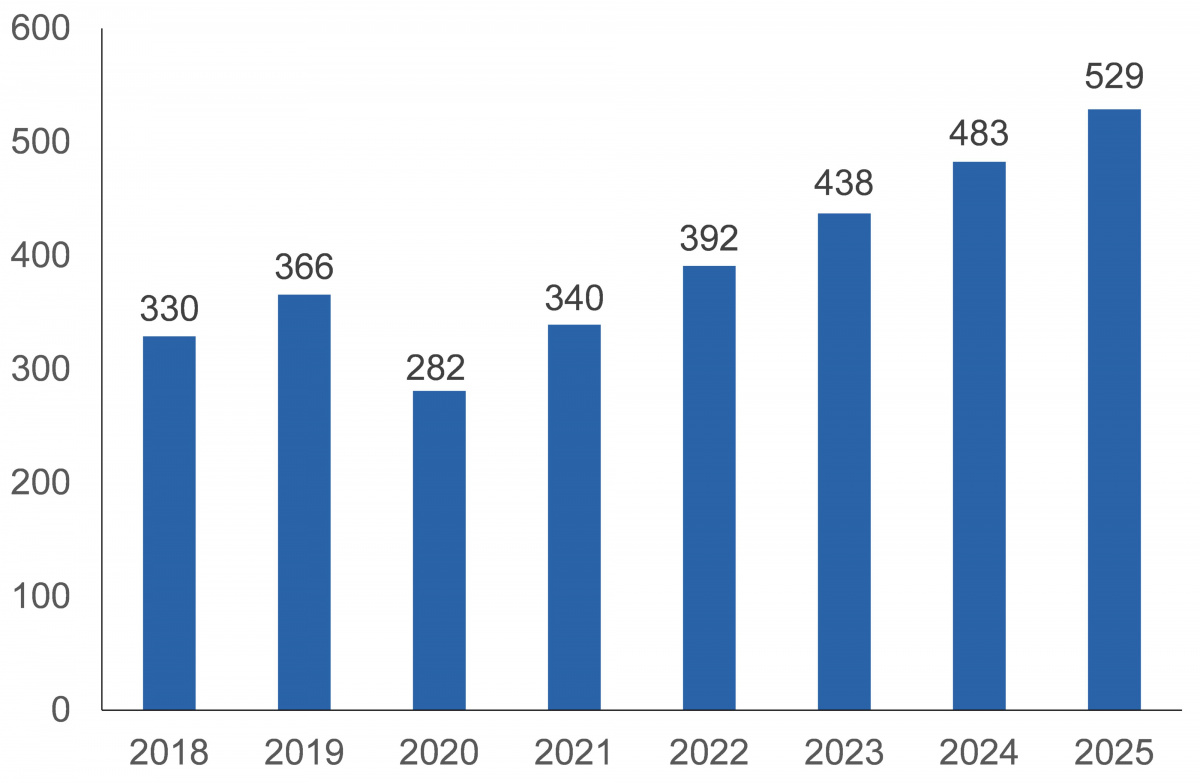
Source: Commercial Cards in Europe 2021 (RBR)
- 03:00 am

What if there was a button to unsubscribe from all your paid subscriptions at once? There is, and a former Mastercard president just invested €4 million in it, as the global Corona pandemic has fueled an explosive “subscription surge.”
What started off as a simple idea at a Danish hackathon in 2016, to be able to cancel paid subscriptions like fitness memberships and phone plans with a click of a button, has in 2021 turned into a hastily growing enterprise, and has now caught the eye of a true paytech pioneer: Javier Perez, who recently stepped down from Mastercard, has chosen Danish Subaio as the very first investment of his new venture firm, Global PayTech Ventures (GPT), funding the subscription management scale-up with a €4 million Series A investment to conquer new European markets.
"Subaio represents all the characteristics that we want to invest in. There is a massive market demand within the payments ecosystem and the team has deep technical expertise and a great product that solves a problem for banks and consumers alike. That is why they have a European market leading position within the subscription management space, and we will invest both capital, our payment expertise and network of global contacts to realize the company's full potential," says Javier Perez, Founder & Managing Partner at GPT, who stepped down as President of Mastercard Europe for two decades at the turn of the year.
Vote of confidence from ABN Amro, Nordea and a paytech pioneer
Already trusted by eight banks in different markets including European market leaders Nordea and ABN Amro, the investment from the ex-Mastercard exec is a true vote of confidence for the innovative one-stop subscription shop, according to Subaio CEO and Co-founder, Thomas Laursen:
“The fintech sector is flush with funding. Thus, raising capital is not about how much you raise, but who you raise it from. It was imperative for us to receive a smart money investment that can propel us to the next level. Partnering up with a capacity such as Javier Perez and his team at GPT with their unique insight into the paytech industry is about getting knowledge and network into our company.”
Corona fueling explosive subscription surge
The funding from GPT will be earmarked to penetrate new European markets, scale-up the staff by 100 percent over the next 12-24 months and develop new features to the “unique machine learning with a human touch” software solution that can take Subaio to the next level in the wake of the Corona pandemic, which has created explosive growth in the global subscription market - e.g. with Netflix:
“The average consumer has between 8-11 subscriptions. Thus, banks’ customer support resources managing claims to unwanted or unrecognized subscriptions are sharply rising. Sometimes, banks are advising clients to simply cut their cards and replace them with new ones to cancel a subscription, which is an expensive exercise costing 20-50 euro per contact, and therefore we aim to offer this cancellation button as a white label solution to the entire financial industry,” ends Thomas Laursen.
- 06:00 am

SteelEye, the compliance technology and data analytics firm, has been recognised as providing the best trade reconstruction solution at the European TradingTech Insight Awards 2021.
SteelEye won the award due to its ground-breaking Auto-Trade Reconstruction technology. Launched in August 2020, the service uses Artificial Intelligence and Machine Learning to reduce the time it takes financial firms to reconstruct a trade from days to seconds.
“Under MiFID II, Dodd-Frank and other regulations, authorised firms can be asked at any point to reproduce the records that relate to a trade or client order. This requires a review of all transaction details, conversations, emails, meeting minutes and more to reconstruct the scenario. With datasets spread across siloed platforms, meeting the typical deadline of 72 hours is a significant challenge, if not impossible,” said Matt Smith, CEO of SteelEye.
He added: “By unifying a firm’s data under a single lens and leveraging AI and advanced data relationships, SteelEye makes trade reconstructions automated and effortless. At the click of a button our clients can immediately reconstruct any scenario.”
The SteelEye platform seamlessly captures structured and unstructured data across any asset-class, communication type and system – unifying it on a single compliance platform, where it is cleansed, normalised, indexed and made instantly retrievable.
The Auto-Trade Reconstruction solution looks at any given scenario or piece of data in SteelEye and simultaneously brings together all information that is deemed to be relevant, such as communications or transactions, as well as independent pricing. By accepting or rejecting these suggestions the system learns over time, becoming better at reconstructing each scenario. Clients using the service can immediately look at a trade or order and automatically see all the related phone calls, meetings, WhatsApp messages, in addition to finding out information about the trade/order itself.
- 09:00 am

Level Financial Technology has secured a revolving credit facility from Triple Point to provide early wage access in a first-of-its-kind ESG deal.
The interest rate Level pays will reduce by up to a third if users also access budgeting tools available through the app to make positive changes to their personal finances.
This landmark agreement is a significant milestone for Level, which is working with some of the largest employers in the UK and was rolled out to Capita’s 45,000-strong workforce at the end of last year.
The facility will enable Level to offer early wage access to its current users, drawing down a percentage of their earned salary before their usual pay cycle. But unlike competitors solely offering this capability, Level will be incentivised by Triple Point to ensure as many people as possible have access to tools and education to make sustainable behavioural changes.
Alongside early wage access, Level provides employees with a comprehensive range of services to improve financial health, including budgeting tools powered by Open Banking, salary-linked savings and financial education and advice from the Money & Pensions Service.
Level founder and CEO Stephen Holliday, explains: “The Level platform has been built to help people make positive changes to their personal finances.
“While early wage access offers a way to navigate unforeseen expenditure, we strongly believe that true financial freedom can only be gained by powering positive behavioural change, which is why our budgeting tools encourage a savings culture that enables people to meet their financial goals, at whatever stage of their careers.
“This is something that should be at the top of the agenda for the UK’s largest employers in 2021, who have a crucial role to play in improving the financial health of the nation. We are delighted to be partnering with Triple Point, who share our total commitment to ethical business.”
Environmental, social and governance (ESG) investing has been attracting attention for many years now, but the way Triple Point has aligned its rate of return to achieving positive financial outcomes is widely acknowledged to be an industry first.
Steve Gordon, Relationship Director at Triple Point, commented: “Our latest impact-linked pricing facility helps align our own goals with those of Level. Giving employees access to earned salary earlier than pay day involves a degree of responsibility and in Level we have a partner that shares our ethical views and has a technology solution that not only provides education but access to market leading savings tools too.
“We are excited to be working with Level in the roll-out of their financial wellbeing platform and supporting those employees that need short term access to earned salary knowing that the access provided is done so ethically, responsibly and sustainably.”
- 02:00 am
42% of financial services businesses want better support and guidance on data security in relation to open banking, according to the latest research by open banking provider YTS.
The survey of financial professionals including banks, lenders and retailers, revealed businesses want better education and training, alongside increased guidance, to help reduce fears around the security risks of open banking adoption. Respondents also stated that they wanted this support to come primarily from regulators.
This ranked higher than taking a ‘wait and see’ approach by allowing more time for open banking technology to develop (39%), which has often been cited as a way to assuage data security concerns, but as YTS’ data demonstrates, won’t solve the issues businesses are facing.
Lack of customer and business willingness to accept risks around data security were the second and third most cited factors threatening the progress of widespread open banking adoption, on 27% and 25% respectively. Over a third of respondents (35%) also believe that an ‘unfriendly’ regulatory environment is threatening the progress of widespread open banking adoption.
YTS is calling for the entire open banking and financial services industry to do more to empower businesses to adopt open banking technology, creating a more nurturing environment for the technology to thrive. This can primarily be achieved by introducing better education and accessible, transparent support for businesses looking to adopt the technology. This must be the spearhead of an industry-wide effort to banish myths and create more solid foundations for growth.
Roderick Simons, Chief Technology Officer at Yolt Technology Services, comments: “To fully maximise open banking’s potential, we must all do more to educate businesses and consumers about its security foundation . Open banking means their financial data is more protected than ever, with the individual in charge of whether their data is shared or not and secure APIs preventing risks from unwanted third-party access. We want to work with regulators, financial services institutions, and businesses themselves to lead the way in educating, training, and supporting businesses to overcome misperceptions of open banking. Doing so will unleash the power of open banking and create huge opportunities for both consumers and businesses.
“Once there is widespread adoption and trust in open banking technology, stakeholders across the open banking ecosystem can then turn their attentions to creating an open finance framework that gives consumers the ability to access their entire financial footprint in one place.”
- 07:00 am

Today, version 1.7.0 of the reference implementation of the software behind the XRP Ledger (XRPL) was released with key contributions from RippleX aimed at improving the Ledger’s decentralization, security and efficiency.
Release Highlights: Improvements for Validators, Server Operators
As a part of its commitment to the XRP Ledger, RippleX continued to work on improving the use of available system resources and making the software work efficiently on various server configurations. Building on previously contributed improvements, a new set of changes has slashed memory usage by 50%. Part of these memory savings came directly from Ripple CTO David Schwartz, who implemented a change that eliminates a layer of caching to further improve memory and execution time.
XRP Ledger community participants like Bharath Chari, founder of Alloy Networks and member of the XRP Ledger Foundation, have positively described the improvement as, “sheer voodoo”:

Other optimizations include: improved validation and proposal routing, which benefit operators of single servers and large clusters alike, and validator manifests, which are now propagated widely and more efficiently over the peer network — giving greater visibility into the overall ecosystem of operators.
Also being introduced today is forward ledger replay — a pivotal improvement to XRPL that enhances security and reduces the amount of bandwidth needed by allowing servers to more easily retain synchronization with the rest of the network. This is an experimental feature that can be enabled via options.
Proposed and agreed upon by XRPL server operators, the features in this latest release of the code demonstrates a shared commitment to improving the XRP Ledger’s performance, innovation and decentralization.
Looking Ahead
Today’s release is another step in the continuous evolution of the XRPL. Feature updates, such as those being introduced today, are reviewed and voted on by the XRPL’s network operators and help improve its capabilities.
The XRP Ledger Foundation — whose goal is to accelerate the development and adoption of XRPL by engaging developers — will also play an active role in maintaining XRPL’s infrastructure and default Unique Node List (UNL) in the future.
“Enhancements, such as today’s improvements to memory usage, are key to growth and innovation on the Ledger,” says Bharath Chari of the XRP Ledger Foundation. “We look forward to supporting the wider ecosystem, including the superb code development by the RippleX team. Testament to this will be our focus on producing an evolving list of validators and enhancing the core code and infrastructure behind the XRP Ledger."
For details on feature updates in XRPL 1.7.0, visit XRPL.org.
- 07:00 am

BSO, the pioneering infrastructure and connectivity provider, has won Best High Performing Network Services at the TradingTech Insight Europe Awards 2021.
The judging panel commended BSO for its market expertise, technical innovation and ability to provide the capital markets with mission-critical infrastructure it can depend on. BSO’s global network reaches 33 countries, 85 cities, and over 250 data centre locations, connecting all major trading venues and exchanges across Europe, Asia-Pacific, the Middle East, and North America.
The judges particularly hailed BSO’s customer experience and noted that implementing infrastructure intelligently requires a bespoke, consultative approach which cannot be achieved solely through product features and technical capabilities.
Michael Ourabah, Chief Executive Officer at BSO, said: “In addition to resilient, ultra-low latency connectivity, financial firms need specialist advice to orchestrate their specialist infrastructure and fulfil their organisational needs. Nowhere is this more evident than in the capital markets. Receiving this award is an honour and endorses our decades-long heritage in financial services.”
Andrew Delaney, President of the A-Team Group, who hosted the TradingTech Insight Europe Awards 2021, commented: “Our awards recognise leading providers of trading technology solutions, services and consultancy to capital markets and BSO has proven themselves to be worthy winners of this prestigious title. We congratulate BSO on winning the Best High Performance Network Services in recognition for the continuing excellence in the trading technology space.”
The TradingTech Insight Europe Awards recognises excellence in trading solutions and services for capital markets. A-Team Group’s editors judge the awards in collaboration with an Advisory Board formed of market specialists. Winning providers supply exceptional trading infrastructure, trading technology and data solutions, thereby enabling market practitioners and suppliers to overcome the challenges they face in a rapidly changing marketplace.
BSO’s award win follows its recent triumph at the FOW | Global Investor International Awards 2020 where the company won Connectivity Provider of the Year.








