
Published
- 07:00 am

SnapLogic today announced the latest release of the SnapLogic Fast Data Loader, making it fast and easy for an IT specialist, data engineer, or business analyst to load data into a cloud data warehouse. New users can get started with Fast Data Loader for free, for as long as they like, with no commitment. Sign up for the Fast Data Loader here.
With the SnapLogic Fast Data Loader, users can quickly and easily load data from SaaS applications such as Salesforce, ServiceNow, and Coupa, as well as cloud databases including Oracle and Microsoft SQL Server into a cloud data warehouse such as Amazon Redshift, Snowflake, or SAP Data Warehouse Cloud. With no coding required, fast parallel loading, full or incremental updating, and historical tracking, the SnapLogic Fast Data Loader helps users get fast, reliable data access to power their customer, product, and sales analytics initiatives.
New and enhanced features in the May 2021 release of the SnapLogic Fast Data Loader include:
● New UI – A new UI makes it easier to set up and manage new data loads. A simple three-step process walks the user through the stages of identifying and connecting data sources and targets, presenting only the information that is relevant at each stage.
● New Dashboard – A new dashboard provides a centralized, interactive way to monitor and manage existing data loads. Execution details related to data loads such as number of tables and records loaded, and the schedule of all future data loads, can be viewed from the new dashboard.
● Tight Integration – Fast Data Loader is an application that runs on top of the SnapLogic Intelligent Integration Platform. Users authorized for both products can now easily switch between the two.
“Cloud data warehouses are crucial to building a robust and modern analytics stack, however data loading from multiple sources can be slow and challenging and is holding enterprises back,” said Craig Stewart, CTO at SnapLogic. “The latest release of the SnapLogic Fast Data Loader helps users overcome these challenges so they can more quickly access the data to develop the analytics and insights they need to better engage customers, kick-start new product initiatives, and improve sales efficiency.”
Sign-ups to the SnapLogic Fast Data Loader can also be achieved through the Snowflake Partner Portal, the Amazon Redshift Console, and the SAP Store.
- 01:00 am

The global adoption of smartphones and mobile internet paved the way for a universal mobile payment ecosystem coexisting alongside established ‘offline’ technologies such as physical credit cards. According to a report by GSMA, the number of registered mobile payment accounts grew by 12.7 percent globally to 1.21 billion accounts in 2020, and exceeding, for the first time, a daily transaction volume of over USD 2bn. The report expects the USD 3bn mark to be surpassed by 2022. A robust outlook for e-commerce and the adoption of digital technologies like open banking payment solutions provides the foundation for growth in the digital payment market. Legal & General Investment Management (LGIM) realized the vast potential in this development and expanded its broad thematic ETF offering with its new L&G Digital Payments UCITS ETF.
Using a dynamic designed investment strategy, which leverages real-time data on companies engaged in the digital payments value-chain as provided by Payments Cards & Mobile, the ETF delivers a specialised portfolio of companies. L&G’s digital payments ETF is based on LGIM’s design process to leverage expert proprietary datasets and active research, which is systematically and rules-based captured by the Solactive Digital Payments Index NTR (the underlying index).
The Solactive Digital Payments Index
The Solactive Digital Payments Index aims to track the performance of a basket of stocks of companies that are actively engaged in the digital payments industry and are expected to benefit from the acceleration and proliferation of digital payments. Eligible companies for the index are selected based on their role in the digital payments value-chain, classified through the following activities: issuing bank/card issuer, payment acquirer, payment gateway, payment processor, cardless payment service provider, and payment technology provider.
“Both widespread access to the internet and a high smartphone ownership rate are enabling a more seamless shopping experience for customers,” comments Dr. Axel Haus, Team Head Qualitative Research at Solactive. “The upside from these technologies may also potentially benefit business owners via sales growth, lower transaction costs, and higher transparency. LGIM’s Digital Payments UCITS ETF potentially benefits from the massive global development in mobile payment, a trend, which we expect to advance further.“
- 01:00 am
Ian McKenna, founder of AdviserSoftware.com and the Financial Technology Research Centre, comments on M&G’s appointment of Ignition Wealth to develop a new hybrid advice proposition: “This morning‘s announcement about M&G committing to a hybrid digital advice proposition is a significant win, not just for the two organisations, but for the whole digital advice, advice tech and fintech sector. M&G are the company that used to be known as Prudential, one of the most emblematic brands in UK personal finance. For an Australian Fintech to win such a prestigious UK customer is clearly a great way for them to enter the market. Equally for M&G complementing their existing traditional restricted advice team with a low-cost hybrid automated proposition is a great way to support hundreds of thousands of former potential customers who will be approaching retirement and need help but have a level of assets that will make full blown traditional advice uneconomic.
“In a wider market context this demonstrates that a real revolution is going on in the UK personal finance sector, driven by Fintech. Traditional advice, delivered by highly qualified and heavily regulated individuals has increasingly become unaffordable in the UK to anyone who is not wealthy. This deal and others recently shows that major financial services firms are recognising that technology can enable the delivery of significantly lower cost services to make advice affordable again for the majority of the British population. Potentially tens of millions can benefit. The hardest challenge for emerging robo and automated advisers has been the cost of customer acquisition. M&G already have millions of customers who could benefit from this service in the future so they avoid that massive expense and should be able to scale far more quickly. Humans will still have an important role to play in the delivery of the advice, but it will increasingly be driven by the technology, which in addition to being cheaper can bring greater regulatory certainty. As the big guns like M&G enter this the market will be revolutionised.
“Whilst it has taken time for automated at retirement advice to be developed it is now becoming an increasingly competitive sector. We expect to see a number of other organisations currently in stealth mode go public before the end of the year. This is becoming a highly competitive sector add will make financial advice affordable for millions more people over the next couple of years.”
- 06:00 am

| ● | Commerzbank successfully executed two live transactions to secure payments for commercial transactions based on blockchain technology |
| ● | Key milestone for the market launch of Marco Polo Payment Commitment |
In May 2021, Commerzbank joined with İşbank and LBBW to become one of the first banks to execute commercial transactions with German and Turkish corporate clients via the Marco Polo trade finance network in a live environment. The purpose of these transactions was to establish an irrevocable payment commitment to the supplier, issued by the buyer’s bank.
With these live transactions, Commerzbank has reached a key milestone in the run-up to the market launch of Marco Polo Payment Commitment. The data required to establish the payment commitments for both transactions was exchanged in a digital format via the Marco Polo trade finance network, using Corda blockchain technology.
The first cross-border transaction took place on 10 May 2021, in cooperation with İşbank, between corporates Kuraray Europe GmbH and Şişecam. The underlying commercial transaction involved the export of laminated special glass interlayers from Germany to Turkey. The payment by open account has been replaced by an irrevocable payment undertaking with digital exchange and matching of trade data.
The second transaction – the ‘go-live’ in Commerzbank’s home market of Germany, followed on 20 May 2021, in cooperation with LBBW and between KSB and Voith. The underlying transaction was the purchase of special couplings. As with Commerzbank’s first live transaction, the data transfers required to secure payments between the pump and valve manufacturer KSB and the technology group Voith, as well as the credit institutions involved, were performed in a secure and closed area with access only permitted to the parties involved in the transaction.
A Marco Polo Payment Commitment is an irrevocable, abstract undertaking by the buyer's bank to the supplier to make payment on the due date. The payment commitment is based on the exchange and successful automatic matching of digital trade data in the DLT/blockchain network, thus providing financing options.
Nikolaus Giesbert, Divisional Board member Transaction Banking at Commerzbank AG, said: “Our clients are looking for innovative supply chain management solutions. Commerzbank is focusing on speed and transparency in this area, where blockchain applications have tremendous potential. This transaction is a major step towards market launch.”
“KSB is an international digitalisation pioneer in our sector, and has set standards with many innovative solutions,” said Dr Stephan Timmermann, KSB Management Spokesman. Dr Matthias Schmitz, Managing Director responsible for Finance and Procurement, added: “After digitalising our production and products wherever possible, we are now systematically approaching digitalisation of our processes. The Marco Polo platform, and technologies such as blockchain and distributed ledger, are allowing us to raise our trading processes to a new, paper-free, and – most importantly – secure level.”
“Following our pilot transaction in 2020, we were thrilled to carry out a first live transaction using the Marco Polo platform. Having automated and digitalised most of our internal processes over recent years, the Marco Polo network is the perfect match for our digitalisation strategy. With Commerzbank, İşbank and Şişecam, we have joined forces with valuable business partners to pave the way for digitalisation of one of the last remaining paper-based processes – documentary payments“, emphasised Juliane Löbig, Director Finance & Accounting at Kuraray Europe GmbH.
“Live payment commitment transactions involving KSB, Kuraray, Şişecam and Voith, and Marco Polo member banks Commerzbank, İşbank and LBBW are proof that digital end-to-end settlement processes with a high degree of automation and an electronic data exchange are possible, and will become a reality in trade finance“, noted Daniel Cotti, Managing Director, Centre of Excellence Banking & Trade at TradeIX.
As a founding member of the Marco Polo initiative, Commerzbank – together with LBBW and Turkey’s İşbank – was one of the first banks to settle Marco Polo Payment Commitments for live commercial transactions digitally via Marco Polo’s distributed-ledger technology (DLT) network. The network, operated by the FinTech TradeIX, is built on R3’s Corda blockchain technology.
- 09:00 am
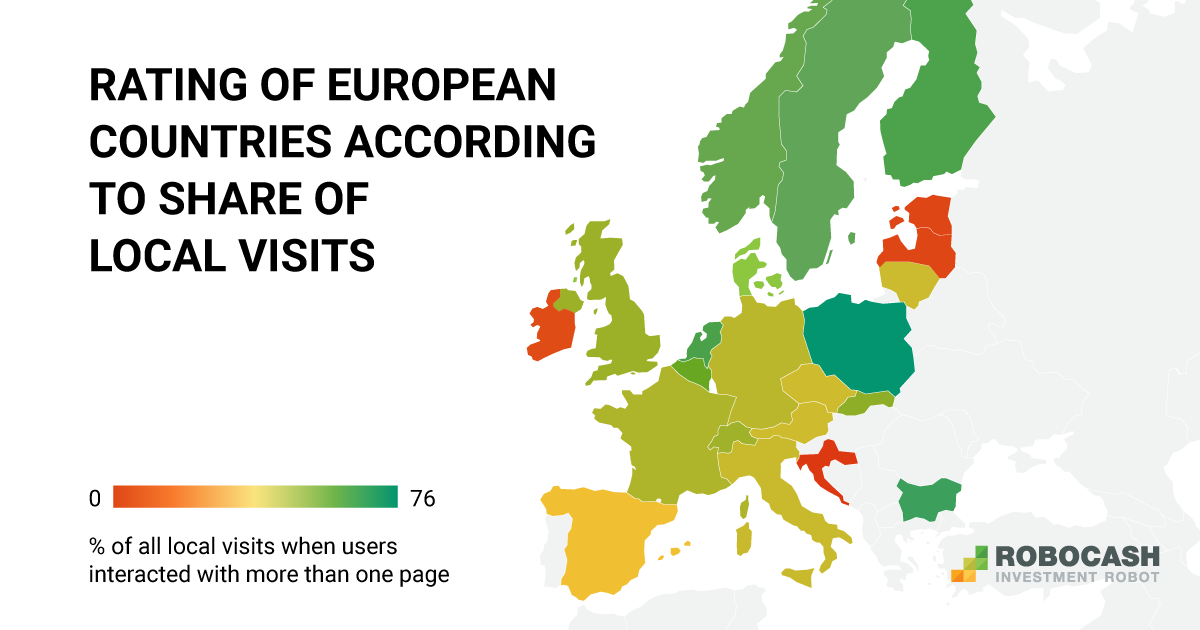
Analysts of the European P2P investment platform Robo.cash claim that more than 60% of all visits on selected Nordic P2P lending websites are local. At the same time, most of the developed Western European countries show an equal distribution of domestic and foreign demand.
Analysts at Robo.cash have analyzed internet traffic statistics of 99 P2P-platforms from 23 European countries over a three-month period. All of them operate in consumer lending, business lending, or both. The researchers have considered the relative proportion of visits from the country where the platform is headquartered excluding the bounce rate.
According to the findings, all the countries can be divided into three groups. The first group, where the degree of local involvement reaches 76%, is represented mostly by Nordic countries, Bulgaria, and Poland. Apparently, local investors here are actively exploring the domestic market to get more involved in foreign projects later.
Most countries including the UK, Germany, France, Italy and Switzerland fall into the range of 37-55% of "involved" local visits. The experience, stability and low risks of these platforms attract the attention of both foreign and local investors.
The last group shows a low share of local interest (up to 5% of all visits). The platforms here are mostly focused on working in the pan-European investment field, headquartered in such countries as Latvia and Estonia, which traditionally stand out on the European P2P investment market.
The research confirms that the European P2P-landscape is quite heterogeneous, with more conservative countries aimed at the local investors, and others working mostly on the pan-European level.
- 07:00 am
Three quarters (76%) of compliance professionals in the accounting sector expect to see more anti-money laundering (AML) regulation as a result of the UK’s exit from the European Union, according to new research released today by LexisNexis® Risk Solutions, the global data and analytics provider.
These findings are based on a survey over 875 compliance professionals across the real estate, banking, accountancy, lending, wealth management and legal sectors, and seek to showcase how businesses are coping with the current AML framework.
This extra regulatory burden would come at a time when compliance professionals are already showing signs of struggling to comply with current AML regulations, including the Fifth Money Laundering Directive (5MLD) that came into force in January 2020. Research shows the accountancy sector is on average only 60% of the way towards reaching compliance with 5MLD, despite having had over 12 months to do so. This leaves the sector exposed to money laundering breaches, regulatory fines and reputational damages – all of which should be avoided.
Tellingly, over three quarters (79%) of compliance professionals across the seven sectors surveyed believe that a regulatory clampdown is coming within the next 12 months, with almost half thinking it could be within 6 months.
In anticipation of potential further post-Brexit regulatory commitments, the Accountancy sector has unanimously called on the regulator for further guidance in implementing effective AML programmes, with 87% of compliance professionals in the industry agreeing that the regulator should provide better guidance.
The absence of clear guidance from the regulator may also explain the accountancy sector’s lack of faith in 5MLD, compared to other regulated sectors. Almost half (43%) said they expected the Directive to have no impact on their ability to prevent and detect financial crime, notably higher than the third (32%) of respondents across other sectors who felt the same.
Nina Kerkez, Director of UK&I Consulting at LexisNexis® Risk Solutions, comments:
“The regulatory burden of AML compliance, including the requirements of 5MLD, is hugely challenging for all industries, but it appears that compliance professionals in the accountancy industry feel like they’ve been cast adrift by the regulator at a critical time in proceedings.
The industry’s fraught progress with 5MLD appears symptomatic of a lack of guidance from the regulator on the correct way to implement the requirements, as well as perhaps a general feeling of being overwhelmed by the sheer extent and complexity of what is now expected in terms of the forensic levels of investigation required by a risk-based approach to AML. It seems what’s needed is a strong regulatory / industry collaborative partnership, where all regulatory and supervisory bodies can work closely together to resolve these educational gaps and make better progress towards their AML implementation. And if firms’ predictions about the post-Brexit regulatory clampdown prove accurate, this needs to happen sooner rather than later.
With such a high number of Accountancy compliance professionals showing scepticism for the impact 5MLD will have on financial crime detection, the regulator also appears to have some influencing work to do to better demonstrate the tangible benefits of 5MLD, if they want to see better progress being made towards implementation.
Additionally, regulatory bodies could do more to advise firms on how investment in technology can further the fight in prevention of financial crime. By automating and streamlining customer due diligence and investigations processes, for example, they would free up the time of skilled professionals to focus on robust risk-based activities that will really make a difference. Technology can not only better equip firms to mitigate the risks facing them, it enables them to fulfil their duty to protect wider society.”
- 01:00 am

Highlights
- FICO today announced the latest release of the FICO® Falcon® Fraud Manager model for Retail Banking.
- The FICO® Falcon® Fraud Manager model for Retail Banking leverages machine learning to enhance scam detection in tandem with Falcon Fraud Manager’s existing third-party fraud detection score to better enable banks to detect and prevent authorized push payment (APP) scams.
- The new Scam Detection Score leverages targeted profiling of customer behavior to help FICO® Falcon® Fraud Manager clients detect 50% more scam transactions.
- Powered by more than 120 patents in fraud-specific machine learning and AI, the FICO® Falcon® Platform helps financial institutions detect and prevent fraud seamlessly, in real-time. More than 2.6 billion payment accounts worldwide are protected by Falcon.
Today, FICO, a global analytics software provider, announced the latest release of the FICO® Falcon® Fraud Manager model for Retail Banking, which leverages machine learning to detect and prevent scams by adding a Scam Detection Score to Falcon Fraud Manager’s existing third-party fraud detection score for retail banking transfers.
“The proliferation of mobile payment apps and new open banking standards in the wake of the pandemic have caused authorized push payment (APP) scams to grow,” said Scott Zoldi, chief analytics officer, at FICO. “FICO has been following how the sophistication of scams are evolving at breakneck speed and we are strategically innovating to offer our clients in retail banking the cutting-edge scam detection analytics needed to combat today’s criminals.”
APP scams manipulate customers into sending money to an account controlled by scammers. They can take multiple forms, including mobile game payments, online purchases that never arrive, or text messages from someone the victim mistakenly believes is a friend, business partner or bank official. In the UK, UK Finance reported a 5% increase in losses to such fraud in 2020 with reported losses of £479 million. These scams have proved particularly difficult to detect as the person initiating the payment is the legitimate account holder – who has been tricked into making the payment.
FICO’s new Scam Detection Score helps Falcon customers overcome the challenge of detecting authorized push payment (APP) scams, using the distinguishing characteristics revealed by the FICO® Falcon® Fraud Manager model for Retail Banking to identify 24 times the number of fraudulent transactions on favorite devices. While banks and card issuers today have used the Falcon Retail Banking fraud score to detect both fraud and scams, the new Scam Detection Score further detects 50% more scam transactions at a 0.5% transaction review rate.
Powered by more than 120 patents in fraud-specific machine learning and AI, the FICO® Falcon® Platform helps financial institutions detect and prevent fraud seamlessly, in real-time. More than 2.6 billion payment accounts worldwide are protected by Falcon.
- 08:00 am

Neobank Zopa has outlined its approach to defining the future of work. With some organisations declaring an end to office-based working and others retrenching to the ‘known’ model by asking staff to return, Zopa is applying a test and learn approach for the rest of 2021. The neobank which has around 450 staff, has announced its trial to staff in order to work collaboratively with them to define ways of working in the post-Covid future. Zopa’s approach will allow it to create a model which enables the company’s ambitious growth goals whilst also creating an employee experience which is compelling and future focused.
Pre-pandemic, Zopa offered flexible working arrangements across the business, which allowed for a smooth transition to 100% work from home during the Covid lockdowns. Zopa was able to transition staff to home working rapidly to protect its workforce while continuing to deliver award winning customer service to over 400,000 current customers. In a year where staff have worked predominantly at home, Zopa has obtained its full bank licence, launched a successful savings account and credit card, surpassed £6bn lent out in loans and increased its customer base by 27%. Having re-opened its London office for optional use in March, Zopa is keen to apply what it has learned to shape its post covid future.
As part of the test, Zopa employees will be able to work from wherever they choose to throughout the coming year. Additionally, in 2021, employees will also be able to work worldwide for up to 90 days. This will enable people to travel or to return to see family abroad as the UK’s traffic light system continues to evolve. Zopa will also be making several changes to its London office, repurposing space to prioritise face to face interactions when employees are in the office and ensuring that the space is also well set up for distributed interactions between employees in the office and in other locations.
Prior to reopening its office, 80% of employees at Zopa expressed an interest in a blended approach between home and office working based on their needs and circumstances. This has manifested via an 18% increase month on month of staff coming into the office since reopening.
Zopa’s Chief Customer Officer, Clare Gambardella said: “Zopa as a business has been able to achieve a huge amount in the last year while our teams were working from home. However, we are aware that the pandemic environment isn't representative of a sustainable ongoing model for us or our people. By testing and learning with our employees throughout 2021, we can understand how a distributed working model functions in the longer term and what the differing preferences are for the people throughout our business. Our goal is to find a model which enables both Zopa’s continued growth and our ability to attract and retain the best talent.”
Official testing will begin on 1st June, and Zopa will continue to review and adapt its approach based on a mixture of quantitative data and qualitative feedback from the business, employees and stakeholders.
- 04:00 am

WiseAlpha has won the award for Best Alternative Investment Account at the Good Money Guide Awards 2021, for its pioneering digital platform which offers Fractional Bonds to private investors for the first time ever.
The Good Money Guide Awards champion financial services firms who are leaders in innovation and customer service. This Award is centred around consumer satisfaction and all votes were collected through the form of customer reviews, highlighting WiseAlpha as a consumer favourite.
knowledge and confidence in Corporate Bonds investment with the launch of its brand new podcast series The Bond Academy, available now through Apple Podcasts, Spotify and Google Podcasts.
customers for the work we’re doing. Watch this space. There’s much more to come!”
- 04:00 am

Avaloq has won the prestigious Transaction Processing Solution category at The Ninth Annual WealthBriefing European Awards 2021. The firm was also highly recommended in the Innovative Use of Artificial Intelligence (AI) category.
In the Transaction Processing Solution category, Avaloq’s scale and resilience were cited as two key elements that impressed the judges most; in the AI one, Avaloq’s Natural Language Processing (NLP) engine, used within chat functions, was seen as a high-profile use of AI and one expected to bolster advisor productivity by helping them serve content quickly and accurately to clients.
Avaloq’s NLP function is a core element of the firm’s Engage solution, which allows wealth managers to interact seamlessly with their clients via social messaging services such as WhatsApp and WeChat in a secure and compliant manner. It helps institutions capitalize on the growth of new sales and service channels and comes at a time when ‘conversational banking’ has become a key trend in wealth advisory and the wider financial services sector.
Showcasing ‘best of breed’ in European wealth management, the WealthBriefing awards recognize outstanding organizations judged to have demonstrated true innovation and excellence during the previous year. Each of the two categories was highly contested, with a small group of finalists and commended submissions chosen from a large pool of entrants.
Martin Greweldinger, co-CEO of Avaloq Group, said: “We are delighted to win this year’s Transaction Processing Solution award which underlines the robustness and reliability of our core banking platform. Furthermore, we are really pleased to see that our multi-year efforts around AI and NLP which went into our new stand-alone platforms are recognized by the market particularly given the market disruptions in 2020 caused by the pandemic. Avaloq remains dedicated to providing the very best solutions for banks and wealth managers, especially with regards to the very latest technologies and processes aimed at making our clients more efficient, more competitive and more responsive to growth opportunities.”








