
Published
- 02:00 am

ACI Worldwide , a leading global provider of real-time digital payment software and solutions, today announced it is extending its partnership with Pick n Pay to drive payments modernization for the South African retailing leader. Pick n Pay will utilize ACI Omni-Commerce, a secure, validated point-to-point encryption (P2PE) omni-channel payments platform, which delivers a safe, consistent and seamless payments experience to customers across all channels, whether in-store, online or mobile.
ACI Omni-Commerce will enable Pick n Pay to grow its business and consolidate its technology while simultaneously unlocking new payment capabilities. The solution will provide the retailer with the flexibility to react to new consumer payment preferences as well as increased self-service options.
“We anticipate significant growth in transaction volumes over the next ten years as a variety of innovative digital payments products are launched — the combination of scalability and flexibility that ACI Omni-Commerce offers will not only support that growth but also ensure we’re future-proofing our payments environment,” said Jason Peisl, head of customer applications, Pick n Pay. “Transitioning to a service-based architecture will reduce time-to-market and equip us to respond to global payment trends, enabling us not only to maintain but to expand our leadership position within South Africa’s retail sector.”
“Africa continues to be fertile ground for payments innovation, and South Africa — as the continent’s second largest economy — plays a key role,” said Brett Stevens, director, Africa, ACI Worldwide. “Retailers need to move quickly to succeed in this challenging and dynamic environment, without compromising security and resilience of their core systems. Continuing its long-standing cooperation with ACI, Pick n Pay is strongly placed to grow its market share, leveraging more of our device and channel-agnostic payment technologies as the needs of its customer base evolve.”
- 07:00 am

Tradovate, LLC, a leading online brokerage firm for active, self-directed futures traders, announced today that it will be one of the first brokers to offer futures trading on FairX from day one when the new exchange launches this month. Tradovate is also the first firm to announce commission-free trades for FairX market participants.
Tradovate’s mission is to deliver new technology, the latest futures products and new pricing models designed to reduce a trader’s total costs. The FairX futures offering will be its most significant achievement to date in that mission, as the firm will provide commission-free trades with no market data fees, subscription fees, lifetime license fees, inactivity fees or platform fees. Through the end of the year, Tradovate will cover any exchange and clearing fees on FairX transactions for its clients.
Rick Tomsic, Founder & CEO of Tradovate Holdings, LLC, said: “From inception, Tradovate’s vision was to change the futures industry through technology and pricing innovation. Our team built a brokerage firm focused on powerful, yet easy-to-use technology to reduce costs while providing the features and tools that futures traders desire. We have worked tirelessly to make sure we meet the needs of active traders – whether they already trade futures or want to participate in the burgeoning futures market based on their stock, options or forex trading experience. Tradovate is excited to help level the playing field for active retail traders by bringing FairX contracts to our clients commission-free and with zero fees.”
FairX will launch futures that are designed for retail traders, offering new opportunities to get exposure to the stock market with indexes that are highly correlated to some of the most actively traded instruments. FairX intends to offer products on a small, simple and accessible basis. These smaller contracts will be commission-free at Tradovate, making them easier to build and scale in and out of positions with more flexibility.
Neal Brady, CEO of FairX, said: “Tradovate has a strong following among active traders, and we appreciate the firm’s enthusiasm for our product lineup and our shared commitment to a quality, low-cost offering. The Tradovate team has placed great emphasis on providing a robust platform which traders can easily use from anywhere, making it a great fit for our contracts that are designed to trade around the clock, with product specifications tailored to individual investors.”
Tradovate’s modern, cloud-based platform powers individuals’ trading with access to desktop (both Mac- and PC-compatible), web and mobile platforms for research, analysis and trading.
For more information, please visit FairX Futures at Tradovate.
- 09:00 am

Wealth at Work Group Limited ("Wealth at Work"), a UK-based specialist provider of workplace financial education, guidance and regulated financial advice for individuals, is pleased to announce that it has agreed to an investment from Aquiline Capital Partners ("Aquiline"), a private investment firm based in New York and London with $6.4 billion in assets under management.
Wealth at Work, which employs approximately 250 people, works with over 450 private and public sector employers including Marks & Spencer, BT, Experian and the NHS, delivering financial wellbeing programmes and retirement services.
Since its 2015 management buyout backed by Equistone Partners Europe ("Equistone"), Wealth at Work has continued to achieve rapid growth to meet the significant demand for its services, which are now offered to over a million employees across the organisations with whom it works. The technology-driven service is uniquely tailored to each client's requirements through a complete suite of services ranging from seminars and digital tools such as the Financial Healthcheck through to virtual or telephone guidance services and regulated financial advice.
Wealth at Work's management team, which continues to be led by CEO David Cassidy, will retain a significant equity stake. Equistone will retain a minority stake in the Company alongside Aquiline and management.
David Cassidy, Chief Executive Officer of Wealth at Work, said: "This investment will allow us to continue to grow and meet the rapidly increasing demand for our services which are used by a number of the largest companies and organisations in the UK. I very much look forward to working with Aquiline whose deep understanding of the UK and US retirement market and track record of supporting technology-driven growth will help us further develop our offering to clients, deliver innovation and set new standards of best practice. We would also like to take this opportunity to thank Equistone for the support they have provided so far, and we look forward to continuing our work with them as we take our business to the next chapter."
Jeff Greenberg, Chairman and Chief Executive Officer of Aquiline, said: "Individuals are facing increasingly complex and important financial decisions as they plan for retirement, which Wealth at Work helps them navigate. We believe that David and his team have built a platform that can deliver high-quality, personalised financial guidance and advice to a growing number of workplace savers across the UK in a highly scalable and technology-enabled manner. We are excited about partnering with them in the next phase of their journey."
Dominic Geer, Senior Partner at Equistone, said: "We are delighted that, after five years of working closely with David and his team at Wealth at Work, the company is in a strong position to explore exciting new opportunities. Wealth at Work has grown significantly since 2015, and through investment in organic and acquisitive growth has emerged as a clear market leader. Equistone has a successful track record of investing in financial services businesses in the UK and internationally and we look forward to remaining involved in this next phase of the company's development."
Closing of the investment is subject to the parties obtaining relevant regulatory approval.
Evercore provided corporate finance advice and Herbert Smith Freehills provided legal advice to Aquiline. Due diligence was performed by Oliver Wyman (commercial), Deloitte (financial and tax), West Monroe (technology) and Howden (insurance).
Deloitte's Manchester and London-based Financial Services teams provided corporate finance advice and Travers Smith provided legal advice to Wealth at Work in relation to the transaction.

François Drouard and Emmanuel Desdoigts
SLM Terminal & Mobile and Project Manager at Fime
In today’s frequently changing payments landscape, stakeholders are embracing new tec see more
- 08:00 am

The use of cash in the UK has significantly reduced, with the COVID-19 pandemic fueling a shift in consumer payment preferences, according to a new report recently released by financial technology leader FIS® (NYSE: FIS).
The 2021 Global Payments Report, by Worldpay from FIS projects that by 2024, cash will account for just 7 percent of in-store purchases in the U.K., down from 27 percent of in-store payment transactions in 2019. The 1202report found that cash usage for in-store purchases in the country declined from 27 percent in 2019 to just 13 percent of total purchases last year.
Pete Wickes, General Manager, EMEA, Worldpay from FIS said: “This research shows the speed and scale of the transformation in consumer behavior in just 12 months. The decline in the use of cash in the UK has accelerated, and while this opens up new opportunities for businesses to optimize and drive efficiencies, we need to be mindful that important parts of the economy continue to rely on cash, such as charity donations and restaurant tip jars, while there are many in society who remain underbanked. Fintechs and regulators need to collaborate to build new frameworks that allow for this shift and use technology to boost financial inclusion especially for those underserved communities.”
The Worldpay Global Payments Report, which examines current and future payments trends across 41 countries, found that digital commerce accelerated globally under the pandemic. Across all countries studied, cash usage dropped by 10 percent in 2020 to 20 percent of transactions. The 2021 report predicts that many European countries, including Denmark, Norway and Sweden, will be almost cashless by 2024, and that the growth of non-cash payment methods will be primarily split between cards and mobile payments, with mobile payments expected to comprise a third of the POS market in 2024.
Share of cash at POS, percentage of total
Country | 2019 | 2020 | 2024F | CAGR 20-24 |
Sweden | 15.2% | 8.8% | 0.4% | -51.3% |
Denmark | 15.4% | 12.4% | 0.8% | -48.5% |
Norway | 13.8% | 4.5% | 0.9% | -30.1% |
Hong Kong | 11.0% | 9.1% | 1.6% | -31.2% |
Australia | 15.7% | 8.3% | 2.1% | -25.3% |
Netherlands | 17.2% | 11.6% | 2.8% | -27.4% |
Canada | 10.2% | 5.4% | 3.8% | -3.8% |
France | 29.2% | 11.8% | 5.7% | -12.8% |
China | 22.8% | 12.9% | 5.9% | -12.8% |
UK | 27.4% | 13.4% | 6.9% | -12.1% |
To download the complete copy of the report, including the methodology, please visit https://worldpay.globalpaymentsreport.com/
About The Global Payments Report
Figures quoted are taken from data published in The 2021 Global Payments Report by Worldpay from FIS unless otherwise stated or referenced. This data was collected using consumer surveys, B2B surveys and input from local research teams. 46,000 consumers were surveyed globally. For research methodology, please refer to page 135 of the report.
FIS is a leading provider of technology solutions for merchants, banks and capital markets firms globally. Our employees are dedicated to advancing the way the world pays, banks and invests by applying our scale, deep expertise and data-driven insights. We help our clients use technology in innovative ways to solve business-critical challenges and deliver superior experiences for their customers. Headquartered in Jacksonville, Florida, FIS is a Fortune 500® company and is a member of Standard & Poor’s 500® Index. To learn more, visit www.fisglobal.com. Follow FIS on Facebook, LinkedIn and Twitter (@FISGlobal).

Julia Schoonenberg
Senior VP for Financial Institutions (MEA) at IDEMIA
It is impossible to imagine our lives without plastics. see more
- 08:00 am

The year 2020 was a challenging year for the European banking sector, with many of Europe's largest financial institutions coping much worse with the crisis than their US peers. However, the last few months have witnessed a significant recovery, with the market cap of Europe's largest banks reaching almost pre-pandemic levels.
According to data presented by BuyShares.co.uk, the combined market capitalization of the largest banks in Europe jumped by almost 30% in the last six months reaching $438.6bn in May.
Market Cap of Europe's Largest Bank Up by 20% in 2021
As the economic recovery from the COVID-19 accelerated in the first half of 2021, global banks' market cap almost completely recovered and reached pre-pandemic levels. In the first quarter of the year, the market capitalization of the global banking sector hit €7.3trn, a massive 48% increase YoY.
Also, global bank shares made up for the 2020 losses. The total shareholder return of the global top 100 banks outperformed the market, growing by 16.8% quarter-over-quarter, the best TSR across all industry sectors. The TSR of Western European banks increased by 18.2% year-over-year.
The positive trend continued in the last two months. Statistics show the market cap of Europe's largest bank, HSBC, increased by 20% since December, rising from $107.2bn to $128.7bn last week.
Also, in the first quarter of 2021, the London-based financial giant reported a pre-tax profit of $5.8bn, a 79% increase YoY, beating the analyst expectation of $3.3bn. Reported revenue was nearly $13bn, 5% less compared to the same period a year ago, reflecting the low interest rate environment.
PNB Paribas, the second-largest bank in Europe, witnessed a 27% market cap increase in this period. In December, the combined value of shares of the French financial giant stood at $66.4bn. Statistics show this figure jumped to $84.8bn last week.
ING Group the Top Performer Among European Banks
The combined value of shares of Europe's third-largest bank by assets and the largest financial institution in Switzerland, UBS, rose by 12% since the beginning of the year, growing from $50.1bn to $56.3 billion last six months. The largest Spanish bank, Banco Santander SA, witnessed a much more significant increase, with its market cap growing by 36% in this period.
However, the YCharts data revealed that ING Group witnessed the biggest market cap increase in 2021. Between December and May, the market cap of the Dutch financial institution jumped by 42% to $52.5bn.
Also, ING Group was the top performer among the European banks, with a TSR of 38.4% in the first quarter of the year. Société Générale, Swedish SEB Group, and Barclays followed with 31.1%, 30.8%, and 27.5%, respectively.
After suffering significant losses in 2020, Britain's biggest high street lender, Lloyds Banking Group, started recovering this year. In the three months of 2021, the Group recorded a profit before tax of £1,76bn compared to £404 million in the same period in 2020, largely reflecting the improved economic outlook for the United Kingdom. Also, the market cap of the sixth-largest bank in Europe increased by 39% since December, reaching $48.3bn last week.
The full story can be read here: https://buyshares.co.uk/market-cap-of-europes-largest-banks-jumped-by-30-in-six-months-and-hit-438b/
- 05:00 am

• The ATMNow project makes CaixaBank the world's first bank to offer a fully omni-channel experience, with the same quality, image and service on all its digital channels.
• The bank plans to adapt its 9,000 ATMs to the new system by the end of July.
• As well as transforming the style and menu navigation, ATMNow offers new services, such as cash withdrawals in just two steps, and opens the door to banking that integrates multiple shared digital channels.
CaixaBank begins to deploy its new ATM technology platform, ATMNow, designed to overhaul the user experience and add new services and functions.
The new platform has been developed with the aim of offering the same banking and image services on ATMs as users experience on CaixaBankNow, the online banking channel accessible via the web and mobile app. Although the technological characteristics of the devices are completely different, ATMNow involves a comprehensive adaptation to the ATM environment of the user experience and service quality of CaixaBank's digital banking.
The project represents a technological milestone in digital services innovation, enabling the bank headed by Chairman José Ignacio Goirigolzarri and CEO Gonzalo Gortázar to become the world's first full omni-channel bank, able to deliver the same customer experience across all its digital channels.
The implementation of ATMNow began with the installation of the platform in 50 ATMs located in key points across Barcelona. The process will be extended over the coming days to the rest of Spain, seeking to complete deployment by the end of July with more than 9,000 ATMs on the CaixaBank network adapted. Furthermore, in the second half of the year, all the Bankia-network ATMs will be integrated to the platform.
New features added
In addition to standardising styles and browsing flows to unify the user experience with the web and mobile channels, ATMNow provides CaixaBank’s ATMs with new services and functions that offer a more user-friendly and seamless interaction. Among other innovations, it improves the cash withdrawal process, which is simplified to only two steps.
It also features the addition of option menu customisation technology, enabling each user to have direct access to their most used features and options on the home screen. This personalisation will be conducted by default, each time the customer uses the ATM with their card without the need to reconfigure settings. Furthermore, the ATM screens have been redesigned to allow for more spaces to provide information to help users.
Through ATMNow, CaixaBank's full omni-channel nature paves the way for the creation of new services. For example, users will be able to set up operations through the app or on the web that they want to execute later at an ATM, upon identifying themselves. These new functions are planned to be integrated gradually.
ATMNow is a project conceived with new agile and design thinking methodologies. The process was devised taking into account feedback from customers of different ages and profiles, as well as groups of employees from the financial institution.
New phase in the deployment of facial-recognition technology for ATMs
The implementation of ATMNow will be accompanied by a new surge of facial-recognition technology facilities, offering customers withdrawals with less physical contact, while strengthening security in the use of terminals.
Currently there are more than 700 ATMs throughout Spain that feature this service, in which CaixaBank has been a trailblazer on a global level. The bank expects to reach 1,250 ATMs with biometric identification by the end of July 2021, thus, all the branches of CaixaBank's new model in Spain, will have at least one ATM integrating this feature. To facilitate use, customers will be able to sign up and register their biometric data from their mobile phone using CaixaBankNow, without having to be assisted by an adviser.
CaixaBank, the digital banking leader
Offering the best user experience in all physical or online customer service channels is one of the pillars of CaixaBank's 2019-2021 Strategic Plan. Currently, the bank has the largest customer base in Spain with a total of over 10 million users of all digital service channels.
Thanks to its digital transformation strategy, the company has been ranked among the best banks in the world for the quality of its digital products and services, receiving accolades such as the “World's Best Consumer Bank 2020” and the “Best Bank in Spain 2020” from the North American magazine Global Finance. These awards are in addition to those obtained in the digital banking sector, such as “Best digital bank in consumer banking in Spain 2020”, and in the private banking sphere, in which CaixaBank has been named “Best Private Bank in Europe for its digital culture and vision 2020”.
In addition, the CaixaBankNow app has been ranked by Global Finance as the “Best Consumer Mobile Banking App in Western Europe” for the third year running.
- 07:00 am

Today, American Express unveiled the Global Business Spend Indicator (GBSI), its new survey of global businesses conducted with the Centre for Business and Economic Research (CEBR)[1].
The survey reveals that, after a bumpy ride over the last year, business spending levels are set to grow in the UK, with survey participants predicting that B2B spend will grow at an average of 1.4% in the second quarter compared to the same period last year. Applying that projection from the survey respondents to broader UK macroeconomic data would equate to an estimated £5 billion[2] in additional B2B spending from UK businesses. Increased spending plans are bolstered by widespread optimism, with 70% of UK businesses saying they feel positive about their prospects over the next 12 months.
“While it has been a very challenging year for UK businesses, the GBSI shows signs of optimism - with increased spending across key B2B categories, including online advertising, ecommerce and technology,” said Dan Edelman, Vice President and General Manager, UK Merchant Services at American Express. “Businesses have their sights on the future and have been spending to increase their resilience and take advantage of growth opportunities ahead.”
The GBSI is designed to explore the importance of business spending in both the global and local economies based on a survey of more than 3,600 businesses of all sizes in the UK, Australia, Canada, Japan, Mexico, and the U.S. For this report, B2B spend is classified as goods and services that a business purchases from another business to keep their business running. The survey focused on nine B2B spending categories, and three additional categories - taxes, people/workforce and travel, entertainment and expenses - for a robust look at the dynamics and impact of overall business spending.
After A Slow Start to the Year, Business Spending Plans Indicate a Boost for UK Businesses
The report reveals that the UK has been hardest hit by the pandemic’s impact on business revenues compared to the other countries covered by the GBSI, with revenues down by an average of 9.3% year-over-year in Q1 2021.
However, confidence is increasing among the business community in the second quarter of 2021, most likely boosted by the UK vaccination programme and gradual easing of lockdown restrictions. The latest GDP growth estimates from the CEBR, which predicts UK GDP growth of 7.1% in 2021, show that confidence amongst UK businesses is well founded.
This is reflected in the fact that the UK businesses surveyed report that, overall, they have been increasing business spending across all the core categories of spend (except for travel, entertainment and expenses) since the start of the year. For B2B spend specifically, the UK companies surveyed report that spending was up by an average of 2.7% from Q4 2020 to Q1 2021 and anticipate further increases in Q2 2021 at an average 0.9% growth rate relative to Q1.
This increase in B2B spending reflects the UK businesses’ focus on growth in 2021 based on the research findings.
Remaining competitive (32%), securing new business (33%), and increasing profitability (32%) are the top three priorities for UK businesses in the next twelve months, reflecting their desire to drive growth[3]. Digital Investments Accelerate with Focus on E-Commerce and Online Advertising
The pandemic has clearly transformed the way people buy, communicate, and work over the past twelve months, which has accelerated the pace of digital transformation for UK businesses across all areas of their operations.
The GBSI findings show that UK businesses are keen to take advantage of digital growth opportunities this year, by boosting investment in e-commerce technologies and spending on online advertising. Technology spending by the businesses surveyed increased by 5% on average in Q1 2021 compared to Q4 2020 and is anticipated to grow by a further 2.4% in Q2 over Q1. The businesses surveyed also expect their spend on Search Engine Optimization, social media, search, and digital costs to be up by 4% Q2 2021 compared to the prior quarter, reflecting the focus on reaching new audiences and securing new business.
UK businesses also appear to be harnessing the power of technology to improve efficiency as they grow, with IT and technology consultancy expected to be among the fastest growing areas of spend within the business and professional services category between Q1 and Q2 2021.
Supply Chain: Cost Matters but Supplier Reputation and Flexibility Increasingly Important
*all percentages are averages
Alongside their growth agenda, research reveals UK businesses’ strong focus on the operational effectiveness of their business, especially when it comes to their suppliers.
Of the countries studied in the GBSI, the UK has the second highest share of businesses that have mostly or fully automated their processes such as receiving payments from business customers (52%), making payments to suppliers (47%), and procurement (42%).
“Many businesses have been thinking differently about supply chain management - from how they select suppliers to how and what they pay in order consolidate the supply chain and keep cashflow moving. This, in turn, has helped unlock the renewed confidence we’re now seeing, as businesses look to shift their focus on investing to grow,” added Edelman.
Interestingly, while cost remains a major factor in supplier choice - 18% say the costs of products and services is extremely important when selecting a supplier - reputation is also growing in importance likely due to the supplier disruption brought about by the pandemic and the need to quickly adapt their businesses. Just under a quarter of companies surveyed (21%) rank company reputation as extremely important in supplier choice and 12% of UK businesses surveyed now consider environmental concerns as extremely important when selecting suppliers.
Flexibility of supplier arrangements has also risen in importance as businesses adapt to the ebbs and flow of demand, with one in five UK businesses surveyed (20%) saying they have reduced their long-term commitments to purchase from specific suppliers, and a similar share of respondents (18%) saying they have chosen suppliers with more flexible payment terms to increase their adaptability.
In addition, 22% of respondents report that payment flexibility has become more important as a result of the pandemic.
- 04:00 am
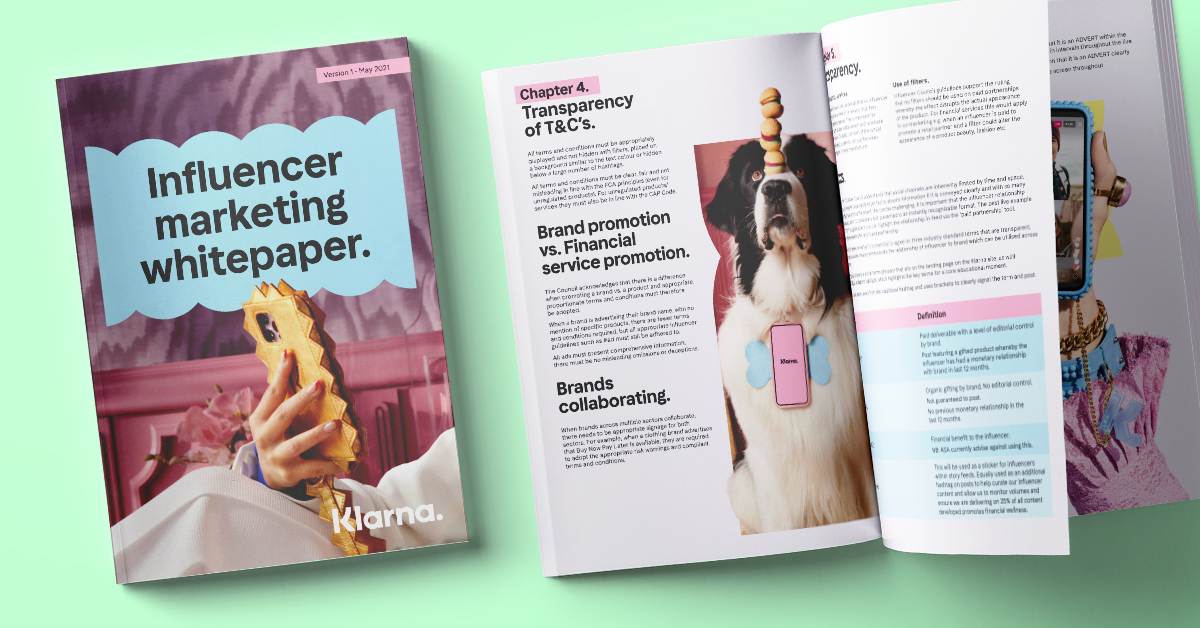
Klarna, the leading global payments and shopping service, and its industry-wide Influencer Council, have released their Influencer Marketing Whitepaper to serve as a guide for influencers and brands to advertise online responsibly.
The Influencer Council, formed in March, was established to provide greater clarity on influencer marketing guidelines following research which revealed that only one quarter (27%) of UK consumers understood the use of advertising hashtags on influencers’ posts. The Council, chaired by Christian Howes, brought together brands, influencers, psychotherapists, policy members and the Committee of Advertising Practice (CAP) to provide a well-rounded perspective from across the industry.
Over the course of several months, the Council discussed what best practice should look like for influencers posting advertisements across social media platforms and how to ensure greater understanding amongst consumers regarding owned and paid-for content. Covering a range of angles, including responsibility, geography and age range, transparency, emotive language and terminology, the Council created a dedicated set of guidelines for influencers and brands to follow when posting. These guidelines go further than any materials and guidance available today - for better protection of brands, consumers and influencers.
Accompanying the Whitepaper, Klarna has also released a toolkit which will include branded stickers, Instagram story templates and badges to clearly illustrate the nature of the post, whether it’s an advert, part of an affiliate agreement or gifted. This will be available for brands, influencers, consumers and agencies working with Klarna.
AJ Coyne, Head of UK Marketing at Klarna said: “By launching the Influencer Council, we set out to learn more about how brands, influencers and consumers interact with posts on social media and to create more clarity amongst online advertising guidelines. Each session has sparked fascinating discussions on responsibility, terminology and transparency and I believe that we’ve created guidance that is clear, easy to adopt and, most importantly, drives change for the better. These guidelines go further than any have done previously and set a precedent for brands across all industries to follow suit.
“We would like to thank all our Council members for their involvement and hope that our Whitepaper will encourage brands and influencers alike to work together to create a transparent community. ”
Influencer Council Chair, Christian Howes, said: “It’s been an honour to chair the Influencer Council and I am proud to have helped deliver a set of guidelines which will deliver greater understanding amongst consumers and influencers.
The industry is constantly evolving and so we will continue our meetings bi-annually to ensure that our guidelines keep up with the latest trends and are applicable across all platforms.”
The Council was held under Chatham House rules to ensure that discussion was open but all information was anonymously contributed. The Council will aim to meet twice a year, with the first follow-up meeting to be scheduled for November 2021.








