
Published
- 08:00 am

New partnership aims to improve financial wellbeing through a gamified app experience
Maslife, the payment and wellbeing platform that rewards people for keeping healthy, has collaborated with regulated e-money services provider Paynetics to power its new financial wellbeing app.
The new Maslife platform enables users to make informed decisions about their lifestyle, wellbeing, and finances. It offers customers a full suite of financial tools to support them in better managing their finances and improving their state of mind.
Health is intrinsically linked with finances, however, the two are traditionally dealt with separately. There are many financial, health, and mindfulness apps on the market, but none that bring together these priority areas of life in an integrated way.
Maslife changes the way we deal with health and finance. The new app helps its users to implement positive habits and mindsets with actionable steps. These include mindful spending and budgeting with accounts in GBP, EUR, and USD, free currency exchanges, virtual and metal debit cards, along with other payment services.
Physical and mental health is supported within the app with health activity monitoring, guided meditation, informative podcasts, and much more.
Kash Amini, CEO of Maslife, said: “Maslife has been designed from the ground up to support and encourage our users from both a financial and a wellbeing perspective. These important aspects of a person’s life are closely linked and affect each other deeply. With this in mind, we have been working tirelessly on our AI-powered app to support and encourage our users in a way that works for them individually, with targeting and gamification to make it enjoyable. For this reason, our platform and ambitious roadmap of features demand advanced, forward-thinking partners. We are delighted to be working with Paynetics, Mastercard, GPS, and Thames Card Technology to support our exponential growth, enabling our users to be the best they can be.”
Maslife wants everyone to be able to benefit from its smart AI-powered app, which is customised to the user’s lifestyle. As such, they are offering free virtual accounts and cards where users can try all the wellbeing features for two weeks, including guided meditation, physical activities using AI, and more. Members can also add a physical card if they wish to benefit from additional rewards and make in-store purchases.
The Maslife partnership with Paynetics furthers the commitment of both companies to ‘fintech for good’, in collaboration with Mastercard, Global Processing Services (GPS) and Thames Card Technology.
Paynetics has integrated i's all-in-one banking-as-a-service (BaaS) solution with Maslife’s unique financial wellbeing offering to give consumers a rich and supportive financial experience.
Amanda Harrison VP, Head of Business Development at Paynetics said: “We have streamlined our integration services, enabling any established brand or fintech to migrate to Paynetics easily. We are delighted to onboard Maslife to help revolutionise the way consumers manage their finances. Over the last year, the financial challenges and stresses faced by many individuals have illustrated the need for a payment platform that also prioritises mental and physical health. Our innovative financial infrastructure, and collaboration with Mastercard, GPS, and Thames Card Technology has enabled this innovative wellbeing and payments application that will improve people’s lives.”
The app offers a dynamic, gamified experience that engages users and helps them achieve their lifestyle and financial goals. Users can set regular financial and wellness targets through the app, monitor their progress, and be rewarded if they hit them. With each goal reached, users gain more points, and the resulting healthier user gets to unlock new levels.
Maslife is improving its rewards programme with redemptions available on in-store purchases. New digital currencies will be integrated into the platform allowing members to make purchases and payments in a wide range of currencies anywhere in the world.
Neil Harris, Group Chief Commercial Officer at GPS said: “For years, we’ve known about the impact that debt and financial hardship can have on an individual's mental health. This is why GPS is really proud to work alongside Paynetics, Mastercard, Thames Card Technology, and the team at Maslife to deliver a new service that can help transform the wellbeing and finances of users.
“Our trusted and proven processing engine of the GPS Apex platform provides the transactional ledger with the highest levels of transaction management, security, and compliance. All whilst giving Maslife users the opportunity to customise their experiences and personalise the rewards and services they choose.”
By bringing together easy-to-use tools and incentives to solve daily challenges, Maslife is supporting the prioritisation of health and finances to foster a better future for its users.
- 02:00 am

· A highly experienced, energetic, and results-driven business leader
· Driving accelerated cloud adoption and technology modernisation programmes for clients
· Spearheading regional expansion plans for the UK
· Forging greater collaboration with GFT's global teams to deliver increased value to shared international clients
GFT, the global IT services and software engineering firm, announces Carlton Hopper as UK Managing Director. His appointment follows a year of sustained growth for GFT within the UK financial services marketplace and the forging of highly strategic business partnerships across new industry sectors. These include manufacturing, retail, and the automotive industries, where the company provides innovative cloud solutions, technology modernisation projects, data-powered AI programmes and more.
Carlton joins GFT from IBM Global Business Services, where he was the Partner for Banking, running strategic programmes encompassing IT strategy, digital delivery and IT resilience, to name a few. Prior to this, he was IBM's market development head for the UK financial services team and the European & UK blockchain lead. Carlton brings over 30 years of banking, technology and consulting experience, having worked at Accenture, Barclays and Ernst & Young. Alongside his love of guitar playing, Carlton has an established reputation for energy, enthusiasm, and an outstanding commitment to building high performing teams and delivering innovation and positive change to a client's business.
Carlton Hopper, UK Managing Director, commented: "GFT is an exceptional, high growth business with an impressive cross-industry client list. The firm is home to some of the industry's most talented people, underpinned by an award-winning service delivery capability, providing a rare combination of engineering skills core to all digital transformation programmes, and subject matter expertise. As client demand for our services grows apace and inspired by the successful transition to remote working during the pandemic, one of my first projects is to launch a regional network of GFT capability. Watch this space; there is more to share."
Christopher Ortiz, Group Chief Executive, Global Markets and Region Manager APAC & UK concluded: "We are delighted to welcome Carlton into the GFT family. I believe his knowledge and extensive experience of clients' needs are invaluable assets, not only for the UK business but also for the wider GFT group. I am looking forward to working closely with him and his team to deliver modern, business-critical solutions which support the evolving needs of our new and existing clients, across multiple industry sectors both now and into the future."
- 08:00 am

New functionality enables quick development wins for best possible trading experience for financial firms of all sizes; paves path to hyper-personalization of trading environments.
Glue42, the company that delivers integrated desktop experiences to financial institutions globally, has released new functionality to help firms bring an optimal trading experience and efficient operation in days versus weeks. The new release, Glue42 Enterprise 3.12, focuses less on individual applications and extends the workspace concept with an enterprise store that allows users to search for business solutions with best outcomes.
With desktop integration going mainstream and firms of all sizes buying into the concept, financial institutions are looking at how they can fast-track the delivery of the best possible user experience, leveraging existing resources and technology. At the same time, they need to consider that traders rarely perform their tasks within a single application and instead are the human glue between different data silos and systems.
To address this reality, Glue42 has added a set of features to make traders’ workspaces easier to use and reduce the burden on the desktop machine.
“It’s all about making traders and IT departments that support them more efficient,” said James Wooster, COO, Glue42. “Quite often our clients need to build back-end infrastructure services to handle personalization, permissions and security. This takes time and can delay go-live.”
He continued, “The new functionality is a natural evolution of the Glue42 Enterprise platform. It follows client demand to move away from app-centric desktops into hyper-personalized experiences based upon micro-applications, workspaces and user-aware enterprise stores”
With trading efficiency in mind, the new set of features enables the curation of an individual user experience accessible through a new launch pad. An upgraded global search engine capable of locating multi-app workflows, multi-screen layouts, business functions and business data, provides traders with answers in form that can be actioned immediately. More so, new server-side support enables firms’ development teams to configure trader specific profiles that provide levels of customization not previously possible.
For more information, join Glue42 for a 30-minute webinar on Tuesday, July 27 at 10:00 a.m. EST / 3:00 p.m. BST.
- 03:00 am
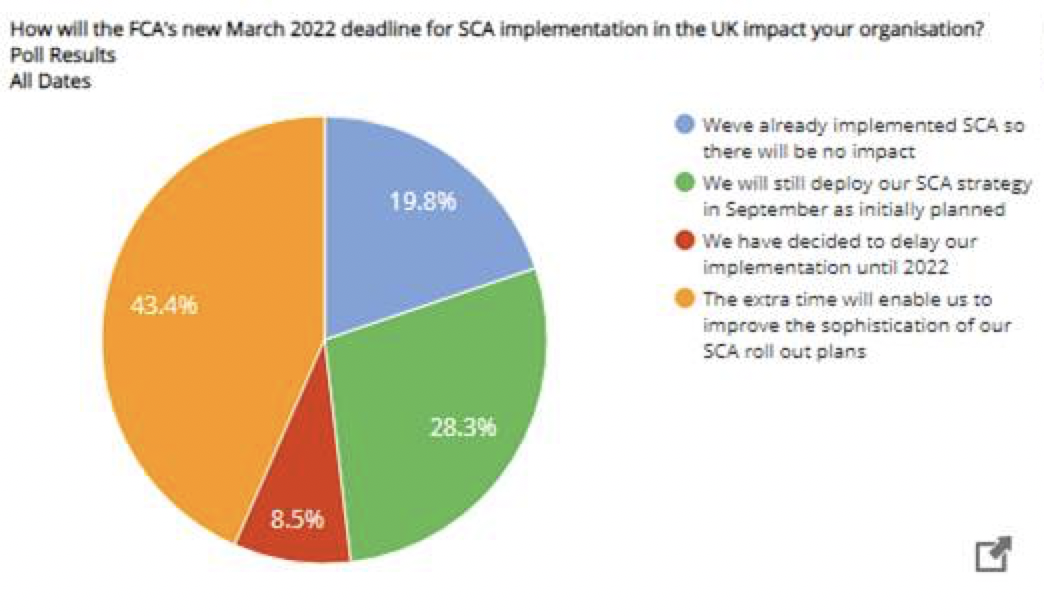
42% plan to use the extension to improve rollout plans, but poll reveals uncertainty still surrounds SCA regulation
UK banks have welcomed the six-month extension to implement Strong Customer Authentication (SCA) for e-commerce transactions, with 42% planning to use the extra time to improve and enhance the sophistication of their SCA roll out plans, according to a poll conducted by LexisNexis® Risk Solutions, the global data and analytics company.
The poll, conducted during a UK Finance webinar entitled ‘Addressing CNP Fraud in 2021: A Deep Dive into the Anatomy of a Payment Journey’ and attended by nearly 500 UK financial services professionals, reveals that UK financial services plan to utilise the SCA deadline extension to March 2022 to enhance their PSD2 strategy.
“The results from the poll were very interesting,” commented Dan Holmes, Solutions Director at LexisNexis Risk Solutions. “They suggested that some issuers are pressing on with SCA compliance, while others remain cautious – leveraging the extra time given by the deadline extension suggests that issuers may have been preparing to do the minimum to meet requirements, and then build-out post-September. They will now however take advantage of the extension to improve delivery sophistication
“Behavioural Biometric Authentication is a good example of what can be done with this extra time, as it buys more time for things like profile baselining, an essential component of biometric authentication. On behavioural biometrics specifically however, what the poll results really show us is the uncertainty around SCA compliance and a potential gap in who defines what a ‘compliant’ authentication strategy is - As well as what parameters this should be set within.”
The poll also asked respondents how their organisation shared fraud risk intelligence across the online customer journey. Only a minority (12%) indicated that they did share intelligence across all areas of their customer journey, suggesting that some financial services organisations may be wasting an opportunity when it comes to leveraging intelligence in remote payment channels.
Dan Holmes continues: “Financial Services organisations must leverage the defences or intelligence available from other parts of their business for their remote purchase channels. If you are already looking at device intelligence or utilising digital identity in one area of your business, then use those capabilities to assess fraud in your remote purchase channels.
“As well as ensuring the effective sharing of risk intelligence across the entire customer journey, financial services organisations must assess how innovative solutions,which tap into specific data like behavioural biometrics, can help them to improve their ability to authenticate customers effectively without causing additional friction or checkout abandonment.”
- 09:00 am

Aims to create a thriving ecosystem for its retail partners by helping them utilize PayNearby’s platform extensively to earn more
In continuation with its brand ethos ‘Zidd Aage Badhne Ki’, PayNearby, India’s leading branchless banking and digital payments network, has launched “PayNearby University” under its trade app to educate and handhold its retail partners towards a better livelihood and a sustainable life for themselves and their families. Available in 10 regional languages for an engaging learning experience, PayNearby University is designed to empower retailers by utilizing the full potential of the platform and help create a thriving ecosystem for the retail community.
PayNearby was built to educate, engage and push a wide range of assisted financial and digital services including basic banking services like cash withdrawal, domestic remittance, goal-based savings and insurance to the last mile. Today, more than 15+ lakh retailers use the PayNearby platform to service close to 15 crore Indians on a wide range of products and services. The success of the model lies not only in the 10+ lakh transactions that it clocks daily or the monthly GTV of ~5500 crores plus, but in the social reach of the platform across 17,500+ PIN codes in the country, helping uplift both the retail community and consumers in those areas, thereby helping access to the Government’s DBT disbursements in an easy manner. The company’s constant commitment has been to empower local retailers who are building the nation ground-up while driving financial inclusion at the last mile, thus creating a digitally forward and financially inclusive India.
Reiterating this commitment is PayNearby University, where retailers can acquire knowledge about the financial product and services the company offers, learn how to use these services, and how to efficiently utilize the platform to earn more. PayNearby University ensures that retailers can upskill themselves and are able to deliver financial products seamlessly to the customers at the last mile. It also trains retailers on the best practices in investments and how to manage their finances better in order to take care of themselves and their families’ future. PayNearby University enables bite-sized learning videos which are easy to consume along with financial and insurance consultation and career guidance, in turn, creating more aware, engaged and empowered retailers.
To enhance the learning experience, PayNearby University is available in 10 regional languages to all retailers who have downloaded the app across the country. With over 250+ videos made available, the initial response has been excellent with over 3,50,000 users visiting the module with 310,000+ daily impressions. To make the learning journey more profound, completion certificates are available which can be downloaded on successful completion of assessments.
Commenting on the development, Anand Kumar Bajaj, Founder, MD & CEO, PayNearby said, “Retailers are the very core of a business ecosystem and it is important for them to have all the necessary knowledge and skills to make their work easy and enhance customer engagement. As an organization, PayNearby recognizes the mutual relationship that it has with the retailer community and we want to take all possible steps to ensure the sustainable livelihood of the retailers. An important milestone in this direction is PayNearby University. PayNearby University was created with the vision to empower and upskill our retailers not just in trade skills but life skills as well and help them become financially independent and aware Digital Pradhans.
For India to thrive and grow, it is important that the retail community is given the essential support and tools to stay relevant in the fast-evolving economy. We are confident that this free-of-cost module which retailers can consume at their convenience in their own language will be a game-changer and in the long run, will help retailers across the country bridge the digital divide that exists in India. We are extremely delighted that PayNearby University is in sync with our Zidd Aage Badhne Ki.”
- 05:00 am
The survey of 300 financial crime decision makers working in the financial services sector in the UK, also found that on average, organisations spent £53 annually on financial crime defence for each customer relationship they have. Moreover, they refused an average of £90,240.77 and exited an average of £90,869.52 worth of UK customer relationships for financial crime reasons during the last 12 months.
Andrew Jacobs, head of regulatory consulting at DWF, said: "Responses to the survey indicated that firms with a revenue of around £10m per year are likely to spend in the region of 1.72% of total revenue on financial crime prevention and deterrence. Larger firms are typically spending less than 1% of total revenue to fight financial crime, particularly those with l revenue of £50m or greater. As a cross-section of the Financial Services sector, this tells us that proportionately, smaller firms are spending a greater share of their turnover on financial crime prevention.
"Conversely, firms with greater revenue (£10M plus) are clearly spending most of their financial crime spend on human resources, with over 32% of annual spend being on Financial Crime roles, compared to those firms with a turnover up to £500,000 for whom Financial Crime roles never exceeds 27% of total annual financial crime prevention spend. This figure and our wider analysis shows us that Human Resources continue to be one of the most effective ways of detecting human behaviour linked to Financial Crime activity.
"In a climate where businesses are being held to account on their Environmental, Social and Governance approach by investors, clients, employees and society more broadly, it is important for financial services business to make sure that they are considering evolving parameters, so that governance is robust and their control framework remains alive to new risks."
The financial crime decision makers cited that employee resources in financial crime roles cost their firms an average of £180,000 per year. At the end of their respective reporting periods, respondents said there were an average of nine full-time employed UK staff within their firm performing financial crime roles, spending an average of 46 hours of employee time per week monitoring transaction alerts and reviewing screening alerts. Analysis also showed that every additional 10 hours spent weekly on monitoring transactions and reviewing alerts, result in an additional 1.5 Suspicious Activity Reports (SARs) raised internally.
Technology is key to increasing financial crime detection and prevention – but it is also a significant factor in driving up costs and staff workload. Respondents highlighted that over the last 12 months, £76,000 was spent on financial crime prevention technology, per firm. They also stated that they expect their firms will spend around £800,000 on crime prevention technology in the next five years. Technology usage is widespread – with 82% of firms using an automated system to screen clients and 84% employing transaction-monitoring software for Anti-Money laundering (AML) and sanctions detection.
"Just as dedicating more staff to financial crime boosts results, so too does the use of technology. However, our analysis has found that this technology usage does not necessarily improve efficiency. In fact, organisations that use automated systems spend more time reviewing alerts – for every 1,000 customer relationships, they will spend around an additional 49 hours per week monitoring transactions and reviewing screening alerts compared to firms that don’t utilise automation. The statistics tell us that because technology generates more alerts and highlights more potential risks, it also requires more time on follow-up investigatory work, but exactly how much is created is dependent on whether firms have correctly calibrated their systems. There is the real danger that poorly aligned alert systems simply create a cottage industry within a firm," said Jacobs.
Bev Robertson, Chief Operating Officer of Association of Professional Compliance Consultants, added: "This research provides a great snapshot into the deployment and engagement of firms. It not only highlights the costs and resources involved, but also looks at the challenges of balancing elements such as the use of technology versus manual screening in identifying and subsequently reporting on suspected financial crime – it highlights the variances across sectors and indeed around the global world of financial services. It also provides some thought-provoking ‘not to be ignored’ takeaways that firms should definitely be considering when evaluating their own financial crime prevention programs."
- 01:00 am

Hedge fund managers come in many ways - Some make decisions with their gut and some with mathematical data. Either way, there are many succeeding at that. But you know, there’s a reason the most successful investors who have relied on their gut instinct are stars - it’s damn hard to do.
At face value, it seems better for an investor to rely on sourced data than gut instinct. At least with data, you can try to predict the future using signals from the present, but relying on gut instinct in that case is not easy. In fact, the world’s best-known performing hedge fund, Renaissance Technologies, is known to rely majorly on computerized trading using quantitative models derived from mathematical and statistical analysis of real-world situations - just a very successful example.
Algo Trading (What, Why, and For)
To start, Algorithmic trading is a method of executing market orders using automated, pre-programmed instructions. It's the use of computer codes and chart analysis to buy or sell assets according to set parameters such as volatility conditions and price movements at a given time.
The rise of algo trading can be traced to human curiosity, this time the curiosity of hedge fund and asset managers to optimize for profitable trading strategies without the need for constant human attention. With pre-programmed strategies, bots can be trained to buy or sell assets at unique market signals (e.g high volatility of stocks, Dow closing 500 below its 20-day moving average) without having a human wait all-days long for those signals.
Algo trading makes use of complex formulas, combined with mathematical models and then some human oversight to make trading decisions. It's such that algo traders often make use of high-frequency trading tech, capable of making tens of thousands of trades per second, far beyond what a human can handle. The benefits of algo trading can include:
Trades executed at the best possible prices
Reduced risk of manual errors when making trades
Backtesting for viability using available historical and real-time data
Reduced transaction costs
Problems of Algo Trading
While these benefits make algo trading attractive, it’s not something that’s easy to implement, given there are many hurdles to cross trying so. Such hurdles include the lack of required computing resources, lack of programming and technical expertise, lack of access to testing data e.t.c. These hurdles make firms shy away from algo trading, but it’s not all that bleak; there are workarounds and solutions to these hurdles.
One such workaround and solution to setting up algo trading operations is tapping into the resources, talent and technical expertise of others rather than building yours from scratch. For example, you can access computing resources on the cloud on an on-demand basis instead of buying your own servers; you can make use of mathematical techniques and algorithms created by others instead of programming yours from scratch.
Usually, setting up your own trading bots is a difficult and daunting task. It requires major expertise in quantitative disciplines and then hard work to put this quantitative expertise to use in trying to model and predict the markets, hard work including many trials and errors. If you’re willing and able to put in that hefty work to do so, fine, but if you’re not, there are some software solutions for that, such as one we’ll suggest to you.
Solutions
What we’re suggesting is a software suite where there’s access to a vast network of algorithmic trading bots harnessing the technical and mathematical knowledge and expertise of others. For example, MetaTrader 5 platform for hedge funds presents 13 000 ready-made solutions & robots. With these bots, you can choose and tweak your trading strategies while staying in tune with validated investment strategies put together by a network of global investors.
As a hedge fund trader, it’ll be optimal for you to make use of trading bots and automated strategies built by others instead of creating yours from scratch, especially when you have limited resources to do so.
As to computing resources, there are also online solutions where you can connect to servers hosted online to handle your trading operations. In this case, MetaTrader 5 also comes in handy, with direct access to this website called MQL5, a unique and very valuable property in its right. MQL5 is an online hub of distinct groups where traders get access to distributed computing resources on the cloud to test and analyze their trading strategies on real-time or historic data. You know, with cloud computing, it’s easier and faster for you to deploy your algo models and tests.
Distributed computing resources are very important for traders building and testing algorithmic trading systems and strategies. It’s easier to build stronger systems when you can train it on a vast amount of data available and accessible via the net, i.e. “cloud”.
With direct access to the MQL5 cloud computing network, hedge fund traders can easily test and judge the performance of their trading strategies without risking any loss in the process.
These kinds of features make it easy for traders to adopt sound algorithmic strategies and are one that should excite any hedge fund trader.
Conclusion
Algo trading is a validated strategy for hedge fund traders, ranging from small ones in the million-dollar range all the way to the big ones we know of. It provides a level-playing field for both the big investor and the small one alike.
With state-of-the-art tools around, you can be put in the best position to implement algo trading as your strategy. After that, the rest is up to you, at least the best effort you put in. But, to note, you’ll be in competition with many other algo traders globally so you have to work with that in mind.
- 03:00 am

New referral programme rewards users and new customers with Bitcoin SV cryptocurrency
Zumo, the Scottish crypto app, has announced the return of its popular Refer and Share programme designed to help people get comfortable with crypto.
The first Refer and Share campaign launched in October 2020 and brought 20,000 new users into crypto through the Zumo app, offering a simple and low-barrier way for new participants to enter the crypto space.
Now, with the UK finally opening up after long months of lockdown, the Edinburgh-based company has launched a new giveaway that will reward users with a summer pint’s worth of Bitcoin SV (BSV) each time they refer a friend. In total, Zumo will give away around £100k worth of BSV over the coming months.
There’s no limit on the number of people Zumo users can refer; every sixth referral will attract an extra BSV bonus, and the top crypto champions will be placed on the Zumo Refer and Share Leaderboard where they can compete for additional BSV rewards.
Amelie Arras, Zumo Marketing Director, said: “We’re extremely proud to be relaunching this popular giveaway with a bigger and better reward.
We passionately believe that crypto is for everyone; this is our way of offering people a super simple way to get comfortable with crypto without needing to put up any of their own money.
With Scottish summer in full swing, we’re saying to people: why not share Zumo with friends to earn yourself some smart money - and who knows, maybe fund a few of those post-lockdown drinks!"
- 03:00 am
Partnership will drive delivery of AccessFintech’s data and workflow solution
Capco, the global technology and management consultancy, and AccessFintech, the leading fintech company evolving the financial industry operating model through collaborative workflow, today announced a partnership that brings together AccessFintech’s data management and workflow solution with Capco’s proven delivery and engineering expertise in the financial services space.
As they address new regulations and heightened competition, banks, brokers, custodians and buy side firms remain focused on delivering efficiency improvements and enhancing their technology platforms. However, fragmented or partial data and cumbersome manual processes arising from legacy systems mean increased costs and liquidity risk. At the same time, firms are also increasingly looking to modernise their internal processes and systems.
By allowing for faster workflow adoption and change management via joint engineering solutions, this new partnership will support firms in addressing challenges around operations and regulatory compliance, including areas such as the incoming CSDR regime, IBOR reconciliation, pre-matching and settlements, and cash payment affirmations.
AccessFintech’s Synergy Network extends and enriches data, synchronizes workflow and enables technology-driven operations transformation, providing innovative and efficient transaction lifecycle management and benchmarking insights across the entire financial ecosystem. Capco’s experience in delivering transformation projects will accelerate the pace at which clients can integrate their operations with the Synergy Network to benefit from the additional transparency and certainty it offers.
Owen Jelf, Partner & Global Head of Capital Markets at Capco, said: “Whether for regulatory, risk, efficiency or cost purposes, financial institutions are actively pursuing global transformation journeys to achieve overall process simplification and a streamlining of their technology ecosystems. By bridging the gap between legacy and modern systems, innovative solutions such as the Synergy Network accelerate those journeys and deliver cost effective and highly controlled rules-based process environments.”
AccessFintech’s EVP Business Development Boaz Zilberman said: “AccessFintech is already working with a critical mass of significant financial institutions and is successfully processing more than a billion transactions a month. Coupling Capco’s industry benchmark technology and operations change management and delivery expertise with our Synergy Network and platform is an important accelerator of our clients’ operation and technology transformation.”
- 02:00 am

Bringing Direct Resort Investment and Enjoyment Deals to Everyday Investors. |
LABS Group, an end-to-end blockchain property investment platform, has successfully raised $3,650,000 for Kunang Kunang Resort. Kunang Kunang Glamping Resort is the world's first-ever community-owned project fractionalized into Rewarding Timeshare (RTS) NFTs, transforming the way investors build their diversified portfolio, with access to diverse assets, low transaction costs and the ability to trade 24/7. An upcoming auction will supply 1095 RTS-NFTs, with each day of the calendar year represented by 3 RTS-NFTs. Interested parties will be able to purchase RTS-NFTs with lower entry barriers and a wealth of benefits. By fractionalizing Kunang Kunang Resort, LABS Group makes resort and hotel investment available for everyone. As quoted by Yuen Wong, the CEO of LABS Group: "LABS is a digitised real estate investment ecosystem powered by blockchain. With that, we make real estate investment possible for everyday investors. We could bring deals directly to everyday investors, cutting out the middlemen to bring extra value. Furthermore, LABS has made cross-border real estate investment easy, and has carried out all the due diligence for our investors." The RTS-NFT Auction Kunang Kunang project's newly revamped auction will commence from July 26th, 2021. Bidders can participate through two methods: the auction or an immediate purchase. The auction will last for 7 days starting from July 26th at 1PM UTC. Interested bidders can bid for their desired RTS-NFTs at the Refinable Marketplace, where 365 RTS-NFTs will be available at the starting price of $3333 USDT. 730 RTS-NFTs will be reserved for immediate purchase from July 26th 1PM UTC onwards with a starting price of $3999 USDT. Seasonal prices could vary however, as RTS-NFTs from July to September are fixed at $4333 USDT while RTS-NFTs that fall on special days are fixed at $4666 USDT. To understand more regarding the project, visit here. RTS-NFT Benefits and Rewards RTS-NFT owners are entitled to a miscellany of benefits. This includes 30 years of staying rights, freedom to swap, trade and more. Additionally, the first 100 bidders can win a 200 USDT rebate by placing any first bid on the RTS-NFT auction. All RTS-NFT holders also receive a special NFT holder privileges package during their stay at the resort on their RTS-NFT date, including:
Upcoming Pipeline and Development Plan Kunang Kunang Resort is in preparation for its opening in February. LABS Group will also continue to move forward with plans to expand their real estate business with more resorts globally, this includes prospective plans in Thailand, Cambodia, Indonesia, and Japan. With determination to spread their success globally, LABS Group will be a spectacle to behold in the coming years. |








