
Published
- 06:00 am
PCI Pal, the global provider of cloud-based secure payment solutions, has today confirmed that it has been selected by Essex County Council, to manage the security of the organisation’s telephone-based payment transactions by reducing the need for any sensitive payment card information to be entered from within the Council’s IT infrastructure.
Working with PCI Pal’s partner, Pay360, Essex County Council will utilise the cloud-based Call Secure Plus solution to ensure all payments handled by the Council’s 250 telephone-based employees are completed in the most safe and compliant way, to help meet the requirements of the Payment Card Industry Data Security Standards (PCI DSS) and reduce related risk to the Council.
The Call Secure Plus solution will enable Essex County Council’s customers to input payment information in an anonymous way using their telephone keypad, yet the agent remains on the line, able to assist callers in seamlessly completing the transaction. Importantly, no payment card information will enter the Council’s systems and will instead be sent directly to the payment merchant for processing.
The solution integrates with the Council’s existing telephony and contact centre systems, in addition to its existing payment gateways.
Ben Quick, Sales Director at Pay360 said “Today, the risks presented by cybercrime are significant and it’s important that organisations have systems and processes operating in the most safe and secure way. We therefore recommended the integration of the Call Secure Plus solution, for a number of reasons: the first being that payment information will not enter the Council’s system at any stage, meaning no customer credit card data will be stored, therefore greatly reducing overall risk. Secondly, it will enable the Council’s agents to remain in full conversation with customers, providing a seamless payment experience.”
Darren Gill, Chief Revenue Officer for PCI Pal said, “We are delighted to have been selected by Essex County Council, via our partner Pay360, to help the organisation secure all payments that are managed by its 250 employees.”
- 03:00 am

A recent survey sought to understand how customers of banks, digital banks, and other fintech apps would react to embedded insurance offers based on real-time transaction data. The survey of 504 Canadian bank customers was conducted by Momentive.ai (the research company of SurveyMonkey), and commissioned by Cover Genius. The question asked:
Suppose your bank, with your permission, monitored your transactions and offered a prompt for purchasing protection products based on your purchase history inside of your banking app. Please indicate how interested you would be in allowing them to make these offers.
The findings show that 67% of Canadian digital bank customers would be highly interested in receiving embedded insurance offers based on their transaction data, as would 57% of traditional bank customers. ‘Trust in banks to protect personal data’ is the primary driver for their interest, stated by 40%.
“The data show unequivocally that consumers are not aligned with government regulation prohibiting banks from offering embedded insurance in real time with financial transactions,” said Michael Fitzgibbon, Director of Insurance for Cover Genius Canada. “Canadians are indicating that current restrictions on bank-embedded insurance that would sit alongside mortgages and auto loans and the like are outdated in a highly digitized, post-pandemic economy where consumers increasingly appreciate the relevance and timeliness of embedded offers.”
Fitzgibbon, who is based in Toronto, recently joined Cover Genius to further bolster the global insurtech's activity in the Canadian market where he will oversee and manage partnerships, insurer engagement, and customer experience. With over 30 years experience in the insurance space, Fitzgibbon has held key executive leadership roles with regional and global insurance brokers and sees a great growth opportunity in Canada, coupled with disruption in the insurance industry. “Cover Genius has seen a significant increase in demand for embedded insurance offerings from their network of global partners - a growth that was intensified in the past 15 months due to the shift to conducting everything online. Canadian companies across a variety of business verticals are eager to embed truly personalized protection at checkout or sign-up or based on transaction feeds.”
The research mirrors surveys of 3,551 Americans commissioned by Cover Genius published last month, and 12 other countries, which similarly examined 14 life events or activities or major purchases that lead to insurance consideration, such as childbirth, purchases of car, property, pets and expensive items, contracting for a wage and becoming a lessee or landlord. Across the globe, the data points to significant demand for timely and relevant transaction-based insurance offers, with dramatically higher preferences if they’ve recently had major purchases or life events, or if they used a traditional insurer in the last 12 months, or if they purchased insurance from their bank. The authors note the significant gap between an insurtech approach and the “bancassurance” reality, where traditional banks partner with traditional insurers for offerings that are typically divorced from underlying activities.
The survey of Canadian customers also confirms that there’s broad support for bank-embedded offers for property insurance such as Renters, Homeowners and/or Landlords (39% of respondents are highly interested), auto insurance (28%), travel insurance (26%) and a range of warranties for high value personal and household items (38%).
The role and nature of traditional insurers as a “second step” in the buying process is also examined in the paper. Digital bankers and younger demographics are more likely to purchase insurance, however the data also points to a healthy future for banks as insurance distributors: 75% of Canadians who chose a traditional insurer or broker in the last 12 months would prefer bank-embedded offers for next time.
While recent experience purchasing insurance is one way to identify early adopters, another is identifying users of popular fintech apps. The breakthrough findings show that 72% of 114 customers who use mobile wallets, 91% of Instalment payment users, 69% of investment account/app users, and 84% of accounting software users are highly interested in receiving insurance offers. Interest is also high for small business operators (90%).
“This desire for a frictionless end-to-end experience has enabled Cover Genius to add partners like Intuit, Wayfair, Booking Holdings, eBay, Descartes ShipRush and gig economy and mobility companies”, Fitzgibbon adds. “Why limit the choice to traditional insurers when more than half of Canadians want their banks, fintechs and other financial service providers to tailor embedded insurance offerings for their needs?”
Download the full report, "The Embedded Insurance Report: A consumer-focused case for transaction-based offers from Banks, Neobanks and Fintechs", or the report for Canada.
- 09:00 am

Available Now, Kong Mesh 1.4 With Five ZeroLB Algorithms for Decentralized, Horizontally Scalable L4 and L7 Traffic Balancing Across Legacy Data Centers and the Cloud
Kong Inc., the cloud connectivity company, today unveiled a new concept called ‘ZeroLB’ and a breakthrough pattern for load balancing. The company also announced the general availability of Kong Mesh 1.4, with industry-first features to support ZeroLB out of the box, offering up to 4x improvement in network performance and a substantial cost reduction compared to traditional centralized LB-based architectures. Based on customer feedback, this modern approach for load balancing is expected to save organizations with mission-critical applications up to a million dollars a year by reducing required technology investments.
ZeroLB is a modern, decentralized load balancing pattern that aims to remove every load balancer that is being deployed in front of individual services and applications. In this capacity, ZeroLB eliminates the need for elastic cloud load balancers, software load balancers and hardware load balancers from the equation. ZeroLB reduces costs, improves network performance by removing extra hops in the network, removes complexity in applications and also gives access to more advanced self-healing capabilities, while simultaneously maximizing portability across every environment and every cloud. To read more about this new pattern, please see “ZeroLB: a new decentralized pattern for load balancing.”
One Kong customer is a global travel company that processes an average of 2 billion pricing requests per day. The company partnered with Kong to scale load balancing traffic in a horizontal and seamless manner across its legacy data centers and the cloud. This company says it expects to see seven figures in cost reductions per year by replacing legacy, centralized load balancers with modern ZeroLB load balancing powered by Kong Mesh, while improving performance by 2x and enabling a more pragmatic transformation to the cloud.
“Traditional load balancers were built for the monolithic era and don’t work well with today’s cloud native applications because they are slow and create points of failure that cause businesses to lose customers and sales,” said Marco Palladino, CTO and co-founder of Kong Inc. “I’m thrilled to be spearheading this effort at Kong to evangelize the ZeroLB movement, where legacy load balancing as we know it within the network is dead. Kong is introducing a new way of building load balancers for today’s modern era of software architectures by decentralizing it.”
Kong Mesh 1.4: Powers Horizontally Scalable ZeroLB Across Any Infrastructure
Kong Mesh is an enterprise-grade service mesh built on top of CNCF’s Kuma and Envoy. This modern control plane is focused on simplicity, security and scalability for multi-cloud and multi-cluster environments on both Kubernetes and VMs. The 1.4 release enables modern, decentralized and portable load balancing that works across every cloud, including Kubernetes and VMs, and local development machines that improve accuracy and replicability, therefore lowering unexpected production errors. It provides automatic resiliency across clusters, clouds and regions.
Key features in Kong Mesh 1.4 include:
● Five different decentralized load balancing algorithms, which include round robin, least request, ring hash, maglev and random
● L4 + L7 load balancing to address every service type, from databases and events to HTTP and gRPC services
● Automatic self-healing capabilities with health checks, circuit breakers, zone-aware load balancing and cross-zone connectivity capabilities
● Comprehensive support for both Kubernetes (automatically injected sidecar) and VMs (manually injected sidecars) across every cloud
● Extension of the connectivity logic for Kong Mesh using any WebAssembly-supported language, thanks to Envoy’s native support
"Traditional, centralized load balancers are finally entering the decentralization era that other technologies in our stack started a long time ago," said Martin Casado, the pioneer of software-defined networking with his company Nicira (sold to VMware) and a partner at Andreessen Horowitz, an investor in Kong. “ZeroLB is a fundamental concept to adopt in a decentralized world. By removing all of the complexity in a standardized, performant way, Kong is doing for LBs what microservices have done to our legacy monoliths, and offering a horizontally scalable and portable way to load balance across every cloud including Kubernetes and VMs."
- 05:00 am

Tinexta provides IT solutions, information and consulting services in niche markets, predominantly to corporate clients. It has leading or strong market positions in the majority of its businesses, which have structural growth drivers. Management’s strategy of diversifying its services and geographic expansion via M&A and subsequent organic growth has generated improving financial metrics, while remaining shareholder friendly with respect to cash returns and a robust balance sheet. Our discounted cash flow (DCF)-based valuation is c €41 per share.
Year end | Revenue (€m) | PBT* | EPS* | DPS | P/E | Yield |
12/19 | 258.7 | 53.5 | 0.80 | 0.00 | 44.0 | N/A |
12/20 | 269.0 | 58.6 | 0.86 | 0.26 | 41.4 | 0.7 |
12/21e | 373.7 | 72.1 | 1.08 | 0.33 | 32.6 | 0.9 |
12/22e | 438.6 | 92.8 | 1.40 | 0.43 | 25.3 | 1.2 |
12/23e | 502.5 | 115.1 | 1.73 | 0.54 | 20.4 | 1.5 |
Note: *PBT and EPS are normalised, excluding amortisation of acquired intangibles, exceptional items and share-based payments.
Structural growth drivers
Tinexta is exposed to favourable growth trends, including the transition to a digital economy with a requirement for enhanced online security; governments’ desires to stimulate innovation and growth; and the internationalisation of trade. Management’s strategy is to further develop the group by expanding domestically and/or internationally, and to offer more services in ‘highly innovative areas’ to existing and potential new clients, while seeking cross-selling opportunities between the business units. As a result, Tinexta is likely to make further acquisitions. To date, management’s strategy has proven to be very beneficial to its growth prospects, profitability, free cash flow generation and ROIC.
Strong organic growth for revenue and profits
We are introducing forecasts for FY23 to be consistent with management’s customary three-year business plan, and to include the medium-term growth of a new venture with Intesa Sanpaolo that increases distribution of services and other M&A. For FY21–23, we forecast an organic revenue CAGR of c 12% and a reported EBITDA CAGR of c 21%. This compares favourably with Tinexta’s historical growth due to its greater exposure to higher growth markets. Following H121 results, we upgrade our FY22 EBITDA forecast by c 6%, due mainly to M&A. Underlying positive free cash flow supports a dividend pay-out ratio of c 33% and leaves plenty of headroom for likely strategic acquisitions. Excluding future potential acquisitions, we see the balance sheet (end FY21e net debt to EBITDA 2.6x due to recent M&A) de-gearing quickly (we forecast 1.0x by end FY23).
Valuation: DCF-based valuation of c €41 per share
Tinexta’s prospective EV/EBITDA multiples (19.2x, 15.5x and 12.9x) and P/E multiples (32.6x, 25.3x and 20.4x) for FY21e, FY22e and FY23e are at a premium to historical multiples, reflecting an improving business mix, growth rates and profitability. Our DCF points to a valuation of c €41 per share.
- 01:00 am

BSO, a global pioneering infrastructure and connectivity provider, has been confirmed as one of the first official international approved connectivity partners for the NSE International Exchange (NSE IFSC). The partnership will provide Asian, European and American trading firms with added infrastructure solutions helping future traders gain faster, more secure access to the Indian market via BSO’s global network.
Situated in Gujarat International Finance Tec-City (GIFT-City), the NSE IFSC was launched as a global trading platform, offering easy access for foreign investors, multiple products, lower trading costs, longer trading hours and all transactions traded and settled in US dollars. Despite being relatively new to the international market, the NSE IFSC has rapidly become a new centre for trading in Nifty Futures & Options, INR USD and other derivatives product in Asia for American and European trading firms looking for derivatives exposure linked to Indian market. As such, it’s seeking to sign-up global connectivity partners to facilitate international trading firms, of which BSO is the first.
This announcement comes in light of increased demand from trading firms for connectivity into India and in particular, GIFT City. India has seen a significant growth in its trading activity with 8.85 billion contracts traded in 2020. As the only non-domestic official service provider to deliver connectivity into NSEIFSC at GIFT-City, BSO is perfectly positioned to meet increased market demand and support trading firms with secure, low-latency access to the rapidly emerging markets.
Mr. Ravi Varanasi, Chief Business Development Officer and Group President NSE Commented: “We are delighted to announce BSO as one of our first International Network Carrier (INC). BSO’s global presence across diverse markets along with their low-latency and highly resilient connectivity service will not only provides access to NSE IFSC for market participants across globe, but it will also encourage international trading members to use this connectivity to provide trading access to their clients through the innovative Segregated Nominee Account Provider (SNAP) framework.
Michael Ourabah, CEO of BSO commented: ‘The NSE IFSC is fast becoming a leading global exchange, with competitive tax structures, trading hours and increasingly impressive derivatives volume. BSO will ensure firms trading via this platform will receive the most secure, reliable, low-latency connectivity between GIFT-City and other financial centres around the world. At BSO, we pride ourselves on our uniquely engineered international network, and our connectivity partnership with the NSE IFSC marks our pledge to connect emerging markets, such as GIFT City, with established markets around the world.”
- 05:00 am

- From the start of 2021, the UK has reported a total of 14,883 instances of cyber crime, with the total losses of £5.7m
- Despite 90% of offences being made against the public, UK businesses have reported £1.9M of losses - a third of the total figure
- Offences involving hacking, social media and email account for 6.3k of reported incidents
- Primary targets for cyber crime appear to be tech-savvy individuals under 40
British people and businesses have suffered financial losses of £5.7m from a reported 14,883 cyber crime incidents since the start of the year.
The new study from click fraud prevention experts PPC Shield indicates that malicious hacking, fraudulent use of social media accounts and email scams are the most common form of cyber crime so far this year – accounting for 43% of all reported incidents since 1st January. Also in the high-ranking categories are reports of malware/viruses, personal hacking and extortion.
Data compiled from the National Fraud Intelligence Bureau indicates that those under 40 reported the most incidents this year, at a total of 5,000. This suggests that scammers and hackers are predominantly targeting younger, more tech-savvy generations; Those used to juggling multiple social media accounts, email addresses and banking apps.
Though cyber crime against corporate bodies only accounts for 10% of the UK’s reported offenses, their financial losses of £1.9M accounts for a third of the total figure.
Concerning the effects on victims of cyber crime - ONS data from the Crime Survey for England and Wales (CSEW) indicates that 72% of those affected by cyber crime expressed that they had been emotionally affected by their experiences, with almost a third stating a moderate to severe impact as a result of the offense – predominantly annoyance and anger.
A further 1 in 10 individuals experienced emotions such as anxiety, depression, fear or difficulty sleeping.
Despite the personal nature of the crimes, 81% of offences were committed by an individual person (as opposed to a group) that was not known to the victim.
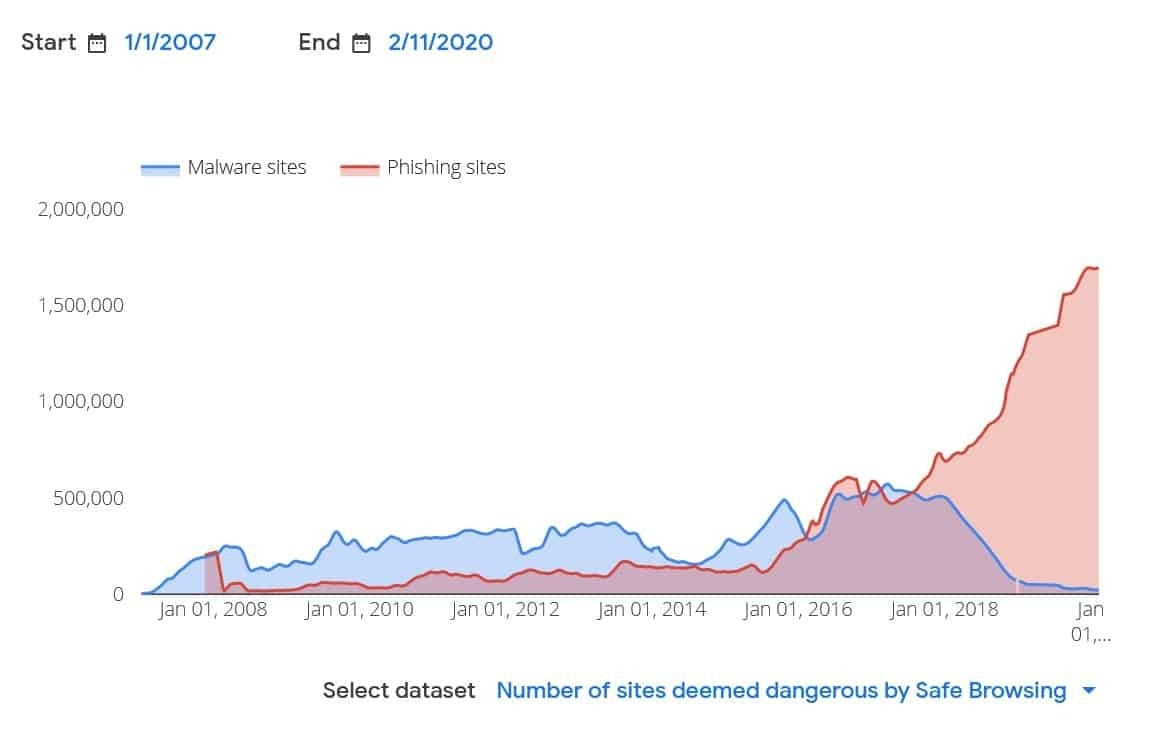
Concerning the tools used to commit cyber crime, malware (software designed to cause damage to a computer, server, client, or network) is at its lowest point since 2007, according to Google’s Transparency Report. In contrast, phishing websites - which seek to gain passwords, credit card numbers and other private information without the use of applications - have seen an increase of more than 750% since 2007.
In all cases of cyber crime that resulted in financial loss, one in three individuals discovered the offence through communications from their bank, building society or other financial institution.
Including non-cyber assisted fraud, the UK has logged 253,736 reports that equate to total financial losses of £1.2bn this year. Health minister Lord Bethell has previously commented on the rise of phishing scams conducted over the course of the COVID-19 pandemic, with an increase in fraudulent text and calls to mobile phones, with individuals posing as bank employees, HMRC and even the NHS charging for fake COVID tests and track & trace.
A spokesperson for PPC Shield comments: “With the internet such an essential part of our daily lives, taking care online and using robust security measures are of utmost importance. Always be aware of what you are clicking on, and be especially wary of phishing sites and emails sent from companies or individuals that you are not familiar with.”
- 05:00 am

- Over 10 years, Chargebacks911 has protected over 10 billion transactions and recovered over $1 billion in falsely disputed and/or stolen revenue to-date
- Grown from working with just 12 merchants to over 45,000
- Expanded its connection hub in both scale and scope, growing from 5 to over 500 data integrations
- Launched its new brand Fi911, to include end-to-end chargeback lifecycle management for financial institutions and payment facilitators
- Celebrated over 200 students graduate from its not-for-profit, Paid for Grades educational programme
- Donated over $1 million to charity
Founded in 2011 in Tampa Bay, Florida by Monica Eaton-Cardone and Gary Cardone, Chargebacks911 is now celebrating its 10-year anniversary. The company has since successfully protected more than 10 billion online transactions and has recovered over $1 billion in falsely disputed and/or stolen revenue.
The global leader in chargeback management, remediation and dispute resolution now has over 400 fintech professionals working across corporate offices in North America, Europe and Asia for some 45,000 active merchants in 87 countries across 27 verticals. It also recently launched a new dispute management brand for financial institutions, Fi911, to empower FIs with the most sophisticated dispute management technology in the world. Today, it serves some of the world’s largest financial institutions.
“We were the first chargeback company in North America and Europe – we can add APAC to that list this year as well,” said Co-Founder and COO, Monica Eaton-Cardone. “Originally when we first started, it was assumed that chargebacks were an unavoidable cost of doing business. Instead of trying to combat them, merchants would just accept them – there was a need for serious, transformative change.
“We’ve been working hard to alter this perception over the past decade. It’s now widely acknowledged how systemically unfair the chargeback process can be to sellers and many want to join our campaign for change.”
Gary Cardone, CEO of Chargebacks911, added, “Right now, we’re in a moment of history where the world is digitising at a staggering rate, causing an upwards trajectory of global ecommerce which is expected to grow 16.5% from 2020 to $2641.1 billion in 2021.
“Chargebacks911 will continue to innovate and expand our technology and solutions, to support the growing, multi-acquired, multi-currency and multi-lingual merchants and FIs who are raring to take advantage of the expanding global opportunities.”
Discussing her proudest moments, Eaton-Cardone explained, “Of all our accomplishments over the past 10 years, I’m most proud of how we’ve elevated awareness and helped inspire change. This was our first goal, and arguably our largest initial barrier to success. It is also something that’s impossible to achieve without genuine teamwork, dedication, and perseverance.”
As the company has grown, so too has its desire to give back and champion many causes – both in and out of the industry. It has helped over 200 students graduate the Paid for Grades programme by providing learning modules in key subjects, support through tutors and cash rewards upon graduation.
Eaton-Cardone is a long-time advocate of overhauling chargeback processes and making other substantial changes to legacy infrastructure and policies. In a bid to improve merchant rights and equip them with the knowledge to effectively manage chargebacks, she authored the book, Chargebacks for Dummies, and then offered it free to the public. To help educate the consumer sector, she partnered with Citibank, American Express and Bank of America, spear-heading the ConsumerAction initiative which provides free courses and guides to banks and their cardholders – teaching them when and how to correctly use the chargeback process, and protect themselves from unauthorised charges.
This was followed by Chargebacks911’s thousands of pages of free content, infographics, eBooks and advice on its website, and more recently the launch of its educational seminars series, Chargeback University, in London, Toronto, New York, Chicago, San Francisco and Los Angeles.
“Initially, raising awareness of the issue was an uphill battle, but over the past few years there’s been a seismic shift in public opinion,” said Eaton-Cardone. “Instead of automatically blaming the sellers, there is now an acceptance that fraud can go both ways in the merchant-consumer relationship.
“Equally, we’re becoming increasingly cognisant of the link between consumer fraud and price-inflation – when the cost of fraud rises for the merchant, eventually it’s going to result in higher prices for the consumer. That’s why chargeback fraud is like a multibillion-dollar hidden tax on online products.”
Eaton-Cardone predicts that the next 10 years will see a decade of ecommerce dominance, creating a further need for companies like Chargebacks911.
She concluded, “There is big change coming over the next decade – the drastic increase in digital payments and chargebacks we’ve seen from COVID-19 has just been a taste of that – we are dealing with a structural and permanent shift in merchant-led technology and consumer behaviour. In order to reduce the billions that will be lost to invalid payment disputes, we must continue our push for industry-wide effective chargeback management systems, updated dispute rules based on modern (and future) commerce, and adequate support for both merchants and financial institutions.”
For more information about Chargebacks911, visit chargebacks911.com

ince Graziani
CEO at IDEX Biometrics ASA
Central Bank Digital Currencies (CBDCs) are becoming increasingly popular with nation states around the world, and for a good reason. see more
- 08:00 am

Current proof-of-concept (PoC) processes can take on average 18-24 months. By centralising the PoC process QAssure/prooV's end-to-end PoC platform shortens the time from discovery, testing to deployment of the right solution by 75% so financial enterprises can adopt new technology while it is still new and the technology is relevant.
By combining smart integration technology, behavioural prediction analytics with bespoke development to support workflows, this solution will also leverage Delta Capita’s integration, testing and managed services expertise and its unique capability of certification and assurance. Upon the completion of the PoC, the digital assurance platform will further help in performing both ends to end functional and non-functional testing of the solution. It will reduce the testing timeframe from months or weeks to days and ensure that all solutions produced are of the highest standard.
The news follows the recent merger of QAssure and prooV™, a cloud-based testing platform owned by global technology group, Prytek.
Jerry Ngo, Vice Chairman, Delta Capita Asia says “The true potential of innovation is often held back by slow processes, and this needs to change. These challenges aren’t unique to one sector. There is a huge opportunity to help drive innovation across various industry verticals. We’re always looking for ways to do things better, and faster – with cost efficiencies front of mind. We have already been able to put this into action with a use case that was presented to us by a government entity that is at the forefront of catalyzing innovation by smaller start-ups - by allowing them the ability to quickly respond to problems being posed by their clients.”
Toby Olshanetsky, CEO and Co-founder of prooV™ says “We are very excited about this opportunity. Our joint offering will allow to meet the growing demands of a continuously changing landscape – particularly as financial institutions plan to increase onboarding of FinTech solutions. A crucial part of this effort is running proofs-of-concept - but then security, regulation, bureaucracy, legal red tape, and slow processes come into play. QAssure and Delta Capita is the hub where you can discover, test, analyse, compare and deploy new technology this will give our customers 360 PoC solution: before, during and after PoC is finished with no regulatory barriers, no security risks, just pure technology testing and evaluation.’
Delta Capita has been reinventing this space by putting together disparate capabilities into leading edge use case solutions for our customers for example within the KYC space putting together Karbon, Karbon8, Scannovate and Klarion into an end-to-end orchestration. With this innovation-as a-service offering, we investigate the challenge of innovation itself and of technology adoption for our clients.
- 05:00 am

RegTech company, Napier, provider of advanced anti-financial crime compliance solutions, has announced that cross-border payment specialist ONEPIP will be using its technology as part of ONEPIP’s upgraded anti-money laundering (AML) controls.
Napier’s AI-led Transaction Monitoring, Client Activity Review and Risk-Based Scorecard Review will give ONEPIP a systematic, intelligent review of all its transactions and customer profile data to help identify suspicious activity quickly and easily, creating a robust compliance solution.
Dagian Cheong, Head of Risk Management, said “With over 25,000 transactions worth over USD4.5bn in value since 2016, licensed operations in Hong Kong and Singapore, and planned expansion in the region, automated transaction monitoring has become imperative for the management of the risks in our business.
“As one of the fastest-growing FinTechs in the region, ONEPIP is on a continual quest to collaborate with best-in-class technology innovators, to integrate with our proprietary FX management platform, to meet the exacting standards of all our stakeholders, which include regulators and partner banks. We are particularly grateful to the Monetary Authority of Singapore for awarding us with the Digital Acceleration Grant which helped fund this project."
Named as Best AML/CTF Solution in the Regulation Asia Awards for Excellence last year, Napier works with financial organizations around the globe to provide an AI-led platform for intelligent AML and trade compliance. Its presence in APAC was further strengthened earlier this year with the opening of a new Kuala Lumpur base, adding to its offices in Singapore, London, North America, Australia and Dubai.
Robin Lee, Head of APAC at Napier, said: “Financial services organizations continue to face mounting pressures to ensure that their regulatory compliance measures are constantly up to date and robust enough to identify any potential criminal activity, or face huge fines. With Napier’s advanced and intelligent technology, this can move from being a mandatory duty to a competitive edge. ONEPIP’s new solution enhances its regulatory compliance regime to further strengthen its position as the trusted cross-border payment specialist in the region and beyond.”








