Published
- 09:00 am

Commenting on the ECB meeting and revised forward guidance on interest rates, Shane O’Neill, Head of Interest Rates at Validus Risk Management, said: “There was increased anticipation for today’s meeting minutes release. The ECB’s chief economist, Philip Lane, downplayed the economic threat posed by the delta variant and committed to the PEPP program continuing until at least March 2022, and the ECB’s role in QE continuing beyond that – the result, somewhat counter-intuitively, was a large move higher in yields. German yields have their largest one day move since March.
“There was one key take away for the markets, and this was the revised forward guidance on interest rates. ECB members, led by Lane, have reformulated the forward guidance on interest rates to include three main points: inflation should reach target well in advance of projection horizon; the governing council should be confident that inflation is present on a durable basis; and rates should not be hiked unless underlying inflation was also judged to have made satisfactory progress towards 2%.
“Immediate market reaction was very subdued – EURUSD and 10y yields virtually unchanged on the release. This does, however, seem like positive news for risk assets – the ECB has in effect built in a buffer to allow them to keep conditions extremely accommodative even in the face of rising inflation, as long as they perceive it as transitory. Assets negatively effected by rising inflation could come under pressure due to this rewording but as that seems a long way off in Europe, as opposed to the US for example, the accommodative nature of the change should win out and provide support to EUR risk assets. Though far from groundbreaking, these minutes seem additive to the risk on moves seen over the last couple of days and attention will now switch to the September ECB meeting for any further developments on the PEPP programme and its future.”
- 05:00 am


- 09:00 am
Accounting software provider and SKU-level data expert provide increased visibility into business finances, improving customer experiences
Sensibill, the only customer data platform that enriches SKU-level data specifically for the financial services industry, and FreeAgent, provider of cloud accounting software for small businesses and accountants, announced their partnership today, supporting more than 110,000 business customers to better manage their business expenses. The two award-winning companies will help small businesses and accountants automate and organize their finances, accounting, and taxes.
FreeAgent recognized their business customers needed a simple, user-friendly alternative to manual-based administrative activities, such as receipt management. These businesses wanted more automation, allowing them to spend more time running their businesses instead of managing the back-end operations. This partnership removes two common pain points:1) reconciling receipts with statements continues to be time-consuming for businesses; and 2) manually organizing and filing receipts requires too much effort.
Understanding the problems small businesses face in day-to-day expense management and receipt tracking, the two companies partnered to offer a more comprehensive solution. Leveraging Sensibill’s technology within the FreeAgent solution in a new feature called Auto Extract, small businesses can capture, organize, and categorize their receipts, attaching them to corresponding bank transactions. This ultimately makes receipts significantly easier to find and reference. By extracting data from receipts, Sensibill and FreeAgent are reducing errors from manual entries, providing greater visibility and accuracy behind purchases while helping alleviate the stress of tax season.
Roan Lavery, CEO and Co-founder of FreeAgent, said, “Automation is at the center of our business, which is why partnering with Sensibill was a natural choice. Through this partnership - which powers our new Auto Extract feature - we aim to increase customer satisfaction and engagement, while making the lives of our small business customers and accountant partners much easier. It’s great to be working alongside Sensibill to help businesses get back to pursuing their passions - without all of the administrative hassles.”
Danny Piangerelli, Chief Technology Officer of Sensibill, added, “By joining forces with FreeAgent, we’re eliminating the time and money businesses have traditionally spent manually entering data into clunky and cumbersome spreadsheets and systems. Instead, we’re delivering item-level details that enable faster, better expense management. Our combined technologies make it possible for these businesses and accountants to take care of their business, anywhere and anytime. Together, we are arming small businesses with the right tools to run their businesses with more efficiency, speed, and accuracy – something that has never been more important than in the current climate.”
- 03:00 am

This week, CNBC broke an investigative story which discussed the many Coinbase users who have fallen victims to hackers, mostly without recourse. Coinbase is known for its historic public offering, as well as its place as an industry leader in the emerging digital assets space. Those interviewed noted that the company’s customer service was lackluster, at best. Coinbase boasts a market cap of roughly $65 billion, as well as a user base of more than 68 million across the globe.
“Brand trust is everything in an emerging industry. Coinbase quickly came out, and it is the most notable of the exchanges, but people are starting to learn that bigger isn’t always better in fintech or finance. Remember, a few years back, when there was a massive push by consumers to leave the big behemoths and transition to local banks and credit unions? In the case of exchanges, there’s even more to consider than solely fee structure and customer service,” opined Richard Gardner, CEO of Modulus, a US-based developer of ultra-high-performance trading and surveillance technology that powers global equities, derivatives, and digital asset exchanges.
“One of the things that most people don’t think about when choosing a digital asset exchange is that technology is far more important than when choosing, for comparison’s sake, a banking institution. If your bank doesn’t have a robust mobile banking offering, while it may be inconvenient, it won’t affect the security of your money. Your checking account is still backed by the FDIC, and banks will work to track down and rectify fraudulent purchases. Cryptocurrencies and digital assets are a completely different kind of asset class,” said Gardner.
“When looking at choosing your digital asset exchange, their commitment to security is critical, particularly during a time where an operation’s security apparatus is not well defined or regulated in most jurisdictions. While bureaucracy is beginning to catch up with technology, one of the biggest strategic differentiators between exchanges is in their commitment to security and compliance. Is your exchange engaging every avenue to create a safe haven for your assets? Did they build their technology stack to get to market quickly, or did they build it to stand the test of time? Security matters, even more than speed and latency. Certainly, it is more important than how well their marketing department has signed on new users. Being the biggest isn’t an indication of anything more than that, likely, the company was well capitalized among the early players,” said Gardner.
Since 2016, Coinbase users have filed over 11,000 complaints with the FTC and CFPB. “We’ve seen, time and again, that some of the biggest regional players have been hacked or otherwise involved in malfeasance. There’s just no substitute for a well-run operation, which is focused on building technology that can withstand external threats, regardless of size,” said Gardner.
Modulus is known throughout the financial technology segment as a leader in the development of ultra-high frequency trading systems and blockchain technologies. Over the past twenty years, the company has built technology for the world’s most notable exchanges, with a client list which includes NASA, NASDAQ, Goldman Sachs, Merrill Lynch, JP Morgan Chase, Bank of America, Barclays, Siemens, Shell, Yahoo!, Microsoft, Cornell University, and the University of Chicago.
“Granted, in many cases, we’re talking about individual users or computers being hacked. That’s not, in and of itself, the fault of Coinbase. But, I think moving forward, it is incumbent on exchange providers to supply education to their customer base. That’s, ultimately, what’s going to keep them successful. Many people are getting into digital assets for the first time. Those people need some handholding to make sure that they’re following industry best practices so that they aren’t the target of nefarious actors,” offered Gardner.
- 03:00 am

Rent payments platform Till introduced four new features that enrolled landlords can offer their tenants.
- Budget and Save lets renters make short-term installment payments leading up to their rent due date. This can help with expense management so tenants can ensure rent is paid in full and on time.
- Rent Protection covers rent for residents who are short on rent to make sure they don’t miss a payment. Residents can repay Till while using the Budget and Save tool for the following month.
- Free Credit Builder, which is free for both renters and landlords, helps residents build their credit and incentivizes them to make payments on time.
- Rewards for Rent gives eligible residents rent payment rewards—like having Till cover their rent—when they make on-time payments.
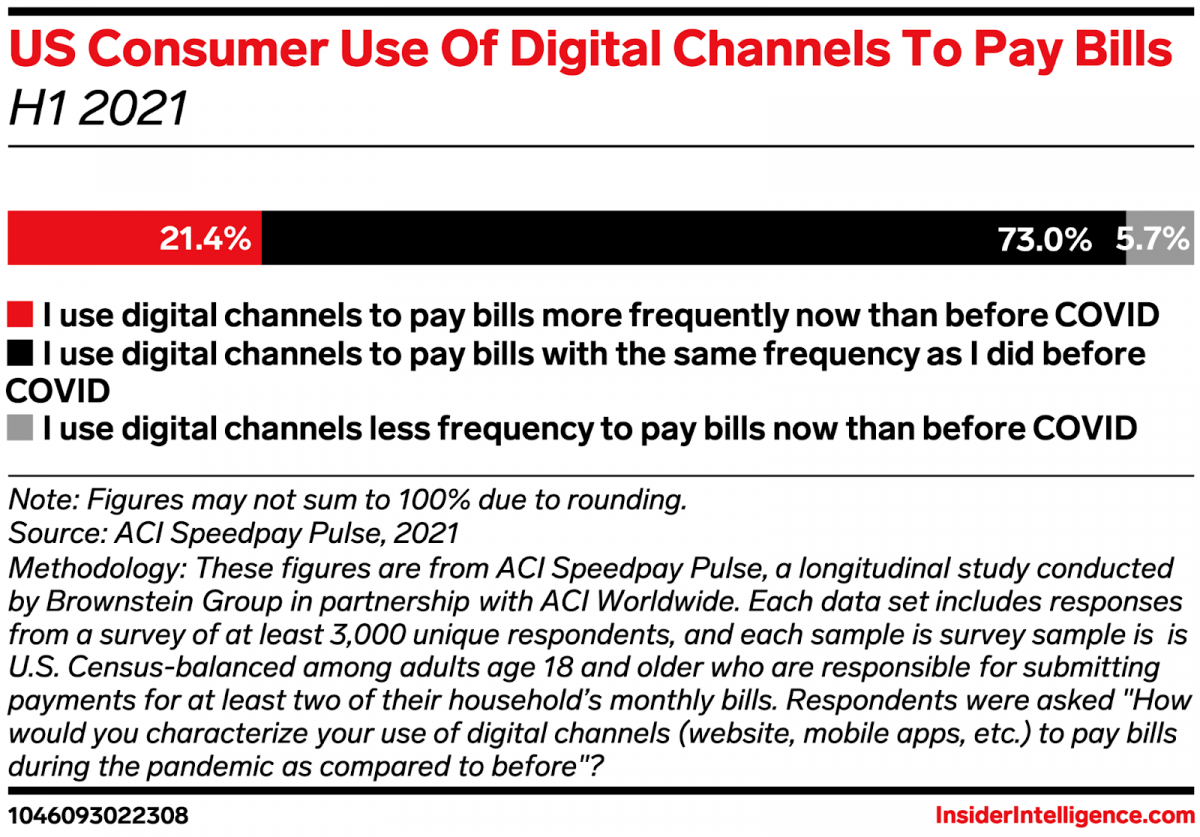
Why it’s worth watching: The US rental market is huge—and it’s prime for disruption as consumer appetite for digital bill payments rises.
- In 2019, renters made up 36%—approximately 44.2 million—of US households, according to Pew Research. That same year, they paid a whopping $512.4 billion in rent, per Zillow.
- More recently, the rental market has seen higher demand for digital payment options, likely triggered by a need for faster payments and the rise in contactless transactions during the pandemic. The percentage of digital rent payments almost doubled from 17% in Q4 2019 to 33% in Q4 2020, per data from Zego.
- There’s also been more innovation in the space: For instance, Mastercard recently introduced the Bilt Mastercard credit card, which offers perks like 2x points for rent payments.
The opportunities: Till’s new features can help it further penetrate the rental market and could make it a leader in the space as the market undergoes digital transformation.
- Till’s Credit Builder feature incentivizes on-time payments by helping renters build their credit. Alternative credit-building tools like those offered by Credit Sesame and card issuers are bringing more consumers into the credit system, increasing their access to key financial services. Credit Builder can further that initiative and help Till pull in more customers.
- And the Budget and Save tool’s installment payments offer customers more payment flexibility. The feature is similar to many of the buy now, pay later solutions that have grown popular amid the past year’s pandemic-induced financial uncertainty. Letting customers pay their rent in short-term installments can help Till build good customer relationships, which could lead to more platform engagement.
- The solutions can help landlords get paid faster and reduce missed payments, making it an appealing partner. Till’s new features could draw more landlords to its network if it demonstrates that it can reduce escalating unpaid rents: The share of unpaid rent balances more than doubled from 1.9% in 2019 to 4.5% in 2020, per Zego—adding cash-flow pressure on landlords.
- 08:00 am

First Ever Communications Network Brings Banks and Law Enforcement Together to Fight Back Against Fraudsters
FiVerity, a leading provider of cyber fraud defense, today announced the launch of the Cyber Fraud Network™, the industry’s first collaborative system built to combat the convergence of cyber tactics with fraudulent theft. FiVerity’s Cyber Fraud Network improves the collective cyber fraud knowledge of financial institutions, regulators, and law enforcement by facilitating the secure exchange of intelligence on suspected fraudsters without disclosing personally identifiable information (PII).
This revolutionary information-sharing network gives financial institutions the industry’s first secure method of sharing the critical details that make it easier to effectively combat synthetic identity fraud (SIF). In this growing financial crime, criminals combine information taken from social media and compromised identities available on the dark web to create entirely new, fraudulent identities. These identities are then used to infiltrate consumer lending institutions and steal billions of dollars. SIF is one of the fastest-growing financial crimes and is responsible for a growing number of credit losses. In 2020 alone, FiVerity estimates SIF cost U.S. financial institutions $20 billion.
Using AI and machine learning solutions, the network detects sophisticated forms of cyber fraud and delivers actionable, proactive threat intelligence to banks and law enforcement agencies. For years, fraudsters using a single synthetic identity have been able to create accounts at multiple institutions, with little fear of being caught. Now, the network can help prevent this through information sharing, while keeping PII safe.
As noted by The Federal Reserve in its July 2020 Payment Fraud Insight paper, “No single organization can stop synthetic identity fraud on its own. Fraudster tactics continually evolve to stay a step ahead of detection – and the most sophisticated fraudsters can operate at scale in organized crime rings, generating significant losses for the payments industry. It is imperative that payments industry stakeholders work together, share information and keep up with the threat.”
The Cyber Fraud Network, which can be accessed through simple and secure API integration, strengthens each user’s defense by alerting them to fraudulent activity detected throughout the network. This multiplies each user’s ability to identify - and learn from - new fraud patterns. In addition to providing ongoing defense, FiVerity offers a fast and lightweight portfolio analysis to identify SIF accounts within existing portfolios.
“Financial institutions - from the smallest community bank to the largest global lender - all understand the severity of the cyber fraud problem,” said Greg Woolf, CEO of FiVerity. “Until now, they’ve been uncertain about what information they can share without violating privacy regulations or other security rules. Many also worry about giving up a competitive advantage when sharing customer data. FiVerity’s Cyber Fraud Network was created to solve these problems and give financial institutions the tools they need to share information without violating their customers’ privacy.”
The network’s “double-blind” approach splits the encryption key across members, so that no single institution holds the complete key to decrypt PII data. This allows financial institutions to maintain complete confidence in the security of their customer data, as the only companies that can validate a shared profile are the ones that already possess the corresponding PII.
For more information about FiVerity’s Cyber Fraud Network, please visit fiverity.com/cyber-fraud-network.
- 03:00 am

SavvyMoney, the leading provider of a fully integrated credit score solution that provides credit scores, reports, and actionable insights directly from a financial institution’s online and mobile banking platform, today announced the launch of its 500th financial institution partner. By partnering with both digital banking platforms and financial institutions, this fast-growing fintech is leveraging its strengths in the credit score and technology sectors to bring financial education to consumers via their trusted financial institution across the United States.
More than 35 digital banking platforms have selected SavvyMoney to seamlessly integrate into digital banking, adding additional value and functionality to end-users. Financial institutions are then able to deliver SavvyMoney’s solution to their end-users via their digital banking platform. The industry-wide adoption of SavvyMoney’s engaging platform highlights the power of the solution. SavvyMoney’s partners share a common goal of elevating their personalized digital banking experience. Each financial institution partner is committed to providing next-level, personal financial wellness.
“We are excited that so many financial institutions have trusted SavvyMoney to be their credit score, personalized loan offer, and analytics marketing solution,” said JB Orecchia, CEO and President of SavvyMoney. “Knowing these partners depend on SavvyMoney to push the needle from a technology, credit, and financial wellness perspective fuels us to keep innovating.”
“The strong adoption of SavvyMoney’s agile platform highlights the confidence financial institutions have in their solution,” said Jonathan Price, EVP Emerging Businesses, Corporate & Business Development at Q2. “Leveraging Q2’s Innovation Studio, the implementation between our platform and SavvyMoney was quick and easy. We’re proud to offer SavvyMoney to our financial institutions and are excited for their continued growth.”
Founders Federal Credit Union, the 500th financial institution partner to go live with the SavvyMoney solution, is a Q2 customer that implemented SavvyMoney via the integration.
“Founders Federal Credit Union is honored to be the 500th partner,” says Nicki Nash, Chief Marketing Officer at Founders. “We take pride in offering this cutting-edge technology and look forward to discovering new insights as we examine the data. We plan to launch a digital loan recapture campaign in the coming months and really leverage SavvyMoney analytics for maximum return on our investment.”
Further enhancements and exponential growth are expected as SavvyMoney continues to partner with financial institutions to drive deeper relationships and engagement in digital banking through financial wellness.
- 03:00 am

MSA and 88mph co-lead on seed round as pawaPay expands payments infrastructure across Sub-Saharan Africa
African payments company pawaPay, has secured a $9m Seed raise. The round was co-led by MSA and UK-based investment fund 88mph, with participation from Vunani Capital, Kepple Ventures and Zagadat Capital. The capital will be deployed to scale pawaPay’s operational presence, find more talent to join the team, and expand into new markets on the continent.
Founded in 2020, pawaPay is focused on the mobile money infrastructure provided by telecommunications companies (telco) in Africa. Each telco in each country provides its own unique mobile money product, which makes the mobile money infrastructure as a whole - across borders and telcos - highly fragmented and opaque. For merchants, this fragmentation means that it is unnecessarily expensive to use and frustratingly unstable. Through pawaPay’s simple API, merchants can access more than 300 million customers in more than ten markets and enjoy seamless, transparent and highly reliable payments.
pawaPay’s customers are large Pan-Africa/global merchants and companies needing to make payments to African consumers’ accounts. Payments in Africa have long been made difficult by large unbanked populations, declined credit card transactions, charge-backs, fraud, dropped and lost payments, and slow cross-border settlements. The alternative financial infrastructure created by the telco-led mobile money wallets now has more than half a billion registered accounts in Africa, making it both one of the largest financial infrastructures in the world and one of the most under-developed. pawaPay has positioned itself as an industry leader in high volume mobile money payments and focuses on delivering reliability and transparency for merchants wishing to connect to the customers on the continent. With a single API, pawaPay’s customers can access all telco mobile money systems and thus receive and send payments to hundreds of millions of people. pawaPay handles local operations, compliance, regulatory cover and bank accounts, making it as simple as clicking a button to start receiving payments in a new market. pawaPay is already successfully handling millions of transactions on its rails per week and has operations in 10 countries.
Commenting on the company’s raise and growth prospects, Nikolai Barnwell, CEO of pawaPay said, “Africa’s alternative financial infrastructure is in an exciting phase with double digits CAGR everywhere. And mobile money has come out as the de facto money infrastructure for hundreds of millions of people on the continent. A quarter of the adult population is an active mobile money user. A third of all wallet holders have their salaries paid into them. We’re making a bet that this infrastructure will continue to grow and offer a superior experience than traditional financial infrastructures such as card and banking. With more than 500 million registered users on the continent - 200 million of which are active frequent users, this isn’t a fringe fad or a stepping stone to cards and swift payments. This is an example for the rest of the world of how payments could - and should look. Most of our competitors are largely focused on bank and card payments; but over the past many years we have been laser focused on addressing the unique set of challenges that accompanies specializing in mobile money. I think this gives us a good position to explore the opportunities that are coming up as this alternative financial infrastructure continues to grow.
“We are excited to have world-class investors supporting our vision to connect every mobile money wallet in Africa to each other, and the rest of the world, as we continue to make it simpler to do payments”.
Kresten Buch, Founder of 88mph, added “When we first invested in Africa in 2010, one of the key drivers was that mobile money was a superior payment method to credit and debit cards when used for online payment. So, we are excited to be an investor in pawaPay’s journey and continue to witness the development of digital infrastructure in Africa''.
Mr. Eazi, singer, songwriter, entrepreneur and Founder of Zagadat Capital, added: “Being investors hugely focused on Africa and very familiar with the landscape, we believe that mobile money focused fintech is not just one of the most exciting places to invest but also one of the most important bridges to ensuring financial inclusion of the billions of people across the continent, the kicker for us was that we believe in the clear mission, vision and strategy & we are confident that the pawaPay team is the best team to achieve it”.
- 06:00 am

iQSTEL, Inc. (OTCQB: IQST) today announced achieving $5.23 Million in revenue for the month of July based on preliminary accounting. The July 2021 revenue exceeds the July 2020 revenue by 21%. The company has exceeded $5 million in revenue now for four consecutive months.
iQSTEL Inc. (OTCQB: IQST) (www.iQSTEL.com) is a US-based publicly-listed company with an Independent Board of Directors offering leading-edge Telecommunication, Technology and Fintech Services for Global Markets, with presence in 15 countries. The company provides services to the Telecommunications, Electric Vehicle (EV), Financial Services, Chemical and Liquid Fuel Distribution Industries. iQSTEL has 5 Business Divisions: Telecom, Electric Vehicle (EV), Fintech, Technology and Blockchain, with worldwide B2B and B2C customer relations operating through its subsidiaries: Etelix, SwissLink, QGlobal SMS, SMSDirectos, Global Money One, IoT Labs and itsBchain. The Company has an extensive portfolio of products and services for its clients: SMS, VoIP, international fiber-optic connectivity for 5G, Cloud-PBX, OmniChannel Marketing, EV Batteries, EV Chargers, EV Battery Management System, EV IoT Connectivity, Mobile App For EV Connectivity, EV Dashboard Display, Visa/Mastercard Debit Card, Cryptocurrency Exchange Services, Money Remittance, Mobile Top Up, IoT Smart Gas Platform, IoT Smart Tank Platform, Mobile Number Portability Application MNPA (Blockchain Platform) and Settlement & Payments Marketplace SPM (Blockchain Platform).
Safe Harbor Statement: Statements in this news release may be "forward-looking statements". Forward-looking statements include, but are not limited to, statements that express our intentions, beliefs, expectations, strategies, predictions or any other statements relating to our future activities or other future events or conditions. These statements are based on current expectations, estimates and projections about our business based, in part, on assumptions made by management. These statements are not guarantees of future performance and involve risks, uncertainties and assumptions that are difficult to predict. Therefore, actual outcomes and results may, and are likely to, differ materially from what is expressed or forecasted in forward-looking statements due to numerous factors. Any forward-looking statements speak only as of the date of this news release and iQSTEL Inc. undertakes no obligation to update any forward-looking statement to reflect events or circumstances after the date of this news release.
- 03:00 am

TIBCO Receives Highest Possible Scores in Natural Language Query, Cloud Connectivity and Hybrid Environments, and Four Other Criteria
TIBCO Software Inc., a global leader in enterprise data, empowers its customers to connect, unify, and confidently predict business outcomes, solving the world's most complex data-driven challenges. Today, TIBCO announced it was named a Leader in The Forrester Wave™: Augmented BI Platforms, Q3 2021 report. The study analyses vendors’ strengths in augmented business intelligence (BI), evaluating companies through rigorous research across 25 criteria.
“The worlds of BI, analytics, data science, and data management are colliding and converging, as we innovate and adapt to rapidly changing business ecosystems,” said Michael O’Connell, chief analytics officer, TIBCO. “This position as a leader in augmented BI adds to TIBCO’s recognition by top analyst firms as a leader in analytics. We see this as confirmation of TIBCO’s hyperconverged analytics vision, where the combination of visual analytics and data science with real-time data results in smarter decisions and high-value business outcomes.”
The Forrester Wave™: Augmented BI Platforms, Q3 2021 gave TIBCO the highest possible scores in the criteria of machine learning for citizen data scientists, machine learning functionality for data scientists, natural language query, cloud connectivity and hybrid environments, and translytical low-code app development.
According to the Forrester report, “TIBCO Spotfire fuses all advanced analytics — data science, geolocation, streaming. TIBCO Spotfire packs a formidable set of advanced capabilities in a single platform – an impressive number of complex, highly interactive data visualisations (a differentiator that reference customers point out); advanced geospatial, graph, and network analytics; and about a dozen pre-packaged ML models. The product also includes Spotfire Data Streams, a highly differentiated streaming analytics capability that can be set up simply by connecting to a streaming data source, while most competing platforms require additional integration efforts to achieve the same capability.”
TIBCO Spotfire 11 delivers embedded data science workflows, opening up its use by non-developers, while Spotfire Mods assists in enabling low-code development for tailored, visual analytics applications, speeding customer innovation. More than just a BI dashboarding solution, Spotfire scales across any size enterprise, meeting simple or advanced use cases and serving the full spectrum of forward-thinking, data-driven users, including analysts, citizen data scientists, and data scientists. TIBCO continues to add innovative enhancements, including a generational set of immersive, smart, and real-time analytics capabilities. This increases business value by compressing the time from business events to analytics, insights, and action.