
Published
- 04:00 am

Central European energy group to implement OneStream’s Intelligent Finance platform
Energetický a průmyslový holding (EPH), a leading Central European energy group, has selected corporate performance management (CPM) vendor OneStream Software to unify the company’s finance operations. EPH will utilize the OneStream platform to streamline their financial close, consolidation, planning and reporting processes for over 400 users across the enterprise.
EPH owns and operates assets in the Czech Republic, the Slovak Republic, Germany, Italy, Ireland, the UK, France and Switzerland. The company manages over €18 billion in assets, with €8.5 billion in revenue in 2020. The company needed a flexible platform that could accommodate the complexity of EPH’s assets, as well as manage the company’s continued growth and ever-changing business environment. After a detailed evaluation process, OneStream was selected for the platform’s modern approach to CPM.
“OneStream brings a new and fresh concept based on predefined process and best practices in financial management,” said Martina Matouskova, Business Performance Director at EPH. “The platform is flexible to support our complex business environment as well as rapid changes in our Group structure. Partnering with OneStream will help with future automatization of our finance processes and will play a key role in improving our user experience.”
“Just as EPH seeks to achieve excellence in all aspects of its operations, our mission at OneStream is to drive 100% customer success,” said Craig Colby, President at OneStream. “We are thrilled to partner with EPH to evolve their financial processes and to support their growth by providing key insights into business performance, flexibility for users and a unified approach to the office of finance, from financial close and consolidation to reporting, planning and analytics.”
- 02:00 am
Roseland Born Logistics to utilize the new funds to purchase a new box truck for the company
Nav, the simple and intelligent financing platform for small businesses, today announced Roseland Born Logistics as the most recent $10,000 grand prize winner of its quarterly Small Business Grant. Roseland Born Logistics is a black-owned, logistics company that provides inbound and outbound dry freight services. Owned and operated by Mark Davis and Chris Banks, the logistics company plans to use the grant money to purchase a box truck for the business.
Nav’s quarterly Small Business Grant comes at a time when many small businesses are looking for financing, but are unable to access new funds because of changes in bank financing offerings and solutions. Nav is stepping in and providing solutions for small business owners in a post-PPP world through the Small Business Grant and working to make sure that small businesses are continuously supported.
“It’s an honor for Nav to work with the smallest of small businesses at every age and stage of their business, especially businesses like Roseland Born Logistics who are newer to the small business world,” said Greg Ott, Nav CEO. “We are inspired by Chris Banks and Mark Davis’ tenacity and drive to go out on their own and build a small business, and we look forward to seeing the great work that Roseland Born Logistics will do for the Minneapolis-area.”
Prior to opening Roseland Born Logistics, Banks and Davis were working at other companies. When they realized that they weren’t being paid their worth, the two decided they wanted to take ownership of their careers and build their own company. From there, Roseland Born Logistics was launched.
“With my co-owner, Chris Banks, we started this business back in April 2021. What we didn't realize before starting our business is how difficult it actually is to get funding as a new small business -- many banks only want to work with businesses that have been up and running for at least one year,” said Mark Davis, co-owner of Roseland Born Logistics.“As one of the only black-owned transportation companies in Minnesota, we wanted to make a lasting impact in our community. And thanks to Nav’s grant, we’re continuing to meet our goals and grow within our first year of business.”
Nav also awarded a runner-up prize of $5,000 to Artland Studios, an art education studio located in Paden, Oklahoma. Owner of Artland Studios, Leslie Anne Martin, founded her business in October 2018 as a sole proprietorship, and recently upgraded to an LLC in March 2021. Martin created the studio to provide art opportunities to children and adults living in rural, central Oklahoma.
“I grew up in Paden, Oklahoma so I knew there wasn’t nearly enough funding for arts programs in the local schools or arts opportunities for adults,” said Leslie Anne Martin, Owner of Artland Studios. “My long term goal for Artland Studios is to be able to host artist residencies, where an artist can come for a period of time, use the facilities and the equipment, make incredible art, and then conclude their residency with an art exhibition in the local vicinity.” Martin plans to use the funds from Nav to help build a classroom space within her studio so adults and children have a place to learn about the arts.
Nav created the Nav Small Business Grant in 2018 to raise awareness about the obstacles small business owners and entrepreneurs experience when building and maintaining their businesses. As of September 2021, Nav has awarded $170,500 to small businesses across the country. In the last round of grant winners, Nav provided a $10,000 grand prize to JW Equine Services, a full-service equine training facility.
The next round of Nav’s Small Business Grants are open now and will close on October 26, 2021. Learn more about the grant and how to apply here.
- 09:00 am
UK-based personal finance management platform Fineo partnered with European open banking company Nordigen to leverage open banking technology. Fineo facilitates the integration of customer bank accounts using Nordigen's account information API to offer a clever way to manage finances. Fineo understands that managing personal finances isn’t always easy, so they developed a solution that allows users to do so in a simple, but powerful way. The company aims to give users the best tools to make personal financial management easy and effective.
“Every day we make decisions on where to eat, what transportation to use, or what our plans are for the upcoming weekend. All these choices have a financial basis and have an impact on personal finances. Our tools help users develop a vision of the financial life they want to achieve both in the short and long term. Nordigen’s account information API enables us to help them create a foolproof budget by taking into account future expenses, so that they don’t have any surprises.” says Fineo Representative Mohammed Amine Atmani.
Using Nordigen’s free API, Fineo customers are able to connect their personal bank accounts through Fineo’s personal finance platform. The platform provides the tools for users to plan a budget, have a centralised view of all their accounts, manage transactions and analyse finances. The end result is a fast and easy technological solution for creating and maintaining a personal budget. Nordigen’s API is fully PSD2 compliant, so Fineo users gain the additional benefit of a secure connection to their open banking account data.
“Fineo is perfectly positioned to leverage secure, consented connections to account information to provide users with the best personal finance management experience. PSD2 was created to democratise access to open banking data and we’re pleased that our solution can help Fineo offer a seamless and effective personal finance management solution to users all over Europe.” says Rolands Mesters, co-founder and CEO of Nordigen.
- 06:00 am

Bitcoin's growth in recent years has resulted in investors reaping significant returns with the asset's rising value. The growth in Bitcoin's return on investment has seen the asset outperform stocks by major banks.
According to data acquired and calculated by Finbold, Bitcoin's return on investment over the past five years has outperformed leading banks' stocks by 4,214% on average. The cryptocurrency has outperformed Wells Fargo (WFC) by a whopping 7,151.86%.
Compared to Citigroup (C), Bitcoin ROI is higher by 4,951.47%, while Goldman Sachs (GS) ranks third at 3,101.94%. JP Morgan (JPM) is fourth at 3,067.51%, while Bank of America (BAC) is fifth at 2,800.59%.
Among the highlighted asset classes, Bitcoin also controls a higher market capitalization of $813.56 billion as of September 21. JP Morgan (JPM) ranks second with a market cap of $471.17 billion. Among the banks, Bank of America (BAC) has the second-highest market at $340.80 billion.
Wells Fargo (WFC), Citigroup (C), and Goldman Sachs (GS) have a market cap of $190.82 billion, $141.49 billion, and $131.96 billion, respectively.
Bitcoin banks on monetary debasement to grow in value
The report highlights some of the drivers being Bitcoin's significant return on investments. According to the research report:
"Additionally, the gains might be a reflection that the asset is emerging as a formidable hedge against inflation and a store of value. Amid the coronavirus pandemic, stocks plunged, and while most economies went into recession and central governments embarked on wide-scale printing of money, Bitcoin was viewed as a hedge against monetary debasement."
It is worth noting that Bitcoin has sustained the returns despite facing barriers on the regulatory front alongside concerns on high volatility.
Read the full story with statistics here: https://finbold.com/bitcoins-5-year-roi-outperforms-major-banks-stocks-by-over-4000-on-average/
- 03:00 am
Nearly 70% of people claim to be doing more to protect themselves from online fraud and identity theft than a year ago
According to research released today by Trulioo, the leading global identity verification company, 68% of consumers claim to be doing more to protect themselves from online fraud and identity theft than a year ago.
The research found more than three-quarters (76%) of people feel that they’re at greater risk from online fraud than they were 12 months ago, and 75% are now worried about becoming a victim of fraud.
The research is presented in a new whitepaper, ‘New Fraud Threats in the Digital-First World’, which examines how online brands can find the right balance between online security and customer experience in a digital-first world.
The steps people are taking range from creating stronger passwords and changing them more frequently, through to installing VPNs and anti-virus software. Alongside this, many people are reading up on security issues to become more informed and be more selective about the businesses they buy products and services from online.
However, while people are trying to protect themselves from online fraud and identity theft, 80% admit that they could be doing more and 70% are worried that they’re not keeping up with the latest fraud threats. In fact the biggest barrier stopping people taking more action to protect themselves online is quite simply that they don’t know what to do and don’t feel knowledgeable enough around the risks they face.
“The last 18 months have seen the use of digital services skyrocket as consumers have needed flexibility and convenience during a period of lockdowns and social distancing,” said Zach Cohen, COO, Trulioo. “But in this day and age, greater use of digital brings an unwanted shadow of identity theft and fraudulent activity. As we move from response to recovery, businesses need to reassure customers that they are taking all necessary steps to protect them in an efficient and convenient way.”
Some consumers feel that their online footprint is now so broad and dispersed from using so many websites that they can no longer take any meaningful action to protect themselves across the board. On average, consumers have started transacting with six new brands during the last year, engaging with these businesses for the first time. This is particularly true in China, where more than half (52%) of consumers report that they transact with too many websites to do more to protect themselves, versus 25% in the U.S. and 24% in the UK.
Cohen concluded, “The message from the research is loud and clear. Businesses need to reset their security strategies to meet the needs of consumers that will continue to heavily rely on digital services for many aspects of their lives. This will involve educating customers around how to protect themselves, demonstrating that websites and apps have the right security measures in place at all times, and providing a choice of highly secure but convenient identity authentication methods. Doing this will not only help keep the fraudsters at bay, but it will be the basis for trusted customer relationships in the future.”
The whitepaper, ‘New Fraud Threats in the Digital-First World’, is available for download now.
- 08:00 am
- Chase will introduce a fee-free current account that combines money management features with cashback rewards on everyday debit card spending
- Chase customers can access their bank through an intuitive mobile app and reach customer support 24/7, with no reliance on chat bots
- New customers can join Chase by signing up at chase.co.uk
JPMorgan Chase today launched its new digital bank in the U.K. under the Chase brand. Chase is the largest consumer bank in the United States and provides a broad range of financial services to more than 60 million American households.
New customers can sign up at chase.co.uk, after which they will be invited to download the Chase app. Customers can open a current account in minutes via the simple and intuitive app. The account offers a range of features to help people budget, manage money, spend and save. A U.K.-led customer support team will be a key part of the Chase banking experience. With just a few taps in the Chase app, customers will be connected to a specialist – 24 hours a day, 7 days a week.
Sanoke Viswanathan, CEO of the bank, said: “We’re offering people in the U.K. the opportunity to experience Chase for the first time with a current account that’s based on simplicity, a fuss free rewards programme and exceptional customer service.”
The Chase current account will launch with a rewards programme offering 1% cashback on all eligible debit card spend for 12 months*. This has been developed in line with U.K. consumer debit card spending habits in order to ensure all customers can benefit from rewards on many of the things they already buy every day, including but not limited to groceries, travel, meals, entertainment, fashion, homewares, electronics, as well as flights and holidays.
There will be no fees to open the Chase current account and start earning cashback rewards. Customers will receive the cashback rewards without needing to switch their banking provider, commit to a minimum account balance or set up direct debits. The 1% cashback is payable when customers use their Chase debit card in person or online, and will be offered at retailers at home and abroad.
In addition to a simple and straightforward rewards programme, Chase also features:
- Customisable additional current accounts to simplify money management: configurable through the Chase app in seconds and designed to help people budget, set aside, save and spend in the way that works best for them. Each Chase account comes with its own unique account number, and the Chase debit card can be linked to it instantly, so customers can spend at any time from the account of their choice.
- Small change round-ups on which they will earn 5% interest for 12 months: customers can save as they spend by rounding up their debit card purchases to the nearest £1, and depositing the small change into a separate account where it will earn interest at 5%** for 12 months. Round-ups will be rolled out to all customers over the coming weeks.
- Fee-free debit card use abroad: customers won’t be charged any fees by Chase when using their card while travelling, including for cash withdrawals at ATMs abroad.
- A numberless debit card: card details are stored behind a secure login on the Chase app, so customers don’t put their account details at risk if they lose their physical card. They can still continue to use their Chase card via their digital wallet. The debit card has been made from recycled plastic (rPVC) and all card packaging is made from recycled materials and everything is fully recyclable.
“Having spoken extensively to consumers across the U.K., we know that people want good value combined with an excellent experience, from a trusted bank. With cashback on everyday debit card spend and an interest boost on round-ups, we can help customers save while they spend on items they already buy every day,” said Viswanathan.
Chase intends to introduce a broad range of banking products in the future, including new current account features, savings and investment accounts, and lending products.
- 08:00 am

A safer, more secure and private way to pay with iPhone and Apple Watch
Payhawk, the growing platform that combines expense, payment and invoice management in one solution, today brings its customers Apple Pay, a safer, more secure and private way to pay that helps customers avoid handing their payment card to someone else, touching physical buttons or exchanging cash — and uses the power of iPhone to protect every transaction.
Customers simply hold their iPhone or Apple Watch near a payment terminal to make a contactless payment. Every Apple Pay purchase is secure because it is authenticated with Face ID, Touch ID, or device passcode, as well as a one-time unique dynamic security code. Apple Pay is accepted in grocery stores, pharmacies, taxis, restaurants, coffee shops, retail stores, and many more places.
Customers can also use Apple Pay on iPhone, iPad, and Mac to make faster and more convenient purchases in apps or on the web in Safari without having to create accounts or repeatedly type in shipping and billing information. Apple Pay makes it easier to pay for food and grocery deliveries, online shopping, transportation, and parking, among other things. Apple Pay can also be used to make payments in apps on Apple Watch.
Security and privacy are at the core of Apple Pay. When customers use a credit or debit card with Apple Pay, the actual card numbers are not stored on the device, nor on Apple servers. Instead, a unique Device Account Number is assigned, encrypted, and securely stored in the Secure Element, an industry-standard, certified chip designed to store the payment information safely on the device.
Apple Pay is easy to set up. On iPhone, simply open the Wallet app, tap +, and follow the steps to add Payhawk’s credit or debit cards. Once a customer adds a card to iPhone, Apple Watch, iPad, and Mac, they can start using Apple Pay on that device right away. Customers will continue to receive all of the rewards and benefits offered by Payhawk’s cards.
For more information on Apple Pay, visit: https://www.apple.com/uk/apple-pay/. For more information on Payhawk, please visit: https://payhawk.com/.
- 09:00 am

Latest raise led by Tiger Global Management LLC with participation from global payments technology firm Stripe. Brings the total raised to date to c$270m.
TrueLayer processes billions in payments, with 400% growth in payment volume and 800% growth in monthly payment value as the company expands across Europe and doubles its customer base.
Funding to accelerate the global rollout of TrueLayer’s payments network, with a focus on instant and recurring payments.
TrueLayer, the global open banking pioneer, today announced that it has closed a $130 million fundraising round, led by new investor Tiger Global Management LLC, the New York-based technology investor, with participation from global payments technology provider Stripe. The latest investment gives the business a post-money valuation of more than $1 billion.
The raise reflects TrueLayer’s position as the market leader in open banking payments, and the scale of its ambition to introduce a new global payment network, making instant and recurring payments available everywhere, in a few lines of code. In 2021, TrueLayer has processed billions in payments, experiencing 400% growth in monthly payment volume and 800% growth in monthly payment value as the company expanded across Europe and doubled its customer base.
Millions of consumers and businesses use TrueLayer to pay for goods and services. Whether investing through Freetrade, banking with Revolut, buying or selling a car on Cazoo, or saving money with one of the UK’s largest loyalty card schemes, TrueLayer powers some of Europe's most innovative brands. With the new funding it takes greater aim at opportunities in ecommerce, to supercharge the mainstream adoption of open banking payments. On average, 1 in 3 people already choose to pay via technology powered by TrueLayer, and some merchant partners are seeing more than 70% of their customers choosing to pay securely with their bank account over cards or digital wallets.
Francesco Simoneschi, CEO and co-founder of TrueLayer, commented: “There is only so long that global business can rely on systems that are outdated, expensive and not fit for the digital age. TrueLayer is carving a new world of payments altogether, which can deliver a fundamentally faster, safer and more user friendly experience that also improves conversion and delivers higher revenues for merchants. We are leading this innovation through instant deposits and withdrawals, and merging Variable Recurring Payments and Direct Debit to build ‘account on file’ services on top of our open banking network. There is an opportunity to rewire the financial system from the ground up and we are leading that evolution through open banking payments.”
TrueLayer’s network provides 95%+ coverage across the UK and major European markets, and accounts for more than half of all open banking traffic in the UK, Ireland and Spain. Its API-first approach helps customers to seamlessly pay, onboard, and share financial information in seconds, garnering a reputation as the technology provider behind many of the most valuable fintechs and cutting-edge businesses.
“Our investors have seen the impact TrueLayer is having by empowering important sectors, from ecommerce platforms and marketplaces, banks, through to trading and investment firms. I’m delighted to welcome an investor of the calibre of Tiger Global, who have an incredible track record backing firms like Flipkart, Nubank and Square that are creating the platforms, distribution networks and services of tomorrow,” Simoneschi added. “I’m also incredibly proud to have a new partner like Stripe, a company we have long admired for its developer experience and focus on solving real world problems that deliver significant value to its customers. I’m looking forward to collaborating closely with both firms to deliver on our vision.”
The new funding will be used to further scale TrueLayer’s business, offering the benefits of instant bank payments to more markets and sectors, and delivering continued product development and innovation, such as the PayDirect solution. It will also be used to continue the firm’s geographic expansion and deepening its engineering, product and commercial teams globally.
“When Francesco and I founded TrueLayer it was with a belief that open banking would act as a catalyst for fundamental change in financial services. I’m incredibly proud of how we’ve built the firm, with a focus on quality engineering and user experience aligned to product development that delivers the best possible services,” commented Luca Martinetti, co-founder and CTO at TrueLayer. “That is reflected in the thousands of developers using our services, the talent we are retaining and the calibre of leaders we’re attracting from world-class technology and fintech companies. Our people buy into the vision for what we’re building and the journey ahead. It’s also reflected in the quality of our investors who believe in our ambition and are as excited as us about what comes next.”
Alex Cook, Partner, Tiger Global, said: "The shift to alternative payment methods is accelerating with the global growth of online commerce, and we believe TrueLayer will play a central role in making these payment methods more accessible. We're excited to partner with Francesco, Luca and the TrueLayer team as they help customers increase conversion and continue to grow the network.”
The funding round is the latest milestone for TrueLayer in 2021. It follows the launch of its PayDirect solution, Verification API, and Payouts solution, receiving its full EU authorisation from the Central Bank of Ireland and establishing its European HQ in Dublin.
- 04:00 am
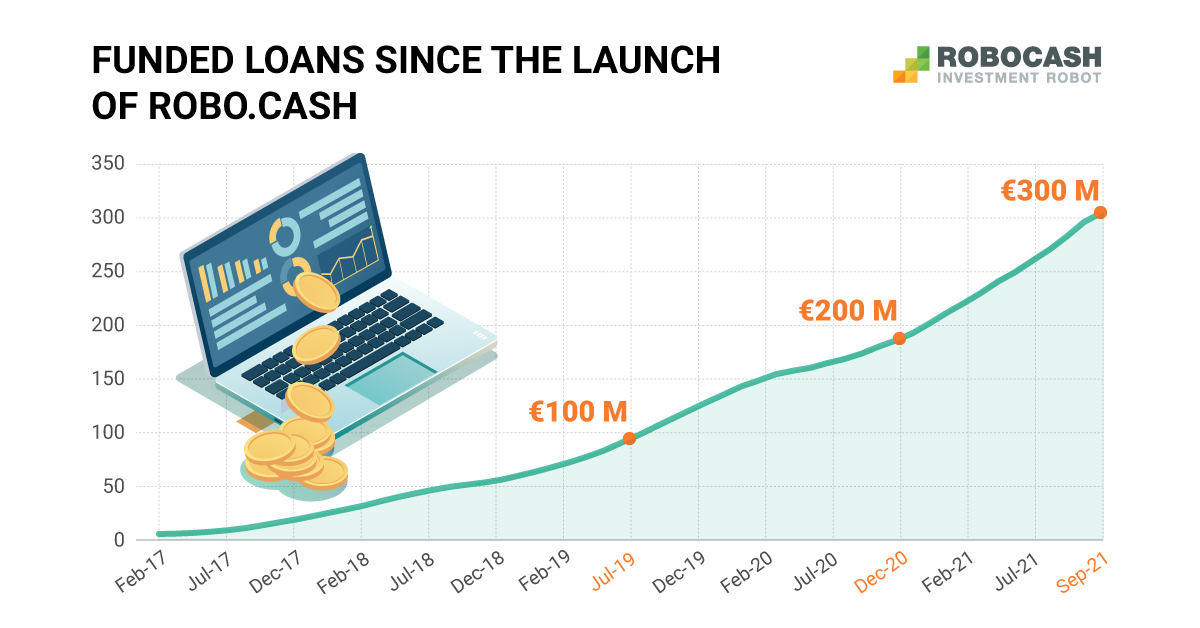
In September, European investment platform Robo.cash reached 300 M euro in total funded loans. The month was also recorded by another achievement - the number of investors crossed the mark of 19 thousand.
2021 sets a dynamic pace for the platform development, supporting the trend of the previous year. Thus, August brings in 13.4 M euro of funded loans, which is 105% more than in August 2020. With a slight decline in April and June, the volumes grow steadily, averaging 7%.
The platform currently has 19 thousand investors. For the entire period of Robo.cash operation, the customers have already earned more than 66 M euro.
In May, the platform introduced two new types of loans to invest in - “Buy Now, Pay Later” and salary-linked loans. They are placed by the service UnaPay launched by Robocash Group in the Philippines. The product is already successfully developing, increasing the volume of loans financed through the platform by 46% MoM since its integration. Investors of the platform have already funded almost 1.8 M euro of such loans.
“The platform received its first 100 M euros of funded loans two years after launch. After a year and a half, we have passed the 200 M mark. Now we are pleased to announce that we have reached a new milestone in less than 9 months. These results show that we are moving in the right direction. Thus, we follow market trends, integrate new products and bring even better transparency to our investors who are largely involved in these achievements”, comments Sergey Sedov, CEO of Robocash Group.
- 06:00 am
The increasing mobile data and cloud computing traffic and the rapid development of technologies such as artificial intelligence and the Internet of Things significantly increased the volume and complexity of data sets, driving the growth of the big data and business analytics market.
According to data presented by StockApps.com, the global big data and business analytics (BDA) market was valued at $215.7bn in 2021. This figure is projected to grow by 27% to over $274bn by the end of the next year.
Global BDA Spending to Surge by $60B in a Year
Over the years, digitalization has completely changed the economy, society, and people, and the COVID-19 has only speeded up the entire process. The data generated by billions of devices is in the center of this revolution. According to Statista, there are more than 21 billion interconnected devices globally, and their number is set to explode in the following years as internet consumption rises and new gadgets and machinery hit the market.
Big data is the set of technologies created to store, analyze and manage this bulk data, and identify patterns to design smart solutions. However, digitalization and increased cloud adoption have also been significant boosters for the growth of the business analytics market. Advanced analytics tools, like predictive analytics and data mining, help extract value from the data and generate business insights.
According to IDC's Worldwide Semiannual Big Data and Analytics Spending Guide, the global big data and business analytics (BDA) market had seen impressive growth even before the pandemic, with revenues rising from $122bn in 2015 to nearly $169bn in 2018.
By the end of 2019, total spending on these technologies and solutions jumped to over $189bn. As the COVID-19 continues driving the global shift to digital solutions, total BTA spending is expected to jump above $215bn in 2021. More than half of BDA spending will go towards services. IT services are projected to make up around $85bn, and business services will cover the remainder.
By the end of 2022, global BDA spending is projected to jump by almost $60bn, showing the most significant annual increase so far.
United States Account for Half the Total BDA Spending
The IDC survey also showed the United States is the leading big data and business analytics market, with a 51% market share in 2021. The adoption of big data and AI in the country has been increasing for the last two years, and as of 2021, around 49% of industry-leading firms in the US are driving innovation with data.
Far behind the United States, Japan ranked as the second-largest BDA market with a 5.7% share this year. China, the United Kingdom and Germany follow, with 5.5%, 5.1%, and 4.4% market share, respectively.








