Published
- 08:00 am

UK-Based Service Provider Inca Cloud is First to Build a New Multi-Cloud Service Alternative to the Public Cloud on Nebulon smartInfrastructure
Nebulon, Inc.®, the pioneer of smartInfrastructureTM, server-embedded, infrastructure software delivered as-a-service, today announced the Nebulon smartIaaSTM solution, designed to help cloud service providers deliver new services at a lower cost across both hosted and customer-owned data centres. Nebulon also announced that UK-based service provider Inca Cloud has chosen the Nebulon smartIaaS solution with Supermicro® as a part of its new cloud service, WSO by Inca. The service will be built for both hosted and private cloud deployments and will provide enterprises with a multi-cloud solution as an alternative to standalone Google Cloud, AWS and Microsoft Azure.
Cloud Service Providers (CSPs) today are focused on developing new services and revenue sources, reducing service delivery costs by optimising infrastructure and operations, and maintaining high customer satisfaction by minimising availability risks and security threats. Achieving these goals can be a challenge for those CSPs deploying single-use hyperconverged infrastructure (HCI) technology versus a fully open platform providing a common experience across hypervisors and bare metal use cases. HCI also puts significant pressure on service costs because its data services consume up to 25% of server resources — effectively one-in-four servers and related software purchases are lost to HCI overheads. In addition, both HCI software updates and server operating system maintenance take critical storage resources offline placing data and committed customer service level agreements at risk.
Nebulon’s smartIaaS solution is a blueprint that helps CSPs drive incremental revenue growth by provisioning, monitoring and maintaining application infrastructure in both the CSP data centre as well as that in the customer’s own data centre via a single API. With this capability, CSPs can easily leverage their orchestration platforms to deliver new multi-cloud services with a common cloud-like experience for their clients. CSPs can also take advantage of additional Nebulon solution blueprints for bare-metal- and Kubernetes-based services, extending their offerings beyond hosted virtualisation services.
60% of enterprises have repatriated at least one application back from public cloud infrastructure services to their on-premises data centres due to previously unforeseen reasons, including cost, security, and compliance,” said Scott Sinclair, Practice Director at Enterprise Strategy Group. “As we see organisations become more strategic about which workloads are in which locations, they will increasingly expect the same experience and operational simplicity no matter which data centre they choose. Nebulon delivers that consistent, simple experience for both enterprises and service providers and its timing could not be better.”
The Nebulon smartIaaS solution can help CSPs in three other ways. Firstly, it can streamline the costs of a CSP’s existing services by offloading all data services from the server CPU, memory, and network to a next-generation IO controller in each server called an SPU (services processing unit). CSPs can therefore use 100% of their servers for their hosted applications, therefore buying fewer servers and software licenses and lowering their costs by 33% on average. Secondly, smartIaaS can also help maintain high customer satisfaction by keeping storage resources online during software updates and server maintenance thereby reducing availability risks. And, lastly but arguably most importantly, the Nebulon smartIaaS solution includes a zero-trust security model with end-to-end encryption to minimise security threats.
UK-based cloud service provider Inca Cloud, has chosen the Nebulon smartIaaS solution as a part of its new multi-cloud service, WSO by Inca. With WSO, Inca can provide enterprise clients with a single platform to provision and maintain workloads in the public, hosted or private cloud data centre. The public cloud is a ‘rental model,’ and while appropriate for certain use cases, is two to four times more expensive when compared to other alternatives. With WSO by Inca, monthly costs are completely transparent for public cloud, hosted and private data centre deployment options. This service also provides an extensive library of machine images, as well as a common cloud-like experience independent of data centre type. With the help of Nebulon smartInfrastructure, Inca is able to deliver this breakthrough, yet cost-effective, multi-cloud service to its customers.
“Inca is pioneering a multi-cloud service model for enterprises unlike anything offered in the industry today,” said Damon Dance, Director of Sales at Inca Cloud. “With a Nebulon-based Supermicro foundation for the hosted element of our multi-cloud service, we are able to bring to market a ‘smart’ vision that would have been impossible to deliver just a couple of years ago. Customers can now retain the flexibility and operating model which make the public cloud so appealing whilst regaining the control it removes, and improving both predictability and cost advantages for their cloud deployments.”
“In order for cloud service providers to not just survive, but thrive and lead in a competitive market, they need the ability to attack growing trends with differentiated solutions,” said Siamak Nazari, CEO at Nebulon. “There is a massive opportunity for CSPs to offer solutions, which provide a more cloud-like experience for enterprises repatriating or retaining workloads in private or hosted data centres, and I am thrilled that our smartIaaS-based Inca solution will allow customers to do just that.”
- 09:00 am

Comviva, one of the global leaders in providing digital financial solutions today announced a strategic partnership with Strands to provide an integrated suite of intelligent digital banking, wallet and payment solutions.
Through this partnership, Comviva will leverage Strands’ smart Personal Finance Management (PFM) solution to enable banks and financial service providers to deliver personalized and contextual digital offerings to their consumers, enhancing consumer-engagement and generating cross and up-sell opportunities.
Speaking on the partnership, Srinivas Nidugondi, Chief Growth & Transformation Officer at Comviva said, “Comviva is focused on enhancing consumer experience by embracing next generation technologies. Our collaboration with Strands will allow us to leverage data-analytics, Artificial Intelligence and Machine Learning driven Personal Finance Management solution to provide enhanced digital banking and payment experience. For banks, financial institutions, and digital wallet providers the PFM solution will help to accelerate innovation, increase user engagement, create up-sell and cross-sell opportunities and generate greater consumer long-term value and brand loyalty.”
Strands offers innovative financial solutions such as Personal Finance Management to over 700 banks and financial institutions in more than 30 countries, providing personalized digital experience to over 100 million consumers. The PFM developed by Strands, empowers digital banking and wallet users to get an aggregate view of all their accounts, track all the financial transactions and get a complete view of their income, expenses and cash flow through visual dashboards. Users can monitor expenses and income over a given period of time in terms of categories such as food, transport, utilities, leisure, etc. With detailed insights on income and expenses, users can leverage the PFM to create monthly budgets and closely track them to achieve their personal saving goals.
With Strands PFM, users can have complete control over their day-to-day cash flows through visualization of their past and upcoming transactions in a calendar heat map. Using in-built pattern recognizer, the PFM can forecast upcoming income, expenses and cash-flows, enabling users to take intelligent decisions and manage their finances better. Users can anonymously compare their financial behaviour with peers belonging to the same age group, gender, location or income group and create smarter financial goals aligned with their social group.
Speaking on the partnership, Erik Brieva, CEO of Strands said, “In Comviva, we have a leading partner with whom to deliver an enhanced personal banking experience through Strands PFM, Like Strands, Comviva has a global reach and is committed to developing truly innovative digital financial solutions. PFM and Comviva’s mobiquity® banking suite naturally complement one another. We look forward to working closely with Comviva in continuing to push the boundaries of financial innovation and, as a result of our partnership, enabling banks to improve the financial services experience of millions of their customers around the globe.”
Users can set reminders for upcoming payments or alerts to fund the account for future payments, thus, ensuring that users pay on time without the hassle of remembering the payment date. The PFM tool also
provides proactive, actionable notifications to users in real-time on breaching the spending limits, eliminating the element of surprise from users’ financial future. Strands leverages data driven predictive analytics, Artificial Intelligence and Machine Learning capabilities to provide personalized financial advice and recommendations to users helping them to build a secure financial future.
Comviva flagship mobiquity® Product Suite, powers over 70 digital banking, wallet and payment services in more than 50 countries, serving over 130 million consumers and processing 7 billion transactions valuing over $130 billion annually.
- 05:00 am
Avast research finds growing security challenges for SMBs around use of personal devices for work during pandemic
New research from Avast (LSE:AVST), a global leader in digital security and privacy, has found that employees in almost a third (31%) of Small and Medium Businesses (SMBs) in the UK are connecting to the corporate network using personal devices that do not have any security controls in place, according to IT Decision Makers (ITDMs) within SMBs.
Since the pandemic began, SMB leaders and ITDMs have had to quickly adapt to changing working behaviors. Whether teams are fully remote or hybrid, trying to ensure employees have the right technology in place hasn’t been straightforward. Of the ITDMs surveyed in this study, 66% stated they had not provided employees with their own dedicated work computers, whilst 19% encouraged employees working from home to use personal devices due to difficulties providing company hardware to them. A further 22% provided corporate software to employees to use in conjunction with personal devices due to these difficulties.
Since working from home was introduced at the start of the pandemic, only 23% of ITDMs said their company has specifically asked employees not to use personal devices for work activities. A further 15% of ITDMs have noticed unidentified or unauthorised devices on the corporate network that they believe are employees’ personal devices.
When SMB employees were asked directly about the personal devices they use for work, 27% stated they had connected a personal computer to a company network and 15% had connected a personal smartphone. Of those who did this, 8% didn’t get permission before connecting a personal computer and 13% didn’t get permission before connecting a personal smartphone.
“One of the biggest challenges with the move to remote and hybrid working has been ensuring employees have the freedom to do their jobs in a safe and productive manner,” commented Marc Botham, VP Worldwide Channel & Alliances at Avast. “IT teams have understandably done their best to make this happen, but as we begin to resume some form of normality, it’s crucial that the security of personal devices accessing the corporate network is treated with as much importance as the security of corporate devices. To help address this challenge we recently introduced a new Network Discovery tool, available for free to Avast Business Hub users, so that SMB leaders and IT teams can rest easy in the knowledge they have complete network visibility.”
Network Discovery is a fully integrated network discovery tool that aims to help SMBs, Managed Service Providers (MSPs) and Value-Added Resellers (VARs) gain full network visibility. As well as gaining better visibility into the IT network, Network Discovery provides users with the capability to keep track of unauthorised devices accessing the business network. This is something that is particularly critical in an age of hybrid working where employees may be spread across a variety of locations using both personal and work-approved devices.
The research was conducted in July 2021 by Dynata. It surveyed 500 IT Decision Makers in the UK and 500 in Germany, as well as 1000 SMB workers in the UK and 1000 in Germany.
- 08:00 am

- The intended partnership will benefit in the global expansion of RuPay and UPI
NPCI International Payments Ltd (NIPL), the international arm of National Payments Corporation of India, and PPRO, the leading global provider of local payments infrastructure have today signed a memorandum of understanding (MOU) to partner together to expand and empower international growth of India’s digital payments ecosystem.
The agreement aims at expanding RuPay card and UPI acceptance across PPRO’s global clients such as payment service providers (PSPs) and global merchant acquirers. This partnership will drive NIPL’s continued expansion into foreign markets and will add India to PPRO’s Local Payment Method (LPM) coverage map.
The intended collaboration between NIPL and PPRO will empower the payment service providers, banks, gateways, and enterprises with payment platforms that depend on PPRO to expand their platforms internationally and beyond borders, giving their merchants access to Indian consumers who perform digital transactions using RuPay and UPI. More than a third of the 777 million Indian online consumers shop across borders, with nearly a half of all transactions taking place with online shops in the United States and China. Enabling merchants in these and many other countries to accept payments through RuPay card and UPI will increase consumer reach significantly.
Stefan Merz, Chief Strategy & Growth Officer at PPRO explains “Expansion into India’s e-commerce market presents a huge growth opportunity for PPRO. The country’s e-commerce landscape is worth 52.6 billion USD, predicted to increase to 120 billion USD in 2025, and is made up of an online population of over 700+ million people, making it one of the largest in the world. However, like all emerging markets, while India presents great opportunities for merchants, it also has its set of complexities. Our strategic partnership with NPCI International helps navigate through market intricacies and opens up the Indian market for our PSP partners and their global merchants, helping them to benefit from the high potential that the country has to offer.”
Speaking on the partnership Ritesh Shukla, CEO, NIPL, said “We believe this strategic collaboration with PPRO will result in a significant increase in online acceptance of RuPay Cards and UPI powered Apps, which in turn will empower Indian consumers to continue using their preferred payment modes hassle-free across the globe. We are confident that our proven product capabilities, combined with the vast merchant network of PPRO, will enable acceptance and scale-up in online markets. We are excited about our partnership with PPRO, which will enable consumers from India transact seamlessly using NPCI’s world-renowned platforms and deliver seamless user experience."
NPCI International is committed to the deployment of RuPay and UPI across the globe. RuPay is the first-of-its-kind Global Card payment network from India with over 635 million cards issued to date. UPI is amongst the most successful real-time payments (RTP) systems globally, allowing users to transfer money on a real-time basis, across multiple bank accounts without revealing details of one’s bank account to the other party. In 2020, UPI enabled commerce worth USD 457 Billion, which is equivalent to approximately 15% of India’s GDP.
- 09:00 am

Young professionals are most likely age group to experience feelings of burnout (aged 16-34)
· During the past 18 months, respondents flagged experiencing trouble sleeping (46%), exhaustion (46%) and negative thoughts (39%) as a direct result of work
· Plus, nearly half of respondents (48%) admitted to getting agitated at partners, family members and friends in response
· The Visier study finds that Britain’s burnout problem has the potential to trigger an employee retention crisis if not managed – 79% of respondents say they’ve considered leaving their current job due to feelings of burnout
More than half of young professionals (those aged 16-34), feel burnt out right now, according to new research exploring experiences of burnout pre and post pandemic from people analytics company, Visier.
The study asked 2,000 Brits whether they were currently experiencing feelings of burnout -defined using the World Health Organisation’s (WHO) definition of ‘feelings of energy depletion or exhaustion, increased mental distance from one’s job and reduced professional productivity in relation to chronic workplace stress.’
The findings - which follows the 18-month period of COVID-19 disruption to the workplace - indicate that nearly three quarters (73%) of all respondents feel more burnt out since the onset of the pandemic, with 16–24-year-olds (80%) suffering in greater numbers.
Gen Z however, is not alone. During the past 18 months, as a direct result of work, all respondents flagged experiencing trouble sleeping (47%), exhaustion (46%) and negative thoughts (39%). Plus, nearly half of respondents (48%) admitted to getting agitated at partners, family members and friends. When asked what was contributing to these feelings of burnout, respondents cited shortage of employees (38%), long work hours (30%) and lack of reward and recognition (25%) as major contributing factors.
Tackling retention challenges
Britain's burnout problem is a challenge for retaining employees. According to the same survey, more than half (79%) of respondents have considered leaving their current job due to feelings of burnout. And, more than a third (38%) are actively job searching right now.
When it comes to burnt-out young professionals, the good news however, is that at least half of young professionals feel comfortable talking to their boss or manager about feelings of mental or physical exhaustion.
Flexibility key to improving burnout
When asked what, if anything, could reduce levels of burnout at work, more reward and recognition for the work that I do (41%), more flexibility in my working day (38%) and a better resourced team (37%) were all cited as key factors by those currently feeling burnt out at work.
Of all employees surveyed, more than a third (36%) of respondents said they would like to see employers implement more flexible working hours and more wellness programmes (32%) to reduce burnout in the workplace.
Andrea Derler, Principal for Research and Customer Value of Visier said: “Britain is currently undergoing an occupational health crisis. Burnout is becoming pervasive in our workplaces and employers need to act now to protect the wellbeing of their people or face the reality of a talent exodus. In particular, companies risk losing up and coming junior talent as burnout is becoming a generational issue – felt strongest by the Gen-Z and Millennial workforce.
“Though time off work is an important way to recharge, it isn’t enough to alleviate chronic burnout. Leaders must understand how their people are feeling and engage employees in conversations about burnout using workplace tools to gauge their stress levels. Managers can then work with direct reports to alleviate work-related fatigue and provide crucial support. Only by identifying these feelings earlier on is it possible to act in time before the burnout crisis leads to voluntary turnover”.
- 03:00 am

London-based Fintech start-up Lightyear has partnered with Currencycloud, the experts simplifying business in a multi-currency world, to achieve their goal of removing hidden fees when investing globally. This partnership will allow Lightyear to open up international markets and offer their customers GBP, USD and EUR accounts so they can easily deposit, hold and invest in multiple currencies without paying hidden fees.
As veterans of Wise (previously TransferWise), which eradicated hidden fees from remittances, Lightyear founders Mihkel Aamer and Martin Sokk are looking to do the same for global investing. By integrating Currencycloud, Lightyear is able to offer a simple way for European investors to invest in different markets through the investment app using different currencies.
Currencycloud will allow Lightyear’s customers to manage multiple currencies from within their account, meaning they can buy and sell through the app and convert currencies when it suits them, rather than incurring hidden fees associated with moving money across borders at point of sale or purchase.
Offering a fee-free service to allow people in the UK to invest in US markets, the pair are looking to build a scalable platform and plans to expand across Europe in the first half of next year.
Lightyear CEO and Co-founder Martin Sokk says of the partnership, “At Lightyear, we’re on a mission to remove ambiguity in the investment world and put an end to the unjustifiable fees levied at retail investors. Our multi-currency offering is at the heart of our business; it allows us to remove the friction of foreign exchange fees when investing in global stocks. Our partnership with Currencycloud means our European customers will be able to invest freely without complexities when dealing with multiple currencies and global exchanges.”
Nick Cheetham, Chief Revenue Officer Currencycloud commented, “Wealthtech companies are on a mission to revolutionize investing for investors of all stripes. Lightyear are true innovators in the field who now have a cross-border solution embedded in their offer: opening up global markets to even first-time European investors. We look forward to being part of their journey of simplifying investing for people as they build a scalable platform and grow.”
Currencycloud is incorporated in Lightyear’s investment app, which is available to customers in the UK today.
- 04:00 am

A micro-hospital nestled next to an AI-powered grocers, a tiny factory making local goods next door to a drone-delivering neighbourhood florist, a cinema showing films made round the block rather than Hollywood blockbusters and shops where everybody knows your name: according to a leading futurist, these are just some of the features of the ideal high street and community of tomorrow – and 90% of Britons can’t wait to see them become a reality.
Britain’s community bank, Metro Bank commissioned leading Consumer Futurist, Will Higham to develop a blueprint for the high street and community of 2040.
Far from the vision of a detached, tech-driven world devoid of social interaction, Higham’s blueprint suggests that the nation’s strong desire for face-to-face contact and putting the ‘local’ back into local communities (both accelerated by the pandemic), will see the emergence of completely new kinds of micro high streets and hyper-local neighbourhoods, with technology playing a role in driving more face-to-face opportunities, not less.
10 features from the Blueprint for the High St and Community of the Future:
1. Shopkeepers – aided by technology – will know every customer by sight, including their full name, in order to provide a more personalised experience. Artificial Intelligence will also enable shopkeepers to keep an inventory of everything their customers do and want, to help them provide a genuine ‘personal service’.
2. Many high street shops selling local products will adopt drone deliveries to residents and other businesses.
3. Advances in 3D printing will enable each high st to have its own micro-factories and workshops. This will enable better local production, providing quick access to more products for those outside of the main urban centres, and shorten haulage routes.
4. In the past we might have seen one hospital cover multiple neighbourhoods, but tomorrow’s hyper-local communities will include micro-hospitals on the high street: GP’s offices that are expanded to include beds and even surgery space, alongside consulting rooms for local osteopaths and acupuncturists.
5. Micro-cinemas will also open on the high street. Like the smallest screens in cineplexes, they’ll only show films chosen by local residents, or even filmed by locals. Some citizens may even open ‘cottage cinemas’ and charge people to watch the latest film in their state of the art home cinema set-up.
6. Many high streets will have their own currency – or local vouchers – and offer discounts to those showing local ‘passports’. It’s a trend that’s starting to spread, from the Brixton Pound to the Bristol Pound.
7. High streets will have their own distinct commercial theme, attracting relevant services to the area: one may be a thriving hub for jewellery, another for cycling and cycling gear. This is something that was common a few hundred years ago, as can be seen by surviving street names, from Threadneedle Street to Sadlers Yard.
8. Every high street will be car-free and fully pedestrianised. Autonomous cars will pick visitors up from their homes and drop them off at the edge of the high street. Then they’ll head off to pick up others or wait for their passengers in new people-free ‘dark car parks’ underground.
9. The high street will house more neighbourhood co-op schemes: from creches to volunteer-run micro-tourism offices that sing the praises of the nearby streets and citizen-run estate agents. Some will be housed in stand-alone buildings: others in existing shops, cafes or banks.
10. Future high streets will cater to a community borrowing and bartering trend. We’ll see more ‘time banks’, there’ll be product libraries where residents can borrow specialist and big ticket items, and citizen-run toy, book and magazine libraries where no-longer wanted items are donated, borrowed and swapped will exist.
The full report outlining the future high st and local community can be read here: https://www.metrobankonline.co.uk/about-us/research/back-to-the-future/
Leading Consumer Futurist Will Higham comments, “Britons’ renewed love of community is one of the biggest trends we’ve seen in the last ten years, especially with the boost it’s been given by lockdown. And anxiety around our globalised world is making Britons look back at the way communities used to live with renewed interest. That’s true of young and old alike.
“Check out how well vinyl records and board games are selling with Gen Z. It’s not a luddite rejection of technology though. As the report shows, innovations like AI and e-commerce can actually help bring communities closer together. Building a bright future for the local high street will be about combining the best of the present with the best from centuries past.”
Metro Bank also commissioned research with the public to understand if the features of the future high street would be welcome. Surprisingly, from a generation who spend a vast amount of time interacting via technology, over half (61%) of 16-24 year olds reveal they would like stores to know their name. 67% of those over the age of 55 would also like to be on first name terms with more of their local stores and like the idea of a community-first high street.
Over 90% of Brits (one in four (83%) 16-24 year olds) think the world would be a nicer place if there were more face-to-face interactions, with almost half (49%) saying lockdown has made them take more interest in their local community. One in five (20%) now volunteer in their local area and 66% are open to start contributing their skills and free time to help others.
Kat Robinson, customer experience director from Metro Bank adds, “Community has always been at the heart of Metro Bank so it’s very reassuring to see that the future of the high street is going to be very much centred around just that. The fact that nine out of ten Britons want more face to face interactions reflects what we see every day in our business – customers want a real person to talk to – especially when they are making big decisions about key moments in their life such as taking out their first mortgage.
“It appears we’ve already taken steps in the right direction by supporting small start-ups and entrepreneurs and by having business managers at each of our stores who are solely focussed on helping local businesses. We also let business customers use the store’s meeting facilities, free of charge.”
The report findings prove that even with technology driving a lot of what’s to come in the future, it’s people who shape our local communities. People form the bedrock of our business and we’re committed to ensuring that remains the case for decades to come.”
For more information, please contact metrobank@cowpr.com.
- 08:00 am

- 70% of all financial services firms are using machine learning to predict cash flow events, fine-tune credit scores and detect fraud
- 54% of Financial Services organisations with over 5,000 employees have adopted AI
- It is forecast that AI Market to Hit USD 360.36 Billion by 2028
The Payments Association (formerly The Emerging Payments Association (EPA)) today announces the release of its latest research, ‘Using AI Intelligently: Smart ways to use Artificial Intelligence in Payments’, showing how artificial intelligence (AI) and machine learning (ML) are being used in the payments, finance and banking sectors and how they may be used in the future.
The report, supported by Fable Fintech, an international payments company, completed in collaboration with several important figures in the payments industry, shows that the majority of financial services organisations with over 5,000 employees are using some form of AI. These technologies allow companies to scale processes faster than human beings, process data far more efficiently than current decision-making programs and, most importantly, can find patterns and make inferences.
At a time when financial technology (FinTech) companies are working to make their products more personal while also making them efficient and seamless – as 92% of consumers expect a fast, frictionless experience while also getting one that is as trustworthy and secure as possible – AI offers a way to combine the best elements of human operators and traditional digital automation. The efficiency savings are potentially astronomical, but more important is the ability of AI to improve itself in real time by analysing results and spotting patterns. Use cases for AI range from giving more accurate credit scores to document processing and anti-fraud applications.
The research shows how interest and uptake in AI was slow but steady pre-COVID, but following the pandemic interest increased dramatically as financial organisations sought ways to become more efficient. This in turn caused a rise in regulatory interest in AI to mitigate risks relating to privacy, unlawful discrimination, and security. Venture capital has also flowed into the industry, with AI-orientated start-ups in the finance and insurance industry being the seventh largest sector for investors.
Tony Craddock, Director General at The Payments Association, comments: “We knew that AI was transforming the payments industry, but from talking to figures within the industry about their own experience with AI we have seen that they are moving from using AI in distinct siloed processes to having it be a core technology driving their business. By giving AI technology ‘oversight’ over different processes companies are creating datasets that allow AI to make predictions and improve processes.”
He adds: “We have also seen how important AI is from a financial inclusion perspective: less advanced decision-tree based systems could only work with limited amounts of data when doing things like approving a new customer for a loan, but AI systems can see a holistic picture of who a person is and make a much more nuanced decision, which will open up financial options to people who would otherwise have been excluded. Much of this is enabled by Open Banking, which explains why so many innovations in payments are interdependent.”
Naushad Contractor, Chief Executive and Founder of Fable Fintech, says: “The financial services industry is going through a period of profound change and disruption. Technology is providing the means for firms to reimagine the way in which they operate and interact with their customers, suppliers and employees. One significant area of development is the effective utilisation of artificial intelligence (AI). AI is fashion but it’s at an early stage and we are not really seeing it applied across the board on a consistent basis in a way that we all recognise and understand. AI is big Data, Big Processes but when AI starts to predict rather than just correlate, then we will see the true value of what it brings.”
The whitepaper stresses that we are only starting to see the transformative impact of AI on the finance sector. One estimate puts the potential value of AI in finance at $1 trillion annually, but this could be the tip of the iceberg when it is considered how much AI will improve in the future. To download a copy of the whitepaper, please visit: https://bit.ly/3FozkRt
For more information on the work and services of The Payments Association you can visit https://thepaymentsassociation.org/ or contact jay.bennett@thepaymentsassociation.org
- 09:00 am
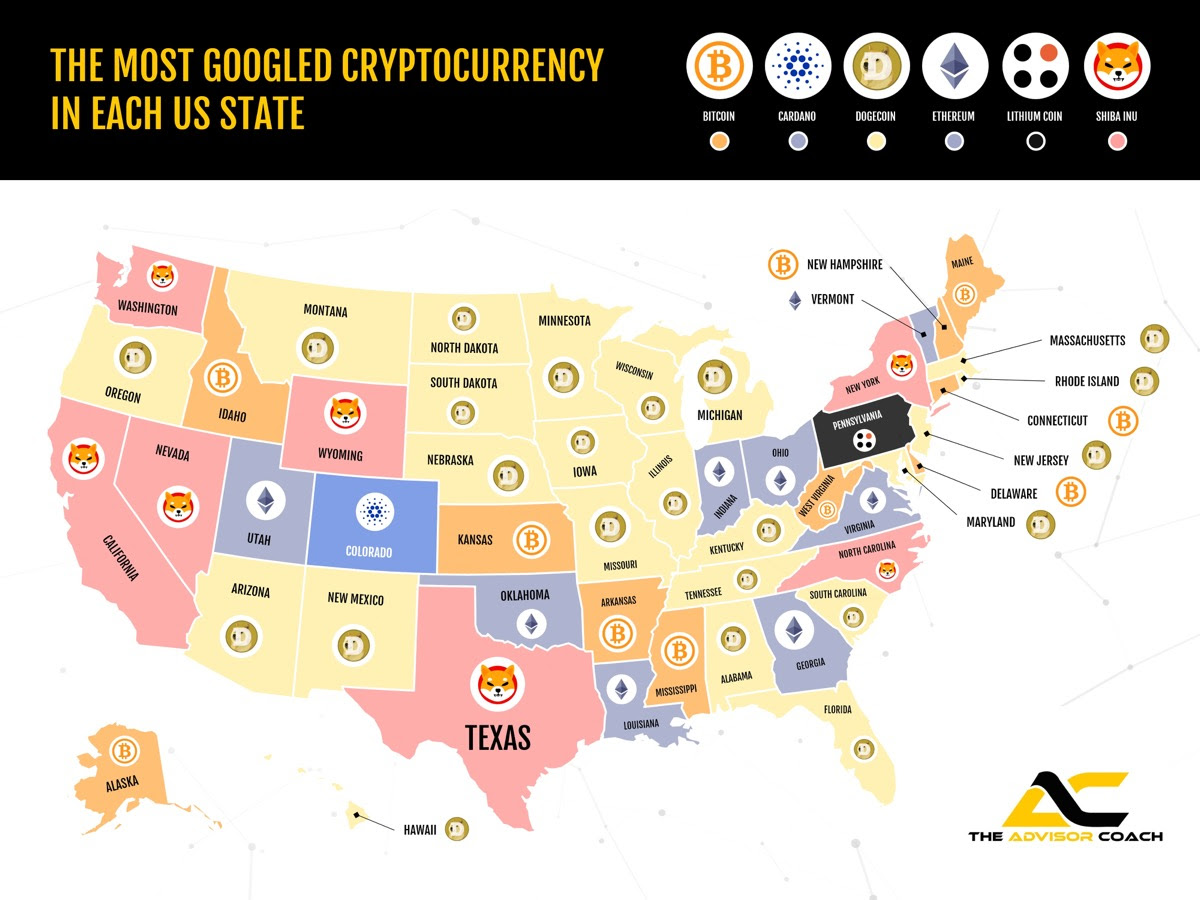
- Dogecoin is the cryptocurrency searched for the most in 23 states, the highest of any cryptocurrency.
- Bitcoin has the second highest number of states searching for it the most out of any other cryptocurrency.
- Seven states searched for Shiba Inu the most out of any cryptocurrency
New research has revealed the cryptocurrency that each state wants to invest in the most with Dogecoin taking the top spot.
The research conducted by financial advisor The Advisor Coach analysed Google Trends data to establish the cryptocurrency that each state wants to invest in based on searches.
The analysis revealed that Dogecoin had the highest number of states wanting to invest in the cryptocoin with a total of twenty-three states, including Illinois, Florida, Hawaii and New Jersey. The rise in interest can be partially attributed to the endorsement of Elon Musk who stated earlier in the year that Tesla would accept Dogecoin as a form of payment.
Bitcoin was the second most popular with ten states searching to invest in Bitcoin more than any other cryptocurrency, including Connecticut, Alaska, Mississippi, and New Hampshire.
A total of eight states want to invest in Ethereum the most, the third highest number in the research. States seeking to invest in Ethereum the most include Georgia, Louisiana, Virginia and Ohio.
Shiba Inu debuted fifteen months ago and has grown astronomically, rising more than 14,000,000%. This leads it to be seven US states’ most searched for cryptocurrency to invest in, with states including California, New York, Texas and Nevada.
Lithium was the most popular cryptocurrency in one state – Pennsylvania. Cardano was also the most popular cryptocurrency in only one state – Colorado.
Commenting on the findings, a spokesperson for The Advisor Coach said: “The rise in cryptocurrencies has been enormous over the last year, with more and more people looking to invest in them.
“This study offers incredible insight into where these investments are coming from across the US, with Dogecoin surpassing Bitcoin as the most popular cryptocurrency on the internet. With more than 6,500 cryptocurrencies available globally, it is fascinating to see currencies that may not be the most valuable are still the most sought after.”
The study was conducted by The Advisor Coach, which specialises in offering expert advice to business on expanding their clientele.
Most popular Cryptocurrency by State | |
Cryptocurrency | How many states Google it the most |
Dogecoin | 23 |
Bitcoin | 10 |
Ethereum | 8 |
Shiba Inu | 7 |
Cardano | 1 |
Lithium | 1 |
- 08:00 am
Rank | Company | Category | Funding | Valuation | Twitter followers | Annual search volume | Influence score |
1 | Robinhood | Investing | $5.6 bn | $11.7 bn | 503,400 | 28,320,000 | 7.22 |
2 | Stripe | Payments | $2.2 bn | $95 bn | 182,100 | 17,770,000 | 6.07 |
3 | Kraken | Blockchain & Bitcoin | $133 m | $20 bn | 781,800 | 23,990,000 | 5.64 |
4 | Klarna | Personal Finance | $2.2 bn | $31 bn | 33,800 | 27,560,000 | 4.9 |
5 | Wise | Payments | $542 m | $11 bn | 99,900 | 17,100,000 | 3.12 |
6 | Current | Personal Finance | $403 m | $2.2 bn | 546,500 | 417,800 | 2.82 |
7 | Chime | Personal Finance | $1.5 bn | $1.4 bn | 136,500 | 2,028,000 | 2.5 |
8 | Gemini | Blockchain & Bitcoin | - | $5 bn | 295,300 | 414,700 | 2.33 |
9 | Carta | Wall Street & Enterprise | $692 m | $6.8 bn | 21,800 | 6,646,000 | 2.00 |
10 | BlockFi | Blockchain & Bitcoin | $504 m | $3 bn | 135,400 | 3,623,500 | 1.95 |
Stock trading and investment app Robinhood is the most influential company in the fintech sphere, scoring 7.22/10. This is largely because of its high annual search volume, suggesting it's the most publicly sought after fintech company. It also raised the greatest VC funding totalling $5.6 billion.
The company with the highest valuation is Stripe, an online payment service based in San Francisco. The company is currently valued at $95 billion which is 43 times more than its funding of $2.2 billion.