
Published
- 08:00 am
Workday will help to digitally transform entire back-office
The Financial Ombudsman Service has gone live on Workday Financial Management and Workday Human Capital Management to help it to digitally transform its entire back office and the way it operates.
The Financial Ombudsman Service was set up by Parliament in 2001 to resolve complaints between financial businesses and their customers. Every year over 1 million people contact the service.
With one flexible cloud-based system to plan, execute, analyze, and extend, the Financial Ombudsman Service will be able to adapt effectively to today’s changing world. Workday brings together financial, people, and operational data into a unified data core. With always-live data and up-to-the-moment reporting, the Financial Ombudsman Service will be able to put all its data to work and see the whole enterprise picture.
“We worked as 'one team' and set ourselves high standards to execute with incredible resilience, especially given the tough timelines working remotely,” said Hitesh Amin, VP & Senior Partner, IBM. “The success of this programme will help the Financial Ombudsman Service to focus on the next chapter of their digital transformation journey.”
“Having the best core business systems in place helps the Financial Ombudsman Service to focus on moving the organisation and its people forward,” said Michael Douroux, Workday. “Workday will help the Financial Ombudsman Service to build a culture of agility and data-driven decision making that will allow it to respond to whatever comes next. The last couple of years have shown us that digital transformation is more important now than ever.”
- 08:00 am

IDT Corporation (NYSE: IDT), a global provider of fintech, cloud communications, and traditional communications services, has scheduled its report of financial and operational results for the first quarter of its 2022 fiscal year (the three months ended October 31st) on Tuesday, December 7, 2021.
IDT’s earnings release will be issued and posted on the IDT investor relations website (https://www.idt.net/investors-and-media) at approximately 4:30 PM Eastern.
IDT will host an earnings conference call beginning at 5:30 PM Eastern with management’s discussion of results, outlook, and strategy followed by Q&A with investors. To listen to the call and participate in the Q&A, dial 1-888-506-0062 (toll-free from the US) or 1-973-528-0011 (international) and request the IDT Corporation call (participant access code: 267194).
A replay of the conference call will be available approximately three hours after the call concludes through December 20, 2021. To access the call replay, dial 1-877-481-4010 (toll-free from the US) or 1-919-882-2331 (international) and provide this replay number: 43480. The replay will also be accessible via streaming audio at the IDT investor relations website.
- 04:00 am

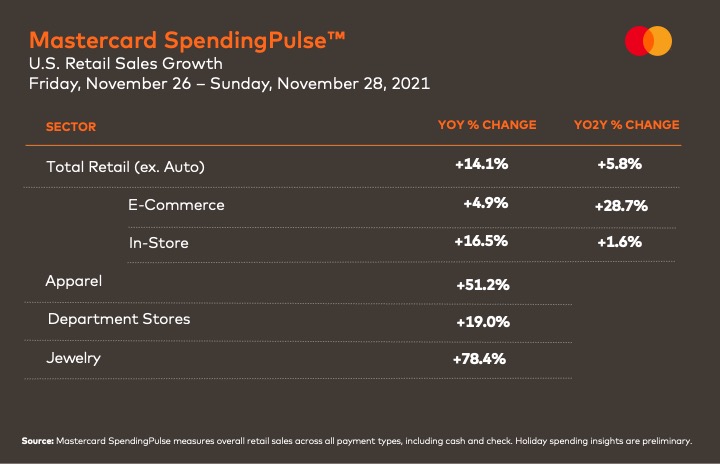
Shoppers drove U.S. retail sales during Thanksgiving weekend up +14.1% year-over-year and +5.8% compared to 2019, excluding auto. According to Mastercard SpendingPulse™, which measures overall retail sales across all payment types including cash and check, in-store sales rebounded, increasing +16.5% YOY while e-commerce sales experienced sustained growth up +4.9% YOY for the weekend running Friday, November 26 through Sunday, November 28.
Apparel (+51.2%), Department Stores (+19.0%) and Jewelry (+78.4%) were key drivers for the weekend’s growth.
- 04:00 am

Berlin-based fintech is the market’s only authorised financial crime benchmark for banks and financial institutions
· Former HSBC Head of Financial Crime Compliance, Ben Arber, will head up US business development
· Elucidate employs more than 35 people across Europe and has raised €5.7M in funding to date
Elucidate, the financial crime risk scoring company, has today announced its expansion into the US market with a new office in Miami, as part of the company’s mission to establish itself as the global standard for benchmarking financial crime risk.
Its new US headquarters confirms Elucidate’s focus on the Americas as a primary target for its services, which empower banks’ compliance teams with actionable intelligence into financial crime risk to help them analyze information across their network within a data-driven framework, saving time and money. As the market’s only authorised financial crime benchmark, the Elucidate FinCrime Index (EFI) is regulated by the BaFin and ESMA.
Elucidate’s US launch closely follows the appointment of banking compliance veteran Ben Arber, Former HSBC Head of Financial Crime Compliance, as Elucidate’s Head of Sales for the Americas, earlier this year. Arber brings more than 20 years’ experience in senior compliance roles for HSBC in Asia, Europe, and North America, and has been responsible for building Elucidate’s operations in the US region since early June.
Elucidate’s expansion into the US comes at a time when Miami is emerging as one of the country’s leading tech hubs, with dozens of investors and startups moving or opening offices in the city this year alone.
Commenting on choosing Miami as Elucidate’s US HQ, Head of Sales for the Americas, Ben Arber, said: "We considered more traditional hubs like New York and San Francisco but are convinced Miami is the best place to grow Elucidate's operations. Not only is the city going through a technology boom, which we are excited to be a part of, but its location enables us to better serve customers in the Caribbean and Latin America - two regions that will greatly benefit from our platform."
A data-science company at its core, the new office reaffirms Elucidate’s ability to comply with US data regulations and provide dedicated customer support in the region.
Filipe Garcia, Elucidate’s CTO and Co-Founder said: "As an ISO certified company, data security and management are priorities for our operation and one of the reasons our customers trust us with their sensitive data. Our new offices in Miami will help us maintain our standards, comply with all data protection regulations, and provide localized support to new and existing customers."
Elucidate’s Miami office is now the company’s second physical office, three years on from when it was founded by CEO Shane Riedel and CTO Filipe Garcia in Berlin in 2018. It currently serves customers in more than seven countries (rating the financial crime compliance of over 20,000 organisations to date), employs more than 35 people across Europe, and is actively recruiting new members of staff in its business development team in the next three months to focus exclusively on the US market.

Michael Moran
Senior Currency Strategist at ACY
Summary: A darker shade of black emerged on Friday after the new Covid variant, Omicron which was first detected in South Africa, spread around the world on Sunday. see more

- 03:00 am

NRI, a leading provider of consulting services and system solutions, started providing a platform for over-the-counter transactions, Allain, to Tokai Tokyo Securities Co., Ltd. (Tokai Tokyo) on November 15th. Allain strengthens Tokai Tokyo’s alliance strategy by optimizing and enhancing its over-the-counter trades.
As trading products and methods diversify more and more lately, securities firms are expected to enhance their offerings and expand trading volume. Tokai Tokyo, a core subsidiary of Tokai Tokyo Financial Holdings who has a strong alliance with Japanese regional banks, aims to grow their business further by not only using their own sales channels but also utilizing the ones of other companies and partners.
With Allain, Tokyo Tokai can communicate with clients and partners regarding available quantity and price of the positions in real time, instead of through emails and FAX. As a result, Tokyo Tokai and its alliance together can better coordinate to manage positions and pricing. Clients and partners also benefit from Allain, as they can monitor the quantity of securities to be sold to their own clients, and order more from Tokai Tokyo as needed. In addition, Allain automates processing, including order placement, execution and reconciliation by relaying order information to THE STAR, NRI’s back-office system.
Furthermore, Tokai Tokyo can accumulate and analyze the trading data to optimize position management and pricing. The implementation of Allain is part of Tokai Tokyo’s Digital Transformation initiatives to expand their business through the utilization of digital technologies. Through this partnership with NRI, Tokai Tokyo will provide more diverse products and trading opportunities to their clients and partners.
- 01:00 am

- Development set to begin at eco-friendly retirement village with more than 200 units
- Shawbrook Bank supports developer with £17 million development loan
- Five-fold increase in retirement living accommodation required to meet needs of ageing population
Work is set to start on a sustainable residential project for the over-55s in Burnham-on-Crouch, Essex, after property developer Burnham Waters Ltd., secured a £17 million loan from Shawbrook Bank.
Construction on the “Burnham Waters”, Integrated Retirement Community (IRC) scheme – which will comprise 103 bungalows, 55 independent living flats, a 70-bedroom care home and a parade of shops – is set to begin before the end of the year. (www.burnhamwaters.co.uk).
Burnham Waters Ltd is in the process of being certified by ARCO (The Association of Retirement Community Operators) and will play an active role in leading the transformation of the retirement sector in terms of the classification, qualification and definition of retirement living.
The scheme aims to reduce CO2 emissions by 30% compared with current building regulation requirements, with highly energy efficient bungalows each having its own electric vehicle charging point. In addition, the on-site facilities help reduce the need for travel and an electric minibus service provides connection to the town centre.
Plans for the scheme also feature a gym for residents, a swimming pool, tennis courts, an on-site surgery, and landscaped gardens and nature trails with a strong ecological focus.
Shawbrook Bank is supporting “Burnham Waters” first phase of construction, including the first 44 bungalows, which range from 936 to 1,485 sq ft. Units are expected to be ready for market by late spring/early summer 2023.
The UK currently needs to supply five times more housing for older people just to keep pace with the country’s ageing population, with 2.1 million more people in England and Wales expected to be over 65 by 2029*.
Kate Chambers, Finance Director at Burnham Waters Ltd., said: “We’re creating a vibrant community for the over-55s in Burnham-on-Crouch, where residents can enjoy independence and privacy while being connected to friends, neighbours and a host of amenities.
Ian Holloway, Project Director at Burnham Waters Ltd, added: “Shawbrook Bank has proven to be a dependable partner that understands the intricacies of financing a multi-phase and complex project like “Burnham Waters”, and we’re on the cusp of starting this major project thanks to their support.”
Patrick Coughlan, Relationship Manager at Shawbrook Bank, said: “Burnham Waters is an ambitious scheme, both in providing high-quality living on a large scale and in striving to be fit for a greener future”.
“The UK’s ageing population means we need more projects like this. Our experience in property development and in healthcare means we’ve been able to help developers in the retirement living and care sectors, giving them access to specialist finance to deliver these much-needed schemes.”
- 07:00 am

Decades have passed since the establishment of the first virtual worlds, such as World of Warcraft or Second Life, and developers' aspirations to create immersive universes where users can roam freely have not reduced their pace. Meta’s (formerly known as Facebook) new 'Metaverse' depicts the latest development in that segment, and through the inclusion of virtual reality content in real life, so called augmented reality, both the digital and non-digital world coalesce more and more. Solactive now released its Solactive Global Metaverse Index, including publicly listed companies that potentially stand to benefit from the adoption and usage of technologies expected to grow and support the functioning of the metaverse. Canadian ETF pioneer Horizons ETF will issue an ETF tracking the index.
In 2007, Second Life founder Philip Rosedale argued that a 3D world wide web would become status quo with all internet users owning a digital avatar eventually. With a growing demand in both virtual and augmented reality services, recent studies project the metaverse opportunity to reach at least $800 USD billion of market capitalization by 2024.1 Horizons ETFs’ new Horizons Global Metaverse Index ETF (“MTAV”) enables investors to capture themassive performance potential of companies operating in the fields of AR/VR, Creator Economy, Digital Infrastructure, Digital Marketplaces, Gaming, and Digital Payment.
The Solactive Global Metaverse Index includes companies headquartered in one of the countries, which are part of the Developed Markets and Emerging Markets2. To receive a pure selection of constituents, companies must not be classified under any of the following industries: casinos/gaming, electronics/appliance stores, food retail, and motor vehicles. The selection procedure of the Solactive Global Metaverse Index is powered by Solactive’s proprietary big data and natural language processing (NLP) algorithm ARTIS®. ARTIS® is utilizing advanced algorithms to parse high volumes of public documents to evaluate companies’ exposure to specific themes or topics. Each company identified by ARTIS® receives a score that reflects its exposure to the index strategy. This set of companies are then reviewed to ensure relevance to the theme of the index based
on business operations. Companies that do not exhibit relevant business exposure to the theme are removed from the selection process at this stage. The final index contains 50 companies.
“The metaverse is the next frontier of the human experience and technological innovation. We believe that the metaverse will become an extremely important realm for social and economic interaction over the next decade,” said Steve Hawkins, President and CEO of Horizons ETFs. “Even today, these technologies are already reframing the way that we engage with one another, from virtual reality to non-fungible tokens (“NFTs”). MTAV is the first index-based ETF in Canada to offer direct exposure to the global companies that are investing heavily in building and expanding the digital worlds that encompass the metaverse.”
Timo Pfeiffer, Chief Markets Officer at Solactive, comments: “I remember my first exposure to digital worlds was two grey blocks passing a giant pixel to each other, which was, at the time, a deeply absorbing experience. Now, with technology progressing and computation power rising, unimaginable worlds can be created and experienced immersively in virtual spaces; or our non-digital world can be enhanced through augmented reality, which offers widespread application in our daily lives. With Horizons ETFs, we share a spirit for innovation to always deliver our clients the latest trends in investing. We’re happy to be part of such a cutting edge product.”
Horizons Global Metaverse Index ETF (“MTAV”) started trading on November 29th, 2021, under the ticker symbol MTAV:TSX on Toronto Stock Exchange (“TSX”).
- 07:00 am

Dynamic Planner has published the first of its new annual ‘Dynamic Planner Spotlight Report: Growth, opportunity and sustainability – the financial advice market in 2021’. The findings paint a picture of a robust advice industry which is facing into the future with confidence and focusing on maximising the benefits of the rapid transformation of financial advice brought about by the pandemic.
The first study has found that eight out of 10 advice professionals would recommend financial planning as a career, underlining the strength of positivity among the advice community in the future of the industry. Client enquiries increased in the pandemic and 56% of advisers expect to grow their business in the next five years. Technology has improved the ability of advisers to serve clients and three quarters expect to look after clients on a hybrid basis, combining remote and face-to-face advice delivery. Sustainability is looked on favourably and is seen as a great opportunity to engage with clients.
Ben Goss, CEO of Dynamic Planner said: “Being at the heart of one of the largest advice communities gives us a unique insight into what is driving the future of financial planning and advice in the UK today. The aim of the Dynamic Planner Spotlight Report is to investigate and share this insight, and in doing so play our part in what we believe is the biggest transformation of the industry in a generation.”
The Dynamic Planner Spotlight Report is based on research amongst the users of Dynamic Planner, one of the largest advice communities in the UK. The report will be published on an annual basis, shining a light on the burning issues of the moment.
Key findings reveal:
- Eight out of ten individuals working for financial advice firms would recommend financial planning as a career, demonstrating the industry’s overall confidence in the future. Women are especially positive, with 88% of respondents recommending financial planning as a career;
- Over the last three years, and against the backdrop of the pandemic, 1 in 2 (50%) advice firms increased adviser numbers. Over a third (38%) of firms saw new client enquiries increase during the past 18 months as individuals took stock of their finances;
- Close to half expected to increase client numbers over the next three years, and one in seven expects to increase numbers significantly. The next generation of advisers has great confidence in their ability to grow their client base – a consensus among all advisers under 30;
- The majority of advisers are looking to grow their businesses over the next five years. Mid-sized firms with between 6 and 49 advisers are the most likely to be actively seeking growth. Most expect to expand their businesses organically, by growing client assets and increasing headcount within their firm. Around one in ten firms are looking to acquire other businesses;
- Around 8% of advisers are looking to sell their business and/or exit the industry within the next five years. For Sole Traders specifically, this number increases to 23%, perhaps reflecting the wider consolidation activity in the market and the current high valuations for advice firms;
- With percentage of investment remaining the dominant form of adviser charging for most firms, serving existing clients remains a profitable activity. At the same time, while many firms have looked to increase adviser headcount in recent years, this is an industry that feels constrained by an ability to serve an increased number of clients;
- Time spent on back-office activities has increased and many advisers are ‘time poor’. This is cited as the main reason why advisers are unable to offer services to consumers who they do not take on as clients;
- Half of all respondents state that the burden, cost and pressure of regulation is currently a significant challenge for their business. The number increases to 62% for Sole Traders, but the challenge is constantly mentioned by firms of all sizes;
- Outsourcing investment management, either by using multi asset/multi manager funds or via a Discretionary Fund Manager, are the two most popular investment strategies within advice firms, and over a quarter of firms expect to do this even more in the future: Only one in five firms report that they are now building their own portfolios;
- Nearly three quarters of firms expect to adopt a hybrid advice model, mixing remote and face-to-face advice where appropriate, whereas only one fifth of advisers expect to return completely to face-to-face advice;
- There is a strong degree of positivity amongst advisers about sustainable investing. Over half of respondents believe that sustainability offers a great opportunity to engage with their clients, and 55% feel they already have the tools and materials necessary to make an informed choice for their clients around sustainability;
- Use of financial planning software and systems is widespread amongst all advice firms, and technology appears to be working for advisers – nearly nine in ten believe that technology is improving their ability to serve clients.
Ben Goss, CEO at Dynamic Planner said: “The advice industry has always been characterised by two main attributes – resilience and adaptability. These characteristics have recently been tested like never before, and we wanted to understand the challenges advisers are currently facing and the level of confidence in their plans for the years ahead.
“What we found is that advisers are facing into the future with confidence, with the majority happy enough to recommend it as a career choice. Many, particularly younger advice professionals, are confident that client numbers will increase in the years ahead, with the tailwind of the pandemic continuing to drive consumers towards financial advice. Of course events of the past 18 months have accelerated the use of technology to enable remote delivery of advice, and most advice firms expect to continue with some form of hybrid working.
“When it comes to sustainability the signs are clear from our report that advisers – and the clients they serve – expect sustainability to be at the heart of their investment decisions. It is an obvious opportunity for advice firms, and the wider financial services industry, to really seize in the years ahead.
“However, significant challenges remain. Time spent on regulation and back-office activities has increased in recent years, often to the detriment of time spent with clients. Reducing the time and cost to serve clients, whilst maintaining high levels of engagement and demonstrating value, is a big issue for advice firms of all sizes. Technology is undoubtedly the key to unlocking this potential, with the majority of advisers saying it is improving their ability to serve clients.”








